Munich Personal RePEc Archive
Multidimensional structural
transformation index: a new measure of
development
Kelbore, Zerihun Getachew
University of South Africa
22 December 2014
Multidimensional Structural Transformation Index: A New Measure of
Development
Zerihun Getachew Kelbore
University of South Africa, Bureau of Market Research
Pretoria, South Africa
Email: [email protected]
Abstract
Achieving structural transformation is believed to be a priority agenda in development policy of developing countries. However, the discussion of structural transformation has been bound to an analysis of labor shifts and productivity convergence between economic sectors. This narrow definition of structural transformation neglects the vital aspect of structural transformation: social transformation. This study tries to fill this gap by proposing a multidimensional structural transformation index (STI). The proposed index measures structural transformation in two phases based on economic and socio-demographic indicators. This multidimensional indicator may contribute to the development literature as it can be used to measure the extent of structural transformation across economies and overtime.
The investigation of the relationships of the STIs with the GDP per capita revealed that the STI based on economic and social dimensions appears to have greater effect on GDP per capita than STI focusing on economic indicators. The implication of this is that structural transformation containing social transformation as its priority is essential to achieve inclusive growth, sustain structural transformation, significantly reduce poverty, and hence enhance economic development.
Each of the STI is a single number lying between 0 and 1, where 0 indicates lack of structural transformation and 1 complete transformation. The index is mathematically consistent, easy to compute, and comparable across countries overtime.
1. Introduction
Structural change has been considered as one of the essential ingredients of modern economic growth. As a stylized fact in development economics literature, structural change is defined as a reallocation of economic activity across three broad sectors of the economy (agriculture, industry, and services) that accompany the process of modern economic growth. The reallocation, induced by some policy measures, occurs as factors of production moved from lower productivity to higher productivity uses (Lewis, 1954; Chenery H. , 1986). For Kuznets structural changes not only in economic but also in social institutions and beliefs are required for modern economic growth (Kuznets, 1971). In line with Kuznets, Chenery indicated that economic development is a result of a set of interrelated changes in the structure of an economy that is required for its continued growth (Chenery, 1979).
It is believed that in poor countries, where there is disequilibrium in factor returns across sectors, the reallocation of resources to sectors of higher productivity contributes to growth. This belief among development economists resulted in a proposition that structural change and economic growth are strongly interrelated. The possible implications of this hypothesis in development policy attracted the attention of early development economists including Fisher, Clark, Lewis, Kuznets, and Chenery, among others.
Despite the indications by (Kuznets, 1971), of the essence of social transformation in addition to economic transformation, studies so far concentrated on and made structural transformation synonymous to economic transformation. The possible reason for the relegation of the social aspect of the transformation in the analysis of structural transformation may relate to a dearth of data or lack of interest on social transformation indicators as an essential part of the required transformation. However, as we discuss in the theoretical framework (Section 2 of this paper), modern economic growth is much more than mere economic transformation, and a disruptive process. Various sectors of the economy grow at different rates and hence the groups of the population attached to the slow growing sectors lose out relatively to those in faster growing sectors(Syrquin, 1988). To this effect, policy actions and institutional changes are essential ingredients of the transformation in order to minimize the costs of, and resistance to, the disruptive process of the high rates of economic growth and structural transformation. Thus, the role of the state (sovereign state) in managing the transformation is that it has to act as a clearing house for necessary institutional innovations; as an agency for resolution of conflicts among group of interests; and as a major entrepreneur for the socially required infrastructure ( (Kuznets, 1971).1
Structural transformation is on the spotlight in Africa`s development policy agenda. As it is one of the manifestations of the modern economic growth as well as a mechanism to sustain the economic growth, understanding the structure of the African economies and designing policies that pave the way to growth promoting structural transformation is what Africa needs today.
To this end, the proposed new multidimensional measure of structural transformation in Africa, called structural transformation index (STI), measures the extent of structural transformation in African economies and indicates the aspects of structural transformation that hinder the pace of the transformation. The STI helps in guiding policy design, infrastructure investment decision, and political commitment to speed up the transition out of poverty and to an inclusive growth in which the benefits are equally shared among citizens in each of the countries. It may also help in indicating areas where donors and development partners can substantially influence and contribute towards achieving the goals of structural transformation and poverty reduction. .
The United Nations Economic Commission for Africa`s Economic Report on Africa (2014) discusses structural transformation in Africa measured by changes in the shares of rural labor force in total labor and the share of agriculture in GDP during 1960—2008 and found that the transformation has lagged far behind that of other developing regions, especially East Asia and Latin America. With quite a small share of GDP from agriculture and the rural labor force accounting around 20% of the total labor, the Latin American countries appear to
1Syrquin (1988) calls this intervention “minimal developmentstate”, although its role goes beyond the one in
reflect the most advanced stages of structural transformation compared with the other developing regions such as East Asia and Pacific, South Asia, and Africa(excluding North Africa). Whereas structural transformation in Africa remains limited, and the data show that still share of rural population is high, and the downward trend as a function of income per worker is limited and inconsistent. Agriculture`s share of GDP in Africa has declined as a function of income per capita, with a nearly linear trend (UNECA, 2014).
The path Africa is going through differs from other developing regions. In the case of East Asia and Latin America as the structural transformation occurs we observe a trend towards convergence of the rural population share with the agricultural value added share of GDP as income grows. This distinction is important due to its implication on rural-urban income disparities. The rural-urban income disparity, consequently, dies out as the structural transformation leads the rural population share to converge downwards to the agricultural value added share of GDP. This is the path that Africa is yet to follow (UNECA, 2014).
The remaining parts of the paper are organized as follows, Section 2 discusses the theoretical framework of the proposed index; Section 3 elaborates the methodological framework and data; Section 4 provides results and discussion; and Section 5 concludes.
2. Theoretical Framework
Modern analysis of sectoral transformation originated with Fisher (1935, 1939) and Clark (1940), and dealt with sectoral shifts in the composition of the labor force(Syrquin, 1988).2 However, in the later years, studies
of long run transformation by Kuznets established the stylized facts of structural transformation. The stylized facts that focus on economic aspect of the transformation are organized into two measures of structural transformation namely, production and consumption measures. Although both measures are equally important, in this paper the focus is on the production measure per se due to lack of comparable cross country data on consumption expenditure for African countries.3
The production measure of structural transformation analyzes the sectoral changes in the employment and value added shares in the gross domestic product (GDP) as economies grow. That is, structural transformation is said to occur when the increase in GDP per capita is associated with a decrease in both the employment share and the nominal value added share in agriculture, and increases in both employment share and the nominal value added share in services and industry.
However, following (Kuznets, 1971) and (Timmer & Akkus, 2008) this paper adopts a wider framework in the analysis of structural transformation and constructs a composite indicator of structural transformation encompassing economic, social, and political dimensions of the transformation.
The guiding framework of the proposed measure of structural transformation takes into account the broader definition of structural transformation and constitutes the following dimensions as its building blocks. First, it starts with the production measures of structural transformation and analyses the shifts in sectoral composition as an indication of structural transformation. In this regard, we take sectoral shares of value added in GDP and consider each of the sectoral shares as indicators of structural transformation and compare the observed shifts in sectoral compositions against the stylized facts. The other important aspect of structural transformation under the production measure approach is the changes in employment shares among the sectors. This measure, though empirically appealing, is not included in the construction of the STI due to irregularities of data overtime and across countries.
2They are the first to deal with the process of reallocation during the epoch of modern economic growth, and to use the form of
sectoral division of (primary—secondary—tertiary), which later on Kuznets categorized as agriculture, industry, and service.
3In the case of consumption measures final consumption expenditure shares are used as a measure of economic activity at the
Second, as a departure from the conventional measures of structural transformation, we incorporate the socio-demographic indicators as a measure of structural transformation. The socio-demographic dimensions are captured by the level of urbanization, demographic transition, and human capital accumulation. The rationale behind these measures is that as the historical evidence shows high rates of growth in per capita income in the developed world were accompanied by rapid shifts in production and social structure mainly referred to as industrialization and/or urbanization accompanied by shifts in demographic patterns, an increasing input into human capital through formal education, and shifts in sets of values that largely conform to the opportunities and requirements associated with modern urban life.
We consider urbanization as an outcome of structural transformation and take it as one of the multiple dimensions that enable us track the level of structural transformation of economies. The demographic transition from high fertility/high mortality rate to low fertility/low mortality is also considered as one aspect of structural transformation.
3. Methodology for constructing Structural Transformation Index
Composite indicators which compare country performance are increasingly recognized as a useful tool in policy analysis and public communication. They provide simple comparisons of countries that can be used to illustrate complex and sometimes elusive issues in wide ranging fields such as environment, economy, society or technological development.
It often seems easier for the general public to interpret composite indicators than to identify common trends across many separate indicators, and they have also proven useful in benchmarking country performance (Saltelli, 2007). This is because composite indicator provides a clue to the matter of larger significance or makes it perceptible a trend or phenomenon that is not immediately (Hammond, Adriaanse, Rodenburg, Bryant, & Woodward, 1995).
As structural transformation is multidimensional, it needs to be evaluated along several dimensions and has to be presented in a way which is comprehensive, easy to understand and interpret. To this end, we follow a multidimensional approach to construct a structural transformation index. Our approach is similar to the approaches adopted by the UNDP for the construction of Human Development Index (HDI) and Financial Inclusion Index (Sarma, 2012). As indicated by OECD (2008), we have built a theoretical framework that guides the construction of the structural transformation index (STI) and in the following we provide a methodology to compute the indicators of each dimension that constitute the composite indicator.
Each of the indicators is selected based on the theoretical framework and normalized to make them comparable. The indicators are normalized using a Mini-Max Normalization method and compare the performance within the continent, Africa.
A. Mini-Max Normalization
In this method each indicator for a generic country c nd time t is transformed as follows:
where and are the minimum and the maximum value of across all counties c at time t. In this way the normalized indicators have values lying between 0 (laggard, , and 1 (leader,
Thus the higher the value of the higher the country`s achievement in indicator i. If n dimensions of structural transformation are considered, then, a country`s achievements in these dimensions will be represented by a point S= (I1, I2,…., In) on the n-dimensional space. On the n-dimensional space, the point O=
(0, 0,…, 0) represents the point indicating the worst situation while the point P=(1, 1,…., 1) represents an idea
situation indicating the highest achievement in all indicators.
B. Weighting
We applied a factor analysis to generate the weights. Factor analysis groups together individual indicators, which are collinear to form a composite indicator, that captures as much as possible of the information common to individual indicators. Each factor, estimated using the principal components analysis, reveals the set of indicators with which it has the strongest association. In doing so, the factor analysis helps in accounting for the highest variation in the indicator set using the smallest possible number of factors. As a result, the composite indicator no longer depends upon the dimensionality of the data set but rather is based
on the “statistical” dimensions of the data(OECD, 2008). However, the weight generated using factor analysis is not a measure of the theoretical importance of the indictors associated with the composite indicator; it only corrects the overlapping information between two or more correlated indictors.
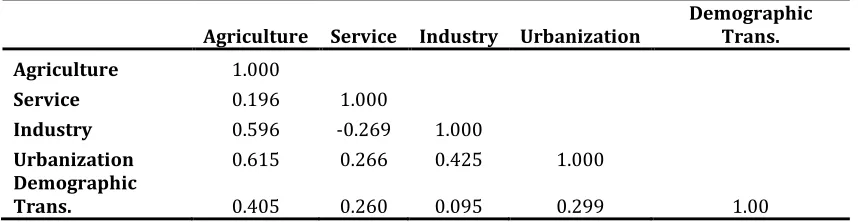
[image:6.612.93.522.362.473.2]The first step in generating weights using factor analysis is to check for the correlation structure of the data. The correlation between the indicators show that the indicators are correlated with the maximum correlation occurring between agriculture and urbanization (0.62) followed by agriculture and industry (0.6). In general, the correlation structure shows that there is a possibility that some of the indicators contain overlapping information that needs to be accounted for in the construction of the composite indicator.
Table 1 Correlation between indicators
Agriculture Service Industry Urbanization
Demographic Trans.
Agriculture 1.000
Service 0.196 1.000
Industry 0.596 -0.269 1.000
Urbanization 0.615 0.266 0.425 1.000
Demographic
Trans. 0.405 0.260 0.095 0.299 1.00
In the second step, a factor analysis has been conducted to identify a certain number of latent factors representing the data. We prefer factor analysis to principal components analysis, for principal components analysis is simply based on linear data combinations whereas factor analysis decomposes data variance into that accounted for by common and unique factors. This, therefore, allows us to construct weights representing the information content of individual indicators without reducing the number of indicators (OECD, 2008).
Each factor depends on a set of coefficients (loadings), where each coefficient measuring the correlation between the individual indicator and the latent factor.
In factor analysis only a subset of principal components (factors) that account for the largest amount of variance are retained. The criteria used in retaining the factors include:
i) Having eigenvalues closer to and larger than 1
Table 2 Eigenvalues of STI data set
Factor Eigenvalue Proportion Cumulative
Factor1 2.09 0.42 0.42
Factor2 1.33 0.27 0.68
Factor3 0.87 0.17 0.86
Factor4 0.42 0.08 0.94
Factor5 0.29 0.06 1.00
Based on the three criteria indicated above, we retain three factors with eigenvalues closer to 1 and above. Factor 1 explains 42% of the overall variance, Factor 2 explains 27%, and Factor 3 accounts for 17% of the overall variance, contributing cumulatively to the overall variance by 86%.
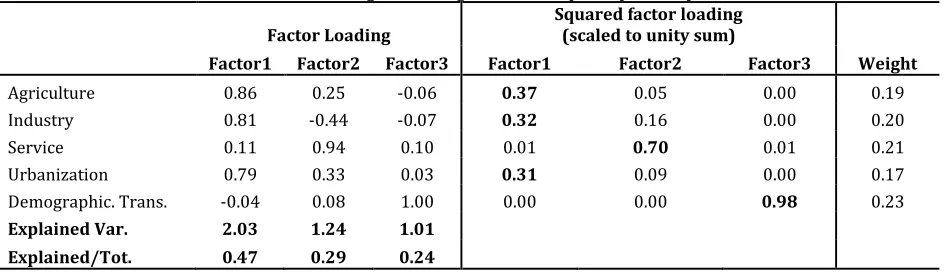
In the third step, we rotate the factors using varimax rotation in order to minimize the number of individual indicators that have a high loading on the same factor. The reason behind the transformation of the factor axes is to obtain a simpler structure of the factors in which each indicator is loaded exclusively on one of the retained factors. The first part of Table 3 below provides the rotated factor loadings mapping each indicator to the retained factors. The second part of the table gives the square of factor loadings that represent the proportion of the total unit variance of the indicator which is explained by the factor. The squared factor loadings are scaled to unity. We group individual indicators based on the highest factors loadings into intermediate composite indicators. Accordingly with the STI data set, we have three intermediate indicators (Table 3). The first intermediate indicator includes Agriculture (with a weight of 0.37), Industry (weight 0.32), and Urbanization (weight 0.31). The second intermediate only by Service (weight 0.70), and the third only by Demographic transition (weight 0.98).
Table 3 Factor Loadings and weight based on principal components
Factor Loading
Squared factor loading
(scaled to unity sum)
Factor1 Factor2 Factor3 Factor1 Factor2 Factor3 Weight
Agriculture 0.86 0.25 -0.06 0.37 0.05 0.00 0.19
Industry 0.81 -0.44 -0.07 0.32 0.16 0.00 0.20
Service 0.11 0.94 0.10 0.01 0.70 0.01 0.21
Urbanization 0.79 0.33 0.03 0.31 0.09 0.00 0.17
Demographic. Trans. -0.04 0.08 1.00 0.00 0.00 0.98 0.23
Explained Var. 2.03 1.24 1.01
Explained/Tot. 0.47 0.29 0.24
*Extraction method: principal components, varimax normalization; Explained Variance is the variance explained by the factor and
Explained/Tot. is the proportion of the overall variance explained by the factor.
C. Aggregation
The normalized indictors are aggregated using two approaches. The first uses the most widely spread linear aggregation method, which is the summation of weighted and normalized individual indicators:
With and , for all and .
A linear additive aggregation technique allows an assessment of the marginal contribution of each indicator separately. These marginal contributions can then be added together to result in a composite index. However, the limitation of this approach is that it assumes away the possible synergies among individual indicators in yielding a composite indicator. As a result the linear additive aggregation technique could result in a biased composite indicator, where the information from the individual indicators could not be entirely accounted for.
The second approach is a distance based approach. It takes into account the Euclidian distance of each indicator from its ideal and the worst points. In this technique of aggregation, the location of the achievement point with regard to the worst point O and the ideal point P is the crucial point in measuring a country`s level of structural transformation. Larger distance between S and O would indicate higher financial inclusion; and a smaller distance between S and P would indicate higher financial inclusion. In the n-dimensional space, it is possible to have two points having same distance from P but different distance from O and vice versa. Thus two countries can have their achievement points at the same distance from one of these points but having different distances from the other point. If two countries have their achievement points at the same distance from P but different distances from O, then the country with higher distance from O should be considered moving higher on the structural transformation spectrum. While if they have the same distance from O but different distance from P, then the country with less distance from P should be considered better achievers of structural transformation. Thus, these two distances are crucial in the construction of an STI.
Following (Sarma, 2012), in the proposed STI, we use a simple average of the Euclidian distance between S and O and inverse Euclidian distance between S and P. Both these distances are normalized by the distance between O and P, to make the STI lie between 0 and 1. In computing the simple average between the distances, the inverse distance between I and P is considered. This ensures that the STI is a number that lies between 0 and 1, having well defined bounds, and is monotonically increasing, i.e. higher value of the index indicates better performance in structural transformation. Therefore, to compute the STI, we first measure S1, the distance between S and O , and S2, an inverse distance between S and P. Consequently, the final STI is
computed as an average of S1 and S2. The exact equations of the computation are given as follows:
(2)
(3)
(4)
Equation 2 gives the normalized Euclidian distance of S from the worst point O, normalized by the distance between the worst point O and the ideal point P. The normalization is done to make the value of S1 lie
Equation 3 provides the inverse normalized Euclidean distance of S from the ideal point P. In this, the numerator of the second component in the equation is the Euclidean distance of S from the ideal point P, normalizing it by the denominator and subtracting it from 1 gives the inverse normalized distance. The normalization is required to ensure the value of S2 lie between 0 and 1; and the inverse distance is considered
in order to enable higher values of S2 correspond to higher performance in structural transformation.
Equation 4 is a simple average of S1 and S2, thus incorporating distances from both the worst and the ideal
point.
The proposed STI, as discussed above follows a multidimensional approach of composite indicator construction similar to the UNDP and with the adjustments introduced by Samra (2012). The method of
aggregation is similar to the “method of displaced ideal” of (Zelany, 1974) in the context of multi objective optimization programming. Unlike Zeleny (1974) that considers only the displacement from the ideal point, the STI, following Samra (2012), is constructed considering displacement form both an ideal and the worst points. The distance based aggregation approach is preferred to the arithmetic average and geometric
averages, where “perfect substitutability” across indicators is assumed. With a perfect substitutability assumption in case of arithmetic aggregation an increase in one indicator can be compensated for by a decrease of equal amount in another and in the case of geometric aggregation a decrease in one indicator is compensated by a proportional increase in the other. However, as long as all indicators (dimensions) are assumed to be equally important for the overall index value, the perfect substitutability assumption is inappropriate.
The constructed STI satisfies the following mathematical properties:
1. Boundedness: The STI has well defined and meaningful bounds. It is bounded below by 0 and above
by 1 ).
2. Unit free measure: The overall STI is unit free due to the fact that each indicator (dimension) is unit free.
3. Homogeneity: The STI is homogeneous of degree zero, i.e., STI (I1, I2,…., In) = STI (α1I1, α2I2,…., αnIn). This implies that if the dimensions (indicators) are changed by the same constant, the STI value remains unchanged.
4. Monotonicity: The STI is a monotonous function of the indicators (dimensions). This indicates that higher values of the indicators will give to higher values of the STI.
4. Results and Discussion
3.
78
3.
8
3.
82
3.
84
Lo
g o
f S
er
vi
ce
V
al
ue
A
dd
ed
3.
1
3.
2
3.
3
3.
4
3.
5
1970 1980 1990 2000 2010
Year
Log of Agri. Value Added Log of Industry Value Added
[image:10.612.111.504.74.280.2]Log of Service Value Added
Figure 1 Change in Sectoral Composition of African Economies overtime, 1970—2012.
Although we have shown the shares of industry in GDP in its broader definition, the contribution of manufacturing—thought to be the nucleus of the modern economic growth—is dismal as the share of manufacturing in GDP changed from 10.79% in 1981 to 10.92% in 2010 (WDI, 2014).The dismal performance of manufacturing over the three decades period implies that the structural transformation in the economic front has been largely biased towards the service sector. Therefore, the structural transformation in the economic front, we can say, is not in the conventional direction in which countries move out of agriculture, embark on industrialization, and end up services dominated. The drift of African countries out of the conventional path is influenced by stagnation of the growth of the agricultural sector that led to rapid labor migration to urban informal service sector, which appear to have lower productivity levels. Further, this labor shift to the informal service sector has been aggravated due to inadequate expansion of the industrial sector to absorb the growing labor force, and decline in the agricultural sector faster than normal under successful transformation (Badiane, 2012).
10
12
14
16
18
20
C
ru
de
D
ea
th
R
at
e
20
25
30
35
40
45
1970 1980 1990 2000 2010
Year
Urbanization Crude Birth Rate
[image:11.612.103.511.73.303.2]Crude Death Rate
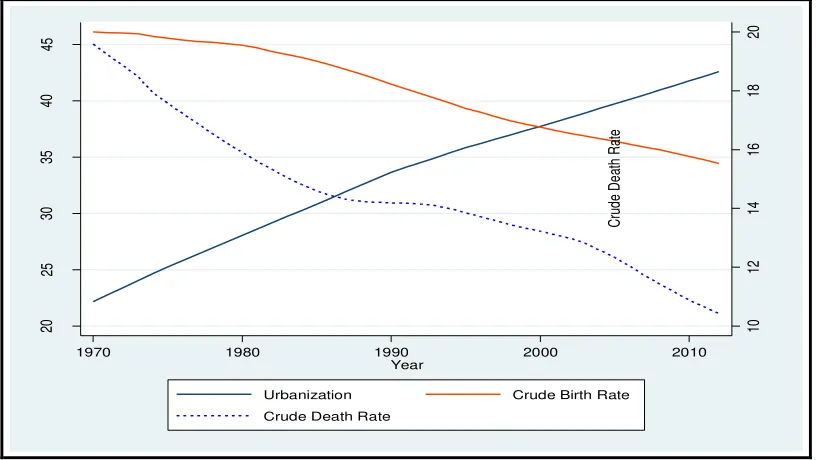
Figure 2 Urbanization and Demographic Transition in Africa, 1970—2012.
The demographic transition indicators (crude birth rate and crude death rates per 1000 people) indicate that Africa is still in stage two of the demographic transition. The crude death rate per 1000 people substantially declined from about 20 to 10 over the period of four decades owing to the application of highly effective imported medical and public health technologies. Similarly, the crude birth rate per 1000 people has declined from over 45 to 34. Although, this implies that the stage of the demographic transition in Africa is still marked by high population growth, the declining rates are indicative of the undergoing demographic transition. The progress in demographic transition from high fertility and mortality to low fertility and mortality paves the way for reaping the demographic dividend that follows the transition4.
4.1 Economic Transformation
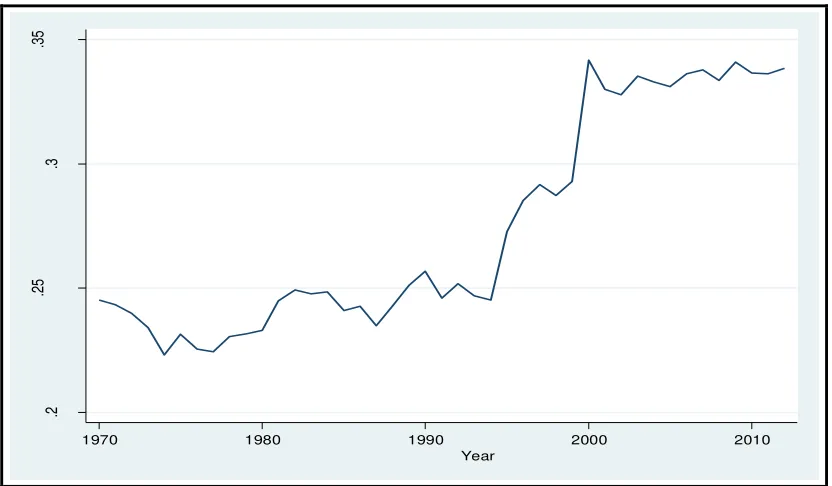
In this part we present the results of the STI that measures economic transformation. The economic transformation aspect of the index, as mentioned elsewhere above, is the conventional measure of structural transformation of economies. In general, the average continental value of the STI that measures economic transformation is below 0.5. Nevertheless, as Figure 3 shows, in Africa structural transformation on the economic front has been improving over the period of the last four decades. The process, however, has been challenging and is marked by periodical setbacks.
4 Demographic dividend defined as the economic growth potential that can result from shifts in a population`s age
.2
2
.2
4
.2
6
.2
8
.3
.3
2
1970 1980 1990 2000 2010
[image:12.612.121.493.71.287.2]Year
Figure 3 STI (Economic) for Africa from 1970—2012
The regional performance of Structural transformation is presented in Figure 4. The results show that structural transformation in the economic dimension has been improving since the 1970s across all regions in Africa with the exception of Western and Southern Africa regions. Southern Africa has exhibited a remarkable structural transformation up until the 1990s and the pace slowed down in the years after 2000, although the STI score in 2000s is by far greater than 1970s and 1980s. In Western Africa, the transformation has been slightly reversed in the 1980s, picked up in the 1990s and again reversed in the years after 2000, but still the region is in a better condition than it was in the 1970s and 1980s. The relatively poor performance of the region may be attributable to the civil wars in Liberia and Sierra Leone, and political instability and poor economic performance in Niger. In the Sub-Saharan region in general the transformation has been progressing over the four decades we investigated. However, the pace of the transformation has relatively slowed in the last decade (2000—2012). As a result, the economic aspect of structural transformation in Africa has shown no (negligible) change between 1990s and 2000s. This in turn may conform to the recent claims by some studies that Africa has embarked on pre-matured deindustrialization.
[image:12.612.132.484.494.676.2]4.2 Economic and Social Transformation
The results for the STI that embraces the broader definition of structural transformation are higher than the STI scores that consider the economic indicators per se. Therefore, discussion of structural transformation focusing merely on production measures, i.e., analyzing the shifts in sectoral compositions of economies, appears to underestimate the achievements in structural transformation that countries register. The social aspect of the transformation is a sine qua non for sustaining the economic transformation and hence the overall structural transformation.
Figure 5 below shows that the STI incorporating the Social dimensions of the transformation takes a similar path to that of the STI constructed based on economic indicators. Unlike the STI measuring the economic transformation, the STI that considers the social dimension of the transformation has been relatively smooth over time and sharply increased after mid—1990s. The overall assessment indicates that Africa has been progressing in achieving structural transformation over the last four decades, and the progress is observed across regions.
.3
5
.2
5
.2
.3
1970 1980 1990 2000 2010
[image:13.612.99.515.264.507.2]Year
Figure 5 STI, Economic & Social, 1970—2012
Figure 5 Economic & Social STI by region, by decade
4.3 Comparison of STI (Economic) and STI (Economic &Social)
[image:14.612.141.473.458.642.2]In this section, we discuss the comparison of the two indices, STI based on economic indicators and STI including economic and social indicators. The results, as discussed above and explained further below, show that STI based on economic and social dimensions is higher than STI based on economic dimensions (see Figure 6). In addition, the variability of the index, measured by coefficient of variation (CV) across time and between countries tends to be low for the STI based on social and economic indicators. For both kinds of indexes, the variability decreases overtime, except that it increased in the 1980s (see Annex A&B). The decrease in variability overtime across regions and in the continent implies that the improvement in structural transformation appears to bring convergence among countries in terms of the level of economic development.
Figure 6 STI Economic and STI Economic &Social regional and continental average 1970—2012
after 19935. This implies that a focus on social transformation in the 1990s and more vigorously after 2000
following the Millennium Development Goals (MDGs) program appears to have largely contributed for the social and economic transformation in Africa.
.2
4
.2
6
.2
8
.3
.3
2
.3
4
1970 1980 1990 2000 2010
Year
[image:15.612.123.491.137.371.2]STI, Economic & Social STI, Economic
Figure 7 Lowess transformed STI (Economic) and STI (Economic &Social), 1970—2012.
4.4 Relationship of the STI with other variables
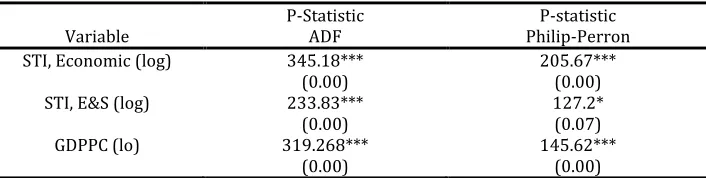
To ascertain the validity of the STI we demonstrate the relationship between the STI and other conventional measures of economic performance in the development literature. In this regard, we discuss the relationship of the STI with the GDP per capita of African countries over the corresponding period for which the STI is constructed. To investigate the causality between the two variables, we conducted a Granger causality test on the two STIs and the GDPPC. This enables us test the long held hypothesis that structural transformation is both the cause and the effect of economic growth. Prior to conducting Granger causality test, the time series properties of the series have been tested using a panel unit roots test and the results show that all of the variables are stationery (see Table 4). We conducted a Fisher—Type panel unit root test with augmented Dickey-Fuller (ADF) and Phillips-Perron(PPERRON) tests6. The ADF option includes drift term and three lags
whereas the PPERRON option includes the same number of lags, but with a trend term.
5The basic idea of LOWESS smoothing is to create new variable that for each y-variable, yi, contains the corresponding
smoothed value. The smoothed values are obtained by running a regression of y-variable on x-variable (STI on year, in our case) using only the data. The regression is weighted so that the central point gets the highest weight and points that are farther away receive less weight. The estimated regression line is then used to predict the smoothed value yi-hat for yi only.
6 Maddalla and Wu (1999) and Choi (2001) indicate that the Fisher type test is a better test than Im-Pesaran-Shin(IPS) in
Table 4 Time series properties of STI and GDPPC Variable P-Statistic ADF P-statistic Philip-Perron STI, Economic (log) 345.18***
(0.00)
205.67*** (0.00) STI, E&S (log) 233.83***
(0.00)
127.2* (0.07) GDPPC (lo) 319.268***
(0.00)
145.62*** (0.00)
The p-values are in parenthesis. *** Significant at 1%, * significant at 10%, P-statistic is a chi-square with 106 degrees of freedom. The corresponding critical value at 1 and 10% and 100 degrees of freedom is 135.8 and 118.5.
The results of the Granger—Causality tests show that Structural transformation based on economic indicators causes GDPPC after 3 years whereas structural transformation that embraces social transformation causes GDPPC after 6 to 7 years. The reverse causality shows that GDPPC causes both aspects of the transformation nearly after 5 to 6 years later (see annex E). The long lags before the STI that includes social transformation implies that the payoff of social transformation in terms of GDPPC can only be observed at least after 5 years period.
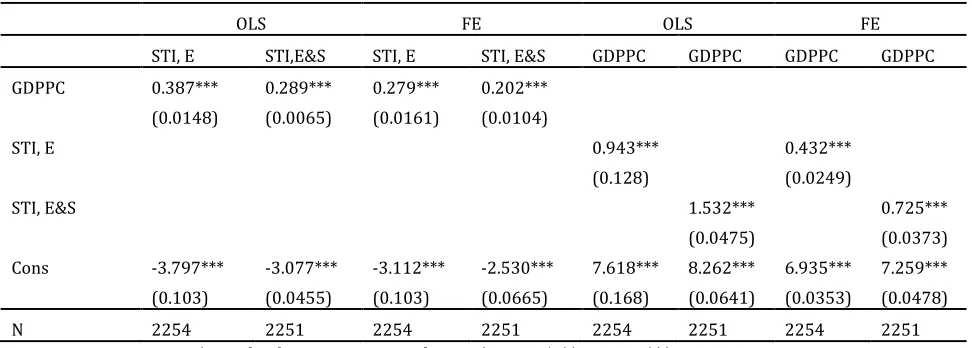
Further, we run a regression of STIs on GDPPC and vice versa to statistically show the relationship and measure the magnitude of the influence of both STIs on GDPPC. The first part of Table 4 provides the regression of STIs on GDP per capita level. The results show that change in GDP per capita level has higher effect on STI that focuses on economic indicators than the STI that is based on economic and social indicators. We see that in the OLS regression a 1% increase in GDP per capita increases STI that relies on economic indicators by 0.4% and STI that relies on economic and social indicators by 0.3%. Similarly, in the fixed effects regression, 1% change in GDP per capita increases STI based on economic indicators by 0.3% and the STI based on economic and social indicators by 0.2%. This can be attributed to two reasons. First, it may stem from the inherent relationship between GDP per capita and economic indicators constituting the STI that relies on economic indicators. Second, it may show that a relatively lower proportion of the increasing GDP per capita is destined towards investments contributing for social transformation.
The second part provides regression of GDPPC on STIs. The results show that both STIs have statistically significant effect on GDP per capita. However, the effect of the STI constructed based on social and economic indicators exceed the effect of STI that relies on economic indicators per se in the OLS regression by about 60%; and by 30% when the country specific characteristics are accounted for using the fixed effects regression. That is, percentage change in STI (economic) results in 0.9% and 0.4% increases in GDP per capita in OLS and FE regressions, respectively. While a percentage increase in STI (economic & social) yields 1.5% and 0.7% increase in GDP per capita as shown in OLS and FE regression coefficients, respectively.
of the Millennium Development Goals (MDGs) program in the last 15 years may have facilitated and positively contributed to step up the transformation.
[image:17.612.71.557.240.414.2]Although Africa witnessed on average 5% a year growth (some countries returning more than 7%) over the last decade, a large part of its population remained in economic poverty, rampant unemployment, and inequality. The structural transformation, as both of the indexes measure, is below 0.5 implying that the continent has a long way to go to achieve structural transformation. To this end, Africa needs to provide due attention to social transformation in its quest for achieving structural transformation. This is justifiable in that structural transformation including social transformation has much more contribution to raise GDPPC than structural transformation that targets economic transformation only (See Table 5).
Table 5 Relationship between STIs and GDPPC
OLS FE OLS FE
STI, E STI,E&S STI, E STI, E&S GDPPC GDPPC GDPPC GDPPC
GDPPC 0.387*** 0.289*** 0.279*** 0.202***
(0.0148) (0.0065) (0.0161) (0.0104)
STI, E 0.943*** 0.432***
(0.128) (0.0249)
STI, E&S 1.532*** 0.725***
(0.0475) (0.0373)
Cons -3.797*** -3.077*** -3.112*** -2.530*** 7.618*** 8.262*** 6.935*** 7.259***
(0.103) (0.0455) (0.103) (0.0665) (0.168) (0.0641) (0.0353) (0.0478)
N 2254 2251 2254 2251 2254 2251 2254 2251
*standard errors in parentheses, * p<0.05, **p<0.01, ***p<0.001
5 Conclusion
Economic development is a process of transformation from production of primary products largely produced by unskilled labor towards production of goods and services that require knowledge and skilled labor. This shift in production from primary to industrial value added products and services; and the resulting labor movement from less productive to high productive sectors can be considered as structural transformation that, as economic history witnesses, inevitably happens to every country in the world. However, this narrow definition of structural transformation overlooks the social transformations that speeds up and possibly sustain and ensures healthy transition towards a new way of life that comes with economic growth.
In this paper, we proposed a new multidimensional measure of development progress with a particular emphasis to African countries. To this end, we constructed two types of composite indicators: Structural Transformation Indexes (STIs). The first based on economic indicators (sectoral shares of GDP), and implies the conventional understanding of structural transformation where shifts in sectoral composition of the economy from agriculture dominated towards service and industry. The second takes the indicators of the first index and incorporates social dimensions such as urbanization and demographic transition. The result shows that STI based on economic and social dimensions exceeds the STI that relies only on economic indicators. This, therefore, indicates that the broader definition of structural transformation that accounts for both economic and social transformations is a better indicator of economic development.
incorporating social transformation is important to achieve solid and sustainable structural transformation and hence inclusive economic growth and development. Most importantly, it significantly contributes to poverty reduction as the social transformation involves more population and allows them to ready themselves both to take up economic opportunities and maintain the economic growth.
References
Badiane, O. (2012). Beyond Economic Recovery: The Agenda for Economic Transformation in Africa, in Patterns of Economic Growth and Structural Transformation in Africa . IFPRI. Washington D.C.: International Food Policy Research Institute.
Chenery, H. (1979). Structural Change and Development Policy. New York: Oxford University Press.
Chenery, H. (1986). Growth and Transformation, in: H. Chenery, S. Robinson and M. Syrquin, Industrialization and Growth. New York: Oxford University Press.
Choi, I. (2001). Unit Root Tests for Panel Data. Journal of International Money and Finance, 20, 249-272.
Kuznets, S. (1971). Economic Growth oof Nations. Cambridge, MA: Harvard University Press.
Lewis, W. A. (1954). Economic Development with unlimited supplies of labor. Manchester School of Economic and Social Studies.
Madalla, G., & Wu, S. (1999). A Comparative Study of Unit Root Tests with Panel Data an New Simple Test. Oxford Bulletin of Economics and Statistics(Special Issue), 0305-0349.
UNFPA. (2014). The Power of 1.8 Billion: Adolescents, Youth, and the Transformation of the Future: The State of World Population in 2014. New York: United Nations Population Fund.
Hammond, A., Adriaanse, A., Rodenburg, E., Bryant, D., & Woodward, R. (1995). Environmental indicators: A systematic approach to measuring and reporting on environmental policy performance in the context of sustainable development (Vol. 36, p. 460). World Resource Institute.
OECD. (2008). Handbook on Constructing Composite Indicators (pp. 1–162). Paris: OECD Publishing.
Saltelli, A. (2007). Composite indicators between analysis and advocacy. Social Indicators Research, 81, 65–77. doi:10.1007/s11205-006-0024-9
Sarma, M. (2012). Index of Financial Inclusion – A measure of financial sector inclusiveness Mandira Sarma July 2012 (No. 07). Berlin.
Syrquin, M. (1988). Chapter 7 Patterns of structural change. Handbook of Development Economics, 1, 203–273. doi:10.1016/S1573-4471(88)01010-1
Timmer, B. C. P., & Akkus, S. (2008). The Structural Transformation as a Pathway out of Poverty : Analytics , Empirics and Politics. Center for Global Development, (150).
UNECA. (2014). Ecopnomic Report on Africa: Dynamic industrial policy in africa. Addis Ababa, Ethiopia: United Nations Economic Commission for Africa.
Annex
A. Summary statistics of Economic STI by region, by decade
Central Eastern North South West SSA Africa
1970-1979
Mean 0.281 0.219 0.349 0.304 0.229 0.251 0.267
Stdev. 0.119 0.148 0.167 0.091 0.087 0.116 0.130
CV 0.424 0.674 0.479 0.298 0.380 0.462 0.487
Min. 0.055 0.018 0.148 0.077 0.000 0.000 0.000
Max. 0.592 0.591 0.743 0.487 0.417 0.592 0.743
No. Obs. 90 110 70 100 150 470 520
No. Countries 9 11 7 10 15 47 52
1980-1989
Mean 0.285 0.229 0.354 0.353 0.226 0.263 0.278
Stdev. 0.155 0.177 0.158 0.121 0.074 0.140 0.147
CV 0.542 0.773 0.446 0.343 0.326 0.532 0.527
Min. 0.021 0.000 0.075 0.127 0.043 0.000 0.000
Max. 0.665 0.714 0.719 0.600 0.371 0.714 0.719
No. Obs. 90 110 70 100 150 470 520
No. Countries 9 11 7 10 15 47 52
1990-1999
Mean 0.333 0.291 0.376 0.445 0.263 0.319 0.331
Stdev. 0.154 0.181 0.118 0.142 0.091 0.156 0.154
CV 0.462 0.620 0.313 0.319 0.346 0.488 0.464
Min. 0.056 0.004 0.163 0.168 0.000 0.000 0.000
Max. 0.644 0.734 0.571 0.734 0.448 0.734 0.734
No. Obs. 90 118 70 100 150 478 528
No. Countries 9 12 7 10 15 48 53
2000-2012
Mean 0.368 0.305 0.383 0.421 0.250 0.322 0.332
Stdev. 0.149 0.139 0.112 0.127 0.076 0.136 0.136
CV 0.405 0.456 0.293 0.302 0.304 0.422 0.410
Min. 0.130 0.129 0.212 0.245 0.059 0.059 0.059
Max. 0.650 0.681 0.683 0.701 0.421 0.701 0.701
No. Obs. 117 156 91 130 195 624 689
B. Summary statistics of Economic & Social STI by region, by decade
Central Eastern North South West SSA Africa
1970-1979
Mean 0.312 0.201 0.333 0.271 0.237 0.248 0.262
Stdev. 0.086 0.135 0.129 0.101 0.064 0.103 0.112
CV 0.277 0.673 0.386 0.372 0.270 0.415 0.426
Min. 0.178 0.034 0.168 0.089 0.106 0.033 0.034
Max. 0.544 0.545 0.602 0.492 0.398 0.545 0.602
No. Obs. 90 106 70 100 150 466 516
No. Countries 9 11 7 10 15 47 52
1980-1989
Mean 0.300 0.222 0.357 0.322 0.232 0.260 0.276
Stdev. 0.116 0.170 0.131 0.126 0.051 0.124 0.130
CV 0.387 0.766 0.366 0.392 0.220 0.477 0.471
Min. 0.122 0.054 0.154 0.105 0.139 0.054 0.054
Max. 0.596 0.632 0.628 0.567 0.340 0.632 0.632
No. Obs. 90 110 70 100 150 470 520
No. Countries 9 11 7 10 15 47 52
1990-1999
Mean 0.315 0.261 0.392 0.385 0.247 0.291 0.307
Stdev. 0.128 0.172 0.132 0.141 0.067 0.137 0.142
CV 0.405 0.658 0.337 0.366 0.271 0.471 0.463
Min. 0.114 0.025 0.179 0.121 0.113 0.025 0.025
Max. 0.604 0.706 0.606 0.692 0.414 0.706 0.706
No. Obs. 90 118 70 100 150 478 528
No. Countries 9 12 7 10 15 48 53
2000-2012
Mean 0.458 0.379 0.423 0.390 0.373 0.394 0.398
Stdev. 0.115 0.084 0.080 0.067 0.056 0.085 0.086
CV 0.252 0.221 0.189 0.172 0.150 0.215 0.215
Min. 0.240 0.258 0.320 0.272 0.259 0.240 0.240
Max. 0.651 0.654 0.648 0.559 0.503 0.654 0.654
No. Obs. 117 156 91 130 195 624 689
C. Countries analyzed, by Region
Central East North
Angola AGO Burundi BDI Algeria DZA
Central African Republic CAF Comoros COM Egypt, Arab Rep. EGY
Cameroon CMR Djibouti DJI Libya LBY
Congo, Rep. COG Eritrea ERI Morocco MAR
Gabon GAB Ethiopia ETH Mauritania MRT
Equatorial Guinea GNQ Kenya KEN Sudan SDN
Sao Tome and Principe STP Madagascar MDG Tunisia TUN
Chad TCD Rwanda RWA
Congo, Dem. Rep. ZAR Somalia SOM
Seychelles SYC Tanzania TZA
Uganda UGA
West South
Benin BEN Botswana BWA
Burkina Faso BFA Lesotho LSO
Cote d'Ivoire CIV Mozambique MOZ
Cabo Verde CPV Mauritius MUS
Ghana GHA Malawi MWI
Guinea GIN Namibia NAM
Gambia, The GMB Swaziland SWZ
Guinea-Bissau GNB South Africa ZAF
Liberia LBR Zambia ZMB
Mali MLI Zimbabwe ZWE
Niger NER
Nigeria NGA
Senegal SEN
Sierra Leone SLE
Togo TGO
D. Data Source and Definitions
Variable Definition Source
Agriculture Share of agriculture in GDP (%) obtained by dividing
agriculture value added to total value added UNCTAD STAT
Industry Share of industry in GDP (%) obtained by dividing industry
value added to total value added UNCTAD STAT
Services Share of services in GDP (%) obtained by dividing services
value added to total value added UNCTAD STAT
GDP per capita Gross Domestic Product (in 2005 US dollars) divided to total population
World Development Indicator (WDI)
Demographic Transition
Difference between crude birth rate and crude death rate. Crude birth rate is defined as number of births per 1000 people; Crude death rate defined as number of deaths per 1000 people
WDI
Urbanization % of population living in urban areas out of the total
population WDI
E. Granger—Causality Test based on Fixed Effects Regression
Lags 1 2 3 4 5 6 7 8 9 10
STI to GDPPC
STI, E 0.01 -0.0139 0.0132* 0.0092 0.0033 0.0041 0.0092 0.0205* -0.0189** 0.00653 (0.0093) (0.0107) (0.0065) (0.0078) (0.0122) (0.0079) (0.0096) (0.0090) (0.0062) (0.0098) STI,
E&S 0.0444 -0.0307 0.0252 0.0506 0.00319 -0.00169 0.0692* 0.0320 -0.124* 0.0222 (0.0440) (0.0401) (0.0326) (0.0364) (0.0294) (0.0249) (0.0342) (0.0297) (0.0474) (0.0290)
GDPPC to STI, Economic
GDPPC 0.0946 0.0139 0.0259 -0.0509 0.175 -0.386 0.167*+ -0.0332 0.0498 0.0559 (0.108) (0.0469) (0.0855) (0.248) (0.372) (0.358) (0.0960) (0.0360) (0.0831) (0.0471)
GDPPC to STI, Economic and Social
GDPPC -0.00926 0.0197 0.0104 -0.00752 0.0261 -0.135** 0.109* -0.0358 0.0132 0.0162 (0.0232) (0.0261) (0.0317) (0.0357) (0.0294) (0.0439) (0.0464) (0.0388) (0.0283) (0.0224)
*standard errors in parentheses, *+ p<0.1, * p<0.05, **p<0.01, ***p<0.001
F. STI (Economic and Social) and GDP per capita (log), 1970—2012.
5. 5 6 6. 5 7 7. 5 G D P Pe r C ap ita (l og ) .2 .2 5 .3 .3 5
1970 1980 1990 2000 2010
Year