Munich Personal RePEc Archive
A value network development model and
implications for innovation and
production network management
Vermeulen, Ben and De Kok, Ton
School of Industrial Engineering, Eindhoven University of
Technology, Eindhoven, The Netherlands., Institute of Innovation
Economics, Hohenheim University, Stuttgart, Germany.
July 2013
A value network development model and implications
for innovation and production network management
B. Vermeulena,1,∗
, A.G. de Kokb
a
Institute of Economics, University of Hohenheim, Stuttgart, Germany.
b
School of Industrial Engineering, Eindhoven University of Technology, Eindhoven, The Netherlands.
Abstract
In managing their value network, firms have to balance current and future value concerns and own and network partners’ concerns. Firms generate im-mediate value through manufacturing and selling the current generation of products together with other firms in their production network. Firms gen-erate future value by developing a new product generation with other firms and research institutes in their innovation network. Product innovation and production often take place simultaneously and recurrently. We take the dis-cernible production and innovation activities to occur in co-evolving layers of the same network. We formulate a biplex value network development model that lays out the temporal pattern of production and innovation activities in the value network. We introduce terminology to pinpoint temporal inter-actions between the innovation and production activities. We study several exemplary complications in the cross-table of inter- and intragenerational interactions versus interactions within and across network layers.
Keywords: value network, network management, network development, innovation network, production network, temporal complication
∗Corresponding author. University of Hohenheim, Institute of Economics, Room 231,
Wollgrasweg 23, D-70599, Stuttgart, Germany. Telephone number: +49-711-459-24483. Email: [email protected].
1
The first author gratefully acknowledges financial support of the Dutch science
foun-dation NWO, grant 458-03-112, and of the DACH research programInnovation Networks
1. Introduction
Firms are embedded in networks in which value is created and appro-priated co-opetitively with their suppliers, customers and other organiza-tions (Brandenburger & Nalebuff, 1996; H˚akansson & Snehota, 1989; Achrol,
1997). Firms generate immediate value through manufacturing and selling
establishment, the actual product research & development and the ultimate production (e.g. M¨oller & Svahn, 2009; Aarikka-Stenroos & Sandberg, 2012). While the population of the innovation and production networks may differ, future producers are often involved in research and development. Given this overlap, we take the discernible production and innovation activities to take place in separate layers of the same value network. In this conceptual paper, we study value network development as outcome of network management activities of individual firms in each of these layers, hereby acknowledging the technologically defined position of firms in and structural features of the network. By studying innovation and production network management in conjunction, we find temporal and interdisciplinary managerial complica-tions.
In Section 2, we formulate our biplex value network development model that lays out the temporal pattern of production and innovation activities in the value network. We introduce terminology to pinpoint temporal interactions of activities in the innovation and production network layers. Members man-age the value network to balance production activities for immediate value and innovation activities for future value. In contrast to the various product life-cycle, technology life-cycle and ecological industry life-cycle models, we stress that innovation and production are not strictly successive activities, but often take place simultaneously. Furthermore, both discontinuous prod-uct innovation and changes to the prodprod-uction portfolio generally occur recur-rently. The topology of and capabilities present in the current value network are antecedents to the future value network. In Section 3, we discuss sev-eral strategic network management complications present in the cross-table of inter- and intragenerational complications versus within and across the product and innovation network. We hereby take a strategic network man-agement perspective explicitly acknowledging the technological foundation of relationships. In Section 4, we conclude.
2. Biplex network development model
an existing market and whether the network does so with a new or existing product technology.
In our perspective, there are two main reasons to engage in relationships2 : firstly, the production and sales of a well-defined product to generate im-mediate value and, secondly, the research and development of new product technology (and complementary production technology) to generate value in the future3. We argue that these two main reasons to engage in relationships
shape two elementary network forms: the innovation network, which serves
research and development of product technology, and theproductionnetwork, which focuses on efficient production of the selected, relatively well-defined product design. We discuss each of the elementary networks separately first, with emphasis on the management concerns. We then discuss their inter-relationship in Subsection 2.3 and discuss three theoretical interactions be-tween these two networks in Subsection 2.4. In Section 3, we discuss several concrete cases in which network management copes with these theoretical interactions.
2.1. Innovation network
Under the assumption that Schumpeterian technology competition drives industry developments, firms recurrently look for product innovations to re-store profit margins. In developing new products, firms collaborate to tap into alternative knowledge bases and to attune capabilities, at first to explore and later to exploit technological and market opportunities. This notion is widely shared in fields such as industrial purchasing and marketing (cf. H˚akansson & Snehota, 1995), social network studies of innovation (cf. Soh & Roberts, 2003; Gilsing, 2005), economic analysis of innovation (cf. Pyka & K¨uppers, 2002) and strategic management (cf. Dyer & Singh, 1998).
According to the network embeddedness principle (H˚akansson & Snehota, 1995), capabilities derive their value from the combination with capabilities owned by others in the network. Furthermore, capabilities can be cross-fertilized to create new capabilities. To create an innovative product, firms first explore the capabilities available in their current and adjacent indus-tries, then narrow down innovation targets to pursue, and then -at low
level-2
We omit super-network activities, like standardization and format establishment.
3
attune and cross-fertilize capabilities (cf. Chesbrough, 2003). The innovation network takes different forms and develops differently when firms are engaged in flexibly reconfiguring capabilities than when the firms are engaged in cre-ating, absorbing, and cross-fertilizing capabilities (cf. Belussi & Arcangeli, 1998). Clearly, with the challenges and network forms, also the management concerns and activities change (cf. M¨oller & Svahn, 2009). We distinguish two innovation network stages based on activities in interfirm relationships. The reconnaissance stage is characterized by monitoring for and reconnais-sance of options in developing technology and market. With gradual (formal) commitment of partners to certain R&D trajectories, the innovation network gets established gradually, relationship by relationship. The recombination stage is characterized by recombination and synergistic attuning of capabili-ties in realizing experimental product and production technology according to an envisaged product design. Despite the linear chronology of the terms, innovation network formation may cycle through pre- and post-establishment while con- and deconstructing (parts of) the innovation network.
Monitoring and reconnaissance occur both at the firm population level, by browsing the population of possible and actual network members, as well as at the level of these firms’ knowledge and capability pools. Firms ex-change ideas about the product design with different potential component suppliers and potential customers. Firms iteratively select potential vertical partners with whom there is basic consensus. With these, they engage in pre-liminary recombination of technological knowledge to establish (indications of) feasibility. So, there are technology-based ’generative rules’ that govern the formation of relationships (and coordination within those relationships) (Kogut, 2000). As such, there is co-evolution of the technology and the net-work developing and producing the product4
(cf. Stolwijk et al., 2013). However, technology development is a process of trial-and-error (Nelson & Winter, 1982). Upon repeated failures in experimental recombinations, the preliminary product concept is rejected and relationships possibly aban-doned. Firms then engage in new rounds of reconnaissance, now commu-nicating also the failures and new product ideas. This process continues until technological feasibility and market viability have been established to a degree such that it is acceptable to all participants to pursue further
formal-4
ization. Until that time, firms are hesitant to dedicate resources to a single solution.
Over the course of time, firms move from monitoring and reconnaissance to recombination and attuning, with which the innovation network of firms crys-tallizes. By the process just described, the firms in the network, firstly, share the consensus on what product technology is to be developed and, secondly, have already established basic technological feasibility and market viability. Firms come to know which product technology and production capabilities are required. The horizontal and diagonal redundancy in the network that may have been present during reconnaissance reduces (through explicit for-mal severance or simply dieing out of communication) as the value of infor-mation exchange drops. With this, firms generally select one out of possibly multiple potential vertical partners for further recombination. Within this relatively fixed network of capabilities, firms start to synergistically attune the product technology and capabilities (cf. Schilling, 2000). In this, pur-suing product modularity may well be a deliberate strategy (cf. Baldwin & Clark, 2000).
The product becomes decomposed into market viable, technologically fea-sible and manufacturable components. Firms are selected in and out of the innovation network based on their conviction of viability and feasibility, and their production capabilities. So, the network now starts to feature the ver-tical relationships that reflect the product and production technological de-pendencies (Kogut, 2000; Hite & Hesterly, 2001; Walker et al., 1997). With phasing in of production, marketing and sales of the new product, the pro-duction network takes shape.
2.2. Production network
life-cycle, firms manage their supplier and customer portfolio based on cost economies. As the production network serves exploitation of existing ideas, the network structure is generally defined by the product technology decom-position. Diseconomies of scope may however limit vertical specialization or promote vertical integration (Hoetker, 2006). Moreover, firms need not comply with emerging product designs and take their vertically specialized production role, but may rather vertically integrate to dedicate themselves to proprietary technology for horizontally differentiated products (cf. Argyres & Bigelow, 2010). So, the production network is shaped by the product tech-nology decomposition, which is mediated by both cost economies and the competitive differentiation strategy.
When producing a dominant product design, technological activities are lim-ited to incremental problem-solving (Rosenkopf & Tushman, 1998) routinized in the production process. As such, communication with innovation network partners is generally limited.
Note that there is a stage in which products in one technology generation are phased out and products in the next technology generation are phased in. In this cross-phasing stage, there is a temporary boom in ties as the production network consists of firms working on either one or both of the product tech-nology generations. Those firms producing old techtech-nology exclusively should prepare for a switch or consider an exit.
2.3. Two-layered model
Our contention is that, over the industry evolution, the value network fea-tures innovation relationships during particular periods and possibly feafea-tures changes in production relationships upon cross-phasing product generations.
Each value network has a (changing) mix of production and innovation
ac-tivities (cf. Lamming et al., 2000; M¨oller & Svahn, 2003). In understanding how the value network evolves, however, we need to understand how the
innovation network and production network evolve interactively. To study
produc-tion network decisions affect one another.
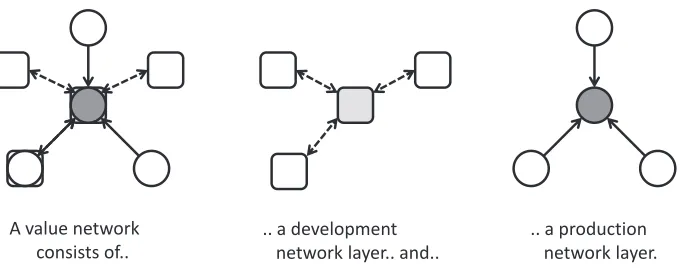
A value network consists of..
.. a development network layer.. and..
[image:9.595.138.478.163.297.2].. a production network layer.
Figure 1: A graphical illustration how a value network is made up of a product innovation and a production network layer each consisting of firms and their interactions.
We propose our biplex network development model for this ’disentangled’ evolution of both networks5 and their interaction. Explicit in this biplex network development model is that the innovation and production network co-exist during particular intervals of the industry evolution, that value net-works must conduct both activities proficiently (Benner & Tushman (2003) call this ’ambidexterity’) to assure continuity and hereto adapt the capabili-ties to changes in technology and market demand. The biplex model serves as a conceptual framework to reflect on the complications in organizing both regular production as well as R&D of new product technology.
We contend that firms arecontinuously producing products to sell, while they
intermittently (but generally recurrently) generate radically new products.
The development of product technology of generation g + 1 and production
of the products based on technology generation g occur simultaneously. In
the production phase (and hence network), there is also incremental product and process innovation that fine-tunes technology locally.
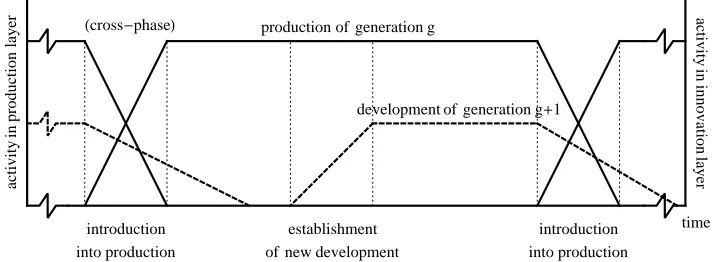
We thus propose the biplex network development model depicted in Figure 2, which is an abstract temporal layout of both activities.
5
time
activity
in
production
layer
activity
in
innovation
layer
introduction into production
establishment of new development
introduction into production Hcross-phaseL production of generation g
[image:10.595.127.486.133.264.2]development of generation g+1
Figure 2: A graphical impression of the biplex network development model with production (innovation) activity plotted in the continuous (dashed) line.
While innovation and production may have their own autonomous orga-nizational rationales, there are two phases (labeled ’introduction’ and ’estab-lishment’) during which there is definitely close interaction between the two networks.
During the introduction phase, firms arrange production facilities to man-ufacture the product based on the new technology generation. Firms draw up contracts for delivery with suppliers and customers, thereby formalizing the new production network. The old product is also phased out, such that contracts may be discontinued. We thus see a cross-phasing from the old generation production network into the new generation production network. Furthermore, facilities, communication structures, and contacts in place for radical innovation research are discontinued, such that the value network is rid of the innovation partners that do not coincide with production partners. During the establishment phase, firms start radical research by engaging in reconnaissance and early recombination with a wide variety of firms. The contacted firms may belong to the pool of current production partners, pre-vious innovation partners (e.g. universities), and also firms yet external to the value network or even current industry. As described before, firms move and are moved in and out of the innovation network. The firms in the net-work gradually reach consensus on the product definition, establish market viability, and prove technological feasibility.
network may have an immediate impact on the other network.
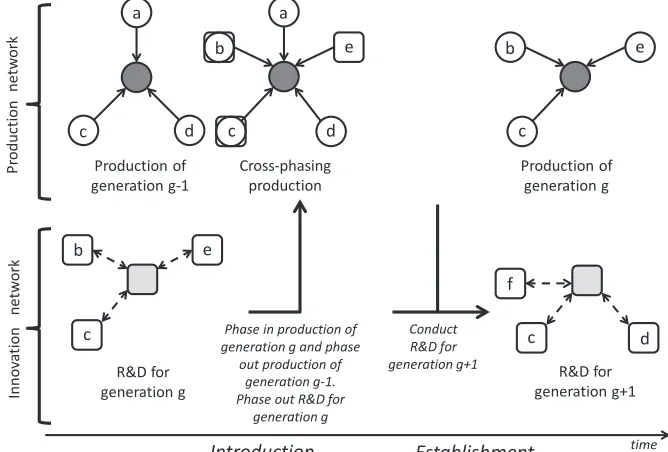
Figure 3 contains an illustration of how the two layers of the value network develop over time. By signing contracts, fixing production schedules and placing orders with suppliers, the switch from innovation to production is relatively clear-cut. The coming into existence of the next generation inno-vation network may well be more gradual.
R&D for generation g Production of generation g-1 Cross-phasing production R&D for generation g+1 Phase in production of
generation g and phase out production of
generation g-1. Phase out R&D for
generation g Production of generation g time Conduct R&D for generation g+1
Introduction Establishment
a a
b
c c c
c
d d
b e b e
c d
[image:11.595.135.469.231.457.2]f e In n o v a ti o n n e tw o rk P ro d u c ti o n n e tw o rk
Figure 3: A simple illustration how the (two layers of the) value network change(s) over time.
2.4. Temporal interactions
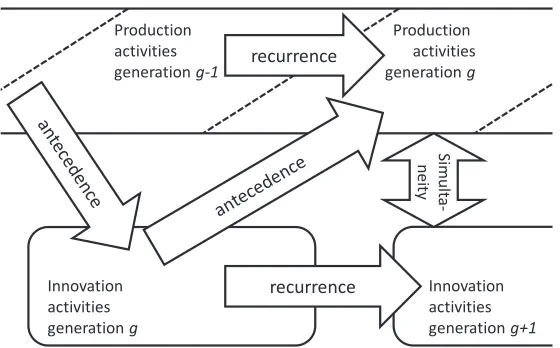
By adopting an explicit distinction between the innovation and the pro-duction network (as layers in the value network) and studying the temporal layout of innovation and production activities, we find several temporal in-teractions of innovation and production activities: recurrence, simultaneity, and antecedence.
the development of a new generation of product technology and thus extend the industry life-cycle. So, firms active in an industry are faced with recur-rent product development activities and recurrecur-rent phasing-in of new products into production (and phasing-out of outdated products out of production).
Secondly, there issimultaneity. In striving for continuity, firms should be engaged both in exploiting existing capabilities efficiently to generate current value, as well as developing new capabilities to assure future value creation. Our contention is that innovation and production activities do not occur clear-cut successively and there hence is also no clear temporal interleaving in the membership of the production and the innovation network. Firms may well be involved in both activities at the same time, such that the firm is member of a production as well as an innovation network simultaneously. The two value network layers co-exist and co-evolve. Regardless of whether the production and innovation network are working on the same or differ-ent generation of product technology, network managemdiffer-ent decision in one network are well likely to affect the other network.
Thirdly, there is antecedence in the formation of the innovation
net-work (cf. Halinen & T¨ornroos, 1998; Kogut, 2000; Rosenkopf & Tushman, 1998; Zirpoli & Camuffo, 2009). In the formation of the innovation network, firms rely on current production partners and use existing transaction and communication infrastructures. Firms elaborate on the existing technology paradigm or prefer to rely on firms with critical resources (like a physical network) (cf. Fleury & Fleury, 2007). Innovativeness is served if firms in the innovation network are not restricted in their partner or product technology choices by future production facilities. Furthermore, there also is antecedence in the formation of the production network as firms in the innovation network take into account future production performance. This does not mean they should stick to manufacturers in the current production network. However, collaboratively developing particular product technology with one supplier or customer and then switching to another as soon as actual production starts may be opportunistic and have unfavorable social consequences for future innovation projects. Hence, the current innovation network structure and population carries over to the production network structure and population as well, to some extend.
Production activities generation g-1
Innovation activities generation g
Production activities generation g
Innovation activities generation g+1 recurrence
recurrence
S
im
u
lt
a
-
n
e
it
[image:13.595.167.447.125.299.2]y
Figure 4: Graphical model of the temporal interaction concepts.
3. Biplex network management complications
Current innovation and production management literature provides regu-lar management strategies concerned with the network for thecurrent prod-uct technology generation and either innovation or prodprod-uction respectively. However, given the development of the two value network layers and given the various temporal complications (simultaneity, recurrence, and antecedence), when and how should a firm manage (a particular layer in) its value net-work? Simultaneity calls for network management strategies that attend to
both the innovation and production concerns. Recurrence and antecedence
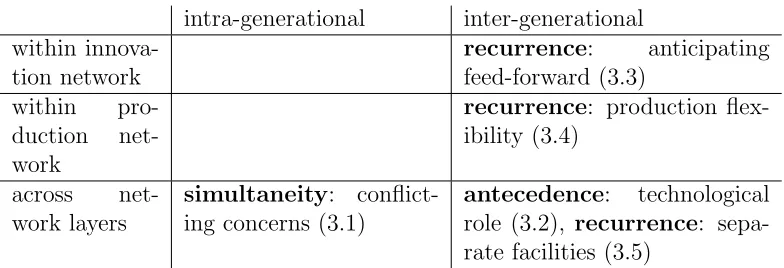
call for network management strategies that take into account the effect of changes to the current network on future options and how to overcome the effects of past choices on current options. In the present section, we provide a non-exhaustive list of network management issues that become apparent by looking at temporal interactions between the two network layers at the same time or from one to the next generation (between different and within the same layer). Table 1 contains the exemplary network management issues we discuss in this paper.
3.1. Conflicting concerns
intra-generational inter-generational within
innova-tion network
recurrence: anticipating feed-forward (3.3)
within
pro-duction
net-work
recurrence: production flex-ibility (3.4)
across
net-work layers
simultaneity: conflict-ing concerns (3.1)
[image:14.595.111.503.123.257.2]antecedence: technological role (3.2), recurrence: sepa-rate facilities (3.5)
Table 1: The exemplary temporal network management issues per combi-nation and between parentheses the number of the subsection in which we discuss the particular issue.
production and the innovation network when both activities occur simultane-ously. Whenever concerns are aligned in both network layers, e.g. removal of a subpar supplier, this may not be a problem. However, the concerns in the innovation and production network may be opposed. Whenever R&D and production are conducted simultaneously, the cost-based view dominant in management of the production network and the capability-based view dom-inant in management of the innovation network may arrive at conflicting recommendations for the value network change.
An obvious situation in which there is conflict of concerns is that of supplier management. On the one hand, cost and efficiency concerns in the production network may call for squeezing suppliers or pure transaction cost economic governance forms, but, on the other hand, the financial health, willingness to share knowledge and collaborative stance of suppliers may be needed in the innovation network (now or in the future) (cf. Macher & Mowery, 2004). In this case, firms better maintain a co-opetitive attitude towards (potential) network partners as it is beneficial for long term competitiveness of the value network and its members.
Another situation in which there is a conflict of concerns is in deciding on the governance over certain capabilities. Due to simultaneity, there may be
gov-ernance over capabilities up- or downstream in the value network, firms have to give priority to static efficiency and cost-based rationales in the production layer over dynamic efficiency and capability-based rationales in the innova-tion layer or vice versa.
While this ambiguity calls for giving the concerns in one layer the priority over those in the other layer, the governance decision is also conditional, i.e. depending on the current status and conditions (cf. Cacciatori & Jaco-bides, 2005). For example: when a firm is vertically specialized, it may seek alliances to tap into certain knowledge bases, but when already vertically integrated, that same firm may not divest the internal capabilities and ver-tically specialize to engage in the same alliances.
Evidently, while ambiguity and conditionality are evident complications in the governance decision within the biplex network development model, this is not an exhaustive list. Furthermore, ambiguity and conditionality (and several other types of general management complications) in fact also occur
within individual layers.
3.2. Technological role and comprehension
Antecedence refers to how the production network emerges out of the in-novation network, or how an inin-novation network for new R&D is formed out of the current production network by relying on existing partners and infras-tructure. An example of how such antecedence affects network development is found in the case that the technological foundation of the value network may persist. After all, in value network management decisions, a firm is influenced by the technological role it fulfills and the comprehension of tech-nological developments it has (cf. Harland et al., 2001). Furthermore, firms are contacted on the basis of this role and existing capabilities, also while establishing an innovation network for the next generation of technology, so this role may persist over successive life-cycles. Consequently, previously existing technological and organizational capabilities determine the newly established innovation network (Zirpoli & Camuffo, 2009).
inter-nal recombination options and absorptive capacity, with specialization comes also selective perception and corporate filters (Henderson & Clark, 1990). Both the lack of being able to escape the technological role and the limited comprehension decreases the absorptive capacity and locks in firms. So, the current value network constrains the technology that can be absorbed (Chris-tensen & Rosenbloom, 1995; Orsenigo et al., 2001; Jacobides & Winter, 2005) and, under extensive vertical specialization, incumbents are likely to fail to make the transition to a new industry after a technological discontinuity (cf. Soh & Roberts, 2003; Henderson & Clark, 1990; Afuah, 2001; Belussi & Ar-cangeli, 1998).
Employ-ing a wide network horizon and exercisEmploy-ing orchestration power may hamper the value network from adopting new capabilities and from morphing to ac-commodate new product technologies. As such, establishing the appropriate horizon and managing firms across this horizon is a strategically crucial com-petence (Holmen & Pedersen, 2003; M¨oller & Halinen, 1999). Conclusively, taking a technologically specialized scope and narrow network horizon may cause overlooking potential technological incompatibilities as well as miss technological opportunities, but taking a broad horizon and a technological integrative perspective may be a source of lock-in.
3.3. Anticipating feed-forward in product-market strategy
Ultimately, the product that is developed in the innovation network needs to be produced. As such, there is a feed-forward of the design choices made during innovation into the future production network. Anticipating this feed-forward, firms have to align the product-market strategy. An innovation network targeting the main market segment with price competition (focused price competition strategy) may work towards a modular design and a verti-cally specialized production network that facilitates outsourcing for scale and scope economies. An innovation network targeting a specialized high-quality-high-price niche (focused niche strategy), should work towards a superiorly performing, synergistically integrated solution (cf. Argyres & Bigelow, 2010) that provides a tenable position given the substitution by mainstream prod-ucts. To achieve such synergistic optimization, tight vertical governance or even vertical integration in the innovation network may be required.
Our contention is that firms in the innovation network should explicitly com-municate the future product-market strategy and anticipate the feed-forward of technological choices in the product-market strategy (cf. Ford & Mouzas, 2010).
However, while the future production network, facilities and activities should be anticipated, firms should transcend their current technological role and decomposition of production tasks so as to overcome antecedence. Failing to rid oneself of the current role may lock-in the value network in current technology and insufficiently leverage the opportunities of breakthrough tech-nology.
3.4. Production flexibility
gen-eration propagates into the production of the next gengen-eration. If the two generations of products are technologically different, either the transition in production arrangement is dynamically inefficient or production of at least of generation is statically inefficient. While cost economies and production efficiencies are managerial priorities in production network management, a ’focused factory’ (Skinner, 1974) -i.e. a dedicated production network in our perspective- is dynamically inefficient with recurring disruptive product innovation. The switching time in production then forms a liability (cf. Lan-glois & Robertson, 1989). Moreover, sticking too much to current production facilities forms a definite source of lock in. On the other hand, maintaining a ’strategic flexibility’ (Hayes & Pisano, 1994; Gerwin, 1993) to absorb un-defined turmoil or preparing for a wide range of products to produce hurts static efficiency during technological stable periods. We argue that, in or-der to be cost competitive, production networks need to be able to make timely switches from producing one to the next generation of products, i.e. the production network needs to have a cross-generational flexibility. One immediate implication for network management is that firms may need to unsentimentally switch production partners in cross-phasing.
3.5. Separate facilities per layer
We argued that value networks should be dynamically efficient in innova-tion and statically efficient with cross-generainnova-tional flexibility in producinnova-tion. However, is that even possible, given the interactions due to simultaneity?. If the current production network is also used for experimentation and man-ufacturing of early designs of the next generation, the static efficiency of production decreases. Moreover, one is already involving the current pro-ducers, such that the current production network is an antecedent of the innovation network (see Subsection 3.2). As products may then be designed for the production facilities at hand, innovative product development is ham-pered.
4. Conclusions
In this paper, we started from the notion that firms manage their value network and thereby balance current and future value generation concerns (i.e. production versus innovation) and balance own and network partners’ concerns. Current value is generated and appropriated in the production network layer and future value is generated in the innovation network layer. We then formulated a biplex value network development model that basi-cally is a temporal layout of innovation and production network activities, given that industries evolve by recurring radical product technology break-throughs. From this network development model it is obvious that there are several temporal complications that firms encounter in managing their innovation and production network layers. We then studied several evident issues in the cross-table of inter- and intragenerational complications versus within versus across network layers. Interesting first implications are that recurrence calls for the installation of merely cross-generational production flexibility and separate innovation experimentation facilities. Furthermore, simultaneity gives rise to ambiguity in governance. Antecedence calls for strategic alignment already in the innovation network. We know that the list of issues discussed is by no means exhaustive, but is a clear indication that network management of a firm would benefit from taking explicitly into account the two value network layers and the simultaneity and recurrence/ antecedence of its innovation and production activities.
Each of the cells in the cross-table, Table 1, provides topics for further re-search. Moreover, the biplex development model itself may be further refined with different phases in innovation and production network development. We already hinted on the reconnaissance and recombination phases in the inno-vation network development.
An interesting avenue for further research is to relate the activities in the biplex model to technological events and (anticipated) activities of compet-ing networks, to be more explicit about managerial options and priorities. Innovation network management may, for instance, be different when an in-novation network is the inventor of a radically new technology from when it is merely established in response to an invention by a competing network.
References
Aarikka-Stenroos, L., & Sandberg, B. (2012). From new-product
Re-search, 65, 198–206.
Achrol, R. (1997). Changes in the theory of interorganizational relations
in marketing: towards a network paradigm. Journal of the Academy of
Marketing Science, 25, 56 – 71.
Afuah, A. (2001). Dynamic boundaries of the firm: Are firms better off being vertically integrated in the face of a technological change? The Academy of Management Journal,44, 1211 – 1228.
Allee, V. (2000). Reconfigurating the value network. Journal of Business
Strategy, (pp. 36 – 39).
Anderson, J., H˚akansson, H., & Johanson, J. (1994). Dyadic business rela-tionships within a business network context. Journal of Marketing, 58, 1 – 15.
Argyres, N., & Bigelow, L. (2010). Innovation, modularity, and vertical
deintegration: Evidence from the early u.s. auto industry. Organization
Science,21.
Baldwin, C., & Clark, K. (2000). Design Rules: The Power of Modularity. MIT Press.
Belussi, F., & Arcangeli, F. (1998). A typology of networks: Flexible and evolutionary firms. Research Policy,27, 415 – 428.
Benner, M., & Tushman, M. (2003). Exploitation, exploration, and
pro-cess management: The productivity dilemma revisited. The Academy of
Management Review, 28, 238 – 256.
Brandenburger, A., & Nalebuff, B. (1996). Co-Opetition. Harper Collins.
Brusoni, S. (2003). Authority in the Age Of Modularity. Working Paper
SPRU.
Cacciatori, E., & Jacobides, M. (2005). The dynamic limits of specialization: Vertical integration reconsidered. Organization Studies,26, 1851 – 1883.
Chesbrough, H. (2003). Open Innovation: The new Imperative for Creating
Chesbrough, H., & Kusunoki, K. (2001). The modularity trap: Innovation, technology phase shifts and the resulting limits of virtual organizations. In I. Nonaka, & D. Teece (Eds.),Managing Industrial Knowledge (pp. 202 – 230). Sage.
Christensen, C., & Rosenbloom, R. (1995). Explaining the attacker’s ad-vantage: Technological paradigms, organizational dynamics, and the value network. Research Policy, 24, 233 – 257.
Dyer, J., & Singh, H. (1998). The relational view: Cooperative strategy and
sources of interorganizational competitive advantage. Academy of
Man-agement Review, 23, 660 – 679.
Fleury, A., & Fleury, M. (2007). The evolution of production systems and
conceptual frameworks. Journal of Manufacturing Technology
Manage-ment,18, 949 – 965.
Ford, D., & Mouzas, S. (2008). Is there any hope? The idea of strategy in business networks. Australasian Marketing Journal, 16, 64 – 78.
Ford, D., & Mouzas, S. (2010). Networking under uncertainty: Concepts and research agenda. Industrial Marketing Management,39, 956 – 962.
Gerwin, D. (1993). Manufacturing flexibility: A strategic flexibility. Man-agement Science, 39, 395 – 410.
Gilsing, V. (2005). The Dynamics of Innovation and Interfirm Networks:
Exploration, Exploitation and Co-Evolution. Edward Elgar.
H˚akansson, H., & Snehota, I. (1989). No business is an island: The network
concept of business strategy. Scandinavian Journal of Management, 5,
187 – 200.
H˚akansson, H., & Snehota, I. (1995). Developing Relationships in Business Networks. Routledge.
Halinen, A., Salmi, A., & Havila, V. (1999). From dyadic change to
chang-ing business networks: An analytical framework. Journal of Management
Studies, 36, 779 – 794.
Harland, C., Lamming, R., Zheng, J., & Johnsen, T. (2001). A taxonomy of
supply networks. The Journal of Supply Chain Management,37, 21 – 27.
Hayes, R., & Pisano, G. (1994). Beyond world-class: The new manufacturing strategy. Harvard Business Review, .
Henderson, R., & Clark, K. (1990). Architectural innovation: The reconfigu-ration of existing product technologies and the failure of established firms.
Administrative Science Quarterly, 35, 9 – 30.
Hite, J., & Hesterly, W. (2001). The evolution of firm networks: From emergence to early growth of the firm. Strategic Management Journal,22, 275 – 286.
Hoetker, G. (2006). Do modular products lead to modular organizations?
Strategic Management Journal, 27, 501 – 518.
Holmen, E., & Pedersen, A. (2003). Strategizing through analyzing and
influencing the network horizon. Industrial Marketing Management, 32,
409 – 418.
Jacobides, M., & Winter, S. (2005). The co-evolution of capabilities and transaction costs - explaining the institutional structure of production.
Strategic Management Journal, 26, 395 – 413.
Kambil, A. (2008). Purposeful abstractions: Thoughts on creating business network models. Journal of Business Strategy, 29, 52 – 54.
Kogut, B. (2000). The network as knowledge: Generative rules and the emergence of structure. Strategic Management Journal, 21, 405 – 425.
Kothandaraman, P., & Wilson, D. (2001). The future of competition: Value-creating networks. Industrial Marketing Management, 30, 379–389.
Lamming, R., Johnsen, T., Zheng, J., & Harland, C. (2000). An initial classification of supply networks. International Journal of Operations & Production Management,20, 675 – 691.
Langlois, R., & Robertson, P. (1989). Explaining vertical integration:
Lessons from the american automobile industry. The Journal of Economic
Leonard-Barton, D. (1992). Core capabilities and core rigidities: A paradox
in managing new product development. Strategic Management Journal,
13, 111 – 125.
Macher, J., & Mowery, D. (2004). Vertical specialization and industry struc-ture in high technology industries. Advances in Strategic Management,21, 317 – 355.
March, J. (1991). Exploration and exploitation in organizational learning.
Organization Science, 2, 71 – 87.
M¨oller, K., & Halinen, A. (1999). Business relationships and networks: Man-agerial challenge of network era. Industrial Marketing Management, 28, 413 – 427.
M¨oller, K., & Svahn, S. (2003). Managing strategic nets: A capability per-spective. Marketing Theory, 3, 201 – 226.
M¨oller, K., & Svahn, S. (2009). How to influence the birth of new business fields - network perspective. Industrial Marketing Management, 38, 450 – 458.
Nelson, R. R., & Winter, S. G. (1982). An Evolutionary Theory of Economic Change. Harvard University Press.
Oksanen, P., Hallikas, J., & Sissonen, H. (2010). The evolution of value networks. International Journal of Networking and Virtual Organisations,
7, 381 – 398.
O’Reilly III, C., & Tushman, M. (2008). Ambidexterity as a dynamic
ca-pability: Resolving the innovator’s dilemma. Research in Organizational
Behavior, 28, 185 – 206.
Orsenigo, L., Pammolli, F., & Riccaboni, M. (2001). Technological change
and network dynamics: Lessons from the pharmaceutical industry.
Re-search Policy, 30, 485 – 508.
Ritter, T., & Gem¨unden, H. (2003). Network competence: Its impact on innovation success and its antecedents. Journal of Business Research, 56, 745 – 755.
Ritter, T., Wilkinson, I., & Johnston, W. (2004). Managing in complex business networks. Industrial Marketing Management,33, 175 – 183.
Rosenkopf, L., & Almeida, P. (2003). Overcoming local search through al-liances and mobility. Management Science, 49, 751 – 766.
Rosenkopf, L., & Tushman, M. (1998). The coevolution of community net-works and technology: Lessons from the flight simulation industry. Indus-trial and Corporate Change,7.
Sanchez, R., & Mahoney, J. (1996). Modularity, flexibility, and knowledge
management in product and organization design. Strategic Management
Journal, 17, 63 – 76.
Schilling, M. (2000). Toward a general modular systems theory and its
ap-plication to interfirm product modularity. The Academy of Management
Review, 25, 312 – 334.
Skinner, W. (1974). Focused factory. Harvard Business Review, .
Soh, P., & Roberts, E. (2003). Networks of innovators: A longitudinal per-spective. Research Policy,32, 1569 – 1588.
Stolwijk, C., Ortt, J., & den Hartig, E. (2013). The joint evolution of alliance networks and technology. a survey of the empirical literature.Technological Forecasting & Social Change, 80, 1287 – 1305.
Walker, G., Kogut, B., & Shan, W. (1997). Social capital, structural holes and the formation of an industry network. Organization Science, 8, 109 – 125.
Zirpoli, F., & Camuffo, A. (2009). Product architecture, inter-firm vertical
coordination and knowledge partitioning in the auto industry. European