Applied Mathematics, 2010, 3, 499-503
doi:10.4236/am.2010.16065 Published Online December 2010 (http://www.SciRP.org/journal/am)
On Embedding of m-Sequential k-ary
Trees into Hypercubes*
Indra Rajasingh, Bharati Rajan, Ramanathan Sundara Rajan
Department of Mathematics, Loyola College, Chennai, India E-mail: [email protected]
Received June 25, 2010; revisedOctober 12, 2010; acceptedOctober 18,2010
Abstract
In this paper, we present an algorithm for embedding an m-sequential k-ary tree into its optimal hypercube with dilation at most 2 and prove its correctness.
Keywords:Hypercube, Embedding, Dilation, Pre-order Labeling, Hamiltonian Cycle, k-ary Tree
1. Introduction
Let G and H be finite graphs with n vertices. V G
and
V H denote the vertex sets of G and H, respectively.
E G and E H
denote the edge sets of G and H,respectively. An embedding f of G into H is defined
[1] as follows:
1) f is a bijective map from V G
V H
2) f is a one-to-one map from E G
to
Pf f u ,f v : Pf
f u
,f v
is a path in Hbe-tween f u
and f v
.The dilation of an embedding f of G into H is given by
= max
f
,
: ,
dil f P f u f v u v E G
where Pf
f u
,f v
denotes the length of the pathf
P . Then, the dilation of G into H is defined as
,
= min
dil G H dil f
where the minimum is taken over all embeddings f of G
into H. Embedding G into H with minimum dilation is
important for network design and for the simulation of one computer architecture by another [2].
Embeddings as mathematical models of parallel com-puting have been discussed extensively in the literature [3,4]. In these models, both the algorithm to be imple-mented and the interconnection network of the parallel computing system are represented by graphs. The im-plementation details are then studied through the embed-ding.
A tree is a connected graph that contains no cycles.
Trees are the most fundamental graph-theoretic models used in many fields: information theory, automatics clas-sification, data structure and analysis, artificial intelli-gence, design of algorithms, operation research, combi-natorial optimization, theory of electrical networks and design of network [5]. Trees are ubiquitous in computer science. A rooted tree represents a data structure with a hierarchical relationship among its various elements [6].
The most common type of tree is the binary tree. It is so named because each node can have at most two des-cendents. Binary trees are widely used in data structures because they are easily stored, easily manipulated and easily retrieved [5]. A k-ary tree is a rooted tree in which
each node has no more than k children. It is also known
as a k-way tree.
From a computing perspective, trees form an impor-tant class of computational structures. Many operations such as searching and storing can be easily performed on tree data structures. Hence, there is a large literature on embeddings of various kinds of trees into the graphs of interconnection networks [3,7-25]. In particular, embed-dings of binary trees into hypercubes have received spe-cial attention since they naturally arise as the computa-tional structures of algorithms that employ dvide-and- conquer paradigm [12].
ded into a hypercube with constant dilation [26].
In 1984, Havel [9,27] conjectured that a binary tree can be embedded into a k-dimensional hypercube Qk with dilation one if and only if each of its partite sets contains at most 2k1 vertices. In 1985, Bhatt and Ipsen
[7] conjectured that a binary tree can be embedded into its optimal hypercube with dilation at most two as well as into its next-to-optimal hypercube with dilation one. As observed in [13], the conjecture of Havel is stronger than those of Bhatt and Ipsen. Though all these problems have been resolved in several special cases, they still remain open for the general case.
Monien and Sudborough [14] proved that every binary tree can be embedded into a hypercube with dilation 3 and O
1 expansion. Chen and Stallmann [26] proved that a simple linear-time heuristic embeds an arbitrary binary tree into a hypercube with expansion 1 and aver-age dilation no more than 2. Dvořák [15] constructed the embedding of certain classes of binary trees into hyper-cubes based on an iterative embedding into their sub-graphs induced by dense sets. Heun and Mayr [16] proved that arbitrary binary trees can be embedded into hypercubes with dialtion 8. Further, they constructed an embedding of double-rooted complete binary trees into hypercubes [17]. Sunitha [4] constructed an embedding of some hierarchical caterpillars into their optimal hypercube with dilation 2. Choudum et al. [28] provedthat subclasses of height-balanced trees can be embedded into hypercubes. Further, they proved that the height-balanced trees and Fibonacci trees can be embedded into hypercubes [6]. Eğecioğlu and Ibel [18] proved that the dynamic
k-ary tree can be embedded into its asymptotic
hyper-cube.
Thus there is a vast literature on embedding trees into hypercubes. In this paper, we define an m-sequential k-ary tree and prove that it can be embedded into its
op-timal hypercube with dilation at most 2.
2. Preliminaries
In this section, we introduce the labeling hal to label the
vertices of the hypercube architecture. We obtain results that enable us to prove the main result of this paper.
Definition 1 [5] An r-dimensional hypercube Qr
has nodes respesented by all the binary r-tuples with two nodes being adjacent if and only if their corresponding r-tuples differ in exactly one position.
The decimal representation of the vertices is the set
0,1, 2,, 2n1 .
For convenience, we use the symbol1
x instead of x and therefore the set of labels of the
vertices is
1, 2, , 2 . n
Remark 1 Let G be graph with m vertices. The
hypercube of dimension log2
m is called its optimalhypercube, and one of dimension log2 m1 is called
next-to-optimal.
Definition 2 Let r
Q be an r-dimensional hypercube. A partial ordering “” on Qr is defined by QiQj if and only if Qi is a subcube of Qj, 1i j, r. The notation Qi<Qj shall mean Qi Qj and i j.
Q Q
Definition 3 A hamiltonian labeling of hypercube r
Q , denoted by hal, is the labeling of the vertices of Qr defined inductively as follows: Consider the ordering
1< 2< < i< < r
Q Q Q Q on Qr . Label vertices of
1
Q as 0 and 1. If ( )i
uV Q is labeled x , then label the unique vertex
i1 \ i
vV Q V Q adjacent to u as 2i1 1
x
.
Remark 2 The labeling hal is the decimal equivalent of the binary gray code sequence [26].
Definition 4 A hamiltonian cycle is a cycle that visits each node of the graph exactly once. By convention, the trivial graph on a single node is considered to possess a hamiltonian cycle. A graph possessing a hamiltonian cycle is said to be a hamiltonian graph.
Theorem 1 The hamiltonian labeling hal of Qr determines a hamiltonian cycle = 1,2,
,2 ,1r
r
C in
r
Q ,r2.
Proof We prove that hal determines the hamiltonian
cycle
1, 2,, 2 ,1l
in lQ for all l, 2lr.We prove
the result by induction on r. For r=2,C2= 1,2,3,4,1
is a hamiltonian cycle in Q2. Assume that
1
1= 1, 2,3, , 2 ,1k
k
C is a hamiltonian cycle in 1.
k
Q
Consider k
Q . We observe that Qk1is a subcube of
. k
Q Let Fk1 denote the other
k1
-dimensionalsubcube contained in k.
Q By definition of Qk,
u v,is an edge in k 1
Q if and only if
', 'u v is an edge in
1
k
F , where
, 'u u and
, 'v v are edges in Qk.Thus
=
P
1,2,3,,2k1
is a hamiltonian path in k1 Qimplying that
1= 2 + 1 1, 2 + 1k k 2, , 2 + 1k 2k
P
1
= 2 ,2k k1,,2 +1k
is a hamiltonian path in k 1
F . Moreover, the vertex
labeled 2k1 is adjacent to the vertex labeled
2k 1
2k1= 2k11. Again the vertex labeled 1 is adjacent to the vertex labeled
2k 1 1 = 2 .
k Thus
1 1
1 1 1
2k ,2k 1 ' 2 ,1 = 1,2, ,2k k ,2k 1, ,2 ,1k
P P
is a hamiltonian cycle in k
Q .
The following results are easy consequences of Theorem 1 and the hal labeling of vertices of the
hypercube.
Lemma 1 Let x and y be the hal labeling of vertices u and v in r.
Q If m
y
x =2 for some m, r
m
1 , then d u v
, = 2 in r. QProof Without loss of generality let x>y. Now
1 1
= 2m = 2m 2 = 2m m 1 2m 1
I. RAJASINGH ET AL. 501
where z is the label of some vertex w in r.
Q Thus
= 2m1 1 , = 2m 1
x z y z is a solution to the
equation = 2 .m
xy This implies that w is adjacent to
both u and v. In other words, d u v
, = 2 in r. QLemma 2 Let x and y be the hal labeling of vertices u and v in r.
Q If yx=2m2x1 for some m,
1 m r, then d(u,v)=1 in r. Q
Lemma 3 Let 1 and y be the hal labeling of vertices u and v in r.
Q If y1=2mi2m for some m and i,
1m,ir, then d(u,v)=2 in r. Q
Proof It is straightforward to see that y1=2mi2m
implies y=2miz1, where m
z=2 is the label of
some vertex w in r.
Q Thus, { = 2y m i 1 z z, = 2 }m is a
solution to the equation 1 = 2m i 2 .m
y This implies
that w is adjacent to both u and v. In other words,
2 = ) , (u v
d in r.
Q
3. Embedding Algorithm
Embeddings with dilation more than one become significant when trees with branch lengths representing time are considered. In this section, we obtain an embedding algorithm and prove its correctness.
Definition 5 A rooted tree T is said to be a step-up tree if for every internal node u of T, any two subtrees
i
T and T rooted at children of u are ordered in T in j
such a way that if V T
i V T
j , then Ti lies to theleft of T . See Figure 1. j
Definition 6 For m2 and k1, an m-sequential k-ary tree T(m,k) is a step-up tree obtained by recursively growing the root u with k children under the following conditions.
(a) The subtrees rooted at the children of u are of
sequential order
2m2,2 ,2m m1,2m2,,2m k 2
or
2m1,2m1,2m2,,2m k 1
.(b) The root of a subtree of order 2st, 0t2,
3
s has s1 children which in turn are the roots of
subtrees of sequential order
3,2 ,2 ,2 3 ,2s 2,2s1
t
except when s= 3, = 2t and in this case the sequential
order is (2, 3).
(c) A subtree of order 3 or 4 with v as a root node is
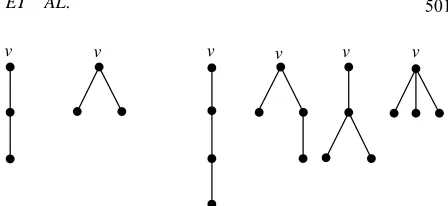
isomorphic to one of the graphs shown in Figure 2.
T1 T2 T3 Tk
[image:3.595.312.536.61.164.2]u
Figure 1. Step-up tree T with V T
1 V T
2
kV T .
v
v v v v v
Figure 2. A subtree of order 3 or 4 with v as a root node.
Remark 3 T(m,k) rooted at u is said to be of Type A or Type B depending whether the subtrees rooted at the children of u are of sequential order (2m2,2 ,2m m1,
2 2
2m ,,2m k )
or
2m1,2m1,2m2,,2m k 1
, res- pectively. See Figure 3.Remark 4 T(m,k) of Type A has 2mk31 nodes and T(m,k) of Type B has 2 2m
k1
nodes.
In the sequel, we need the following definition of pre-order tree traversal.
Definition 7 Let T be a rooted tree. A pre-order labeling of nodes of T is the labeling of its nodes the first time we visit the nodes in the traversal. See Figure 4.
Embedding Algorithm
Input: T(m,k) and its optimal hypercube r. Q
Algorithm: Label the nodes of T using pre-order
labeling and the vertices of the hypercube using hal
labeling.
Output: Embedding of T into Qr with dilation at
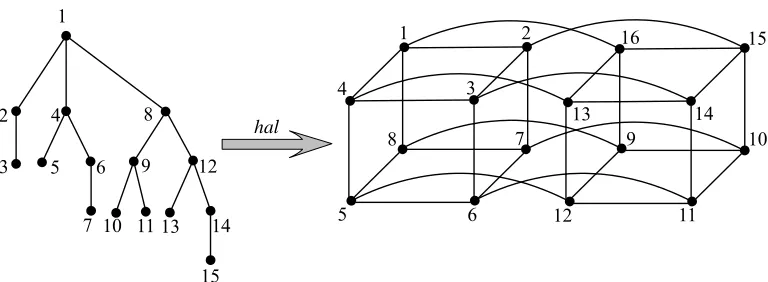
most 2. See Figure 5.
(a) (b)
Figure 3. (a) T (2, 4) of Type A; (b) T (3, 2) of Type B.
1
2
3 4
5 6
7 8
9
10 11 12
13 14
15
[image:3.595.308.541.423.528.2] [image:3.595.365.480.565.698.2]1
2
3 4
5 6
7 8
9
10 11 12
13 14
15
hal
1
5 4
2
7 3
6
16 15
14 13
10
8 9
[image:4.595.106.490.79.220.2]11 12
Figure 5. Embedding of T(2, 3) of Type A into Q4.
Theorem 2 An m-sequential k-ary tree can be embedded into its optimal hypercube with dilation at most 2.
Proof Consider an embedding f of T into r
Q using
the embedding algorithm, labeling the nodes of T using
pre-order labeling and the vertices of the hypercube using hal labeling such that f(x)=x.
Let v be an internal node of T with children
1, ,2 , p
v v v . Let T T1, ,2 ,Tp be the subtrees rooted at
1, , , ,2 p
v v v respectively. Since T is a step-up tree, we
have V T 1 V T 2 V T
p .Suppose that the root ofT is u. Then the label of u is 1.
Case 1 (v is a child of u):
Let ei=(1,yi), 1 i k. By definition of pre-order traversal,
1 2 1
= 2.
i i
y V T V T V T
By definition of m-sequential k-ary tree of Type A,
1 2 1
1 2 ( 3)
3 4
= 2 2 2 2 2 2
= 2 [1 2 2 ] 2 = 2 2.
i
m m m m m i
m i m i
V T V T V T
Therefore 1=2mi41 i
y and hence by Lemma 2,
the edge ei is of dilation 1.
Again by definition of m-sequential k-ary tree of Type B,
1 2 1
1 2 ( 1)
1
= 2 1 2 2 2
= 2 1 2 2 1= 2 2 1.
i
m m m m i
m i m i i
V T V T V T
Therefore m i i
i
y 1=2 2 and hence by Lemma 3, the
edge ei is of dilation 2.
Case 2 (v is not a child of u):
Let the label of v be x. Let ei=(x,yi), 1 i p.
By definition of pre-order traversal,
1
2
1= 1 .
i i
y V T V T V T x
By definition of m-sequential k-ary tree,
11 2 i 1 = 3 4 2i = 2 1.i
V T V T V T
Therefore i
i x
y =2 and hence by Lemma 1, the edge
i
e is of dilation 2.
4. Conclusions
In this paper, we have obtained an embedding algorithm to embed an m-sequential k-ary tree into its optimal
hypercube with dilation at most 2. We have also proved its correctness. This study is important as the embedding of binary trees into hypercubes received special attention in the computational structures of algorithm such as searching and storing.
5. References
[1] S. L. Bezrukov, J. D. Chavez, L. H. Harper, M. Röttger and U. P. Schroeder, “Embedding of Hypercubes into Grids,” Proceedings of the 23rd International Symposium on Mathematical Foundations of Computer Science, Brno, 24-28 August 1998 , pp. 693-701.
[2] S. L. Bezrukov, B. Monien, W. Unger and G. Wechsung, “Embedding Ladders and Caterpillars into the Hyper- cube,” Discrete Applied Mathematics, Vol. 83, No. 1-3, 1998, pp. 21-29.
[3] P. Manuel, I. Rajasingh, B. Rajan and H. Mercy, “Exact Wirelength of Hypercube on a Grid,” Discrete Applied Mathematics, Vol. 157, No. 7, 2009, pp. 1486-1495. [4] V. Sunitha, “Embedding Some Hierarchical Caterpillars
into Hypercube,” Electronic Notes in Discrete Mathe- matics, Vol. 22, No. 10, 2005, pp. 387-389.
[5] J. M. Xu, “Topological Structure and Analysis of Inter- connection Networks,” Kluwer Academic Publishers, Norwell, 2001.
I. RAJASINGH ET AL. 503
2009, pp. 39-52.
[7] S. N. Bhatt and I. C. Ipsen, “How to Embed Trees in Hypercubes,” Technical Report YALEU/DCS/RR-443, Yale University, Connecticut, 1985.
[8] Q. Dong, X. Yang, J. Zhao and Y. Y. Tang,“Embbedding a Family of Disjoint 3D Meshes into a Crossed Cube,” Infor- mation Sciences, Vol. 178, No. 11, 2008, pp. 2396-2405. [9] I. Havel, “On Hamiltonian Circuits and Spanning Trees
of Hypercubes,” Casopis.Pest.Mat., Vol. 109, No. 2, 1984, pp. 135- 152.
[10] I. Havel and P. Liebl, “O Vnoren Dichotomickeho Stro- mu Do Krychle (in Czech with English summary),” Casopis. Pest. Mat., Vol. 97 , No. 2, 1972, pp. 201-205. [11] L. Nebesky, “On Cubes and Dichotomic Trees,” Casopis.
Pest. Mat., Vol. 99, No. 2, 1974, pp. 164-167.
[12] D. E. Knuth, “The Art of Computer Programming-3, Sorting and Searching,” Addison-Wesley Publishing Company, Massachusetts, 1973.
[13] T. Dvořák, I. Havel, P. Liebl and J.-M. Laborde, “Gene- ralized Hypercubes and Graph Embedding with Dila- tion,” Rostocker Mathematisches Kolloquium, Vol. 39, 1990, pp. 13-20.
[14] B. Monien and H. Sudborough, “Simulating Binary Trees on Hypercubes,”VLSI, Algorithms and Architectures, Proceedings of the 3rd Aegean Workshop on Computing, LNCS, Springer-Verlag Vol. 319, No. 24, 1988, pp. 170-180.
[15] T. Dvořák, “Dense Sets and Embedding Binary Trees into Hypercubes,”Discrete Applied Mathematics, Vol. 155, No. 4, 2007, pp. 506-514.
[16] V. Heun and E. W. Mayr, “A New Efficient Algorithm for Embedding an Arbitrary Binary Tree into Its Optimal Hypercube,”Journal of Algorithms, Vol. 20, No. 2, 1996, pp. 375-399.
[17] V. Heun and E. W. Mayr, “Optimal Dynamic Em- beddings of Complete Binary Trees into Hypercubes,” Journal of Parallel and Distributed Computing, Vol. 61,
No. 8, 2001, pp. 1110-1125.
[18] O. Eğecioğlu and M. Ibel, “Asymptotic Hypercube Em- beddings of Dynamic k-ary Trees,” Congressus Nume- rantium, Vol. 126, 1997, pp. 21-32.
[19] J. Fan and X. Jia, “Embedding Meshes into Crossed Cubes,” Information Sciences, Vol. 177, No. 15, 2007, pp. 3151-3160.
[20] J. Fan, X. Jia and X. Lin,“Complete Path Embeddings in Crossed Cubes,” Information Sciences, Vol. 176, No. 22, 2006, pp. 3332-3346.
[21] J. S. Fu, “Longest Fault-free Paths in Hypercubes with Vertex Faults,” Information Sciences, Vol. 176, No. 7, 2006, pp. 759-771.
[22] I. Havel and P. Liebl,“One-Legged Caterpillars Span Hypercubes,”Journal of Graph Theory, Vol. 10, No. 1, 1986, pp. 69-77.
[23] T. C. Lin and D. R. Duh, “Constructing Vertex-Disjoint Paths in (n, k)-star Graphs,”Information Sciences, Vol. 178, No. 3, 2008, pp. 788-801.
[24] C. H. Tsai and Y. C. Lai, “Conditional Edge-Fault-Tolerant Edge-Bipancyclicity of Hypercubes,” Information Sciences, Vol. 177, No. 24, 2007, pp. 5590-5597.
[25] R. Y. Wu, G. Chen, Y-L. Kuo and G. J. Chang, “Node- disjoint Paths in Hierarchical Hypercube Networks,” Information Sciences, Vol. 177, No. 19, 2007, pp. 4200-4207.
[26] W. K. Chen and M. F. M. Stallmann,“On Embedding Binary Trees into Hypercubes,” Journal on Parallel and Distributed Computing, Vol. 24, No. 2, 1995, pp. 132-138. [27] I. Havel, “On Certain Trees in Hypercubes,” In Topics in
Combinatorics and Graph Theory, Physica-Verlag, Heidelberg, 1990, pp. 353-358.