Aeroelastic stability analysis via multiparameter eigenvalue
problems
Arion Pons, Stefanie Gutschmidt
Abstract:
This paper presents a new method of identifying and analysing stability
boundaries in parametric systems using multiparameter spectral theory. Considering
our driving application, the analysis of aeroelastic flutter instability, we identify
methods by which the location of the stability boundary be expressed as a
multiparameter eigenvalue problem and thus solved. This approach yields
far-reaching results, including direct solvers for arbitrarily large polynomial problems,
iterative and approximate direct solvers for systems that are strongly nonlinear in the
frequency domain, and a novel method of system visualisation. These solvers and
methods are tested on two aeroelastic section models and the Goland wing benchmark
model, and their advantages and limitations are explored.
1.
Introduction
The understanding and prediction of aeroelastic instability is a primary concern in the discipline
of aeroelasticity. Aeroelastic instability, often termed
flutter
when occurring dynamically, be
observed in a wide variety of systems – not only wings and aerofoils, but wall plates [1], hosepipes
[2] and more. In a linear system, or the linearisation of a nonlinear system, the onset of flutter can be
described by the modal stability criterion:
Im(𝜒) > 0
for stability,
(1)
where
𝜒
are the time-eigenvalues of the system, transformed according to
𝑞(𝑡) = 𝑞̂𝑒
𝜄𝜒𝑡for the system
coordinate
𝑞
[3]. Note that other transforms and nondimensional eigenvalue definitions are possible.
A flutter point then be described as a tuple of the modal frequency of instability,
𝜒
f∈ ℝ
, and any
relevant system parameters (in particular, a local airspeed). As flutter is often associated with
structural failure, only the first few flutter points are usually of industrial relevance.
Sazesh [12] characterized flutter instability using stochastic methods, and Afolabi [13,14] applied
eigenvector orthogonality conditions from catastrophe theory.
All of these approaches, however, are based on the single-parameter approach of computing a
stability metric (
Im(𝜒)
,
𝜇
or whatever else) across a range of system parameter values and identifying
relevant stability boundaries. We propose an entirely different method of analysis. We show that the
solution of an aeroelastic system for its flutter points – or the analysis of any other frequency-domain
stability problem – is nothing other than a multiparameter eigenvalue problem. We will demonstrate
how this approach leads to a number of improved solvers for a wide range of parametric stability
problems drawn from the field of aeroelasticity. Our methods are equally applicable in other fields.
2.
Multiparameter analysis
Consider a linear finite-dimensional system with eigenvector
𝐱 ∈ ℂ
𝑛, continuously dependent on
both an eigenvalue parameter
𝜒 ∈ ℂ
, and another structural or environmental parameter
𝑝 ∈ ℝ
:
A(𝜒, 𝑝)𝐱 = 𝟎,
(2)
where
A ∈ ℂ
𝑛×𝑛. Any complex-valued structural parameter can be split into two real parameters. We
then note that the condition for the stability boundary,
Im(𝜒) = 0
, is equivalent to defining the
problem with
𝜒 ∈ ℝ
. However, under
𝜒 ∈ ℝ
a solution to Eq. 2 only exists on the stability boundary,
and nowhere else. To define some form of solution in the subcritical and supercritical areas (above
and below the stability boundary, respectively), following [15], we take the complex conjugate of Eq.
2 as another equation:
A(𝜒, 𝑝)𝐱 = 𝟎,
(3)
A
̅(𝜒, 𝑝)𝐱̅ = 𝟎.
(4)
3.
Linear and polynomial problems
3.1.
Direct solution
Consider a linear instability problem:
(A + B𝜒 + C𝑝)𝐱 = 𝟎,
(5)
(A̅ + B̅𝜒 + C̅𝑝)𝐱̅ = 𝟎.
(6)
Post-multiplying Eq. 5 by
C̅𝐲
and premultiplying Eq. 6 by
C𝐱
, we obtain
(A + B𝜒 + C𝑝)𝐱 ⊗ (C̅𝐲) = 0,
(7)
(C𝐱) ⊗ (A̅ + B̅𝜒 + C̅𝑝)𝐲 = 0.
(8)
Equations 7 and 8 are equal to zero and so we equate them. After cancelling the terms in
𝑝
, the result
becomes:
Δ
1𝐳 = 𝜒Δ
0𝐳,
(9)
with an enlarged eigenvector
𝐳 = 𝐱 ⊗ 𝐲
and the operator determinants
Δ
0= B ⊗ C̅ − C ⊗ B̅,
(10)
Δ
1= C ⊗ A
̅ − A ⊗ C̅,
(11)
Δ
2= A ⊗ B̅ − B ⊗ A
̅,
(12)
which are of size
𝑛
2relative to system coefficients of size
𝑛
. Equation 9 is a generalized eigenvalue
problem (GEP), in the single parameter
𝜒
. GEP solvers are very widely available.
The operator determinants also define a GEP in
𝑝
. Multiplying by
B̅𝐲
and
B𝐱
, we have:
Δ
2𝐳 = 𝑝Δ
0𝐳.
(13)
3.2.
Linearisation of polynomials
Any polynomial MEP can be linearised [18,25]; a process which resembles the well-known
linearisation of single-parameter problems. For example, a quadratic problem
(A + B𝜒 + C𝜏 + D𝜒𝑝 +
E𝜒
2+ F𝑝
2)𝐱 = 𝟎
be linearised with the eigenvector definition
𝐪 = [𝐱; 𝜒𝐱; 𝑝𝐱]
.
([
A
B
C
0 −𝐼
𝑛0
0
0
−𝐼
𝑛] + [
𝐼
0 D E
𝑛0 0
0
0 0
] 𝜒 + [
0 0 F
0 0 0
𝐼
𝑛0 0
] 𝑝) [
𝐱
𝜒𝐱
𝑝𝐱
] = 𝟎.
(14)
Quadratic problems are particularly relevant in aeroelasticity given the near-quadratic dependence of
most systems on airspeed and modal frequency. There is also an alternate method of linearisation,
known as quasilinearisation [18], which increases the number of eigenvalue parameters instead of the
coefficient size. In this brief work however we focus on standard linearisation.
3.3.
Singularity
A linear MEP be singular; as governed by the singularity of
Δ
0. When this occurs the operator
determinant method as described breaks down [18,26]. A number of problems that arise in the study
of aeroelasticity are singular, because the linearization of polynomial problems tends to generate
singular linear problems, even if all the coefficients of the original problem are at full rank (cf. Eq.
14). Recently, an extension to the operator determinant method was proposed that allows it to cope
with this singularity. Muhič and Plestenjak [25] proved that the eigenvalues of a polynomial system
are equivalent to the finite regular eigenvalues of the pair of singular operator determinant GEPs
constructed via linearization. The finite regular eigenvalues of Eq. 5 and 6 are the pairs (
𝜒
,
𝑝
) such
that [26]:
rank(A + B𝜒 + C𝑝) < max
(𝑠,𝑡)∈ℂ2rank(A + B𝑠 + C𝑡),
(15)
that is, they are the points that cause the singular problem to have its maximum rank. On the basis of
this proof, Muhič and Plestenjak [25] devised a set of algorithms which would extract the common
regular part of the singular matrix pencils
Δ
1− 𝜒Δ
0and
Δ
2− 𝑝Δ
0. This common regular part is
represented by two smaller nonsingular matrix pencils (
Δ
1ns− 𝜒Δ
0nsand
Δ
2ns− 𝑝Δ
0ns), which be
4.
Nonlinear problems
4.1.
Direct methods
A variety of nonlinear eigenvalue problems arise in aeroelasticity, and take a variety of forms.
Note that such problems are not equivalent to nonlinear stability problems; being already in the
frequency domain. One particularly common class are polynomial problems containing a nonlinear
scalar function – in aeroelasticity often Theodorsen’s function [4]. Such problems be transformed
into approximate polynomial problems (and thus solved) with the choice of an appropriate
approximation for the nonlinear function. Polynomial, rational or rational fractional-order
approximations are all admissible. We give a specific example of this method in Section 5.
4.2.
Iterative methods
Another more general approach to nonlinear MEPs is the use of iterative algorithms that assume
nothing about the problem’s internal structure. Ruhe [29] proposed a method of successive linear
problems for one-parameter eigenvalue problems; and generalizations to this method for MEPs were
published independently by Pons [30] and Plestenjak [31]. For the system of Eq. 2-3 taking first-order
Taylor series in the eigenvalue variables, we obtain an implicit fixed-point iteration via a linear MEP:
(A
𝑘+ Δ𝜒
𝑘X
𝑘+ Δ𝑝
𝑘P
𝑘)𝐱 = 0,
(16)
(A̅
𝑘+ Δ𝜒
𝑘X̅
𝑘+ Δ𝑝
𝑘P̅
𝑘)𝐱̅ = 0,
(17)
where
A
𝑘= A(𝜒
𝑘, 𝑝
𝑘)
,
P
𝑘= 𝜕
𝑝A(𝜒
𝑘, 𝑝
𝑘)
,
X
𝑘= 𝜕
𝜒A(𝜒
𝑘, 𝑝
𝑘)
and
Δ𝜒
𝑘= 𝜒
𝑘+1− 𝜒
𝑘, etc. This linear
problem be solved at each step with the operator determinant method. This however comes at the
cost of
𝒪(𝑛
6)
computational complexity [31].
Alternatively, a more computationally efficient method of solving nonlinear MEPs be devised
by applying Newton’s method to the determinant of the nonlinear matrix coefficient. Defining a state
vector
𝐯 = [𝜒, 𝑝]
𝑇and the complex-valued scalar determinant function
𝑧 = det(A(𝐯))
, we obtain the
Newton iteration
𝐯
𝑘+1= 𝐯
𝑘− J(𝐯
𝑘)
−1𝐅(𝐯
𝑘),
(18)
with a real-valued residual function
𝐅(𝐯) = [
Re(𝑧(𝐯))
Im(𝑧(𝐯))
] = 𝟎,
(19)
(in basic form) to two-parameter linear MEPs by Podlevskii [32,33] and to nonlinear MEPs
independently by Pons [30] and Plestenjak [31]. This method has computational complexity
𝒪(𝑛
3)
,
for LU-based determinant evaluation [34].
4.3.
The contour plot
Modal damping or root locus plots are traditional methods of visualising the stability behaviour of an
aeroelastic system. However, neither is suitable for visualising our multiparameter formulations, as
we have
𝜒 ∈ ℝ
always. To this purpose we introduce the contour plot, as per Pons and Gutschmidt
[30,35]. This involves plotting contours of
Re(𝑧)
and
Im(𝑧)
, where
𝑧 = det(𝐴(𝜒, 𝑝))
for Eq. 2; i.e.
the real and imaginary parts of the matrix function determinant, as a function of its parameters. These
contours be plotted by evaluating
𝑧
over a grid of
𝜒
and
𝑝
; their intersection represents a point
𝑧 = 0
,
i.e. a stability boundary. This process is particularly useful for strongly nonlinear matrix functions,
including nondifferentiable ones. A variety of contour plots are presented in Section 5.
5.
Numerical experiments
5.1.
Section model
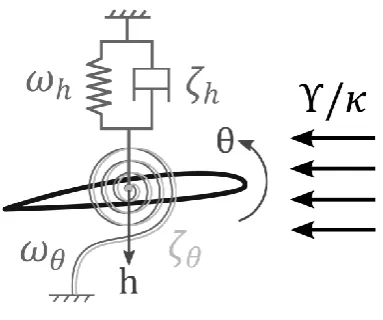
[image:6.595.130.480.539.600.2]As an initial test system we consider an aerofoil with two degrees of freedom (plunge
ℎ
and twist
𝜃
).
Figure 1 shows a schematic of such a system, with dimensionless parameters as per Table 1 and the
airspeed parameter
Υ
; the airspeed per semichord. A frequency domain analysis of this system, under
Theodorsen’s unsteady aerodynamic theory yields a problem of the form:
((G
0+ G
11𝜅+ G
2𝐶(𝜅)𝜅+ G
3𝐶(𝜅)𝜅2) 𝜒
2− D
0𝜒 − K
0) 𝐱 = 𝟎,
(20)
where
𝐱 = [ℎ; 𝜃]
,
𝜅 = Υ 𝜒
⁄
is the reduced frequency, and
𝐶(𝜅)
is Theodorsen’s function, composed
of a number of Bessel functions [4]. The matrix coefficients in Eq. 20 are:
G
0=
1𝜇[
2
−𝑎 − 𝑟
𝜃−𝑎 − 𝑟
𝜃 18+ 𝑎
2+ 𝑟
2] , G
1=
1 𝜇[
0
−1
0 −
12
+ 𝑎] , G
2=
𝜇𝜄[
1 + 2𝑎
−2
−1 + 2𝑎
1 2− 2𝑎
2
]
(21)
G
3=
1𝜇[0
0 1 + 2𝑎
−2
] , D
0= 2𝜄 [
𝜁
ℎ0
𝜔
ℎ𝑟
2𝜁
0
𝜃
𝜔
𝜃] , K
0= [
𝜔
ℎ20
0
𝑟
2𝜔
𝜃2
]
(22)
with parameters as per Table 1. See Pons and Gutschmidt [28] or Hodges and Pierce [4] for details.
Taking
𝐶(𝜅) = 1
corresponds to the assumption of quasisteady aerodynamics, and with a change of
variables produces a polynomial system:
where
Υ = 𝑈 𝑏
⁄
is the local airspeed per semichord. This polynomial system be linearized and solved
with the operator determinant method of Section 3.
[image:7.595.203.395.180.340.2]Figure 1.
Schematic of section model
Table 1: Parameter values for the section model
Parameter
Value
mass ratio –
𝜇
20
radius of gyration –
𝑟
0.4899
bending nat. freq. –
𝜔
ℎ0.5642 rad/s
torsional nat. freq. –
𝜔
𝜃1.4105 rad/s
bending damping –
𝜁
ℎ1.4105 %
torsional damping –
𝜁
𝜃2.3508 %
static imbalance –
𝑟
𝜃−0.1
pivot point location –
𝑎
−0.2
The results of this process are shown in Figure 2(a), which includes a contour plot of the system.
The flutter point is located at
𝜒 = 1.20 rad/s
and
Υ = 1.98 Hz
(
𝜅 = 0.606
). This agrees with
nondimensional analytical results by Hodges and Pierce [4]. We can, however, go further than an
analytical approach: we increase the matrix coefficient system size arbitrarily (and the polynomial
system order) and still obtain exact solutions. A direct solver for polynomial flutter problems of
arbitrary size and order has never before been presented.
We can also consider the case when
𝐶(𝜅)
is fully variable. The resulting MEP is nonlinear;
however a variety of approximations for Theodorsen’s function are available. We take a rational
function given by Jones [36]:
𝐶(𝜅) =
12𝜅2+𝑐1𝜅+𝑐2 [image:7.595.183.415.376.493.2]with
𝑐
1= −0.2808𝜄
,
𝑐
2= −0.01365
,
𝑐
3= −0.3455𝜄.
Manipulating Eq. 20 we then obtain a
polynomial problem of maximum order
𝜅
4𝜒
2, requiring a custom linearization of
10
blocks width.
This be solved via the operator determinant method in under 0.2s on a laptop computer. The results
are shown in Figure 2(b), also with a contour plot of the system. The fact that this solver is direct is a
significant advantage over existing solvers for systems of this form.
Figure 2.
Flutter point results for the section model with two aerodynamic models.
5.2.
Goland wing
As a benchmark test for our iterative algorithms, we analyse the well-known Goland Wing test
case – representing a cantilever Euler-Bernoulli beam and Saint-Venant torsion model, with strip
theory Theodorsen aerodynamics [37]. Originally a differential MEP (containing spatial derivatives as
well as eigenvalue parameters), it is transformed by the Generalised Laplace Transform Method
(GLTM) [35] into a nonlinear algebraic problem or fixed size (
12 × 12
). This transformation is
without discretisation error, though it comes at the cost of obscuring the internal structure of the
model – hence we treat the transformed problem as black-box nonlinear MEP. There is a small
variation in parameter values for the Goland wing and so we take parameter values from Pons and
Gutschmidt [35] and Wang [38]. For these parameters the Goland wing’s first flutter point is located
at airspeed
𝑈
𝐹= 138 m/s
and modal frequency
𝜒
𝐹= 69.9 rad/s
. The first divergence point (static
instability) is located nearby at
𝑈
𝐷= 253 m/s
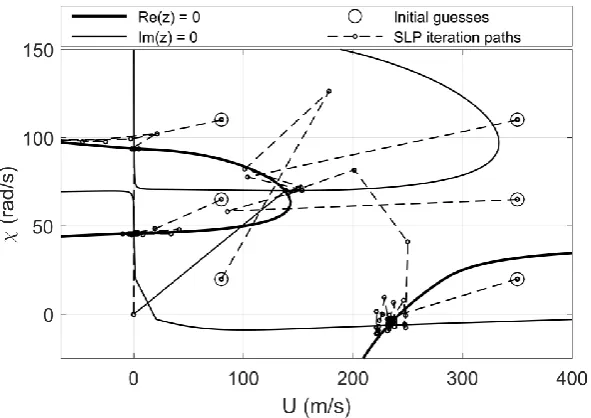
. Figure 3 shows example SLP iteration paths
[image:8.595.134.459.232.437.2]literature. Figure 4 shows the convergence basins of the SLP and ICP algorithms to the flutter point,
computed numerically. The SLP algorithm has the larger basin; though both are very satisfactory and
the ICP is more computationally efficient.. The SLP algorithm is likely to be attractive for smaller
systems with little a priori knowledge, whereas the ICP is effective for larger and more expensive
systems, for which an initial flutter point estimate from an approximate model be available.
Figure 3.