Optimal Territorial Resources Placement for
Multipurpose Wireless Services Using Genetic
Algorithms
Daniele Cacciani1, Fabio Garzia2, Alessandro Neri1, Roberto Cusani2
1Department of Applied Electronics Rome 3 University Rome, Italy; 2Department of Information, Electronics and
Telecommunica-tion Engineering SAPIENZA—University of Rome, Rome, Italy. Email: [email protected]
Received February 8th, 2011; Revised March 20th, 2011; Accepted April 5th, 2011.
ABSTRACT
This paper presents a study for finding a solution to the placement of territorial resources for multipurpose wireless services considering also the restrictions imposed by the orography of the territory itself. To solve this problem genetic algorithms are used to identify sites where to place the resources for the optimal coverage of a given area. The used algorithm has demonstrated to be able to find optimal solutions in a variety of considered situations.
Keywords: Genetic Algorithm, Wireless Optimization, Digital Terrain Elevation Data (Dted), Wireless Resources Placement
1. Introduction
In a lot of enforced contexts there is the need to place some resources to guarantee the best coverage of an as-signed region. It’s sufficient to consider the wide-spread use of means of communication that exploit the air as a transfer channel like television and cellular services or to consider the need to watch over a region where some sensors are used to guarantee the safety from different threats like the terrorism [1-3].
For this reason every day it is necessary to find new places to install systems of transmission and/or reception like antennas, base stations for cellular phones and sen-sors.
Actually this kind of operation is not automatic and it is made through the experience of people that place re-sources by analysing the map of the interested region. Naturally this process is approached by the iterative computation of the effective obtained coverage for any attempt.
The purpose of this paper is to describe a new tech-nique to automatize the initial phase of this process by elaborating an algorithm for the placement of resources on the ground to guarantee the best coverage of a given region. In this context the term “best” must be considered in a wider sense because it’s simplified by thinking about
work, to face real situations.
The problem is quite complex both from a theoretical (a closed analytical solution doesn’t exist and it’s neces-sary to proceed with subsequent approximations) and from a computational point of view (it’s necessary to reduce computation time to reasonable values) [6-38].
To solve the considered problem, different algorithms have been analysed. These algorithms, besides the prob-lem’s characteristics, have been evaluated by other typi-cal characteristics or by their own implementation. Be-cause of the problem’s complexity, it’s assumed that the algorithm works by subsequent iterations, reaching cycle after cycle the better solution, but not necessary the op-timal solution; this kind of behaviour, coherent for a planning algorithm, allows the final user to get early a solution and to be able to decide if and how long to wait for a better solution. The purpose of this paper is to find an algorithm characterized by a certain number of useful properties that are:
1) To provide quickly a solution: an algorithm that provides a solution from the first iterations is preferred to one that needs more iterations;
2) To provide iteration after iteration better solutions: the algorithm have to provide gradually better solutions increasing the number of iterations. The solution’s good-ness depends on the elaboration time too. If the solution isn’t satisfying, the algorithm must be able to continue with the research starting from the last found solution;
3) To reach the optimal solution: is the capability of the algorithm to reach the optimal final solution;
4) To provide the distance from the optimal solution: in the solution of practical problems, the knowledge of the distance from the optimal solution is maybe more important than the reaching of solution itself; in fact the knowledge of the distance between the actual solution and the optimal one allows to evaluate if and when it is opportune stopping the research for a better solution;
5) To reduce computational load: it’s important to find an algorithm that uses the minimum number of opera-tions to reduce resources and computational time.
This research leads to analyse different kinds of algo-rithms that have already been used to solve similar lems or that can be adapted to the solution of this prob-lem. For example algorithms of linear planning and evo-lutionary algorithms have been analyzed. Genetic Algo-rithms, that are evolutionary algorithm based on the con-cepts of Selection, Crossover [6-10] and Mutation [15], have demonstrated to be the best one.
This paper is structured as follows. In section 1 the model used for sensors and the study of the objective function is presented. In section 1 the coverage algorithm is presented. In section 3 the genetic algorithm used to solve the problem is described. In section 4 the fitness
function of genetic algorithm is formulated. In section 5 the computational complexity and convergence time is discussed. Section 6 presents the experimental results. Finally, section 7 discusses some conclusions and con-siders possible future developments.
2. Coverage Algorithm
To verify the goodness of a solution it is necessary to evaluate the coverage obtained by the placement of the resources of the solution itself so it has been necessary to create a linear algorithm that evaluates the coverage of a single resource.
The main idea is that the Genetic Algorithm places resources on the ground, cycle by cycle. For every placed resource a circular coverage area characterized by a ray R is considered. To evaluate the effective territorial cov-erage of every resource a covcov-erage algorithm that works using the point of placement of the resource itself and the related DTED data is used.
In Figure 1 a scheme of the working parameters of the mentioned algorithm is shown:
In the Figure 1 we have the following quantities: j = point where the resource is placed;
j + 1 = cell near the one where the resource is placed;
h(j + 1) = altitude in the cell j+1;
heq(j + 2) = equivalent altitude in the cell j + 2;
P = quantity to add to h(j+1) to obtain heq(j + 2);
h(j + 2) = altitude in the cell j + 2;
hvis = visibility altitude that is the altitude we consider
for the visibility of the cells.
Starting from the point where the resource is placed, for every cell of the grid that the considered resource potentially covers, the equivalent altitude is evaluated for the next cell using a linear equation derived from a sim-ple ratio between triangles:
j 1
j :h j
1
j2
j1 :
P
(1)
Solving Equation (1) with respect to P we have:
1 2 1
1 1
h j j j
P h
j j
j
(2)
From Figure 1, using Equation (2), we have:
2
1
2
eq
h j h j P h j1
(3)This quantity is used to verify if the cells next to the one we consider can be viewed to the visibility altitude.
The initial conditions of this algorithms are:
1) The visibility altitude is higher than the maximum of the altitude of the grid;
2) The terrestrial curvature doesn’t influence the eva- luation;
z
x hvis
P
heq(j + 2)
h(j + 1)
j
h(j + 2)
[image:3.595.308.536.84.293.2]j + 1 j + 2
Figure 1. Context of the coverage algorithm. characterized by a certain ray R without loss of generality since different shaped coverage diagrams with reduced increases of computation times can be also considered.
In this study we used two different resources charac-terized by a coverage ray R1 and R2 (R1 > R2) respectively;
this allows of simplifying the algorithm without any loss of generality.
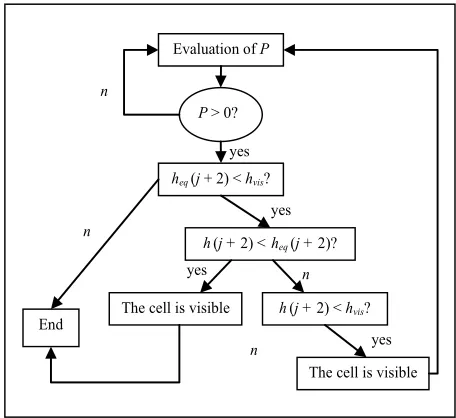
The evaluation of effective coverage is done following selected directions: the choice of these directions is ex-plained in the following. For every direction the flow chart representing the working principle of the algorithm is shown in Figure 2.
The steps that characterize the algorithm are:
1) We start evaluating the first P that is the one be-tween the cell in which the resource is placed and the next one. If P is smaller than zero it means that the cell next to the cell where the resource is placed has an alti-tude lower so it is visible at the visibility altialti-tude. It’s necessary to evaluate P while it is negative or at a dis-tance as long as the ray of the resource is covered. When a P greater than zero is found we evaluate the equivalent altitude and we go to the next step;
2) We compare the equivalent altitude with respect to the visibility altitude: if this quantity is smaller than the other we stop the evaluation along that ray and the evaluation goes on the next ray, otherwise we go to the next step;
3) We compare the equivalent altitude with respect to the altitude of the cell. If the equivalent altitude is greater than the altitude of the cell it is visible at the visibility altitude and the algorithm goes on with the next ray. If the visibility altitude is smaller we have to control that the altitude of the cell is smaller than the visibility alti-tude and if it’s true the value of P is changed with the current value and the cell is visible at the visibility alti-tude.
n yes
n n
yes
yes yes
n
Evaluation of P
P > 0?
heq (j + 2) < hvis?
h(j + 2) < heq (j + 2)?
End The cell is visible h(j + 2) < hvis?
[image:3.595.58.289.84.260.2]The cell is visible
Figure 2. Scheme of the coverage algorithm. These 3 steps are applied to the whole coverage area of the resource along the directions whose choice is ex-plained in the following sections. For this reason it’s necessary to insert a cycle in this evaluation so that it is applied to every ray derived from the angular step chosen. Moreover it’s necessary to cover the holes between two adjacent rays.
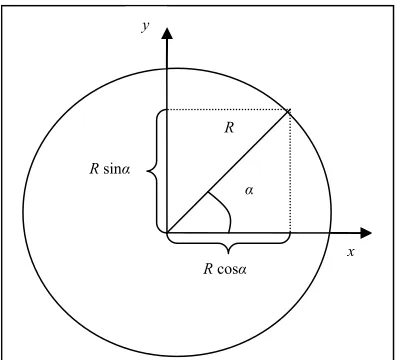
The Figure 3 represents the way we used to reduce the coverage of a resource characterized by a coverage ray R. The angle α is the angle formed by the ray along which we are evaluating the coverage and the x axis and it is equal to the angular step. In Figure 3 it is possible to see that the projection on the axis of the considered ray is proportional to the sine and cosine of the angular step.
The algorithm along a ray stops when the sum of the increments is greater than the projection of the point on the axis. The mentioned values are equal to R*cos α and
R*sin α, as shown in Figure 4.
x y
R sinα
R cosα α
[image:4.595.73.271.90.270.2]R
Figure 3. Scheme of resource’s coverage.
R sinα
R cosα
x y
dx = dR cosα α
R
[image:4.595.73.274.294.703.2]dy = dR sinα
Figure 4. Increments on the rays.
Ray 4
Ray 3
Ray 2
Ray 1 x y
Figure 5. Coverage of the holes.
3. Spatial Resources Allocation Genetic
Algorithm
Genetic algorithms are considered wide range numerical optimisation methods, which use the natural processes of evolution and genetic recombination. Thanks to their versatility, they can be used in different application fields [10-38].
The algorithms encode each parameters of the problem to be optimised into a proper sequence (where the alpha-bet used is generally binary) called a gene, and combine the different genes to constitute a chromosome. A proper set of chromosomes, called population, undergoes the Darwinian processes of natural selection, mating and mutation, creating new generations, until it reaches the final optimal solution under the selective pressure of the desired fitness function.
GA optimisers, therefore, operate according to the fol-lowing nine points:
1) Encoding the solution parameters as genes; 2) Creation of chromosomes as strings of genes; 3) Initialisation of a starting population;
4) Evaluation and assignment of fitness values to the individuals of the population;
5) Reproduction by means of fitness-weighted selec-tion of individuals belonging to the populaselec-tion;
6) Recombination to produce recombined members; 7) Mutation on the recombined members to produce the members of the next generation;
8) Evaluation and assignment of fitness values to the individuals of the next generation;
9) Convergence check.
The coding is a mapping from the parameter space to the chromosome space and it transforms the set of pa-rameters, which is generally composed by real numbers, in a string characterized by a finite length. The parameters are coded into genes of the chromosome that allow the GA to evolve independently of the parameters themselves and therefore of the solution space.
Once created the chromosomes it is necessary to choose the number of them which composes the initial population. This number strongly influences the effi-ciency of the algorithm in finding the optimal solution: a high number provides a better sampling of the solution space but slows the convergence.
Fitness function, or cost function, or object function provides a measure of the goodness of a given chromo-some and therefore the goodness of an individual within a population. Since the fitness function acts on the pa-rameters themselves, it is necessary to decode the genes composing a given chromosome to calculate the fitness function of a certain individual of the population.
selec-4. Sensor Models and Object Function
tion strategy which uses the fitness function to choose a certain number of good candidates. The individuals are assigned a space of a roulette wheel that is proportional to their fitness: the higher the fitness, the larger is the space assigned on the wheel and the higher is the prob-ability to be selected at every wheel tournament. The tournament process is repeated until a reproduced popu-lation of N individuals is formed.
4.1. Description of the Fitness Function
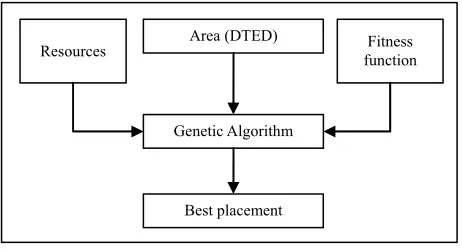
The solution’s scheme is shown in Figure 7.
The first step to do to solve the considered problem is to find a good coding for the sensors. In this paper sen-sors are modelled by four parameters: two for the posi-tion (coordinates X and Y); one for the length of the ray
R of circular coverage diagram to consider two kind of different sensors; one parameter that tells us if that sensor is effectively active on the solution grid. Naturally a lot of parameters can be added to describe a sensor but this is not in the scope of the present paper that is to find a first level solution to the placement of territorial TLC resources for multipurpose services.
The recombination process selects at random two in-dividuals of the reproduced population, called parents, crossing them to generate two new individuals called children. The simplest technique is represented by the single-point crossover, where, if the crossover probabil-ity overcome a fixed threshold, a random location in the parent’s chromosome is selected and the portion of the chromosome preceding the selected point is copied from parent A to child A, and from parent B to child B, while the portion of chromosome of parent A following the random selected point is placed in the corresponding positions in child B, and vice versa for the remaining portion of parent B chromosome.
It’s necessary to find an objective-function that evalu-ates a solution’s goodness by the sensor’s model. In this case two terms are selected, the first relative to the per-centage of coverage of the assigned region and the sec-ond relative to the cost of the resources necessary to ob-tain that coverage. Qualitatively this function has the form: Fitness = f (coverage, resources’ cost).
If the crossover probability is below a fixed threshold, the whole chromosome of parent A is copied into child A, and the same happens for parent B and child B. The crossover is useful to rearrange genes to produce better combinations of them and therefore more fit individuals. The recombination process has shown to be very impor-tant and it has been found that it should be applied with a probability varying between 0.6 and 0.8 to obtain the best results.
In general it’s necessary to remind that resources could be of different kind; they can be different from each oth-er by their poth-erformances and/or their covoth-erage area (volume), so they can be modelled with different cover-age rays.
In the hypothesis of minimizing the objective function, it’s necessary take care not of the coverage percentage but of its complement, that is to say the uncovered per-centage of the solution grid. After these considerations, in the hypothesis of considering two kind of resources characterized by different coverage areas, the objective function is:
The mutation is used to survey parts of the solution space that are not represented by the current population. If the mutation probability overcomes a fixed threshold, an element in the string composing the chromosome is chosen at random and it is changed from 1 to 0 or vice versa, depending of its initial value. To obtain good re-sults, it has been shown that mutations must occur with a low probability varying between 0.01 and 0.1. The op-erative scheme of a GA iteration is shown in Figure 6.
1 1 2 21
tot
F n c n c
A
(4)
where:
Atot = grid’s total area
Δ is the covered area after the resources’ positioning The converge check can use different criteria such as
the absence of further improvements, the reaching of the desired goal or the reaching of a fixed maximum number of generations.
n1 and n2 are respectively the number of the active
resources with coverage ray R1 and the number of
[image:5.595.104.489.609.704.2]ac-tive resources with coverage ray R2.
Resources Area (DTED)
Genetic Algorithm
Fitness function
[image:6.595.57.288.86.212.2]Best placement
Figure 7. Solution’s scheme.
c1 and c2 are factors associated to the resources that
represent their cost.
α and β are coefficients that allow to weigh properly the objective-function’s terms. Their evaluation is il-lustrated in the following.
In this case α and β are estimated by giving the condi-tion that a resource should be added in the grid if it gives a contribution to the coverage at least equal to a percent-age δ of its own coverage capability.
These coefficients can be estimated by solving the sys-tem below:
11 22
12 11 2 2
, , , 1, (5a)
, , , , 1 (5b)
sensor sensor
F n n F A n n
F n n F A n n
These equations give the equality between the objec-tive-function’s value and the value of itself calculated by adding a new resource that gives a contribute to the total coverage percentage with a δ percentage of its own cov-erage capability. By this way it is possible to estimate the values of α and β that allow to eliminate resources which work under the minimum percentage. So it’s possible to reach the system below:
1
1 1 2 2 1 1 2 2
1
1 1 2 2 1 1 2 2
1 1 1
1 1 1 (6b)
sensor
tot tot
sensor
tot tot
A
n c n c n c n c
A A
A
n c n c n c n c
A A (6a)
Solving this system it’s possible to obtain:
1
1 1 1 2 2 1 1 2 2
1
1 1 2 2 2 1 1 2 2
(7a)
(7b)
sensor
tot tot tot
sensor
tot tot tot
A
n c c n c n c n c
A A A
A
n c n c c n c n c
A A A
1 1 1 1 1 1 2 2 2 2 (8a) (8b) sensor sensor tot tot sensor sensor sensor tot
A c A
A c A
A c A
c c A
A
From these last equations it is possible to draw two important considerations. The first one is that the values of α and β aren’t bounded to a specific number so it’s possible to choose arbitrary values to be assigned to one of them and obtain the value of the other one by Equation (8a). The second consideration comes from the analysis of Equation (8b) where it’s possible to see how the re-source’s cost is directly proportional to the coverage area of the resource itself. To calculate effective values of these parameters it’s necessary to express the objec-tive-function with other parameters.
Dividing all the terms of Equation (8b) by the total area we obtain:
2
1 π 1 tot 1
c R A N
2
2 π 2 tot 1
c R A N2 (9b) where N1 and N2 are respectively the maximum number
of resources with ray R1 and the maximum number of
resources with ray R2. Replacing these values in
Equa-tion (8a) and (8b) we obtain:
2 1 2 1 π π tot tot A R A R
(10)
As it can be seen, the value of β depends on the mini-mum percentage δ that the resources must have to remain placed in the grid. Considering a real working percentage of the order of 40%, we obtain δ = 0.4. Replacing this value in the previous equation we have:
At this point it is necessary to calculate the value of α
to find the final values of these parameters. The objec-tive-function’s values must be included in a range [0, 1], where 1 represents the worst case and 0 the best case in which the 100% of coverage and the minimum use of resources is reached. Considering the condition for the worst case, it’s possible to estimate the value of α. In fact, in the worst case, no resource is placed on the grid so the coverage percentage is 0. Replacing these values in the objective-function we obtain:
1 2
0
1 0 0 1
tot
c c
A
1
13a (12)
Finally the values of α and β are:
1 (
0.4 (13b)
)
Replacing these values in Equation (4) we obtain:
1 2
1 2
1
1 0.4 0.4
tot
F n n 1
A N N
(14)
Analysing this function it’s possible to draw the con-siderations below:
if no resources are placed on the grid (n1 = 0 and n2 =
0), the value of equation (14) is equal to 1.
if the coverage area is 100% it’s difficult to establish which is the fitness value. In this case the first term is equal to 0 while the sum of the other two has a value that is impossible to know a priori. If we consider that using all the resources the fitness value is equal to 0.8, it’s simple to understand that in the case of total cov-erage the fitness value is lesser than this number.
how it can be seen, the resources used to cover the grid are weighed with the inverse of their maximum number so directly with the square of their own cov-erage ray: a resource with longer covcov-erage ray weights in a more negative way on the fitness value with respect to a resource with shorter coverage ray. This function allows the algorithm to eliminate re-sources which have been placed on the grid but that be-cause of superimpositions or bebe-cause of presence of ob-stacles can’t give a contribute to the coverage that is at least equal to the 40% of their own coverage capability and the single terms weight on the final fitness value is now calculated. Starting from the first element, it’s pos-sible to estimate how much an increase of the coverage percentage of 1% weighs on the fitness value. To esti-mate it, it’s necessary to calculate the difference between the first term with no coverage and the first term with 1% of coverage:
100 1
1 1 1
100
tot tot tot
A A
A
0.01 (15)
An increase of one point of percentage reflects on the fitness value with a decrease equal to 0.01.
To estimate the weight of the other two terms it’s suf-ficient consider only one kind of resource. One resource with coverage ray R1 weighs on the fitness value with a
value W1 equal to:
2 1 1
π
tot
R W
A
(16)
so its contribution, as just said, depends on its ray. Similarly for a resource with coverage ray R2 is:
2 2 2
π
tot
R W
A
(17)
Comparing Equation (16) and Equation (17) it is pos-sible to see that adding one resource with coverage ray R1
weighs more than adding a resource with coverage ray
R2.
4.2. Places Choice
To complete this work is possible to consider the sites that can be utilized to place the resources. By an a-priori analysis of the grid it is possible to find those sites that are non-reachable or that are occupied by other resources previously placed. After doing this analysis, a matrix is generated. The matrix is as big as the grid to cover. The sites that can’t be used are marked with a logical 0. If a resource is placed on a 0, the related solution is deleted by a penalization of its fitness value.
5. Performances and Results
5.1. Evaluation Time
re-source is:
2π
radialstep angular step
op
N
R (18)
It is possible to see that the number of unit-operations depends directly on the ray and inversely on the radial step (the step on which we move along a radial direction) and on the angular step (angular distance between two subsequent radials). In this case we used a radial step equal to 1 for the coverage’s estimation.
Now it is necessary to insert this calculus in the con-text of the genetic algorithm in which every coverage’s calculus of a resource is applied to every active resource for every chromosome of every generation. Starting with considering active resources in a chromosome, we have the number of unit-operations for every chromosome (Nopch):
1 1 2
2π 2π
gular step angular step
opch
N n R n
an R2 (19)
where n1 and n2 are respectively the number of active
resources with coverage ray R1 and active resources with
coverage ray R2 in a single chromosome. To obtain the
number of unit-operation in a generation (Nopgen) it’s
necessary to sum this quantity for every chromosome in a generation:
total number of chromosomes 1 1 1 2 2 2π angular step 2π angular step j j opgen j N n n R
R (20)wheren1ij and n2ij are respectively the number of active resources with coverage ray R1 and the number of active
resources with coverage ray R2 in the chromosome j.
Now, to obtain the total number of unit-operations in a cycle (Nopc), it’s necessary to execute the sum on every
generation:
total number of chromosomes generations 1 1 1 2 2 2π angular step 2π angular step ij ij opc i j N n n R
1 R (21)where n1ij and n2ij are respectively the number of active resources with coverage ray R1 and the number of active
resources with coverage ray R2 in the j chromosome and
in the i generation.
How we can see, the number of operations that it’s necessary to do is directly proportional to the ray of the
resource and inversely proportional to the chosen angular step. Naturally this number depends on the number of chromosomes and generations. If we want to reduce the calculus time we have to reduce the generations’ number, the chromosomes’ number, the resource’s ray or we have to increase the radial or angular step. Each operation makes the algorithm faster but has a negative effect on the final solution so it’s necessary to find the right com-promise between computation time and solution’s good-ness.
Now we analyse the curve that represents the time trend as a function of the grid to explore.
We consider a starting grid of n*n in which are placed resources with area A1 and A2. The initial number of the
resources is given by: 2 1
N n A1 (22a) 2
2
N n A2 (22b) If we increase the grid side we can have two different cases: in the first case the ratio between total area and resource area remains equal while in the second one the resources area remain equal.
For the first case we want to double the side grid ob-taining a 2n * 2n grid. The total area of the grid is 4n2.
If we increase not only the side grid but also the sources areas, keeping constant the number of initial re-sources, we obtain:
2
1 4
N n A1 (23) where N1 is the number of resources with area
1
A.
This quantity must be equal to equation (22a) and Equation (22b) because we supposed that the ratio be-tween resource area and total area is equal, keeping un-changed the number of initial resources, so it must be
1 4 1
A A. Similarly, for the other resource, it’s
2 4 2
A A .
With this argument it’s simple to understand that re-sources areas are multiplied by four as the number evalu-ated cells and the number of unit-operations. Analysing the second case, the resources areas are constant while the grid side is multiplied for a factor two. In this situa-tion the number of initial resources increases according to the equations:
2
1 4 1 4
N n A N
1 (24a)
2
2 4 2 4
N n A N2 (24b) where N1 is the number of initial resources in the grid
with side 2n. How we can see in this case, the number of initial resources is multiplied by four increasing in the same way the number of unit-operations.
four. The same is valid for every factor we multiplied the grid side: the number of unit-operations, and therefore the computational time, is multiplied by the square of that factor according to the equation below:
22 2 1
T L L T1 (25) where T1 is the time spent for evaluating the starting grid, L1 is the starting grid side, L2 is the new grid side and T2
is the time spent to evaluate the new grid.
Evaluation time increases in quadratic way with respect to the expansion grid side factor and is characterized by the trend shown in Figure 8.
In this graphic two points are signed: the first is the point that represents the grid configuration we used in the simulations and we use it as a point of reference. The second point is that one that represents a situation closer to reality in which the expansion grid side factor is 80. In this last case the computation time is equal about to 9 hours, as it is possible to see in the graphic.
5.2. Convergence of Solutions
Solution convergence is different depending on the pa-rameters’ configuration that is used. In Figure 9 fitness graphics as a function of generation number for different cases we studied (Table 1) are shown.
It is possible to see that trends are very different from each other: some of them converge very early while other configurations don’t converge in the first 100 generations. It’s possible to affirm that every configuration reach the same final result but some of them reach it faster than others so these configurations are the best because they allow us to decrease evaluation time. For this study we considered 500 generations but for some configurations it is possible to decrease the number of generations up to 250 halving evaluation time, so this figure considers only the first 250 generations.
An example of solution is shown in Figure 10.
6. Numerical Results
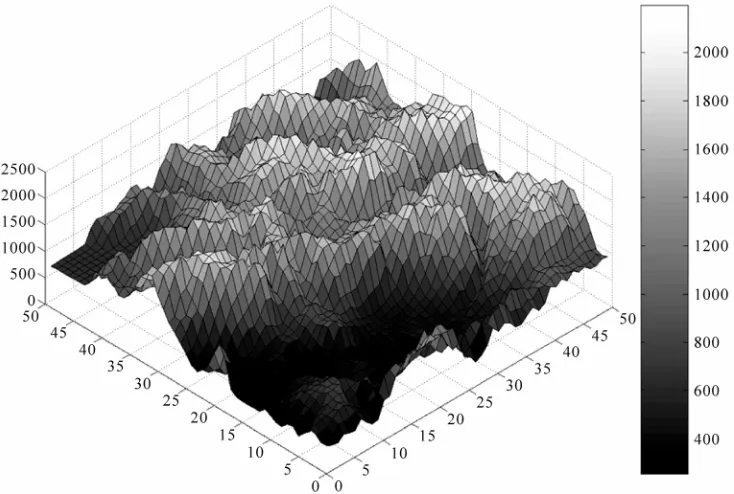
In Table I the mean values of all the studied situations are reported so it is possible make a comparison between each other. The first 10 situations are evaluated without obstacles on the grid to test and verify the goodness of the genetic algorithm. The situations from 11 to 20 are evaluated considering the example DTED data shown in Figure 11. A 50 km * 50 km territory is considered; each cell is 1 km * 1 km and the angular step for coverage verification is 30˚.
[image:9.595.310.534.86.258.2]In the first part of the table the values extracted at the generation number 250 are reported while in the second part the values extracted at the end of the genetic cycle are reported.
[image:9.595.310.535.311.478.2]Figure 8. Trend of the evaluation time according to the grid’s expansion factor using a 2800 MHz PC, Intel CPU Pentium IV.
Figure 9. First 250 generations of the most interesting cases.
Figure 10. Example of solution: coverage of a [50 km * 50 km] grid with a 30˚ angular step using R1 = 10 km and R2 =
km, case 18 of table 1, grid step = 1 km. 4
[image:9.595.312.532.505.679.2]Figure 11. 3D-DTED level 0 used for simulations.
Table 1. Numerical results of different cases. How we can see from this table, every configuration is
characterized by similar performances about the final coverage percentage and the final fitness value in the two parts of the table. The difference between them is repre-sented by the number of generations necessary to reach the final solution: in some cases the configurations use a low number of generations so they reach the final solu-tion in a shorter time with respect to other configurasolu-tions.
Case Final
Gen. Final Fitness
Final
coverage (%) # R1 10 Km # R2 4 Km
1 398 0.305 89.49 6.05 10.65
2 396 0.302 90.61 6.15 10.95
3 436 0.303 90.10 5.95 11.65
4 482 0.303 90.49 6 11.85
5 493 0.302 89.64 5.6 13.25
6 494 0.300 90.66 5.85 12.45
7 481 0.301 89.62 5.65 12.8
8 395 0.313 88.99 6.7 6.25
9 489 0.306 90.38 6.95 5.9
10 446 0.307 92.91 7.4 5.65
11 475 0.384 79.45 6.8 10.8
12 423 0.388 80.53 6.8 12.55
13 489 0.369 81.34 5.3 22.2
14 497 0.360 80.50 3.4 30.55
15 385 0.397 77.77 6.95 10.55
16 347 0.394 78.88 6.5 17.7
17 408 0.390 79.69 6.95 11.25
18 406 0.389 79.30 6.75 11.8
19 405 0.444 77.57 7.1 8.6
20 402 0.414 78.10 8.64 2.6
7. Conclusions
At the end of this work some considerations are possible. The first is that the genetic algorithm shown its strength of application in the resolution of complex problems such as the one we considered. It can solve real problems because it can consider all their practical characteristics (DTED, resources with different coverage ray R, etc.).
The algorithm has shown to be extremely flexible and it can be used to solve other complex problems.
This work shows that an efficient automation of the process of territorial resources placement is possible.
[image:10.595.61.285.378.718.2]In this work different implementations of the algo-rithm have been studied to try to improve its perform-ances. The main implementations were directed to insert an a-priori knowledge: the reduction of the number of resources with coverage ray R2 and the insertion of a
non-random initial population has shown a significant importance in the improvement of the results. Not all the simulations gave optimal solutions (such as the different kind of crossover and mutation that were implemented ad-hoc).
For future work and above all for future study of this problem, it’s possible to extend this work in a wider re-gion using more efficient techniques to reduce the evalu-ation time such as the memorizevalu-ation of the visibility of the cells.
REFERENCES
[1] S. S. Dhillon, K. Chakrabarty and S. S. Iyengar, “Sensor Placement for Grid Coverage under Imprecise Detec-tions,” Proceedings of the Fifth International Conference on Information Fusion, Vol. 2, 8-11 July 2002, pp. 1581- 1587.
[2] K. Chakrabarty, S. S. Iyengar, H. Qi and E. Cho, “Grid Coverage for Surveillance and Target Location in Dis-tribuited Sensor Networks,” IEEE Transactions on Com-puters, Vol. 51, No. 12, 2002, pp. 1448-1453.
doi:10.1109/TC.2002.1146711
[3] S. Liu, Y. Tian and J. Liu, “Multi Mobile Robot Path Planning Based on Genetic Algorithm,” Proceedings of the Fifth World Congress on Intelligent Control and Automation, Vol. 5, 15-19 June 2004, pp. 4706-4709. [4] F. Garzia and R. Cusani, “Optimization of Cellular Base
Stations Placement in Territory with Urban and Environ-mental Restrictions by Means of Genetic Algorithms,” Proceedings of Environment and Technological Innova-tion Energy, Rio de Janeiro, 2004.
[5] F. Garzia, C. Perna and R. Cusani, “UMTS Network Planning Using Genetic Algorithms,” International Jour-nal of Communications and Network, Vol. 2, No. 3, 2010, pp. 193-199.
[6] H. Maini, K. Mehrotra, C. Mohan and S. Ranka, “Knowledge-Based Non-Uniform Crossover,” Proceed-ings of the First IEEE Conference on Evolutionary Com-putation, IEEE World Congress on Computational Intel-ligence, Orlando, 27-29 June 1994, pp. 22-27.
doi:10.1109/ICEC.1994.350048
[7] E. Falkenauer, “The Worth of the Uniform,” Proceedings of Congress on Evolutionary Computation, Vol. 1, 6-9 July 1999, pp. 138-146.
[8] L. J. Zhang, Z. H. Mao and Y. D. Li, “Mathematical Analysis of Crossover Operator in Genetic Algorithms and Its Improved Strategy,” Proceedings of IEEE Inter-national Conference on Evolutionary Computation, Perth, Vol. 1, 29 November-1 December, 1995, pp. 412-222.
doi:10.1109/ICEC.1995.489183
[9] Y. Shang and G. J. Li, “New Crossover Operators in Ge-netic,” Proceedings of the Third International Conference on Tools for Artificial Intelligence, 10-13 November 1991, pp. 150-153.doi:10.1109/ICEC.1995.489183
[10] J. Lu, B. Feng and B. Li, “Finding the Optimal Gene Or-der for Genetic Algorithm,” Proceedings of the 5th World Congress on Intelligent Control and Automation, Vol. 3, 15-19 June 2004, pp. 2073-2076.
doi:10.1109/WCICA.2004.1341949
[11] G. Bilchev, H. S. Olafsson and L. Comparino, “Genetic Algorithms and Greedy Heuristics for Adaptation Prob-lems,” Proceedings of IEEE International Conference on Evolutionary Computation, IEEE World Congress on Computational Intelligence, 4-9 May 1998, pp. 458-463. [12] J. A. Vasconcelos, J. A. Ramirez, R. H. C. Takahashi and
R. R. Saldanha, “Improvements in Genetic Algorithms,” IEEE Transactions on Magnetics, Vol. 37, No. 5, 2001, pp. 3414-3417.doi:10.1109/20.952626
[13] K. Y. Chan, M. E. Aydin and T. C. Fogarty, “An Epista-sis Measure Based on the Variance for the Real-Coded Representation in Genetic Algorithms,” Proceedings of Congress on Evolutionary Computation, Vol. 1, 8-12 December 2003, pp. 297-304.
[14] M. O. Odetayo, “Empirical Study of the Interdependen-cies of Genetic Algorithms Parameters,” Proceedings of the 23rd EUROMICRO Conference, “New Frontiers of Information Technology,” Budapest, 1-4 September 1997, pp. 639-643.
[15] J. Cheng, W. Chen, L. Chen and Y. Ma, “The Improve-ment of Genetic Algorithm Searching Performance,” Proceedings of International Conference on Machine Learning and Cybernetics, Vol. 2, 4-5 November 2002, pp. 947-951.
[16] Z. Wang, D. Cui, D. Huang and H. Zhou, “A Self-Adaptation Genetic Algorithm Based on Knowledge and Its Application,” Proceedings of 5th World Congress on Intelligent Control and Automation, 2002, Vol. 3, 15-19 June 2004, pp. 2082-2085.
doi:10.1109/WCICA.2004.1341951
[17] H. Shimodaira, “A New Genetic Algorithm Using Large Mutation Rates and Population-Elitist Selection (GAL ME),” Proceedings of the 8th IEEE International Con-ference on Tools with Artificial Intelligence, 16-19 No-vember 1996, pp. 25-32.
[18] S. Ghoshray and K. K. Yen, “More Efficient Genetic Algorithm For Solving Optimization Problems,” Pro-ceedings of IEEE Interantional Conference on Systems, Man and Cybernetics, “Intelligent System for the 21st Century,” Vol. 5, 22-25 October 1995, pp. 4515-4520. [19] M. R. Akbarzadeh and T. M. Jamshidi, “Incorporating
A-Priori Expert Knowledge in Genetic Algorithms,” Pro-ceedings of IEEE International Symposium on Computa-tional Intelligence in Robotics and Automation, 10-11 July1997, pp. 300-305.
Conference on Genetic Algorithms in Engineering Sys-tems: Innovations and Applications, 2-4 September 1997, pp. 270-277.
[21] D. E. Goldberg, “Genetic Algorithms in Search, Optimi-zation and Machine Learning,” Addison-Wesley, Boston, 1989.
[22] L. Nagi and L. Farkas, “Indoor Base Station Location Optimization Using Genetic Algorithms,” Proceedings of IEEE International Symposium on Personal, Indoor and Mobile Communications, London, Vol. 2, 2000, pp. 843-846.
[23] B. Di Chiara, R. Sorrentino, M. Strappini and L. Tarri-cone, “Genetic Optimization of Radio Base-Station Size and Location Using a GIS-Based Frame Work: Experi-mental Validation,” Proceedings of IEEE International Symposium of Antennas and Propagation Society, Vol. 2, 2003, pp. 863-866.
[24] J. K. Han, B. S. Park, Y. S. Choi and H. K. Park, “Ge-netic Approach with New Representation for Base Station Placement in Mobile Communications,” Proceedings of IEEE Vehicular Technology Conference, Atlantic City, Vol. 4, 2001, pp. 2703-2707.
[25] R. Danesfahani, F. Razzazi and M. R. Shahbazi, “An Active Contour Based Algorithm for Cell Planning,” Proceedings of IEEE International Conference on Com-munications Technology and Applications, 2009, pp. 122-126. doi:10.1109/ICCOMTA.2009.5349224
[26] R. S. Rambally and A. Maharajh, “Cell Planning Using Genetic Algorithm and Tabu Search,” Proceedings of ternational Conference on the Application of Digital In-formation and Web Technologies, Beijing, 16-18 October 2009, pp. 640-645.
[27] K. Lieska, E. Laitinen and J. Lahteenmaki, “Radio Cov-erage Optimization with Genetic Algorithms,” Proceed-ings of IEEE International Symposium on Personal, In-door and Mobile Radio Communications, Boston, Vol. 1, 8-11 September 1998, pp. 318-322.
[28] A. Esposito, L. Tarricone and M. Zappatore, “Software Agents: Introduction and Application to Optimum 3G Network Planning,” IEEE Antennas and Propagation Magazine, Vol. 51, No. 4, 2009, pp. 147-155.
doi:10.1109/ICCOMTA.2009.5349224
[29] L. Shaobo, P. Weijie, Y. Guanci and C. Linna, “Optimi-zation of 3G Wireless Network Using Genetic Program-ming,” Proceedings of International Symposium on Com-putational Intelligence and Design, Changsha, Vol. 2, 12-14 December 2009, pp. 131-134.
[30] C. Maple, G. Liang and J. Zhang, “Parallel Genetic Algo-rithms for Third Generation Mobile Network Planning,” Proceedings of International Conference on Parallel Computing in Electrical Engineering, 7-10 September 2004, pp. 229-236.
doi:10.1109/ICCOMTA.2009.5349224
[31] I. Laki, L. Farkas and L. Nagy, “Cell Planning in Mobile Communication Systems Using SGA Optimization,” Proceedings of International Conference on Trends in Communications, Bratislava, Vol. 1, 4-7 July 2001, pp. 124-127.
[32] D. B. Webb, “Base Station Design for Sector Coverage Using a Genetic Algorithm with Method of Moments,” Proceedings of IEEE International Symposium of Anten-nas and Propagation Society, Vol. 4, 20-25 July 2004, pp. 4396-4399.
[33] A. Molina, A. R. Nix and G. E. Athanasiadou, “Opti-mised Base-Station Location Algorithm for Next Genera-tion Microcellular Networks,” Electronics Letters, Vol. 36, No. 7, 2000, pp. 668-669.
doi:10.1049/el:20000515
[34] G. Cerri, R. De Leo, D. Micheli and P. Russo, “Base-Station Network Planning Including Environ-mental Impact Control,” IEEE Proceedings on Commu-nications, Vol. 151, No. 3, 2004, pp. 197-203.
doi:10.1049/ip-com:20040146
[35] A. Molina, G. E. Athanasiadou and A. R. Nix, “The Automatic Location of Base-Stations for Optimized Cel-lular Coverage: A New Combinatorial Approach,” IEEE International Conference on Vehicular Technology, Houston, Vol. 1, July 1999, pp. 606-610.
[36] N. Weaicker, G. Szabo, K. Weicker and P. Widmayer, “Evolutionary Multi-Objective Optimization for Base Station Transmitter Placement with Frequency Assign-ment,” IEEE Transactions on Evolutionary Computations, Vol. 7, No. 2, 2003, pp. 189-203.
doi:10.1109/TEVC.2003.810760
[37] G. Fangqing, L. Hailin and L. Ming, “Evolutionary Algo-rithm for the Radio Planning and Coverage Optimization of 3G Cellular Networks,” International Conference on Computational Intelligence and Security, Beijing, Vol. 2, 11-14 December 2009, pp. 109-113.