doi:10.4236/wsn.2011.32008 Published Online February 2011 (http://www.SciRP.org/journal/wsn)
Compressing Information of Target Tracking in Wireless
Sensor Networks
Jianzhong Li, Qianqian Ren
Department of Computer Science and Technology, Harbin Institute of Technology, Harbin, China E-mail: {lijzh, qqren}@hit.edu.cn
Received January 21, 2011; February 15, 2011; February 22, 2011
Abstract
Target tracking is a well studied topic in wireless sensor networks. It is a procedure that nodes in the network collaborate in detecting targets and transmitting their information to the base-station continuously, which leads to data implosion and redundancy. To reduce traffic load of the network, a data compressing based target tracking protocol is proposed in this work. It first incorporates a clustering based data gather method to group sensor nodes into clusters. Then a novel threshold technique with bounded error is proposed to exploit the spatial correlation of sensed data and compress the data in the same cluster. Finally, the compact data presentations are transmitted to the base-station for targets localization. We evaluate our approach with a comprehensive set of simulations. It can be concluded that the proposed method yields excellent perfor-mance in energy savings and tracking quality.
Keywords:Wireless Sensor Networks, Target tracking, Compressing
1. Introduction
Target tracking is an important problem of wireless sen-sor networks (WSNs). It has been applied in various areas such as disaster predication, emergency response, battle-field surveillance, home and office control, etc. Many target tracking protocols have been proposed to support long-term surveillance by using large scale WSNs [1-5].
In the applications of target tracking with WSNs, the users are often interested in observing where the target is at each time interval and figuring its trajectory. In such cases, continuous information reporting of the target is required. In continuous surveillance, sensor nodes in the network collaborate in detecting the target, measuring the signal the target emitting and transmitting measure-ments to the base-station for further processing. However, the limits of WSNs including limited bandwidth, pro- cessing capabilities and energy supply challenge the re-search of target tracking.
To minimize the volume of information transmission, we can process the information of targets in a distributed way in the network and transmit localization results to the base-station. In-network localization is an effective idea to reduce the volume of transmitted data, but is ra-ther infeasible for multiple targets tracking that need high complexity computation, such as Kalman filter,
Particle filter and Bayesian transforms in targets decom-position. The limited computation capacity of sensor nodes may not be sufficient to perform complex opera-tions at nodes.
Considering the scenarios of target tracking, sensor nodes generate sensed data of targets by measuring the signal they emit. Most physical signals decay with dis-tance, thus readings of the sensor nodes have similar pattern if their distances to a target are approximately same. In other words, sensed data for targets usually ex-hibits a large degree of redundancy. Approximation is an efficient mean of data reduction, in which sensed data with similar patterns is replaced by an approximate value, and only the approximate values are transmitted to the base-station. Approximation can reduce the amount of sensed data that need to be transmitted with allowable accuracy scarifying.
readings for the same target maximally by grouping the original data and approximating them falls within the error bound around estimated values. The proposed ap-proach can release the traffic load and reduce energy consumption for data transmission efficiently. However, this often comes at the price of loss in tracking quality, which is equivalent to a loss in data precision and locali-zation accuracy. We analyze the error of tracking results and discuss the determinations of parameters in the paper. In addition, the proposed compressing provides a low overhead, which makes it practical for overhead sensitive applications with WSNs.
The contributions of this paper are as follows:
We introduce a new approximation scheme that makes full use of correlations among data of mul-tiple sensor nodes. It exploits the spatial correlation of targets information to implement data reduction.
We incorporate the idea of data reduction into tar-get tracking, which shrinks the volume of trans-mitted data efficiently with guarantee of tracking quality. It is an efficient solution for prolonged network lifetime.
We explore the trade-off between energy savings and tracking quality. We aim to design a tracking system in an energy-efficient manner at the price of allowable accuracy sacrificing.
We provide an extensive experiments and analysis of our framework using a simulated sensor network. Experimental results show that our approach achie- ves well performance in terms of tracking quality and energy conservation.
The remainder of this paper is organized as follows. Related work is shown in Section 2. We give the network model in Section 3. A data compressing based tracking protocol is detailed in Section 4. We analyze the perfor-mance of proposed technique in Section 5. Section 6 presents detailed simulations. Finally, we conclude this paper in Section 7.
2. Related Work
In recent years, many research works have been provided in the area of target tracking using WSNs. The important issues studied mainly include energy efficient tracking and accurate tracking.
The authors in [6-9] adopt binary sensor model to track targets. The output of each binary sensor is only one bit (0 or 1). The binary sensor nodes based tracking can conserve the energy for data transmissions efficiently. However, this kind of nodes does not have the capacity of calculation, and any loss of packets may affect the tracking accuracy evidently. Some works address the problem of energy efficiency by reducing the number of
nodes participating in working. In [10], a distributed tracking algorithm using dynamic conveying tree struc-ture is presented, which optimizes the problem of target tracking by building a convoy tree sequence with high tree coverage and low energy consumption. The work of [11] proposes an information-driven tracking approach by deciding the collaboration of sensor nodes consider-ing the constraints of information and resource consump-tion.
The authors in [2] propose a minimal contour-tracking model to minimize the number of nodes involved in tracking. It searches for the minimal tracking area based on the vehicular kinematics to minimize working nodes. In [12], the problem of tracking mobile nodes is ad-dressed by measuring the Doppler shifts of the transmit-ted signal. Moreover, the extended Kalman filter is adopted to remove the effects of the measurement errors in sensor networks with uncertainty. The distributed al-gorithms for in-network tracking and range queries are proposed in [13], they use differential one-form in the application of target tracking to search for a given identi-fiable target with low time complexity. The proposed approaches are also flexible to network changes and node mobility.
The above tracking techniques focus on reducing transmission amounts or the number of nodes participat-ing in work.
To further reduce energy consumption in the long- term surveillance, nodes scheduling is applied in moving target tracking systems [4,14,15]. A real-time target tracking system with WSNs is designed in [3,4], which adopts an energy management scheme to make sensor nodes rotate in active and sleep state to conserve energy of the network. Moreover, some scheduling and wake-up topics are analyzed. In [14], an optimal node sleep sche-duling protocol for rare-event detection is proposed. A deterministically rotating sensory coverage with con-strains of detection delay is developed. The authors of [15] study the problem of network deployment and de-sign an efficient scheduling protocol. It wakes up and shuts down sensor nodes with certain spatial and tem-poral preciseness.
tracking quality guarantee. We seek to exploit the re-dundancy of tracking information, compress the sensed data, and transmit the compressed data to the based-station. Our method not only reduces data transmission to the base-station, but also implements localization in com-pressed data structure directly.
3. Network Model
This section describes the network model used in this paper. To simplify the presentation, we give the network model based on following assumptions.
A monitored area is covered by a large number of homogeneous sensor nodes with redundant density. Each node gets its own location via GPS or a cer-tain localization technique.
All sensor nodes in the monitoring area have the same sensing range, denoted as R. The sensing area of each sensor node is a disk centered at the node with radius R.
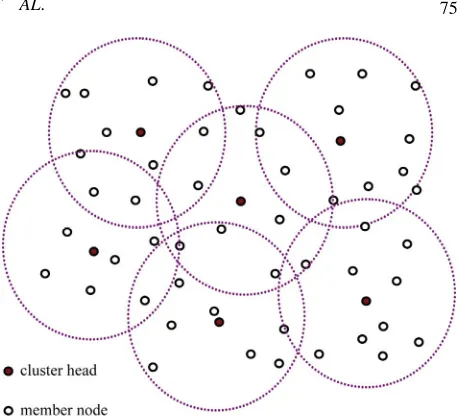
[image:3.595.309.539.60.269.2] Nodes in the network are organized as an adaptive clustering hierarchy [16]. Under the clustering based routing protocol, sensed data is routed to the destination.
Figure 1 gives an example of the network model. There are one cluster head node and multiple member nodes in each cluster. When a member node detects the target, it transmits sensed data to its cluster head. The cluster head node processes packets from its member nodes to obtain a compact data structure, which is trans-mitted the base-station.
4. Compressing Based Target Tracking
Protocol
In this section, we first illustrate the general framework of data compressing based target tracking protocol (DCTTP), then present its working procedure in details.
4.1. General Framework of DCTTP
Target tracking is a procedure that nodes in the network collaborating in detecting and locating the given targets. When targets show up in a local area, nodes surrounding them (targets are insider their sensing range) detect the targets via measuring the signal they emit, generate sensed data and send it to cluster head nodes. After re-ceiving packets from member nodes, the cluster heads suppress these data maximally with guarantee of tracking quality, and then transmit a compact data description to the based station for further processing to locate targets. DCTTP can be divided into four phases: 1) data collec-tion, 2) data compressing, 3) data transmission and 4)
Figure 1. An example of the network model.
targets localization.
4.2. Data Collection
Sensor nodes in the network are organized as a hierarchy of clusters. The entire network is divided into multiple clusters, and there are one cluster head node and multiple member nodes in each cluster. Each cluster head keeps a list of its member nodes. As soon as a target appears in a local area, all nodes receive the signal emitted by the target generate sensed data, then transmit it to their clus-ter head nodes, respectively.
When a cluster head receives the packet from a mem-ber node, it fires a waiting timer Tw. Before reporting
sensed data to the base-station, it waits for Tw time to
collect packets from member nodes that have sent mes-sages to it. This timer scheme can release packets lost resulted by data collision in a certain degree. A larger Tw
would allow larger latency in collecting sensed data and obtaining tracking results for the base-station. On the other hand, a larger Tw gives the cluster heads more
chances to collect enough data to locate targets with cer-tain precision. Thus, the trade-off exists between tracking latency and precision. We thus allow applications to set an upper bound for this delay. In other words, applica-tions can choose the trade-off adaptively.
After Tw time, cluster heads begin to process data
re-ceived from member nodes.
4.3. Data Compressing
as NX
n X1, 1
,,
n Xj, j
,,
nm,Xm
, where njis the node id and j is the serial number of node nj in
member list, j
1,m . Xj is a d-dimensional vector
x1j,,xkj,,xdj
, where d is the number of targets inthe monitoring area and xkj is the reading of target k,
1,k d . If the cluster head does not receive data of target k from node nj, it sets xkj1.
The cluster head compresses data from its member nodes as a compact structure with three entries:
mean: it defines the mean value of data from all member nodes.
bitmap: it is a map indicating if the sensed data of a sensor node can be approximated to mean within a given compressing error bound . The ith bit (i = 1, 2,) is used to indicate if the data from ith node can be approximated by mean. If it is, set the value of bit i 1, else keep it as 0. For example, a cluster has four member nodes and their sensed data is 30, 32, 30, 34. Their expected value (mean) is 31.5. If the given compressing error is 2, then bitmap is 1 (0001 in binary). As the first three data falls with
around mean, they can be replaced by mean, and the last value falls outside of mean, the 4th bit of bitmap is updated to 1.
variance: it is an active array to store the variance of data when it falls more than the specified error constraint away from mean.
After time Tw, the cluster head initializes bitmap as 0.
To simplify the presentation, we use b1b2bm to
represent the bits of bitmap, where bi{0,1}, it is the value of ith bit of bitmap.
Since the compressing mechanism is applied indepen-dently for each target, we only consider the sensed data of target k for simplicity. First, the expected value of all data in NX is computed, and then the cluster head vali-dates whether the data in NX can be replaced by mean with guarantee of compressing error. For each data xkj,
if it is –1, it means that the data of node nj is not received,
then set bi 1 and write 0 to variance. Otherwise, its
va-riance of mean 2 kj
is calculated. If 2 kj
, the cluster head replaces xkj by mean. Otherwise, set bi 1 and write
kj
to variance sequentially. We observe that the num-ber of 1 in bitmap shows the numnum-ber the values have been written to variance.
Algorithm 1 describes the compressing algorithm. The cluster head computes the expected value of all received data for the same target and assigns it to mean. For each data xkj, if it is within of mean, then it can be
fil-tered out. Otherwise, the jth bit of bitmap is set 1, meanwhile the variance of k
j
x and is written to va-riance [getIndex(j)]. getIndex() is a function returns the corresponding subscript of kj in variance by counting
the number of 1 in b1bm.
Algorithm 1: Compressing algorithm
Input: 1) the set of data NX = {(n1, X1),…, (nj, Xj),…, (nm, Xm)}
2) compressing error bound Output: a compact data description //initialization
1: set bitmap = 0
2: computer mean of all received data //main loop
3: for each data xkj in NX
4: if (xkj== -1) 5: set bj to 1
6: append 0to variance[ getIndex(j)] 7: else
8: compute its variance of mean 2
kj
9: if ( 2
kj
)
10: set bi to 1
11: append kjto variance[getIndex(j)] 12: end if
13: end if 14: end for
15: return a compact structure <mean, bitmap, variance>
Now, we analyze the complexity of Algorithm 1. As the time complexity of function getIndex() is decided by the order of xkj in NX. For the best case, it runs in O(1)
time, while for the worst case, it runs in O(m), thus the average time complexity of function getIndex() is O(m/2). In Algorithm 1, computing the expected value of all re-ceived data requires O(m) time, and sentences 3 to 14 run in O(m/2 + m × m/2) time, so the time complexity of the algorithm is O(m2/4) .
4.4. Data Transmission
After processing all packets from member nodes, the cluster head obtains a series of compact representation of sensed data for each target, which are transmitted to the base station.
4.5. Targets Localization
participant nodes’ locations. Sensor nodes are weighted under its distance from the target. Thus, a sensor close to the target will be assigned a higher value.
Upon receiving a compact data description Gk, target
localization is implemented to locate target k. As the base-station keeps the member list of each cluster, we can scan Gk.bitmap to identify if a node in the list has
contributed sensed data of target k, moreover if its value has been replaced by Gk.mean.
Algorithm 2 presents the algorithm of targets localiza-tion on Gk, the algorithm is implemented on the
com-pressed data directly. F(.) is a function converting the signal strength a sensor samples into the distance be-tween the sensor and moving target emitting signal. We
use
1 d i F xto denote the weight of node ni, where xi is
the sensed data generated by ni, exponent d is typically
set as 1. Algorithm 2 runs in O(m) time.
Algorithm 2.Target localization algorithm
Input: 1) the member list N = {n1, n2,…} 2) Gk
Output: (xk, yk)
//initialization
1: set count = 0, index = -1, w = 0, xk= 0, yk= 0
//main loop
2: for each node nj in member list
scan Gk.bitmap
3: ifith bit of Gk.bitmap is 0
4: count++
5: .. i d k k k n x x x
F G mean
7: .. i d k k k n y y y
F G mean
//( ni.x, ni.y) is the location coordinate of ni
8:
k.1 d
w w
F G mean
9: else 10: index++
11: if variance[index]!=0
12:
. var.
i d k k k n x x x
F mea G ance index
13:
.var.
i d k k k n y y y
F mea G ance index
14:
k.var1
dw w
F mea G ance index
15: end if end if 16: end for
17: output (xk,yk
w w )
5. Analysis of DCTTP
In this section, we analyze the characteristic of DCTTP, and further discuss the trade-off between tracking quality and energy conservation.
We first define two metrics to measure the perfor-mance of DCTTP.
Definition 1 (Compressing error): Compressing error is the error between the real sample and its estimated value.
Definition 2 (Compression ratio): Compression ratio is the size of compact data description over the size of original data.
Let denote the density of the network. As sensor nodes are uniformly and independently distributed in the sensing area, the number of sensor nodes located in any subarea s, denoted as N(s), follows Possion distribution with mean of s , where
! i s s iP N s i e
(1)
When a moving target shows up in a local area, only nodes of which sensing disk cover the target generate sensed data. These nodes locate in the disk centered at the location of the moving target with radius R, then the number of nodes that can detect the target can be represented as:
2 2 ! i R R iP N s i e
(2)
Thus, the number of nodes that can detect the target is
2P N s i R
.Definition 3 (Detecting area): Detecting area is a local area, nodes in which can detect the target. It is a disk centered at the target with radius R.
Definition 4 (Dividing disk) Dividing disk is a disk centered at the target with radius r, denoted as DDr.
shortly.
Definition 5 (Detecting cirque) Detecting cirque is a subarea formed by dividing disk DD i1 excluding dividing disk DDi, denoted as DCi i 1.
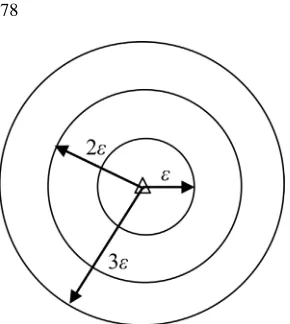
According to the design of DCTTP, only the sensed data that fluctuates over their expected value can be re-placed by mean. We divide the detecting area into a sub-set of areas by a serial of dividing disks with radius
, 2 , , R
, respectively, as shown in Figure 2.
Nodes in the same subarea trend to have similar sensed data, that’s most of them fluctuate over their expected values, compressing these data together can obtain better compressing ratio.
In the area of DCi i1 , there are
2 2i 1 RFigure 2. The figure of the sensing area division.
member nodes. Assume that a units are needed to represent the sensed data and node id, thus, a cluster head node need transmit 2a
2i1
R2 units data to report the readings of one target. While with DCTTP, the cluster head transmits a compact data description of
2
22 1 1 2 1
a i R p i R a units, where p is the percentage of the filtered data and
1p
2i1
R2is the number of values written to variance. a units are used to represent mean and
22i 1 R
units are used to represent bitmap, re-spectively.
The compression ratio of data in DCi i1 , denoted as CRi i1 can be defined as:
2 2
1 2
2 1 1 2 1
2 2 1
i i
a i R p i R a
CR
a i R
(3)
Setting a = 64, then we have:
1
21 1 16
64 2 1
i i p CR i R
(4)
Thus, the compression ratio of data in the whole de-tecting area is:
2 1
2
1 1 16
64 2 1
16 ln 33 32 64 1 R whole i p CR i R R p R R
(5)In formula (5), parameters R and p are fixed when the network is being deployed. It is clearly that and p are two key factors decide the compressing ratio, further energy conservation of the network.
In theory, sensed data of nodes in the same detecting cirque can be replaced by their expected value with
va-riances less than However, measurement errors and data noisy make variances of parts data beyond , these data has to be stored into the item variance of the com-pact structures.
As the measurement error and data noisy at a certain node usually follow Gaussian distribution [17]. As p is decided by the distribution of data and , thus pressing ratio is in inverse proportion to the given com-pressing error bound . That’s energy conservation is at the cost of data quality sacrificing. We can choose ap-propriate compressing error according to the moving mode of targets and experiences to obtain optimal per-formance of the system.
6. Experiments and Evaluation
In this section, we report our simulation results under two scenarios: with data noisy and without noisy. In each case, we report the performance of tracking quality and energy conservation and our analysis.
In the simulations, sensors nodes are deployed in a re-gion of 1000 × 1000 unit field. The locations of nodes are known. All sensor nodes have the same sensing ra-dius. Three electronic cars are simulated as the targets, which move along any velocity. For the case with noisy, we set the mean and variance of Gaussian noise at each sensor node to 1.
We first define two metrics to measure the perfor-mance of DCTTP in terms of tracking quality and energy conservation, that’s tracking error and energy savings ratio.
Tracking error: It is the average distance between the real trace of the moving target and its estimated trace.
Energy savings ratio: It is defined as the ratio of energy savings of DCTTP over the normal tracking sys-tem without energy conservation mechanisms.
In each scenario, we explore the impact of some key system configurations on the system performance, such as network density, sensing range and compressing error.
[image:6.595.86.286.564.642.2]6.1. Tracking Error
error of data, which contributes to data that are more precise.
[image:7.595.311.534.74.261.2] [image:7.595.58.288.306.490.2]Figure 4 shows the influence of sensing range on tracking error. We observe that sensing range is one of key factors that influence tracking quality. As the raising of sensing range, more sensor nodes can detect the tar-gets, which provides better tracking performance. It is observed that tracking error decrease slightly as the in-crease of compressing error, especially for data with noisy. From the results, we can conclude that: 1) com-pressing data does not bring obvious tracking error; 2) our compressing technique can efficient alleviate the impact of data noisy on tracking quality.
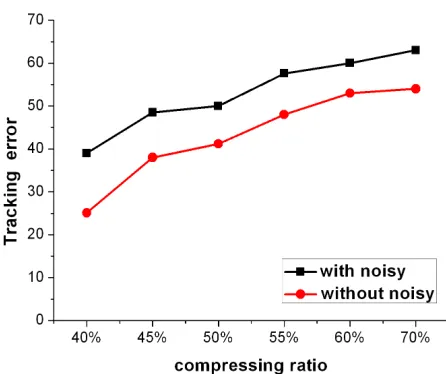
[image:7.595.313.534.517.704.2]Figure 5 presents the influence of compressing ratio on tracking error. It is clear that tracking error is in in-verse proportion to compressing ratio, while when com-pressing ratio reaches 50%, the change of tracking error approaches to constant.
Figure 3. Impact of network density on tracking error.
Figure 4. Impact of sensing range on tracking error.
Figure 5. Impact of compressing ratio on tracking error.
6.2. Energy Savings Ratio
Figure 6 depicts the impact of network density on ener-gy savings. Clearly, applying data compressing algo-rithm conserves much energy. As the increase of network density, energy savings enhances significantly. For in-creasing network density leads to more sensed data to be compressed, more energy of packets transmission is saved.
From Figure 7, we observe that energy saving increases monotonically with the raise of sensing range. The rea-son is that the increase of sensing range leads to more sensor nodes detecting the target, and more information transmitted to the base station, thus, the advantage of data compressing is more remarkable.
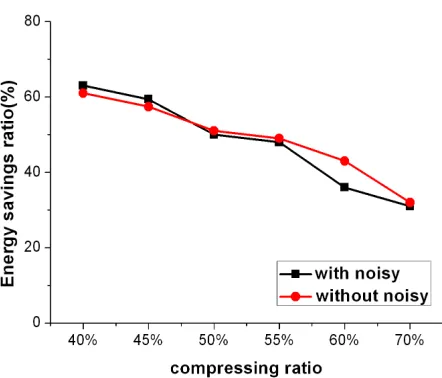
Figure 8 plots the influence of compressing ratio on energy savings. It is shown that the degree of data com-pressing also has influences on energy savings, especially
[image:7.595.59.280.520.702.2]Figure 7. Impact of sensing range on energy savings ratio.
Figure 8. Impact of compressing ratio on energy savings ratio.
for data with noisy.
7. Conclusions
In this paper, we concentrate on energy efficient tracking, dedicated to conserve the whole network energy, as well as maintain high tracking quality. We have proposed a data compressing scheme to reduce information trans-mission of targets. In addition, we incorporate the pro-posed data compressing technique with tracking protocol and optimize it to obtain trade-off between energy con-servation and tracking quality.
We implement a set of simulations to validate our ap-proach. The results demonstrate the effectiveness of proposed protocol and illustrate influences of several parameters on the system. As our future work, we will implement our tracking algorithm on real sensor nodes.
8. Acknowledgements
This work is partially supported by the NSFC-RGC of China under Grant No.60831160525, the Key Program of the National Natural Science Foundation of China under Grant No. 61033015, the National Natural Science Foundation of China under Grant No. 60933001, the National Natural Science Foundation of China under Grant No. 60703012, the Natural Science Foundation of Heilongjiang Province of China under Grant No. F201038 and the Science and Technology Innovation Research Project of Harbin for Young Scholar under Grant No. 2009RFQX080.
9. References
[1] Q. Ren, J. Li and H. Gao, “Tpss: A Two-Phase Sleep Scheduling Protocol for Object Tracking in Sensor Net-works,” Proceedings of 6th IEEE International Confe-rence on Mobile Ad-hoc and Sensor Systems, Macao, 2009, pp. 458-465.
[2] Z. Zhong, T. Zhu, D. Wang and T. He, “Tracking with Unreliable Node Sequences,” INFOCOM, Rio de Janeiro, 19-25 April 2009, pp.1215-1223 .
[3] J. Jeong, T. Hwang, T. He and D. Du, “MCTA: Target Tracking Algorithm Based on Minimal Contour in Wire-less Sensor Networks,” Proceedings of 26th Conference
on Computer Communications, Anchorage, 6-12 May
2007, pp. 2371-2375.
[4] T. He, P. A. Vicaire, T. Yan, L. Luo, L. Gu, G. Zhou, R. Stoleru, Q. Cao, J. A. Stankovic and T. Abdelzaher, “Achieving Real-Time Target Tracking Using Wireless Sensor Networks,” ACM Transaction on Embedded Computing System, 2007.
[5] T. He, P. Vicaire, T. Yan, Q. Cao, G. Zhou, L. Gu, L. Luo, R. Stoleru, J. A. Stankovic and T. Abdelzaher, “Achieving Long-Term Surveillance in VigilNet,” Pro-ceedings of 25th Conference on Computer Communica-tions, Barcelona, April 2006, pp. 1-12.
[6] N. Shrivastava, R. Mudumbai, U. Madhow and S. Suri, “Target Tracking with Binary Proximity Sensors: Fun-damental Limits, Minimal Description, and Algorith,” ACM Sensys, November 2006.
[7] W. Kim, K. Mechitov, J.-Y. Choi and S. K. Ham, “On Tracking Objects with Binary Proximity Sensors,” Pro-ceedings of 4th International Conference on Information Processing in Sensor Networks, April 2005.
[8] J. Singh, U. Madhow, R. Kumar, S. Suri and R. Cagley, “Tracking Multiple Targets Using Binary Proximity Sensors,” Proceedings of 6th International Conference on Information Processing in Sensor Networks, April 2007. doi:10.1145/1236360.1236427
[image:8.595.62.283.286.475.2][10] W. S. Zhang and G. H. Cao, “DCTC: Dynamic Convey Tree-based Collaboration for Target Tracking in Sensor Networks,” IEEE Transactions on Wireless Communica-tion, Vol. 3, No. 5, September 2004, pp. 1689-1701. doi: 10.1109/TWC.2004.833443
[11] F. Zhao, J. Shin and J. Reich, “Information-driven Dy-namic Sensor Collaboration for Tracking Applications,” IEEE Signal Processing Magazine, Vol. 19, No. 2, March 2002, pp. 61-72. doi:10.1109/79.985685
[12] B. Kusy, A. Ledeczi and X. Koutsoukos, “Tracking Mo-bile Nodes Using RF Doppler Shifts,” Proceedings of 5th International Conference on Embedded Networked Sen-sor Systems, 2007, pp. 29-42. doi:10.1145/1322263.1322 267
[13] R. Sarkar and J. Gao, “Differential Forms for Target Tracking and Aggregate Queries in Distributed Net-works,” Proceedings of 11th ACM International Sympo-sium on Mobile Ad hoc Networking and Computing, 2010, pp. 377-388.
[14] Q. Cao, T. Abdelzaher, T. He and J. Stankovic, “Towards
Optimal Sleep Scheduling in Sensor Networks for Rare-Event Detection,” Proceedings of the 4th Interna-tional Symposium on Information Processing in Sensor Networks, 15 April 2005, pp. 20-27.
[15] C. Gui and P. Mohapatra, “Power conservation and Qual-ity of Surveillance in Target Tracking Sensor Networks,” Proceedings of the International Conference on Mobile Computing and Networking, 2004.
[16] W. Heinzelman, A. Chandrakasan and H. Balakrishnan, “Energy-efficient Communication Protocol for Wireless Micro-sensor Networks,” Proceedings of the 33rd Inter-national Conference on System Sciences, Vol. 8, January 2000.