Acceleration
and
Optical Interferometry
A thesis submitted in partial fulfilment of the requirements for the Degree of
Doctor of Philosophy in Physics at the University of Canterbury
Richard Neutze
;::;:.
University of Canterbury
PHYSICAL SCIENCES LIBRARY THESIS
Ccn.t
Abstract
The influence of acceleration on a number of physical systems is examined. We present a full relativistic treatment of a simple harmonic oscillator with rela-tivistic velocities. The line element for Schwarzschild geometry is expanded in a set of Cartesian coordinates and is shown to be locally equivalent (neglecting curvature) to the line element of a linearly accelerating frame of reference. We consider the rate of a linearly accelerating quantum mechanical clock and the measurement of frequency by non-inertial observers, requiring this measure-ment to be of finite duration. These analyses demonstrate the standard mea-surement hypothesis for accelerating observers only approximates the physical behaviour of these systems.
Acknowledgements
I am indebted to both of my supervisors, Dr. William Moreau and Profes-sor Geoffrey Stedman, for the advice and encouragement they have given me throughout the course of this work. The enthusiasm for my work displayed by Bill during the formulative stages of this research played a large part in my de-cision to undertake doctoral studies at this stage of my life. When Bill accepted sabbatical leave in 1994, Geoff was only too happy to become co-supervisor of my thesis. I am very grateful to Geoff for his guidance throughout this period as I looked beyond my doctorate and aimed to develop my expertise in directions which would lead to a career in science.
I have enjoyed the environment of this department and the company of other graduate students. Hughan, Richard, Kumar, Steve, Tom, Siva and Wang have all provoked lively discussions from time to time, thus helping to make the years pass quickly. I am particularly indebted to Hughan who proved a valuable foil for many of my more speCUlative ideas.
I wish thank my parents and my family for the love and support they have given me throughout my life, especially for providing a stimulating environ-ment for an inquisitive young mind as I grew up in rural New Zealand.
Over the last four years Kate has prevented me from allowing obsession with my thesis to become the bane of my life. My most treasured memories from these years arise from our journeys together around New Zealand. For this, and for the continuous support which Kate has provided, I will always be grateful.
I am thankful to the New Zealand Vice Chancellors Committee and the William Georgetti trust for their financial support throughout the course of this work.
Contents
1 Introduction 1
1.1 Relativity and optics: an informal overview 1
1.2 Structure of this thesis 5
1.3 Notation and conventions 8
2 Hyperbolic Motion and the Relativistic Spring 9
2.1 Classical motivation 9
2.2 Hyperbolic Motion 10
2.3 Relativistic Spring 13
2.3.1 Relativistic equations of motion 13
2.3.2 Solution to the equations of motion 15
3 Local equivalence of Schwarzschild geometry with an
acceler-ating frame 21
3.1 The principle of equivalence 21
3.2 Schwarzschild solution in local Cartesian coordinates 24
3.3 Linearly accelerating coordinate systems 25
3.4 Comparison of the first-order Schwarzschild and accelerating
frame line elements 29
3.5 What is the significance of the principle of equivalence? 31
4 Measurement of :Frequency by non-inertial observers 4.1 General covariance and the hypothesis of locality 4.2 Measurement of time by accelerating clocks 4.3 Helicity-rotation coupling
35 35 38 43 4.4 Frequency measurement by a linearly accelerating observer 48
4.4.1 Calculation of the Doppler effect 50
4.5 Frequency measurement by observers in Schwarzschild geometry 53 4.5.1 Frequency measurements in general relativity. 54
4.5.2 Non-instantaneous measurement of frequency 56
5 Reanalysis of the light drag experiment of Sanders and Ezekiel 61
5.1 Fresnel drag 61
5.2 The experiment of Sanders and Ezekiel 5.2.1 Systematic errors
5.2.2 Relativistic effects
5.3 Phase shift through the moving glass sample 5.3.1 Relativistic form of Snell's law
5.3.2 Snapshot of the glass sample in I'
5.3.3 Phase shift through the moving sample 5.4 Phase shift in air
5.5 Modified Lauh Drag coefficient
5.5.1 Comparison with the analysis of Sanders 5.5.2 Comparison with the experimental results
6 Fresnel drag in a linearly accelerating dielectric 6.1 Optical tests of Maxwell's covariant equations
66 67 69 71 72 74 78 79 83 86 89 95 95
6.2 Covariant formulation of Maxwell's equations 99
6.3 Wave equation in a linearly accelerating frame 103
6.4 Accelerating dielectric within a stationary cavity 105 6.4.1 Passive interferometer containing an oscillating glass
sample 109
6.4.2 Resonant cavity containing a linearly accelerating glass
sample 111
6.5 Freely falling dielectric within a cavity stationary in Schwarzschild
geometry 116
7 Optical interferometer with angular acceleration
7.1 Sagnac effect
7.2 Sagnac interferometer with angular acceleration
7.3 Resonant Cavity with angular acceleration 7.4 Ring laser with angular acceleration
7.5 Solution of Maxwell's equations for a ring laser with angular acceleration
7.5.1 Maxwell's equations in a angularly accelerating frame
121 121 124 129 133 136
of reference 137
7.5.2 Solution of Maxwell's equations for a ring laser with angular acceleration
7.5.3 Sagnac interferometer with angular acceleration: a com-parison
viii
139
8 Oscillating mirror within a rotating ring laser 147
8.1 rung laser locking 147
8.2 Invariant phase in a rotating frame of reference 151
8.3 Sagnac effect 154
8.4 Rotating ring laser with a moving mirror 158
8.5 Output spectra of a rotating ring laser with one mirror oscillating163
8.5.1 Beat frequency between opposite beams 164
8.5.2 Beat frequency between adjacent modes 167
9 Conclusion 175
A Temporal response of a Fabry-Perot interferometer to a
fre-quency modulated signal 177
B Published papers 181
References 183
Chapter 1
Introduction
1.1 Relativity and optics: an informal overview
Special relativity grew out of Einstein's dissatisfaction with the state of the theory of electrodynamics at the turn of this century. Lorentz [82] was able to explain the phenomenon of angular aberration and the light drag experi-ment of Fizeau [45] by postulating a static ether which was not dragged along by the motion of material media. For Einstein, the special status this ether theory gave to the inertial frame in which it was stationary was entirely un-satisfactory. Lorentz's electrodynamics, as a preferred frame theory, was even more stringent than Galilean relativity for which, kinematically, no inertial frame was preferred. Furthermore, the form of Maxwell's equations within an ether theory were greatly complicated when electromagnetic phenomena were viewed from an inertial frame moving relative to the ether.
A key example which led Einstein to reject the electrodynamics of Lorentz was an apparent asymmetry which arose when considering the behaviour of a conductor moving relative to a magnetic field. Within Lorentz's ether the-ory the description, based upon Maxwell's equations, of the behaviour of the conductor was substantially different for the two cases: i) the conductor sta-tionary with respect to the ether and the magnetic field moving; and ii) the reverse. Einstein rejected this asymmetry and introduced the principle of rel-ativity [37] in which it was postulated that the laws of nature take the same form in any inertial frame of reference. Combined with an additional postu-late that all observers agree on the value of the speed of light in vacuum, this principle led directly to the special theory of relativity. Within the special theory Einstein demonstrated that Maxwell's equations take the same form in any inertial frame of reference, which immediately removed the asymmetries of the Lorentz's ether theory. In his Autobiographical Notes, written forty years after publication of the special theory, Einstein stated 'The special theory of relativity owes its origin to Maxwell's equations of the electromagnetic field.
2 Chapter 1. Introduction
Inversely the latter can be grasped formally in a satisfactory fashion only by way of the special theory of relativity' [62].
Aside from his conviction of the requirement for symmetry in any phys-ical theory, Einstein, as were Lorentz, FitzGerald and Poincare before him, was strongly influenced by the observation of angular aberration [19] and the results of the light drag experiment of Fizeau [45]. Although not critical in Einstein's development of the special theory of relativity, the null result of the experiment of Michelson and Morley [99], which was designed to detect a phase shift at second order in velocity due to the motion of the Earth relative to the ether, provided compelling experimental evidence in support of special relativ-ity. Historically this experiment has been (incorrectly) credited as one of the founding pillars upon which relativity was based. While this claim was repeat-edly denied by Einstein [62], the experiment of Michelson and Morley, more than any other experiment of nineteenth century, compelled Einstein's peers to accept the special theory of relativity as the most legitimate description of electromagnetic phenomena.
Despite the successes of special relativity, Einstein was uncomfortable with the elevated status it gave inertial observers. Within two years of Einstein's publication of the special theory two highly significant discoveries were made which were to pave the way to the general theory. The first was Minkowski's realisation that, within the special theory of relativity, space and time could be described geometrically [100]. Within this framework Minkowski showed that spatial separations and time like intervals should be treated on an equal footing, a remarkable philosophical break from the Newtonian concepts of ab-solute space and abab-solute time. A second breakthrough which occurred in the same year was Einstein's discovery of the principle of equivalence
[381,
which exploited the empirical coincidence of inertial and gravitational mass. Gen-eralising the principle of relativity to hold under arbitrary coordinate trans-formations Einstein was led to the requirement of general covariance which, combined with the geometric description of flat space-time and the equivalence principle, led to the general theory of relativity [39], a geometric description of gravitation.1.1. Relativity and optics: an informal overview 3
in the acceptance of general relativity by Einstein's contemporaries. Consider-ably more accurate measurements of the bending of electromagnetic radiation by a massive body were provided by Fomalont and Sramek in 1976 [46]. In
their experiment Fomalont and Sramek successfully recorded the deviation of the path taken by radio waves emitted from a quasar as it was eclipsed by the sun, achieving experimental confirmation of general relativity to an accu-racy of - 1%. Closely related was the experiment, in 1979, of Reasenberg et al. [120] who tracked the path taken by a spacecraft which continuously emit-ted an electromagnetic signal. From the measured delay in propagation time from the satellite to the Earth based laboratory Reasenberg et al. were able
to confirm the predictions of Schwarzschild geometry to 0.2%.
One of the most significant laboratory based experiments to confirm a cen-tral prediction of any gravitational theory which incorporates the equivalence principle, of which the general theory of relativity is one, was that of Pound and Rebka [119] who located a Fes7 MOssbauer source and receiver at differ-ent heights in their laboratory, enabling them to measure the gravitational redshift induced by the Earth's gravitational field. Closely related was the experiment of Hay et al. [58] who mounted a MOssbauer source and receiver upon a rotating disk and detected the second order transverse Doppler shift. Colella, Overhauser and Werner [29] also measured a gravitationally induced phase shift in de Broglie waves using neutrons. In their experiment a ring neutron interferometer was inclined at a variety of angles relative to the sur-face of the earth. A phase shift arising from gravitational redshift in the de Broglie waves was detected through measuring the intensity of the recombined neutron beams as a function of the inclination of the interferometer.
4 Chapter 1. Introduction
Broglie waves arising from the motion of media has also been detected using a ring neutron interferometer. Klein et al. [68J and Bonse and Rumpf [17J observed a phase shift when their sample's boundaries were moving relative to the laboratory, whereas Arif et al. [8J detected a null phase shift result when the boundary of the moving media was stationary with respect to the inter-ferometer. This null phase shift was predicted by Home et al. [63] and arises from the neutron-nucleus potential being independent of the velocity of the media when the neutron's energy is removed from a nuclear resonance. Arif et al. [6, 7] performed a similar experiment, this time using a sample with a nuclear resonance at thermal energies. As such the neutron-nucleus potential became velocity dependent, inducing a phase shift directly analogous to the historical experiment of Fizeau.
As early as 1913 Sagnac, using a passive ring optical interferometer, re-ported an observation of the phase shift induced by rotation [125]. Since this first observation the Sagnac effect has become a topic of wide experimental and theoretical interest [118, 60, 5]. With the invention of the ring laser the sensitivity of optical devices to rotation was dramatically improved. The most precise of these is that possessed by the Canterbury Ring Laser Group, which has measured the Sagnac beat frequency induced by the rotation of the Earth with a precision of three parts in 1022 [139]. A rotationally induced phase
shift has also been observed for super-conducting Cooper pairs [159], in neu-tron interferometry [153] I in atom interferometry with 40Ca beams (121] and
in interferometry with bare electrons [56].
A ring interferometer and ring laser are also sensitive to a variety of post Newtonian gravitational effects [133, 130]. In particular, it has been suggested that the influence of Lense-Thirring frame dragging by a rotating massive body is detectable, in principle, by a ring laser. A comprehensive review of the var-ious classical and quantum gravitational effects to which ring interferometers and ring lasers are sensitive has been given by Stedman [136].
for-1.2. Structure of this thesis 5
malism of general relativity. This quest provides the underlying goal of the work performed throughout this thesis.
Our primary interest in optical interferometry is in connection with the Canterbury Ring Laser Group. With this motivation we are led to consider experimental proposals for which a ring interferometer or ring laser is ideally suited. Given our desire to search for novel observable consequences of the formalism of standard relativity using optical interferometry it is most natural to seek generalisations of previous successful experiments. Obvious extensions include consideration of the effects of acceleration in the laboratory based experiments of Sagnac [125] and Sanders and Ezekiel [128], or to introduce time dependent boundary conditions in optical experiments performed in a rotating frame of reference. In this thesis we present a full analysis of precisely these generalisations. Chapters 6, 7 and 8 respectively present, within the context of optical interferometry, a relativistic treatment of light drag within a linearly accelerating dielectric sample, an analysis of the optical behaviour of a ring interferometer and ring laser with angular acceleration and we determine the optical response of a rotating ring laser with one mirror oscillating.
However, along the path to mastering the dual formalisms of general rela-tivity and optical interferometry, required for the analyses presented in chap-ters 6, 7 and 8, several other problems of physical interest have arisen and been solved. Within this thesis we present the results of the most successful of these 'detours', all of which provide insight into the physical consequences of the theory of relativity. This thesis has the title Acceleration and optical
inter-ferometry. It is the influence of acceleration and relativistic effects in optical interferometry which provide the threads which sew together the apparently self contained and independent blocks of work presented in each chapter. All work reported within this thesis belongs to either of these two categories in relativistic physics and the final three chapters combine these parallel interests, leading to a series of novel experimental predictions which either fall within, or just outside, the technological sphere accessible to todays experimentalist.
1.2 Structure of this thesis
predom-6 Chapter 1. Introduction
inantly optical systems, of physical interest. Each chapter presents original material in its own right and is self contained.
In chapter 2 we give an unorthodox derivation of hyperbolic motion, which describes the worldline of a uniformly accelerating particle. This approach is chosen as the formalism, when applied to the classical problem of a mass be-ing acted upon by an idealised sprbe-ing obeybe-ing Hooke's law, provides a natural extension of simple harmonic motion into the relativistic realm. Having moti-vated the physical model, we present a full relativistic solution for the motion of a massive particle when attached to a centre of attraction by an idealised spring.
In chapter 3 we expand the Schwarzschild line element and define a local Cartesian coordinate system with its origin a finite distance from the centre of the non-rotating, spherically symmetric gravitating body. This expansion enables a simple comparison to be drawn between the line element of an, appropriately chosen, linearly accelerating frame of reference. This comparison provides a clear illustration, using a well known solution of Einstein's field equations, of how the equivalence principle is incorporated into the general theory of relativity.
Chapter 4 represents our first discussion of optical phenomena, which re-mains the focus for the remainder of the thesis. Within this chapter we derive the Doppler effect for two non-inertial observers, the first linearly accelerat-ing and the second stationary in Schwarzschild geometry, when the source is inertial. Unlike the geometric formalism of general relativity we find the Doppler shift relations are dependent upon the duration of the measurement. Before calculating these frequency transformation formula we discuss the rate at which a linearly accelerating clock runs, demonstrating that the rate of a quantum mechanical clock is affected by its acceleration. We also briefiy review the literature concerned with helicity-rotation coupling.
1.2. Structure of this thesis 7
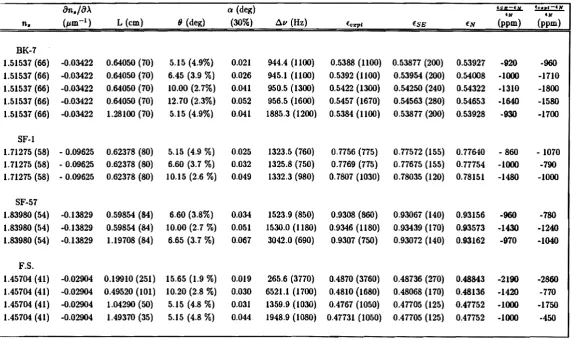
and Ezekiel's stated experimental uncertainty and is significantly worse than their claim of an overall agreement between experiment and theory to 60 ppm. We unify our interest in non-inertial systems and optical interferometry in the final three chapters of this thesis. In the first of these, chapter 6, we per-form an analysis of light drag in an accelerating dielectric using the covariant formulation of Maxwell's equations. As predicted by Tanaka [146], we find light which propagates through accelerating media suffers a shift in frequency. When the dielectric is accelerated along one arm of a ring interferometer this frequency shift leads to potentially observable experimental effects, causing the response profile of a resonant cavity to become asymmetric and induces a beat between the opposite arms of a passive ring cavity. If the sample is oscillated then Fourier analysis of the recorded beat between the opposite arms would produce sideband structure in the final spectra. We also consider an analogous case of a dielectric freely falling along an arm of a resonant cavity stationary in a gravitational field.
Chapter 7 presents an analysis of the optical behaviour of a ring interferom-eter with angular acceleration. When the mirrors are separated by vacuum we utilise a transit time technique to calculate the observable phase shifts. When material media separates the mirrors we apply the covariant form of Maxwell's equations and formulate and solve the wave equation for this system. Both approaches yield identical predictions in the appropriate limits. Our results predict an asymmetric response profile for a resonant cavity with angular ac-celeration. We also show the beat frequency for a ring laser with angular acceleration is precisely that given by the Sagnac effect for an instantaneously co-rotating ring laser.
8 Chapter 1. Introduction
1.3 Notation and conventions
Throughout this thesis we employ the Minkowski metric in Cartesian coor-dinates with 11/111
=
diag( -1,1,1,1). We adopt the convention that inertial frames of reference are labelled I and non-inertial frames of reference S. Carte-sian coordinates of an inertial frame of reference are labelled with uppercaseChapter 2
Hyperbolic Motion and the Relativistic Spring
In this chapter we derive hyperbolic motion from the basic classical model of a uniformly accelerating particle. When moving from the classical domain into the relativistic realm we must replace the particle's classical momentum. with its relativistic counterpart. We also apply this prescription to the problem of a massive particle which is acted upon by an idealised spring. This leads to a natural relativistic generalisation of simple harmonic motion. We present a
full relativistic solution for the motion of this massive particle.
2.1
Classical motivation
A particle undergoing constant acceleration and the simple harmonic oscillator are two elementary topics in classical mechanics that are thoroughly discussed in all of the standard expositions of the subject [49]. But while the relativis-tic generalisation of constant acceleration, defined with respect to instanta-neously comoving inertial frames, has received a complete treatment in the literature [3, 49, 101, 103], the relativistic extension of simple harmonic mo-tion, by comparison, has received considerably less attention. This omission is surprising as the simple harmonic oscillator is one of the most important prob-lems in classical mechanics and is thoroughly discussed in all of the standard expositions of the subject [49]. Furthermore, since the simple harmonic oscil-lator is a central idea in physics, from normal modes of vibration in molecules and solids to those in relativistic quantum fields, it is worthwhile considering a complete and rigorous relativistic treatment of the basic classical model.
Synge [141] has given an exact expression for the period of a relativistic oscillator in terms of an integral which Goldstein [49] has identified as being expressible in terms of standard elliptical integrals. Skinner [135] covers the topic in a problem. All three of these authors give the relativistic correction to the period to leading order, but they have not calculated the world line
10 Chapter 2. Hyperbolic Motion and the Relativistic Spring
nor analysed the motion in any detail. The question "What happens to a simple harmonic oscillator when the energy is such that the velocities become relativistic?" is a natural one to ask. Moreau, Easther and Neutze [105] were the first to provided a detailed and rigorous solution. In brief, the effect of time dilation along the world line is to cause simple harmonic motion at low energy to become anharmonic at high energy.
In this chapter we derive and solve the equations of motion for a rela-tivistic particle attached to a centre of attraction by an idealised spring. We approach this problem from a somewhat different perspective to that previ-ously reported
[105].
We begin, in section 2.2, by considering the motion of a relativistic particle which is acted upon by a constant force. We apply the prescription of Moller[103l
and replace the particle's classical momentum with its relativistic momentum when making the transition from Newtonian mechanics to relativistic mechanics. The resulting solution is well known and the particle follows hyperbolic motion. This approach to hyperbolic motion, which is now regarded as somewhat 'old fashioned', is chosen as it highlights the physical assumptions made in deriving the relativistic corrections to the classical motion. Furthermore, in section 2.3 we are able to apply the same formalism to derive a very natural relativistic generalisation of the motion of a simple harmonic oscillator. In developing the relativistic oscillator by analogy with a well known problem in relativistic mechanics, the physical basis for this generalisation is made transparent. Having established the equations of motion for our relativistic oscillator we present a full solution in section 2.3.2.2.2 Hyperbolic Motion
Hyperbolic motion is one of the standard examples of relativistic motion and is discussed in virtually all texts on general relativity. Its importance is twofold: it provides an intuitive example from which one can appreciate the distinction between rest mass and relativistic mass in relativistic mechanics; and, through the equivalence principle, accelerated motion provides a useful tool through which one can grasp many of the important features of gravitation without first mastering the full mathematical structure of general relativity.
2.2. Hyperbolic Motion 11
position and velocity. Newton's equation of motion for this system is dpl
(2.1) - - F dT - ,
where
pI =m dX
dT (2.2)
is the particle's classical momentum along the X axis of I, and m is the inertial
mass of the particle. In Newtonian mechanics the inertial mass of a particle is identical to its rest mass mo and is independent of the particle's velocity. In classical mechanics the solution to Eq. (2.1) predicts that this particle will follow parabolic motion.
We now follow the prescription given by Moller [103, pp.65-68j and make the transition from Newtonian mechanics to relativistic mechanics by: (a) identifying the variable T in Eq. (2.1) as parameterising the coordinate time of the inertial frame I; and (b) the inertial mass m of the particle in Eq. (2.2),
which denotes the particle's resistance to acceleration, becomes the 'relativistic mass' m
=
mo 'Y, where'Y ==1/
Jl -
(dX/ dT)2 / c2 = dT / dr and r is the proper time along the worldline of the particle. Applying this prescription to Eq. (2.2)we find the particle's momentum becomes
I dX _ dX dX
P
=
m dT=
1110 'Y dT = mo dr ' (2.3) which is the relativistic momentum of the particle.We again consider the motion of a particle, restricted to move along the X
axis, which experiences a force F applied parallel to the X axis which is inde-pendent of the particle's position and velocity [103, p.73-7
41.
The relativistic expression for Newton's equation of motion, Eq. (2.1), is thereforedpi d dX d2X dr
dT = mo dT dr = 1110 dr2 dT = F (2.4) where we have simply replaced the classical momentum with its relativistic counterpart, defined by Eq. (2.3). IT we assume our particle is stationary at
X = 0 when T
=
0 then Eq. (2.4) has the solutionT - -sm -c . hear) ,
a c
c2
arc2
X - cosh()
-a c a
(2.5)
(2.6)
12 Chapter 2. Hyperbolic Motion and the Relativistic Spring
From the above formulation of this problem it would appear that we have chosen a special frame of reference from which to view this motion, namely the inertial frame I in which we have defined the force F acting on our particle. However, it is easily demonstrated that our particle will follow the same char-acteristic motion when viewed from any inertial frame of reference. If we make a Lorentz boost to another frame I' moving with velocity c tanh 8 relative to
I, then the worldline of the particle in I' is described by
T' -
~{Sinh(a;
-8)+Sinh8} , (2.7)X' - : {cosh(ac'T - 8) - cosh 8} . (2.8)
Thus, apart from a difference in the choice of the origin for primed and un-primed coordinates, the motion of the accelerating particle appears identical in any inertial frame. When 'T = c 8/ a the particle is instantaneously
sta-tionary in I'. Eqs. (2.7) and (2.8) give, at this moment, d'T
=
dT' and d2 X' / d'T2 = ~ X' / dTI2 = a. Thus a particle following hyperbolic motional-ways has an acceleration a with respect to the inertial frame with which is is instantaneously comoving.
It is convenient to express the equation of motion, Eq (2.4) in in terms of the covariant form of Newton's second law
(2.9)
where FIJ is the Minkowski force acting on the particle and pI-'
=
modXIJ /d'Tare the 4-vector components of the relativistic momentum. In the inertial frame of reference instantaneously comoving with the particle, Eqs. (2.7) and (2.8) with 8
=
a'T/c give ~T'/d'T2=
0 and ~X'/d'T2 = a such that themagnitude of the Minkowski force,
(2.10)
2.3. Relativistic Spring 13
2.3 Relativistic Spring
In classical mechanics a particle which is attached by a perfect spring to a fixed point in an inertial frame I will follow simple harmonic motion. This problem has become one of the central ideas in physics, finding application in spectroscopy, the theory of solids, quantum field theory, and numerous other areas of current research. It is therefore of interest to derive and solve the equations of motion arising from a relativistic treatment of the basic classical model.
2.3.1 Relativistic equations of motion
As in section (2.2), we begin our relativistic treatment of a simple harmonic oscillator by first considering the classical formulation of the problem. Hooke's law in Newtonian mechanics states that the force acting on a particle connected by an idealised spring to the origin of an inertial frame I is proportional to the negative of the particle's displacement in I. Without loss of generality we assume that our particle is constrained to move along the X axis. Classically, Newton's equation of motion for the system is
dpl
- = - k X
dT (2.11)
where k is the spring constant. In classical mechanics the solution to Eq. (2.11) predicts that our particle will display simple harmonic motion.
We now apply the same formalism which we used in section 2.2 and make the transition from classical mechanics to relativistic mechanics by identifying
T as the coordinate time of I and replacing the classical momentum of the par-ticle in Eq. (2.11) with its relativistic counterpart, Eq. (2.3). The relativistic equation of motion for a particle attached to an idealised spring is therefore
such that
(2.12)
14 Chapter 2. Hyperbolic Motion and the Relativistic Spring
a force of constant magnitude and direction would follow hyperbolic motion. The physical assumptions made in the derivation of this equation of motion for a relativistic oscillator are transparent and this formalism has provided a very natural generalisation of a classical oscillator into the relativistic realm. This approach is physically equivalent to those taken in all of the literature known to the author concerned with a relativistic generalisation of the classical harmonic oscillator [49, 105, 135, 141].
From the invariance of the magnitude of the four velocity we have
(2.13)
Differentiating with respect to 1" produces
d2T dT _ ~ d2 X dX = 0
d'T2 d'T c2 d'T2 d'T
Using this expression to substitute for the d2 X/d'T2, Eq. (2.12) becomes
~T
+
w2XdX =0d'T2 c2 d'T (2.14)
and integrating with respect to 1" we obtain
dT W 2X2
d'T
+
2';;2
= C1 (2.15) The integration constant C1 is evaluated by choosing the initial conditionsX
=
0 and dX/dT=
Vo at T=
1"=
O. From Eqs. (2.12) and (2.13)Physically "Yo is the total energy of the particle expressed in units of its rest mass. This can be seen from the relativistic expression for energy when the particle is at the origin of I. At this point the potential energy is zero such that E = rnac2J1 +
v5
"Y5 = moc2 "Yo, where we have used pI =rna
"Yo Vo at theorigin.
Substituting Eq. (2.15) into Eq. (2.12) we obtain the equation of motion, with respect to the proper time variable 1", for a relativistic particle attached
to an idealised spring with the centre of attraction the origin of I,
2.3. Relativistic Spring 15
This equation of motion may also be obtained from a Lagrangian formalism in which a relativistic particle is considered to move in the one dimensional har-monic oscillator potential
i
kX2, as was demonstrated by Moreau et a!. [105}.As in section 2.2, it is intuitive to recast these equations of motion in terms of the covariant form of Newton's second law, Eq. (2.9). This also serves to to illustrate the analogy between the classical description of an idealised spring and its relativistic generalisation. From Eq. (2.16), the X component of the Minkowski force is
Combining Eqs. (2.13), (2.14) and, from Eq. (2.15), dT W2X2
- = 'Yo
-dr 2 c '
we obtain
such that
(2.17)
(2.18) Written in this form the analogy between the classical idealised spring and its relativistic counterpart is striking. The magnitude of the Minkowski force exerted on the particle by the idealised spring is proportional to the negative of its displacement from the centre of attraction evaluated in the rest frame of the centre of attraction. This corresponds intuitively to the classical formulation of Hooke's law. Of course Eq. (2.18) is not form invariant under a Lorentz boost. Throughout this chapter we work entirely within a special frame of reference, namely that in which the centre of attraction is stationary.
2.3.2 Solution to the equations of motion
The solution of Eq. (2.16) determines the motion of our particle in terms of proper time for a given total relativistic energy 1110
c?
'Yo. Because of the tran-scendental nature of the equation, we can only obtain the solution in the form16 Chapter 2. Hyperbolic Motion and the Relativistic Spring
It is instructive to consider Eq. (2.16) in the form,
rFX 2 [ K(X)]
dr2
+
w 1+
moc2
X = 0 , (2.19)where we have defined the kinetic energy of the particle at X by
K ( X)
=
E -moe - -
2 1 k X 2 = mo c--_2 { 'Yo - 1 - -w2
}
2 2&
Interpreting the instantaneous angular frequency of the relativistic oscillator as the coefficient of X, we find the angular frequency w(X) = w.)1
+
K(X)/moe2varies with the kinetic energy K(X), from a maximum value of
w../fO
at the origin to a minimum value of w at the turning points. Thus the effect of time di-lation is to cause the relativistic oscillator to become anharmonic, with a range of angular frequencies along its world line. The strength of the anharmonic-ity increases with increasing total relativistic energy, and in the nonrelativistic limit the oscillator becomes harmonic. In this limit K(X)/moe? = v2/2e?«
1, and Eq. (2.19) becomes(2.20) with the proper time equivalent to the coordinate time at this order. This recovers Eq. (2.11) in the non-relativistic limit, which was the classical starting point for this analysis.
To derive the relativistic solution we first multiply Eq. (2.16) by dX/ dr
and integrate to obtain
( dX ) 2 2 2 ( w
2
X2) 2 ( 2
dr
+
w X 'Yo - ~ = c-- 'Yo - 1) ,where we have used dX/dr = Vo 'Yo at X = 0 to evaluate the constant of integration. Rearranging we can express this in the form,
2dX
dr =
±
,
V(A~ - w2X2) (A~ - w2X2) (2.21)
where A± = e .)2 (-yo
±
1), and the+
sign is to be chosen for dX>
0 and the - sign for dX<
0 so that dr is always positive. Physically A_/w is the maximum amplitude of the oscillation. This can be seen as follows: when the particle is at its maximum amplitude, Xo, the particle has no kinetic energysuch that all of its energy E = moe?'Yo will comprise of the particle's potential energy plus its rest mass. Therefore E = moe?
+
!
kXJ = moe? 'Yo and henceXo
= .:.
.)2 (-yo - 1) = A_ . (2.22)2.3. Relativiatic Spring 17
By a. change of variable,
X
=
(A_Iw)
sin a, Eq. (2.21) can be expressed in the standard form of an elliptic integral of the first kind [50],where K,
=
A_IA+
and ¢=
sin-1(w XIA_).
The world line T (X) can now be obtained from Eq. (2.17),
(
w2X2)
dT
=
,0 -
~ d7' •If we substitute Eq. (2.21) for d7' and again make the change of variable
X
=
(A_Iw)
sin a, the integration produces(2.24)
The integral in Eq. (2.24) can be expressed as [F (¢, K,) - E (¢, K,)] IK,2, where
is an elliptic integral of the second kind [50]. Making this substitution and substituting Eq. (2.23) for 7', we find that
T(X)
=
~ {J2('Yo+1)E(.p''')-~F(.p,,,)}
, (2.25)where X
=
(elw)J2 ('0 -1)sin¢ and K,=
J(To -1)I
(To+
1).In figure 2.1 we show plots of the normalised displacement,
(w X)IA_,
18 Chapter 2. Hyperbolic Motion and the Relativistic Spring
[image:28.595.90.478.76.362.2]~
... 0.2
-h
~ 0
-0.2
-0.4
-0.6
-0.8
Figure 2.1: The normalised displacement X(T)/Xo as a function of the normalised coor-dinate time, wT, for one complete cycle with
Po
= 0.20, 0.90, and 0.99. The corresponding amplitudes are 0.20, 1.61, and 3.49 to three figure accuracy. The world lines become more anharmonic with increasing energy. At f30 = 0.99 the world line is nearly straight between the turning points, indicating that only in these regions where the velocity is becoming non-relativistic is the force effective in changing the velocity. Unlike simple harmonic motion, the period of the relativistic motion is not independent of the amplitude.It is interesting to examine the motion in the ultra-relativistic region where "Yo
»
1. In this case K, -+ 1 and A+ -+ A_ -+ c~. Then Eq. (2.25) becomes1"
=!
fI'
rtj,
sec ada=
1 In(1
+sin tP )=
1 In(~
+X) ,w
V
;;
Jo w yl2"Yo 1 - sintP
w yl2"Yo yl2"Yo - X(2.26) and Eq. (2.24) becomes
yl2"Yo
1tj,
.
T = "Yo 1" - - - tan asm ada
w 0 (2.27)
Substituting Eq. (2.26) for
e
in Eq. (2.27) and integrating by parts, after a cancellation we obtain the simple result,T
=
yl2"Yo sintP=
X . (2.28)w c
In the ultra-relativistic region the world line approaches that of a photon,
2.3. Relativistic: Spring 19
the amplitude becomes very large: X_ ~
c.j2;0/w »c/w.
In the limiting case where ;0 -+ 00, the amplitude X_ -+ 00, and the motion ceases to be periodic. Of course a massive particle can never reach this limit.Chapter 3
Local equivalence of Schwarzschild geometry
with an accelerating frame
In this chapter we draw a comparison between the line element of Schwarz schild geometry, expressed in local Cartesian coordinates, with an appropriately cho-sen linearly accelerating frame of reference. This comparison provides a clear illustration of how the equivalence principle is incorporated into general rela-tivity.
3.1
The principle of
equivalence
In the last months of 1907 Einstein made the discovery which was to lead him to a geometric theory of gravitation. Within a review article on his spe-cial theory of relativity
[381,
published two years earlier, Einstein discussed the problem of how· to generalise this theory to include the measurements of non-inertial observers. He was convinced that the key to this extension lay in the empirical coincidence of the equality of inertial and gravitational mass. To interpret and exploit this coincidence, Einstein introduced a new physical prin-ciple, later to be called the principle of equivalence. This principle extended the observed equality between inertial and gravitational mass by stating that all observations performed in either a hypothetical homogeneous gravitational field or a uniformly accelerating frame of reference will be identical. Thus these two systems are indistinguishable and therefore physically equivalent, with the laws of physics taking the same form within both systems of reference. From this perspective the metric theory of Minkowski[1001,
which described the observations of inertial observers in flat spacetime, if generalised to include metrics with non-vanishing curvature would describe the spacetime structure of a gravitational field. It was this conceptual leap, unanticipated by his con-temporaries, which led Einstein to a geometric description of gravitation.Experimental support for the equivalence principle is provided by several
22 Chapter 3. Local equivalence of Schwarzschild geometry with an accelera.ting fra.me
high precision experiments which have been performed which set limits on the difference between the accelerations, aA and aB, of objects A and B of different composition, when falling within the gravitational field of the Earth or Sun. The empirical independence of the acceleration of a body in a gravitational field from its internal structure is the origin of the so called 'weak equivalence principle' [155]. If we define the parameter
then the pendulum experiments performed by Newton
[Ill]
set a limit of 1111<
10-3 and the torsion balance experiments of EotvOs [42] found 1111<
10-9•Using a triangular torsion balance, with two masses of aluminium and one of gold at the vertices, Roll, Krotkov and Dicke [122] searched for a twenty four hour variation in the torque exerted on their balance by the gravitational field of the sun. A temporal variation would arise if the gravitational acceleration of aluminium and silver differed, due to the changing orientation of the sun relative to the Earth based laboratory. With this experiment they were able to demonstrate that the acceleration of macroscopic amounts of gold an alu-minium were equal to within 1111
<
10-11• Braginski and Panov, using a similarexperimental arrangement, improved on this sensitivity by an order of magni-tude when comparing the acceleration of aluminium to that of platinum [20]. Experiments to test the validity of the weak equivalence principle for individ-ual atoms and elementary particles have been inaccurate with the exception of neutrons, where Koester [69] set a lower limit of 11
<
10-4• Adelberger [2] hasdiscussed the motivation for a rekindling of interest in experimental tests of the universality of free fall. Because general relativity has proved an accurate theory for gravitational phenomena this interest is primarily concerned with the search for short range 'feeble' interactions which may lie hidden beneath gravitation. To date, however, no such interactions have been uncovered.
3.1. The principle of equiw.lence 23
an appropriate choice of coordinate system for a linearly accelerating frame of reference, Moreau et a1. demonstrated the first order equivalence of a local coordinate system stationary in Schwarzschild geometry with an accelerating frame of reference. Disparity between the two coordinate systems was shown to arise directly from the curvature of the Schwarzschild spacetime manifold.
In this chapter we present this demonstration of the local equivalence of Schwarzschild geometry with an accelerating frame of reference. We do not attempt, however, to provide a comprehensive review of the extensive litera-ture on the equivalence principle. Instead, in section 3.5 we touch briefly on some of the diverging interpretations which exist within the literature. From a pragmatic perspective, one is free to choose whichever philosophical interpre-tation of this principle one pleases, but the local equivalence of Schwarzschild geometry with a linearly accelerating frame of reference is irrefutable.
The equivalence principle pertains to the equivalence of a uniformly accel-erated frame in flat spacetime and the local effects of a gravitational field in curved spacetime. In the context of Schwarzschild geometry, this equivalence would apply between a local, stationary frame whose origin is fixed at some radial distance R from the center of the spherically symmetric, non-rotating, gravitating body and an accelerated frame in flat spacetime with a suitable value of acceleration. Thus we are motivated to transform the Schwarzschild line element to a set of displaced rectangular coordinates. The resulting expres-sion for the Schwarzschild line element in a small region in the neighbourhood of the displaced origin consists of terms of two distinct types: (1) those that correspond to a line element in a uniformly accelerated reference frame in flat spacetime; and (2) those that correspond to curvature and are related to geodesic deviation. Only the second set of terms contribute to nonzero
Rie-mann tensor elements. This dissection of the Schwarzschild line element into acceleration and tidal effects provides a specific example of the equivalence principle at work in general relativity.
24 Chapter 3. Local equivalence of Schwarzachild geometry with an accelerating frame
3.2
Schwarzschild solution in local Cartesian coordinates
In the first months of 1916 Karl Schwarzschild [132] published the solution of the spacetime manifold surrounding a non-rotating, spherically symmetric mass distribution. Interestingly Karl Schwa.rzsch.ild arrived at this solution shortly before Einstein's publication of his generally covariant theory of gravi-tation [39] and Schwarzschild's solution was based on the restricted field equa-tions of the 1913 paper of Einstein and Grossmann [41], which are valid for vacuum. Also in 1916 Johaness Droste [35] independently published a much simpler derivation of the Schwarzschild solution. The Schwarzschild line ele-ment in the coordinates of Droste is [101],
ds2 = -(1 - 2m)c2 dt2
+
(1 - 2m)-ldr2+
r2(d()2+
sin2 ()d¢2), (3.1)r r
where m
==
GM/c2 is the geometric mass of a non-rotating, spherically-sym-metric body.
In general relativity the fundamental concept is that of the spacetime man-ifold. The intrinsic, observer independent properties of the spacetime manifold are described by the metric tensor and its derivatives. A coordinate system is a one-to-one onto map from a subset of the manifold M to an open subset of
r
[152]. A change from one coordinate system to another merely relabels the events on the spacetime manifold. Thus a coordinate transformation does not result in any change to the motion of physical objects on the spacetime manifold, but merely represents an alternative choice for the description of this motion.As motivated above, we are interested in a local coordinate system using rectangular coordinates whose origin is fixed at coordinate distance R from the center of the spherically symmetric, non-rotating, gravitating body. The coordinate transformation to this set of displaced rectangular coordinates with the
z
axis pointing directly from the centre of attraction is given byx
=
r sin () cos ¢; y=
r sin () sin ¢ z=rcos()-R. (3.2) Solving Eqs. (3.2) for r, we have2z X2+y2+Z2
r=R 1+ R+ R2 (3.3)
Taking the differential of Eq. (3.3) and squaring,
2 [ 2z
x2
+
y2+
z2j-l [X2 2 y2 2 ( Z ) 2 23.3. Linearly a.cceleraiing coordinaie lI)'IItema 25
+
~; dxdy+~
(1+
~) dxdz+~
(1 +
~)
dydz]. (3.4)We can also write
(3.5)
with the final term given by Eq. (3.4).
Substitution of Eqs. (3.3), (3.4), and (3.5) into Eq. (3.1) gives the Schwarzschild line element expressed in the displaced rectangular coordinates.
ds2 = -
[1-
2mlR ] c2dt2 +dx2+
dV2+
dz2VI
+
~+
:z:2+~!+z2[ 2z x
2
+
y2
+
z2]-1 {[
2ml R]-I}
- 1 + - +
1 - 1 -
-;=============:::====;::R R2
V1
+
it
+
3:2+~;+z2[X2 y2 ( Z ) 2
X R2dx2
+
W dy2+ 1 +
R dz2+~;dxdy+ ~
(1+
~) dxdz+~
(1+
~)
dvdz] (3.6)Equation (3.6) is exact for all values of R
>
O.We are interested in a small region about the origin x
=
y=
z=
0 and assume IxIRI, lylRI, and IzIRI« 1. We do not assume mIR« 1, and so do not make a weak field approximation. Neglecting second order terms in Ixl RI, Ivl RI, and IzI RI in all factors in Eq. (3.6), we write a first-order expression for the line element as2 ( 2 m 2mZ) 2 2 2 2 ( 2m 2mZ) -I 2
ds = -
1--+--
edt +dx +dy+ 1--+--
dzR R2 R R2
+
4m(1-
2m+
2mZ)-1(~dxdz
+
]{dydZ) (3.7)R R R 2 R R '
for small displacements about the origin with no restriction on the magnitude
of2mlR.
3.3
Linearly accelerating coordinate systems
26 Chapter 3. Local equivalence of !khwarzschild geometry with an accelerating frame
of spacetime points on the spacetime manifold. A change from one coordinate system to another does not alter the spacetime manifold itself. We therefore search for a convenient coordinate transformation from an inertial frame of ref-erence, I, in Hat spacetime which represents an accelerating frame of reference suitable to our purposes.
An inertial frame I in Hat spacetime using Cartesian coordinates which span the entire manifold is described by the Minkowski line element,
(3.8)
As discussed in section 2.2, an observer 0 with constant linear acceleration relative to the inertial frame with which 0 is instantaneously comoving will follow hyperbolic motion in I. Without loss of generality we restrict the mo-tion of this observer to lie along the Z axis of I and assume 0 defines the origin of an accelerating frame of reference, S. A Lorentz boost from I to an inertial frame of reference moving parallel to the Z axis leaves the X and Y coordinates unchanged. It is therefore natural to define the spatial coordinates perpendic-ular to the acceleration of S by x
=
X and y=
Y, where we have adopted the convention, used throughout this thesis, that uppercase {T, X, Y, Z} represent inertial time and spatial coordinates, and lowercase {t, x, y, z} represent non-inertial coordinates. If we require that both Z and z are zero when T=
t=
0, combined with the requirement that 0, who defines the origin of S, follows hyperbolic motion, we are led to a set of coordinate transformations from I toS which are given by [3]
T -
~
fez) sinh(act)
X
-
x,y
-
y ,e
(at)
c2
(3.9)Z - - fez) cosh -
a
- - f(O)c
a
where, in complete generality, fez) may be an arbitrary function. It should be noted that if all {x, y, z} are fixed then every point in S follows hyperbolic motion in I, which demonstrates that this relabelling of the spacetime manifold has defined a set of linearly accelerating coordinate systems.
It is very natural to define a coordinate system for which z = Z when S is instantaneously comoving with I, which occurs when at t
=
T=
O. This system is unique and is given byaz
fez) = 1
+
2' '
3.3. Linearly accelerating coordinate sysiems 27
which is defined for z
>
-c?-/
a. The line-element for this acceleratingcoordi-nate system is given by the substitution of Eqs. (3.9) and (3.10) into Eq. (3.8), which yields
(3.11)
This choice for an accelerating frame of reference has the nice feature that the spatial components of the metric are Euclidean. Furthermore, by making a Lorentz boost of Eqs. (3.9) to a frame ]' moving with velocity c tanh 0 relative to ], it is easily demonstrated that the spatial coordinates of S are identical to those of the inertial frame with which the origin of S is instantaneously
comoving. This provides an intuitive interpretation of this coordinate system as we recognise that coordinate displacements represent proper distances in
S. It is for this reason that this coordinate system is commonly referred to as a rigid accelerating frame of reference [3, 32, 101, 103, 104]. An alternative derivation of this coordinate system is given by Misner et al. [101]. They consider a a uniformly accelerating observer who is Fermi-Walker transporting an orthonormal tetrad of basis vectors, one of which, eo, is parallel to the the observer's 4-velocity. Because the orthogonal spatial coordinates of this tetrad are defined to measure proper spatial distances, the coordinate system above is recovered. For reasons of priority this coordinate system has become commonly known as a uniformly accelerating frame in Fermi coordinates and we adopt this convention.
General relativity predicts that a free particle will follow a geodesic of the spacetime through which it is moving, described by the geodesic equation [152, Eq. 3.3.3]
(3.12) where l' is the proper time along the worldline of the particle, and we have adopted the Einstein summation convention. The Christoffel symbols rJ.& <kjJ are
given by [152, Eq. 3.1.30]
Calculating the equation of motion for a particle freely falling along the z axis of an accelerating frame in Fermi coordinates we find
,pz
2 (az)
- = - a ' "
28 Chapter 3. Local equivalence of Schwaruc:hild geometry with an accelerating frame
where 'Y
=
dt/d". =1/)1-
(dz/dt)2/C2. Thus the acceleration of a freeparti-cle is dependent on both its velocity and position in S. The geodesic equation for a particle freely falling in Schwarzschild geometry is given by the substitu-tion of the metric components of the line element Eq. (3.7) into the geodesic equation. For purely radial motion we obtain, at r = R, the equation of motion for a particle freely falling in Schwarzschild geometry
[101,
Eq. 25.28],d2r G M
- - - -d".2 - R2 (3.14)
which is independent of the velocity of the particle. Because this equation of motion is independent of the particle's velocity at R, whereas Eq. (3.13) is
not, it follows that Fermi coordinates do not provide an appropriate choice with which to make a comparison with our first order Schwarzschild line ele-ment, Eq. (3.7). We therefore return to Eq. (3.9) and search for an alternative accelerating coordinate system for which the geodesic equation for a particle restricted to move along the
z
axis is independent of the velocity of the particle. We proceed by substituting the Eq. (3.9) into Eq. (3.8), which yields the line element for an arbitrary linearly accelerating frame of reference,(3.15) where t(z)
==
dJ(z)/dz. From Eq. (3.12) and the line element above we obtain the equation of motion for a particle freely falling along thez
axis of this arbitrary frame of reference,a2 [t(Z) JII(Z)] (dZ)2
c2[J(z) J'(z)J
+
J(z)+
J'(z) d". .Requiring Eq. (3.14) gives us two conditions which much be satisfied, a2 R2
t(z) = G M c2 J(z) ,
which have the solution
t(z) J"(Z)
J(z)
+
j'(z) = 0 ,~
J(z) =YK.+
-;2 ,
(3.16)
(3.17) where a = G M / R2,
K.
is a constant of integration, andJ
(z) is defined on the regionz
>
-K.
t?
/2a.
From Eq. (3.15) this accelerating coordinate system has the line element
(
2aZ)
(
2aZ)-1
3.4. ComparillOft of tbe first-order Scbwarucbild and acc:eleratinc frame line elements 29
This line element, with K. = 1, was previously obtained by French
[471,
who suggested that, because of its apparent similarity with the Schwarzschild line element, it would enable a pedagogical introduction to gravitation to be pro-vided for students familiar to special relativity but unfamiliar with the general theory. Broucke [221 also discussed this line element, suggesting that it pro-vided the most natural description of a linearly accelerating frame of reference as it could be derived from a linearisation of the Schwarzschild line element. While the article of Broucke appeared a few years earlier than that of French, it has become commonplace to refer to this coordinate system as a uniformly accelerating frame using French's coordinates. We also adopt this convention throughout this thesis.Because of obvious differences between this line element, Eq. (3.18), and the line element for Fermi coordinates, Eq. (3.11), one should appreciate that the variable z in French's coordinates does not represent proper distance in
S but is related to distances measured by standard measuring rods aligned along the z-axis by o-(z') =
J:z~J
, (K.+
2 a zlc)-1/2 dz. In a small spatial interval surrounding K. - 2 a zI
c = 1 the spatial coordinates of French are equal to the spatial coordinates of a Fermi frame and therefore represent proper spatial intervals.3.4 Comparison of the first-order Schwarzschild and
ac-celerating frame line elements
H
we compare the first-order Schwarzschild line element, Eq. (3.7), with the line element for an accelerating frame of reference using French's coordinates, Eq.(3.18), we see that, with a = MGIR2 and K. = 1-2m1R, the two areidentical except for the off diagonal terms in the former. These extra terms correspond to curvature that is still present in the small region about the origin in which Ixl
RI,
IylRI,
and IziRI
«
1. In fact only the off-diagonal terms in Eq. (3.7) contribute to the elements of the Riemann tensor while the diagonal terms correspond exactly to accelerated motion in flat spacetime. This may be seen by multiplying the off-diagonal components of the metric tensor by a factor Q, 913 -+ 913Q and 923 -+ 923Q in Eq. (3.7). Calculation30 Chapter 3. Local equivalence of Scbwal'ZlCbild geometry with a:o accelerating frame
For example, to first order we obtain
(3.19)
which becomes zero as Q ... O. The persistence of curvature in the region of small displacements about the origin confirms the result of Ohanian [113].
In deriving Eq. (3.17) we have required that the equation of motion of a free particle moving parallel to the z axis of our accelerating frame is identical to the equation of motion of a particle falling radially in Schwa.rzschild geometry. Thus the off diagonal terms in the first order Schwarzschild line element which correspond to curvature do not affect the worldline of a radially falling particle at first order. As discussed in section 3.3, the z coordinate does not measure proper distance in the z direction in the accelerating frame. For the same
reason z (and T) do not measure proper distance in Schwarzschild geometry. The key point, however, is that for geodesic motion along the z axis (dx =
dy
=
0), in both the Schwarzschild manifold and the flat spacetime manifold the z coordinate is related to proper distance in the same way to first order, and worldlines z(t) of test particles will be the same to this order.It is interesting to compare where coordinate time t is kept in the two spacetimes as it demonstrates the effect of time dilation in each of them. From Eq. (3.18), with a = MG/R2 and K,
=
1-2m/R, we see that coordinate timein the accelerated frame is kept by a clock fixed at z
=
R. Equation (3.1) indicates that the Schwarzschild coordinate time is kept by a clock at spatial infinity. A clock fixed at Tl = R in Schwarzschild geometry will run at the same rate as a clock fixed at the origin of the accelerating frame. In comparison, a clock located at Z2=
tl.z in the accelerating frame will run at a different rateto a clock located at T2 = Tl
+
tl.z in Schwarzschild geometry. The rates of these second clocks compared to the first clocks is(3.20)
where tl.¢>
=
m tl.z21 R2 in the accelerated frame in flat spacetime and tl.¢>=
m/ R - m/(R+
tl.z2 ) in the Schwarzschild spacetime. Thus Z2=
R in the3.5. What is tbe signiflc:ance of the principle of equivaleDce? 31
the origin if coordinate time is kept by a clock fixed at z = R in the acceler-ated frame in flat spacetime and a clock fixed at infinity in the Schwarzschild spacetime.
3.5 What is the significance of the principle of
equiva-lence?
In this chapter we have drawn a comparison between a specific solution to Einstein's field equations and an accelerating frame of reference in flat space-time. Throughout we have avoided any weak field approximation. This demon-strates, in a pedagogical manner, how the equivalence principle is incorporated into general relativity. The resulting expressions show the gravitational field surrounding a non-rotating spherically symmetric gravitating body can, in a lo-cal region, be separated into two distinct components: that which corresponds to an accelerating reference frame in flat spacetime and that which corresponds to curvature. It is worthwhile to briefly reflect on how this example relates to the wider literature concerned with the equivalence principle.
A modern definition of a 'true' gravitational field is that it is a spacetime manifold for which the curvature is non-zero. This is closely related to the fact that the presence of any gravitational source, that is energy or momentum, will cause the spacetime to become curved. Without the presence of gravita-tional sources the spacetime will remain flat. From this perspective inertial or 'fictitious' forces which arise from accelerated motion do not induce 'true' gravitational fields. It would therefore appear that a traditional statement of the equivalence principle, such as that given by Pauli [117, p.145], is flawed. Pauli's statement of the equivalence principle reads:
For every infinitely small world region (ie a world region which is so small that space- and time-variation of gravity can be neglected
in it) there always exists a coordinate system KO(Xb X2 , Xa, X4 ) in
which gravitation has no influence either on the motion of particles or any other physical processes.
Eminent relativists such as Synge [142, p. ix] have argued strongly against this and other formulations of the equivalence principle which claim the local effects of gravitation can be transformed away: