PREFERRING NASO ALVEOLAR MOULDING
Dr. Savitha Sathyaprasad, *Dr. Anjana Ajith, Dr. Vinodhini Jyothivelu, Dr.
Dr. Sruthy Padmagiri and Mrs. Rekha Patali
PG Student, Speciality of Pedodontics and Preventive
ARTICLE INFO ABSTRACT
Background:
presurgical approximation of lip/palate
preference
NAM among the CL/P surgeons in India and evaluating the technical of NAM appliance. The study
CL/P team.
evaluating the preference of NAM in t
performing NAM were collected through the questionnaire. A total prepared out of which 40 were filled
collected
the 107 respondents, 63.6 % preferred PSIO and surgeons prefer
part of CL/P team. conclude
of moulding and regular
Copyright©2019, Anjana Ajith. This is an open access distribution, and reproduction in any medium, provided
INTRODUCTION
Orofacial clefts are among the most common congenital disorders worldwide having a significant impact on the health, development, quality of life, survival of affected individuals and their families, even in settings where specialized, early
care is widely available and accessible.[1]
prevalence of approximately 1 in 700 children (Mossey and Little, 2002) being born with CL/P each year, remains the best estimate to date (Mossey and Modell, 2012). Cleft lip with or without cleft palate show a sevenfold range from 3.4 to 22.9 per 10,000 live births, while reports of isolated cleft palate only range from 1.3 to 25.3 per 10,000 live births, a 20
variation (Mossey et al., 2009).[1] United States Bureau of
Census (2001) quotes that an infant affected with
each 2.5minute [2] with Asians exhibiting the maximum
incidence of cleft palate followed by Caucasians and Africans. As per the incidence in India over 28,600 infants are born every year with cleft lip/ palate which means 78 affected infants are born every day, or 3 infants with clefts born every
hour. [5] CL/P present with separated lip segments and
significant abnormality of the nasal structure with wide nasal base and depressed, concave lower lateral nasal cartilage.
There is projection and outward rotation of the pre
along with retro-positioning of the anterior maxillary wall on the affected side thus widening cleft between the non
ISSN: 0975-833X
Article History:
Received 17th November, 2018
Received in revised form
26th December, 2018
Accepted 6th January, 2019 Published online 28th February, 2019
Citation: Dr. Savitha Sathyaprasad, Dr. Anjana Ajith, Dr. Vinodhini Jyothivelu, Dr. Krishnamoorthy, S.H., Dr. Sruthy Padmagiri and Mrs.
2019. “Preferring naso alveolar moulding – present scenario
Key Words:
Naso alveolar molding and Pedodontist, cleft lip and palate, Questionnaire survey.
*Corresponding author: Anjana Ajith
RESEARCH ARTICLE
PREFERRING NASO ALVEOLAR MOULDING – PRESENT SCENARIO
Dr. Anjana Ajith, Dr. Vinodhini Jyothivelu, Dr.
Dr. Sruthy Padmagiri and Mrs. Rekha Patali
, Speciality of Pedodontics and Preventive Dentistry
ABSTRACT
Background: Naso Alveolar Moulding (NAM) is an effective and
presurgical approximation of the alveolar segments to increase the overall procedural success lip/palate (CL/P) cases. Even though it has become routine at certain centers in western countries, the preference still remains evasive in India. Objectives: The study aimed at assessing the preference for
among the CL/P surgeons in India and evaluating the technical
of NAM appliance. The study also assessed the preference of Pedodontists in the
CL/P team. Methods: CL/P surgeons associated with Smile Train across India
evaluating the preference of NAM in their daily practice and their opinions on the technical aspects of performing NAM were collected through the questionnaire. A total
prepared out of which 40 were filled through direct personal interview and 150 were sent and ected via mail. The results were analyzed using NPar tests and chi
the 107 respondents, 63.6 % preferred PSIO and 59.8 % preferred NAM. Ninety two percent of the surgeons prefer NAM being done by Pedodontists and 81.3% opined t
part of CL/P team. All the results were statistically significant conclude that, NAM is a preferred technique in cases especially with wide
of moulding and regular follow up adjustments are instrumental in ensuring success of NAM.
access article distributed under the Creative Commons Attribution License, the original work is properly cited.
clefts are among the most common congenital disorders worldwide having a significant impact on the health, development, quality of life, survival of affected individuals and their families, even in settings where specialized, early
[1]
World-wide a prevalence of approximately 1 in 700 children (Mossey and Little, 2002) being born with CL/P each year, remains the best estimate to date (Mossey and Modell, 2012). Cleft lip with or ange from 3.4 to 22.9 per 10,000 live births, while reports of isolated cleft palate only range from 1.3 to 25.3 per 10,000 live births, a 20-fold United States Bureau of Census (2001) quotes that an infant affected with cleft is born with Asians exhibiting the maximum incidence of cleft palate followed by Caucasians and Africans. As per the incidence in India over 28,600 infants are born every year with cleft lip/ palate which means 78 affected with clefts born every
present with separated lip segments and significant abnormality of the nasal structure with wide nasal base and depressed, concave lower lateral nasal cartilage.
projection and outward rotation of the pre-maxilla positioning of the anterior maxillary wall on the affected side thus widening cleft between the non-joined
segments. Nasal asymmetry occurs due to a shortened columella pulling the nose to the unaffected side and unopposed pull of the orbicularis oris muscle causing flattening of nasal tip and inferior displacement of the soft triangle. The nasal septum is twisted, slanted and dislocated out of the vomerine groove twisti
cartilage will be dislodged from its normal anatomical position. Intra-orally, the alveolar segments are displaced to abnormal positions with the medial surface of the greater segment rotated laterally and the lesser segment c
medially. [4-8] The basic treatment objective for the CL/P
patient is restoring the normal anatomy of the alveolar and nasal components which requires multiple surgical procedures from birth to maturity and frequent outpatient attendances. The major hard and soft tissue abnormalities observed in these patients makes it highly desirable to restore the correct skeletal, cartilaginous and soft tissue relationships pre
surgically. [10] Many techniques to realign or approximate lip
and alveolar segments collectively called as “Pre surgical
infant orthopedics (PSIO)” has been employed since 1950 as
an adjunct to surgical correction of protruding pre
original research on the neonatal molding of the nasal cartilage was performed for the first time by Matsuo and Hirose. However, in 1993, Grayson introduced a highly effective version of cartilage molding which came to be known as Naso
alveolar moulding.1 The basic principle of NAM
International Journal of Current Research Vol. 11, Issue, 02, pp.1584-1588, February, 2019
DOI: https://doi.org/10.24941/ijcr.34190.02.2019
Dr. Savitha Sathyaprasad, Dr. Anjana Ajith, Dr. Vinodhini Jyothivelu, Dr. Krishnamoorthy, S.H., Dr. Sruthy Padmagiri and Mrs.
present scenario”, International Journal of Current Research, 11, (02), 1584
PRESENT SCENARIO
Dr. Anjana Ajith, Dr. Vinodhini Jyothivelu, Dr. Krishnamoorthy, S.H.,
Dentistry, India
(NAM) is an effective and successful procedure enabling the the alveolar segments to increase the overall procedural success in cleft routine at certain centers in western countries, the The study aimed at assessing the preference for among the CL/P surgeons in India and evaluating the technical considerations in the fabrication also assessed the preference of Pedodontists in the multidisciplinary CL/P surgeons associated with Smile Train across India were approached for daily practice and their opinions on the technical aspects of performing NAM were collected through the questionnaire. A total of 190 questionnaires were through direct personal interview and 150 were sent and via mail. The results were analyzed using NPar tests and chi square tests. Results: Among 59.8 % preferred NAM. Ninety two percent of the NAM being done by Pedodontists and 81.3% opined that Pedodontists should be a statistically significant Conclusion: From the study we that, NAM is a preferred technique in cases especially with wide clefts. The age of initiation
adjustments are instrumental in ensuring success of NAM.
License, which permits unrestricted use,
Nasal asymmetry occurs due to a shortened pulling the nose to the unaffected side and unopposed pull of the orbicularis oris muscle causing flattening of nasal tip and inferior displacement of the soft he nasal septum is twisted, slanted and dislocated out of the vomerine groove twisting the nasal tip and the alar cartilage will be dislodged from its normal anatomical orally, the alveolar segments are displaced to abnormal positions with the medial surface of the greater segment rotated laterally and the lesser segment collapsed
The basic treatment objective for the CL/P patient is restoring the normal anatomy of the alveolar and nasal components which requires multiple surgical procedures from birth to maturity and frequent outpatient attendances. The or hard and soft tissue abnormalities observed in these patients makes it highly desirable to restore the correct skeletal, cartilaginous and soft tissue relationships
pre-Many techniques to realign or approximate lip and alveolar segments collectively called as “Pre surgical
has been employed since 1950 as an adjunct to surgical correction of protruding pre-maxilla. The onatal molding of the nasal cartilage was performed for the first time by Matsuo and Hirose. However, in 1993, Grayson introduced a highly effective version of cartilage molding which came to be known as
Naso-The basic principle of NAM is that the
INTERNATIONAL JOURNAL OF CURRENT RESEARCH
cartilages in the newborn baby is moldable because of the estrogen received from the mother during first month after birth which in turn increases the level of hyaluronic acid that inhibits intercellular matrix linkage of nasal cartilage making it
soft with high plasticity. [9] Even though Pre-surgical
Orthopedic movements of jaw segments have become routine at certain centers but the long-term results of these and most importantly how much it is preferred by the cleft lip and palate surgeons prior to the surgeries is yet to be evaluated fully in India. This study was conceptualized with the prime aim of assessing the popularity and acceptance of NAM among cleft lip and palate surgeons with reference to the important technical aspects involved in carrying out the procedure in infants and fabrication of the appliance and also to assess the preference to a Pedodontist performing the procedure.
MATERIALS AND METHODS
Subjects: The subjects of the study were Surgeons associated
with Smile Train who are actively involved in CL/P rehabilitation in affected children.
Study Design: The study was initiated following the approval
from institutional ethical committee. I t was a questionnaire Survey which began in the month of March, 2017 and was completed by April 30, 2017. The prepared questionnaire included covering letter and the body. The covering letter included the details of the student, the Guide and the institution, title of the study and its purpose. It was a modest introduction to the study and humble invitation to the eminent surgeons for participating in the study.
The body of the questionnaire consisted of:
Totally 22 questions of which 12 questions were open ended questions and 10 questions were closed ended questions. Open ended questions included the age at which NAM is to be performed, the choice of material for recording the impression and fabricating the appliance, timing of recall appointments and most importantly, opinion of the surgeons about the participation of Pedodontist in the comprehensive cleft lip and palate team. Closed ended questions were to assess whether NAM is used prior to surgery, the technique of NAM followed, the design of the appliance, method of traction, adverse reactions and their remedies and the grading of outcome of NAM. Hundred and fifty questionnaires were sent via mails to the cleft lip and palate surgeons across India associated with Smile Train and 40 questionnaires were filled through direct interview with the surgeons in Bhagwaan Mahaveer Jain Hospital and other centers in Bangalore and Dakshina Kannada region. To improve the response to the mailed questionnaires, reminders were sent after 2 weeks and then again after 3 weeks of sending the first mail. Statisitical analysis was performed using NPar tests and chi square tests
RESULTS
We were able to collect responses of 107 surgeons from various rehabilitation centers across India actively involved in the care of affected children. Chi square test was used to estimate the level of significance. Out of these 107 respondents, 63.6 % of surgeons prefer pre-surgical infant
orthopedic procedures in their patients (P VALUE = 0.005).
(Table 1) Among the various infant orthopedic procedures, NAM is preferred by 59.8 % of the surgeons.
(P VALUE= 0.000) (Graph 1) One interesting and most
inspiring observation was that 92% of surgeon propose NAM
procedure can be done by Pedodontist (P VALUE= 0.000)
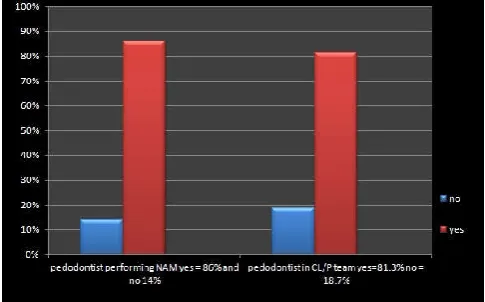
along with other specialists including Prosthodontists and Orthodontists and 81.3% of the Surgeons prefer having a Pedodontist in the cleft lip and palate team (Graph 2). The study also assessed the technical aspects of carrying out Naso alveolar molding in the child. The age at which most of the surgeons (60 %) preferred NAM was within one month, the other preferences being within 3 months and beyond 3 months. (Graph 3) Impression material of choice was silicone putty material by 42% and alginate by 21.4 % of the respondents. Special labs were preferred for fabrication of appliance by 38.3% and their own clinical setting by 25.2% of the respondents. Material of choice for fabrication of appliance was invariably soft self-cure acrylic and the technique preferred was mostly Figueroa’s by 44.9% followed by Grayson’s by
[image:2.595.312.555.550.701.2]27.1% andLiou’smethodby2.8%oftherespondents(Graph4).
Table 1. Preference of Presurgical orthopedic procedure by the surgeons
PSIO Frequency Percent
0 (preferring) 39 36.4
1 ( not preferring) 68 63.6
Total 107 100.0
Gaph 1. Preference of Nasalveolar moulding procedure by the surgeons – original pic
Graph 2 . Preference to pedodontist in performing NAM and inclusion of Pedodontist in the multidisciplinary team – original pic
proposed by Dr. Krishna Shama Rao, Dr. Vikram Shetty and Dr. Ajay Bajaj. Adverse effects noted due to wear of the appliance included soreness, ulcers, nasal ulcerations etc and remedies preferred by surgeons in such cases included mainly the moisturizing gels like Aloe Vera gels and adhesive tapes. Thirty six percent of respondents have observed good cooperation from the parents of children and 32% have told that the parents are mostly cooperative but not always. The surgeons who prefer NAM have mostly rated the procedure as yielding good results, excellent results and average results by 39%, 29% and 5% of the respondents respectively.
Graph 3. Age of the child to start Nasoalveolar moulding as preferred by the surgeons – original pic
Graph 4. Depicting the percentage of surgeons preferring various techniques of NAM –original pic
DISCUSSION
In India, the incidence of cleft lip/ palate is estimated to be one
in 500 live births. [16] In a country like India where the annual
birth rates are very high, such large incidence would mean a good proportion of the population being affected. This fact in itself is sufficient to draw our attention towards studies regarding the plethora of deformities and other problems in the child associated with CLP and more importantly the comprehensive management of these problems. According to Rubin et al (2015), obtaining an aesthetic and functional primary surgical repair in patients with complete CL/P can be challenging due to tissue deficiencies and alveolar ridge
displacement.[14] Patients with wider and more severe clefts
generally have more pronounced naso-labial stigmata that tend
to worsen with growth.[15] Apart from the obvious aesthetic
defect and functional problems, there is an array of underlying defects that may not manifest at initial examination but are bound to surface sooner or later. Grayson (1999) proposed that although plastic surgery has made great advances in the area of cleft surgery, surgical repair alone cannot solve the multiple
problems encountered with the deformities of the cleft.1 In
such cases, acceptable facial esthetics can be achieved by employing simple, cost effective procedures like pre-surgical infant orthopedics that has been employed since the 1950s as an adjunctive neonatal therapy for the correction of CL/P. The traditional orthopedic approaches failed to address the deformity of the nasal cartilages in unilateral, as well as bilateral, clefts of the lip and palate and the deficiency of columella tissue in infants with bilateral clefts. NAM represents a paradigm shift from the traditional methods of pre-surgical infant orthopedics and has almost become the synonym for Pre surgical infant orthopedic procedures(
PSIO).[19] It includes two concepts - Passive molding using
customized plates of acrylic guiding the development of the
alveolus[12] so as to achieve selective repositioning of the
alveolar segments as well as the surrounding soft tissue by molding the alveolar processes and the deformed nasal
cartilages and lengthening of the deficient columella.[10,13] the
second oneisnegative sculpturing through series of alterations
made to the tissue side of NAM plate by adding up or removal of acrylic in required regions to obtain required alignment of
the alveolar and nasal parts.[12] NAM mainly utilizes the
malleability of immature nasal cartilage and its ability to maintain a permanent correction of its form. Hence the advantages of Pre-surgical Infant Orthopedics can be considered from a soft tissue perspective as well as from the usual osseous perspective. It facilitates nonsurgical elongation of the columella in bilateral cleft lip and palate through the application of tissue expansion principles by gradual elongation of the nasal stents and the application of forces that are applied to the lip and nose. NAM also eliminates surgical scars associated with traditional columella reconstruction, has reduced the number and cost of revision surgical procedures,
and reduced the need for secondary alveolar bone grafts.[20]
The principal objective of pre-surgical NAM is to reduce the severity of the initial cleft deformity which enables the surgeon to enjoy the benefits associated with repair of an infant who presents with a minimal cleft deformity. Lip segments that are almost in contact at rest, symmetrical lower lateral alar cartilages, and adequate nasal mucosal lining, which permits postsurgical retention of the projected nasal tip, reduction in the width of the alveolar cleft segments until passive contact of the gingival tissues is achieved are the outcomes of an ideal NAM procedure. The advantages of NAM itself increases its popularity and various studies shows its wide spread application.
In the current study the overall preference for the PSIO procedure among CL/P surgeons in India is 63.6% with a preference of 59.8 % for NAM. This is in accordance to Sandy et al (1998) showing 47-51% of neonates treated United Kingdom using pre-surgical appliances and In the United States and Canada, 71% of centers reported using some form of pre-surgical molding before bilateral cleft lip surgery, with naso alveolar molding being the most popular at 55% of those
using this treatment according to Tan et al. (2012).[21,22] Ideally
PNAM should begin as early as possible to increase the permanence of nasal improvement. In our study, the most preferred timing for NAM is within 1 month after birth (60%)
which is in accordance to Bennum et al. who proposed early
(before 15 days old) PNAM treatment resulted in improved
nasal morphology and Matsuo et al. (1984) who determined
saliva, being comfortable to the patient, easy manipulation, being inexpensive, and preventing respiratory arrest. Elastomeric putty has the advantage of not extruding deep into the undercut areas in the region of cleft and also resist tearing
during removal.[25] Invariably all the clinicians prefer soft
self-cure acrylic for fabricating the appliance. Since its introduction by Grayson, NAM has undergone modification several times. The original technique introduced by Grayson involved the initiation of nasal molding once the alveolar segments have been approximated to 6 mm which increased the number of appointments resulting in excess financial burden on the parents. Grayson has also proposed a weekly follow-up in the patients as the molding of cartilage can be effectively done during the first 6 weeks of the infants’ life with selective adjustment of the appliance in each visit. In Figueroa and Liou techniques, nasal stent is introduced along with the alveolar molding appliance in the first appointment itself. This has facilitated simultaneous and mutually dependent nasal and alveolar molding that is found to restore the esthetics better. In our study, majority of the surgeons have preferred Figueroa’s
technique (44.9%). Talmant et al. developed a nearly identical
technique, but all molding was performed post-surgically. Suri and Tompson proposed a modified muscle-activated maxillary
orthopedic appliance; Retnakumari et al. described alveolar
molding appliance with expansion screw; dynamic pre-surgical nasal remodeling intraoral appliance was designed by Bennun and Figueroa; extra-oral nasal molding appliance by Doruk and Kiliç and self-retentive appliance with orthodontic wire was used by Singh et al.
The most common complication following wear of the appliance is irritation to the oral mucosal or gingival tissue. Intraoral tissues may ulcerate from pressure or rubbing. Common areas of breakdown are the frenum attachments, the anterior pre-maxilla, and the posterior fauces as the molding plate is retracted. However, the use of NAM has been controversial and has polarized professionals in the field of
craniofacial rehabilitation, challenging the established
standards of care.[23] NAM proponents say that the technique
reduces the severity of the cleft (e.g., nasal defect, cleft size) thereby improving the future surgical results and minimizes
scarring and Lee et al. (2004) proved that mid-facial growth in
the sagittal and vertical plane was not affected by NAM and
gingivoperiosteoplasty.[24] Ezzat C F et al. (2006) found that
PNAM therapy improved nasal symmetry and helped
normalize the dental alveolar arch.[25] Several short-term (4
months to 1 year) and long-term (4.5 to 9 years) studies like Maull et al., 1999; Ezzat et al., 2007; Jaeger et al., 2007; Barillas et al., 2009 etc indicate that NAM significantly
improves nasal symmetry over surgery alone.[23] According to
Hotz et al (1979) controversy still exists over whether or to what extent pre-surgical infant orthopedic treatment in CL/P makes sense. First of all, not all kinds of early orthopedic approaches are equivalent and comparable. Furthermore, long term evaluation of the effect of early orthopedic procedures can only be of value if the concomitant surgical interventions are performed with the same technique, the same timing and, if
possible, by the same surgeon.[18] Berkowitz (2009) argues that
NAM plus gingivoperiosteoplasty compromises future facial growth. Other opponents also suggest that NAM places an extra emotional burden on the family system, which already must adapt to having a newborn with a birth defect and that without parent /caregiver compliance the procedure is an
additional burden on the family.[23] The frequent appointments
associated with NAM have decreased its preference among
surgeons in CL/P as indicated in the study even though more number of surgeons have supported the procedure. Lack of awareness among the parents combined with the extra burden of follow-up visits; make the procedure less accepted by the parents of the children who are made aware of the surgical aspects better. NAM being a highly technique sensitive procedure depends on the follow-up adjustments of the appliance to get the desired approximation of the alveolar segments. The parents should be properly educated regarding the importance of NAM especially in the cases with large cleft where it will be difficult to surgically approximate the segments, so that they are motivated enough to bring their children for the regular follow-up visits till the desired result is obtained. In this regard the Smile Train project has succeeded in providing adequate care to children affected with CL/P who belong to lower strata of society all around the world. The drawback of the current study is the small sample size from which the results have been derived. The study can be further improvised with larger sample size and by collecting the data through direct personal interview with the cleft lip and palate surgeons across India.
Conclusion
PNAM has been proved to be an effective adjunctive therapy for reducing hard and soft tissue cleft deformity before surgery, but its preference remains questionable. The present study showcases the current scenario of Naso Alveolar molding in India. Pre-surgical naso-alveolar molding with primary retrograde nasal reconstruction improves the quality of the reconstructive outcome and decreases the number of surgical procedures. Generally, the acceptance of naso-alveolar molding has been slow in the Indian scenario because of the lack of sufficient resources, poor background of the parents and lack of awareness among the general public regarding the procedures. The present study shines light on the slow yet steady increase in the preference for the procedure. The study shows immense scope for Pedodontists in the field of comprehensive cleft lip/ palate management. A vast majority of surgeons preferred the Pedodontists doing NAM on the child besides other specialists. Thus the current study is a wake up call for the fellow Pedodontists to be actively involved in the comprehensive CL/P management team.
Acknowledgement: Special acknowledgement to my guide Dr
Savitha Sathyaprasad for enabling me to conduct the study. I soulfully acknowledge my parents and brother who are the never-ending source of support in all my endeavors. I acknowledge my friend and colleague Dr Vinodhini J for her support throughout the conductance of the study. I acknowledge the CL/P team under Dr Krishnamoorthy Bonanthaya in Mahaveer Jain Hospital, Bangalore for his valuable suggestions. I thank Professor Dr Krishnamoorthy S H and Asst Professor Dr Allwin Antony Thottathil for helping in the formulation of questionnaire.
Conflict of interest: None
REFERENCES
1. Kadir A, Mossey PA, Orth M, Blencowe H, Sowmiyaus M,
2. Mossey P, Little J. Addressing the challenges of cleft lip and palate research in India. Indian Journal of Plastic Surgery: Official Publication of the Association of Plastic Surgeons of India. 2009 Oct;42(Suppl):S9.
3. Presurgical Nasoalveolar Molding Techniques for a Complete
Unilateral Cleft Lip and Palate Infant: A Case Report Montian Manosudprasit, Pathomporn Chongcharueyskul, Tasanee Wangsrimonkol, Poonsak Pisek.
4. Grayson BH, Cutting CB. Presurgicalnasoalveolarorthopedic
molding in primary correction of thenose, lip, and alveolus of infants born withunilateral and bilateral clefts. Cleft Palate CraniofacJ 2001; 38: 193-8.
5. Pai BC, Ko EW, Huang CS, Liou EJ. Symmetry ofthe nose
after presurgicalnasoalveolar molding ininfants with unilateral cleft lip and palate: apreliminary study. Cleft Palate Craniofac J 2005;42: 658-63.
6. Grayson BH, Santiago PE, Brecht LE, Cutting CB.
Presurgicalnasoalveolar molding in infants with cleft lip and palate. Cleft Palate Craniofac J 1999;36: 486-98.
7. Kamble VD, Parkhedkar RD, Sarin SP, Patil PG.
Presurgicalnasoalveolar molding (PNAM) for aunilateral cleft lip and palate: a clinical report. JProsthodont 2013; 22: 74-80.
8. Suri S (2010) Optimal timing for nasal cartilage molding in
presurgicalnasoalveolar molding. Plast Reconstr Surg 125: 112e–113e.
9. PRESURGICAL NASOALVEOLAR MOULDING. Sonia
Sivadas, ArathiRao, Suprabha.3500 incidence in india.
10.Patel D, Goyal R, Puri T. PresurgicalNasoalveolarMoulding
An Adjunct to Facilitate Surgical Repair in Infants with Cleft Lip and Palate. Modern Plastic Surgery, 2013; 3(1):34–42.
11.Laxmikanth SM, Karagi T, Shetty A, Shetty S.
Nasoalveolarmolding: A review. Journal of Advanced Clinical
& Research Insights. 2014; 1: 108–113
12.Liou EJW, Subramanian M, Chen PKT (2007) Progressive
changes of columella length and nasal growth after nasoalveolarmolding in bilateral cleft patients: a 3-year
follow-up study. Plastic Reconstr Surg 119:642–648
13.Rubin MS, Clouston S, Ahmed MM, Lowe K, Shetye PR,
Broder HL, Warren SM, Grayson BH. Surgeons’ Assessment of Presurgical Clefts and Predicted Surgical Outcome in Patients Treated with and without Nasoalveolar Molding. The Journal of craniofacial surgery. 2015 Jan; 26(1):71.
14.. Latham RA. Development and structure of the premaxillary
deformity in bilateral cleft lip and palate. Br J Plast Surg.
1973; 26:1–11.
15.Radhakrishna U, Ratnamala U, Gaines M, et al. Genomewide
scan for nonsyndromic cleft lip and palate in multigenerational Indian families reveals significant evidence of linkage at 13q33.1-34. Am J Hum Genet. 2006;79:580–585.
16.Chaisrisookumporn N, Stella JP, Epker BN. Cephalometric
profile evaluations in patients with cleft lip and palate. Oral Surg Oral Med Oral Pathol Oral Radiol Endod. 1995;80:137– 144.
17.Hotz MM, Gnoinski WM. Effects of early maxillary
orthopaedics in coordination with delayed surgery for cleft lip and palate. Journal of maxillofacial surgery. 1979 Jan 1;7:201-10.
18.Grayson BH, Maull D. Nasoalveolar molding for infants born
with clefts of the lip, alveolus and palate. InCleft Lip and Palate 2006 (pp. 451-458). Springer Berlin Heidelberg.
19.Splengler LA, Chavarria C, Teichgraber FJ, Gatenes J, Xia JJ.
Presurgicalnasoalveolarmoulding therapy for the treatment of bilateral cleft lip and palate: A preliminary study. Cleft Palate-Craniofac J 2006;43:321-8.
20.Sischo L, Chan JW, Stein M, Smith C, Van Aalst J, Broder
HL. Nasoalveolar molding: prevalence of cleft centers offering NAM and who seeks it. The Cleft Palate-Craniofacial Journal. 2012 May;49(3):270-5.
21.Sandy J, Williams A, Mildinhall S, et al. The Clinical
Standards Advisory Group (CSAG) Cleft Lip and Palate Study. Br J Orthod. 1998 Feb. 25(1):21-30.
22.Tan SP, Greene AK, Mulliken JB. Current surgical
management of bilateral cleft lip in North America. Plast Reconstr Surg. 2012 Jun. 129(6):1347-55.
23.Lee CT, Grayson BH, Cutting CB, Brecht LE, Lin WY. Pre
pubertal midface growth in unilateral cleft lip and palate following alveolar moulding and gingivoperiosteoplasty. Cleft Palate-Craniofac J 2004;41:375-80.
24.Ezzat CF, Chavarria C, Teichgraeber JF, Chen JW, Stratmann
RG, Gateno J, Xia JJ. Presurgicalnasoalveolar molding therapy for the treatment of unilateral cleft lip and palate: a preliminary study. The Cleft palate-craniofacial journal. 2007 Jan;44(1):8-12.
25.Ravichandra KS, Vijayaprasad KE, Vasa AA, Suzan S. A new
technique of impression making for an obturator in cleft lip
and palate patient. Journal of Indian Society of Pedodontics
and Preventive Dentistry. 2010 Oct 1; 28(4):311.