An Energy-Balanced Clustering Routing Algorithm for
Wireless Sensor Network
Fengjun Shang, Yang Lei
College of Computer Science and Technology, Chongqing University of Posts and Telecommunications, Chongqing, China
Email: [email protected]
Received May 19, 2010; revised June 27, 2010; accepted August 4, 2010
Abstract
In this paper, we consider a network of energy constrained sensors deployed over a region. Each sensor node in such a network is systematically gathering and transmitting sensed data to a base station (via cluster- heads). This paper focuses on reducing the power consumption of wireless sensor networks. Firstly, we pro-posed an Energy-balanced Clustering Routing Algorithm called LEACH-L, which is suitable for a large scope wireless sensor network. Secondly, optimum hop-counts are deduced. Lastly, optimum position of transmitting node is estimated. Simulation results show that our modified scheme can extend the network lifetime by up to 80% before first node dies in the network. Through both theoretical analysis and numerical simulations, it is shown that the proposed algorithm achieves higher performance than the existing clustering algorithms such as LEACH, LEACH-M.
Keywords:Wireless Sensor Network, LEACH, Energy Efficient, Multiple-Hop
1. Introduction
Wireless Sensor Networks (WSNs) can collect reliable and accurate information in distant and hazardous envi-ronments, and can be used in National Defence, Military Affairs, Industrial Control, Environmental Monitor, Traf-fic Management, Medical Care, Smart Home, etc. The sensor whose resources are limited is cheap, and depends on battery to supply electricity, so it’s important for Rout- ing to efficiently utilize its power.
In this paper, we propose an advanced multiple-hop routing protocol named LEACH-L, whose features can be described as follows: when the cluster-heads are close to, they directly communicate with Base station (BS); when they are far in distance, they telecommunicate by multiple-hop way, and the shortest transmission distance is limited. The sensors in different areas use different frequencies and gaps to communicate with BS. In the last part, the authors respectively simulate LEACH [1], LEACH-M [2], and LEACH-L on the Matlab. The simu-lation experiments indicate that: LEACH-L can prolong the whole network lifetime.
2. Related Works
Various issues in the design of wireless sensor networks
such as the design of low-power signal processing archi-tectures, low power sensing interfaces, energy efficient wireless media access control and routing protocols, have been areas of extensive research in recent years. LEACH is one of the first hierarchical routing approaches for sen- sors networks, which attempts to improve energy and routing efficiency of such networks. The idea proposed in LEACH has been an inspiration for many hierarchical routing protocols, although some protocols have been independently developed.
In [2], the author puts forward energy-LEACH and multihop-LEACH protocols called LEACH-M. Energy- LEACH protocol improves the choice method of the cluster head, makes some nodes which have more resi- dual energy as cluster heads in next round. Multihop- LEACH protocol improves communication mode from single hop to multi-hop between cluster head and sink. Simulation results show that energy-LEACH and multi-hop-LEACH protocols have better performance than LEACH protocols.
makes it harder to maintain communication connectivity in topology control.
In [4], author addresses the problem of clustering in WSNs, subject to upper bounds on the maximum latency, the energy consumed by intermediate nodes, and clusters size. Those constraints are necessary for the reliability of the system and for extending its lifetime.
In [5], author proposes a novel energy efficient clus-tering scheme for single-hop wireless sensor networks. A novel cost function is introduced to balance the load among the cluster heads and prolongs the network life-time significantly against the other clustering protocols such as LEACH.
In [6], an Energy-Efficient Unequal Clustering is pro-posed for multihop sensor network. Simulation results show that the unequal clustering mechanism balances the energy consumption well among all sensor nodes and achieves an obvious improvement on the network life-time.
In [7], a novel multicast protocol, uCast is proposed for energy efficient content distribution in sensor net-works. The uCast support a large number of multicast sessions, especially when the number of destinations in a session is small.
In [8], a novel energy-efficient protocol is proposed, called Route Maintenance based-on Energy Threshold and extends the lifetime of nodes and enhance the effi-ciency of the entire network.
LEACH-C uses a centralized algorithm to form clus-ters [9]. A non-autonomous cluster-head selection is again the main disadvantage of this algorithm. Moreover, it re- quires the location information of all nodes in the net-work. However, location information in mobile wireless networks is only available through GPS or a location- sensing technique, such as triangulation which requires additional communication among the nodes.
In [10], DCHS algorithm is proposed. In this algo-rithm, in order to extend the lifetime, a parameter En_ current/En_max is introduced. Nevertheless, it has a cru-cial disadvantage: After a certain number of rounds the network is stuck, although there are still nodes available with enough energy to transmit data to the base station, so DCHS algorithm need be improved.
3. LEACH-L Algorithm
In order to explain our idea, we fist define some parame-ters as follows.
The Eelect is consumed energy per bit.
The fs and mp are consumed energy per bit and
per area respectively.
The do is a distance, which decide the parameter value
both fs and mp.
The EDA is the energy required for data aggregation.
The is a cluster-head section probability, used dur-ing cluster creation.
p
The round is the time, which all cluster members com-municate with cluster heads and cluster heads communi-cate with BS.
3.1. Problem Formulation
This paper proposes a modification of LEACH cluster-head selection algorithm to reduce energy consumption. For a microsensor network, we make the following as-sumptions:
The base station (BS) is located among the sensors and is stationary.
All nodes in the network are homogenous and en-ergy-constrained.
All nodes are able to reach BS in one hop.
Nodes have location information.
Propagation channel is symmetric. Cluster-heads perform data compression.
This paper presents an improvement to the LEACH’s cluster-head selection algorithm by introducing distance- based factor, called LACH-L. In LEACH-L, the clusters are re-established in each round. Each of these rounds consists of a set-up and a steady-state phase. New cluster heads are elected in each round and as a result the load is well distributed and balanced among the nodes in the network. Moreover, each node transmits to the closest cluster-head to split the communication cost to the sink. Only the cluster head has to report to the sink and may consume a large amount of energy, but this happens pe-riodically for each node. During the set-up phase clus-ter-heads are determined and the clusters are organized. During the steady-state phase data transfers to the base station occur.
We use a simplified model shown in Figure 1 for the radio hardware energy dissipation. Both the free space ( power loss) and the multi-path fading ( power loss) channel models are used in the model, depending on the distance between the transmitter and receiver. Transmis-sion ( Tx) and receiving costs (
2
d d4
E ERx) are calculated as
follows [9]:
2
4 , ( , )
,
elect fs o
Tx
elect mp o
lE l d d d E l d
lE l d d d
(1)
where d is the distance between the transmitter and the receiver.
Where is:
0 fs
mp
d
(2)
Figure 1. Radio energy dissipation model.
( )
Rx elect
E L E L (3) with L as the length of the message in bits, d as the dis-tance between transmitter and receiver node. A sensor node also consumes DA amount of energy for data
aggregation. We assumed that the sensed information is highly correlated, thus the cluster-head can always ag-gregate the data gathered from its members into a single length-fixed packet.
E
3.2. Problem in Single-hop Routing
When the scope of WSN gets larger, the diversity of en-ergy consumption among cluster-heads of LEACH as well gets larger.
Let’s suppose that there are cluster-heads which is r far from the BS and which is 3r far from the BS.
( ) S i ( )
S j
When , the energy consumption of is listed
as 0
r d S i( )
4 ( , )
Tx elect mp
E k r kE k r The energy consumption of S(j) is written as
4 ( , ) 81
Tx elect mp
E k r kE k r
In the formula, when the circuit consumption is the same, the energy consumed by transmit amplifier of S(i) is 8l times as much as that of S(j) so WSNs in large scope should adopt multiple-hop routing protocols.
3.3. Introducing Multiple-Hop Routing
The data collected by myriad sensors flow to a small number of BS, which leads to the energy of sensors which near to basic be used up quickly and leads to the break of networks, so the question existing in many-to- one networks is viewed as the hot spot [11]. Meanwhile, only considering the shortest route will result in the geo-graphic superiority of individual sensor embodied in the multiple routes, and this is proved in LEACH-M. Be-sides, multiple-hops routing cuts down the communica-tion consumpcommunica-tion, but increases the circuit energy con-sumption. In order to go on the research, let’s suppose
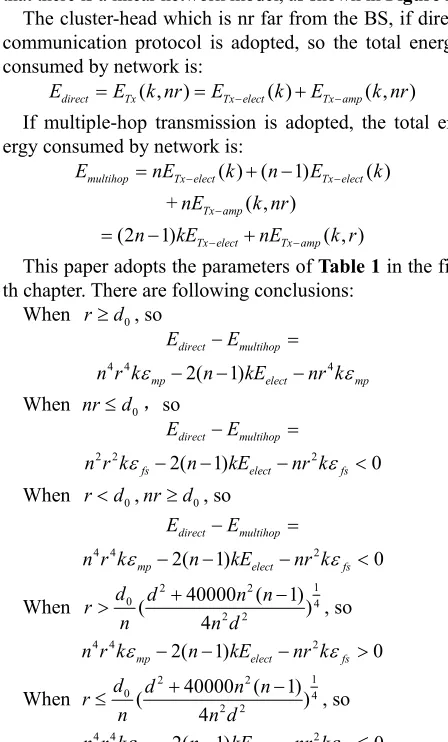
that there is a linear network model, as shown in Figure 2. The cluster-head which is nr far from the BS, if direct communication protocol is adopted, so the total energy consumed by network is:
( , ) ( ) ( , )
direct Tx Tx elect Tx amp
E E k nr E k E k nr If multiple-hop transmission is adopted, the total en-ergy consumed by network is:
( ) ( 1) ( )
multihop Tx elect Tx elect
E nE k n E k
+nETx amp ( , )k nr
(2n 1)kETx elect nETx amp ( , )k r
This paper adopts the parameters of Table 1 in the fif- th chapter. There are following conclusions:
When r d 0, so
direct multihop
E E
4 4 2( 1) 4
mp elect mp
n r k n kE nr k
When nr d 0,so
direct multihop
E E
2 2 2( 1) 2 0
fs elect fs
n r k n kE nr k
When r d 0,nr d 0, so direct multihop
E E
4 4 2( 1) 2 0
mp elect fs
n r k n kE nr k
When
1
2 2
0 4
2 2 40000 ( 1)
( )
4
d d n n
r
n n d
, so
4 4 2( 1) 2 0
mp elect fs
n r k n kE nr k
When
1
2 2
0 4
2 2 40000 ( 1)
( )
4
d d n n
r
n n d
, so
4 4 2( 1) 2 0
mp elect fs
n r k n kE nr k
Therefore, when the nodes are close to the BS, directly communicate routing can exhibition a good result; when the transmission distance is long, under limiting each transmitting distance the multiple-hop strategy can re-duce the energy consumption of WSN.
3.4. Communication Conflicts
[image:3.595.307.531.88.459.2]The communication between the cluster-heads and the BS should adopt Collision Avoidance when the network be-comes large and the number of sensors increase, or it will give rise to the occurrence of conflicts when the clus-ter-heads are sending data. Therefore, sensor networks in large scope should adopt certain strategies to reduce the
occurrence of conflicts.
3.5. Estimating Hop-Counts
CHs can send their data via just one (high-energy) trans- mit of data to the base station or via a multi-hop scheme where each data message must go through n (low energy) transmits and n receives. Depending on the relative costs of the transmit amplifier and the radio electronics, the total energy expended in the system might actually be greater using multi-hop routing than direct transmission to the base station.
To illustrate this point, consider the linear network shown in Figure 1, where the distance between the no- des is r. If we consider the energy expended transmitting a single l-bit message from a node located a distance nr from the base station using the direct communication approach via one hop and Equations (1) and (3), we have:
2 1 ( )
Tx fs elect
n
E l r lE
(4)
Where is the number of hops. Thus, the total en-ergy is:
TX RX
EtotE E 2 2 ( 1)
2 elect fs
n r
l E l
(5)
And the optimum number of hops is computed as be-low: 2 2 2 0 tot elect fs opt dE d lE l
d
2 100 fs opt elect d d E
This shows that, when transmission energy is on the same order as receive energy, which occurs when trans-mission distance is short, direct transtrans-mission is more en-ergy-efficient than multi-hop routing. Thus we use direct transmission communication among CHs and the base station.
3.6. Selecting Optimum Transmitting Node
To illustrate this point, consider the linear network shown in Figure 3.
Where 0 is distance between BS and node 1,
0 2 0 is distance between node 2 and node 1, is distance between BS and node 2. We select node 1 to transmit data, when node 2 transmits data to BS. From
1 r d 2d
d r r
[image:4.595.303.539.80.451.2]Figure 3. Relay node network model.
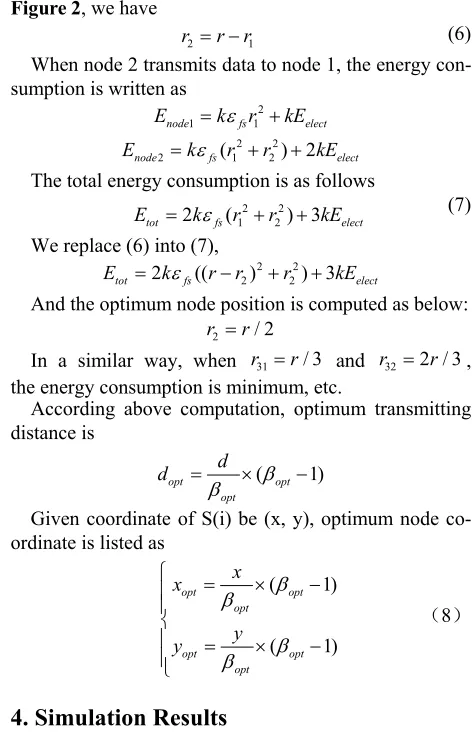
Figure 2, we have
2 1
r r r (6) When node 2 transmits data to node 1, the energy con-sumption is written as
2
1 1
node fs elect
E k r kE 2 2
2 (1 2) 2
node fs elect
E k r r kE The total energy consumption is as follows
2 2 1 2
2 ( ) 3
tot fs elect
E k r r kE (7) We replace (6) into (7),
2 2
2 2
2 (( ) ) 3
tot fs elect
E k r r r kE
And the optimum node position is computed as below: 2 / 2
r r
In a similar way, when r31r/ 3 and r322 / 3r , the energy consumption is minimum, etc.
According above computation, optimum transmitting distance is ( 1 opt opt opt d d )
Given coordinate of S(i) be (x, y), optimum node co-ordinate is listed as
( 1 ( 1 opt opt opt opt opt opt x x y y ) ) (8)
4. Simulation Results
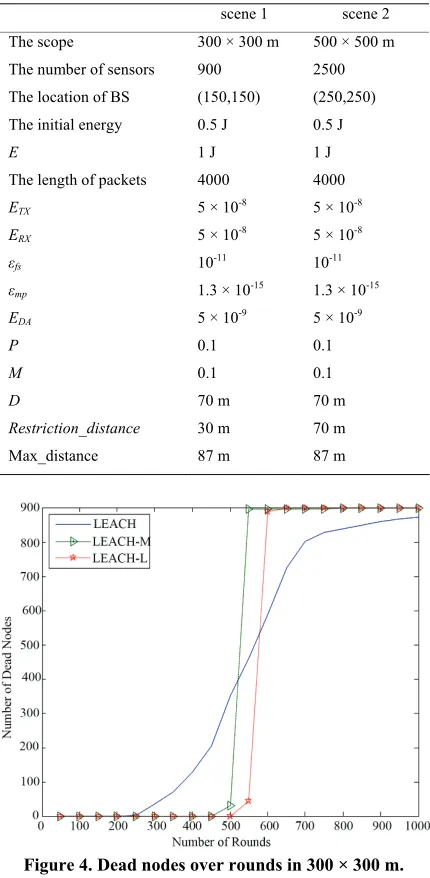
This paper makes Matlab as experiment platform, and goes on imitation in two scenes respectively. The para- meters of imitation experiments see the following Table 1, in which the first ten parameters are same to the docu-ment.
Figure 4 and Figure 5 are the network’s life cycle in two scenes. In the scene 1, the Fist Node Death time (FND) of LEACH-L is 2.5 times more than that of LEACH, and the Half Nodes Death (HND) time of LEACH-L is about 1.1 times more than that of LEACH. In the scene 2, LEA- CH-L’s FND and HND are 12 times and 1.8 times as mu- ch as that of LEACH. Besides, the last node dead time of LEACH and LEACH-M are longer than that of LEACH- L. The reason is that LEACH-L makes power equally distribute among all sensors, therefore, in the pre-period, the network’s activity nodes and cover areas of LEACH-L are greatly larger than that of LEACH-M and LEACH.
Table 1. Simulation parameters.
scene 1 scene 2 The scope
The number of sensors The location of BS
300 × 300 m 900 (150,150)
500 × 500 m 2500 (250,250) The initial energy
E
The length of packets ETX
ERX εfs εmp
EDA
P M D
Restriction_distance Max_distance
0.5 J 1 J 4000 5 × 10⁻⁸
5 × 10⁻⁸
10-11
1.3 × 10⁻¹⁵
5 × 10⁻⁹
0.1 0.1 70 m 30 m 87 m
0.5 J 1 J 4000 5 × 10⁻⁸
5 × 10⁻⁸
10-11
1.3 × 10⁻¹⁵
5 × 10⁻⁹
[image:5.595.61.278.99.629.2]0.1 0.1 70 m 70 m 87 m
Figure 4. Dead nodes over rounds in 300 × 300 m.
Figure 5. Dead node over rounds in 500 × 500 m.
M. In the scene 2, before HND, the data transmitted by LEACH-L is 2.4 times that of LEACH and 2.1 times that of LEACH-M.
Figure 8 is relation between energy consumption and round among LEACH, LEACH-M, LEACH-L in 300 × 300 scene. From Figure 8, it is known that LEACH-L can save energy consumption of network when LEACH- L is compared with LEACH-M and LEACH. After a while, it saves energy in LEACH and LEACH-M better than LEACH-L. In about the 400th round, total energy
[image:5.595.313.530.324.508.2]consumption of network in LEACH-L is more than LE- ACH and LEACH-M, because some nodes in LEACH and LEACH-M are dead with time going.
Figure 9 is relation between energy consumption and round among LEACH, LEACH-M, LEACH-L in 500 × 500 scene. From Figure 9, it is known that LEACH-L can save 50% energy consumption of network in the 100th
round when LEACH-L is compared with LEACH-M and LEACH. In about the 400th round, total energy
consump-tion of network in LEACH-L is more than LEACH and
Figure 6. Received packets over rounds in 300 × 300 m.
[image:5.595.319.525.535.704.2]Figure 8. 300 × 300 energy consumption among LEACH, LEACH-M and LEACH-L.
Figure 9. 500 × 500 energy consumption among LEACH, LEACH-M and LEACH-L.
Figure 10. 300 × 300 energy consumption of LEACH-L in different areas.
Figure 11. 500 × 500 energy consumption of LEACH-L in different areas.
[image:6.595.65.279.294.477.2]LEACH-M, because some nodes in LEACH and LEA- CH-M are dead with time going.
Figure 10 is relation between energy consumption and rounds in different area in LEACH-L. It is obvious that in two areas energy consumption is balancing in 300 × 300 scene.
Figure 11 is relation between energy consumption and rounds in different area in LEACH-L. It is obvious that in two areas energy consumption is balancing in 500 × 500 scene.
5. Conclusions
We have proposed a routing protocol named LEACH-L. The experiments demonstrate that in the larger scope sensor networks, Comparing with LEACH and LEACH- M which is the multiple-hop protocol only considering the distance, LEACH-L can balance network load, re-duce the network’s energy consumption, enhance the net- work’s data collecting precision and extend the net-work’s life cycle, certainly, LEACH-L demands each sen- sor node to record its own location information and the information of candidate routing cluster-heads, increas-ing the storage requirements of sensor nodes. But, com-pared with balancing the nodes’ surplus energy and pro-longing the life time of network, LEACH-L is valuable.
6. Acknowledgements
[image:6.595.66.279.517.693.2]7
. References
[1] W. Heinzelman, A. Chandrakasan and H. Balakrishnan, “Energy-Efficient Communication Protocol for Wireless Microsensor Networks,” Proceedings of 33rd Interna-tional Conference on System Sciences, Hawaii, 2000, p. 10. [2] X. N. Fan and Y. L. Song, “Improvement on LEACH Pro- tocol of Wireless Sensor Networks,” Proceedings of 2007 International Conference on Sensor Technologies and Applications, Valencia, 2007, pp. 260-264.
[3] G. Zhou, T. He, S. Krishnamurthy and J. A. Stankovic, “Models and Solutions for Radio Irregularity in Wireless Sensor Networks,” ACM Transactions on Sensor Net-works, Vol. 2, No. 2, 2006, pp. 221-262.
[4] B. Aoun and R. Boutaba, “Clustering in WSN with La-tency and Energy Consumption Constraints,” Journal of Network and Systems Management, Vol. 14, No. 3, 2006, pp. 415-439.
[5] M. Ye, C. F. Li, G. Chen and J. Wu, “EECS: An Energy Efficient Clustering Scheme,” 24th IEEE International Performance, Computing, and Communications Confer-ence, Phoenix, 2005, pp. 535-540.
[6] G. Chen, C. F. Li, M. Ye and J. Wu, “An Unequal Cluster- Based Routing Strategy in Wireless Sensor Networks,” Chinese Journal of Computers, Vol. 30, No. 1, 2007, pp.
27-36.
[7] Q. Cao, T. He and T. F. AbdelZaher, “uCast: Unified Con- nectionless Multicast for Energy Efficient Content Dis-tribution in Sensor Networks,” IEEE Transactions on Parallel and Distributed Systems, Vol. 18, No. 2, 2007, pp. 240-250.
[8] L. Hu, Y. Li and Q. B. Chen, “A New Energy-Aware Routing Protocol for Wireless Sensor Networks,” Inter- national Conference onWireless Communications, Net-working and Mobile Computing, Shanghai, 2007, pp. 2444-2447.
[9] W. Heinzelman, A. Chandrakasan and H. Balakrishnan, “An Application-Specific Protocol Architecture for Wire-less Microsensor Networks,” IEEE Transaction on Wire-less Networking, Vol. 1, No. 4, 2002, pp. 660-670. [10] M. J. Handy, M. Haase and D. Timmermann, “Low
En-ergy Adaptive Clustering Hierarchy with Deterministic Cluster-Head Selection,” Proceeding of the 4th IEEE Conference on Mobile and Wireless Communications Networks, Stockholm, 2002, pp. 368-372.