Accelerating Gender Equality in
Irish Higher Education Institutions
GENDER
ACTION
PLAN
2018-2020
GENDER
ACTION
PLAN
2018-2020
GE
N
D
ER
A
CT
IO
N
PL
AN
2018
CONTENTS
Foreword 2
Vision 5
Executive Summary by the Chair
6
Summary of Major Actions recommended by the Gender Equality Taskforce
10
Context for the Work of the Gender Equality Taskforce
14
International Experience
18
Gender Equality Taskforce Action Plan for 2018-2020
20
HEIs Showing Leadership – Institutional Gender Action plans
21
Incentivised Progress through Funding Mechanisms
22
Driving Sustainable change in the form of a Centre of Excellence
for gender equality
23
Athena SWAN Charter in Ireland
24
Recruitment and Promotion Procedures and Practices
26
Leadership 30
Governance and Management
32
Embedding Gender Equality in Organisational Culture
34
Implementation Plan – Measuring and monitoring progress
40
Appendix A: Summary of Progress Reports
43
Appendix B: ECU Review of Recruitment and Promotion Practices
55
Appendix C: Trends in Promotion and Recruitment
73
Appendix D: Positive Action Case studies
83
Appendix E: Stakeholder Consultation
90
Appendix F: Abbreviations and Acronyms
95
Appendix G: References
96
Appendix H: Terms of Reference
99
FOREWORD
A few women in leadership roles within our higher education institutions (HEIs) is not success – just because these few women have found a door through, doesn’t mean there still isn’t a wall there1.
I believe that our HEIs can become beacons of equality, diversity and inclusion and that Ireland will become recognised as an excellent place to study and work. Ireland’s size and its track record in effecting change on key policy initiatives means that we can make this vision a reality. But right now, we have a lot of work to do to get there.
The Higher Education Authority (HEA) National Review of Gender Equality in Irish Higher Education Institutions (2016) was an important first step in highlighting the gender inequality that existed at senior academic levels in our HEIs and suggested radical changes to tackle it. However, since the publication of the HEA Expert Group report progress has remained exceptionally slow.
Data trends in the universities over the period 2013-2017, show that there has been a consistently low rate of change year on year, only 1-2% each year at professor level, from a starting position of 18% female professors in 2013 to just 24% in 2017. The HEA Higher Education Institutional Staff by Gender report (2018) highlights that in 2017 only 24% of professor posts were filled by women as compared to 51% female lecturers, the entry level for academic posts in the university sector. While the number of female professors is just one metric, it is a key metric used internationally to compare countries, and it clearly highlights the extent of the problem in academia.
International experience shows us that the path towards gender equality is neither linear nor guaranteed, and the rate of improvement at senior levels in HEIs internationally is extremely slow. Countries who have made considerable efforts to improve their gender equality still show significant under representation of women at professor level (e.g. in 2016, France, 24%; Germany, 23%; Switzerland, 21%. And in 2017: Norway, 29%).
I established the Gender Equality Taskforce to identify significant measures, drawing on the work of the HEA Expert Group, that could accelerate progress in achieving gender equality in Irish HEIs.
New data analysis conducted by the Gender Equality Taskforce on the estimated rate of change for the future suggests that the adoption of a flexible cascade model approach alone (as recommended by the HEA Expert Group) could take more than 20 years to achieve gender balance at professor level (i.e. minimum 40% female professors). If the vision that ‘by 2026 Ireland will be a world leading country for gender equality in higher education’ is to be realised, we need to look at the problem of gender diversity in academia in a new way, transformational positive action measures need to be implemented.
This Action Plan outlines a comprehensive strategic approach to help embed the recommendations of the HEA Expert Group, to bring about sustainable organisational change and to empower a culture of gender equality in the HEIs for all staff, academic and professional, management and support staff at all levels.
The establishment of a Centre of Excellence for Gender Equality will be a key enabler of this and in particular will ensure sustainable change by providing centralised support for the institutions, sharing of good practice, and funding for innovative organisational and cultural change initiatives nationally.
HEIs will set ambitious targets for the proportion of academic and professional, management and support staff of each gender to be in senior positions in 1, 3 and 5 years time, and these will be agreed with the HEA and monitored annually through the Strategic Dialogue process. Each HEI will be held accountable for achieving their targets and performance will be incentivised through additional funding or funding consequences as appropriate, to ensure progress is constant and considerable.
Attainment of Athena SWAN certification is an important part of this Action Plan. Engaging with the Athena SWAN process has been transformative for HEIs, according to stakeholder feedback to the Gender Equality Taskforce. I am pleased to see that all seven universities have now achieved institutional bronze awards, and that the institutes of technology are also starting the process of applying. I am however, conscious of the amount of work involved in this process and it will be a key aim of mine to ensure that Irish HEIs have the necessary support to engage fully with Athena SWAN and be ambitious so that they can work towards obtaining a silver, and eventually a gold, level award.
Accelerating gender equality in HEI’s is a key element in achieving the Department of Education and Skills vision and ambition to create the best education and training service in Europe by 2026. 2
A culture of gender equality benefits everyone, men and women, and will ensure Irish HEIs can perform to their full potential: delivering innovative teaching and learning at third level; attracting and retaining talented staff; and maximising creativity and diversity of thought in research. I believe that gender inequality exists as a result of systemic and cultural barriers which have solidified over time.
We must work together to tear down these barriers.
2 https://www.education.ie/en/Press-Events/Press-Releases/2016-Press-Releases/PR2016-09-15.html (accessed February 16th, 2018). Reiterated in the Action Plan for Education (2017), p. 6.
Mary Mitchell O’Connor,
VISION
By 2026 Ireland will be
a world-leading country
for Gender Equality
Higher education has undoubtedly played a pivotal role in Ireland’s success, and by investing in gender equality it will be possible for higher education institutions (HEIs) to perform to their full potential and to better meet the challenges of the future. However, systematic barriers in HEI organisation and culture mean that talent alone is not always enough to guarantee success.3 4
The Report of the Expert Group: HEA National Review of Gender Equality in Irish Higher Education Institutions, 2016 (hereinafter referred to as the Expert Group report) chaired by Maire Geoghegan-Quinn, was an important first step in tackling gender inequality in our higher education system. It highlighted the extent of the significant under-representation of women at the highest levels, of both academic and professional, management and support staff, and the many structural and cultural mechanisms which create and maintain gender inequality. However, since the recommendations were published only marginal improvements (1-2%) annually have been reported in addressing the under-representation of women at senior levels and in the governance and management of institutions.
The Gender Equality Taskforce, established in November 2017 by the Minister for Higher Education, Mary Mitchell O’Connor, T.D., has developed an Action Plan to accelerate the rate of progress towards gender equality in Irish HEIs and ensure that progress is constant and sustainable.
New qualitative data, gathered as part of the development of this Action Plan, has highlighted that the Expert Group’s recommendations have been a catalyst for change in higher education. The Gender Equality Taskforce was very encouraged to see that the HEIs in Ireland have positively embraced the excellent recommendations of the Expert Group report. It was clear from the stakeholder consultation and the progress reported in the self-audit review of recruitment and promotion initiatives, that there is a deepening understanding of appropriate actions to accelerate gender balance in HEIs and a commitment to collaborate on developing and sharing best practices. This is evidenced by the qualitative progress reports submitted to this Gender Equality Taskforce by the universities and the institutes of technology (IoTs), and a range of initiatives, projects and leadership interventions across the sector, such as the appointments of Vice Presidents/Directors for Equality, Diversity and Inclusion (EDI). All seven universities have now achieved Athena SWAN Institutional Bronze status. This qualitative narrative is as important as the quantitative reporting in measuring progress.
3 HEA (2016), Report of the Expert Group: HEA National Review on Gender Equality in Irish Higher Education Institutions.
4 I. Bohnet (2016) What works: gender equality by design (Cambridge Massachusetts: Harvard University Press); H. Morrissey (2018) A good time to be a girl: don’t lean in, change the system (London: Williams Collins); K. White and P. O’Connor (eds) (2017) Gendered success in higher education: global perspectives (London: Palgrave Macmillan).
However, notwithstanding these positive steps in the right direction, it is clear from the work of the Gender Equality Taskforce that progress is too slow (e.g. there were still only 24% women professors in 2017 compared to 21% in 2016; 30% of the highest paid (>€106,000) core-funded, professional, management and support staff in the universities were women and only 18% in the IoTs, compared to 29% and 17% in 2016 respectively; there has never been a women president in the university sector and only 2 out of 14 Presidents in the IoT sector are women). Progress is also uneven across the sector with the HEIs all at varying stages in their journey to achieve gender equality and for each the trajectory will be unique. Organisational and cultural barriers in the HEIs still exist and will need to be addressed if gender equality is to be achieved in HEIs.
It is imperative that HEIs fully recognise the extent of gender inequality in their organisation, and that the Presidents and senior management take ownership and show leadership in addressing the issue by examining their own context and culture and reviewing in detail their own disaggregated data on gender across all parts and levels of the institution.
To accelerate gender balance, the Gender Equality Taskforce recommends that each HEI should set its own ambitious multi-year targets for the proportion of people of each gender which it aims to have at the senior levels in the HEIs over the next one, three and five-year period. These targets should be included in the HEI’s gender action plan submitted annually to the HEA and be agreed as part of the Strategic Dialogue process. Progress on the goals, actions and targets in the HEI’s gender action plan to address gender inequality should be reported annually to the HEA and linked to funding mechanisms with incentives and consequences where appropriate. If the recommended HEI led approach does not achieve significant change within an appropriate timescale, the HEA and the Minister can adopt a more directive approach.
There are gaps in the data available that need to be addressed particularly in relation to: professional, management and support staff; research staff; staff on contracts. Simple refinement of quarterly returns to the HEA (and analysis process of same) would help immediately to collect better disaggregated data and allow more comprehensive benchmarking at a sector level. Furthermore, the development of a new staff database by the HEA would further improve the quality of the data.
Marie O’Connor
The Gender Equality Taskforce recommends that a Centre of Excellence for Gender Equality be set up within the HEA to ensure a sustainable acceleration towards gender equality is achieved by HEIs and it will advise the Minister and her Department of Education and Skills (DES) on progress, new developments and measures which may be required in future for Ireland. The Centre will be pivotal in enabling sharing of good practice, joint initiatives and co-operation between HEIs, and in developing a better understanding of the impact of the interventions taken and in determining the areas of future focus. The Athena SWAN process has evolved, becoming more demanding in its requirements, since the HEA Expert Group’s report was published. Attainment of Athena SWAN certification is an important part of the vision for the future but taking into account the more recent experience of HEIs in the UK to attain Silver and Gold status the Gender Equality Taskforce recommends that the HEA should have responsibility for determining the optimal timing and requirements in relation to Athena SWAN certification and whether a HEI is deemed eligible or ineligible for research funding based on their award status.
Recruitment, selection and promotion procedures and practices were a key focus for the Gender Equality Taskforce. Although there was some evidence of good practice already in place in some HEIs, this was variable across the sector. The Gender Equality Taskforce recommends that all HEIs should ensure that there are concrete actions in their institutional gender action plans, elaborated where appropriate at discipline and business unit level to bring their existing policies in line with good practice. The establishment of the Centre of Excellence for Gender Equality will play a key role in enabling this for the future.
International case studies show that the rate of change in higher education across Europe has been extremely slow. There are case studies throughout the European Union of positive action interventions which have led to accelerated or transformative change in higher education. Accordingly, the Gender Equality Taskforce recommends that, the HEIs appropriately consider further positive action measures that could be utilised in an Irish higher education context, where they would be a proportionate and effective means to achieve rapid and sustainable change.
In addition, the Gender Equality Taskforce re-enforces and reiterates the recommendations of the HEA Expert Group and has enhanced the recommendations based on further research and stakeholder consultation.
By investing in Gender Equality, Irish institutions will maximise their pursuit of excellence and successfully attract and keep the most talented students and staff, from all over the world. It will also provide Ireland with the opportunity to be recognised as unique in its inclusivity and excellence.
SUMMARY OF MAJOR
ACTIONS RECOMMENDED
BY THE GENDER EQUALITY
TASKFORCE
HEIs SHOWING LEADERSHIP – INSTITUTIONAL GENDER ACTION PLANS
Action(s) recommended by the Gender Equality Taskforce:
To accelerate gender balance, all HEIs shall set ambitious short, medium and long-term targets (1, 3 and 5 years) for the proportion of people of each gender which it aims to have at senior levels of academic and professional, management and support staff across the institution.
All HEIs shall set ambitious short, medium and long-term goals and actions at institutional level in order to progress gender equality.
All HEIs shall submit their institutional gender action plan to the HEA and provide annual progress updates.
It is envisaged that the institutional gender action plan will be implemented through discipline/ business unit gender action plans.
Relevant HEA Expert
Group Objective
â
To ensure a roadmap for attainment of gender equality is developed in
each institution.
INCENTIVISED PROGRESS THROUGH FUNDING MECHANISMS
Action(s) recommended by the Gender Equality Taskforce:
HEA block grant funding shall be linked to an institution’s performance in addressing gender inequality through the Strategic Dialogue process and System Performance Framework.
A new ‘Gender Equality Enhancement Funding Call’ should be set up to support innovative organisational and cultural change initiatives nationally.
New Gender Equality
Taskforce Objective
DRIVING SUSTAINABLE CHANGE IN THE FORM OF A CENTRE
OF EXCELLENCE FOR GENDER EQUALITY
Action(s) recommended by the Gender Equality Taskforce:
A new Centre of Excellence for Gender Equality, with a dedicated resource, shall be established by the Department under the auspice of the HEA. The Centre shall:
ensure sustainable acceleration towards gender equality in HEIs;
foster HEI collaboration and disseminate good practice;
provide centralised support for HEIs;
report regularly to the Minister in relation to performance of the system.
New Gender Equality
Taskforce Objective
â
To ensure sustainable acceleration towards gender equality in the
institutions.
ATHENA SWAN CHARTER IN IRELAND
Action(s) recommended by the Gender Equality Taskforce
HEIs shall apply for an Institutional Bronze award by 2019.
HEIs should retain their Bronze award until such time as they obtain a Silver award.
IoTs working towards TU status will be required to show evidence to the HEA, annually through their institutional gender action plans, that they are working together to build gender equality into their merger process.
Once a TU has been established, it shall be required to achieve a TU bronze award within three years.
The HEA will have responsibility for determining the optimal timing and requirements in relation to Athena SWAN certification, and whether a HEI is deemed eligible or ineligible for research funding based on their award status.
Relevant Expert Group
Objective
GENDER-PROOFING RECRUITMENT AND PROMOTION
PROCEDURES AND PRACTICES
Action(s) recommended by the Gender Equality Taskforce
All HEIs shall ensure that there are concrete actions in their institutional gender action plans, elaborated where appropriate at discipline and business unit level, to bring their existing policies in line with good practice.
The Centre of Excellence for Gender Equality will support the sharing of good practice by HEIs across the sector.
A report on the recruitment, selection and promotion procedures and practices must be submitted to the EDI sub-committee of the governing authority at least once annually, and should include statistical analysis of applications, recruitment and progression for all academic and professional, management and support staff.
Relevant HEA Expert
Group Objective
POSITIVE ACTION INTERVENTIONS
For all staff (academic and professional, management and support staff):
Action(s) recommended by the Gender Equality Taskforce
All HEIs shall strive for gender balance in the final pool of candidates for all competitions.
Each HEI is required to implement the flexible cascade model as a minimum (not a maximum) for both promotion and recruitment of academic staff and senior grades of professional, management and support staff.
Each HEI is required to set ambitious short, medium and long-term targets (1, 3 and 5 years), over and above the flexible cascade model for both promotion and recruitment of academic staff and senior grades of professional, management and support staff.
To enable HEIs to better monitor their progress and monitor patterns, data disaggregated by gender, contract type and broad discipline area or business unit should be collected on the number of applications, recruitments and promotions for all academic grades. This data should be submitted to the HEA annually for analysis at the sectoral and national level. Similar data should also be included for senior professional, management and support staff.
New and additional gender-specific posts, at appropriate levels, as well as other positive action measures, should be considered where they would be a proportionate and effective means to achieve rapid and sustainable change.
All HEIs shall ensure that there are concrete actions in their institutional gender action plan to address stereotyping of ‘female’ and ‘male’ roles.
Relevant HEA Expert
Group Objective
â
To drive change through the use of positive action interventions
for academic staff.
Relevant HEA Expert
Group Objective
â
To drive change at professor level through the use of positive
action interventions.
Relevant HEA Expert
Group Objective
CONTEXT FOR THE
WORK OF THE GENDER
EQUALITY TASKFORCE
Expert Group Report (2016)
The Report of the Expert Group: HEA National Review on Gender Equality in Irish Higher Education Institutions (herein referred to as HEA Expert Group Report), published in 20165 was an important first milestone in developing a strategic approach to tackling gender inequality in Irish higher education. Not only did it highlight clearly for the first time the extent of the significant under-representation of women at the highest levels, of both academic and professional, management and support staff (HEA Higher Education Institutional Staff Profiles by Gender, 2016, hereon referred to as the HEA Staff Profiles6), but it set out deliberately ambitious and radical recommendations, with academic excellence at their heart. The recommendations were not only for the higher education institutions (HEIs), but also for other key stakeholder groups in higher education including the Higher Education Authority (HEA), Department of Education and Skills (DES) and the research funding agencies.
Progress since 2016
Compared to 2016, the level of public discourse around equality issues such as the gender pay gap has increased significantly and there is now a heightened awareness, driven by both men and women, of the need for both equal opportunities and equal results for both men and women7. The third publication of the HEA Staff Profiles in July 2018,8 highlighted that numerical progress towards gender equality had been marginal (1-2%) each year since the inaugural report was published. This report presented gender-disaggregated data for 2017 on the leadership, governance, management and staffing of the universities, affiliated colleges and the IoTs. There was still a significant lack of women on key decision-making bodies in the institutions and at senior levels of both academic and professional, management and support staff.
5 HEA (2016) Report of the Expert Group: HEA National Review on Gender Equality in Irish Higher Education Institutions. 6 HEA (2016) Higher Education Institutional Staff Profiles by Gender.
7 C. Taylor (2018) Legislation to reduce gender pay gap set for this year. The Irish Times, 6 April 2018. See also https://press.pwc.com/News- releases/steady-progress-in-boosting-female-economic-empowerment--but-gender-pay-gap-still-a-major-issue/s/b77e04a0-f01c-4b62-b64f-f12032c6c409
Gender Equality Taskforce approach
The Gender Equality Taskforce formally began their work in November 2017 following the development of their Terms of Reference (see appendix H)
The approach taken by the Gender Equality Taskforce involved the following stages:
Review of recruitment and promotion policies and practices in HEIs, conducted by Equality Challenge Unit (ECU);
Consultation with stakeholders involving face-to-face meetings with the Gender Equality Taskforce, a stakeholder consultation event; and analysis of the outcomes of the consultation process;
Data analysis of academic staff recruitment and promotion by gender; and identification of gaps in data collection, particularly in regards professional, management and support staff data;
Progress reports from HEIs on the HEA Expert Group Report recommendations and analysis of progress made at sectoral level;
Literature review of national and international practice including challenges and emerging solutions since 2016;
Development of three-year gender action plan.
Each of these stages is described below.
Review of recruitment and promotion policies and practices
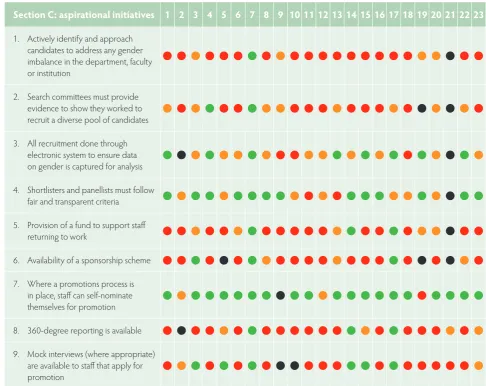
An assessment of recruitment and promotion good practice was undertaken using a self-audit toolkit created by the Equality Challenge Unit9 (ECU). The ECU took initiatives that were included in at least one-third of the thirty-one successful Silver and Gold UK Athena SWAN applications to establish a good practice benchmark for Irish institutions. The self-audit tool contained a list of ten initiatives (five recruitment and five promotion initiatives), as well as nine aspirational initiatives that were seen as innovative and useful to index for future evaluations. The self-audit tool asked HEIs to use a traffic light system to assess their own institution against each initiative: green (initiative is fully rolled-out across the institution); orange (initiative is rolled-out in some departments, or in the process of being rolled-out in the institution); and red (initiative is not rolled-out anywhere in the institution). Twenty-three HEIs across Ireland completed the self-audit (see appendix B for the full report).
Consultation with stakeholders
The Gender Equality Taskforce recognised that it was imperative to engage and consult with the HEIs and other key stakeholders (see appendix E for a full list) to jointly identify areas that required specific focus in the gender action plan. The Gender Equality Taskforce met with key stakeholders through face to face meetings and a stakeholder consultation event in January 2018 to get feedback and identify challenges or barriers to change, in particular in relation to recruitment and progression in academia. The Gender Equality Taskforce commends the high level of participation by the sector and the engagement and commitment of all stakeholders was noteworthy.
Data collection and analysis
Detailed analysis was completed on the available data, but the Gender Equality Taskforce has identified areas where data collection needs to be expanded and enhanced; particularly in relation to professional, management and support staff. Improved data analysis at a national level with detailed annual returns should be a key focus.
Before developing the gender action plan, the Gender Equality Taskforce set out to estimate the rate of change in senior academic staff positions in Irish HEIs under the current academic structures. Due to data limitations, this analysis focused on the seven universities, and fourteen IoTs. The number of applications for senior academic posts by gender, as well as the numbers being recruited or promoted into these posts were analysed over the period 2007-2017.
The HEIs returned staff statistics to the IUA (for the universities) and the DES (for the institutes of technology and colleges) and a summary of the data by sector was submitted to the HEA for consideration.
With a view to making data-driven decisions, several scenarios were examined using the average number of posts available in any given year at professor/senior lecturer level (c. 50 posts in the universities; and c. 50 posts in the IoTs respectively) to estimate when gender balance (minimum 40% of each gender) might be achieved over the next two decades based on the historical rate of change observed for the past decade.
The results are presented in appendix C for the universities and IoTs.
Data areas for future development
Intersectionality
While this report focuses on gender, the Gender Equality Taskforce recognises the imperative to promote equality in higher education across the nine grounds on which discrimination is unlawful in Ireland – gender, civil status, family status, age, race, religion, disability, sexual orientation and membership of the Traveller community. Changes that bring about inclusion for one group will have far-reaching benefits for society.
Progress reports
HEIs were asked to provide a progress update on their implementation of each of the Expert Group report recommendations. The summary of these qualitative progress reports were shared with the IUA and THEA. Each sector had the opportunity to comment on their collective data and the picture emerging, thereby setting a foundation for a culture of benchmarking and sharing of good practice across the sectors. A summary of progress under each recommendation was submitted to the HEA at a sectoral level (see appendix A for the progress reports).
Literature review
INTERNATIONAL
EXPERIENCE
International experience has demonstrated that the path towards gender equality is neither linear or guaranteed 10, and in other countries the rate of change in higher education has also been extremely slow.
Gender inequality in higher education continues to exist in countries which generally finish top of the overall gender equality index, such as Norway and Sweden11. Research highlights how systems for recruitment and promotion are far from gender neutral and not fully open to competition.12 Women’s career progression is affected by exclusionary practices, by workload allocation, an unwelcoming climate and unconscious bias.13
Country case study: Norway
Norway is regarded as a world leader in gender equality but has a persistent issue with gender imbalance at senior positions in academia and research.14 Compared with other countries, Norway has a relatively large number of full professors (both men and women) but the proportion of women in higher positions is still comparatively low. In 2017, 29% of full professors and 47.5% of associate professors were women. The share of female professors has only increased about 1% every year in the last ten years.15 This is despite strong gender equality policies in general, but in particular, policies targeted towards academia. Not to mention the relatively generous parental leave and widespread availability of childcare in Norway. The Norwegian Research Council has cited loss of talent and biased recruitment as both a democratic challenge and an obstacle to achieving the ambitious objectives of Norwegian research.16
Country case study: Switzerland
Since 2000, the federal government have been pursuing a programme called Equal Opportunity at Swiss Universities17 whose main aims included ensuring that 25% of all full and associate professors and 40% of all assistant professors are women by 2012. This goal has still not been reached and the highest annual increase rate ever observed was 1.8% (in 2006, in comparison to 200518). In 2016, 21.3% of full professors and 31.5% of assistant professors were women19. If the rate of promoting women to professorial positions remains at its current slow pace, the percentage of women professors in the year 2020 will be between 22% and 24%20
10 See Possible Reason 1, HEA (2016) Report of the Expert Group: HEA National Review on Gender Equality in Irish Higher Education Institutions p. 14 11 See http://eige.europa.eu/gender-equality-index/2015/countries-comparison
12 H. Peterson and B. Jordansson (2017) Gender equality as a core academic value: undoing gender in a ‘non-traditional’ Swedish university in K. White and P. O’Connor (eds.) (2017) Gendered success in higher education: global perspectives.
13 Ibid. p. 27
14 See https://www.forskningsradet.no/en/Funding/BALANSE/1253985316903/p1254006410319?visAktive=false 15 See http://kifinfo.no/en/content/statistics
16 The Research Council of Norway: Programme for gender balance in senior positions and research management - BALANSE publication. Available at: https://www.forskningsradet.no/en/Funding/BALANSE/1253985316903
17 See https://www.swissuniversities.ch/en/topics/promotion-of-young-talent/equal-opportunities/suc-programme-p-4/
18 Interim report following the completion of the first half of the programme. Available at: https://www.swissuniversities.ch/en/topics/ promotion-of-young-talent/equal-opportunities/suc-programme-p-4/
19 P. Dubach et al. (2017) Frauen and Maenner an Scheizer Hochschulen: Indikatoren zur Chancengleichheit in Studium und wissenschaftlicher Laufbahn.
Figure 1: Trends in the number of women at professor level in France, Germany, Switzerland and Ireland.
0 5 10 15 20 25 30 35 40
Ireland Switzerland
Germany France
2016 2012
2008 2004
[image:21.595.117.542.232.516.2]2001
Figure 1 shows that Ireland started from a lower baseline level of (8%)21 female professors in 2001, relative to France (15%)22, Germany (11%)23, and Switzerland (9%)24, but improved slowly to reach (22%) by 2016, similar to France (24%)25, Germany (23%)26, and Switzerland (21%)27.
However, this figure also shows that gender balance (a minimum 40% of either gender) is still a long way off at senior levels in higher education systems across Europe, and progress is unacceptably slow (which will only be made slower by the introduction of a later retirement age28, and will remain so, unless positive action is taken (see appendix D).
21 P. O’ Connor Understanding success: a case study of gendered change in the professoriate. Journal of Higher Education Policy and Management, 2014 Vol. 36, No. 2. 212-224
22 See https://publication.enseignementsup-recherche.gouv.fr/eesr/9/EESR9_ES_04-les_personnels_enseignants_de_l_enseignement_ superieur_public_sous_tutelle_du_menesr.php
23 See https://www.ssoar.info/ssoar/bitstream/handle/document/54112/ssoar-2017-lother_et_al-Evaluation_des_Professorinnenprogramms_ des_Bundes.pdf?sequence=1 pg. 60
24 See https://www.swissuniversities.ch/fileadmin/swissuniversities/Dokumente/Forschung/Chancengleichheit/Modul1_Diagramme_Umfrage_ Professuren_2014_2015.pdf
25 See https://publication.enseignementsup-recherche.gouv.fr/eesr/9/EESR9_ES_04-les_personnels_enseignants_de_l_enseignement_ superieur_public_sous_tutelle_du_menesr.php
26 See https://www.destatis.de/EN/FactsFigures/SocietyState/EducationResearchCulture/InstitutionsHigherEducation/Tables/ FrauenanteileAkademischeLaufbahn.html
27 See https://www.swissuniversities.ch/fileadmin/swissuniversities/Dokumente/Forschung/Chancengleichheit/Modul1_Diagramme_Umfrage_ Professuren_2014_2015.pdf
GENDER EQUALITY
TASKFORCE ACTION
PLAN FOR 2018-2020
This Taskforce Gender Action Plan is divided into eight themes:
THEME
HEIs showing leadership – Institutional Gender Action Plans Incentivised Progress through Funding Mechanisms
Driving Sustainable change in the form of a Centre of Excellence for Gender Equality Athena SWAN Charter in Ireland
Recruitment and Promotion Procedures and Practices* Leadership
Governance and Management
Embedding Gender Equality in Organisational Culture
* This theme was a particular focus of the Gender Equality Taskforce which was asked specifically to oversee a review of the systems of recruitment and promotion policies and practices in higher education institutions.
The eight themes are based on the original HEA Expert Group Report themes and have been extended to include new ‘Incentivised Progress through Funding Mechanism’ and ‘Support in the Form of a Centre of Excellence’ themes.
HEIs SHOWING LEADERSHIP – INSTITUTIONAL GENDER ACTION PLANS
Action(s) recommended by the Gender Equality Taskforce:
To accelerate gender balance, all HEIs shall set ambitious short, medium and long-term targets (1, 3 and 5 years) for the proportion of people of each gender which it aims to have at senior levels of academic and professional, management and support staff across the institution.
All HEIs shall set ambitious short, medium and long-term goals and actions at institutional level in order to progress gender equality.
All HEIs shall submit their institutional gender action plan to the HEA and provide annual progress updates.
It is envisaged that the institutional gender action plan will be implemented through discipline/ business unit gender action plans.
Gender Equality Taskforce Comments:
It is imperative that HEIs fully recognise the extent of gender inequality in their organisation, take ownership and show leadership in addressing the issue by examining their own context and culture, and reviewing in detail their own disaggregated data on gender across all parts and levels of the institution.
To accelerate gender balance with a reasonable timescale, the Gender Equality Taskforce recommends that each HEI should set its own ambitious multi-year targets for the proportion of people of each gender which it aims to have at the senior levels in the HEIs over the next one, three and five-year period. These targets should be included in the institutional gender action plan submitted annually to HEA and be agreed as part of the Strategic Dialogue process. Progress on the goals, actions and targets in the institutional gender action plan to address gender inequality should be reported annually to the HEA and linked to funding mechanisms with incentives and consequences where appropriate. If the recommended HEI led approach does not achieve significant change within an appropriate timescale, the HEA and the Minister can adopt a more directive approach.
The institutional gender action plan should take account of the HEA Expert Group recommendations and Gender Equality Taskforce actions and, where appropriate, the requirements of Athena SWAN. To ensure the gender action plan is responsive to emerging good practice, the opportunity to suggest an alternative approach to reaching targets (e.g. if it is more appropriate to their particular HEI), would also be facilitated.
It is envisaged that the institutional gender action plan will be implemented and supported through discipline and business unit gender action plans.
Relevant HEA Expert Group Report:
NO. OBJECTIVE RECOMMENDATION
1.21 To ensure a roadmap for attainment of gender equality is developed in each institution.
INCENTIVISED PROGRESS THROUGH FUNDING MECHANISMS
Action(s) recommended by the Gender Equality Taskforce:
HEA block grant funding shall be linked to an institution’s performance in addressing gender inequality through the Strategic Dialogue process and System Performance Framework.
A new ‘Gender Equality Enhancement Funding Call’ should be set up to support innovative organisational and cultural change initiatives nationally.
Gender Equality Taskforce Comments:
A key element of steering the strategic development of the Irish higher education and research system is the HEA’s management of the Higher Education System Performance Framework 2018-2020. The purpose of the Framework is to hold the system accountable for performance and delivery on national priorities and to monitor performance of the system as a whole. A performance compact outlining HEI priorities and targets for specific areas is discussed and agreed with the HEA. Performance is then linked to funding through a Strategic Dialogue process consisting of annual progress updates to the HEA after which a judgement is made as to whether HEI performance has been sufficient. Funding incentives or consequences can then be applied to the HEI as appropriate. In the Performance Framework 2018-2020, gender equality has been included as a high-level objective providing the opportunity to incentivise progress through the funding mechanisms.
To facilitate gender equality initiatives to be implemented nationally the Gender Equality Taskforce also recommends that an annual ‘Gender Equality Enhancement Funding Call’ be established. The initial funding provided by the government over the 3 years of the gender action plan may be leveraged through matched funding and/or time from the HEIs. The VPs/Directors for EDI group could provide stakeholder consultation to the Centre of Excellence for Gender Equality on themes by discipline each year. This initiative is intended to encourage cross-sectoral collaboration as a means to achieve national transformation.
New Gender Equality Taskforce Objective:
DRIVING SUSTAINABLE CHANGE IN THE FORM OF A CENTRE OF
EXCELLENCE FOR GENDER EQUALITY
Action(s) recommended by the Gender Equality Taskforce:
A new Centre of Excellence for Gender Equality, with a dedicated resource, should be established by the Department under the auspice of the HEA. The Centre will:
ensure sustainable acceleration towards gender equality in HEIs;
foster HEI collaboration and disseminate good practice;
provide centralised support for HEIs;
report regularly to the Minister in relation to performance of the system.
Gender Equality Taskforce Comments:
The Gender Equality Taskforce recommends that a Centre of Excellence for Gender Equality be set up within the HEA to ensure a sustainable acceleration towards gender equality is achieved by HEIs and it will advise the Minister and her department on progress, new developments and measures which may be required in future for Ireland.
Detailed data obtained by the Centre from HEIs would be key to enabling data driven decisions to be made so that actual, rather than perceived barriers to gender diversity can be addressed. The Centre should be pivotal in enabling sharing of good practice, joint initiatives and co-operation between HEIs, and in developing a better understanding of the impact of interventions taken and determining the areas of future focus. Providing a centralised support for HEIs will help to embed an institutional gender equality culture.
The Centre will work closely with the HEIs (e.g. with the VPs/Directors for EDI) to achieve efficiencies across the system through the coordination of activities, such as the centralised identification of experts and delivery of training.
The Centre would use the new ‘Gender Equality Enhancement Funding Call’ mentioned above to encourage innovative approaches to addressing gender inequality across the institutions.
New Gender Equality Taskforce Objective:
ATHENA SWAN CHARTER IN IRELAND
Action(s) recommended by the Gender Equality Taskforce:
HEIs shall apply for an institutional Bronze award by 2019.
HEIs should retain their Bronze award until such time as they obtain a Silver award.
IoTs working towards TU status will be required to show evidence to the HEA, annually through their institutional gender action plans, that they are working together to build gender equality into their merger process.
Once a TU has been established, it shall be required to achieve a TU bronze award within three years.
The HEA will have responsibility for determining the optimal timing and requirements in relation to Athena SWAN certification, and whether a HEI is deemed eligible or ineligible for research funding based on their award status.
Gender Equality Taskforce Comments:
Currently all seven universities hold a Bronze institutional Athena SWAN award and several of the IoTs and colleges are in the process of applying.
Since the HEA Expert Group recommendation was published, the remit of the Athena SWAN Charter has expanded to be more inclusive of all staff working in institutions. The original application to Bronze level focused only on Science, Technology, Engineering and Mathematics (STEM) staff, whereas now all departments in an HEI will be included, and whereas previously only academic staff were included in the critical analysis, now professional, management and support staff are also included. It now takes into account the experiences of trans staff and students and requires intersectional analysis with consideration of ethnicity.
This has implications for the overall level of work needed to put together an Athena SWAN award application. To be eligible to apply for a Silver institutional award, the majority of departments must hold a Bronze award, and at least one department must hold a Silver award. On average it was recommended that HEIs take a year to do their critical analysis and write their application for an Athena SWAN Bronze award. In the 12 years since the Charter was established in the UK, just 14% of award-holding universities have reached Silver (13 hold a Silver and 83 hold a Bronze). Many focus on a Bronze institutional renewal before attempting a Silver (15 institutions have not yet reached Silver but have renewed their Bronze between 2-4 times).
The Gender Equality Taskforce notes that engagement with the Athena SWAN process has been transformative for HEIs and encourages them to continue to work towards obtaining a Silver, and eventually a Gold, level award. The Gender Equality Taskforce is cognisant of maintaining the momentum that has built up around the Athena SWAN certification, although recognises that the original timelines may now not be achievable. Given that the change in process and requirements outlined above has increased the amount of work involved in a successful application, it may be necessary to provide some flexibility for obtaining awards (e.g. obtain a Bronze by 2019; obtain a Silver eight years after first achieving an institutional Bronze).
Relevant HEA Expert Group Report:
NO. OBJECTIVE RECOMMENDATION
1.22 To support and recognise the embedding of gender equality across all aspects of the work of HEIs.
RECRUITMENT AND PROMOTION PROCEDURES AND PRACTICES
Irish higher education’s best asset is its people. Effective talent management strategies are required to attract, develop, and retain the best talent, regardless of gender. Current recruitment and promotion practices can lead to women’s achievements being ignored or undervalued.29 This represents a considerable under-utilisation of talent for the institutions and must be addressed.GENDER-PROOFING RECRUITMENT AND PROMOTION PROCEDURES AND PRACTICES
Action(s) recommended by the Gender Equality Taskforce:
All HEIs shall ensure that there are concrete actions in their institutional gender action plans, elaborated where appropriate at discipline and business unit level, to bring their existing policies in line with good practice.
The Centre of Excellence for Gender Equality will support the sharing of good practice by HEIs across the sector.
A report on the recruitment, selection and promotion procedures and practices must be submitted to the EDI sub-committee of the governing authority at least once annually, and should include statistical analysis of applications, recruitment and progression for all academic and professional, management and support staff.
Gender Equality Taskforce Comments:
Review of recruitment and promotion policies and practice by ECU (see appendix B for full report)
An assessment of recruitment and promotion good practice undertaken using a self-audit toolkit created by the Equality Challenge Unit (ECU) benchmarked Irish HEIs against initiatives that were included in at least one-third of thirty-one successful Silver and Gold UK Athena SWAN applications to establish a good practice benchmark for Irish institutions. The main findings apply to both academic and professional, management and support staff in the HEIs and include: The pace of change reported by the Irish HEIs is worthy of praise. Across all 23 institutions approximately half of the
initiatives were either being rolled-out in some departments/faculties in the institution, or in the process of being rolled-out in the institution, but not yet finished for both recruitment (51.3%) and promotion initiatives (45.2%). The prevalence of good practice fully rolled out in the HEIs was greater for recruitment initiatives (35.7%)
than for promotion initiatives (29.6%), which may reflect the recent history of a lack of promotion opportunities in the Irish HE sector.
Institutions with larger total numbers of staff were more likely to have examples of good recruitment and promotion practices in place. There was no consistent pattern of institutions without sufficient recruitment and promotion initiatives rolled out across the institutions when analysed according to different proportions of female executive staff. The comparison with Gold and Silver level institutions and departments represents a significant stretch target for the 23 Irish institutions that undertook the self-audit, but the results indicated that examples of good practice in recruitment and promotion at this level do exist in Ireland, but also that there is significant room for improvement. The tool used to audit the Irish HE sector was designed to take a snapshot of the sector as it currently is, as well as provide a baseline from which improvement over time could be ascertained. Noting of course that the analysis was not based on all best practice initiatives possible, but rather just on good practice observed in successful Gold and Silver Athena SWAN applications.
Gender Equality Taskforce Comments:
(continued)
Taking into account the different contexts of the Irish and UK HE sectors, the pace of change and commitment to rolling out further initiatives reported by Irish HEIs in the self-audit process is noteworthy and demonstrates the level of engagement by the HEIs to address recruitment and promotion challenges in higher education.
Review of recruitment and promotion policies and practice in Irish Higher Education
Reflecting on the ECU findings above, the Gender Equality Taskforce expanded on the key areas for focus identified by the HEA Expert Group Report30 in relation to recruitment and promotion policies and practice, to now include31: Advertising commitment to equality in recruitment process32 and inclusion of a statement that the search
committee are particularly interested in the under-represented gender to apply;
A robust search process will help to ensure that there are enough fully qualified people of both genders included in the selection pool;
Discussion of career development at performance development reviews33;
Compulsory equality and diversity training (including unconscious bias training) for new staff members34
Relevant HEA Expert Group Report:
NO. OBJECTIVE RECOMMENDATION
1.16 To gender-proof recruitment, selection and promotion procedures and practices.
The recruitment, selection, and promotion procedures currently used, will be reviewed to ensure that they are gender-sensitive.
30 HEA (2016) Report of the Expert Group: HEA National Review on Gender Equality in Irish Higher Education Institutions 31 This is not an exhaustive list.
32 Good practice recruitment initiative from the ECU self-audit tool. See Appendix B 33 Ibid
POSITIVE ACTION INTERVENTIONS
For all staff (academic and professional, management and support staff):
Action(s) recommended by the Gender Equality Taskforce:
All HEIs shall strive for gender balance in the final pool of candidates for all competitions.
Each HEI is required to implement the flexible cascade model as a minimum (not a maximum), for both promotion and recruitment of academic staff and senior grades of professional, management and support staff.
Each HEI is required to set ambitious short, medium and long-term targets (1, 3 and 5 years), over and above the flexible cascade model for both promotion and recruitment of academic staff and senior grades of profession, management and support staff.
To enable HEIs to better monitor their progress and monitor patterns, data disaggregated by gender, contract type and broad discipline area or business unit should be collected on the number of applications, recruitments and promotions for all academic grades. This data should be submitted to the HEA annually for analysis at the sectoral and national level. Similar data should also be included for senior professional, management and support staff.
New and additional gender-specific posts, at appropriate levels, as well as other positive action measures, should be considered where they would be a proportionate and effective means to achieve rapid and sustainable change.
All HEIs shall ensure that there are concrete actions in their institutional gender action plan to address stereotyping of ‘female’ and ‘male’ roles.
Gender Equality Taskforce Comments:
The Gender Equality Taskforce analysed application and appointment data for both the universities and the IoTs over the period 2007-2017, and it appears that the pattern of recruitment and promotion, with a few exceptions (e.g. senior lecturers in the university sector and senior lecturer 2 in the IoT sector), is largely in line with a flexible cascade model approach, i.e. the numbers being appointed at the level above reflect the percentage of women at the level below. Women and men had similar success rates in the university sector during 2013-2017, while in the IoT sector women had higher success rates than men.
However, analysis of the estimated rate of change for the future suggests that the adoption of a flexible cascade model approach alone, could take more than 20 years to achieve gender balance at professor level (i.e. minimum 40% female professors). Although the IoT sector currently has a higher percentage of women at senior levels relative to the university sector, it would still take ten years to achieve gender balance at senior lecturer 1 level and seven years at senior lecturer 3 level if the flexible cascade model approach alone was adopted (see appendix C).
Therefore, the Gender Equality Taskforce recommends that the flexible cascade model should be implemented as a minimum (not a maximum) and HEIs will be required to set ambitious short, medium and long-term targets (1, 3, 5 years), over and above the flexible cascade model, for both promotion and recruitment of academic staff and senior grades of professional, management and support staff.
It is clear from the limited progress to date in Ireland, and the experience internationally in academia35, that the HEA Expert Group target of having a minimum 40% women and 40% men to be full professors, at the appropriate pay scale by 2024 will not be achieved without positive action (see appendix D for a more detailed discussion of positive action interventions), being taken by each HEI, as appropriate to its particular circumstances.
Gender Equality Taskforce Comments:
(continued)
Ensuring that the proportion of women recruited to the professor grade increases by 2% per annum over and above the current rate could achieve 30% female professors within a decade and reach close to 40% within 15 years. In addition to this, the establishment of new and additional female specific positions in Ireland would be transformative and could result in 40% of professors being women within a decade in Ireland. (see appendix C)
It should also be noted that while gender balance and gender equality are similar, they are not essentially interchangeable. Achieving a gender-equal system where all staff members are developed and supported equally will take more than merely achieving an equal number of female and male academics at senior levels, though this is one of several important indicators. Gender-balanced data can be a reflection of a culture of gender equality within an organisation, but that culture can be achieved before complete gender-balance is achieved, if the right measures are put in place.
Therefore, to get a holistic picture, the number of professors should be used as one metric in a basket of gender equality metrics. Accordingly, the Gender Equality Taskforce encourages each HEI to consider innovative ways to achieve an ambitious acceleration of gender equality for academic and professional, management and support staff at all levels throughout its own institution.
For the purposes of reporting on ‘professors’ in line with European reporting requirements this metric is calculated using university staff data, as the IoT sector does not have a ‘professoriate’.
In the IoT sector, it is the senior lecturer grades where women are under-represented. The Gender Equality Taskforce split the senior lecturer grade out into SL 1, SL 2, and SL3 to get a better picture of the estimated rate of change at this level. It is noted that attention needs to be given to staff at all levels of the HEIs, and robust workforce planning is needed to realise this.
Relevant HEA Expert Group Report:
NO. OBJECTIVE RECOMMENDATION
1.17 To drive change through the use of positive action interventions for academic staff.
Each HEI will introduce mandatory quotas for academic promotion, based on the flexible cascade model where the proportion of women and men to be promoted/recruited is based on the proportion of each gender at the grade immediately below.
1.18 To drive change at professor level through the use of positive action interventions
A minimum of 40% women and 40% men to be full professors, at the appropriate pay scale.
1.19 &
1.20 To drive change through the use of positive action interventions for professional, management and support staff, and to combat stereotyping of ‘female’ and ‘male’ roles and horizontal segregation among professional, management and support staff.
LEADERSHIP
Action(s) recommended by the Gender Equality Taskforce:
In planning for a new president, the governing authority will ensure that measures to promote gender equality within the search and selection process (as well as documenting the gender balance in the applicant pool, and at each stage of the selection process), are undertaken. The governing authority will provide a report to the HEA.
In the appointment process for all leadership positions (including Head of Department), a requirement of appointment will be demonstrable experience of leadership in advancing gender equality. This will be included as a specific criterion in role descriptions.
All staff in a leadership position within the HEI shall be responsible for integrating gender equality in all processes and decisions made. HEIs should create a framework within the HEI to indicate how this would be implemented.
The HEA shall work with IUA and THEA to develop a national programme to promote competency in advancing gender equality for managers and leaders.
Each institution should appoint a Vice-President/Director for EDI. This may be a full-time or part-time role (if the institution can demonstrate, for its size and complexity, that the role offers sufficient leadership capacity in gender equality, diversity and inclusion), appropriately resourced to be effective in the role and shall be a member of the senior management team.
Gender Equality Taskforce Comments:
The Gender Equality Taskforce acknowledges that the sector would benefit from an appropriate leadership and succession planning programme. This should be considered as part of the enhancement of gender initiatives at national level. Mentoring and sponsorship (see appendix D for a case study on this) at vice-president (VP) and other senior levels could be utilised to develop a diverse pipeline of potential candidates.
HEIs should create a framework within the HEI to indicate how all staff in a leadership position within the HEI will be responsible for integrating gender equality in all processes and decisions made. Priority areas could include: appointment, promotion, workload allocation, resource allocation, career development, return-to-work support and creating an environment supportive of family and care responsibilities and engaging men.
The Gender Equality Taskforce recognises the importance of supporting the professional development of managers and leaders, both in academia and professional, management and support staff areas, and recommends that the HEA work with IUA and THEA to develop a national programme to promote competency in advancing gender equality for managers and leaders.
It is critical that gender equality is driven from the President and senior management to ensure the success of gender equality plans and policies.
Relevant HEA Expert Group Report:
NO. OBJECTIVE RECOMMENDATION
1.1 To foster gender-balance in the leadership of HEIs.
At the final selection step, in the appointment process for new presidents (or equivalent), in so far as is possible, the final pool of candidates must comprise an equal number of women and men. If it has not been possible to achieve gender balance at the final selection step, the interview panel must account to the Governing Authority/or equivalent, for why this is not possible.
1.2 & 1.3
To ensure HEI leaders foster a culture of gender equality in their HEI.
In the appointment process for a new president, a requirement of appointment will be demonstrable experience of leadership in advancing gender equality. In the appointment process for a new vice-president, a requirement of appointment will be demonstrable experience of leadership in advancing gender equality.
1.4 To lead cultural and organisational change in their area of responsibility.
The deans and heads of school/department, divisional directors and section/unit managers will be responsible for integrating gender equality in all processes and decisions made. Evidence of leadership in advancing gender equality will be taken into account in appointments to these management positions.
GOVERNANCE AND MANAGEMENT
REPRESENTATION ON KEY DECISION-MAKING BODIES
Action(s) recommended by the Gender Equality Taskforce:
HEIs shall submit to the HEA, in their annual December returns, a gender breakdown of governing authority/body, academic council and executive management team members by gender.
Gender Equality Taskforce Comments:
The progress reports submitted by the HEIs and the stakeholder consultation highlighted the need to further clarify the definition of ‘key decision-making bodies’. These could include for example the following:
Governing Authority and committees Executive Senior Management team General Management team Relevant departmental teams Promotional boards
The Gender Equality Taskforce recommends that each institution, by the end of 2019, will have reviewed the structure of its academic council so that academic councils will comprise a minimum of 30% of the underrepresented gender by 2020 and a minimum of 40% women and 40% men by 2024, at the very latest. Sub-committees of academic council
should be restructured in the course of 2018 to ensure they consist of at least 40% women and 40% men.
The Gender Equality Taskforce recommends that chief officers report annually to governing authority on diversity in their leadership team and proposed measures to promote further diversity.
The Gender Equality Taskforce reiterates that the standards for gender balance set out above are minimum standards, and that in many circumstances it is both preferable and practicable to have balanced groups comprising equal numbers of women and men.
Relevant HEA Expert Group Report:
NO. OBJECTIVE RECOMMENDATION
1.6 & 1.7
To ensure gender balance on all key decision-making bodies.
GOVERNING AUTHORITY GENDER EQUALITY SUB-COMMITTEE
Action(s) recommended by the Gender Equality Taskforce:
All HEIs to establish an EDI sub-committee of governing authority (or a joint committee of governing authority and academic council).
Gender Equality Taskforce Comments:
The Gender Equality Taskforce recommends that the establishment of an EDI sub-committee of governing authority (or a joint committee of governing authority and academic council) be a mandatory requirement for all HEIs.
The chair of the sub-committee should be a member of the governing authority, and the VP/Director for EDI should be a member of the sub-committee. If there is a separate HR committee, HEIs should consider whether the VP/Director for EDI should be a member of that committee also.
As part of its work, the sub-committee should consider how best to communicate its activities/outcomes within the institution.
Relevant HEA Expert Group Report:
NO. OBJECTIVE RECOMMENDATION
1.8 To provide strategic oversight of organisational processes and policies in relation to gender equality.
EMBEDDING GENDER EQUALITY IN ORGANISATIONAL CULTURE
ACADEMICALLY-LED GENDER EQUALITY FORUM
Action(s) recommended by the Gender Equality Taskforce:
The academically-led HEI gender equality forum shall be chaired by either the President (or equivalent) or the Vice-President/Director of EDI.
Gender Equality Taskforce Comments:
The HEA Expert Group recommendation to establish an independent, academically-led gender equality forum has been implemented in 5 of the 7 universities and 7 of the 14 IoTs. It is often the institutional Athena SWAN self-assessment committee that fulfils this function. Senior members of staff across all areas of the institution need to lead by example if true cultural and organisational change is to take place.
Relevant HEA Expert Group Report:
NO. OBJECTIVE RECOMMENDATION
1.9 To support the mainstreaming of gender equality across the HEIs.
FLEXIBLE AND AGILE WORKING
Action(s) recommended by the Gender Equality Taskforce:
Each HEI will re-examine its guidelines to consider a structure of flexible working models (inclusive of core hours, remote working and career breaks) and develop guidelines to underpin this.
The HEA Centre of Excellence for Gender Equality will monitor progress on the development of guidelines and will disseminate good practice among HEIs.
Gender Equality Taskforce Comments:
While there was a strong focus on family-leave in the HEA Expert Group Report, the stakeholder consultation highlighted that while it was appropriate for this to be given attention, the focus should not be so restricted.
Consideration should be given to wider opportunities to enhance the provision of support for all staff members, including those with caring responsibilities. For example, a strong consensus emerged from the stakeholder consultation process that there was an opportunity with modern technology to address work-life balance in HEIs. Flexibility in working environments was important to both men and women.
The Centre of Excellence for Gender Equality should be pivotal in enabling sharing of good practice, joint initiatives and co-operation between HEIs, and in developing a better understanding of the impact of interventions taken and determining the areas of future focus. Providing a centralised support for HEIs will help to embed an institutional gender equality culture.
Relevant HEA Expert Group Report:
NO. OBJECTIVE RECOMMENDATION
1.10 To enhance the provision of support for staff members with caring responsibilities.
DEVELOPING GENDER AWARENESS AMONG STAFF
Action(s) recommended by the Gender Equality Taskforce:
The institutional gender action plan shall include measures to actively develop gender awareness among all staff.
Gender Equality Taskforce Comments:
HEIs need to ensure that the symbolic links between gender and discipline (e.g. masculinity and technology, femininity and education) are challenged.
While the gendering of subjects may begin at previous levels of education, HEIs have a central role to play in changing societal perceptions of gendered professions.
Institutions can reap the benefits of a gender-aware workforce by taking best practice from business as examples. Key areas for focus include:
Establishing a HeforShe/MARC initiative, the goal of which is to engage men as agents for change, for the achievement of gender equality;
The provision of face-to-face unconscious bias and gender equality awareness training measures for all staff complemented by a plan to continually review and update the training when appropriate;
Each senior manager will be required to sponsor (see appendix D for more information on this) the career development of two of the under-represented gender;
Managers will take responsibility for the active promotion of achievements by both women and men; The incorporation of evidence of advancing gender equality into staff members’ performance reviews; The provision of a gender-aware leadership induction programme for staff moving into leadership positions,
which should constitute a minimum 40% of both genders as participants.
Relevant HEA Expert Group Report:
NO. OBJECTIVE RECOMMENDATION
1.11 To increase gender awareness among staff.
INTEGRATING THE GENDER DIMENSION INTO TEACHING & LEARNING,
RESEARCH, AND QUALITY ASSURANCE
Action(s) recommended by the Gender Equality Taskforce:
The institutional gender action plan shall include actions to embed gender equality in Teaching & Learning, and Research, in particular how has the gender dimension been implemented into undergraduate and postgraduate curricula.
Departmental reviews shall include an analysis of gender equality.
HEIs will ensure that gender is examined as part of its quality assurance report.
Gender Equality Taskforce Comments:
HEIs have a responsibility to ensure that all their graduates are gender-aware; in particular if they are responsible for educating teachers who greatly influence the society of the future. Therefore, face-to-face unconscious-bias training should be fully integrated into teacher education.
HEIs should ensure that the gender dimension is integrated into all research content and provide training and support for research staff on how to