Original Article
Association of
RBM5
rs2013208 SNP with
serum lipid levels in two Chinese ethnic groups
Hui Gao, Rui-Xing Yin, Qing-Hui Zhang, Wei-Jun Li, Jian-Hua Huang, Yuan Bin
Department of Cardiology, Institute of Cardiovascular Diseases, The First Affiliated Hospital, Guangxi Medical University, Nanning, Guangxi, China
Received April 25, 2017; Accepted June 30, 2017; Epub August 1, 2017; Published August 15, 2017
Abstract: The RNA binding motif protein 5 gene (RBM5) rs2013208 single nucleotide polymorphism (SNP) has been associated with high-density lipoprotein cholesterol (HDL-C) levels in a previous genome-wide association study, but little is known about such association of the RBM5 rs2013208 SNP and serum lipid profiles in the Chinese popula-tions. The present study was to detect the association of the RBM5 rs2013208 SNP and several environmental factors with serum lipid levels in the Jing and Han populations. Genotyping of the RBM5 rs2013208 SNP in 635 subjects of Jing and 648 participants of Han peoples was performed by polymerase chain reaction and restriction fragment length polymorphism, and then confirmed by direct sequencing. There were no significant differences in the genotypic and allelic frequencies of the RBM5 rs2013208 SNP between the two ethnic groups or between males and females. The RBM5 rs2013208G allele carriers had lower serum HDL-C levels in both Jing and Han than the G allele non-carriers. The G allele carriers in Jing had higher serum total cholesterol (TC) levels and higher apoli-poprotein (Apo) A1/ApoB ratio than the G allele non-carriers (P < 0.05). Subgroup analysis according to sex showed that the G allele carriers had lower serum HDL-C levels in both Jing and Han females but not in males (P < 0.05). The G allele carriers had higher TC levels in Jing females but not in Jing males, and lower ApoA1/ApoB ratio in Jing males but not in Jing females. Serum lipid parameters were also correlated with several environmental factors in the Jing and Han populations, or in males and females in both ethnic groups. The association of the RBM5 rs2013208 SNP and serum lipid levels is different between the Jing and Han populations. These associations might have an ethnic- and/or sex-specificity.
Keywords: RNA binding motif protein 5 gene, single nucleotide polymorphism, rs2013208, lipids, environmental factors
Introduction
Cardiovascular diseases (CVD) are the leading causes of morbidity and mortality in most developed and developing countries [1, 2]. It is well established that dyslipidemia is a major risk factor for CVD among several conventional risk factors such as older age, positive family history, diabetes mellitus, obesity, hyperten-sion, tobacco use, and unhealthy diet [3-5]. Metabolic abnormalities in blood lipids, in par-ticular low-density lipoprotein cholesterol (LDL-C) elevation and high-density lipoprotein cho-lesterol (HDL-C) depression, are mainly involved in the development and progression of CVD [6, 7]. Epidemiological studies have consistently shown that dyslipidemia is a complex trait resulted from the joint effects of multiple
genetic and environmental factors [8, 9] and their interactions [10]. Through family history and twin studies, almost 40%-70% of the inter-individual variation in plasma lipid phenotypes can be explained by genetic polymorphisms [10, 11]. Human genetic studies of lipid levels can identify targets for new therapies for cho-lesterol management and prevention of heart disease [12, 13].
targets that enable clinically-important chang-es in blood lipids [12, 15]. A recent study has identified 157 loci associated with lipid levels at P < 5 × 10⁻⁸, including 62 loci not previously
associated with lipid levels in humans which has mentioned that the RBM5 rs2013208 SNP was associated with HDL-C levels for the first time [14]. Among the new 62 loci, two SNPs showing strongest association to coronary artery disease (CAD) near RBM5 (rs2013208,
PHDL = 9 × 10-12, P
CAD = 7 × 10⁻⁵) and CMTM6 (rs-
7640978, PLDL = 1 × 10⁻⁸, P
CAD = 4 × 10⁻⁴) [14].
RBM5 (http://www.ncbi.nlm.nih.gov/gene) is a candidate tumor suppressor gene which encodes a nuclear RNA binding protein that is a component of the spliceosome A complex. The encoded protein plays a role in the induction of cell cycle arrest and apoptosis through pre-mRNA splicing of multiple target genes includ-ing the tumor suppressor protein p53. This gene is located within the tumor suppressor region 3p21.3, and may play a role in the inhibi-tion of tumor transformainhibi-tion and progression of several malignancies including lung cancer. However, the biological function of the RBM5
rs2013208 SNP on serum lipid metabolism remains unclear. Importantly, the genetic varia-tion has different magnitudes of effect in the different ethnicities but until now no GWAS has comprehensively investigated the genetic determinants of serum lipid levels in the Chinese populations. Therefore, it would be necessary to characterize the relationship between the RBM5 rs2013208 SNP and serum lipid levels in the Chinese populations.
China is a multiethnic country of 56 ethnic groups, the custom of every ethnic group is not identical. Han is the dominant ethnic group and Jing is a native minority existing 28199 people among the 55 minority groups according to the sixth national census statistics of China in 2010. In the early 16th century, the Jing ances-tors emigrated from Vietnam to China, now most of them live in the so called “Three Islands of Jing Nationality”, Dongxing City, Guangxi Zhuang Autonomous Region, People’s Republic of China [16, 17]. Jing is unique in Chinese eth-nic minorities living in the nation of the sea, the way of life is single. Jing nationality is a rela-tively conservative and isolated minority, and preserves their custom of intra-ethnic mar-riage, which suggests that there are lots of dif-ferences between Jing and Han (as well as the
other landlocked nationalities) nationality in diet custom and culture characteristics. To our knowledge, the association of RBM5 rs2013- 208 SNP and serum lipid profiles has not been previously reported in this population. Thus, the present study was to detect the association of the RBM5 rs2013208 SNP and serum lipid levels in the Jing and Han populations.
Materials and methods
Subjects
A total of 648 unrelated subjects (245 males, 37.81% and 403 females, 62.19%) of Han na- tionality and 635 unrelated participants (244 males, 38.43% and 391 females, 61.57%) of Jing nationality were randomly selected from our previous stratified randomized samples. All participants were rural agricultural (Han) and/or fishery workers (Jing) living in Jiangping Down, Dongxing City, Guangxi Zhuang Autono- mous Region, People’s Republic of China. The participants’ age ranged from 27 to 92 years with a mean age of 57.44±12.55 years in Han and 56.22±12.99 years in Jing, respectively. All participants were healthy and had no evidence of diseases related to atherosclerosis, CAD and diabetes. None of them were using lipid-lower-ing medication. The present study was approved by the Ethics Committee of the First Affiliated Hospital, Guangxi Medical University (No: Lunshen-2011-KY-Guoji-001; Mar. 7, 2011). Informed consent was obtained from all participants.
Epidemiological survey
was calculated from the height and weight measurements.
Biochemical parameter
A fasting venous blood sample of 5 ml was drawn from the participants after an overnight (at least 12 hours) fast. A part of the sample (2 mL) was collected into glass tubes and allowed to clot at room temperature, and used to deter-mine serum lipid levels. Another part of the sample (3 mL) was transferred to tubes with anticoagulate solution (4.80 g/L citric acid, 14.70 g/L glucose, and 13.20 g/L tri-sodium
formed in a total volume of 25 μL, containing 10 × PCR buffer (1.8 mM MgCl2) 2.5 μL, 1 U
[image:3.612.92.395.97.452.2]Taq polymerase, 2.5 mmol/L of each dNTP (Tiangen, Beijing, People’s Republic of China) 2.0 μL, 20 pmol/L of each primer and 50 ng of genomic DNA, processing started with 95°C for 7 min and followed by 45 s of denaturing at 95°C, 35 s of annealing at 58°C and 1 min of elongation at 72°C for 30 cycles. The amplifica-tion was completed by a final extension at 72°C for 7 min. Then 10 U of BsuRI enzyme was added directly to the PCR products (10 μL) and digested at 37°C overnight. After restriction Table 1. Comparison of demography, lifestyle and serum lipid levels
between the Jing and Han Chinese
Parameter Han Jing t (x2) P
Number 648 635
Male/female 245/403 244/391 0.052 0.820
Age (year) 57.44±12.55 56.22±12.99 -1.71 0.088 Height (cm) 156.21±7.75 156.94±7.73 1.68 0.093 Weight (kg) 55.50±9.37 57.87±9.89 4.42 0.000 Body mass index (kg/m2) 22.67±3.16 23.42±3.18 4.17 0.000
Waist circumference (cm) 77.24±8.98 79.89±8.85 5.31 0.000 Cigarette smoking [n (%)]
Non-smoker 551 (85.0) 549 (86.5) < 20 cigarettes/day 23 (3.5) 19 (3.0)
≥ 20 cigarettes/day 74 (11.4) 67 (10.6) 0.600 0.741 Alcohol consumption [n (%)]
Non-drinker 543 (83.8) 563 (88.7) < 25 g/day 23 (3.5) 39 (6.1)
≥ 25 g/day 82 (12.7) 33 (5.2) 25.240 0.000 Systolic BP (mmHg) 132.28±19.25 132.13±21.65 -0.133 0.895 Diastolic BP (mmHg) 80.22±10.06 80.22±10.07 -1.55 0.12 Pulse pressure (mmHg) 51.18±15.15 51.91±17.96 0.784 0.433 Glucose (mmol/L) 6.65±1.11 7.32±0.38 14.628 0.000 Total cholesterol (mmol/L) 4.93±0.88 4.92±0.94 -0.229 0.819 Triglyceride (mmol/L) 1.32 (0.63) 1.44 (0.73) -3.99 0.000 HDL-C (mmol/L) 1.81±0.51 1.76±0.44 -2.130 0.033 LDL-C (mmol/L) 2.86±0.44 2.82±0.45 -1.724 0.085 Apolipoprotein (Apo) A1 (g/L) 1.32±0.20 1.29±0.23 -2.432 0.015
ApoB (g/L) 1.04±0.24 1.05±0.24 0.806 0.420
ApoA1/ApoB 1.34±0.38 1.30±0.38 -2.13 0.034
BP, blood pressure; TC, total cholesterol; TG, triglyceride; HDL-C, high-density lipopro-tein cholesterol; LDL-C, low-density lipoprolipopro-tein cholesterol; ApoA1, apolipoprolipopro-tein A1; ApoB, apolipoprotein B. The quantitative variables were presented as mean ± standard deviation and their difference between the groups was determined by the t-test. The values of triglyceride were presented as median (interquartile range), and the difference between the groups was determined by the Wilcoxon-Mann-Whitney test. The difference in percentage of cigarette smoking and alcohol consumption between the groups was determined by Chi-square-test.
citrate) and used to ex- tract DNA. The levels of total cholesterol (TC), tri-glyceride (TG), HDL-C and LDL-C in the samples were determined by en- zymatic methods with co- mmercially available ki- ts. Serum apolipoprotein (Apo) A1 and ApoB levels were assessed by the immuneturbidimetric im- munoassay [19, 20].
DNA amplification and genotyping
Genomic DNA was isolat-ed from peripheral blood leukocytes using the phe-nol-chloroform method. The extracted DNA was stored at -20°C until an- alysis. Genotyping of the
per-enzyme digestion of the amplified DNA, geno-types were identified by electrophoresis on 2% ethidium-bromide stained agarose gels and visualizing with ultraviolet illumination. Geno- types were scored by an experienced reader blinded to the epidemiological and lipid results. Six samples (AA, AG and GG genotypes in two; respectively) detected by the PCR-RFLP were also confirmed by direct sequencing. The PCR product was purified by low melting point gel electrophoresis and phenol extraction, and then the DNA sequences were analyzed in Shanghai Sangon Biological Engineering Te- chnology & Services Co., Ltd., People’s Republic of China. The methods of DNA amplification
and genotyping were referred to our previous studies [20, 21].
Diagnostic criteria
The normal values of serum TC, TG, HDL-C, LDL-C, ApoA1 and ApoB levels, and the ratio of ApoA1 to ApoB in our Clinical Science Ex- periment Center were 3.10-5.17, 0.56-1.70, 1.16-1.42, 2.70-3.10 mmol/L, 1.20-1.60, 0.80-1.05 g/L, and 1.00-2.50; respectively. The indi-viduals with TC > 5.17 mmol/L and/or TG > 1.70 mmol/L were defined as hyperlipidemia [22, 23]. Hypertension was assessed accord-ing to the criteria outlined by the 1999 World Health Organization-International Society of Hypertension Guidelines for the management of hypertension [24, 25]. The categories of nor-mal weight, overweight and obesity were defined as a BMI of < 24, 24-28 and > 28 kg/ m2; respectively. The diagnostic criteria of
over-weight and obesity were according to the Cooperative Meta-analysis Group of China Obesity Task Force [26].
Statistical analyses
[image:4.612.90.289.73.229.2]Epidemiological data were recorded on a pre-designed form and managed with Excel soft-ware. Data analysis was performed using the software SPSS version 16.0 (SPSS Inc., Chica- go, Illinois). Qualitative variables are expressed as raw counts and percentages. Quantitative variables are presented as the mean ± stan-dard deviation, except serum TG levels, which were presented as medians and interquartile ranges. Allele frequency was determined via direct counting, and the standard goodness-of-fit test was used to test the Hardy-Weinberg equilibrium. Difference in genotype distribution between the groups was obtained using the chi-square test. The difference in general char-acteristics between Jing and Han was tested by the Student’s unpaired t-test. The association between genotypes and serum lipid parame-ters was tested by analysis of covariance (ANCOVA). Age, sex, BMI, cigarette smoking, and alcohol consumption were adjusted for the statistical analysis. Multivariable linear regres-sion analyses with stepwise modeling were used to determine the correlation between gen-otypes (AA = 1, AG/GG = 2) and several environ-mental factors with serum lipid levels in males and females of Han and Jing populations. Two sided P value < 0.05 was considered statisti-cally significant.
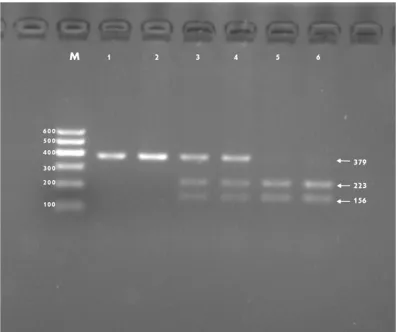
Figure 1. Electrophoresis of PCR products of the samples. Lane M, 100 bp marker ladder; lanes 1-6, samples. The 379 bp bands are the target genes.
[image:4.612.90.289.293.459.2]Results
General and biochemical characteristics of the subjects
Table 1 shows the general characteristics and serum lipid levels between the Jing and Han
[image:5.612.92.525.78.342.2] [image:5.612.92.391.405.619.2]After the genomic DNA of the samples was amplified by PCR and imaged by 2% agarose gel electrophoresis, the purpose gene of 379-bp nucleotide sequences was seen in all sam-ples (Figure 1). The genotypes identified were named according to the presence or absence of the enzyme restriction sites. The absence of Figure 3. A part of the RBM5 rs2013208 SNP sequence.
Table 2. Comparison of the genotype and allele frequencies of the
RBM5 rs2013208 SNP in the Han and Jing populations [n (%)]
Group n Genotype Allele
AA AG GG A G
Han 648 470 (72.5) 169 (26.1) 9 (1.4) 1109 (85.6) 187 (14.4) Jing 635 477 (75.1) 143 (22.5) 15 (2.4) 1097 (86.4) 173 (13.6)
x2 3.587 0.346
P 0.166 0.556
Han
Male 245 177 (72.2) 67 (27.3) 1 (0.4) 421 (85.9) 69 (14.1) Female 403 293 (72.7) 102 (25.3) 8 (2.0) 688 (85.4) 118 (14.6)
x2 2.975 0.077
P 0.226 0.781
Jing
Male 244 182 (74.6) 55 (22.5) 7 (2.9) 419 (85.9) 69 (14.1) Female 391 295 (75.4) 88 (22.5) 8 (2.0) 678 (86.7) 104 (13.3)
x2 0.445 0.180
P 0.800 0.671
populations. The levels of weight, waist circumfer-ence, BMI, TG, glucose were higher in Jing than in Han, but the ApoA1/ApoB ratio, the percentages of subjects consuming alco-hol, the levels of ApoA1, HDL-C were lower in Jing than in Han (P < 0.05-0.001). The values of gender ratio, age, systolic blood pressure, diastolic blood pressure, pulse pressure, LDL-C, TC, ApoB and the percentages of smoking were not differ-ent between the two eth-nic groups (P > 0.05 for all).
the cutting site indicates the A allele cannot be cut, while its presence indicates the G allele can be cut. Thus, GG genotype is homozygote for the presence of the site (156- and 223-bp),
[image:6.612.90.522.85.241.2]AG genotype is heterozygote for the presence and absence of the site (156-, 223- and 379-bp), and AA genotype is homozygote for the absence of the site (379-bp; Figure 2).
Table 3. Comparison of the genotypes and serum lipid levels in the Han and Jing populations
Genotype n TC (mmol/L) TG (mmol/L) (mmol/L)HDL-C (mmol/L)LDL-C ApoA1 (g/L) ApoB (g/L) ApoA1/ApoB Han
AA 470 4.93±0.87 1.33 (0.62) 1.84±0.54 2.87±0.43 1.32±0.20 1.03±0.24 1.35±0.38 AG/GG 178 4.94±0.91 1.30 (0.67) 1.74±0.43 2.86±0.44 1.32±0.20 1.06±0.25 1.31±0.36
F 0.138 -0.530 3.937 0.002 1.254 1.696 1.474
P 0.710 0.596 0.048 0.969 0.263 0.193 0.225 Jing
AA 477 4.86±0.94 1.43 (0.76) 1.78±0.45 2.83±0.44 1.29±0.24 1.05±0.24 1.28±0.37 AG/GG 158 5.11±0.90 1.52 (0.66) 1.67±0.43 2.80±0.46 1.30±0.18 1.04±0.26 1.34±0.42
F 5.586 -1.214 4.984 2.136 0.001 2.010 6.376
P 0.018 0.225 0.026 0.144 0.972 0.157 0.012
TC, total cholesterol; TG, triglyceride; HDL-C, high-density lipoprotein cholesterol; LDL-C, low-density lipoprotein; ApoA1, apoli-poprotein A1; ApoB, apoliapoli-poprotein B; ApoA1/ApoB, the ratio of apoliapoli-poprotein A1 to apoliapoli-poprotein B. The value of triglyceride was presented as median (interquartile range), the difference between the genotypes was determined by the Wilcoxon-Mann-Whitney test.
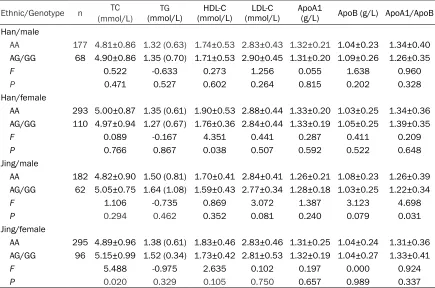
Table 4. Comparison of the genotypes and serum lipid levels between males and females in the Han and Jing populations
Ethnic/Genotype n (mmol/L)TC (mmol/L)TG (mmol/L)HDL-C (mmol/L)LDL-C ApoA1 (g/L) ApoB (g/L) ApoA1/ApoB Han/male
AA 177 4.81±0.86 1.32 (0.63) 1.74±0.53 2.83±0.43 1.32±0.21 1.04±0.23 1.34±0.40 AG/GG 68 4.90±0.86 1.35 (0.70) 1.71±0.53 2.90±0.45 1.31±0.20 1.09±0.26 1.26±0.35
F 0.522 -0.633 0.273 1.256 0.055 1.638 0.960
P 0.471 0.527 0.602 0.264 0.815 0.202 0.328
Han/female
AA 293 5.00±0.87 1.35 (0.61) 1.90±0.53 2.88±0.44 1.33±0.20 1.03±0.25 1.34±0.36 AG/GG 110 4.97±0.94 1.27 (0.67) 1.76±0.36 2.84±0.44 1.33±0.19 1.05±0.25 1.39±0.35
F 0.089 -0.167 4.351 0.441 0.287 0.411 0.209
P 0.766 0.867 0.038 0.507 0.592 0.522 0.648 Jing/male
AA 182 4.82±0.90 1.50 (0.81) 1.70±0.41 2.84±0.41 1.26±0.21 1.08±0.23 1.26±0.39 AG/GG 62 5.05±0.75 1.64 (1.08) 1.59±0.43 2.77±0.34 1.28±0.18 1.03±0.25 1.22±0.34
F 1.106 -0.735 0.869 3.072 1.387 3.123 4.698
P 0.294 0.462 0.352 0.081 0.240 0.079 0.031 Jing/female
AA 295 4.89±0.96 1.38 (0.61) 1.83±0.46 2.83±0.46 1.31±0.25 1.04±0.24 1.31±0.36 AG/GG 96 5.15±0.99 1.52 (0.34) 1.73±0.42 2.81±0.53 1.32±0.19 1.04±0.27 1.33±0.41
F 5.488 -0.975 2.635 0.102 0.197 0.000 0.924
P 0.020 0.329 0.105 0.750 0.657 0.989 0.337
[image:6.612.89.524.330.618.2]Nucleotide sequences
The results were se- parated into AA, AG and GG genotypes of the RBM5 rs2013208 SNP by PCR-RFLP and the genotypes were fu- rther confirmed by di- rect sequencing (Figu- re 3); respectively.
Genotypic and allelic frequencies
The genotypic and al- lelic frequencies of the rs2013208 SNP in the both ethnic gro- ups are shown in Table 2. The frequency of
RBM5 rs2013208-G allele was 14.4% in Han and 13.6% in Jing (P > 0.05). There was no significant differ-ence in either genotyp-ic or allelgenotyp-ic frequencies between Han and Jing, or between males and females of the both ethnic groups.
Genotypes and serum lipid levels
[image:7.612.89.408.99.724.2]As shown in Tables 3 and 4, the levels of TC and the ratio of ApoA1 to ApoB were different between the AA and AG/GG genotypes in Jing (P < 0.05 for each) but not in Han, the G allele carriers had hi- gher TC levels and ApoA1/ApoB ratio th- an the G allele non-carriers. The G allele carriers had lower serum HDL-C levels than the G allele non-carriers in both Han and Jing. Subgroup analyses showed that the G allele carriers in Han females but not in Table 5. The risk factors for serum lipid parameters in the Han and Jing
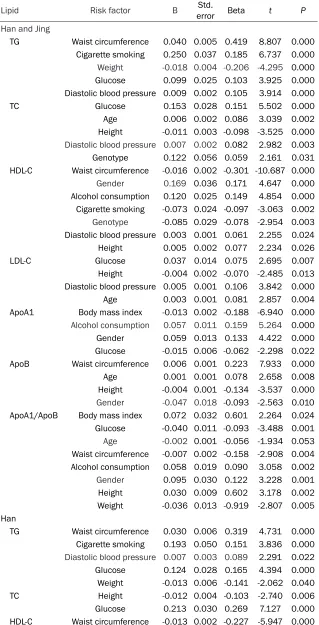
populations
Lipid Risk factor B errorStd. Beta t P
Han and Jing
TG Waist circumference 0.040 0.005 0.419 8.807 0.000 Cigarette smoking 0.250 0.037 0.185 6.737 0.000 Weight -0.018 0.004 -0.206 -4.295 0.000 Glucose 0.099 0.025 0.103 3.925 0.000 Diastolic blood pressure 0.009 0.002 0.105 3.914 0.000 TC Glucose 0.153 0.028 0.151 5.502 0.000 Age 0.006 0.002 0.086 3.039 0.002 Height -0.011 0.003 -0.098 -3.525 0.000 Diastolic blood pressure 0.007 0.002 0.082 2.982 0.003 Genotype 0.122 0.056 0.059 2.161 0.031 HDL-C Waist circumference -0.016 0.002 -0.301 -10.687 0.000 Gender 0.169 0.036 0.171 4.647 0.000 Alcohol consumption 0.120 0.025 0.149 4.854 0.000 Cigarette smoking -0.073 0.024 -0.097 -3.063 0.002 Genotype -0.085 0.029 -0.078 -2.954 0.003 Diastolic blood pressure 0.003 0.001 0.061 2.255 0.024 Height 0.005 0.002 0.077 2.234 0.026 LDL-C Glucose 0.037 0.014 0.075 2.695 0.007 Height -0.004 0.002 -0.070 -2.485 0.013 Diastolic blood pressure 0.005 0.001 0.106 3.842 0.000 Age 0.003 0.001 0.081 2.857 0.004 ApoA1 Body mass index -0.013 0.002 -0.188 -6.940 0.000 Alcohol consumption 0.057 0.011 0.159 5.264 0.000 Gender 0.059 0.013 0.133 4.422 0.000 Glucose -0.015 0.006 -0.062 -2.298 0.022 ApoB Waist circumference 0.006 0.001 0.223 7.933 0.000 Age 0.001 0.001 0.078 2.658 0.008 Height -0.004 0.001 -0.134 -3.537 0.000 Gender -0.047 0.018 -0.093 -2.563 0.010 ApoA1/ApoB Body mass index 0.072 0.032 0.601 2.264 0.024 Glucose -0.040 0.011 -0.093 -3.488 0.001 Age -0.002 0.001 -0.056 -1.934 0.053 Waist circumference -0.007 0.002 -0.158 -2.908 0.004 Alcohol consumption 0.058 0.019 0.090 3.058 0.002 Gender 0.095 0.030 0.122 3.228 0.001 Height 0.030 0.009 0.602 3.178 0.002 Weight -0.036 0.013 -0.919 -2.807 0.005 Han
Han males had lower HDL-C levels than the G allele non-carriers (P
< 0.05). The G allele carriers in Jing females but not in Jing males had higher TC levels than the G allele non-carriers (P < 0.001). The G allele carriers in Jing males but not in Jing females had lower ApoA1/ApoB ratio than the G allele non-carri-ers (P < 0.05). There was no significant dif-ference in the remain-ing serum lipid param-eters between the genotypes in Jing, Han, males, or females (P > 0.05 for all).
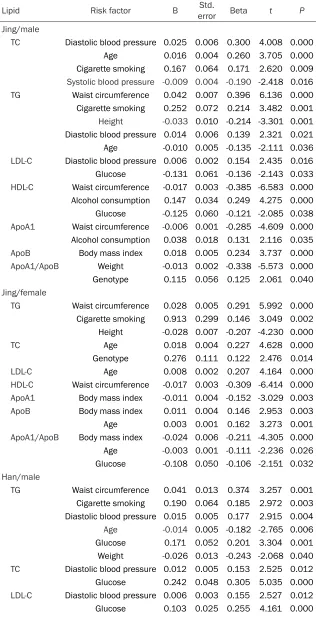
Risk factors for serum lipid parameters
The risk factors for serum lipid parame-ters in Jing and Han are shown in Tables 5 and 6. Multiple line- ar regression analyses showed that serum TC and HDL-C levels in Jing and Han, HDL-C, TC levels and ApoA1/ ApoB ratio in Jing were correlated with geno-types (P < 0.05), res- pectively. When serum lipid data were ana-lyzed according to ge- nder, serum TC levels in Jing and HDL-C lev-els in Han were associ-ated with the geno-types only in females but not in males. The ApoA1/ApoB ratio in Jing was associated with the genotypes only in males but not in females. Several environmental factors such as age, gender, height, weight, waist Gender 0.124 0.049 0.118 2.558 0.011
Alcohol consumption 0.121 0.035 0.160 3.417 0.001 Cigarette smoking -0.112 0.037 -0.142 -3.039 0.002 LDL-C Glucose 0.061 0.015 0.155 3.922 0.000 Systolic blood pressure 0.003 0.001 0.112 2.848 0.005 Height -0.004 0.002 -0.079 -2.066 0.039 ApoA1 Body mass index -0.012 0.002 -0.186 -4.936 0.000 Alcohol consumption 0.075 0.013 0.253 5.809 0.000 Gender 0.064 0.018 0.155 3.571 0.000 Glucose -0.015 0.007 -0.080 -2.128 0.034 ApoB Waist circumference 0.006 0.001 0.220 5.536 0.000 Systolic blood pressure 0.001 0.000 0.115 2.966 0.003 Height -0.007 0.002 -0.208 -4.201 0.000 Gender -0.077 0.024 -0.152 -3.133 0.002 ApoA1/ApoB Waist circumference -0.007 0.003 -0.156 -2.016 0.044 Body mass index 0.093 0.043 0.780 2.176 0.030 Glucose -0.037 0.013 -0.109 -2.911 0.004 Systolic blood pressure -0.002 0.001 -0.092 -2.388 0.017 Alcohol consumption 0.076 0.023 0.136 3.225 0.001 Gender 0.160 0.040 0.206 3.994 0.000 Height 0.040 0.012 0.817 3.186 0.002 Weight -0.045 0.017 -1.113 -2.573 0.010 Jing
TG Waist circumference 0.047 0.007 0.463 6.529 0.000 Cigarette smoking 0.303 0.059 0.214 5.114 0.000 Height -0.029 0.006 -0.251 -5.003 0.000 Diastolic blood pressure 0.010 0.003 0.117 3.111 0.002 Body mass index -0.040 0.019 -0.143 -2.122 0.034 Gender -0.184 0.089 -0.100 -2.058 0.040
TC Age 0.015 0.003 0.205 4.818 0.000
Genotype 0.204 0.084 0.094 2.422 0.016 Diastolic blood pressure 0.009 0.004 0.098 2.464 0.014 Pulse pressure -0.006 0.002 -0.121 -2.843 0.005 Height -0.022 0.006 -0.182 -3.512 0.000 Cigarette smoking 0.149 0.061 0.100 2.461 0.014 Weight 0.010 0.005 0.106 2.135 0.033 HDL-C Waist circumference -0.016 0.002 -0.327 -8.753 0.000 Gender 0.148 0.036 0.162 4.068 0.000 Alcohol consumption 0.144 0.036 0.159 4.001 0.000 Genotype -0.084 0.038 -0.082 -2.218 0.027 LDL-C Age 0.004 0.001 0.128 3.258 0.001 Diastolic blood pressure 0.004 0.002 0.101 2.563 0.011 ApoA1 Weight -0.005 0.001 -0.204 -5.253 0.000 ApoB Waist circumference 0.005 0.001 0.179 4.603 0.000 Age 0.002 0.001 0.105 2.693 0.007 ApoA1/ApoB Waist circumference -0.007 0.003 -0.155 -2.381 0.018 Genotype 0.085 0.034 0.096 2.513 0.012
Age -0.003 0.001 -0.091 -2.386 0.017 Body mass index -0.017 0.008 -0.139 -2.114 0.035
circumference, alcoh- ol consumption and ci- garette smoking, and traditional cardiovas-cular risk factors such as BMI, fasting blood glucose and blood pr- essure levels were al- so correlated with se- rum lipid parameters in the Han and Jing populations and in males and females of both ethnic groups (P
< 0.05-0.001, Tables 5 and 6).
Discussion
In the present study, we showed that the levels of weight, waist circumference, BMI, TG, glucose were high-er in Jing than in Han, but the ratio of ApoA1/ ApoB, the percentag-es of subjects con-suming alcohol, the levels of ApoA1 and HDL-C were lower in Jing than in Han (P
[image:9.612.91.407.99.718.2]< 0.05-0.001). There were no significant dif-ferences in the levels of LDL-C, TC, ApoB between the two eth-nic groups. These dif-ferences in serum lipid profiles between the two ethnic groups may result from the com-bined action of genet-ic including lipid-asso-ciated gene variants, environmental factors including diet, alcohol consumption, cigare- tte smoking, obesity, exercise, hypertension and their interactions [23, 27, 28]. Jing is the only Chinese minority for coastal fisheries Table 6. Relationship between serum lipid parameters and relative factors
in the males and females of the Han and Jing populations
Lipid Risk factor B errorStd. Beta t P
Jing/male
TC Diastolic blood pressure 0.025 0.006 0.300 4.008 0.000 Age 0.016 0.004 0.260 3.705 0.000 Cigarette smoking 0.167 0.064 0.171 2.620 0.009 Systolic blood pressure -0.009 0.004 -0.190 -2.418 0.016 TG Waist circumference 0.042 0.007 0.396 6.136 0.000 Cigarette smoking 0.252 0.072 0.214 3.482 0.001 Height -0.033 0.010 -0.214 -3.301 0.001 Diastolic blood pressure 0.014 0.006 0.139 2.321 0.021 Age -0.010 0.005 -0.135 -2.111 0.036 LDL-C Diastolic blood pressure 0.006 0.002 0.154 2.435 0.016 Glucose -0.131 0.061 -0.136 -2.143 0.033 HDL-C Waist circumference -0.017 0.003 -0.385 -6.583 0.000 Alcohol consumption 0.147 0.034 0.249 4.275 0.000 Glucose -0.125 0.060 -0.121 -2.085 0.038 ApoA1 Waist circumference -0.006 0.001 -0.285 -4.609 0.000 Alcohol consumption 0.038 0.018 0.131 2.116 0.035 ApoB Body mass index 0.018 0.005 0.234 3.737 0.000 ApoA1/ApoB Weight -0.013 0.002 -0.338 -5.573 0.000 Genotype 0.115 0.056 0.125 2.061 0.040 Jing/female
TG Waist circumference 0.028 0.005 0.291 5.992 0.000 Cigarette smoking 0.913 0.299 0.146 3.049 0.002 Height -0.028 0.007 -0.207 -4.230 0.000
TC Age 0.018 0.004 0.227 4.628 0.000
Genotype 0.276 0.111 0.122 2.476 0.014
LDL-C Age 0.008 0.002 0.207 4.164 0.000
HDL-C Waist circumference -0.017 0.003 -0.309 -6.414 0.000 ApoA1 Body mass index -0.011 0.004 -0.152 -3.029 0.003 ApoB Body mass index 0.011 0.004 0.146 2.953 0.003 Age 0.003 0.001 0.162 3.273 0.001 ApoA1/ApoB Body mass index -0.024 0.006 -0.211 -4.305 0.000 Age -0.003 0.001 -0.111 -2.236 0.026 Glucose -0.108 0.050 -0.106 -2.151 0.032 Han/male
and is the only sea people in China. In this case, it has a very special lifestyle and dietary habits compared with the other landlocked nationali-ties. Jing nationality is a relatively conservative and isolated minority in China that retains its regional and special customs. Their marriages were family-arranged in the old days when they sing antiphonal songs to look for the other half. After antiphonal singing, if the boy’s into the girl he would kick sand toward her while approach-ing her. If the girl feel the same she would kick back, which means engagement. Jing stays endogamy, intermarriage with Han or Zhuang people is seldom happened. Jing people don’t get married with someone sharing the same
ancestry in SW USA, 34.85% of Esan in Nigeria, 41.15% in Gambian in Western Divisions in the Gambia. In the present study, we showed that the frequencies of G alleles were 14.4% in Han and 13.6% in Jing (P > 0.05); respectively. Apparently, the minor allele frequency was lower in Asian than the Western populations. There were no conspicuous differences in the genotypic and allelic frequencies of the rs2013208 SNP between the Jing and Han populations, or between males and females in the both ethnic groups. As compared with the data in the 1000 genomes project data, we found that the frequencies of the G allele in our study populations (14.4% in Han and 13.6% in HDL-C Waist circumference -0.017 0.004 -0.267 -4.250 0.000
Alcohol consumption 0.107 0.038 0.187 2.825 0.005 Diastolic blood pressure 0.006 0.003 0.128 2.041 0.042 Cigarette smoking -0.121 0.038 -0.207 -3.175 0.002 ApoA1 Waist circumference -0.005 0.001 -0.213 -3.576 0.000 Alcohol consumption 0.078 0.013 0.350 5.865 0.000 ApoB Waist circumference 0.006 0.002 0.219 3.522 0.001 Systolic blood pressure 0.002 0.001 0.173 2.782 0.006 ApoA1/ApoB Waist circumference -0.013 0.003 -0.279 -4.559 0.000 Alcohol consumption 0.085 0.026 0.199 3.255 0.001 Systolic blood pressure -0.003 0.001 -0.138 -2.238 0.026 Han/female
TG Waist circumference 0.021 0.004 0.246 5.174 0.000 Glucose 0.125 0.033 0.182 3.817 0.000 TC Glucose 0.206 0.038 0.261 5.410 0.000 LDL-C Glucose 0.047 0.019 0.121 2.404 0.017 Age 0.003 0.002 0.091 1.736 0.083 Height -0.007 0.004 -0.109 -2.128 0.034 HDL-C Body mass index -0.031 0.007 -0.209 -4.307 0.000 Genotype -0.140 0.054 -0.126 -2.593 0.010 Pulse pressure -0.003 0.002 -0.111 -2.293 0.022 ApoA1 Body mass index -0.011 0.003 -0.192 -3.948 0.000 Glucose -0.022 0.009 -0.125 -2.562 0.011 ApoB Age 0.003 0.001 0.146 2.952 0.003 Waist circumference 0.006 0.001 0.231 4.786 0.000 Height -0.008 0.002 -0.195 -3.888 0.000 ApoA1/ApoB Weight -0.077 0.024 -1.856 -3.201 0.001 Body mass index 0.147 0.056 1.332 2.619 0.009 Age -0.004 0.001 -0.142 -2.945 0.003 Glucose -0.040 0.015 -0.122 -2.627 0.009 Height 0.062 0.017 1.083 3.695 0.000
TC, total cholesterol; TG, triglyceride; HDL-C, high-density lipoprotein cholesterol; LDL-C, low-density lipoprotein cholesterol; ApoA1, apolipoprotein A1; ApoB, apolipoprotein B; ApoA1/ ApoB, the ratio of apolipoprotein A1 to apolipoprotein B.
last name, also cross-co- usin marriage is stri- ctly forbidden. There- fore, we deduced that some hereditary char-acteristics and geno-types of specific lipid metabolism-associat-ed genes in this popu-lation may be different from those in the Han people.
Jing, P > 0.05) were higher than those in Southern Han Chinese (10.48%), which may be caused by different sample sizes and regions.
Recently, a newly study identifies and anno-tates 157 loci associated with lipid levels obtained from Joint GWAS and Metabochip Meta-analysis (P < 5 × 10⁻⁸) including 62 loci
not previously associated with lipid levels in humans which referred to the association between the RBM5 rs2013208 SNP and HDL-C levels [14]. Besides this, rare studies have pre-viously reported the direct effect of the RBM5 rs20- 13208 SNP on serum lipid levels. Because the effects of newly identified loci were generally smaller than in earlier GWAS, more work is needed to be done to actually confirm the find-ings. In the present study, the levels of TC and the ratio of ApoA1 to ApoB were different between the AA and AG/GG genotypes in Jing (P < 0.05) but not in Han, the G allele carriers had higher TC levels and ApoA1/ApoB ratio than the G allele non-carriers. The G allele car-riers had lower serum HDL-C levels than the G allele non-carriers in both Han and Jing. In the subgroup analyses, the G allele carriers in Han females but not in Han males had lower HDL-C levels than the G allele non-carriers (P < 0.05). The G allele carriers in Jing females but not in Jing males had higher TC levels than the G allele non-carriers (P < 0.001). The G allele car-riers in Jing males but not in Jing females had lower ApoA1/ApoB ratio than the G allele non-carriers (P < 0.05). There was no significant dif-ference in the remaining serum lipid parame-ters between the genotypes in Jing, Han, males, or females (P > 0.05 for all). These results sug-gest that there may be an ethnic and/or sex specific-association of the RBM5 rs2013208 SNP and serum lipid parameters. As far as we know, our study is the first replication of GWAS signals about the association of RBM5 rs- 2013208 SNP with serum lipid levels in the Chinese populations. Therefore, further studies with larger sample size are still needed to con-firm this association.
In the present study, multiple linear regression analysis showed that serum lipid parameters were associated with age, gender, alcohol con-sumption, cigarette smoking, BMI, fasting blood glucose levels and blood pressure in both Jing and Han, or males and females in both ethnic groups. These data suggest that
moderate alcohol intake has been associated with reduced cardiovascular events which were attributed in great part to the increase in HDL-C caused by alcohol consumption [32, 33]. In contrast, heavy alcohol consumption was robustly positively associated with serum TG, LDL-C levels and blood pressure [32, 34, 35]. In addition, our previous studies also docu-mented that BMI and alcohol consumption may interact with certain lipid-related gene variants to modify the serum lipid levels in Bai Ku Yao and Han ethnic groups [36]. Consequently, the joint effects of different dietary habits, life-styles, and environmental factors probably fur-ther modify the association of genetic varia-tions and serum lipid levels in our study populations.
Limitations
There are some potential limitations in our study. First, this is the first time to report the sex-specific association of the RBM5 rs2013- 208 SNP and no previous evidence to support our findings and the number of subjects in our study is moderate, the statistical power is rela-tively reliable. Thus, further studies with larger samples are needed to replicate our findings in other populations. Second, we only measured serum TC, TG, HDL-C, LDL-C, ApoA1, ApoB lev-els, and the ratio of ApoA1 to ApoB, but the sub-classes lipoproteins such as HDL2, HDL3, small dense LDL, and large buoyant LDL were not detected their associations with rs2013208 SNP. Third, we were not able to alleviate the effect of diet during the statistical analysis since the diet intake was self-reported and dif-ficult to classify.
Conclusions
Our study showed that the association of the
RBM5 rs2013208 SNP and serum lipid levels was different between the Jing and Han popula-tions, and between males and females in the both ethnic groups. These findings suggest that there may be an ethnic- and/or sex-speci- fic association between the RBM5 rs20132- 08 SNP and serum lipid levels in different populations.
Acknowledgements
The work was supported by the National Natural Science Foundation of China (No: 81160111).
Disclosure of conflict of interest
None.
Address correspondence to: Rui-Xing Yin, Depart- ment of Cardiology, Institute of Cardiovascular Diseases, The First Affiliated Hospital, Guangxi Medical University, 22 Shuangyong Road, Nanning, Guangxi, China. E-mail: [email protected]
References
[1] Deaton C, Froelicher ES, Wu LH, Ho C, Shishani K and Jaarsma T. The global burden of cardio-vascular disease. Eur J Cardiovasc Nurs 2011; 10 Suppl 2: S5-13.
[2] Moran A, Forouzanfar M, Sampson U, Chugh S, Feigin V and Mensah G. The epidemiology of cardiovascular diseases in sub-Saharan Africa: the global burden of diseases, injuries and risk factors 2010 study. Prog Cardiovasc Dis 2013; 56: 234-239.
Poulter N, Psaty B, Redline S, Rich SS, Rotter JI, Schunkert H, Sever P, Shuldiner AR, Silverstein RL, Stanton A, Thorand B, Trip MD, Tsai MY, van der Harst P, van der Schoot E, van der Schouw YT, Verschuren WM, Watkins H, Wilde AA, Wolffenbuttel BH, Whitfield JB, Hovingh GK, Ballantyne CM, Wijmenga C, Reilly MP, Martin NG, Wilson JG, Rader DJ, Samani NJ, Reiner AP, Hegele RA, Kastelein JJ, Hingorani AD, Talmud PJ, Hakonarson H, Elbers CC, Keating BJ and Drenos F. Large-scale gene-centric meta-analy-sis across 32 studies identifies multiple lipid loci. Am J Hum Genet 2012; 91: 823-838. [4] Anand SS. Quantifying effect of statins on low
density lipoprotein cholesterol, ischaemic heart disease, and stroke: systematic review and meta-analysis. Law MR, Wald NJ, Rudnic-ka AR. BMJ 2003; 326: 1407-408. Vasc Med 2003; 8: 289-290.
[5] Stamler J, Neaton JD, Cohen JD, Cutler J, Eb-erly L, Grandits G, Kuller LH, Ockene J and Pri-neas R. Multiple risk factor intervention trial revisited: a new perspective based on nonfatal and fatal composite endpoints, coronary and cardiovascular, during the trial. J Am Heart As-soc 2012; 1: e003640.
[6] Corella D and Ordovas JM. Single nucleotide polymorphisms that influence lipid metabo-lism: interaction with dietary factors. Annu Rev Nutr 2005; 25: 341-390.
[7] Burnett JR. Lipids, lipoproteins, atherosclerosis and cardiovascular disease. Clin Biochem Rev 2004; 25: 2.
[8] Ordovas JM and Shen AH. Genetics, the envi-ronment, and lipid abnormalities. Curr Cardiol Rep 2002; 4: 508-513.
[9] Yip AG, Ma Q, Wilcox M, Panhuysen CI, Farrell J, Farrer LA and Wyszynski DF. Search for genetic factors predisposing to atherogenic dyslipid-emia. BMC Genet 2003; 4 Suppl 1: S100. [10] Heller DA, de Faire U, Pedersen NL, Dahlen G
and McClearn GE. Genetic and environmental influences on serum lipid levels in twins. N Engl J Med 1993; 328: 1150-1156.
[11] Perusse L, Rice T, Despres JP, Bergeron J, Prov-ince MA, Gagnon J, Leon AS, Rao DC, Skinner JS, Wilmore JH and Bouchard C. Familial re-semblance of plasma lipids, lipoproteins and postheparin lipoprotein and hepatic lipases in the heritage family study. Arterioscler Thromb Vasc Biol 1997; 17: 3263-3269.
[12] Teslovich TM, Musunuru K, Smith AV, Edmond-son AC, Stylianou IM, Koseki M, Pirruccello JP, Ripatti S, Chasman DI, Willer CJ, Johansen CT, Fouchier SW, Isaacs A, Peloso GM, Barbalic M, Ricketts SL, Bis JC, Aulchenko YS, Thorleifsson G, Feitosa MF, Chambers J, Orho-Melander M, Melander O, Johnson T, Li X, Guo X, Li M, Shin Cho Y, Jin Go M, Jin Kim Y, Lee JY, Park T, Kim
K, Sim X, Twee-Hee Ong R, Croteau-Chonka DC, Lange LA, Smith JD, Song K, Hua Zhao J, Yuan X, Luan J, Lamina C, Ziegler A, Zhang W, Zee RY, Wright AF, Witteman JC, Wilson JF, Willem-sen G, Wichmann HE, Whitfield JB, Waterworth DM, Wareham NJ, Waeber G, Vollenweider P, Voight BF, Vitart V, Uitterlinden AG, Uda M, Tu-omilehto J, Thompson JR, Tanaka T, Surakka I, Stringham HM, Spector TD, Soranzo N, Smit JH, Sinisalo J, Silander K, Sijbrands EJ, Scuteri A, Scott J, Schlessinger D, Sanna S, Salomaa V, Saharinen J, Sabatti C, Ruokonen A, Rudan I, Rose LM, Roberts R, Rieder M, Psaty BM, Pramstaller PP, Pichler I, Perola M, Penninx BW, Pedersen NL, Pattaro C, Parker AN, Pare G, Oostra BA, O’Donnell CJ, Nieminen MS, Nickerson DA, Montgomery GW, Meitinger T, McPherson R, McCarthy MI, McArdle W, Mas-son D, Martin NG, Marroni F, Mangino M, Mag-nusson PK, Lucas G, Luben R, Loos RJ, Lokki ML, Lettre G, Langenberg C, Launer LJ, Lakatta EG, Laaksonen R, Kyvik KO, Kronenberg F, Ko-nig IR, Khaw KT, Kaprio J, Kaplan LM, Johans-son A, Jarvelin MR, Janssens AC, IngelsJohans-son E, Igl W, Kees Hovingh G, Hottenga JJ, Hofman A, Hicks AA, Hengstenberg C, Heid IM, Hayward C, Havulinna AS, Hastie ND, Harris TB, Haritu-nians T, Hall AS, Gyllensten U, Guiducci C, Groop LC, Gonzalez E, Gieger C, Freimer NB, Ferrucci L, Erdmann J, Elliott P, Ejebe KG, Dor-ing A, Dominiczak AF, Demissie S, Deloukas P, de Geus EJ, de Faire U, Crawford G, Collins FS, Chen YD, Caulfield MJ, Campbell H, Burtt NP, Bonnycastle LL, Boomsma DI, Boekholdt SM, Bergman RN, Barroso I, Bandinelli S, Ballan-tyne CM, Assimes TL, Quertermous T, Altshuler D, Seielstad M, Wong TY, Tai ES, Feranil AB, Kuzawa CW, Adair LS, Taylor HA Jr, Borecki IB, Gabriel SB, Wilson JG, Holm H, Thorsteinsdottir U, Gudnason V, Krauss RM, Mohlke KL, Ordo-vas JM, Munroe PB, Kooner JS, Tall AR, Hegele RA, Kastelein JJ, Schadt EE, Rotter JI, Boerwin-kle E, Strachan DP, Mooser V, Stefansson K, Reilly MP, Samani NJ, Schunkert H, Cupples LA, Sandhu MS, Ridker PM, Rader DJ, van Dui-jn CM, Peltonen L, Abecasis GR, Boehnke M and Kathiresan S. Biological, clinical and pop-ulation relevance of 95 loci for blood lipids. Nature 2010; 466: 707-713.
[13] Barter PJ and Rye KA. Cholesteryl ester trans-fer protein inhibition as a strategy to reduce cardiovascular risk. J Lipid Res 2012; 53: 1755-1766.
Donnelly LA, Ehret GB, Esko T, Feitosa MF, Fer-reira T, Fischer K, Fontanillas P, Fraser RM, Fre-itag DF, Gurdasani D, Heikkila K, Hypponen E, Isaacs A, Jackson AU, Johansson A, Johnson T, Kaakinen M, Kettunen J, Kleber ME, Li X, Luan J, Lyytikainen LP, Magnusson PK, Mangino M, Mihailov E, Montasser ME, Muller-Nurasyid M, Nolte IM, O’Connell JR, Palmer CD, Perola M, Petersen AK, Sanna S, Saxena R, Service SK, Shah S, Shungin D, Sidore C, Song C, Straw-bridge RJ, Surakka I, Tanaka T, Teslovich TM, Thorleifsson G, Van den Herik EG, Voight BF, Volcik KA, Waite LL, Wong A, Wu Y, Zhang W, Absher D, Asiki G, Barroso I, Been LF, Bolton JL, Bonnycastle LL, Brambilla P, Burnett MS, Ce-sana G, Dimitriou M, Doney AS, Doring A, Elliott P, Epstein SE, Eyjolfsson GI, Gigante B, Goodar-zi MO, Grallert H, Gravito ML, Groves CJ, Hall-mans G, Hartikainen AL, Hayward C, Hernan-dez D, Hicks AA, Holm H, Hung YJ, Illig T, Jones MR, Kaleebu P, Kastelein JJ, Khaw KT, Kim E, Klopp N, Komulainen P, Kumari M, Langenberg C, Lehtimaki T, Lin SY, Lindstrom J, Loos RJ, Mach F, McArdle WL, Meisinger C, Mitchell BD, Muller G, Nagaraja R, Narisu N, Nieminen TV, Nsubuga RN, Olafsson I, Ong KK, Palotie A, Pa-pamarkou T, Pomilla C, Pouta A, Rader DJ, Reilly MP, Ridker PM, Rivadeneira F, Rudan I, Ruokonen A, Samani N, Scharnagl H, Seeley J, Silander K, Stancakova A, Stirrups K, Swift AJ, Tiret L, Uitterlinden AG, van Pelt LJ, Vedantam S, Wainwright N, Wijmenga C, Wild SH, Willem-sen G, Wilsgaard T, Wilson JF, Young EH, Zhao JH, Adair LS, Arveiler D, Assimes TL, Bandinelli S, Bennett F, Bochud M, Boehm BO, Boomsma DI, Borecki IB, Bornstein SR, Bovet P, Burnier M, Campbell H, Chakravarti A, Chambers JC, Chen YD, Collins FS, Cooper RS, Danesh J, De-doussis G, de Faire U, Feranil AB, Ferrieres J, Ferrucci L, Freimer NB, Gieger C, Groop LC, Gudnason V, Gyllensten U, Hamsten A, Harris TB, Hingorani A, Hirschhorn JN, Hofman A, Hovingh GK, Hsiung CA, Humphries SE, Hunt SC, Hveem K, Iribarren C, Jarvelin MR, Jula A, Kahonen M, Kaprio J, Kesaniemi A, Kivimaki M, Kooner JS, Koudstaal PJ, Krauss RM, Kuh D, Kuusisto J, Kyvik KO, Laakso M, Lakka TA, Lind L, Lindgren CM, Martin NG, Marz W, Mc-Carthy MI, McKenzie CA, Meneton P, Metspalu A, Moilanen L, Morris AD, Munroe PB, Njolstad I, Pedersen NL, Power C, Pramstaller PP, Price JF, Psaty BM, Quertermous T, Rauramaa R, Saleheen D, Salomaa V, Sanghera DK, Sara-mies J, Schwarz PE, Sheu WH, Shuldiner AR, Siegbahn A, Spector TD, Stefansson K, Stra-chan DP, Tayo BO, Tremoli E, Tuomilehto J, Uusitupa M, van Duijn CM, Vollenweider P, Wal-lentin L, Wareham NJ, Whitfield JB, Wolffenbut-tel BH, Ordovas JM, Boerwinkle E, Palmer CN,
Thorsteinsdottir U, Chasman DI, Rotter JI, Franks PW, Ripatti S, Cupples LA, Sandhu MS, Rich SS, Boehnke M, Deloukas P, Kathiresan S, Mohlke KL, Ingelsson E and Abecasis GR. Discovery and refinement of loci associated with lipid levels. Nat Genet 2013; 45: 1274-1283.
[15] Kathiresan S, Willer CJ, Peloso GM, Demissie S, Musunuru K, Schadt EE, Kaplan L, Bennett D, Li Y, Tanaka T, Voight BF, Bonnycastle LL, Jackson AU, Crawford G, Surti A, Guiducci C, Burtt NP, Parish S, Clarke R, Zelenika D, Kubal-anza KA, Morken MA, Scott LJ, Stringham HM, Galan P, Swift AJ, Kuusisto J, Bergman RN, Sundvall J, Laakso M, Ferrucci L, Scheet P, Sanna S, Uda M, Yang Q, Lunetta KL, Dupuis J, de Bakker PI, O’Donnell CJ, Chambers JC, Kooner JS, Hercberg S, Meneton P, Lakatta EG, Scuteri A, Schlessinger D, Tuomilehto J, Collins FS, Groop L, Altshuler D, Collins R, Lathrop GM, Melander O, Salomaa V, Peltonen L, Orho-Me-lander M, Ordovas JM, Boehnke M, Abecasis GR, Mohlke KL and Cupples LA. Common vari-ants at 30 loci contribute to polygenic dyslipid-emia. Nat Genet 2009; 41: 56-65.
[16] Lin JH, Liu ZH, Lv FJ, Fu YG, Fan XL, Li SY, Lu JM, Liu XY and Xu AL. Molecular analyses of HLA-DRB1, -DPB1, and -DQB1 in Jing ethnic minor-ity of Southwest China. Hum Immunol 2003; 64: 830-834.
[17] Sun JQ, Yin RX, Shi GY, Shen SW, Chen X, Bin Y, Huang F, Wang W, Lin WX and Pan SL. Associa-tion of the ARL15 rs6450176 SNP and serum lipid levels in the Jing and Han populations. Int J Clin Exp Pathol 2015; 8: 12977-12994. [18] An epidemiological study of cardiovascular
and cardiopulmonary disease risk factors in four populations in the People’s Republic of China. Baseline report from the P.R.C.-U.S.A. collaborative study. People’s Republic of Chi-na--United States cardiovascular and cardio-pulmonary epidemiology research group. Cir-culation 1992; 85: 1083-1096.
[19] Aung LH, Yin RX, Wu JZ, Wu DF, Wang W and Li H. Association between the MLX interacting protein-like, BUD13 homolog and zinc finger protein 259 gene polymorphisms and serum lipid levels. Sci Rep 2014; 4: 5565.
[20] Aung LH, Yin RX, Wu DF, Li Q, Yan TT, Wang YM, Li H, Wei DX, Shi YL and Yang DZ. Association of the TRIB1 tribbles homolog 1 gene rs17321515 A > G polymorphism and serum lipid levels in the Mulao and Han populations. Lipids Health Dis 2011; 10: 230.
[22] Ramazauskiene V, Petkeviciene J, Klumbiene J, Kriaucioniene V and Sakyte E. Diet and se-rum lipids: changes over socio-economic tran-sition period in Lithuanian rural population. BMC Public Health 2011; 11: 447.
[23] Ruixing Y, Yuming C, Shangling P, Fengping H, Tangwei L, Dezhai Y, Jinzhen W, Limei Y, Weix-iong L, Rongshan L and Jiandong H. Effects of demographic, dietary and other lifestyle fac-tors on the prevalence of hyperlipidemia in Guangxi Hei Yi Zhuang and Han populations. Eur J Cardiovasc Prev Rehabil 2006; 13: 977-984.
[24] Ishii M. [The sixth report of the joint national committee on prevention, detection, evalua-tion, and treatment of high blood pressure, and 1999 world health organization-interna-tional society of hypertension guidelines for the management of hypertension]. Nihon Rinsho 2000; 58 Suppl 1: 267-275.
[25] Chalmers J, MacMahon S, Mancia G, Whit-worth J, Beilin L, Hansson L, Neal B, Rodgers A, Ni Mhurchu C and Clark T. 1999 world health organization-international society of hyperten-sion guidelines for the management of hyper-tension. Guidelines sub-committee of the world health organization. Clin Exp Hypertens 1999; 21: 1009-1060.
[26] Zhou BF. Predictive values of body mass index and waist circumference for risk factors of cer-tain related diseases in Chinese adults--study on optimal cut-off points of body mass index and waist circumference in Chinese adults. Biomed Environ Sci 2002; 15: 83-96.
[27] Bruce KD and Cagampang FR. Epigenetic priming of the metabolic syndrome. Toxicol Mech Methods 2011; 21: 353-361.
[28] Ruixing Y, Yiyang L, Meng L, Kela L, Xingjiang L, Lin Z, Wanying L, Jinzhen W, Dezhai Y and Weixiong L. Interactions of the apolipoprotein C-III 3238C > G polymorphism and alcohol consumption on serum triglyceride levels. Lip-ids Health Dis 2010; 9: 86.
[29] Mozaffarian D, Lemaitre RN, Kuller LH, Burke GL, Tracy RP and Siscovick DS. Cardiac bene-fits of fish consumption may depend on the type of fish meal consumed: the cardiovascu-lar health study. Circulation 2003; 107: 1372-1377.
[30] He K, Song Y, Daviglus ML, Liu K, Van Horn L, Dyer AR and Greenland P. Accumulated evi-dence on fish consumption and coronary heart disease mortality: a meta-analysis of cohort studies. Circulation 2004; 109: 2705-2711. [31] Mandai N, Akazawa K, Hara N, Ide Y, Ide K,
Dazai U, Chishaki A and Chishaki H. Body weight reduction results in favorable changes in blood pressure, serum lipids, and blood sug-ar in middle-aged japanese persons: a 5-yesug-ar interval observational study of 26,824 cases. Glob J Health Sci 2015; 7: 159-170.
[32] Mukamal KJ, Chen CM, Rao SR and Breslow RA. Alcohol consumption and cardiovascular mortality among U.S. adults, 1987 to 2002. J Am Coll Cardiol 2010; 55: 1328-1335. [33] Koppes LL, Twisk JW, Van Mechelen W, Snel J
and Kemper HC. Cross-sectional and longitudi-nal relationships between alcohol consump-tion and lipids, blood pressure and body weight indices. J Stud Alcohol 2005; 66: 713-721. [34] Onat A, Hergenc G, Dursunoglu D, Ordu S, Can
G, Bulur S and Yuksel H. Associations of alco-hol consumption with blood pressure, lipopro-teins, and subclinical inflammation among Turks. Alcohol 2008; 42: 593-601.
[35] Stampfer MJ, Krauss RM, Ma J, Blanche PJ, Holl LG, Sacks FM and Hennekens CH. A pro-spective study of triglyceride level, low-density lipoprotein particle diameter, and risk of myo-cardial infarction. JAMA 1996; 276: 882-888. [36] Justesen JM, Allin KH, Sandholt CH, Borglykke

![Table 2. Comparison of the genotype and allele frequencies of the RBM5 rs2013208 SNP in the Han and Jing populations [n (%)]](https://thumb-us.123doks.com/thumbv2/123dok_us/815132.589998/5.612.92.391.405.619/table-comparison-genotype-allele-frequencies-rbm-jing-populations.webp)