Influence of mulching on gherkins at two levels
of irrigation
Vojtěch Ptáček*, Martin Koudela, Josef Sus, Jitka Doležalová
Department of Horticulture, Faculty of Agrobiology, Food and Natural Resources,
Czech University of Life Sciences Prague, Prague, Czech Republic
*Corresponding author: [email protected]
Abstract
Ptáček V., Koudela M., Sus J., Doležalová J. (2018): Influence of mulching on gherkins at two levels of irrigation. Hort. Sci. (Prague), 45: 139–144.
The field experiments described here were conducted over a period of three years. The effect of mulching on emergence, phenophase, the weight of single fruits and yield of the ‘Elisabet F1’ and ‘Harriet F1’ cultivars of gherkins were evaluated, using wheat straw, black non-woven fabric and Ekocover paper mats as mulch compared to a non-mulched control variant. A positive effect of mulching on emergence was found using non-woven fabric at a reduced level of irrigation. The use of non-woven fabrics (21.01 t/ha) and wheat straw (22.92 t/ha) as mulch positively affected yield compared with the non-mulched variant (20.97 t/ha). Reduced levels of irrigation positively influenced the representation of market fruit compared to optimum levels of irrigation (about 1.5 to 3.1%), but these fruits were lighter (about 0.5 to 2.0 g). The influence of the cultivar on the evaluated properties of gherkins was insignificant. Higher yield (9%) and a higher percentage of market fruit (about 0.8 to 2.0%) was found for the ‘Harriet F1’ compared to ‘Elisabet F1’.
Keywords: Ekocover; wheat straw; black non-woven fabric; fruit parameters; emergence
Gherkins are the fifth most grown crop in the Czech Republic with an average yield of 15.9 t/ha. The predominating weather conditions in the Czech Republic at the time of gherkins sowing (the turn of April and May) are characterised by great temperature and moisture fluctuations which cause a big problem for growers (Buchtová 2015). Cu-cumbers are very popular vegetables but they have little tolerance to water stress (Fan et al. 2014) as well as to lower temperatures compared to most cultivated vegetable species, including the water-melon (Kozik, Wehner 2014). In practice, various organic and inorganic materials are used as mulch to reduce water stress (Wortman et al. 2015), or gherkins are treated with various agents such as brassinosteroids, which also reduce the stress of salinity (Li et al. 2013; Lu, Yang 2013). For
cucum-bers, mulching with black non-woven fabric is an effective method which can improve yields by up to 100% (Petříková et al. 2012a). It also exhibits potent anti-erosion properties, which is important as vegetation engagement takes a long time in veg-etables (Van-Camp et al. 2004; Döring et al. 2005; Übelhör et al. 2014).
MATERIAL AND METHODS
The experiment took place at the Demonstra-tion and Research StaDemonstra-tion in Prague’s Troja district from 2012 to 2014. The research station is located 195 m above sea level, in a moderately warm and dry area with an average air temperature of 8.2°C and long-term average rainfall of 590 mm. The sum
of temperatures above 10°C according to the esti-mated pedological-ecological unit is 2600–2800.
A pedological survey detected modal fluvisol soil with a neutral pH of 6.6–6.9. Carbonates are present in small to trace amounts. Sorption capacity is mod-erate and sorption complex is mostly saturated. The C:N ratio characterises the soil quality (the C : N ratio is approximately 10 : 1). The contents of all nutrients in our experiment (Ca, Mg, K, P, N) were high and are shown in Table 1. The soil is characterised by a rela-tively good water-retention capacity of about 100 to 120 mm, which would indicate an efficient water ca-pacity (EWC) for plants of about 60 to 70 mm. Irriga-tion in this area is necessary during dry periods.
The plants were cultivated in accordance with tech-niques recommended by Petříková et al. (2012a). Standard methods of fertiliser application (following a soil sample test) were employed, and Organica (Agro CS, Czech Republic) at 750 kg/ha, urea at 80 kg/ha and calcium ammonium nitrate at 20 kg/ha (14 days after emergence) were administered.
In the experiment, three variants of mulching were evaluated and compared to the non-mulched control group (CV): wheat straw (hereafter WS), black non-woven fabric (hereafter NF) and Eko-cover paper mats of 270 g/m2 (hereafter EM) from the company VUC Czech Republic. The field ex-periment was set up in a randomised block design in four replications. Ten plants were planted in
each repetition. If only a few plants germinated, re-seeding was performed. Drip irrigation was always conducted under the mulch material, into which openings for sowing seeds in 1.5 × 0.2 m-sized clips were created. Mulching with straw was performed once the plants were around 15 cm high.
Irrigation was based on current values of effi-cient water capacity (EWC); the critical value of the EWC was 70% for optimally irrigated variants (OPT) and 45% for variants with reduced levels of irrigation (STR). Irrigation was regulated accord-ing to the measured volumetric soil moisture, tem-perature course and the volume of rainfall. The vol-umes of rainfall and irrigation are listed in Table 2. Soil moisture was measured using Virrib soil sen-sors (AMET – Litschmann & Suchý, Czech Repub-lic). When the values of the soil moisture fell below the determined level, watering was initiated.
[image:2.595.64.532.113.199.2]For evaluation, two parthenocarpic cultivars were used (Semo a.s., Czech Republic): ‘Harriet F1’, is intended for cultivation with irrigation and good quality treatment during vegetation and ‘Elisabet F1’ is suitable for inferior conditions with very little supplemental irrigation and fertilisation and for poorer soils (Semo 2014). Harvesting was carried out 2–3 times per week during which fruits longer than 30 mm were harvested. Important agrotech-nical terms are provided in Table 2. Furthermore, fruits were classified into size categories according
Table 1. Results of soil analysis at the experimental station in the years 2012–2014
pH KCl Ca * Mg * K * P * N/NO3 N/NH4
(mg/kg)
2012 6.95 2 716 351 273 385.5 22.65 2.47
2013 6.99 2 372 336 305 328.8 10.48 1.94
2014 6.92 2 522 336 280 393 14.52 0.98
* determined according to Mehlich 3
Table 2. Agrotechnical terms describing the gherkins grown in the years 2012–2014
Sowing Harvest Irrigation quantity (mm) Rainfall (mm)
9. 5. 2012 29. 6.–24. 8. 2012 OPT = 146 STR = 70 339
20. 5. 2013,
reseeding 17. 6. 25. 7.–11. 9. 2013 OPT = 48 STR = 22 443
6. 5. 2014,
reseeding 2. 6. 7. 7.–25. 8. 2014 OPT = 190 STR = 90 229
[image:2.595.61.540.635.739.2]to the Czech standard CSN 46 3158:2004 and market yield (cucumbers sized between 30 and 110 mm) was determined. The growth rate was evaluated three times according to the phenophase, namely 15, 25 and 35 days after sowing according to the decimal code system developed by Vogel (1996).
The data from the three years were subjected to ANOVA with interactions (treatments, cultivar, level of irrigation). Means were compared using Fisher’s LSD test and P-values ≤ 0.05 were consid-ered to indicate statistically significant differences between the treatments. All statistical evaluations were performed using the Statistica CZ, version 12.0 software system (Stat Soft CR s.r.o. company, Czech Republic). Arcsinus √x/100 transformation was used to obtain the normal data distribution of homogeneous groups expressed as a percentage.
RESULTS AND DISCUSSION
At optimum irrigation, the influence of the evalu-ated mulching variants on emergence was
insignifi-cantly (from 75.0 to 76.8%) lower compared to the control variant (79.6%), while at reduced irriga-tion levels a positive although insignificant influ-ence of NF was observed (76.7%) compared with the CV (74.6%). When using NF, emergence at a reduced level of irrigation was higher compared to emergence at optimum levels of irrigation. This can be explained by the fact that the use of EM or NF slows cooling, reduces the temperature fluctua-tions in the soil between day and night and posi-tively affects the moisture conditions (Jenni et al. 2004; Brant et al. 2008; Haapala et al. 2014) as well as also significantly affecting the microclimate above the mulching (Übelhör et al. 2014).
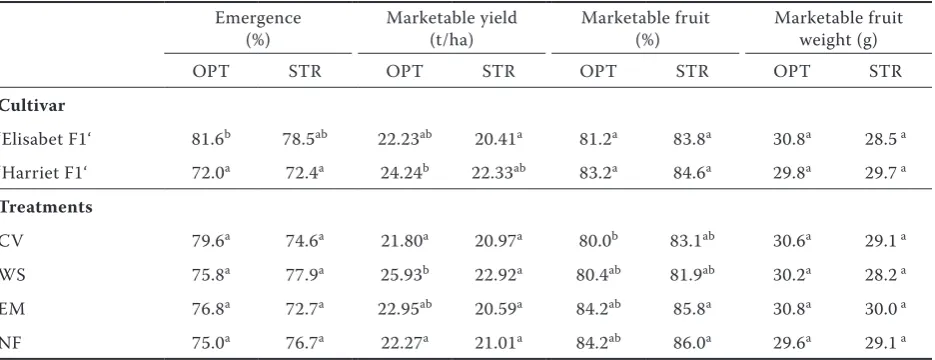
[image:3.595.63.533.418.707.2]At the optimum level of irrigation, significant differences in emergence between the evaluated cultivars were found (‘Elisabet F1’ 81.6% and ‘Har-riet F1’ 72.0%), but at a reduced level of irriga-tion, the differences were insignificant (Table 4). Hniličková and Hnilička (2012) also described an influence of genotype on emergence. Emergence was higher in the ‘Elisabet F1’ cultivar, which con-firms the results of Semo (2014) who reported that
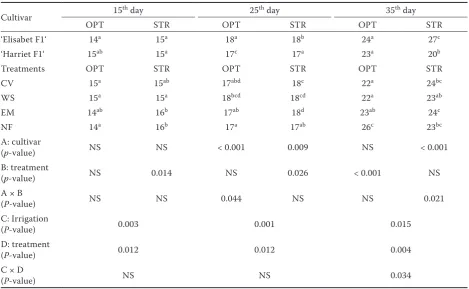
Table 3. Numeric decimal code phenophases based on days after sowing according to Vogel (1996)
Cultivar 15th day 25th day 35th day
OPT STR OPT STR OPT STR
‘Elisabet F1‘ 14a 15a 18a 18b 24a 27c
‘Harriet F1‘ 15ab 15a 17c 17a 23a 20b
Treatments OPT STR OPT STR OPT STR
CV 15a 15ab 17abd 18c 22a 24bc
WS 15a 15a 18bcd 18cd 22a 23ab
EM 14ab 16b 17ab 18d 23ab 24c
NF 14a 16b 17a 17ab 26c 23bc
A: cultivar
(p-value) NS NS < 0.001 0.009 NS < 0.001
B: treatment
(p-value) NS 0.014 NS 0.026 < 0.001 NS
A × B
(P-value) NS NS 0.044 NS NS 0.021
C: Irrigation
(P-value) 0.003 0.001 0.015
D: treatment
(P-value) 0.012 0.012 0.004
C × D
(P-value) NS NS 0.034
‘Elisabet F1’ is also better under inferior conditions and therefore has a higher stress resistance.
An insignificant but positive effect of mulching on growth rate was detected (evaluation according to the phenophase) at a reduced level of irrigation on the 15th day after sowing (Table 3) using EM and NF mulching while the opposite effect was detect-ed at optimum irrigation. This can be explaindetect-ed by the fact that NF and N mulching affects the tem-perature of the soil under the mulch material and thereby positively affects development (Jenni et al. 2004; Brant et al. 2008; Liang et al. 2011). In contrast, for non-mulched variants (CV and WS; mulching done only when plant height is 15 cm) fluctuations of temperature are larger and hence a slowdown in growth occurs (Díaz-Pérez, Dean Batal 2002).
At 35 days after sowing, NF mulching was found to significantly accelerate the development of plants at optimum irrigation. EM mulching also resulted in improved performance compared to the CV, since, as described by Brant et al. (2008), under EM the re-drying of the upper layers of soil does not occur and significant temperature differ-ences do not occur as well.
A significantly positive effect of WS on the yield (25.93 t/ha) was found with the ‘Harriet F1’ cultivar at optimum irrigation compared to the CV (21.80 t/ha), which is in agreement with the results of Koude-la et al. (2012) for gherkins. A significantly higher yield when using straw mulching was also reported
by Ibarra-Jiménez et al. (2004) for cucumbers and Rekika et al. (2009) and Manojlović et al. (2017) for lettuce. From this, one can conclude that WS has a significantly positive affect on moisture condi-tions, as shown by Tu et al. (2006) and Manojlović et al. (2017) and, thus, as described by Liang et al. (2011), has a greater effect than the reduction of soil temperatures. WS also performed better at a reduced level of irrigation compared to CV (22.92 t/ha vs. 20.97 t/ ha). Similar results were reported for cucum-bers by Petříková et al. (2012b) and by Radics, Bognar (2004) for tomatoes.
An insignificantly higher yield was observed at op-timum and reduced levels of irrigation when using NF mulching compared to the CV (optimum irriga-tion: NF 22.27 t/ha; CV 21.80 t/ha; reduced level of irrigation: NF 21.01 t/ha; CV 20.97 t/ha). This cor-responds to the reports of higher yields when using NF for cucumbers (Petříková et al. 2012a) and for watermelons (Hochmuth, Hochmuth 1994).
Similarly, mulching with paper at an optimum lev-el of irrigation positivlev-ely affected yilev-eld (22.95 t/ha) compared to the CV (21.80 t/ha). The positive in-fluence of paper mulch was reported by Radics and Bognar (2004) for tomatoes. For other fruit, we can expect a different reaction to mulching with paper, since its effect was not observed in beans (Radics, Bognar 2004) and watermelons (Shor- gen, Hochmuth 2004).
The percentage of market fruit was higher at re-duced levels of irrigation (Table 4). Opposite
find-Table 4. Evaluated properties of gherkins and yield characteristics (average values)
Emergence
(%) Marketable yield (t/ha) Marketable fruit (%) Marketable fruit weight (g)
OPT STR OPT STR OPT STR OPT STR
Cultivar
‘Elisabet F1‘ 81.6b 78.5ab 22.23ab 20.41a 81.2a 83.8a 30.8a 28.5 a ‘Harriet F1‘ 72.0a 72.4a 24.24b 22.33ab 83.2a 84.6a 29.8a 29.7 a Treatments
CV 79.6a 74.6a 21.80a 20.97a 80.0b 83.1ab 30.6a 29.1 a
WS 75.8a 77.9a 25.93b 22.92a 80.4ab 81.9ab 30.2a 28.2 a
EM 76.8a 72.7a 22.95ab 20.59a 84.2ab 85.8a 30.8a 30.0 a
NF 75.0a 76.7a 22.27a 21.01a 84.2ab 86.0a 29.6a 29.1 a
[image:4.595.65.533.113.293.2]ings were reported by Petříková et al. (2012b) and Koudela et al (2012), which may be due to the influence of that particular year (Larcher 1988). Compared with the control variant, there was a higher proportion of market fruit in all evaluated variants of mulching except for straw mulching at reduced irrigation, where 1.2% more non-standard fruits were identified compared to the CV. The per-centages of market fruit that we observed, ranging from 80.0 to 86.0%, correspond with the data pub-lished by Petříková et al. (2012b).
The average weight of a single fruit was always higher at optimum levels of irrigation, which was also reported by Koudela et al. (2012). The differ-ences between the evaluated variants ranged from 0.5 to 2.6 g. The max. weight of a single fruit was found using the Ekocover mulching variant. At a reduced level of irrigation, the fruits were light-er when using straw mulching than with the CV. Therefore, a positive influence of mulching with straw on the weight of fruit was not confirmed, which corresponds to the findings of Ahmad et al. (2011) and Kaya et al. (2005). Our observations that the weight of a single fruit ranged between 28.2 g and 30.8 g correspond to the results of Petříková et al. (2012b) and Koudela et al. (2012).
CONCLUSION
A positive effect of mulching on emergence was found using non-woven fabric at a reduced level of irrigation. The use of black non-woven fabric (21.01 t/ha) and wheat straw as mulch (22.92 t/ha) positively affected yield compared with the non-mulched vari-ant (20.97 t/ha). Reduced levels of irrigation positively influenced the proportion of market fruit compared to optimum levels of irrigation (by about 1.5 to 3.1%), but these fruits were lighter (by about 0.5 to 2.0 g). The influence of the cultivar on the evaluated prop-erties of gherkins was insignificant. The ‘Harriet F1’ cultivar exhibited a higher yield (9%) as well as higher percentages of market fruit (by about 0.8 to 2.0%) compared to the ‘Elisabet F1’ cultivar.
References
Ahmad I., Hussain Z., Raza S., Memon N., Naqvi S.A. (2011): Response of vegetative and reproductive components of chili to inorganic and organic mulches. Pakistan Journal of Agricultural Sciences, 48: 19–24.
Brant V., Pivec J., Kroulík M., Jursík M. (2008): Vliv mulčovacího papíru na vybrané fyzikální a biologické vlast-nosti půdy a na růst a produkci polních zelenin. Available at www.ekocover.cz (accessed January 30, 2013).
Buchtová I. (2015): Situační a výhledová zpráva Mze 2015 – Zelenina. Prague, MZe ČR.
Díaz-Pérez J.C., Dean Batal K. (2002) Colored plastic film mulches affect tomato growth and yield via changes in root-zone temperature. Journal of the American Society for Horticultural Science, 127: 127–135.
Döring T.F., Brandt M., Hess J., Finckh M.R., Saucke H. (2005): Effect of straw mulch on soil nitrate dynamics, weeds, yield and soil erosion in organicually grown potatoes. Field Crops Research, 94: 238–249.
Fan H.F., Ding L., Du C.X., Wu X. (2014): Effect of short-term water deficit stress on antioxidative systems in cucumber seedling roots. Botanical Studies, 55: 46.
Haapala T., Palonen P., Korpela A., Ahokas J. (2014): Facibility of paper mulches in crop production: a review. Agricultural and Food Science, 23: 60–79.
Hniličková J., Hnilička F. (2012): Vliv nízkých teplot na obsah energie juvenilních rostlin okurky seté (Cucumis sativus
L.). In: Bláha L., Hnilička F. (eds.): Vliv abiotických a bi-otických stresorů na vlastnosti rostlin, Praha, ČZU a VÚRV, March 9–10, 2011: 230–233.
Hochmuth B., Hochmuth G. (1994): Response of pepper and watermelon to paper and polyethylene mulches in two spring seasons in north Florida. Proceedings of the Florida State Horticultural Society, 107: 102–105.
Ibarra-Jiménez L., Quezada-Martín M.R., Rosa-Ibarra M. (2004): The effect of plastic mulch and row covers on the growth and physiology of cucumber. Australian Journal of Experimental Agriculture, 44: 91–94.
Jenni S., Brault D., Stewart K.A. (2004): Degradable mulch as an alternative for weed control in lettuce produced on organic soils. Acta Horticulturae (ISHS), 638: 111–118. Kaya C., Higgs D., Kirnak H. (2005): Influence of
polyeth-ylene mulch, irrigation regime, and potassium rates on field cucumber yield and related trans. Journal of Plant Nutrition, 28: 1739–1753.
Koudela M., Šuk J., Hnilička F., Svozilová L., Martinková J., Kubíček M. (2012): Vliv mulčování slámou na výnos a kvalitu okurek nakladaček. Zahradnictví, 11: 20–22. Kozik E.U., Wehner T.C. (2014): Tolerance of watermelon
seedlings to low-temperature chilling injury. HortScience, 49: 240–243.
Larcher W. (1988): Ekologická fyziologie rostlin. Prague. Academia.
defence-related genes in the phloem in Cucumis sativus. PloS ONE, 8: 6.
Liang Y., Wu X., Zhu J., Zhou M., Peng Q. (2011): Response of hot pepper (Capsicum annuum L.) to mulching practices under planted greenhouse condition. Agricultural Water Management, 99: 111–120.
Lu X.M., Yang W. (2013): Alleviation effects of brassinolide on cucumber seedlings under NaCl stress. Chinese Journal of Apllied Ecology, 24: 1409–1414.
Manojlović M., Čabilovski R., Ljiljana N., Džikursky D., Šeremešić S., Bavec M. (2017): Ground cover management and farmyard manure effects on soil nitrogen dynamics, productivity and economics of organically grow lettuce (Lactuca sativa L. subsp. secalina). Journal of Integrative Agriculture, 16: 947–958.
Petříková K., Hlušek J., Koudela M., Malý I., Pokluda R., Lošák T., Ryant P., Škarpa P., Rod J., Jánský J., Poláčková J. (2012a): Zelenina: pěstování, výživa, ochrana a ekonomika. Prague, Profi Press.
Petříková K., Pokluda R., Koudela M., Hnilička F., Jezdin-sky A., Jurica M., Vojtíšková J., Nedorost Ľ., Kopta T., Martinková J. (2012b): Omezení negativních důsledků vláhového deficitu na hospodářské ukazatele zeleniny – certifikovaná metodika pro praxi. Prague, Czech University of Life Sciences Prague.
Radics L., Bognar E.S. (2004): Comparison of different mulch-ing method for weed control in organic green bean and tomato. Acta Horticulturae (ISHS): 638: 189–196. Rekika D., Stewart K.A., Boivin G., Jenni S. (2009): Row covers
reduce insect populations and damage and improve early
season crisp head lettuce production. International Journal of Vegetable Science, 15: 71–82.
Semo (2014): Okurky nakládačky (Gherkins). Available at: www.semo.cz (accessed December 12, 2014).
Shorgen R. L., Hochmuth R.C. (2004): Field evaluation of Watermelon grown on paper-polymerized vegetable oil mulches. HortScience, 39: 1588–1591.
Tu C., Ristaino J.B., Hu S. (2006): Soil microbial biomass and activity in organic tomato farming systems: Effects of organic inputs and straw mulching. Soil Biology & Bio-chemistry, 38: 247–255.
Übelhör A., Gruber S., Schlayer M., Claupein W. (2014): Influence of row covers on soil loss and plant growth in white cabbage cultivation. Plant, Soil and Environment, 60: 407–412.
Van-Camp L., Bujarrabal B., Gentile A-R., Jones R.J.A., Mon-tanarella L., Olazabal C., Selvaradjou S-K. (2004): Reports of the Technical Working Groups Established under the Thematic Strategy for Soil Protection. EUR 21319 EN/2. Available at http://ec.europa.eu/environment/archives/ soil/pdf/vol2.pdf (accessed Sep 1, 2016).
Vogel G. (1996): Handbuch des speziellen Gemüsebaues. Stuttgat, Ulmer.
Wortman S.E. Kadoma I., Crandall M.D. (2015): Assessing the potential for spunbond, nonwoven biodegradable fab-ric as mulches for tomato and bell pepper crops. Scientia Horticulturae, 193: 209–217.