Abstract—With the advent of social media, online reviews are increasingly perceived as being more genuine than traditional marketer-generated information. However, users’ growing penchant for reviews has resulted in the rise of deceptive opinion spamming, which involves posting misleading reviews to influence users’ impression on products and services insidiously. As a result, it has become challenging for users to distinguish between genuine and deceptive reviews. Hence, this paper develops a linguistic framework to distinguish between genuine and deceptive reviews based on their readability, genre and writing style. The framework is empirically tested by drawing from publicly available secondary datasets. The findings suggest that readability and writing style of reviews could be significant linguistic cues to distinguish between genuine and deceptive comments. In terms of genre however, differences between genuine and deceptive reviews were largely inconspicuous.
Index Terms—Online reviews, deceptive opinion spamming, linguistic framework, readability, writing style
I. INTRODUCTION
ITH the rapid proliferation of social media, users now have the liberty to share their opinions with online peers freely across boundaries of space and time. Different social media platforms allow users to engage in activities that range from simple social tagging and bookmarking to more sophisticated forms such as answering questions and editing wikis. One of the opinion sharing activities that has become extremely popular in recent years include dissemination of online reviews (henceforth known as reviews). Users are increasingly inclined to voice their opinions about products and services in the form of reviews for other potential buyers in the online community [1]. Furthermore, user-generated reviews are generally deemed as being more genuine, and hence reliable, compared to traditional marketer-generated information due to the perceived proximity of the former to ground sentiment [2].
Users’ growing penchant for reviews has resulted as its byproduct in a new form of spamming malpractice, known as opinion spamming [3]. It encompasses two types of misleading reviews, namely, disruptive and deceptive. The former refers to reviews that are frivolous and contain unmistakably irrelevant text. The latter includes reviews that
Manuscript received December 4, 2013; revised January 7, 2014. Snehasish Banerjee is with Wee Kim Wee School of Communication and Information, Nanyang Technological University, Singapore 637718 (e-mail: [email protected]).
Alton Y. K. Chua is with Wee Kim Wee School of Communication and Information, Nanyang Technological University, Singapore 637718 (e-mail: [email protected]).
are maliciously written to appear genuine, and hence not easily detected as spam. Between the two, deceptive reviews generally pose greater threats as they can influence users’ perceptions on products and services insidiously. As more users tap into reviews for making purchase decisions, deceptive opinion spamming is growing into a well-established industrial malpractice [4]. Hence, it is difficult to determine if all reviews posted in review websites are genuine.
It is conceivable that opinions in genuine reviews may not be easily distinguishable from opinion spams in deceptive reviews. However, there could be some subtle linguistic differences to discriminate between the two. This is because texts that are outcome of real first-hand experience generally differ from those that are concocted out of imagination [5]. Even though genuine and deceptive reviews may attempt to advocate similar arguments, they could be articulated differently.
In particular, there could be telltale signs in terms of readability [6], genre [7] and writing style [8] of reviews that could help determine if they are genuine or deceptive. Readability of a review refers to the effort required by users to comprehend the text’s meaning [6]. With respect to genre, the informativeness of genuine reviews and the imaginativeness of deceptive reviews can lead to varying part-of-speech (POS) tag distribution patterns between the two [7]. Furthermore, genuine and deceptive reviews exhibit different writing style in terms of their usage of specific types of words.
Along this research theme however, two gaps can be identified. First, most scholarly inquiry thus far had adopted a text classification approach to differentiate genuine from deceptive reviews [3, 7]. However, in an attempt to document better classification accuracy, precision and recall than existing baselines, such studies often employ a wide array of parameters without adequately explaining the theoretical underpinning. Hence, developing a linguistic framework based on a more robust theoretical reasoning to distinguish between genuine and deceptive reviews could be a significant research endeavor.
Second, most investigation on deceptive opinion spam are confined to positive reviews intended to boost the reputation of products and services [7]. However, organizations may also post deceptive negative reviews to slander offerings of rival businesses. To the best of our knowledge, [9] is the only work till date that has offered some preliminary investigation on negative deceptive opinion spam. Hence, there is a pressing need to analyze differences between genuine and deceptive reviews across both positive and negative entries to ensure better generalizability of findings.
A Linguistic Framework to Distinguish between
Genuine and Deceptive Online Reviews
Snehasish Banerjee, and Alton Y. K. Chua
For these reasons, drawing from publicly available secondary datasets of positive opinion spam [7] and negative opinion spam [9], this paper aims to develop a linguistic framework to distinguish between genuine and deceptive reviews. Taking cue from prior research, the framework suggests that authenticity of reviews could be predicted by three linguistic dimensions, namely, readability, genre and writing style. Next, it conducts a linguistic analysis on the dataset to examine the extent to which these three dimensions could help distinguish between genuine and deceptive reviews.
This paper has implications for both theory and practice. On the theoretical front, it represents one of the earliest attempts to develop a linguistic framework to distinguish between genuine and deceptive reviews. Even though much scholarly attention has delved into the classification of genuine and deceptive reviews using text classification approaches (eg. [3, 7, 10]), little light has thus far been shed on linguistic dimensions in which genuine reviews are richer or those which are dominated by deceptive comments. On the practical front, users as well as moderators of review websites might lean on the findings of this paper to conjecture which reviews are likely to be genuine and which are likely to be deceptive. This could help users in making more informed purchase decisions, thwarting business malpractices of deceptive opinion spamming.
The remainder of the paper is organized as follows. The following section provides a review of the literature on readability, genre and writing style of reviews. The Methods section describes the chosen dataset and presents the analysis procedures. This is followed by the results and the discussion. Finally, the paper concludes by highlighting its implications and suggesting directions for future research.
II. LITERATURE REVIEW
A. Review Readability
Readability of a given review is a measure of the amount of effort and expertise required by users to comprehend its meaning [6]. Prior research suggests that writing deceptive content requires additional cognitive effort, which induces subtle changes in human behavior [11]. These behavioral changes could result in differences in readability between genuine and deceptive reviews [12].
Articulating authentic opinions in genuine reviews is generally deemed easier than deceptive opinion spamming. Given the greater cognitive challenges, deceptive reviews tend to use fewer average syllables per word as well as shorter and simpler sentences than genuine reviews [11]. Therefore, deceptive reviews could be less complex and easier to comprehend in terms of readability vis-à-vis genuine reviews. However, it is also possible for adept authors of deceptive reviews (henceforth known as opinion spammers) to invest sincere efforts to blur such differences. Thus, it is interesting to study the extent to which readability of reviews might help distinguish between genuine and deceptive entries.
B. Review Genre
Writing deceptive reviews require articulating events that did not occur or attitudes that did not exist in reality in a convincing manner [13]. However, texts that are written based on real experiences often differ in flavor from accounts based on imagined experiences in terms of their genre [7].
Text can be classified into two main genres, namely, informative and imaginative [14]. While informative texts tend to contain more adjectives, articles, nouns and prepositions, imaginative texts tend to include more adverbs, verbs and pronouns [7, 15]. Conceivably, genuine reviews are informative while deceptive reviews are imaginative. Therefore, such subtle nuances in POS distribution could likely be observed between genuine and deceptive reviews. At the same time, proficient opinion spammers might attempt to smudge the nuances by rendering their deceptive reviews informative to elude detection. This calls for investigating the extent to which genre of reviews might help distinguish between genuine and deceptive entries.
C. Review Writing Style
Writing style refers to ways users use specific types of words to construct sentences of reviews in order to reflect their opinions [4]. For the purpose of this paper, writing styles of genuine and deceptive reviews are considered in terms of their usage of self references, past tense, function words and perceptual words.
First, genuine reviews could contain more self-references vis-à-vis deceptive reviews. This is because some spammers might feel guilty and could attempt to dissociate themselves from their fictitious arguments. This in turn could be reflected in their reluctance to use self-references such as “I” and “we” in deceptive reviews [8, 16]. Second, genuine reviews could contain more past tense than deceptive reviews. After all, the former is written to share experiences pertaining to prior use of products or services. On the other hand, the latter could also use a mixture of present tense and future tense to suggest to users that satisfying or dissatisfying experiences encountered are largely existent and might recur often [2, 17]. Third, genuine reviews could include fewer function words vis-à-vis deceptive reviews. Function words such as “while” and “upon” are the non-content words that could be relied upon more often by opinion spammers to render their deceptive reviews lengthy and adequate [13], [18]. Fourth, genuine reviews could use fewer perceptual words than deceptive reviews. Even though deceptive reviews might not include specific details about products and services, opinion spammers could attempt to compensate by including more perceptual words such as “see” and “hear” to describe visual or aural perceptions [19, 20]. However, expert opinion spammers can consciously attempt to diminish such nuances. Thus, it is significant to analyze the extent to which review writing style might help distinguish between genuine and deceptive entries.
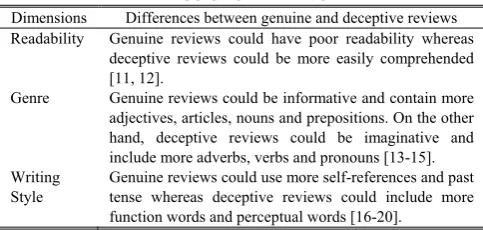
of three dimensions, namely, readability, genre and writing style. In terms of readability, genuine reviews could fare worse vis-à-vis deceptive reviews. In terms of genre, genuine reviews could be informative while deceptive reviews might be imaginative, thereby resulting in different POS distribution patterns. With respect to writing style, genuine reviews could use more self-references and past tense whereas deceptive reviews could include more function words and perceptual words. However, such differences could also be blurred by overly adept opinion spammers.
TABLE I
LINGUISTIC FRAMEWORK
Dimensions Differences between genuine and deceptive reviews Readability Genuine reviews could have poor readability whereas
deceptive reviews could be more easily comprehended [11, 12].
Genre Genuine reviews could be informative and contain more adjectives, articles, nouns and prepositions. On the other hand, deceptive reviews could be imaginative and include more adverbs, verbs and pronouns [13-15]. Writing
Style
Genuine reviews could use more self-references and past tense whereas deceptive reviews could include more function words and perceptual words [16-20].
III. METHODS
To empirically test the proposed linguistic framework, this paper drew from two publicly available secondary opinion spam datasets [7, 9]. The combined dataset used for analysis included 1,600 reviews equally distributed across 20 popular hotels in Chicago. Specifically, it comprised 800 genuine and 800 deceptive reviews. Among both the sets of genuine and deceptive reviews, 400 were positive and 400 were negative. Thus, for each of the 20 hotels, the dataset included 80 reviews (20 genuine positive + 20 genuine negative + 20 deceptive positive + 20 deceptive negative).
To facilitate analysis, each of the linguistic dimensions was operationally defined as follows. Review readability was operationalized based on three metrics that include (1) Gunning-Fog Index (FOG), (2) Coleman-Liau Index (CLI), and (3) Automated-Readability Index. These metrics have been widely used in research on online reviews (eg. [4], [21]). Among these, FOG and CLI specifically measure linguistic complexity while ARI is an indicator of reading ease [22]. A lower value for each metric suggests a more readable review. In other words, low values of FOG and CLI suggest linguistically simple text while a low value of ARI indicates text that is easily readable.
Review genre was quantified on the basis of POS distributions of genuine and deceptive reviews. In particular, the following seven POS tags were considered, (1) adjectives, (2) articles, (3) nouns, (4) prepositions, (5) adverbs, (6) verbs, and (7) pronouns. However, POS such as conjunctions and auxiliary verbs were not admitted for analysis due to lack of literature support on their nuances across genuine and deceptive reviews. The POS tags were computed using Stanford Parser.
Review writing style was operationalized in terms of the proportion of (1) self-references, (2) past tense, (3) function
words, and (4) perceptual words contained in reviews. These were measured using the Linguistic Inquiry and Word Count (LIWC) algorithm, an automated text analysis tool that allows for computing such linguistic indicators of textual content. The applicability of LIWC has been demonstrated in numerous studies, including those that analyzed online content such as blogs (eg. [23]), instant messaging (eg. [24]), as well as deception (eg. [13]).
This paper thus includes 14 independent variables (IVs) for analysis, the three readability metrics, the seven POS tags and the four writing style indicators. On the other hand, the dependent variable comprises genuineness of reviews. The genuineness of all the reviews in the dataset was dummy-coded such that 1 indicates genuine reviews and 0 represents deceptive ones.
Given the dichotomous nature of the dependent variable, binomial logistic regression was used for data analysis [25], [26]. This approach uses maximum likelihood estimation after converting the dependent variable into its logit equivalent, indicating the extent to which the IVs could significantly predict the outcome.
IV. RESULTS
[image:3.595.47.289.213.328.2]The descriptive statistics of the genuine reviews (N = 800) and the deceptive reviews (N = 800) based on the 14 IVs are summarized in Table II. In terms of readability, genuine reviews had lower values compared to deceptive reviews for all the three indicators, namely, FOG, CLI and ARI. The former was apparently less complex and easier to read than the latter. In terms of POS tags, genuine reviews appeared to contain more adjectives, articles and nouns while deceptive reviews seemed to include more prepositions, adverbs, verbs and pronouns. In terms of writing style, deceptive reviews appeared more richly embellished with self-references, past tense, function words and perceptual words compared to genuine reviews.
TABLE II DESCRIPTIVE STATISTICS
Dimen-sions
IVs Genuine (N = 800) Mean ± SD
Deceptive (N = 800) Mean ± SD
Reada-bility
FOG 10.10 ± 3.68 11.11 ± 2.45 CLI 7.25 ± 1.90 7.63 ± 1.70 ARI 6.29 ± 4.38 6.96 ± 2.67 Genre Adj. 9.61 ± 3.36 8.97 ± 3.08 Art. 9.92 ± 2.74 9.66 ± 2.40 Nou. 26.41 ± 4.88 24.56 ± 4.32 Pre. 12.46 ± 2.82 12.61 ± 2.93 Adv. 4.92 ± 2.26 5.11 ± 2.46 Ver. 12.63 ± 3.10 13.42 ± 12.63 Pro. 10.49 ± 3.79 12.37 ± 3.74 Writing
Style
Self. 5.12 ± 2.64 6.77 ± 3.13 Past 6.60 ± 3.07 7.23 ± 3.48 Func. 55.12 ± 5.26 57.39 ± 4.70 Perc. 1.86 ± 1.47 2.25 ± 1.54
For the logistic regression, result of the Omnibus test indicates acceptable performance of the model (χ2 = 361.55;
suggests that the model fits well with the data. The Nagelkerke R2 of the model was 0.27.
Table III summarizes the results of the logistic regression to indicate the extent to which the 14 IVs in the model could help distinguish between genuine and deceptive reviews. In terms of review readability, all the three metrics could significantly predict if reviews were genuine. The two indicators of linguistic complexity, namely, FOG [β = -0.43, Exp(β) = 0.65, p < 0.001] and CLI [β = -0.36, Exp(β) = 0.70, p < 0.001], were negatively related to the dependent variable. This meant that higher the value of these indicators for a given review, lower was its likelihood to be genuine. In other words, higher the linguistic complexity of a review, lower was its likelihood to be genuine and higher was its probability to be deceptive. This suggests that deceptive reviews were linguistically more complex compared to genuine reviews. The indicator of reading ease ARI however had a positive relationship with the probability of a review to be genuine [β = 0.35, Exp(β) = 1.42, p < 0.001]. Put differently, higher the value of ARI for a given review, higher was its likelihood to be genuine. Sine higher ARI value suggests lower reading ease, it appears that even though deceptive reviews were linguistically more complex than genuine entries, the way of articulation rendered the former better in terms of reading ease.
TABLE III
RESULTS OF LOGISTIC REGRESSION
Dimen-sions
IVs β SE Wald Exp(β)
Reada-bility
FOG -0.43 0.06 47.66 0.65*** CLI -0.36 0.05 54.38 0.70*** ARI 0.35 0.05 44.95 1.42*** Genre Adj. -0.02 0.02 0.52 0.98
Art. -0.04 0.03 1.92 0.96 Nou. -0.00 0.02 0.02 0.99 Pre. -0.02 0.03 0.54 0.98 Adv. -0.01 0.03 0.07 0.99 Ver. -0.09 0.03 9.77 0.91** Pro. -0.02 0.03 0.51 0.98 Writing
Style
Self. -0.20 0.03 37.90 0.82*** Past 0.06 0.02 5.65 1.06* Func. -0.09 0.02 15.89 0.91*** Perc. -0.25 0.04 41.20 0.78*** *** p < 0.001, ** p < 0.01, * p < 0.05
In terms of review genre, verbs [β = -0.09, Exp(β) = 0.91, p = 0.002] was the only POS tag that turned out to be a significant predictor of the outcome. The negative relationship meant that higher the proportion of verbs for a given review, lower was its likelihood to be genuine. This in turn suggests that deceptive reviews were richer in verbs than genuine reviews. The non-significance of the remaining six POS tags perhaps suggests that genuine and deceptive reviews did not significantly differ from each other in terms of genre.
In terms of writing style, the use of self-references [β = -0.20, Exp(β) = 0.82, p < 0.001], perceptual words [β = -0.25, Exp(β) = 0.78, p < 0.001] and function words [β = -0.09, Exp(β) = 0.91, p < 0.001] exhibited significant negative relationship with the outcome. Higher the value of these indicators for a given review, lower was its likelihood to be genuine. Deceptive reviews appeared to be more richly
embellished with self-references, perceptual words and function words compared to genuine reviews. On the other hand, use of past tense [β = 0.06, Exp(β) = 1.06, p = 0.017] was positively associated with the dependent variable. Higher the proportion of past tense in a given review, higher was its likelihood to be genuine. Genuine reviews thus seemed to be richer in past tense vis-à-vis deceptive reviews.
V. DISCUSSION
This paper proposed a linguistic framework to distinguish between opinion in genuine reviews and opinion spam in deceptive reviews. The framework suggests that review authenticity could be predicted based on three linguistic dimensions, namely, readability, genre and writing style. The framework was tested using datasets drawn publicly.
The differences between genuine and deceptive reviews in terms of five factors were consistent with prior research. These include ARI, use of verbs, past tense, function words and perceptual words. First, based on ARI, a measure of reading ease of a given text [22], deceptive reviews were generally more readable than genuine reviews. Given that writing deceptive content requires additional cognitive effort, it could be at times more challenging than articulating genuine reviews [11], [12]. Hence, the former seemed to have been articulated in manner such that it was easier to read than the latter. Second, deceptive reviews comprised significantly more verbs compared to genuine reviews. Given the former’s imaginative genre [7], its dominance over genuine reviews in using of verbs is expected [15]. Third, genuine reviews sharing experiences pertaining to prior use of products or services largely appeared to use more past tense than deceptive entries. The ubiquity of positive (negative) reviews could favorably (adversely) impact the future sales and revenues of a given hotel [2]. Therefore, it appears that opinion spammers might have composed deceptive reviews not only to describe past experiences of products or services, but also to influence present image and future sales of the respective businesses. Fourth, genuine reviews used significantly fewer function words than deceptive reviews. Perhaps, users contributing genuine reviews had enough details to make their entries substantial. However, opinion spammers appeared to rely more on non-content words to render the deceptive reviews lengthy and adequate [13], [18]. Finally, genuine reviews used fewer perceptual words than deceptive reviews. Genuine reviews were perhaps articulated in order to describe experiences without overly emphasizing on feelings and perceptions. However, deceptive reviews were richer in terms of perceptual words perhaps to influence users’ impression through more vivid explanations [19, 20].
were comparable with respect to the usage of these six POS tags in their respective content. This could be vestige of the differences in writing skills between users and opinion spammers who write genuine and deceptive reviews respectively. On one hand, not all users are aware of ways to articulate genuine reviews in an informative manner. On the other, opinion spammers could be adept enough to render deceptive reviews highly informative. As a result, the differences that are expected between informative and imaginative content were not detected between genuine and deceptive reviews with respect to the six POS tags.
The differences between genuine and deceptive reviews in terms of three factors contradicted prior research. These include FOG, CLI and use of self-references. The first two factors, namely, FOG and CLI, measure linguistic complexity of a given text [22]. Genuine reviews fared better than deceptive reviews in terms of these metrics. Interestingly, even though deceptive reviews had better reading ease as suggested by ARI, they appeared linguistically more complex than genuine entries. Moreover, contradictory to prior research [16], genuine reviews appeared to contain fewer self-references compared to deceptive reviews. The dominance of self-references in the latter reflects lack of guilt among opinion spammers. Though prior research expects them to feel the pangs of their conscience and hence, use less self-references to dissociate themselves from their deceptive content [8, 16], such a trend could not be identified.
VI. CONCLUSION
The emergence of social media platforms such as review websites allows users to share reviews of products or services with online peers freely across boundaries of space and time. Reviews are increasingly deemed as being more genuine and reliable than traditional marketer-generated information due to the perceived proximity of the former to ground sentiment. However, users’ growing penchant for reviews has resulted in the rise of deceptive opinion spamming, which involves posting misleading reviews to influence users’ impression on products and services insidiously. As a result, it has become challenging for users to distinguish between genuine and deceptive reviews.
Informed by prior research that point to the presence of linguistic cues unique to genuine and deceptive reviews [11]-[20], this paper developed a linguistic framework to distinguish between genuine and deceptive reviews. In particular, the framework posited that readability, genre and writing style of reviews could help predict if reviews were genuine. The framework was empirically tested by drawing from two publicly available secondary datasets [7, 9]. The findings suggest that readability and writing style of reviews could be significant linguistic cues to distinguish between genuine and deceptive comments. In terms of genre however, even though prior research suggests genuine reviews to be informative and deceptive reviews to be imaginative, such differences were largely inconspicuous.
This paper has three-fold theoretical implications. First, taking the cue from extant literature, it represents one of the earliest attempts to develop a linguistic framework to distinguish between genuine and deceptive reviews. The
framework suggests that genuine and deceptive reviews can be distinguished based on their readability and writing style. Second, given that most investigation on deceptive opinion spam has thus far been restricted to positive reviews, this paper represents a modest attempt to explore a territory of research that has been largely uncharted hitherto. By combining datasets of both positive reviews [7] and negative reviews [9] for analysis, the findings of this paper ensure a better generalizability of the findings. Third, even though prior research suggests that genuine reviews could be informative and deceptive entries imaginative [7, 13-15], such a difference could not be observed in the dataset. However, by combining both positive and negative reviews, the dataset facilitates better generalizability than most extant studies. Perhaps, deceptive reviews are skillfully written to make them as informative as genuine reviews. Therefore, this study contributes to theory by indicating that genre or informativeness of reviews should not be used as a heuristic to distinguish between genuine and deceptive reviews.
Besides, this paper also offers two implications for practice. First, users of review websites could use readability and writing style of reviews to conjecture entries that are likely to be genuine, and those that are perhaps deceptive. Second, moderators of review websites may also use the findings to filter out reviews that are likely to be deceptive. The findings of this paper can thus assist users to make more informed purchase decisions, thereby thwarting business malpractices of deceptive opinion spamming
However, it should be acknowledged that the paper is constrained by the scope of the datasets used for analysis. As indicated earlier, the datasets included reviews posted for 20 popular hotels in Chicago. Therefore, the extent to which the results gleaned from this paper can be extrapolated to reviews submitted for other hotels in different geographical regions is uncertain. However, to the best of our knowledge, [7] and [9] are the only publicly available opinion spam datasets till date. Combining both the datasets to examine the conceptual framework represents a modest effort to maximize generalizability of findings.
This paper offers a few potential directions for future research. Given that this study was limited to reviews for hotel services, future research should consider investigating if such linguistic patterns could also be detected between genuine and deceptive reviews meant for products and other services. Another possible direction of investigation could include analyzing the extent to which linguistic differences could differentiate between genuine and deceptive reviews across products and services of various brands. Such studies can help verify, validate and refine the proposed linguistic framework.
REFERENCES
[1] Y. Wang and D. R. Fesenmaier, “Understanding the motivation of contribution in online communities: An empirical investigation of an online travel community,” Electronic Markets, vol. 13, no. 1, pp. 33-45, Dec. 2003.
[2] C. Dellarocas, “The digitization of word of mouth: Promise and challenges of online feedback mechanisms,” Management Science, vol. 49, no. 10, pp. 1401-1424, Oct. 2003.
[3] N. Jindal and B. Liu, “Opinion spam and analysis,” in Proc. 2008
[4] N. Hu, I. Bose, N. S. Koh and L. Liu, “Manipulation of online reviews: An analysis of ratings, readability, and sentiments,” Decision
Support Systems, vol. 52, no. 3, pp. 674-684, Feb. 2012.
[5] M. Steller, “Recent developments in statement analysis,” in
Credibility Assessment, Netherlands: Springer, 1989, pp. 135-154.
[6] A. Vartapetiance and L. Gillam, “‘I don't know where he is not’: Does deception research yet offer a basis for deception detectives?” in
Proc. 2012 Computational Approaches to Deception Detection, pp.
5-14.
[7] M. Ott, Y. Choi, C. Cardie and J. T. Hancock, “Finding deceptive opinion spam by any stretch of the imagination” in Proc. 2011 Association for Computational Linguistics - Human Language
Technologies, pp. 309-319.
[8] K. H. Yoo and U. Gretzel, “Comparison of deceptive and truthful travel reviews,” in ICT in Tourism, Vienna: Springer, 2009, pp. 37-47.
[9] M. Ott, C. Cardie and J. T. Hancock, “Negative deceptive opinion spam,” in Proc. 2013 NAACL – Human Language Technologies, pp.
497-501.
[10] M. P. O’Mahony and B. Smyth, “Learning to recommend helpful hotel reviews,” in Proc. 2009 ACM Rec. Sys., pp. 305-308.
[11] M. G. Frank, M. A. Menasco and M. O’Sullivan, “Human behavior and deception detection,” in Wiley Handbook of Science and
Technology for Homeland Security, Wiley, 2008.
[12] S. Afroz, M. Brennan and R. Greenstadt, “Detecting hoaxes, frauds, and deception in writing style online,” in IEEE 2012 Symposium
Security and Privacy, pp. 461-475.
[13] M. L. Newman, J. W. Pennebaker, D. S. Berry and J. M. Richards, “Lying words: Predicting deception from linguistic styles,”
Personality and Social Psychology Bulletin, vol. 29, no. 5, pp.
665-675, May 2003.
[14] G. Leech, P. Rayson and A. Wilson, Word frequencies in written and
spoken English: Based on the British National Corpus. London:
Longman, 2001.
[15] P. Rayson, A. Wilson and G. Leech, “Grammatical word class variation within the British National Corpus sampler,” Language and
Computers, vol. 36, no. 1, pp. 295-306, 2001.
[16] A. Vrij, Detecting lies and deceit: The psychology of lying and its
implications for professional practice. Chichester: John Wiley &
Sons, 2000.
[17] W. Duan, B. Gu and A. B. Whinston, “Do online reviews matter? An empirical investigation of panel data,” Decision Support Systems, vol.
45, no. 4, pp. 1007-1016, Nov. 2008.
[18] R. Zheng, J. Li, H. Chen and Z. Huang, “A framework for authorship identification of online messages: Writing‐style features and classification techniques,” Journal of the American Society for
Information Science and Technology, vol. 57, no. 3, pp. 378-393, Feb.
2006.
[19] J. T. Hancock, L. Curry, S. Goorha and M. Woodworth, “Automated linguistic analysis of deceptive and truthful synchronous computer-mediated communication,” in Proc. 2005 IEEE HICSS.
[20] W. S. Hall, E. K. Scholnick and A. T. Hughes, “Contextual constraints on usage of cognitive words,” Journal of Psycholinguistic Research, vol. 16, no. 4, pp. 289-310, Jul. 1987.
[21] A. Ghose and P. G. Ipeirotis, “Estimating the helpfulness and economic impact of product reviews: Mining text and reviewer characteristics,” IEEE Transactions on Knowledge and Data
Engineering, vol. 23, no. 10, pp. 1498-1512, Oct. 2011.
[22] N. Korfiatis, E. García-Bariocanal and S. Sánchez-Alonso, “Evaluating content quality and helpfulness of online product reviews: The interplay of review helpfulness vs. review content,”
Electronic Commerce Research and Applications, vol. 11, no. 3, pp.
205-217, Jun. 2012.
[23] M. A. Cohn, M. R. Mehl and J. W. Pennebaker, “Linguistic indicators of psychological change after September 11, 2001,” Psychological Science, vol. 15, no. 10, pp. 687-693, Oct. 2004.
[24] R. B. Slatcher and J. W. Pennebaker, “How do I love thee? Let me count the words,” Psychological Science, vol. 17, no. 8, pp. 660-664, Aug. 2006.
[25] J. F. Hair, R. E. Anderson, R. L. Tatham and W. C. Black,
Multivariate Data Analysis. NJ: Prentice Hall, 1998.