Abstract— Recently, research on computer based music generation utilizing composition algorithm has drawn attention. The goal of this research is to produce new music, never heard before, using the algorithm developed and presented in this paper. The developed algorithm uses learning technique and probability and statistical analysis. The algorithm uses note sequences and other musical parameters such as note length, pitch, accidentals, modifications (intensity, speed), and note sequence repetition density for the preparation of a probability table that will generate new music. We used thematic music pieces (from same theme) as input music for analysis using learning followed by statistical analysis. We used MATLAB for analysis and MC Music editor for display. This research study is the first of its kind to create thematic music pieces effectively in a computer-based environment. The outcome of this research has a wide range of usage: waiting-music during automated phone-calls, background music in airports, airplanes, and restaurants, and so on. The work can be extended to include variations of frequency and the shape of the note sequences for analysis.
Index Terms—statistical analysis, machine learning, music generation,
I. INTRODUCTION
HIS paper presents a new method for creating music in the composition algorithm domain. Due to the advent of electronics, software, and computing methods music creation is possible without using real instruments. In general such this approach to music generation is called algorithm-based music creation. We have developed a learning followed by probability and statistics based algorithm to create new music that mimic existing styles of the composers by reiterating the thematic elements and generating new music based on input music pieces.
II. LITERATURE REVIEW
The primary composition algorithm approaches are fractals, stochastic and L-systems [1]. These approaches incorporate various techniques. The developed techniques can be
The paper was submitted on 7.13.2013.
Abhijit Suprem is with the department of Electrical and Computer Engineering, California State University, Fresno, California, USA. Corresponding author ([email protected])
Manjit Ruprem is with Buchanan High School, Fresno, California, USA.
categorizes as knowledge-based, grammar, evolutionary, and learning techniques. There are various mathematical models used for each of the approaches for music generation, ranging from the complex methods for fractals, stochastic, and L-systems, and Markov models to more simplistic methods such as probability tables and statistical models [2]. Stochastic learning technique is implemented in the area of algorithmic composition in order to create new music from a set of random, existing music pieces. This research utilizes the principle of learning technique to analyze the existing musing to eventually generate thematic new music pieces. The algorithm has been tested and validated. In the sequel we have briefly review fractal, Markov and L-system.
A. Fractals
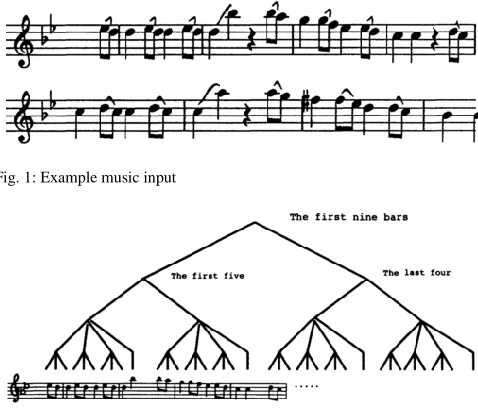
[image:1.612.316.555.443.647.2]Music composition with fractals follows the notion that music is repetitive at various perspectives. Taking the example of Mozart’s Symphony No. 40 from Leach and Fitch’s paper on fractal-based music composition, the repetitions can be represented and analyzed using fractal mathematics [3].
Fig. 1: Example music input
Fig. 2: Fractal-based music composition
B. Markov Model
Markov chain modeling can also be utilized for music generation. Markov modeling is a stochastic method for analyzing and learning from environmental data [4]. The environment in such a case, i.e. music generation, is a
A New Composition Algorithm for Automatic
Generation of Thematic Music from the
Existing Music Pieces
Abhijit Suprem and Manjit Ruprem
database of music pieces in a common format. This method analyzes existing data and generates an optimal matrix of actions for each event in order to maximize the highest reward, which is a fixed number assigned to the model upon generation of structured music [5]. Given a larger database, the model can achieve convergence towards the optimal matrix faster. Under Markov chain modeling exist two subcategories: controlled and autonomous learning.
C. L-Systems
An L-system is a useful method of qualifying music and generating new music based on given rules. An L-system is a fractal generator that obeys grammatical rules [6]. Music is inherently structured as a language with syntax rules that must be followed. However, as music generation is largely a creative process requiring some exploration (i.e. deviation from extant pieces), using L-systems can be a setback [7].
III. MUSIC GENERATION VIA PATTERN RECOGNITION AND STATISTICAL ANALYSIS
Creation of new music (music that has not been heard before) using computer algorithm is a new research area. Computer creates new music either from scratch or using old music pieces from the same theme (classical, rock, instrumental, slow-speed, high-speed, hip-hop, baroque, etc.). The latter approach draws more attention because a listener likes to enjoy to listen to music of the same theme that s/he has been acquainted with. The objective of this experiment is to create a program that can create unique music pieces using pattern recognition and statistical analysis
Patterns are unique sequences, which can be classified and clustered. To create a pattern recognition software, knowledge is needed about the item being identified. In this case, the algorithm needs to identify the notes, their length, and shape. Pattern recognition itself is the study of how machines can observe environment and extract all the repeating processes, learn to distinguish unique patterns, and make decisions based on the sequence of patterns [8].
Statistical analysis is a means to analyze probability of patterns. A statistical approach involves creating a data table for use later. Such a probability table is created with the following procedure:
Identification of current index in dataset
Defining and developing relationship between current and previous indices
Recording of the relationships
With this process, any dataset can be defined with relationships between contents of the dataset. These relationships are recorded and used during music generation.
IV. METHODOLOGY
To develop such an algorithm, appropriate integrated development environment (IDE) is necessary. As much of the analysis is around sequences of notes an IDE that can deal with arrays and matrices will work well. As such MATLAB was used in this research because MATLAB has been designed with matrix manipulation in mind. MATLAB follows BASIC language syntax, and has command toolboxes for specific fields. For this study, only the basic commands
and the matrix toolbox were required. MATLAB script language was learned from “Numerical Methods with MATLAB” by Gerald Recktenwald [9]. A software tool was necessary to convert sheet music to a code format. The standardized musical notation format ABC was used. The ABC specification is listed at www.norbeck.nu/abc/abcbnf.txt. An ABC notation decoding software, MC Music Editor was used to convert sheet music to notation format and to play back output new music pieces.
V. MACHINE LEARNING AND ANALYSIS TECHNIQUE
Various techniques that we used in this research are systematically outlined below.
A. Supervised Machine Learning
Supervised machine learning is a form of artificial intelligence that deals with pattern recognition based on a training input [10]. The agent (software system) is given data that contains patterns. Identification of correct patterns in the data (the correct patterns are known to the trainer) leads to a numerical reward to the agent. Incorrect pattern identification leads to a negative reward. The agent is programmed to follow positive rewards and the methods the program uses to correctly identify patterns in data are given more weight. With repeated training, the agent learns to use the correct method to identify patterns [11].
B. Reinforcement Learning
A reinforcement learning algorithm learns the optimal policy in an environment by choosing actions with highest future rewards [12]. Of particular interest is the Q-learning algorithm. The algorithm has three components: (i) and agent, which learns the environment, (ii) a dynamic or static environment made of states, where various actions can be completed in order to achieve a predetermined objective, with rewards for achieving the objective, and (iii) a goal state for the agent to reach. The environment is modeled for the agent with a matrix known as the R-Matrix, with dimensions M, X, and N, where M is number of states and N is number of actions per state. Each element of the matrix is defined as a state-action pair, and each state action pair has a reward associated with it. Generally, all possible state-action pairs are given a zero reward, all impossible state-action pairs are given negative reward, and the goal state-action pair is given the highest reward. The agent uses the R-Matrix to build the Q-Matrix, which is a model of the shortest path from any state to the goal state. The Q-Matrix has the same dimensions as the R-Matrix. Each state action-pair in the Q-Matrix has a reward value used for choosing optimal learning mechnism. The model for Q-Learning is as follows:
Q(state, action) = R(state, action )+ (γ*Max(Q(next state, all actions)))
where,
Q(state, action) is state-action pair for the particular action the agent has chosen
γ, a value from 0 to 1, is the agent’s consideration for future rewards and the reduction factor for rewards Max[Q(next state, all actions)] is the maximum rewards
possible in the next state
The learning rate defines which actions are chosen. A higher learning rate leads to less exploration and more exploitation, i.e. the agent will choose actions that lead to higher rewards, and vice versa [13].
C. Statistical Modeling
Statistical modeling can be utilized in music generation as a probability-based prediction method. Such modeling has two phases: information retrieval and prediction.
1) Information Retrieval
Music can be stored in various standardized formats to ease the retrieval process. Currently, there are four standards for music storage: (i) Humdrum, (ii) ABC notation, (iii) MusicXML, (iv) Humdrum, and (v) Portable Document Format (PDF).
Humdrum: Humdrum is an older format for music storage. Each line contains a note and its duration. Multiple staffs are represented by tab delimiters on each line.
ABC notation: The ABC notation format is a highly simplistic representation of music that can depict various musical elements and events such as ties, triplets, tempo, and volume. However, the notation is less verbose than required and is not as standardized as other formats. Therefore, it can be difficult to set up input data. ABC notation was used in a preliminary test of the algorithm. The absence of more advanced elements and events makes the notation format unfit for the algorithm. Portable Document Format: The Portable Document
Format (PDF) is one of the most widespread music notation formats. Majority of sheet music can be found in PDF format. The PDF format, however, stores music graphicall and current Optical Music Recognition (OMR) techniques are not advanced to properly characterize and translate graphical music to a text form. MusicXML: MusicXML (Music Extensible Markup
Language) is a more widespread format for music representation. Currently, there exist many music pieces in the MusicXML format. Further, there are various APIs in different languages for efficient data retrieval from XML documents by DOM (Document Object Model) traversal. The MusicXML format was used for this research. As MusicXML 3.0 can represent various notation symbols and musical structures, it is a flexible choice for this research.
2) Prediction
The prediction phase involves using retrieved data to build a knowledgebase for generating future music. As noted, there are machine learning methods, Markov chains, and fractal-based methods that can be used in this phase. For the purposes of this research, machine learning methods were used.
VI. METHODOLOGY
Learning algorithms have pervaded many commercial systems from speech recognition, image processing, and
mobile robot navigation to conversation dynamics and data mining [1]. Such systems have become commonplace in today’s technological environment, and every day, new techniques are being developed to use learning algorithms in various applications. This paper presents a novel method for music generation based on machine learning method. Music generation has been traditionally been restricted to only probability and statistical models [2]. There have been some research on using artificial intelligence in music generation [3]. The methods used in this research are new as they analyze input data statistically rather than on a note-by-note basis.
A. Music database
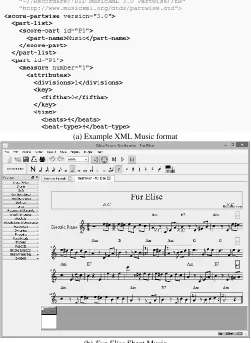
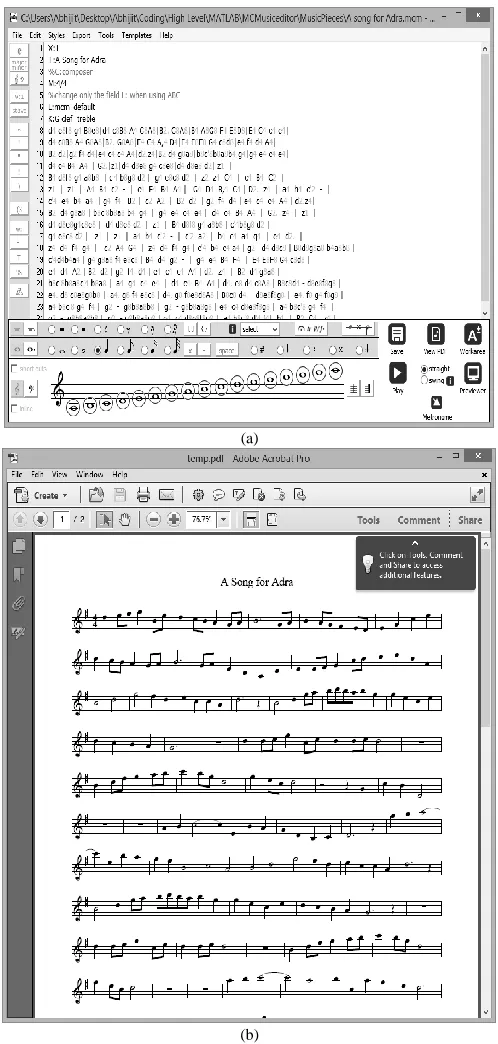
Before implementing the analysis algorithm in MATLAB script language, several music pieces were imported using MusixXML. Some music pieces did not have corresponding MusicXML files; however, they had ABC notation formats. These files were used in conjunction with other MusicXML files. Fig. 3 shows the XML schema for Fur Elise, as well as the accompanying digital sheet music. Fig. 4 shows ABC notation for A Song for Adra (an example) and the accompanying sheet music as a PDF file.
(a) Example XML Music format
[image:3.612.314.565.350.693.2]B. MATLAB Script algorithm
The MATLAB script accomplishes three goals: (i) import music pieces and create music database, (ii) analyze patterns in music database using machine learning and statistical analysis and (iii) generate new music based on analysis.
(a)
(b)
Fig. 4: (a) ABC notation for A Song for Adra and (b) digital sheet music
1) Music database creation
The MATLAB language includes various APIs for XML schema parsing [14]. These were used to read MusicXML files and convert the content to readable database format (Fig. 5). A parser was written for files in ABC format. Both parsers (XML and ABC) were modified to create the same output
format for music database. The database stores the following for each note: (i) note identifier of the current note (ii) the note identifier of the previous note, (iii) current sequence identifier.
2) Learning and analysis phase
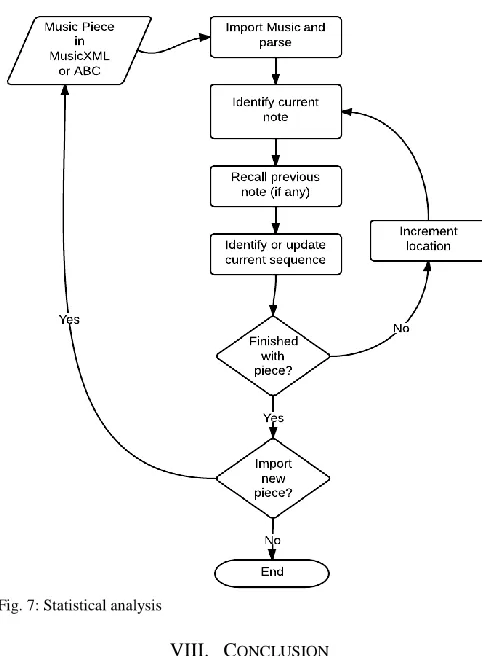
The database is analyzed using statistical methods. As each thematic piece (i.e. rock, classical, instrumental, etc.) has varying signal (sound) morphology, statistical analysis yields a generalized rule-based matrix of note and sequence identifiers for creating new pieces (Fig. 7).
[image:4.612.48.297.119.641.2]Each sequence has a high probability of some sequences appearing after it, and a lower probability of other sequences. The rule-based matrix contains these probabilities. During music generation, this matrix is used as the source or environment matrix. The rewards are predetermined to reduce operational time for achieving convergence.
Fig. 5: Database format for music pieces for each note
Note identifier: The note identifier is an identification code that can be used to determine note attributes such as pitch, length, accidentals, or any modifications such as arpeggios, allegros, pianissimo, etc.,
[image:4.612.315.575.246.381.2] Sequence identifier: The sequence identifier is an identification code for a sequence of notes. The sequence may be a rising, falling, peaked, or trough style (Fig. 6).
Fig. 6: Sequence types
3) Music generation phase
[image:4.612.312.563.491.586.2]music. The process is repeated until generated music morphology closely matches source music morphology within predefined error bounds.
VII. DISCUSSION
[image:5.612.48.289.224.552.2]This research is first of its kind to characterize the music in a computer-based system in the sense that learning is integrated statistical analysis to produce thematic music pieces. This entails interdisciplinary knowledge base in the areas of music, music interpretation (technical viewpoint), programming, and data analysis and prediction. The results are encouraging to motivate the researchers to develop a complete computerized music infrastructure to generate new music from extant pieces.
Fig. 7: Statistical analysis
VIII. CONCLUSION
This study is a step to understand the effect of existing parameters on the created music in a computerized music system. In this study, extant music pieces were used to create new pieces through machine learning and statistical analysis methods. Few music parameters were used in the learning and analysis phase because of time and the research is still at the rudimentary stage. The future work will include the study of the effect of other parameters such as fina, coda, pick-ups, varying time-signatures, and more key signatures.
ACKNOWLEDGMENT
I would like to acknowledge Dr. Honora Chapman, Director, Smittcamp Family Honors College, for her advice and encouragement. I would also like to acknowledge Dr. Nagy Bengiamin, Chair of Electrical and Computer Engineering and Dr. Ram Nunna, Dean of Lyles College of Engineering for providing the computing facilities for this research. I also acknowledge my parents for allowing us to accomplish part of this research in a home computing system.
REFERENCES
[1] D. Plans, D. Morelli (2012). Experience-Driven Procedural Music Generation for Games, IEEE Transactions on Computational Intelligence and AI in Games, vol.4, no.3, pp.192-198
[2] W. Schulze, B. van der Merwe (2011)., Music Generation with Markov Models, IEEE MultiMedia, vol.18, no.3, pp.78-85
[3] J. Leach, J. Fitch (1995). Nature, Music, and Algorithmic Composition,
Computer Music Journal, vol. 19, no. 2, pp 23-33
[4] J. A. Whittaker, M. Thomason (1994). A Markov chain model for statistical software testing, IEEE Transactions on Software Engineering, vol.20, no.10, pp.812-824
[5] Q. Yuting, J. Paisley, L. Carin (2007). Music Analysis Using Hidden Markov Mixture Models, IEEE Transactions on Signal Processing,vol.55, no.11, pp.5209-5224
[6] J. Mishra (2008). Classification of Linear Fractals through L-System,
First International Conference onEmerging Trends in Engineering and Technology, vol. 1, no. 5, pp. 16-18
[7] P. Meyer (1993). The Fractal Dimension of Music. Senior Thesis, Columbia University
[8] A. Jain, R. Duin, M. Jianchang (2000). Statistical pattern recognition: a review, IEEE Transactions on Pattern Analysis and Machine Intelligence, vol.22, no.1, pp.4-37
[9] G. Recktenwald (2000). Numerical Methods with MATLAB: Implementations and Applications. Upper Saddle River, NJ: Prentice Hall.
[10] V. Shen, C. Yue-Shan, T. Juang, (2010). Supervised and Unsupervised Learning by Using Petri Nets, IEEE Transactions onSystems, Man and Cybernetics, Part A: Systems and Humans, vol.40, no.2, pp.363-375 [11] K. Dixon, C. Lippitt, J. Forsythe (2005). Supervised machine learning
for modeling human recognition of vehicle-driving situations,
International Conference onIntelligent Robots and Systems, vol. 2, no. 6, pp.604-609
[12] P. Kulkarni (2012). Introduction to Reinforcement and Systemic Machine Learning. Reinforcement and Systemic Machine Learning for Decision Making, Piscataway, NJ: IEEE, pp 1-21
[13] G. Maozu, L. Yang, J. Malec (2004). A new Q-learning algorithm based on the metropolis criterion, IEEE Transactions onSystems, Man, and Cybernetics, Part B: Cybernetic, vol.34, no.5, pp.2140-2143