A reliable estimate of the soil’s nitrogen (N)-supplying capacity (NSC) is essential for determin-ing the rate of N fertilizer application required to optimize crop yield and quality, and to minimize the adverse impacts of excess N on environment and farm economy. Among the numerous methods proposed for assaying NSC, biological methods (aerobic and anaerobic incubation) are considered to be the most reliable, as their results are highly correlated with the yield and plant N uptake (PNU). However, since biological methods are highly time consuming and tedious, they are not considered suitable as routine tests. In pursuit of developing a rapid, yet reliable, index of soil N availability, many chemical indices have evolved over time, but no single method has performed consistently
enough to receive broad acceptance across a wide range of soils. For example, in a study by Sahrawat (1983), organic C (Corg) and total N (Ntot) showed strong correlations with PNU (r = 0.82 and 0.84, respectively), whereas, Hussain et al. (1984) re-ported much weaker correlations between the same (r = 0.38). Similarly, while Gianello and Bremner (1986b) found hot KCl extractable-N (KCl-N) as a good indicator of potentially available-N in soils, the same index was reported as a poor indicator by Hong et al. (1990). Gianello and Bremner (1986b) also recommended phosphate-borate extractable-N as a strong predictor of extractable-NSC, whereas Hong et al. (1990) and Sharifi et al. (2007) found them otherwise. Such contrasting performances of soil test methods for available-N in different soils were
Evaluation of nitrogen availability indices and their
relationship with plant response on acidic soils of India
L.J. Bordoloi
1,2, A.K. Singh
1, Manoj-Kumar
2, Patiram
2, S. Hazarika
21
Department of Agricultural Chemistry and Soil Science, Nagaland University,
Medziphema, India
2
Division of Natural Resource Management (Soil Science), ICAR Research Complex
for NEH Region, Umiam, Meghalaya, India
ABSTRACT
Plant’s nitrogen (N) requirement that is not fulfilled by available N in soil has to be supplied externally through chemical fertilizers. A reliable estimate of soil N-supplying capacity (NSC) is therefore essential for efficient fertilizer use. In this study involving a pot experiment with twenty acidic soils varying widely in proper-ties, we evaluated six chemical indices of soil N-availability viz. organic carbon (Corg), total N (Ntot), acid and alkaline-KMnO4 extractable-N, hot KCl extractable-N (KCl-N) and phosphate-borate buffer extractable-N (PBB-N), based on their strength of correlation with available-N values obtained through aerobic incuba-tion (AI-N) and anaerobic incubaincuba-tion (ANI-N), and also with the dry matter yield (DMY), N percentage and plant (maize) N uptake (PNU). In general, the soils showed large variability in NSC as indicated by vari-ability in PNU which ranged from 598 to 1026 mg/pot. Correlations of the N-availvari-ability indices with AI-N and ANI-N decreased in the order: PBB-N (r = 0.784** and 0.901**) > KCl-N (r = 0.773** and 0.743**) > acid KMnO4-N (r = 0.575** and 0.651**) ≥ Corg (r = 0.591** and 0.531**) ≥ alkaline KMnO4-N (r = 0.394** and 0.548**) > Ntot (r = 0.297** and 0.273*). Of all the indices evaluated, PBB-N showed the best correla-tions with plant parameters as well (r = 0.790** and 0.793** for DMY and PNU, respectively). Based on the highest correlations of PBB-N with biological indices as well as plant responses, we propose PBB-N as an appropriate index of N-availability in the acidic soils of India and other regions with similar soils.
frequently reported in literature (St. Luce et al. 2011), which reinforces the need of developing region-specific indices for N-availability in a given set of soil, crop and climatic conditions.
In India, Corg (Walkley and Black 1934) is fre-quently used as an index of soil N-availability for making fertilizer-N recommendations. For research purposes, however, alkaline permanganate extrac-tion procedure, as proposed by Subbiah and Asija (1956) and modified by Stanford (1978), has been the most preferred method of estimating available N in soils, including the acidic soils which are mostly concentrated in the north-eastern region of India. It is worth noting that the method of Subbiah and Asija (1956) was proposed based on the analysis of 29 soils from India which were mostly alkaline in reaction, and included only one acidic soil from northeast India. It may therefore be hypothesized that the most commonly used alkaline permanganate method may not really be giving a reliable assessment of N availability in acidic soils of India and other regions with similar soils. Moreover, many reports that this method does not provide satisfactory result (Gianello and Bremner 1986b, Elkarim and Usta 2001) further necessitate to evaluate the utility of alkaline KMnO4 method for available-N assessment in such soils. Thus, objective of this study was to determine if the conventionally used alkaline KMnO4-N and Corg provides a reliable estimate of N availability in acidic soils of India and, if not, identify an ap-propriate index of N availability for such soils.
MATERIAL AND METHODS
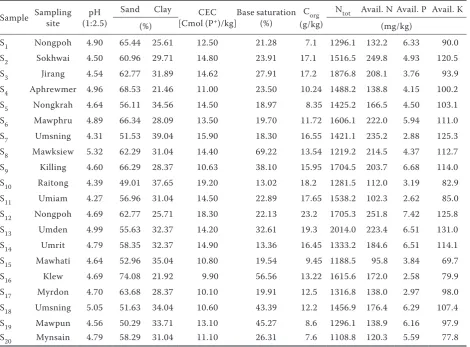
Soils were collected from 20 representative sites (0–20 cm depth) in the state of Meghalaya, India. These were air-dried, passed through 2-mm sieve (0.5 mm for Corg) and analysed for the relevant physico-chemical properties (Table 1) using stand-ard procedures (Page et al. 1982). To assess the correlations between N availability indices and the plant responses, maize (cv. RCM 1-1) was grown in plastic pots containing 7.5 kg of experimental soils with four replications. The plants were harvested at the initiation of tasseling stage, and the dry matter weights were recorded after oven-drying at 70°C for 48 h. Plant N concentration was estimated and the N uptake was subsequently calculated. Kel Plus – N analyzer (Pelican, Chennai, India) was used in soil and plant N analysis.
Soil N-availability indices
Nitrogen released during aerobic incuba-tion (AI-N). A 10-g sample of soil was mixed with 3 g of water-washed 30–60 mesh quartz sand containing 6 mL of water (Keeney and Bremner 1966). The mixture was evenly distributed over the bottom of the beaker and incubated at 30°C under aerobic conditions. After 14 days, the mix-ture was extracted with 2 mol/L KCl, and N was estimated by distillation in the presence of MgO and Devarda’s alloy. The amount of exchangeable NH4 and NO3 present in another portion of the soil-sand mixture that was not incubated was also determined. AI-N was estimated as the difference of the two analyses.
Nitrogen released during anaerobic incubation (ANI-N). The method of Waring and Bremner (1964) as modified by Keeney (1982) was followed. A 5-g soil sample was placed with 12.5 mL of water in a test tube that was stoppered and placed in a constant temperature cabinet at 40°C for 7 days. N released was estimated by distilling the contents with 100 mL of 2 mol/L KCl in the presence of MgO. The amount of NH4-N present in the sample before incubation was also determined. ANI-N was calculated as the difference of the two analyses.
Soil organic carbon (Corg) and total nitrogen (Ntot).These two soil parameters, as indices of N availability, were determined following wet digestion method (Walkley and Black 1934) and micro-Kjeldahl procedure, respectively.
Alkaline KMnO4 extractable N. Nitrogen re-leased as NH3 during distillation of 1-g sample of soil with 10 mL of 0.25 mol/L NaOH containing 0.1 g of KMnO4 was estimated as theindex of soil N availability (Stanford 1978).
Acidified KMnO4 extractable N. Soil sam-ples (3-g portions) were shaken with 15 mL of 0.05 mol/L KMnO4/0.5 mol/L H2SO4 for 1 h and quantitatively transferred to a distillation flask and distilledwith 1 mol/L NaOH to estimate N released as NH3 (Stanford and Smith 1978).
but without heating. KCl-N was estimated as the difference between the two extractions.
Phosphate borate buffer (PBB) extractable N (PBB-N). The method involves steam distillation of 4-g soil for 8 min in presence of 40 mL of phos-phate-borate buffer solution (pH 11.2) (Gianello and Bremner 1986b). The NH4-N initially present in the soil was estimated by steam distillation of 4 g soil with 0.2 g MgO and 20 mL of 2 mol/L KCl for 3.3 min. PBB-N was estimated as the difference between the two estimations.
Statistical analysis
Data were analyzed using the SPSS version 16.0 statistical package (SPSS Inc., Chicago, USA). Pearson’s correlation coefficient was used to com-pare the correlation between chemical and biologi-cal indices and the plant parameters; significance of these tests was considered at 0.05 and 0.01 probability levels.
RESULTS AND DISCUSSION
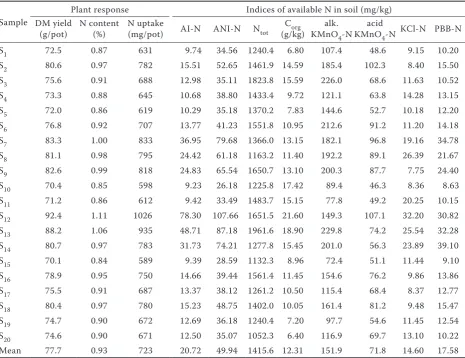
[image:3.595.64.535.102.449.2]Characteristics of the soils and N-availability indices. In general, soils used in the study showed large variability in N-supplying capacity (NSC) as indicated by the differences in plant parameters including plant N uptake (PNU), which is taken as a more realistic indicator of N availability in soils (Sahrawat 1983, Hussain et al. 1984, Li et al. 2011). PNU ranged from 598 mg/pot (S10) to 1026 mg/pot (S12) which corresponds to 6.7% and 9.0% of the Ntot in the respective soils (Table 2). Such variation in soils’ NSC is understandable given the wide variations in soil properties in-cluding Corg, Ntot and clay contents (Table 1). So much variability in NSC of soils within a region implies that crop fertilizer-N requirements may also vary greatly on these soils, and this asserts the need of site-specific soil test-based N recom-mendation, rather than a blanket recommendation for the whole region, to improve the efficiency of applied fertilizers.
Table 1. Physico-chemical properties of the soils used in the study
Sample Sampling site (1:2.5)pH Sand Clay [Cmol (PCEC +)/kg]Base saturation (%) (g/kg)Corg
Ntot Avail. N Avail. P Avail. K
(%) (mg/kg)
S1 Nongpoh 4.90 65.44 25.61 12.50 21.28 7.1 1296.1 132.2 6.33 90.0
S2 Sokhwai 4.50 60.96 29.71 14.80 23.91 17.1 1516.5 249.8 4.93 120.5
S3 Jirang 4.54 62.77 31.89 14.62 27.91 17.2 1876.8 208.1 3.76 93.9
S4 Aphrewmer 4.96 68.53 21.46 11.00 23.50 10.24 1488.2 138.8 4.15 100.2
S5 Nongkrah 4.64 56.11 34.56 14.50 18.97 8.35 1425.2 166.5 4.50 103.1
S6 Mawphru 4.89 66.34 28.09 13.50 19.70 11.72 1606.1 222.0 5.94 111.0
S7 Umsning 4.31 51.53 39.04 15.90 18.30 16.55 1421.1 235.2 2.88 125.3
S8 Mawksiew 5.32 62.29 31.04 14.40 69.22 13.54 1219.2 214.5 4.37 112.7
S9 Killing 4.60 66.29 28.37 10.63 38.10 15.95 1704.5 203.7 6.68 114.0
S10 Raitong 4.39 49.01 37.65 19.20 13.02 18.2 1281.5 112.0 3.19 82.9
S11 Umiam 4.27 56.96 31.04 14.50 22.89 17.65 1538.2 102.3 2.62 85.0
S12 Nongpoh 4.69 62.77 25.71 18.30 22.13 23.2 1705.3 251.8 7.42 125.8
S13 Umden 4.99 55.63 32.37 14.20 32.61 19.3 2014.0 223.4 6.51 131.0
S14 Umrit 4.79 58.35 32.37 14.90 13.36 16.45 1333.2 184.6 6.51 114.1
S15 Mawhati 4.64 52.96 35.04 10.80 19.54 9.45 1188.5 95.8 3.84 69.7
S16 Klew 4.69 74.08 21.92 9.90 56.56 13.22 1615.6 172.0 2.58 79.9
S17 Myrdon 4.70 63.68 28.37 10.10 19.91 12.5 1316.8 138.0 2.97 98.0
S18 Umsning 5.05 51.63 34.04 10.60 43.39 12.2 1456.9 176.4 6.29 107.4
S19 Mawpun 4.56 50.29 33.71 13.10 45.27 8.6 1296.1 138.9 6.16 97.9
Of the two biological indices of N-availability, on average, values of ANI-N were higher than those of AI-N which could be attributed to the fact that the losses of ammonia which may occur under AI were avoided in the enclosed system of ANI. Also, higher temperature used in ANI (40°C) than in AI (30°C) might have resulted in higher values of mineralised-N (Keeney 1982). Of the four chemical extractants (excluding the soil parameters i.e. Ntot and Corg), alkaline KMnO4, on average, extracted the highest amount of N followed by acidified KMnO4, whereas the minimum amount was ex-tracted by hot 2 mol/L KCl, resembling closely by phosphate borate buffer (PBB). Similar differences in the extracting ability of these chemicals were also reported by Nayyar et al. (2006) and Li et al. (2011). These differences are considered to result from their differential ability to extract N from different pools of organic-N in soils. Considering
such a wide variability in the ability of different extractants to predict potentially-available N in soil, it is imperative to select one which could provide satisfactory correlation with the standard methods (i.e. biological incubations) and more importantly with the plant responses.
[image:4.595.65.531.114.472.2]Relationships between soil N-availability indi-ces and plant response. Correlations among soil N availability indices were found significant ex-cept between Ntot and KCl-N (Table 3). The high-est coefficient of correlation (r = 0.946**; P < 0.01) was obtained between AI-N and ANI-N the two standard indices of soil N-availability. Correlations of the chemical indices of soil N-availability with AI-N and ANI-N decreased in the order: PBB-N (r = 0.784** and 0.901**) > KCl-N (r = 0.773** and 0.743**) > acid KMnO4-N (r = 0.575** and 0.651**) ≥ Corg (r = 0.591** and 0.531**) ≥ alkaline KMnO4-N (r = 0.394** and 0.548**) > Ntot (r = 0.297** and 0.273*).
Table 2. Dry matter (DM) yield and N uptake by plant, and various indices of N availability in soil as estimated by biological incubations and chemical extraction methods
Sample
Plant response Indices of available N in soil (mg/kg)
DM yield
(g/pot) N content (%) N uptake (mg/pot) AI-N ANI-N Ntot (g/kg)Corg KMnOalk. 4-N
acid
KMnO4-N KCl-N PBB-N
S1 72.5 0.87 631 9.74 34.56 1240.4 6.80 107.4 48.6 9.15 10.20
S2 80.6 0.97 782 15.51 52.65 1461.9 14.59 185.4 102.3 8.40 15.50
S3 75.6 0.91 688 12.98 35.11 1823.8 15.59 226.0 68.6 11.63 10.52
S4 73.3 0.88 645 10.68 38.80 1433.4 9.72 121.1 63.8 14.28 13.15
S5 72.0 0.86 619 10.29 35.18 1370.2 7.83 144.6 52.7 10.18 12.20
S6 76.8 0.92 707 13.77 41.23 1551.8 10.95 212.6 91.2 11.20 14.18
S7 83.3 1.00 833 36.95 79.68 1366.0 13.15 182.1 96.8 19.16 34.78
S8 81.1 0.98 795 24.42 61.18 1163.2 11.40 192.2 89.1 26.39 21.67
S9 82.6 0.99 818 24.83 65.54 1650.7 13.10 200.3 87.7 7.75 24.40
S10 70.4 0.85 598 9.23 26.18 1225.8 17.42 89.4 46.3 8.36 8.63
S11 71.2 0.86 612 9.42 33.49 1483.7 15.15 77.8 49.2 20.25 10.15
S12 92.4 1.11 1026 78.30 107.66 1651.5 21.60 149.3 107.1 32.20 30.82
S13 88.2 1.06 935 48.71 87.18 1961.6 18.90 229.8 74.2 25.54 32.28
S14 80.7 0.97 783 31.73 74.21 1277.8 15.45 201.0 56.3 23.89 39.10
S15 70.1 0.84 589 9.39 28.59 1132.3 8.96 72.4 51.1 11.44 9.10
S16 78.9 0.95 750 14.66 39.44 1561.4 11.45 154.6 76.2 9.86 13.86
S17 75.5 0.91 687 13.37 38.12 1261.2 10.50 115.4 68.4 8.37 12.77
S18 80.4 0.97 780 15.23 48.75 1402.0 10.05 161.4 81.2 9.48 15.47
S19 74.7 0.90 672 12.69 36.18 1240.4 7.20 97.7 54.6 11.45 12.54
S20 74.6 0.90 671 12.50 35.07 1052.3 6.40 116.9 69.7 13.10 10.22
Mean 77.7 0.93 723 20.72 49.94 1415.6 12.31 151.9 71.8 14.60 17.58
Correlations of the N-availability indices with plant parameters are shown in Table 4. Highest correla-tions with plant N uptake (PNU) were shown by the biological indices, of which, ANI-N showed stronger correlations (r = 0.920**) than the AI-N (r = 0.876**). Among the chemical indices, best correlation with PNU was shown by PBB-N (r = 0.793**) followed by acid KMnO4-N (r = 0.739**). Alkaline KMnO4-N correlated slightly better (r = 0.625**) than the KCl-N (r = 0.604**). Of all the indices, Ntot and Corg showed the least correlations with PNU, with the latter be-ing better correlated (r = 0.516**) than the former (r = 0.350**). Correlations of the dry matter yield and %N with various indices showed similar trend and strength as with PNU.
Significant correlations observed between most of the indices are expected since most of the extractants draw heavily on soil organic matter N pools (Nayyar et al. 2006). However, their differential ability to extract N from different pools may have resulted in hugely different levels of correlations between them. The better reliability of biological indices as compared to chemical ones was further confirmed by the higher levels of their correlation with plant parameters including PNU, as frequently reported in literature (Sahrawat 1983, Hussain et al. 1984). However, since these methods are tedious and time
consuming, an alternative chemical index of soil N-availability, which correlates strongly with the results of incubation methods and more importantly with plant responses, is preferred for routine soil analysis. Among all the six chemical indices, PBB-N showed consistently higher correlations with the re-sults obtained by biological methods as well as with plant parameters. This implies that PBB-N deserves consideration as a routine test for available N in acidic soils of India. The usefulness of PBB-N as a reliable index of soil N-availability was established by many studies involving a wide range of soils and crops (Gianello and Bremner 1986a,b, Hong et al. 1990, Elkarim and Usta 2001).
[image:5.595.64.533.101.238.2]Two soil parameters namely, Ntot and Corg were also evaluated as indices of soil N-availability, but their correlations with either the biological indices or the plant responses were not promising enough to be taken as a reliable predictor of N-availability. In India, Corg is frequently used by soil testing laboratories as an index of N availability. However, results of our study on acidic soils of northeast India, supported by similar results from alkaline soils of northwest India (Nayyar et al. 2006), suggest that an alternative chemical index with better predictive ability than the Corg should be used for accurate prediction of plant-available N in Indian soils.
Table 3. Correlation coefficients for the relationships between the biological and the chemical indices of N availability
AI-N ANI-N Ntot Corg Alk. KMnO4-N Acid KMnO4-N KCl-N PBB-N
AI-N 1 – – – – – – –
ANI-N 0.946** 1 – – – – – –
Ntot 0.297** 0.273* 1 – – – – –
Corg 0.591** 0.531** 0.552** 1 – – – –
Alk. KMnO4-N 0.394** 0.548** 0.422** 0.330** 1 – – –
Acid KMnO4-N 0.575** 0.651** 0.244* 0.307** 0.603** 1 – –
KCl-N 0.773** 0.743** ns 0.455** 0.255* 0.291** 1 –
PBB-N 0.784** 0.901** 0.236* 0.465** 0.587** 0.468** 0.672** 1
*P < 0.05; **P < 0.01; ns - not significant. AI-N – available-N through aerobic incubation; ANI-N – available-N through anaerobic incubation
Table 4. Correlation coefficients for the relationships between plant parameters and the indices of soil N availability
AI-N ANI-N Ntot Corg Alk. KMnO4-N Acid KMnO4 KCl-N PBB-N
Dry matter yield 0.885** 0.925** 0.348** 0.522** 0.633** 0.761** 0.599** 0.790** N concentration 0.876** 0.928** 0.313** 0.490** 0.631** 0.759** 0.607** 0.789**
N uptake 0.876** 0.920** 0.350** 0.516** 0.625** 0.739** 0.604** 0.793**
[image:5.595.62.532.662.728.2]It is also noteworthy that the alkaline KMnO4-N, which (in addition to Corg) happens to be the most widely used index of soil N-availability in India, al-though significantly correlated, did not yield satisfac-tory results compared to the other chemical indices such as PBB-N and acid KMnO4-N. Many studies reported that alkaline KMnO4 method does not provide satisfactory results (Stanford 1978, Gianello and Bremner 1986b, Elkarim and Usta 2001). Our results, which further consolidate these previous findings, suggest that PBB-N, rather than the al-kaline KMnO4-N, can be better used as a reliable index of soil-N availability, particularly in the acidic soils of India.
To conclude, of the six chemical indices of soil N-availability evaluated in this study, PBB-N showed consistently higher correlations with the results obtained by the standard incubation methods as well as with plant parameters. The two commonly used indices of N availability in India, namely Corg and alkaline KMnO4-N did not perform satisfacto-rily when tested for acidic soils. We, therefore, on the basis of our results, propose PBB-N as a better alternative index of N-availability for the acidic soils of India and the other regions with similar soils.
Acknowledgements
We thank Nagaland University for support dur-ing this investigation
REFERENCES
Elkarim A.K.H.A., Usta S. (2001): Evaluation of some chemical extraction methods used as indices of soil nitrogen availability in Polatli state farm soils in Ankara province. Turkish Journal of Agriculture and Forestry, 25: 337–345.
Gianello C., Bremner J.M. (1986a): A simple chemical method for assessing potentially mineralizable organic nitrogen in soil. Communications in Soil Science and Plant Analysis, 17: 195–214. Gianello C., Bremner J.M. (1986b): Comparison of chemical methods
of assessing potentially available organic nitrogen in soil. Com-munications in Soil Science and Plant Analysis, 17: 215–236.
Corresponding author:
Dr. Manoj-Kumar, Division of Natural Resource Management (Soil Science), ICAR Research Complex for NEH Region, Umiam-793 103, Meghalaya, India
e-mail: [email protected]
Hong S.D., Fox R.H., Piekielek W.P. (1990): Field evaluation of several chemical indexes of soil nitrogen availability. Plant and Soil, 123: 83–88.
Hussain F., Kauser A.M., Azam F. (1984): Evaluation of acid per-manganate extraction as an index of soil nitrogen availability. Plant and Soil, 79: 249–254.
Keeney D.R. (1982): Nitrogen-Availability. In: Page A.L., Miller R.H., Keeney D.R. (ed.): Methods of Soil Analysis. Part 2. Chemical and Microbiological Properties. Agronomy Monograph 9. Soil Science Society of America and American Society of Agronomy, Madison. Keeney D.R., Bremner J.M. (1966): Comparison and evaluation of laboratory methods of obtaining an index of soil nitrogen avail-ability. Agronomy Journal, 58: 498–503.
Li W., Xia Y., Ti C., Yan X. (2011): Evaluation of biological and chemical nitrogen indices for predicting nitrogen-supplying capacity of paddy soils in the Taihu Lake region, China. Biology and Fertility of Soils, 47: 669–678.
Nayyar A., Bijay-Singh, Yadvinder-Singh (2006): Nitrogen-supplying capacity of soils for rice and wheat and nitrogen availability indi-ces in soils of northwest India. Communications in Soil Science and Plant Analysis, 37: 961–976.
Page A.L., Miller R.H., Keeney D.R. (1982): Methods of Soil Analysis. Part 2. American Society of Agronomy and Soil Science Society of America, Madison.
Sahrawat K.L. (1983): Correlations between indexes of soil nitro-gen availability and nitronitro-gen percent in plant, nitronitro-gen uptake, and dry-matter yield of rice grown in the greenhouse. Plant and Soil, 74: 223–228.
Sharifi M., Zebarth B.J., Burton D.L., Grant C.A., Cooper J.M. (2007): Evaluation of some indices of potentially mineralizable nitrogen in soil. Soil Science Society of America Journal, 71: 1233–1239. St. Luce M., Whalen J.K., Ziadi N., Zebarth B.J. (2011): Nitrogen
dynamics and indices to predict soil nitrogen supply in humid temperate soils. Advances in Agronomy, 112: 55–102. Stanford G. (1978): Evaluation of ammonium release by alkaline
permanganate extraction as an index of soil nitrogen availability. Soil Science, 126: 244–253.
Stanford G., Smith S.J. (1978): Oxidative release of potentially mineralizable soil nitrogen by acid permanganate extraction. Soil Science, 126: 210–218.
Subbiah B.V., Asija G.L. (1956): A rapid procedure for estimation of available nitrogen in soils. Current Science, 25: 259–260. Walkley A., Black I.A. (1934): An examination of the Degtjareff method
for determining soil organic matter, and a proposed modification of the chromic acid titration method. Soil Science, 37: 29–38. Waring S.A., Bremner J.M. (1964): Ammonium production in soil
under waterlogged conditions as an index of nitrogen availability. Nature, 201: 951–952.