Abstract— Methods that effectively perform face recognition, is an area of research that is still active as the various characteristics of face is not yet fully explored. With increasing research in the area of face detection new methods for detecting human faces automatically are being developed. This paper proposed a face recognition system consisting of three modules, namely, preprocessing, face detection and face recognition. The preprocessing module enhances the face image through denoising and illumination variation correction algorithms. The face detection module identifies the face region from its background using information obtained from skin color, eye / mouth and face boundary. The final module, face recognition, combines three feature reduction algorithms (Enhanced Principal Component Analysis, Linear Discriminant analysis, Independent Component Analysis) and two transformation techniques (Wavelet Packet Transformation and Curvelet Transform) to design 15 recognition models. Experimental results prove that the proposed amalgamation of techniques used during the design and implementation of the face recognition models is successful and improves the recognition process when compared with the existing models.
Index Terms—Color Space, Denoising, Face Identification, Face Recognition, Feature Reduction, Illumination Variation Correction, Transformation Techniques.
I. INTRODUCTION
The ever increasing world population and mobility in all its facets has made security one of the most important social issues. In response to the new threats, organizations need to implement or update personnel security program to prevent unauthorized access to control systems and critical information. Security through person identification and authentication has emerged as a key technology and the use of biometrics for this purpose is increasing steadily. Biometrics refers to a broad range of technologies, systems, and applications that automate the identification
Manuscript received March 17, 2016; revised March 31, 2016. V. Radha, Prof., is with the Department of Computer Science, Avinashilingam Institute for Home Science and Higher Education for Women University, Coimbatore, Tamil Nadu, PIN 641043, India. (Mobile: +94428 43563, e-mail: [email protected]).
N. Nallamal, (Mobile: +96981 92480, e-mail: [email protected]).
or verification of an individual based on his or her physiological or behavioral characteristics [5].
Several state-of-the-art biometric techniques have been developed in recent years which use a variety of human characteristics for identification and recognition [1]. In the present scenario, most of the efforts in authentication systems tend to develop more secure environments, where it is harder, or ideally, impossible, to create a copy of the properties used by the system to discriminate between authorized and unauthorized individuals [7]. Most of the existing systems use only very primitive authentication measures and are not very effective in user authentication [6].
One biometric, which can satisfy the above requirements, is Face. Facial properties of a person are very accurate and are unique to an individual. They are very difficult to duplicate and the authentication systems based on face prove to produce very low false acceptance rate and false rejection rate [12]. Although facial patterns may be altered through factors like illumination conditions, scale variability, age variation, glasses and moustaches, the face recognition system is still one of the most frequently used biometric authentication system.
The problem of face recognition has been an ongoing subject of research for more than 20 years. Although a large number of approaches have been proposed in the literature and have been implemented successfully for real-world applications, robust face recognition is still a challenging subject, mainly because of large facial variability, pose variations and uncontrolled environmental conditions. This paper aims to develop a person recognition and authentication system using face biometric that would operate efficiently on three extremes (high accuracy, high scalability and easy to implement & use), simultaneously. To achieve this primary goal, this work divides the task of face recognition into three major modules, namely, preprocessing, face region detection and face recognition. A series of enhancement operations using image processing techniques are applied for this purpose. The preprocessing module consists of techniques and procedures to improve the quality of face images (both input and database) through noise reduction, illumination
Face Identification and Recognition System for
User Authentication using Advanced Image
Processing Techniques
and lighting variation correction. The second module consists of algorithms that first determine whether any human face is present in the acquired image and if face exists, the algorithm then identifies its location. The final module of the face recognition system compares the various facial characteristics of an input image with a facial database to recognize and authenticate a person. Each of these modules is interrelated to each other and the output from one module is used as input to the next phase. The paper presents methods and techniques used to design and implement these face recognition systems.
The rest of the paper is organized as follows. Section II presents the methodology used by each module and also presents the face recognition systems build using these enhanced procedures. Section III presents the experimental results, while the work is concluded with future research directions in Section 4.
II. PREPROCESSING
This section presents procedures that enhance the features of a face image through the use of denoising and illumination variation correction, so as to improve the performance of the subsequent stages of the proposed system.
A. Denoising
The presence of noise in face images degrade recognition accuracy and therefore, have to be removed or reduced. Several noise filtering algorithms, both linear and non-linear, exists. However, these algorithms, in order to work efficiently, require prior knowledge about the type of noise. But, in real world scenario, it is not always possible to know about the type of noise that corrupts the image. In these situations, an automated method that identifies the type of noise is desired, so that appropriate denoising filter can be used to detect and remove the noise efficiently. In this paper, a Probabilistic Neural Network base Noise Detection and Denoising Algorithm (PNN-NDD) is proposed. PNN-NDD considers three types of noise that most frequently degrades face images. The three types considered are Gaussian, Speckle and Impulse noise. A PNN is used to classify the noise in a corrupted image using five features, namely, mean, variance, skewness, kurotsis and central moment. For training PNN, artificial training images (100 x 100 pixels) with random pixels were generated. After identifying the type of noise, Weiner filter, Speckle Reducing Anisotropic Diffusion (SRAD) filter and Weighted median filter were respectively used to remove the Gaussian, Speckle and Salt & Pepper noise respectively.
B. Illumination and Lighting Variation Correction The second stage of preprocessing focused on correcting illumination and lighting variations in the face image. The illumination problem is the variability of an object’s appearance from one image to another with slight changes in lighting conditions. The same person, with the same facial expression, will look very different under varying lighting conditions. To solve this problem, a Sequential
Enhanced Histogram Equalization and Gamma Intensity Correction (GIC) method is proposed. The SHEQ-GIC adjusts illumination variation in four steps. First, a logarithm function is applied to transform the product of illumination-reflection model into a sum with two components that are low-density and high-density respectively. The high density area is the key cause for over-equalization. The second step arranges the calculated density in descending order and a density region expanding algorithm is applied. This results in a two density histograms based on region division. The third step performs a 3-step Dynamic Histogram Equalization (DHE) of the sub-histograms. The first step performs dynamic range mapping of individual partition followed by HEQ. The final step then uses Gamma Intensity Correction (GIC) algorithm to control the overall brightness of an image. This step ensures that the mean intensity of the output image is the same as that of the input image.
C. Face Detection
The second phase of the study focuses on face detection. Face detection segments the face areas from the background, thus reducing the search space of an image [9]. The process consists of the following steps: (i) preprocessing (ii) color space transformation (iii) skin color detection (iv) segmentation of possible face regions (v) detection of eye / mouth and face boundary, (vi) formation of isosceles triangle to detect the face region.
Popularly used color spaces in face recognition include RGB (Red-Green-Blue), YCbCr (Y-Luma, C-Chroma of blue and red components) and HSV (Hue-Saturation-Value). These produce good results with single image but performance degrades with multiple face images and different poses. In order to solve this problem, in the present research work, a hybrid color space combining RGB components from RGB color space, H from HSV color space and CbCr from YCbCr color space is proposed and is termed as HCSSRD color space model. Using the HCSSRD color space, a neural network is trained to recognize both skin and non-skin regions. During testing, bounding planes or rules for each skin colour subspace are initially constructed from their respective skin colour distributions. Then combination of morphological operations is applied to the extracted skin regions to eliminate possible non-face skin regions. Face regions are labeled and returned as detected faces. The retrieved face regions consist of the following problems, which are solved using morphological and additional operations as detailed below.
Problem 1 : Regions are fragmented and often contain holes and gaps. Fragmented sub-regions are grouped together by applying simple dilation on the large regions. Hole and gaps within each region are closed by a flood fill operation.
proximity may result in the detection of one single region due to the nature of pixel-based methods. Solved using a morphological opening to “open up” or pull apart narrow, connected regions.
Problem 3 : Extracted skin colour regions may not necessarily be face regions. There are possibilities that certain skin regions may belong to exposed limbs (arms and legs) and also foreground and background objects that have a high degree of similarity to skin colour (also known as false alarms). Additional measures are introduced to determine the likelihood of a skin region being a face region. Two region properties, box ratio (width to height ratio of the region bounding box) and eccentricity (ratio of minor axis to major axis of a bounding ellipse), are used to examine and classify the shape of each skin region. A candidate region is considered as face when the box ratio is between 0.4 and 1.0 and eccentricity is between 0.3 and 0.9. The eccentricity ratio is more sensitive to the region shape and is able to consider various face rotations and poses.
After face region identification, facial features are extracted. Among the various facial features, eyes and mouth are the most suitable features for recognition. Eye regions are located by using binary template matching [2] and a Support Vector Machine (SVM) and mouth regions are located using the method proposed by [4]. After extracting the eyes and mouth a triangle drawn with the two eyes and a mouth as the three points in case of a frontal face. This results in an isosceles triangle (i j k) in which the Euclidean distance between two eyes is about 90-110% of the Euclidean distance between the centre of the right/left eye and the mouth. After getting the triangle, the coordinates of the four corner points that form the potential facial region is obtained, using which the face is segmented.
D. Face Recognition
The third phase of the study focus on recognizing the input face image for authentication. This phase considers three subspace reduction algorithms namely, Enhanced 2-Dimensional Principal Component Analysis (2DPRCP), Linear Discriminant Analysis (LDA), Independent Component Analysis (ICA) along with wavelet packet and curvelets via wrapping transformation. After retrieving the reduced feature set, an SVM classifier is used to recognize the faces.
Meng and Zhang [8] enhanced the traditional PCA to use 2-dimensional vectors instead of 1-dimension and proved that the 2D-PCA is an enhanced version to PCA. The 2D representation, apart from being a convenient method for 2D images also leads to a small sized covariance matrix when compared to 1D PCA counterpart. The 2DPCA model during covariance matrix construction builds a feature matrix of a facial image by orthogonal projection of the image onto the most significant eigenvectors. This projection is performed only on row-related feature matrices and ignores the column-row-related feature matrix. Thus, the 2DPCA is extended to include
both row and column-related feature matrices. The
enhanced 2DPCA is termed as 2DPRCP in this study. The reduced feature vectors from the 2DPRCP are then used by the classifier to recognize the face.
Using the three subspace reduction algorithms (2DPRCP, LDA and ICA) along with two transformation algorithms (Wavelet Packet and Curvelets) various face recognition models are designed. They are wavelet packet-based models, curvelet-based models and a combined wavelet packet-curvelets based models. The study also proposes techniques that first decompose the segmented face image using either wavelet packets or curvelets to obtain transformed coefficients. By projecting 2DPRCP or LDA or ICA on the coefficients, three face feature subspaces are created. The feature subspaces thus obtained are then used as input by a radial basis function neural network for recognition.
To optimize the above recognition models, a fusion of wavelet packet and curvelets is also proposed. The design of the fusion technique was motivated by the fact that curvelets can capture curved edges more accurately than wavelet packets. The fusion algorithm first decomposes the face image using wavelet packets and the curvelets via wrapping is applied on each sub-band. The energy value of the curvelets coefficients are then extracted as features. To further reduce the feature subspace while increasing the performance of recognition, the 2DPRCP -projections are used further in LDA or ICA, which is again used during the training and testing of the RBF neural network.
Thus the study analyzes the impact of the application of
2DPRCP / LDA / ICA on the projected facial of (a) Wavelet packet decomposition (b) Curvelet decomposition and (c) Fusion Wavelet Packet and Curvelet decomposition. Thus 15 different variants of face recognition models were built.
III. EXPERIMENTAL RESULTS
2010 and experiments were conducted using Pentium IV machine with 8GB RAM.
A. Preprocessing Results
Experimental results showed that the noise identification classifier produced a maximum accuracy of 98.76 per cent (speckle noise), 95.42 per cent (Gaussian noise) and 93.23 per cent (Salt & Pepper noise). The high PSNR (average 38-42dB) obtained indicated that the methods selected were also efficient in denoising.
Analysis of illumination and lighting variation correction algorithm revealed that the proposed technique gives better performance in terms of contrast (variance) as well as brightness (mean) of the enhanced image as compared to the traditional HEQ, GIC and SVD techniques. The Luminance distortion (LD) ratio was also determined to measure the closeness of the mean luminance between the input and enhanced images. The results with respect to LD again showed that both techniques correct variations in an improved manner.
B. Face Detection Results
Skin detection algorithm consists of two main steps, where the first step detects face skin region and the second step uses a post processing procedure to fine tune the selection of face skin regions. Each of these steps is evaluated in this section.
(a)
(b)
[image:4.595.322.543.49.230.2](c)
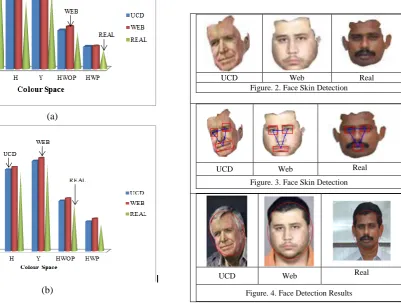
[image:4.595.73.324.391.736.2]Figure. 1. Results of Face Detection Algorithm Figure. 1 shows the FDeR, FDiR and accuracy of the proposed skin detection algorithm for the selected algorithms. In the figures, R means RGB, H means HSV, Y means YCbCR and H denotes the proposed HCSSRD color spaces respectively. WOP and WP indicate the inclusion and exclusion of post processing procedure.
An accuracy of 96.72%, 96.33% and 97.64% was obtained while using the UCD, web and real-time datasets respectively. The high accuracy, low False Detection and low Dismissal Rate shows that the proposed face detection algorithm is effective in identifying skin, eye and mouth regions and segments the face region in a competent manner. The results also prove that the inclusion of post processing has increased the efficiency of the proposed face detection algorithm.
UCD Web Real
Figure. 2. Face Skin Detection
[image:4.595.130.532.442.745.2]UCD Web Real
Figure. 3. Face Skin Detection
UCD Web Real
Figure. 4. Face Detection Results
[image:4.595.316.541.454.741.2]Visual results of sample faces selected randomly are shown in Figure. 2 (Skin Detection), Figure.3. (Facial Feature (eyes and mouth) Detection) and Figure. 4. (Face Detection). Thus, from the various results on skin detection, facial features detection algorithm and face detection shows that the AFDS is efficient in segmenting the ROI from its background.
C. Face Recognition Results
The code scheme used during face recognition experimentation is presented in Table I. For convenience sake, the 15 models are grouped as wavelet packet-based models, curvelts-based models and wavelet packet+curvelet-based models. All the fifteen model are evaluated in terms of FAR, FRR and Accuracy.
Experimental results obtained for these performance measures are discussed in this section. Tables II, III and IV show the FAR, FRR and Accuracy of the five selected face databases while using wavelet packet-based, curvelet-based and wavelet packet + culvelet-based face recognition models respectively.
TABLEI
CODING SCHEME
Model Name Code Model Name Code Model Name Code
2DPRCPr 0 Wavelets W Curvelets C
Wavelet Packet- Based Models Curvelets Based Models WPC Based Models
WP+0 1 C+ 0 6 WP+C+ 0 11
WP+LDA 2 C+LDA 7 WP+C+LDA 12
WP+ICA 3 C+ICA 8 WP+C+ ICA 13
WP+0+LDA 4 C+ 0+LDA 9 WP+C+ 0+LDA 14
WP+0+ICA 5 C+ 0 +ICA 0 WP+C+ 0 +ICA 15
TABLEII
FACE RECOGNITION RESULTS OF WAVELET PACKET BASED RECOGNITION
MODELS
0 W 1 2 3 4 5
YA
L
E FAR 4.97 4.43 4.06 3.88 3.99 3.70 3.81
FRR 11.06 12.90 12.55 11.79 12.01 10.97 11.34
Acc 93.47 94.15 95.99 96.15 96.00 96.82 96.51
F
E
RE
T FAR 5.03 4.99 4.76 4.23 4.44 3.81 3.96
FRR 11.37 11.35 11.14 11.02 11.13 10.37 10.54
Acc 93.52 95.91 95.91 96.12 96.06 96.47 96.34
UCD
FAR 3.27 3.25 3.13 2.99 3.12 2.69 2.94
FRR 9.41 9.29 9.24 8.47 8.62 8.08 8.16
Acc 94.01 95.34 95.46 96.09 95.91 96.66 96.09
WE
B
FAR 4.20 4.18 3.99 3.42 3.54 3.32 3.34
FRR 10.30 10.13 10.11 9.03 9.66 8.52 8.96
Acc 95.16 95.24 96.20 96.46 96.22 97.42 96.65
RE
AL
FAR 3.59 3.40 3.24 2.79 3.02 2.36 2.42
FRR 9.46 9.15 9.00 8.45 8.50 7.93 8.13
Acc 95.14 95.78 96.21 96.73 96.57 97.20 96.79
From the results (Table II), it is evident that while all variants of proposed wavelet packet-based algorithms produce improved results, Model 4, followed by Model 5 produced the best results with respect to FAR, FRR and accuracy.
TABLEIII
FACE RECOGNITION RESULTS OF CURVELETS-BASED MODELS
0 C 6 7 8 9 10
YA
L
E FAR 4.97 3.56 3.41 3.06 3.23 2.86 2.99
FRR 11.06 10.71 10.46 10.03 10.22 9.12 9.56
Acc 93.47 97.17 97.43 97.52 97.48 97.67 97.63
F
E
RE
T FAR 5.03 3.72 3.66 3.47 3.58 3.29 3.32
FRR 11.37 10.33 10.21 10.11 10.13 9.14 9.64
Acc 93.52 96.98 97.14 97.26 97.26 97.47 97.36
UCD
FAR 3.27 2.40 2.29 2.08 2.16 2.01 2.08
FRR 9.41 7.91 7.76 7.43 7.56 7.38 7.40
Acc 94.01 96.73 96.97 97.12 97.06 97.60 97.37
WE
B FAR 4.20 3.31 3.20 3.13 3.14 2.97 3.10
FRR 10.30 8.34 8.29 8.15 8.27 8.05 8.14
Acc 95.16 97.46 97.69 97.73 97.71 97.94 97.73
RE
AL
FAR 3.59 2.30 2.25 2.08 2.22 2.04 2.06
FRR 9.46 7.74 7.62 7.28 7.31 7.18 7.27
Acc 95.14 97.23 97.72 97.77 97.72 97.88 97.88
From the results projected in Table III, again the curvelet-based algorithms combined with Model 0, LDA and ICA, provided best recognition results. While comparing between the proposed algorithms, Model 9 followed by Model 10 produces best results for all the datasets. The results shown in Table IV shows that the Model 14 followed by Model 15 produced the best result. The same trend was observed with all databases. Thus, it can be concluded that the combined wavelet + curvelet-based models, that is, Models 14 and 15 give the best results for all databases and are considered as the best choice for adding security using face biometric.
TABLEIV
FACE RECOGNITION RESULTS OF WAVELET PACKETS-CURVELETS-BASED
MODELS
4 9 11 12 13 14 15
YA
L
E FAR 3.70 2.86 2.80 2.66 2.73 2.03 2.31
FRR 10.97 9.12 8.99 8.22 8.85 7.68 8.33
Acc 96.82 97.67 97.81 98.36 97.09 99.04 98.72
F
E
RE
T FAR 3.81 3.29 3.19 4.30 3.13 2.82 2.92
FRR 10.37 9.14 8.95 8.61 8.94 8.45 8.63
Acc 96.47 97.47 97.47 98.20 97.95 99.63 99.56
UCD
FAR 2.69 2.01 2.00 2.52 1.70 1.12 1.45
FRR 8.08 7.38 7.35 7.97 6.74 6.13 6.23
Acc 96.66 97.60 97.60 98.07 97.75 98.82 98.18
WE
B
FAR 3.32 2.97 2.73 4.01 2.48 1.93 2.46
FRR 8.52 8.05 7.96 8.41 7.56 7.02 7.16
Acc 97.42 97.94 97.94 98 97.94 99.37 99.30
RE
AL
FAR 2.36 2.04 1.95 2.29 1.91 1.17 1.71
FRR 7.93 7.18 7.16 7.92 6.79 6.00 6.13
Acc 97.20 97.88 97.99 98.16 98.05 98.52 98.44
IV. CONCLUSION
face recognition steps are preprocessing (image enhancement and segmentation), face region detection, feature extraction and finally recognition. This research work has proposed techniques in each step of the recognition process to improve the overall performance of face recognition. The experimental results prove that the various proposed models based on wavelets, curvelets and combination approach produce enhanced recognition results when compared to its traditional counterparts.
REFERENCES
[1] Arvind, M, “Biometrics - Finger print, Iris, Retina and Pupil Recognition: Biometrics for beginners”, Version 3, Knol, 2009, (http://knol.google.com/k/arvind-muthukrishnan/biometrics-finger-print-iris-retina-and/3ktp6efifnl1p/7).
[2] Campadelli, P. and Lanzarotti, R, “Localization of facial features and fiducial points”, Proceedings of International Conference on Visualization, Imaging and Image Processing, 2002, pp. 491–495. [3] FERET Database, 2004, http://www.itl.nist.gov/iad/ humanid/feret [4] Hsu, R.L., Mottalen, M.A. and Anil, K. J, “Face detection in color
images”, IEEE Transactions on Pattern Analysis and Machine Intelligence, vol. 24, issue 5, 2002, pp. 696-706.
[5] Kale, A., Sundaresan, A., Rajagopalan, A.N., Cuntoor, N.P., Roy-Chowdhury, A.K., Kruger, V. and Chellappa, R, “Identification of humans using gait”, IEEE Trans Image Process, vol. 13, no. 9, 2004, pp. 1163–1173.
[6] Mahajan, R., Gupta, T., Mahajan, S. and Bawa, N, “Retina as Authentication Tool for Covert Channel Problem”, World Academy of Science, Engineering and Technology”, vol. 56, 2009, pp. 153-158.
[7] Marino, C., Penedo, M.G. and Penas, M, “Lecture Notes in Computer Science”, LNCS 3643, Springer-Verlag Berlin Heidelberg, vol. 3643/2005, pp. 386-391.
[8] Meng, J. and Zhang, W, “Volume measure in 2DPCA-based face recognition”, Pattern Recognition Letters, vol. 28, 2007, pp. 1203-1208.
[9] Tsalakanidou, F., Malassiotis, S. and Strintzis, M.G, “Face Recognition - Face Detection, Global Approaches for, Feature Based Techniques, Problems and Considerations, Conclusions and
Future Developments”,
http://encyclopedia.jrank.org/articles/pages/6741/ Face-Recognition.html, 2010.
[10] Yale database, 1997, http://cvc.yale.edu/projects/yalefaces/ yalefaces.html.
[11] UCD color face database, http://ee.ucd.ie/~prag.
[12] Zhanjie, W. and Li, T, “A face detection system based skin color and neural network”, International Conference on Computer Science and Software Engineering, IEEE Computer Society, 2008, pp. 961-964.