
Abstract—The paper contains an analysis of different approaches in numerical calculations of reinforced concrete walls using FEM programs for linear and non-linear models. The general introduction includes the most important issues regarding the basics of structural design. There are shown and described various ways of walls modeling which are treated as a homogenized material. The objective of this paper is a comparison of numerical analysis when using different numerical FEM programs. Depending on the capabilities of the software, it has taken into account the propagation of cracks in concrete with its impact on the whole structure. Numerical analysis shows the differences in the surface of the required reinforcement between models that take into account the minimum deflection and the acceptable width of the crack.
Index Terms—RC Wall, FEM analysis, Cracks
I. INTRODUCTION
The aim of this paper is a numerical study of concrete walls by using different FEM programs. The analyzed structure was implemented to the following structural programs: Autodesk Robot Structural Analysis Professional and ABC Tarcza. Required reinforcement with restriction of minimum cracks were calculated in these programs. Depending on the possibilities of the used software, the analysis was performed in both a linear elastic and nonlinear range [1], [2]. As a summary, the results gained from all the programs were compared with each other and analyzed. When describing relationships between internal forces and stress in concrete and rebar steel, it is assumed that the cross-section of an RC member may be in one of the three phases. If the stresses only appear in concrete (compressive or tensile), which does not exceed compression and tensile strength, it is assumed that the element (and all of its cross-sections) is not cracked – the member is in phase I. If the member is cracked (and the ultimate limit state is not exceeded in concrete), the cracks can be observed in the cross-sections - in phase II. If the ultimate limit state was reached (internal forces reached values, which must not be exceeded) in the cross-sections of the element, it is assumed that the cross-section is in phase III. Phase I theory is used in the calculations of stresses and deflections in prestressed members and for checking stresses in some structure that are
Manuscript received January 26, 2016; revised April 11, 2016. J.Baranski and J. Szolomicki are with the Wroclaw University of Technology, Wroclaw, POLAND (phone: +48 505-995-008; fax: +48 71-322-14-65; e-mail: jerzy.szolomicki@ pwr.edu.pl)
not prestressed (e.g. dynamically loaded structures). Based on phase II theory, the width of cracks and the deflections of RC members are calculated. These members are generally cracked under live load. Formerly, linear theory was used for reinforcement calculations, which were determined based on the requirement that the stresses in the reinforcement and concrete do not exceed admissible stresses. Nowadays reinforcement is generally determined based on requirements due to the ultimate limit state. Regarding the quantity of reinforcement, one of two possibilities may occur. If the amount of reinforcement in tension is moderate, the ultimate limit state of the yield strength in reinforcement is reached (failure is caused by steel). If very strong reinforcement is applied, then the failure will be caused by concrete. The yield strength in reinforcement will not be reached because, even at lower stresses, the concrete will be crushed sooner in compressed area. In the members, where a very small amount of reinforcement is applied, a situation may occur in which stresses in the reinforcement will reach yield strength directly after cracking– phase II is absent.
II. LINEAR AND NON-LINEAR ANALYSIS OF A CONCRETE STRUCTURE
According to EC2 [3], linear elastic analysis of elements based on the theory of elasticity may be used for both the serviceability and ultimate limit states. For the determination of the action effects, linear analysis may be carried out assuming:
a) uncracked cross sections, b) a linear stress-strain relationship, c) mean values of the elastic modulus.
According to [4], [5], linear analysis methods are based on classical linear elastic solutions from the scope of material strength. The main assumptions associated with the application of this method can be mentioned:
linear relations 𝜎−𝜀 in concrete and reinforcement steel, homogeneity and isotropy of materials creating a
structure,
Bernoulli’s rule of plane cross sections,
tension stiffening as a base of the theory of first order and the linearity of geometrical relationships.
Adaptation of the linear elastic analysis method is very easy due to the possibility of using the superposition principle which exactly adds up the static effects in combinations of loads systems. This principle is that independent calculations of structure due to every kind of effect, are performed and then as a result of those effects, all
Computer Analysis
of Reinforced Concrete Walls
Using FEM Programs
internal forces are added. Linear elastic analysis is also a principle of the classic approach in the Finite Element Method (FEM) and is currently commonly used in conventional engineering software for the static analysis of load bearing structures. In this method the influence of the cross section area of the reinforcement for the moment of inertia of a whole cross section is neglected. Assuming that a plane stress state element is made of isotropic, linear elastic material, the distribution of stresses depends mainly on the geometrical dimensions of this member. Its static scheme also includes the type of supports and the way of loading. According to EC2 [3], nonlinear methods of analysis may be used for both ultimate and serviceability limit states, provided that equilibrium and compatibility are satisfied and an adequate non-linear behavior for materials is assumed, (Figure 1). The analysis takes into account action with and without consideration of the effect of structural deformations, including geometric imperfections (analysis of first or second order). Nonlinear analysis allows a more actual distribution of the internal forces and displacement of the structure to be received, and also a better estimation of its safety than the linear one. This type of analysis can be used both for structures under external static loading and structures under support settlement, influence of temperature or any other extortion of static displacement. In the structural analysis, in which the most significant is the static loading, the influence of previous loadings and unloadings may be neglected and monotonic increase of the considered loading can be assumed.
Figure 1 Schematic representation of the stress-strain relations for structural analysis [EC2].
III. BASICS OF NUMERICAL ANALYSIS Elaboration of the solution method requires extensive research in the range of static processes analysis of reinforced concrete element deformations. A reinforced concrete member is treated as a composition of materials consisting of a spatial concrete matrix with reinforcement of limp steel bars distributed in a discrete way in the material of the matrix. Structural analysis is elaborated with the use of finite element principles. Three methods of reinforcing steel finite element modeling in a concrete matrix are known: a discrete model,
an embedded bar model, a smeared model.
In the discrete model, the trajectory of reinforcement bars coincides with the concrete mesh. The concrete mesh and reinforcement mesh have common nodal points, so concrete is located in the same areas as the reinforcement. Some inaccuracy of the model is a result of the fact, that the concrete mesh is limited by the location of the reinforcement and its small volume is not subtracted from the volume of concrete.
In the embedded bar model, the reinforcement crosses the grid of concrete elements, and the stiffness of steel is determined separately in the finite element of the concrete matrix. The method of building the model consists of separate analyze of the displacements in the steel bar and the concrete elements surrounding it. This technique of modelling is beneficial for structures with a complex system of reinforcement.
In the smeared model, layered reinforcement is assumed. This reinforcement is uniformly distributed in the finite areas of concrete matrix elements. This technique has an application in oversized models of plate and shell structures with an insignificant influence of the reinforcement on the resistance of the structure.
Due to the behavior of a reinforced concrete structure, cooperation between concrete and reinforcing steel is especially important. Reinforcement bars mainly carry forces parallel to their axis. Those forces are transferred from concrete thanks to its bonding with steel. The main reasons for the forming of adhesiveness are:
friction in the contact plane between steel and concrete, chemical adhesion,
shrinkage of concrete,
in the case of ribbed reinforcement mechanical interaction between the ribbing of the bar and concrete.
On the section between cracks the significant part of tensile stresses is carried by concrete, and the formed phenomenon is called the tension stiffening of concrete. In a situation when reinforcement bars carry forces perpendicular to their axis, and in a location where cracks resulting from the acting of transversal forces occur in concrete, dowel action effect can be observed.
calibration of the model and a comparison of the numerical analysis results with experimental research results.
In most cases encountered in practice in a structure’s mechanical range, the Newton-Raphson method is used to solve the systems of equations [1],[2].
. } { = } ]{
[ a
F u
K (1)
Where:
[𝐾] −the matrix of the system coefficients,
{u} – the wanted vector of generalized displacement in three perpendicular directions,
{Fa}– the known vector of generalized loading.
The equation (1) is non-linear, because the matrix of the system coefficients [𝐾] is a function or derivative of the searched values of generalized displacements in three perpendicular directions. The Newton-Raphson method is an iterative process of solving nonlinear equations in the forms:
[𝐾𝑖𝑇]{∆𝑢
𝑖} = {𝐹𝑎} − {𝐹𝑖𝑛𝑟}, (2)
{𝑢𝑖+1} = {𝑢𝑖} + {∆𝑢𝑖}, (3) where:
[KiT]– the matrix of tangent stiffness,
i– the index corresponding with number of incremental step,
{Finr} – the vector of internal nodal forces corresponding with the stress state occurring in a discretizing system.
This method works perfectly for materials with linear-elastic characteristics. However, according to non-linear materials, after the cracking and crushing application, it is not as effective. Its disadvantage is the necessity of reversing the new stiffness matrix during every iteration stage and what is even more important, the lack of possibility to describe the mechanism of material failure, because the solution is not converged at the moment of zeroing out the stiffness matrix. The reflection of eventual structure degradation, visible on a load-displacement curve as sharp drops of loading, is only possible with the use of far more complex iteration methods in comparison to the Newton-Raphson method. In order to achieve a complete path of load-deformation showing both local and global degradation of a structure and a description of failure mechanism, two effective methods can be used:
the modified Newton-Raphson method, the arc-length Crisfield’s method.
The modified Newton-Raphson method consists of changing the solution path near the limit point and moving backwards along the secant until a fast numerical solution convergence achieved [1]. The stiffness matrix in comparison to Newton-Raphson (eq. 1) is described as a sum of two matrixes:
[𝐾𝑖𝑇] = 𝜉[𝐾𝑠] + (1 − 𝜉)[𝐾𝑇], (4) where:
[𝐾𝑠]– the matrix of secant stiffness,
[𝐾𝑇]– the matrix of tangent stiffness,
ξ
– the parameter of adaptation decrease.This method consists of coordination of the adaptation of the decrease parameter 𝜉 during the equilibrium iteration. The matrix of secant stiffness is generated in the numerical method as a result of solving nonlinear issues according to: yielding of the material,
stiffness of the structure with big displacements,
crushing the concrete with relaxation stresses after
cracking taken into account.
In the numerical arc-length (Crisfield’s) method, equation is dependent on the loading of parameter 𝜆:
[𝐾𝑖𝑇]{𝑢
𝑖} = 𝜆{𝐹𝑎} − {𝐹𝑖𝑛𝑟}. (5) In this method, variable loading parameter 𝜆 searched in equilibrium equations is from the range 〈−1,1〉.
The equation in the intermediate step of loading is in the form:
[𝐾𝑖𝑇]{Δui} − Δ𝜆{𝐹𝑎} = (𝜆0+ Δ𝜆𝑖){𝐹𝑎} − {𝐹𝑖𝑛𝑟}, (6) where:
Δ𝜆 - the parameter of loading increment.
Based on equation (6), the searched vector of displacement increment {Δui} composed of two components is described as:
{𝑢𝑖} = Δ𝜆{𝑢𝑖𝐼} + {𝑢𝑖𝐼𝐼}, (7) where:
{uiI} – the vector of displacement increment induced be unitary parameter of loading,
{uiII} – the vector of displacement increment in Newton-Raphson method.
IV. NUMERICAL ANALYSIS
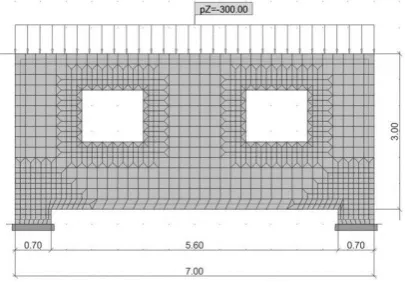
In order to compare the results receiving from different software using FEM, an identical model of the wall was implemented in all programs, (Figure 2). The model is a simply supported deep-beam with two symmetrical openings implemented. It was modeled as a shell structure working as a plane stress state element in a two dimensional coordinate system. All loads act only in the plane of the wall. In the nearest surrounding of the connection between the wall and a support, an accumulation of stresses can occur. This is the reason why finite elements should be placed in such places. In numerical analysis the following was assumed:
Dimensions: height of the whole element: 3.0m, length of the whole element: 7.0m, length of the supported columns: 0.7m, length of the span: 5.6m, dimensions of the openings: 1.0 m x 1.2m; constant thickness of the wall: 0.25m.
Materials: concrete: C25/30, reinforcing steel: AIIIN (B500SP).
Loads:
[image:3.595.305.508.605.746.2]the self-weight, uniformly distributed load applied along the top of the deep- beam, the magnitude of the load: 300kN/m.
1.Numerical analysis by means of Robot Structural Analysis Professional 2015
There are two available methods for the reinforcement of a wall determined in Robot software:
The Analytical method
If the reinforcement values 𝐴𝑥 and 𝐴𝑦(corresponding to two perpendicular directions 𝑥 and 𝑦) are given, an equivalent reinforcement in any other direction (𝑛) is calculated according to the following formula:
𝐴𝑛= 𝐴𝑥𝑐𝑜𝑠2(𝛼) + 𝐴𝑦𝑠𝑖𝑛2(𝛼), (8) where:
𝛼 - the angle included between direction 𝑥 and direction 𝑛. The values of sectional forces (membrane forces) 𝑁𝑛 may be obtained from the following transformational formula:
𝑁𝑛= 𝑁𝑥𝑐𝑜𝑠2(𝛼) + 𝑁𝑦𝑠𝑖𝑛2(𝛼) − 𝑁𝑥𝑦𝑠𝑖𝑛2(2𝛼). (9) Thus, the below-presented inequality formulates the condition of correct reinforcement. The reinforcement that is able to carry the internal forces in an arbitrary section:
𝐴𝑥𝑐𝑜𝑠2(𝛼) + 𝐴𝑦𝑠𝑖𝑛2(𝛼) ≥ Φ(𝑁𝑛), (10) where:
Φ(Nn)- refers to the value of reinforcement required to carry the forces calculated for the direction ' 𝑛 ' - Φ(Nn). This determines on the plane (𝐴𝑥, 𝐴𝑦) the area of 'admissible' values of reinforcement Ax and Ay (half-plane). If such an area is determined for a sufficiently "dense" set of directions 𝑛 (control is performed every 10), one obtains the area of admissible values Ax and Ay. The adopted reinforcement is the minimal reinforcement which yields the minimal sum of surfaces Ax+ Ay.
The Wood&Armer method
Design forces are calculated according to the method by Wood and Armer from the formulas given below for a plane stress structure or for the activated option of panel design for compression/ tension in a shell structure. For the selected directions 𝑥 and 𝑦, two types of design forces 𝑁* are calculated:
the tensile (positive, causing main tension in a section), the compressive (negative, causing section compression). The general procedure takes the following form:
Calculation of 'tensile' forces Nxr,* Nyr*
𝑁𝑥𝑟∗ = 𝑁𝑥+ |𝑁𝑥𝑦|, (11)
𝑁𝑦𝑟∗ = 𝑁𝑦+ |𝑁𝑥𝑦|. (12)
However if Nx< -|Nxy| (i.e. calculated Nxr* < 0),
𝑁𝑥𝑟∗ = 0, (13)
𝑁𝑦𝑟∗ = 𝑁𝑦+ |𝑁𝑥𝑦∙ 𝑁𝑥𝑦
𝑁𝑥|. (14)
Similarly, if Ny< -|Nxy |(i.e. calculated Nyr* < 0),
𝑁𝑦𝑟∗ = 0, (15)
𝑁𝑥𝑟∗ = 𝑁𝑥+ |𝑁𝑥𝑦∙ 𝑁𝑥𝑦
𝑁𝑥|. (16)
If any of the obtained forces Nxr* , Nyr* are less than zero, one should assume a zero value (forces determined when designing a section by reinforcement compression are determined further on).
Calculation of 'compressive' forces Nxs,* Nys*
𝑁𝑥𝑠∗ = 𝑁𝑥− |𝑁𝑥𝑦|, (17)
𝑁𝑦𝑠∗ = 𝑁𝑦− |𝑁𝑥𝑦|. (18)
However, if Nx> |Nxy|(i.e. calculated Nxs* > 0),
𝑁𝑥𝑠∗ = 0, (19)
𝑁𝑦𝑠∗ = 𝑁𝑦− |𝑁𝑥𝑦∙ 𝑁𝑥𝑦
𝑁𝑥|. (20)
Similarly, if Ny> |Nxy|(i.e. calculated Nys* > 0),
𝑁𝑦𝑠∗ = 0, (21)
𝑁𝑥𝑠∗ = 𝑁𝑥− |𝑁𝑥𝑦∙ 𝑁𝑥𝑦
𝑁𝑦|. (22)
If any of the obtained forces 𝑁𝑥𝑠∗, 𝑁𝑦𝑠∗ is greater than zero, one should assume a zero value (such forces are determined when designing a section by reinforcement tension, which is already guaranteed by the tensile forces 𝑁𝑥𝑟∗, 𝑁𝑦𝑟 ∗ calculated earlier).
Figure 3 Required area of reinforcement in XX direction with a restriction of minimum crack width (0,2 mm) ROBOT) [mm2/m]
Figure 4 Required area of reinforcement in YY direction with a restriction of minimum crack width (0,2 mm) (ROBOT) [mm2/m]
[image:4.595.311.556.261.370.2] [image:4.595.310.555.401.507.2]2.Numerical analysis using ABC Tarcza
According to the algorithm presented in EC2 [3] is assumed that cracks may appear in plane stress state element locations. All existing tensile and shearing forces in the plane stress state element must be carried by the reinforcement. Concrete only carries the compressive stresses. In every point of the plane stress state element, σx, σy and τxy should be determined. It is assumed, that tensile stresses are treated as positive. For positive values of 𝑓𝑡𝑑𝑥 and 𝑓𝑡𝑑𝑦, the required reinforcement is determined from following equations:
horizontal:
Asx=fftdx
ydh , (23)
vertical:
Asy= ftdy
fydh , (24)
where:
ℎ – the thickness of the wall,
𝐴𝑠𝑥 - the cross section area of rebars in a horizontal direction,
𝐴𝑠𝑦 - the cross section area of rebars in a vertical direction.
Figure 5 Required area of reinforcement in XX direction with a restriction of minimum crack width (0,2 mm)(ABC Tarcza) [mm2/m]
Figure 6 Required area of reinforcement in XX direction with a restriction of minimum crack width (0,2 mm)(ABC Tarcza) [mm2/m]
The method used for determining the crack width in the ABC Tarcza program may be directly derived from standard equations for the sections under axial tension. However, there is not always compatibility between the directions of principal stresses and the directions of reinforcement. This fact directly affects the spacing of the cracks. The spacing of the cracks was determined using the following equation:
𝑠𝑟𝑚,𝑚𝑎𝑥= 𝑠𝑟𝑚𝑥∙ 𝑐𝑜𝑠 (2𝜋𝜃360) 𝑛
+ 𝑠𝑟𝑚𝑦∙ 𝑠𝑖𝑛 (2𝜋𝜃360) 𝑛
.
(25) The width of the cracks, determined in such way, may be considered as correct when the directions of principal tensile stresses are roughly the same as the directions of reinforcement. In general, when angle 𝜃 exists between the principal direction 𝜎1 and the reinforcement in 𝑥 direction, the width of the crack in direction of 𝜎1stress and in case of
σ1≥ fctm was determined from the following equation:
𝑤1= 𝑤𝑥∙ 𝑐𝑜𝑠 (2𝜋90+𝜃360) 3
+ 𝑤𝑦∙ 𝑠𝑖𝑛 (2𝜋90+𝜃360) 3
.
(26) The width of the cracks in direction of
σ
2 stress and in case of σ2≥ fctmwas determined from the following equation:𝑤2= 𝑤𝑥∙ 𝑐𝑜𝑠 (2𝜋90+𝜃360) 3
+ 𝑤𝑦∙ 𝑠𝑖𝑛 (2𝜋90+𝜃360) 3
.
(27) If during the analysis appear intersecting cracks, the program shows always higher value calculated from equations (25) and (26).
Comparison of stresses x and y and also reinforcement including cracks with limitation, is presented in tabular form (Table I, II, III, IV and Figure 7) and generally shows good agreement despite differences in modeling. The whole process of taking into account the crack width limitation was successful and seems to be reasonable. The software added extra reinforcement in locations in which the crack width exceeded the limitation.
Figure 7 Comparative points
TABLEI
COMPARISON OF STRESSES SX IN COMPARATIVE POINTS A,B,C FOR DIFFERENT NUMERICAL PROGRAMS
Software Number of finite elements
Sx(MPa) pt. A pt. B pt. C
ABC Tarcza
1441 5,12 4,60 -5,55
Robot Structural Analysis
1490 5,31 2,96 -6,08
TABLEII
COMPARISON OF STRESSES SY IN COMPARATIVE POINTS A,B,C FOR DIFFERENT NUMERICAL PROGRAMS
Software Number of finite elements
Sy(MPa) pt. A pt. B pt. C
ABC Tarcza
1441 0,00 2,01 -13,36
Robot Structural Analysis
[image:5.595.54.551.311.688.2]TABLEIII
COMPARISON OF REINFORCEMENTS AX IN COMPARATIVE POINTS A,B,C FOR DIFFERENT NUMERICAL PROGRAMS
Software Number of finite elements
Ax(cm2/m) pt. A pt. B pt. C
ABC Tarcza
1441 18,51 14,70 Ax,min
Robot Structural Analysis
1490 16,77 13,56 Ax,min
TABLEIV
COMPARISON OF REINFORCEMENTS AY IN COMPARATIVE POINTS A,B,C FOR DIFFERENT NUMERICAL PROGRAMS
Software Number of finite elements
Ay(cm2/m) pt. A pt. B pt. C
ABC Tarcza
1441 Ay,min 10,33 -6,70
Robot Structural Analysis
1490 Ay,min 8,76 -6,72
V. CONCLUSIONS
The study deals with the numerical calculations of reinforced concrete walls using FEM programs considering linear and nonlinear models. This paper presents the general principals of structural design and briefly describes linear and nonlinear types of analysis. Very important is the description of the cracked concrete phenomenon, basics of numerical analysis, touching such topics as reinforced concrete models, cooperation between concrete and reinforcing steel, numerical methods of solving systems of equilibrium equations, implementation of finite element system and finally, the nonlinear analysis algorithm. The most common numerical methods have been presented: The Newton-Raphson method,
The modified Newton-Raphson method, The Arc-length (Crisfield’s) method.
The main aim of this paper is the analysis of the calculation methods applied in the designing of a simple reinforced concrete wall with a restriction of minimum cracks and deflections and also comparison of the results of the analysis. A one static scheme with two symmetrical openings, which represents an actual reinforced wall in quite good way, was chosen for the analysis. The numerical calculations of this structure were performed using the following FEM software:
Robot Structural Analysis Professional 2015, ABC Tarcza 6.15.
In the two used software programs (Robot, ABC Tarcza), the results of principal stresses and the required reinforcement were close to each other. However, some differences occur in the corners of the openings, where the stresses reach maximum values. This phenomenon may be caused by different implementation of peak smoothing of stresses in each software program. The settings of this option are generally treated in a very simplified way. Because of this fact, the peak smoothing is hard to control, which may result in such inaccuracies. Moreover, the differences occurred with crack width calculations because of
differences in the methods applied in different programs. This observation may lead to the conclusion that the crack width calculation in this kind of software should be done very carefully during the design stage. Although all the used programs can analyze cracked concrete in some way, we cannot treat the results as an actual response of the RC structure, but only as a general view of localization and the width of cracks.
REFERENCES
[1] M.M. Kjell, “Solution methods for non-linear FEA”, Norwegian University of Science and Technology, 2012.
[2] P. Wrigger, “Nonlinear Finite Element Methods”, Springer Science&Business Media, 2008.
[3] [EC2] PN-EN 1992-1-1 Design of concrete structure – Part 1: General rules and rules for buildings.
[4] F.K. Kong, “Reinforced concrete deep beams”, Taylor&Francis e-Library 2002.
![Figure 1 Schematic representation of the stress-strain relations for structural analysis [EC2]](https://thumb-us.123doks.com/thumbv2/123dok_us/427905.540440/2.595.82.263.429.593/figure-schematic-representation-stress-strain-relations-structural-analysis.webp)
![Figure 3 Required area of reinforcement in XX direction with a restriction of minimum crack width (0,2 mm) ROBOT) [mm2/m]](https://thumb-us.123doks.com/thumbv2/123dok_us/427905.540440/4.595.310.555.401.507/figure-required-reinforcement-direction-restriction-minimum-crack-robot.webp)
![Figure 6 Required area of reinforcement in XX direction with a restriction of minimum crack width (0,2 mm)(ABC Tarcza) [mm2/m]](https://thumb-us.123doks.com/thumbv2/123dok_us/427905.540440/5.595.54.551.311.688/figure-required-reinforcement-direction-restriction-minimum-crack-tarcza.webp)