The UK e-Science Core Programme and the Grid
Tony Hey
∗, Anne E. Trefethen
UK e-Science Core Programme EPSRC, Polaris House, North Star Avenue, Swindon SN2 1ET, UK
Abstract
This paper describes the £120M UK ‘e-Science’ (http://www.research-councils.ac.uk/andhttp://www.escience-grid.org.uk) initiative and begins by defining what is meant by the term e-Science. The majority of the £120M, some £75M, is funding large-scale e-Science pilot projects in many areas of science and engineering. The infrastructure needed to support such projects must permit routine sharing of distributed and heterogeneous computational and data resources as well as supporting effective collaboration between groups of scientists. Such an infrastructure is commonly referred to as the Grid. Apart from £10M towards a Teraflop computer, the remaining funds, some £35M, constitute the e-Science ‘Core Programme’. The goal of this Core Programme is to advance the development of robust and generic Grid middleware in collaboration with industry. The key elements of the Core Programme will be outlined including details of a UK e-Science Grid testbed. The pilot e-Science projects that have so far been announced are then briefly described. These projects span a range of disciplines from particle physics and astronomy to engineering and healthcare, and illustrate the breadth of the UK e-Science Programme. In addition to these major e-Science projects, the Core Programme is funding a series of short-term e-Science demonstrators across a number of disciplines as well as projects in network traffic engineering and some international collaborative activities. We conclude with some remarks about the need to develop a data architecture for the Grid that will allow federated access to relational databases as well as flat files.
© 2002 Elsevier Science B.V. All rights reserved.
Keywords: e-Science; Core Programme; Grid
1. Introduction
The term ‘e-Science’ was introduced by Dr. John Taylor, Director General of Research Councils in the UK Office of Science and Technology (OST). From his previous experience as Head of Hewlett-Packard’s European Research Laboratories, and from his experi-ence as Director General of the OST, Taylor saw that many areas of science are becoming increasingly re-liant on new ways of collaborative, multidisciplinary
∗Corresponding author. Tel.:+44-1793-444022;
fax:+44-1793-444505.
E-mail addresses: [email protected] (T. Hey), [email protected] (A.E. Trefethen).
working. The term e-Science is intended to capture these new mode of working[1]:
‘e-Science is about global collaboration in key ar-eas of science and the next generation of infrastruc-ture that will enable it.’
The infrastructure to enable this science revolu-tion is generally referred to as the Grid [2]. Two examples of such e-Science projects are from parti-cle physics and astronomy. The world-wide partiparti-cle physics community is planning an exciting new series of experiments to be carried out on the new ‘Large Hadron Collider’ (LHC) experimental facility under construction at CERN in Geneva. The goal is to find signs of the Higgs boson, key to the generation of mass for both the vector bosons and the fermions of
the Standard Model of the weak and electromagnetic interactions. The experimental physicists are also hop-ing for indications of other new types of matter such as supersymmetric particles which may shed light on the ‘dark matter’ problem of cosmology. These LHC ex-periments are on a scale never before seen in physics, with each experiment involving a collaboration of over 100 institutions and over 1000 physicists from Eu-rope, USA and Japan. When operational in 2005, the LHC will generate petabytes of experimental data per year, for each experiment. This vast amount of data needs to be pre-processed and distributed for further analysis by all members of the consortia to search for signals betraying the presence of the Higgs boson or other surprises. The physicists need to put in place an LHC Grid infrastructure that will permit the transport and data mining of such distributed data sets. There are a number of funded projects in Europe (EU Data-Grid[3], EU DataTag[4], UK GridPP[5] and in the USA (NSF GriPhyN[6], DOE PPDataGrid[7], NSF iVDGL[8]) in which the particle physicists are work-ing to build a Grid that will support these needs. Our second example of e-Science is much more directly data-centric. In the UK, the astronomers are planning to create a ‘virtual observatory’ in their e-Science AstroGrid project. There are similar initiatives in the USA with the NSF NVO[9]project and the EU AVO [10]project. The goal of these projects is to provide uniform access to a federated, distributed repository of astronomical data spanning all wavelengths from radio waves to X-rays. At present, astronomical data using different wavelengths are taken with different tele-scopes and stored in a wide variety of formats. Their goal is to create something like a ‘data warehouse’ for astronomical data that will enable new types of studies to be performed. Again, the astronomers are consid-ering building a Grid infrastructure to support these Virtual Observatories. Later in this article we shall describe other types of e-Science and e-Engineering problems that have more obvious interest to industry. The vision for a layer of ‘Grid’ middleware that provides a set of core services to enable such new types of science and engineering is due to Ian Foster, Carl Kesselman and Stephen Tuecke. In their Globus project, they have developed parts of a prototype open source Grid Toolkit [11]. Their choice of the name ‘Grid’ to describe this middleware infrastructure res-onates with the idea of a future in which computing
resources, compute cycles and storage, as well as expensive scientific facilities and software, can be accessed on-demand like the electric power utilities of today. These ‘e-Utility’ ideas are also reminiscent with the recent trend of the Web community towards a model of ‘Web services’ advertised by brokers and consumed by applications, which have recently been brought together in the Open Grid Services Architec-ture (OGSA)[12].
In the next section, we outline the general structure of the UK e-Science programme and discuss the ‘ex-istence proof’ of the NASA Information Power Grid (IPG)[13]as the closest example of a working ‘pro-duction Grid’. We also set our activity in context by listing some of the other funded Grid projects around the world. InSection 3, we describe the UK e-Science Core Programme in some detail and in Section 4 we describe the presently funded UK e-Science pilot projects in engineering and the physical sciences. We conclude with some remarks about the evolution of Grid middleware architecture and the possible take-up of the Grid by industry.
2. The UK e-Science programme
2.1. Funding and structure of the UK e-Science programme
allocated £5M specifically to ‘Grid-enable’ their ex-perimental facilities. The sum of £10M has been specifically allocated towards the procurement of a new national Teraflop computing system. The remain-der, some £15M, is designated as the e-Science ‘Core Programme’. This sum is augmented by an allocation of £20M from the Department of Trade and Industry making a total of £35M for the Core Programme.
As is common in DTI programmes, the DTI con-tribution of £20M requires a matching concon-tribution from industry. It is also expected that there will be industrial contributions to the individual Research Council e-Science pilot projects making a total in-dustrial commitment to the e-Science programme of well over £20M. The goal of the Core Programme is to support the e-Science pilot projects of the dif-ferent Research Councils and work with industry in developing robust, ‘industrial strength’ generic Grid middleware. Requirements and lessons learnt in the different e-Science applications will inform the devel-opment of more stable and function Grid middleware that can assist the e-Science experiments and be of relevance to industry and commerce.
The management structure is also indicated in Fig. 1. The Director of the UK Core Programme is advised by a Grid Technical Advisory Group. Tony Hey has been appointed as Director of the Core Programme. The different Research Council e-Science
Fig. 1. Structure and funding for UK e-Science Programme.
programmes are represented on an e-Science Steer-ing Committee, chaired by David Wallace, with the Core Programme Director present as a member. The EPSRC are providing programme management for the Core Programme on behalf of all the Research Councils.
2.2. NASA’s IPG
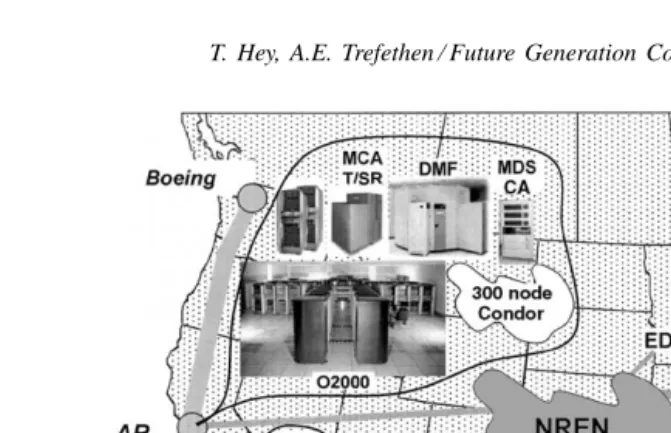
Over the last 3 years, NASA has pioneered a new style of computing infrastructure by connecting the computing resources of several of its R&D Laborato-ries to form the IPG[13](seeFig. 2).
The vision for the IPG has been enunciated by Bill Johnston, the leader of the activity as being inten-ded to:
[image:3.842.121.418.437.640.2]Fig. 2. The NASA IPG.
In NASA’s view, such a framework is necessary for their organisation to address the problem of simulat-ing whole systems. It is not only computsimulat-ing resources that are distributed but also expertise and know-how. In order to simulate a whole aircraft—wings, CFD, engines, landing gear and so on—NASA must be able to bring together not only the necessary computing re-sources but also establish mechanisms by which engi-neers and scientists at different sites can collaborate. This is the ambitious goal of their ‘intra-Grid’ con-necting different NASA sites with different expertise and hardware resources.
In his presentations on the IPG, Bill Johnston makes the point that although technology capable of enabling such distributed computing experiments has been around for many years, such experiments tended to be ‘one off’ demonstration systems requir-ing the presence and knowledge of expert distributed system engineers. He argues that what is needed now is middleware that makes the construction of such systems routine—with no need for experts to build and maintain the system. The IPG is the first step along the road towards a ‘production-quality’ Grid. The IPG middleware is based on the Globus Toolkit that offers secure single sign-on through dig-ital certificates (Grid Security Infrastructure, GSI),
fast secure file transfer (GridFTP) and batch queueing resource management of computational jobs (Globus Resource Allocation Manager, GRAM). The Globus middleware can co-exist with CORBA middleware applications and is supplemented with Miron Livny’s long established Condor software [14] and Reagan Moore’s Storage Resource Broker package[15]. The Condor software allows pools of workstations to be designated and used as a source of ‘idle cycles’ for computational jobs submitted to the pool. The SRB software, on the other hand, goes some way towards federating access to data held in file sys-tems, databases and archival systems. It does this by means of an XML metadata catalogue that allows the logical separation of content from its physical storage.
Table 1
US funded Grid projects
Project Funding agency URL
IPG NASA http://www.nas.nasa.gov/About/IPG/ipg.html
Science Grid DOE http://www-itg.lbl.gov/Grid/
GriPhyN Project NSF http://www.griphyn.org/
PPDataGrid DOE http://www.ppdg.net/
NVO NSF http://www.srl.caltech.edu/nvo/
NEESGrid NSF http://www.neesgrid.org/html/np.html
Distributed Terascale Facility (TeraGrid) NSF http://www.teragrid.org/
DISCOM (ASCI) DOE http://www.cs.sandia.gov/discom/
Earth Systems Grid DOE http://public.lanl.gov/radiant/research/grid.html
FusionGrid DOE http://www.fusiongrid.org/
BIRN NIH http://birn.ncrr.nih.gov/
iVDGL NSF http://www.ivdgl.org/
GridCenter NSF http://www.grids-center.org/
GrADS NSF http://nhse2.cs.rice.edu/grads/
2.3. National and international Grid projects
There are now significant investments being made in Grid research and development around the world. To set the UK programme in context we present a list of funded Grid projects in the USA (Table 1) and in Europe (Table 2). With the recent announcements of both IBM and Sun’s support for the Grid concept, it is clear that the Grid is likely to become the key middleware not only for e-Science and but also for industry and commerce as the middleware matures and gains more functionality.
The majority of these Grid infrastructure and application projects will use the Globus Toolkit as the starting platform on which to provide Grid services.
Table 2
European Union funded projects
Project Funding agency URL
DataGrid (CERN) European Commission http://www.datagrid.cnr.it/,http://www.cern.ch/grid/
EuroGrid (Unicore) European Commission http://www.eurogrid.org/
Damien (Metacomputing) European Commission http://www.hlrs.de/organization/pds/projects/damien/
AVO (Virtual Observatory) European Commission http://www.astro-opticon.org/archives.html
GRIP (Unicore/Globus) National Center for Research Resources
http://www.unicore.org/links.htm
GridLab (Cactus Framework) European Commission http://www.gridlab.org/
CrossGrid (infrastructure components) European Commission http://www.crossgrid.org/crossgrid/crossgrid.html
Grid-Ireland http://www.cs.tcd.ie/coghlan/,http://www.cuc.ucc.ie/
Grid for remote computing http://sara.unile.it/grb/grb.html
[image:5.842.43.498.536.660.2]3. The UK e-Science pilots
3.1. Introduction
As noted above, within the UK e-Science pro-gramme each research council will fund a number of pilot projects in their own application areas. The research councils are each taking a slightly different approach in the selection of pilot projects, which has the consequence that of the more than 20 anticipated projects, eight are already underway and the rest will follow over the next 6 months. PPARC and EPSRC have selected projects at this time. PPARC are fund-ing two e-Science pilots and EPSRC six projects. These two research councils support very different communities. PPARC is focussed on particle physics and astronomy: both have very tightly knit communi-ties but both also have an increasingly global scope. By contrast, the EPSRC community is much broader and including disciplines ranging from basic science to engineering.
In this section, we give an overview of the pilot projects that have been funded to set the context for the e-Science Core Programme. The two PPARC projects have been discussed in the introduction. GridPP is a collaboration of UK particle physicists to build the UK component of a world-wide Grid to support the LHC experiments. The UK project is working very closely with the EU DataGrid project and with CERN. The UK astronomers are com-ing together in the AstroGrid ‘Virtual Observatory’ project. Clearly, there will be close collaboration with the US NVO project and the European AVO project. PPARC are also working closely with the e-Science Core Programme to develop a common architectural vision and a common base of core Grid middleware.
3.2. Engineering and physical science pilot projects
The six pilots funded by EPSRC are as follows.
3.2.1. The RealityGrid: a tool for investigating condensed matter and materials
This project is led by Professor Peter Coveney and involves a University consortium comprising QMW, the Universities of Edinburgh, Loughborough,
Manchester, and Oxford. The goal of this pilot project is to enable the realistic modelling of complex con-densed matter systems at the molecular and mesocale levels, and to provide the setting for the discovery of new materials. Integration of high performance computing and visualisation facilities are critical to this pilot, providing a synthetic environment for modelling the problem that will be compared and integrated with experimental data. The RealityGrid involves the active collaboration of industry: AVS, SGI and Fujitsu are collaborating on the underlying computational and visualisation issues, Schlumberger and the Edward Jenner Institute for Vaccine Research will provide end-user scientific applications to eval-uate and test the environment and tools produced by the project.
3.2.2. Comb-e-Chem—structure-property mapping: combinatorial chemistry and the Grid
3.2.3. Distributed aircraft maintenance environment (DAME)
The collaborating universities on this pilot are York, Oxford, Sheffield, and Leeds, and the project is led by Professor Jim Austin. The project aims to build a Grid-based distributed diagnostics system for aircraft engines. The pilot is in collaboration with Rolls Royce and is motivated by the needs of Rolls Royce and its information system partner Data Systems and So-lutions. The project will address performance issues such as large-scale data management with real-time demands. The main deliverables from the project will be a generic Distributed Diagnostics Grid application; an Aero-gas turbine Application Demonstrator for the maintenance for aircraft engines; and techniques for distributed data mining and diagnostics. Distributed diagnostics is a generic problem that is fundamental in many fields such as medical, transport and manu-facturing and it is hoped that the lessons learned and tools created in this project will be suitable for appli-cation in those areas.
3.2.4. Grid enabled optimisation and design search for engineering (GEODISE)
GEODISE is a collaboration between the Universi-ties of Southampton, Oxford and Manchester, together with BAE Systems, Rolls Royce, Fluent. The goal of this pilot is to provide Grid-based seamless access to an intelligent knowledge repository, a state-of-the-art collection of optimisation and search tools, industrial strength analysis codes, and distributed computing and data resources.
Engineering design search and optimisation is the process whereby engineering modelling and analysis are exploited to yield improved designs. In the next 2–5 years, intelligent search tools will become a vi-tal component of all engineering design systems and will steer the user through the process of setting up, executing and post-processing design, search and op-timisation activities. Such systems typically require large-scale distributed simulations to be coupled with tools to describe and modify designs using informa-tion from a knowledge base. These tools are usu-ally physicusu-ally distributed and under the control of multiple elements in the supply chain. Whilst evalu-ation of a single design may require the analysis of gigabytes of data, to improve the process of design can require assimilation of terabytes of distributed
data. Achieving the latter goal will lead to the de-velopment of intelligent search tools. The application area of focus is that of computational fluid dynam-ics (CFD) which has clear relevance to the industrial partners.
3.2.5. Discovery net: an e-Science testbed for high throughput informatics
The Discovery Net pilot has a completely differ-ent aim than those of the other projects, in that it is focussed on high throughput. It aims to design, de-velop and implement an advanced infrastructure to support real-time processing, interpretation, integra-tion, visualisation and mining of massive amounts of time critical data generated by high throughput de-vices. The project will cover new technology devices and technology including biochips in biology, high throughput screening technology in biochemistry and combinatorial chemistry, high throughput sensors in energy and environmental science, remote sensing and geology. A number of application studies are in-cluded in the pilot—analysis of Protein Folding Chips and SNP Chips using LFII technology, protein-based fluorescent micro array data, air sensing data, re-newable energy data, and geohazard prediction data. The collaboration on this pilot is between groups at Imperial College London, by Dr. Yike Guo, and in-dustrial partners Infosense Ltd., Deltadot Ltd., and Rvco Inc.
3.2.6. myGrid: directly supporting the e-Scientist This pilot has one of the larger consortiums com-prising the Universities of Manchester, Southampton, Nottingham, Newcastle, and Sheffield together with the European Bioinformatics Insitute. The goal of myGrid is to design, develop and demonstrate higher level functionalities over an existing Grid infrastruc-ture that support scientists in making use of complex distributed resources. An e-Scientist’s workbench will be developed, which, not unlike that of Comb-e-Chem, aims to support the scientific process of experimental investigation, evidence accumulation and result assim-ilation, the scientist’s use of the community’s infor-mation, and scientific collaboration, allowing dynamic groupings to tackle emergent research problems.
The myGrid design and development activity will be driven by applications in bioinformatics. myGrid will develop two application environments, one that sup-ports the analysis of functional genomic data, and a second that supports the annotation of a pattern database. Both of these tasks require explicit represen-tation and enactment of scientific processes, and have challenging performance requirements. The industrial collaborators on this project are GSK, AstraZeneca, IBM and SUN.
3.3. Particle physics and astronomy pilot projects
PPARC does not support so broad community as ESPRC (http://www.epsrc.ac.uk) and hence there are only two pilot projects—one for each of their commu-nities. The two pilots funded are as follows.
3.3.1. GridPP
GridPP is a collaboration of Particle Physicists and Computer Scientists from the UK and CERN. The goal of GridPP is to build a UK Grid and deliver Grid middleware and hardware infrastructure to en-able testing of a prototype of the Grid for the LHC project at CERN, as described in the introduction to this paper. The GridPP project is designed to inte-grate with the existing Particle Physics programme within the UK, thus enabling early deployment and full testing of Grid technology. The project is us-ing the Globus toolkit and many of the GridPP cen-tres in the UK are also UK e-Science Grid cencen-tres hence allowing many ways of leveraging effort and technology.
3.3.2. AstroGrid
The AstroGrid project has been described early in terms of the requirements within this community. The project is a collaboration between astronomers and computer scientists at the universities of Edin-burgh, Leicester, Cambridge, Queens Belfast, UCL and Manchester, together with RAL. The goal of AstroGrid is to build a Grid infrastructure that will allow a ‘Virtual Observatory’, unifying the inter-faces to astronomy databases and providing remote access as well as assimilation of data. The Virtual Observatory is a truly global problem and AstroGrid will be the UK contribution to the global Virtual Observatory.
3.4. Concluding remark
These PPARC and EPSRC pilots cover a range of scientific disciplines and Grid technology areas. One conspicuous requirement throughout the applications is the need for support for data management and fed-erated database access. The present Grid middleware offers only very limited support in this area.
4. The UK e-Science Core Programme
4.1. Structure of the Core Programme
As we have explained, the goal of the e-science Core Programme is to identify the generic middleware requirements arising from the e-Science pilot projects. In collaboration with scientists, computer scientists and industry, the Director has a mandate to develop a framework that will promote the emergence of robust, industrial strength Grid middleware that will not only underpin individual application areas but also be of relevance to industry and commerce.
The Core Programme has been structured around six key elements:
1. Implementation of a National e-Science Grid testbed based on a network of e-Science Centres. 2. Promotion of generic Grid middleware
develop-ment.
3. Interdisciplinary Research Collaboration (IRC) Grid projects.
4. Establishment of a support structure for e-Science pilot projects.
5. Support for involvement in international activities. 6. Support for e-Science networking requirements.
We briefly discuss each of these activities below.
4.2. The UK e-Science Grid and the e-Science centres
Nine e-Science Centres have been established at the locations shown on the map of the UK inFig. 3.
College) and Southampton—giving coverage of most of the UK. Manchester also currently operates the UK’s national Supercomputer service. The Centres have three key roles:
(i) to allocate substantial computing and data re-sources and run a standard set of Grid middle-ware to form the basis for the construction of the UK e-Science Grid;
(ii) to generate a portfolio of collaborative industrial Grid middleware and tools projects;
(iii) to disseminate information and experience of the Grid within their local region.
The centres have a pre-allocated budget for industrial collaborative Grid projects of £1M (£3M for the Na-tional Centre) requiring matching funds in cash or kind from industry.
[image:9.842.135.401.437.644.2]Fig. 3 also shows the Rutherford and Daresbury Laboratory sites of CLRC. These national laboratories are key sites of the UK e-Science Grid. The Hinxton site near Cambridge is also shown inFig. 3: Hinxton hosts the European Bioinformatics Institute (EBI), the Sanger Centre and an MRC Institute. This constitutes one of the major centres of genomic data in the world. It is therefore important that this site is linked to the e-Science Grid with sufficient bandwidth to support a number of e-Science bioinformatics projects.
Fig. 3. The UK e-Science Grid.
The National Centre in Edinburgh has also been funded to establish an ‘e-Science Institute’. This insti-tute will organise a series of multidisciplinary research seminars covering a wide range of topics, with scien-tists and experts from all over the world. The seminars can have many different formats, from a one-day work-shop to a month-long ‘e-Science Festival’, planned for summer 2002. Their brief is to make the Institute an internationally known centre for stimulating intellec-tual debate on all aspects of e-Science.
In addition, AccessGrid nodes have been estab-lished in each Centre to aid collaboration both within and outside the UK (Fig. 4). The AccessGrid system was developed at Argonne National Laboratory in the USA and makes use of MBONE and Multicast tech-nologies to provide a more natural video-conferencing experience between multiple sites that allows direct integration of Grid simulations and visualisation[21]. This system allows easy interaction between the Cen-tres and will be used to experiment with innovative ways of working and teaching.
4.3. Promotion of Grid middleware development
Fig. 4. AccessGrid Session at Manchester e-Science Centre.
experience in building and running a Grid. The UK e-Science Grid linking the nine centres and the two laboratories of the CLRC will be used as a testbed in two ways. As discussed earlier, the initial Grid mid-dleware selected is the same as that used by NASA in their IPG. The IPG may be termed an ‘intra-Grid’— since the NASA laboratories connected are all part of one organisation. In the case of the UK e-Science Grid, the Grid connects different universities with dif-ferent IT policies, firewalls and so on. This is a good test of the basic Globus infrastructure and the digital certificate based security system. The centres are con-tributing a heterogeneous collection of resources to this Grid, including supercomputer and cluster com-puting systems as well as diverse data storage systems. This Grid can be used both as a test platform for new Grid middleware and as a resource available for centre industrial projects.
The Core Programme is in discussions with major IT companies such as IBM, Sun, Oracle and Microsoft, as well as with the Globus, Condor and SRB teams and others, concerning the future development of Grid middleware. In this respect, it is encouraging that both IBM and Sun have given strong endorsements to working with the Globus team to take forward the production of improved and robust Grid middleware. The software that will emerge will offer considerably more functionality than the present Grid middleware and will also be produced to industrial quality. In a
recent interview, Irving Wladawsky-Berger made the commitment that ‘all of our systems will be enabled to work with the Grid, and all of our middleware will integrate with the software’ [22]. He also saw that there would be ‘early adopter’ industries such as petro-chemical, pharmaceutical and engineering de-sign with the Grid making de-significant impact on more general commerce and industry by 2003 or 2004. This is certainly what we are seeing in the UK e-Science Grid projects described above.
examine the question of Grid middleware interfaces to Relational DataBase Management Systems and the federation of different data sources [26]. Their pre-liminary ideas have been discussed with the Globus team and with IBM, Oracle and Microsoft. The DBTF has both a short-term remit—to look at developing an interface with some minimal useful functionality as soon as possible—and a longer-term remit—to look at research issues beyond flat files and relational data.
A Grid Architecture Task Force has also been cre-ated, led by Malcolm Atkinson, Director of the Na-tional e-Science Centre in Edinburgh, to look at overall architectural directions for the Grid. They are tasked with producing a ‘UK Grid Road Map’ for Grid mid-dleware development. Again, the ATF is tasked with identifying some specific short-term goals as well as identifying longer-term research issues. Initial ideas from the DBTF point towards the implementation of a database interface in terms of a ‘Grid Services’ model along the lines of Web Services. This leads to the idea of the Grid middleware designed as a ‘Service Oriented Architecture’ with Grid services consumed by higher level applications. Reports from both task forces will be submitted to the Global Grid Forum as white papers for discussion in the near future. We ex-pect to see the eventual emergence of agreed ‘Open Grid Services’ protocols [12], with specified inter-faces to operating systems and RDBMS below this layer and offering a set of Grid services to applica-tions above. It is important that at least a subset of standard protocols that go beyond the present Globus model are agreed as quickly as possible in order to en-sure that the Grid middleware development in the ap-plication projects can proceed effectively. We intend to collaborate with the Globus team and assist in tak-ing forward the open source implementation of these standards.
4.4. IRC Grid projects
The EPSRC in the UK has funded 3, 6-year, com-puter science (CS) oriented, IRCs. These are major projects that fund key CS research groups from a num-ber of universities to undertake long-term research in three important areas. The Equator project, led by Tom Rodden from Nottingham, is concerned with technological innovation in physical and digital life
[27]. The Advanced Knowledge Technologies (AKT) project led by Nigel Shadbolt from Southampton is concerned with the management of the knowledge life cycle[28]. Lastly, the DIRC project, led by Cliff Jones from Newcastle and Ian Sommerville from Lancaster, is concerned with the dependability of computer-based systems. A fourth IRC, jointly funded by EPSRC and the MRC, is the MIAS project led by Mike Brady from Oxford. This application focussed IRC is concerned with translating data from medical images and signals into clinical information of use to the medical profession.
These IRCs were selected after an open competi-tive bidding process and represent a unique pool of expertise in these three key software technologies and in the important multidisciplinary application area of medical informatics. For this reason, the Core Pro-gramme is funding projects with each of these IRCs to enable them to consider the implications of Grid tech-nology on their research directions. In addition, we are funding two collaborative projects combining the soft-ware technologies of the Equator and AKT IRCs with the MIAS application project. In effect these projects constitute a sort of ‘Grand Challenge’ pilot project in ‘e-Healthcare’.
to purchase the required resource as a ‘Grid service’ on a pay-as-you-go basis. This illustrates the way in which Grid Services middleware can encourage the emergence of new ‘Application Service Provider’ businesses.
Fig. 5. SuperJANET4 projected network capacity.
4.5. Support for e-Science projects
and PPARC (www.grid-support.ac.uk). The Cen-tre will provide support for the UK ‘Grid Starter Kit’ which initially consists of the Globus Toolkit, Condor and the Storage Resource Broker middle-ware. The support team will be available to answer questions and resolve problems for Grid applica-tion developers across the UK on a 9 to 5 basis. They will also test and evaluate new middleware software and control future upgrades to the Grid Starter Kit. A further role of the team is to help ed-ucate the systems support staff at the UK e-Science Centres.
4.6. International collaboration
It is important to ensure that the UK e-Science com-munity are actively communicating and collaborating with the international community. It is therefore desir-able to encourage the development of an informed UK community on Grid technologies and provide fund-ing for them to play an active role in the development of internationally agreed Grid protocols at the Global Grid Forum. We have therefore funded a ‘GridNet’ network project which has a substantial travel bud-get for attendance of UK experts at relevant standards bodies—the Global Grid Forum, the IETF and W3C, for example.
The UK programme is also concerned to create meaningful links to international efforts represented by projects such as the EU DataGrid and the US iVDGL projects. We are therefore funding Grid fel-lowships for young computer scientists from the UK to participate in these projects. The National e-Science Centre is also tasked with establishing working agreements with major international centres such as Argonne National Laboratory, San Diego Su-percomputing Center and NCSA in the USA. We are also looking to establish other international links and joint programmes.
4.7. Networking
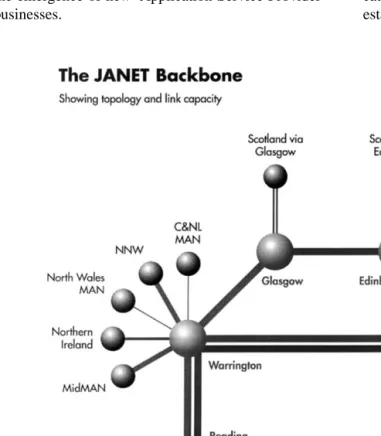
The UK e-Science application projects will rely on the UK universities network SuperJANET4 for deliv-ering the necessary bandwidth. The backbone band-width of SuperJANET4 is now 2 Gbps and there is funding in place to upgrade this to 10 Gbps by mid 2002 (Fig. 5).
In order to gather network requirements from the UK e-Science project—in terms of acceptable laten-cies and necessary end-to-end bandwidth—the Grid Network Team (GNT) has been established. Their short-term remit is to identify bottlenecks and po-tential bottlenecks as well as look to longer term Quality of Service issues. A £500K project with UKERNA and CISCO will be looking at such traf-fic engineering issues and another project will be looking at the question of bandwidth scheduling with the EU DataGrid project. Both of these net-work R&D projects are jointly funded by the Core Programme and PPARC. A potential problem for the UK programme is the ‘balkanisation’ of the UK network into a Super JANET4 backbone run by UKERNA and Metropolitan Area Networks run by university consortia. It may be difficult to provide end-to-end bandwidth QOS guarantees with such a structure.
4.8. Demonstrator projects
The Core Programme has also funded a number of ‘Grid Demonstrator’ projects. The idea of the demon-strators is to have short-term projects that can use the present technology to illustrate the potential of the Grid in different areas. We have tried to select demonstrators across a range of applications. Exam-ples include a dynamic brain atlas, a medical imaging project using VR, a robotic telescope project, auto-mated chemical data capture and climate prediction (www.research-councils.ac.uk/escience/).
5. Conclusions
There are many challenges to be overcome before we can realise the vision of e-Science and the Grid described above. These are not only technical issues such as scalability, dependability, interoperability, fault tolerance, resource management, performance and security but also more people-centric relating to collaboration and the sharing of resources and data.
envisages a “performance contract” framework as the basis for the dynamic negotiation process between resource providers and consumers. For realistic per-formance prediction, we need reliable data collection facilities that are able to monitor the available capac-ity of distributed resources and forecast future per-formance levels using statistical models. Perper-formance forecasting and resource management are complex tasks within the Grid environment. As an example of a people-centric issue, consider the motivation for scientists to share their annotated scientific data— simulation or experimental—in federated data repos-itories. For science to make best use of its limited funds, sharing of such expensively gathered scien-tific data is clearly of paramount importance. Yet the motivation for any individual scientist is not so clear. Perhaps funding agencies need to add some incentive to encourage such a community-minded approach to sharing scientific data.
There are many other challenges. Two important areas not yet addressed by the UK programme are security and scientific data curation. For the Grid vision to succeed in the industrial and commercial sector, the middleware must be secure against at-tack. In this respect, the present interaction of Globus with firewalls leaves much to be desired. Another issue concerns the long-term curation and preserva-tion of the scientific data along with its associated metadata annotations. A 3-year programme is clearly unable to provide a solution to such a long-term problem, but it is one that must be addressed in the near future. Our present e-Science funding has en-abled the UK to make a start on these problems and for the UK to play a full part in the development of the international Grid community. If the Grid middleware succeeds in making the transition from e-Science to commerce and industry in a few years, there will clearly be many new application areas to explore.
Acknowledgements
The authors thank Juri Papay for valuable assis-tance in preparing this paper and Jim Fleming and Ray Browne for their help in constructing the Core Pro-gramme. We also thank Paul Messina for encourage-ment and insight and Ian Foster and Carl Kesselman
for their constructive engagement with the UK pro-gramme.
References
[1] John Taylor e-Science definition:http://www.e-science.clrc. ac.uk/.
[2] I. Foster, C. Kesselman (Eds.), The Grid: Blueprint for a New Computing Infrastructure, Morgan Kaufmann, Los Altos, CA, 1999.
[3] B. Segal, Grid Computing: The European Data Project, IEEE Nuclear Science Symposium and Medical Imaging Conference, Lyon, October 2000, pp. 15–20.
[4] The DataTag Project:http://www.datatag.org. [5] GridPP:http://www.gridpp.ac.uk/.
[6] Griphyn:http://www.griphyn.org/.
[7] The Particle Physics DataGrid:http://www.ppdg.net/. [8] International Virtual Data Grid Laboratory:http://www.ivdgl.
org/.
[9] National Virtual Observatory:http://www.srl.caltech.edu/nvo/. [10] Opticon Astrophysical Virtual Observatory:
http://www.astro-opticon.org/archives.html.
[11] I. Foster, C. Kesselman, Globus: a metacomputing infra-structure toolkit, Int. J. Supercomput. Appl. 11 (2) (1997) 115–128.http://www.globus.org.
[12] I. Foster, C. Kesselman, J. Nick, S. Tuecke, The Physiology of the Grid: Open Grid Services Architecture for Distributed Systems Integration, to be presented at GGF4, February 2002. [13] NASA Information Power Grid: http://www.nas.nasa.gov/
About/IPG/ipg.html.
[14] M. Litzkow, M. Livny, M. Mutka, ‘Condor—a hunter of idle workstations’, Proceedings of the Eighth International Conference of Distributed Computing Systems, June 1988, pp. 104–111.http://www.cs.wisc.edu/condor.
[15] Storage Resource Broker:http://www.npaci.edu/DICE/SRB. [16] Virtual Laboratory Abstract-Machine:http://www.dutchgrid.
nl/VLAM-G/AM/doclive-vlam.html. [17] DutchGrid:http://www.dutchgrid.nl. [18] The Unicore Project:http://www.unicore.de/.
[19] Instituto Nationale di Fisica Nucleare:http://www.infn.it/. [20] PIONIER: Polish Optical Internet Advanced Applications,
Services and Technologies for Information Society: http:// www.man.poznan.pl/pol34/pionier/english/.
[21] AccessGrid:http://www-fp.mcs.anl.gov/fl/accessgrid/. [22] IBM Grid Position News:http://www.ibm.com/news/us/2001/
08/15.html.
[23] P. Watson, Databases and the Grid, Technical Report CS-TR-755, University of Newcastle, 2001.
[24] Sun Gridware:http://www.sun.com/gridware/. [25] Avaki:http://www.avaki.com/products/.
[26] N.W. Paton, M.P. Atkinson, V. Dialani, D. Pearson, T. Storey, P. Watson, Database Acccess and Integration Services on the Grid, UK DBTF Working Paper, January 2002.
Tony Hey is a Professor of Computation
at the University of Southampton and has been Head of the Department of Elec-tronics and Computer Science and Dean of Engineering and Applied Science at Southampton. From 31 March 2001, he has been seconded to the EPSRC and DTI as Director of the UK’s Core e-Science Programme. He is a Fellow of the Royal Academy of Engineering, the British Com-puter Society, the Institution of Electrical Engineers and the In-stitution of Electrical and Electronic Engineers. Professor Hey is European editor of the journal ‘Concurrency and Computation: Practice and Experience’ and is on the organising committee of many international conferences.
Professor Hey has worked in the field of parallel and distributed computing since the early 1980s. He was instrumental in the de-velopment of the MPI message-passing standard and in the Gen-esis Distributed Memory Parallel Benchmark suite. In 1991, he founded the Southampton Parallel Applications Centre in 1991 that has played a leading technology transfer role in Europe and the UK in collaborative industrial projects. His personal research in-terests are concerned with performance engineering for Grid appli-cations, but he also retains an interest in experimental explorations of quantum computing and quantum information theory. As the Director of the UK e-Science Programme, Tony Hey is currently excited by the vision of the increasingly global scientific collabo-rations being enabled by the development of the next generation ‘Grid’ middleware. The successful development of the Grid will have profound implications for industry and he is much involved with industry in the move towards OpenSource/OpenStandard Grid software.
Tony Hey is also the author of two popular science books: ‘The Quantum Universe’ and ‘Einstein’s Mirror’. Most recently
he edited the ‘Feynman Lectures on Computation’ for publication, and a companion volume entitled ‘Feynman and Computation’.
Anne E. Trefethen acts as the Deputy
Di-rector of the Core e-Science Programme. She is on secondment from NAG Ltd., where she is the Vice President for Re-search and Development. Anne joined NAG in 1997 and in her role there she leads technical development in NAG’s nu-merical and statistical products.
Before joining NAG, Anne was the As-sociate Director for Scientific Computa-tional Support at the Cornell Theory Center. For most of the 1990s, the Cornell Theory Center was one of four NSF funded national supercomputer centres in the USA. During her first 3 years at the centre, she was a research scientist in the perfor-mance and algorithms group, working largely on parallel linear algebra and parallel scientific applications, also teaching on the centre’s courses on parallel techniques and numerical algorithms. As an Associate Director she was responsible for the division who supported computational scientists across the country in terms of software, application and algorithmic consultancy, education and training, strategic applications support, and outreach programs. At that time, as well as many technical activities, she was very much involved in the design and development of Web-based educational courses and led the research activity, MultiMatlab, to create a distributed Matlab environment for large-scale problem solving.