Enhanced energy product in Y-Co-Fe magnets intermediate between Nd-Fe-B and
ferrite
P. Tozman, M. Venkatesan, G. A. Zickler, J. Fidler, and J. M. D. Coey
Citation: Applied Physics Letters 107, 032405 (2015); doi: 10.1063/1.4927306
View online: http://dx.doi.org/10.1063/1.4927306
View Table of Contents: http://scitation.aip.org/content/aip/journal/apl/107/3?ver=pdfcov
Published by the AIP Publishing
Articles you may be interested in
Microstructural and magnetic properties of Nd-Fe-B alloys processed by equal-channel angular pressing J. Appl. Phys. 117, 17A742 (2015); 10.1063/1.4918569
Correlation of the energy product with evolution of the nanostructure in the Y,Dy,Nd–(Fe, Co)–B magnetic alloy J. Appl. Phys. 105, 07A720 (2009); 10.1063/1.3067539
Equiaxed Nd–Fe–B fine powder with high performance prepared by mechanical alloying J. Appl. Phys. 101, 09K502 (2007); 10.1063/1.2709408
Microstructure and exchange coupling in nanocrystalline Nd 2 ( Fe Co ) 14 B ∕ α ‐ Fe Co particles produced by spark erosion
Appl. Phys. Lett. 86, 122507 (2005); 10.1063/1.1890474
Enhanced energy product in Y-Co-Fe magnets intermediate between
Nd-Fe-B and ferrite
P.Tozman,1M.Venkatesan,1G. A.Zickler,2J.Fidler,2and J. M. D.Coey1
1
School of Physics and CRANN, Trinity College, Dublin 2, Ireland
2
Institute of Solid State Physics, Vienna University of Technology, Vienna, Austria
(Received 25 May 2015; accepted 10 July 2015; published online 21 July 2015)
The hysteresis of ball-milled Fe-doped YCo5 powder has been optimized by controlling the
temperature and time for rapid annealing under vacuum and argon. The crystallite size is only 25 nm; yet, it has been possible to field align Y(Co,Fe) powder with a 5–20lm grain size in a 5 T field to obtain a remanence ratio of 0.65, due to texture in the ball-milled powder. The nominal energy product of the powder is 140 kJ/m3. A pressed magnet with 78% of theoretical density has an energy product of 65 kJ/m3. This magnet could fill the gap between oriented ferrite (34 kJ/m3) and oriented Nd-Fe-B (350 kJ/m3).VC 2015 AIP Publishing LLC.
[http://dx.doi.org/10.1063/1.4927306]
There is increasing interest in finding oriented dense magnets with properties intermediate between sintered ferrite and sintered Nd-Fe-B, having reduced content of strategic rare earths.1Development and optimization of rare-earth-free magnets may be pursued by atomic substitutions in known uniaxial materials with reasonably high Curie temperatures (Tc) with a view to reducing materials’ costs or
improving processability. Fe-doped YCo5 is a promising
starting point for magnet development, because it is entirely free of the critical heavy rare earths, Tb and Dy; yttrium is potentially in surplus, and substitution of iron for cobalt on 3g(CoII) sites should increase the saturation magnetization.
2
YCo5has the hexagonal CaCu5-type structure (space group
P 6/mmm) with lattice constants a¼494 pm and c¼398
pm.3Bulk crystals have very strong uniaxial anisotropy with
remanence Br¼1.06 T, Curie temperature Tc¼630C,
anisotropy constant K1¼5.7 MJ/m3, and anisotropy field
l0Ha¼13.0 T. The theoretical maximum energy product
(BH)MAX¼14l0M2s ¼224 kJ/m
3at room temperature.4–6
The magnetocrystalline anisotropy energy of YCo5
comes mainly from the orbital moment of cobalt atoms in the structurally distorted 2c(CoI) sites, which lie in the same
plane as Y. Yttrium has no 4f electrons, but contributes to the anisotropy via its 4d electron which hybridizes with the 3d electrons of Fe or Co.7–10The calculated magnetic anisot-ropy constant K1 in YCo5xFex increases with Fe doping
fromx¼0 tox¼0.5 and drops for larger x.11Experimental results confirm thatK1first increases by 20% forx¼0.2 and
then decreases.3,8
YCo5xMx (0x0.75) has been prepared in bulk,
nanocomposites with (20 wt. %aFe) and (30 wt. % Y2Co17),
powders and nanoparticles with and without M¼Fe, Cu
doping by techniques such as arc-melting, mechanical milling, mechanochemical milling, and cluster deposi-tion.3,8,12–18 Moreover, mechanically alloyed YCo5 has a
small temperature coefficient of coercivity and magnets made from it may be operable at high temperature.18
However, the best magnetic properties reported for
conventional dry-milled and annealed YCo4.28 powder are
l0HC¼1.6 T and (BH)max¼61 kJ/m3.19The nominal energy
product of the powder has been increased to (BH)max
¼130 kJ/m3by mechanochemical milling with calcium in a
process involving separation of the YCo5particles in a
multi-step washing and magnetic alignment.20
Here, YCo5xFex (0x0.5) alloy powders are
pre-pared by high-energy ball milling and subsequent rapid ther-mal or vacuum annealing in order to obtain a good energy product. The effects of the two different annealing processes on magnetic and crystallographic properties are compared.
The YCo5xFex alloys with 0x0.5 were prepared
by arc melting in high-purity argon. The ingots were remelted four times to ensure homogeneity. Milling was then carried out under argon for 4 h in a Spex 8000 mixer/mill with stainless steel balls and a ball to powder charge ratio of
15:1. The as-milled YCo5 powder was wrapped in Ta foil
and then subjected to rapid thermal annealing under a flow-ing Ar with an infrared lamp (Ulvac-Riko MILA-5000) at temperatures (Ta) between 800C and 1050C for 1–5 min
and cooled naturally. The iron-doped YCo5xFex0x0.5
powder samples were rapidly annealed at 800C for only
1–3 min, which was the optimum treatment to give the best energy product. The alternative, vacuum annealing treatment of the as-milled powders was carried out in a tube furnace
preheated at 800 and 850C for 2–3 min under a vacuum
of 106–107 Torr, followed by quenching. Ball-milled
YCo4.8Fe0.2powder was pressed in a 5 mm die and vacuum
annealed at 850C for 2 min. Structural characterization was carried out by X-ray diffraction (XRD) with a PANalytical X’Pert Pro diffractrometer using Cu-Ka radiation. Rietveld
analysis of the diffraction patterns was performed using FullProf. The microstructure and composition were analysed with a scanning electron microscope (SEM Carl Zeiss Evo) and an analytical field emission transmission electron micro-scope (TEM FEI TECNAI F20), equipped with an energy dispersive X-ray detector (EDX) and a high angle annular dark field (HAADF) detector. Samples for room temperature magnetic measurements were prepared by mixing the annealed powder with Lecoset 7007 cold-curing resin inside
0003-6951/2015/107(3)/032405/4/$30.00 107, 032405-1 VC2015 AIP Publishing LLC
a 4 mm4 mm cylindrical Perspex bucket. Some samples were oriented in a 5 T field, and all the magnetic measure-ments were carried out using a 5 T Quantum Design super-conducting quantum interference device magnetometer.
The XRD patterns of as-milled powders indicate a
highly disordered crystal structure. However, rapidly
annealed samples are mainly composed of the hexagonal
CaCu5-type (P6/mmm) phase with a minor Th2Zn17-type
rhombohedral (R3m) secondary phase.3,8The XRD patterns
of rapidly annealed powders (800C for 3 min) also show
secondary rhombohedral Y2Co17. Fe-doping increases the
lattice parameters and decreases the intensity of the hexago-nal phase. According to our Rietveld refinement and an early neutron diffraction study,6the Fe atoms prefer to occupy 2c
CoI sites rather than 3g CoII sites. The lattice parameters
increase froma¼495 pm andc¼396 pm toa¼498 pm and
c¼403 pm, and the solid solubility limit is reached at
x¼0.3.
Vacuum and rapid thermal annealed (850C, 2 min)
samples are compared in Fig.1. The peaks are broadened for the vacuum annealed sample and the main (111) peak over-laps with (200). The mean crystallite size for vacuum and rapid thermal annealed samples was found to be 11 nm and 65 nm, respectively, computed from the Scherrer broadening.
SEM images show that annealed samples were agglom-erated in irregular shapes with a 10lm average cluster size. The size and shape of the agglomerates are unaffected by annealing. Average grain sizes of 24 nm and 98 nm were determined for vacuum annealed (850C for 2 min) and rapid thermal annealed (850C for 2 min), respectively (Figs.2(b)
and2(c)). The morphology of the as-milled sample is highly inhomogeneous with polycrystalline iron agglomerates, which are embedded in a nanocrystalline and mostly amor-phous YCo5matrix with an average grain size of 8 nm. The
average grain size obtained from TEM is always greater than that deduced from XRD, which can be attributed to the plas-tic deformation of bulk metallic parplas-ticles.21,22 EDX analysis shows that the ratio of (CoþFe) to Y was 5.7, in fair agree-ment with the nominal composition of 5.0.
Bulk YCo5shows insignificant coercivity at room
tem-perature but a coercive ferromagnetic phase is obtained after
ball-milling and annealing. The coercivity l0Hc, saturation
magnetizationrmax, and nominal maximum energy product
(BH)max for the powder depend strongly on the annealing
temperature, time, and Fe-doping. None of the annealed powder samples was saturated under 5 T.
YCo5powders were then rapidly annealed for 1 min at
[image:3.612.318.559.55.187.2]temperatures ranging from 800 to 1050C at 50C intervals. Coercivity decreases from 0.83 T to 0.55 T with increasing temperature, except at 900C where it is 0.88 T. The coer-civity also decreases with increasing annealing time from 1
[image:3.612.324.551.378.729.2]FIG. 1. XRD pattern for ball-milled rapid thermal (a) and vacuum annealed (b) at 850C for 2 min powders. Stars indicate the reflections of the second-ary Y2Co17phase (300), (303), (006), and (223).
FIG. 2. SEM image of vacuum annealed (a) and TEM bright field image of rapid thermal annealed (850C for 2 min) YCo4.8Fe0.2(b). STEM-HAADF
[image:3.612.59.289.570.731.2]image of vacuum annealed at 850C for 2 min YCo4.8Fe0.2(c).
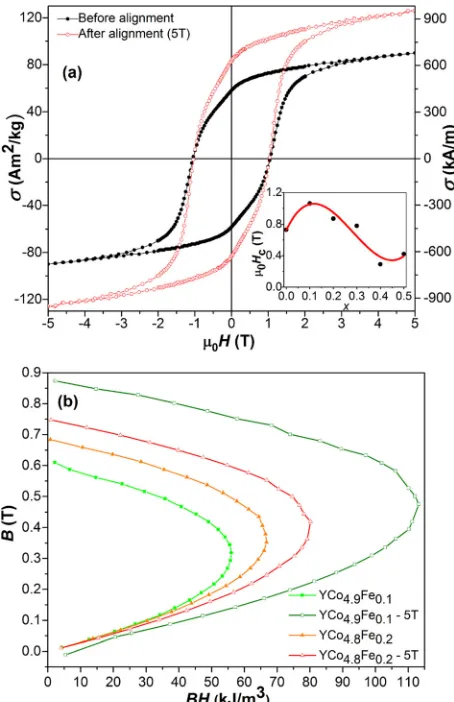
FIG. 3. Hysteresis of rapid thermal annealed YCo4.9Fe0.1before and after
magnetic alignment (a). Calculated maximum energy product before and af-ter magnetic alignment (b).
to 5 min at 800C; the best powder energy product of 66 kJ/
m3 for 2 min annealing was deduced assuming
crystallo-graphic density q¼7560 kg/m3 and N ¼1/3 for spherical
powders.
Ball-milled YCo5xFexwith 0x0.5 was then rapidly
thermally annealed at 800C for 1–3 min, and the highest
coercivity and (BH)maxwere obtained for 2 min. YCo4.9Fe0.1
has the best magnetic properties with l0Hc¼1.06 T,
(BH)max¼56 kJ/m 3
, andrmax¼90 Am 2
/kg.
These properties were improved by magnetically align-ing the powder in epoxy resin under 5 T; the value of (BH)max increases up to 114 kJ/m
3
due to an increment of
rmax to 128 Am
2
/kg andrr/rmax¼0.65. The magnitude of
l0Hcdecreases, whereas the value ofrmaxis enhanced with
Fe-doping, in agreement with calculations.2 After reaching the solid solubility limitx¼0.3, the coercivity drops
signifi-cantly as shown in Fig. 3(a). Unlike dry-ball milled
La(Co,Fe) powders, there is no step in the demagnetization curve near zero field.23
The best magnetic properties were obtained after a short vacuum anneal at 850C for 2 min. The coercivity falls from
1.0 T to 0.42 T as x changes from 0 to 0.5, with a sharp
decrease when x0.3.
The highest (BH)max, obtained for YCo4.8Fe0.2, powders
dispersed in epoxy is 81 kJ/m3withrmax¼112 Am 2
/kg and
l0Hc¼0.75 T withN ¼1/3. After alignment in 5 T, the
pow-der value of(BH)maxis 140 kJ/m 3
withrr/rmax¼0.65 (Fig.4)
due to the enhanced 5 T magnetization of 144 Am2/kg.
Alignment increases the magnetization by 30% for x¼0.3
and x¼0.2. For other compositions, it is less, 5%–10%. The coercivity for magnetically aligned YCo4.8Fe0.2decreases only
by 13% from 0.75 T, its room temperature value, at 400 K demonstrating good temperature stability. The best magnetic properties obtained by rapid thermal annealing under similar
conditions (850C 2 min) are (BH)max¼51 kJ/m
3
, l0Hc ¼0.83 T, andrmax¼95 Am
2
/kg.
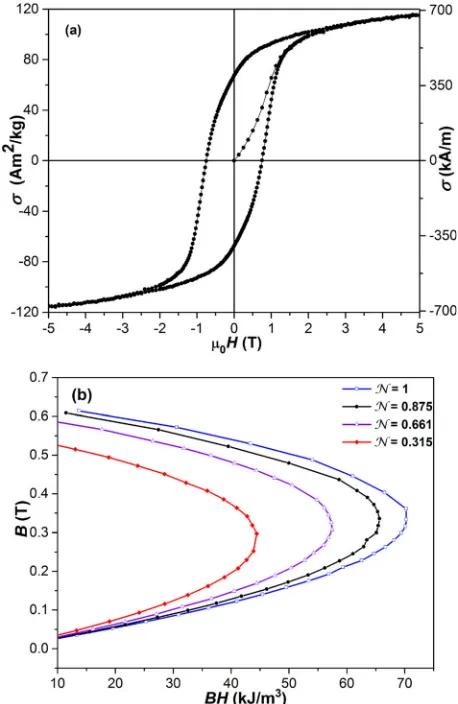
The powder of YCo4.8Fe0.2was pressed into a pellet and
sintered in preheated furnace at 850C for 2 min under vac-uum. The density of the sintered ingot is q¼5880 kg/m3. The room temperature coercivity is unchanged. The maxi-mum energy product is 66 kJ/m3, computed withN ¼0.875, corresponding to the pellet shape.24The variation of (BH)max
with differentN values is compared in Figure5(b).
We have increased the energy product of YCo4.8Fe0.2
powder to 140 kJ/m3 without calcium, in optimized anneal-ing conditions with magnetic alignment. Surprisanneal-ingly, although the individual crystallite size is only 25 nm, it was possible to obtain a 30% increment in remanence by aligning
10–50lm powders. This implies a significant
[image:4.612.60.291.377.733.2]crystallo-graphic [001] texture in the ball-milled material. The
FIG. 4. Vacuum annealed YCo4.8Fe0.2at 850C for 2 min before and after
magnetic alignment (a) and calculated (BH)max of YCo5xFex powders
[image:4.612.324.553.379.731.2]before and after magnetic alignment (b).
FIG. 5. Hysteresis of vacuum annealed pressed magnet YCo4.8Fe0.2 (a).
Calculated maximum energy product for different demagnetizing factorsN, forq¼5880 kg/m3(b).
nanocrystal axes are not randomly aligned, but a significant uniaxial texture is imparted by ball-milling. The textured powder can be field aligned, leading to remanence enhance-ment. Since the coercivity is controlled by microstructure, it is expected that a similar energy product to that measured on powder should be found in fully dense aligned magnets.
This work was supported by the EU FP7 ROMEO Project. TEM investigation was carried out at the University Service Centre for Transmission Electron Microscopy, Vienna University of Technology, Austria.
1
J. M. D. Coey,IEEE Trans. Magn.47, 4671 (2011).
2
X. B. Liu, Z. Altounian, and M. Yue,J. Appl. Phys.107, 09A718 (2010).
3B. Das, B. Balamurugan, W. Y. Zhang, R. Skomski, E. S. Krage, S. R.
Valloppilly, J. E. Shield, and D. J. Sellmyer, in Proceeding of the 22nd International Workshop on Rare-Earth Permanent Magnets and their Applications (REPM’12), Nagasaki, Japan, 2-5 September 2012, article P3-025, p. 427, available at http://digitalcommons.unl.edu/physicsskom-ski/89/.
4
K. J. Strnat and R. M. W. Strnat,J. Magn. Magn. Mater.100, 38 (1991).
5
G. Hoffer and K. Strnat,IEEE Trans. Magn.2, 487 (1966).
6J. M. Alameda, J. Deportes, D. Givord, R. Lemaire, and Q. Lu,J. Magn.
Magn. Mater.15, 1257 (1980).
7
G. H. O. Daalderop, P. J. Kelly, and M. F. H. Schuurmans,Phys. Rev. B 53, 14415 (1996).
8J. Deportes, D. Givord, J. Schweizer, and F. Tasset,IEEE Trans. Magn.
12, 1000 (1976).
9L. Steinbeck, M. Richter, and H. Eschrig, J. Magn. Magn. Mater. 226, 1011 (2001).
10
D. Givord and D. Courtois,J. Magn. Magn. Mater.196, 684 (1999).
11P. Larson, I. I. Mazin, and D. A. Papaconstantopoulos,Phys. Rev. B69,
134408 (2004).
12
J. L. Sanchez Ll, J. T. Elizalde-Galindo, and J. A. Matutes-Aquino,Solid State Commun.127, 527 (2003).
13
J. T. Elizalde Galindo, C. E. Botez, F. Rivera Gomez, and J. A. M. Aquino,Phys. Lett. A366, 110 (2007).
14J. T. Elizalde-Galindo, A. W. Bhuiya, F. Rivera Gomez, J. A. M. Aquino,
and C. E. Botez,J. Phys. D: Appl. Phys.41, 095008 (2008).
15
J. Sanchez Ll, B. Hernando, M. J. Perez, and J. D. Santos,J. Non-Cryst. Solids353, 835 (2007).
16B. Balasubramanian, R. Skomski, X. Li, S. R. Valloppilly, J. E. Shield,
G. C. Hadjipanayis, and D. J. Sellmyer,Nano Lett.11, 1747 (2011).
17
J. C. Tellez-Blanco, R. Gr€ossinger, R. Sato Turtelli, and E. Estevez-Rams,
IEEE Trans. Magn.36, 3333 (2000).
18
I. A. Al-Omari, R. Skomski, R. A. Thomas, D. Leslie-Pelecky, and D. J. Sellmyer,IEEE Trans. Magn.37, 2534 (2001).
19N. Tang, Z. Chen, Y. Zhang, G. C. Hadjipanayis, and F. Yang,J. Magn.
Magn. Mater.219, 173 (2000).
20
A. M. Gabay, X. Hu, and G. C. Hadjipanayis,J. Magn. Magn. Mater.368, 75 (2014).
21T. Ungar, G. Tichy, J. Gubicza, and R. J. Hellmig,Powder Diffr.20, 366
(2005).
22
Y. Zhong, D. Ping, X. Song, and F. Yin, J. Alloys Compd. 476, 113 (2009).
23
P. Tozman, M. Venkatesan, and J. M. D. Coey,IEEE Trans. Magn.50, 1 (2014).
24
D.-X. Chen, E. Pardo, and A. Sanchez, IEEE Trans. Magn. 38, 1742 (2002).