Improving the Throughput of DS-CDMA Systems Using Adaptive Rate
Transmissions Based on Variable Spreading Factors
Lie-Liang Yang and Lajos Hanzo
Dept. of ECS, University of Southampton, SO17 1BJ, UK. Tel: +44-23-8059 3125, Fax: +44-23-8059 4508 Email: lly,[email protected]; http://www-mobile.ecs.soton.ac.uk
Abstract— In this contribution adaptive rate transmissions are investi-gated in the context of DS-CDMA systems using variable spreading fac-tors (VSF). In contrast to conventional adaptive rate transmission schemes, where the transmission rate is usually adapted in response to the channel fading, in this contribution the transmission rate is adapted in response to the multiuser interference (MUI) level. We present the philosophy of the proposed adaptive rate transmission scheme and analyze the effective throughput as well as the resultant bit error rate (BER) performance, when communicating over additive white Gaussian noise (AWGN) channels. Our study shows that when the number of active users in a DS-CDMA system can be modelled with the aid of a Markov chain and when the conven-tional matched filter based receiver is employed, the VSF-assisted adap-tive rate transmission scheme is capable of substantially increasing the system’s effective throughput. Specifically, our results show that the ef-fective throughput may be increased by up to40%, when compared to that of DS-CDMA systems using constant spreading factors. This increased throughput is achieved without wasting power, without imposing extra in-terference upon other users and without increasing the BER.
I. INTRODUCTION
DS-CDMA is the prevalent technique in the third-generation (3G) wireless communications systems, because it is capable of providing numerous advantages compared to the other solutions. The capacity of DS-CDMA systems is limited by both the time-varying charac-teristics of the wireless channel and the multiple-access interference (MAI) or multiuser interference (MUI). The family of efficient tech-niques designed for compensating for the time-varying nature of the wireless channels include the popular RAKE receiver [1] contrived for achieving frequency diversity. Alternatively, multiple transmit and/or receiver antennas can be employed for achieving spatial diversity [2], [3]. The most efficient technique of combating the MAI is multiuser detection (MUD) [4]. The above techniques have attracted world-wide attention in recent years.
Another efficient technique of increasing the capacity of time-varying wireless channels is the employment of adaptive rate trans-missions [5], [6], [7], where the transmission rate can be adaptively adjusted according to the instantaneous channel conditions. The main philosophy behind adaptive rate transmissions is the real-time balanc-ing of the link budget through adaptive variation of the symbol rate, modulation constellation size and format, spreading factor, coding rate/scheme, etc, or in fact any combination of these parameters [7]. However, the results of [6] have shown that when a sufficiently high diversity order is available, regardless, whether this is due to transmit-ter or receiver diversity achieved in the time or frequency domain, the advantages of adaptive rate transmissions erode. Hence, in the context of the 3G DS-CDMA systems using power control, the channel fading can be efficiently mitigated by employing both the RAKE receiver and multiple transmitter/receiver antennas. In order to combat the MUI in DS-CDMA systems, as we have mentioned above, the most efficient
approach is to use multiuser detection receivers [4]. The main obstacle of employing DS-CDMA MUD receivers is the high complexity of the multiuser detection algorithms. Therefore, the conventional matched filter based receiver remains popular because of its simplicity, despite its suboptimal performance.
In this contribution we consider the problem of how the effective throughput of DS-CDMA systems can be increased, when the con-ventional matched filter based receiver is employed. Specifically, we consider a single cell DS-CDMA system, where the number of ac-tive mobile users obeys the Poisson distribution [8] and all the signals transmitted by the mobile users are ideally power controlled. Hence, the multiuser interference level can be modelled as a discrete Markov process [8], which describes the number of active mobile users. In order to exploit the time-varying nature of the multiuser interference level, an adaptive rate transmission scheme using variable spreading factors (VSF) [9] is proposed for increasing the effective throughput. In contrast to the conventional VSF-assisted adaptive rate transmis-sion scheme, where the transmistransmis-sion rate is adapted in response to the channel quality fluctuation recorded at the output of the MUD [10], the transmission rate in the proposed scheme is adapted in response to the time-varying interference level due to the MUI, while maintaining the required target BER value. In this contribution the performance of the DS-CDMA systems using the proposed VSF-assisted adaptive rate transmission scheme is evaluated when communicating over Ad-ditive White Gaussian Noise (AWGN) channels. The reasons for us to consider only AWGN channels are as follows. Firstly, as we have mentioned above, the fading effects encountered in power-controlled DS-CDMA systems can be efficiently mitigated by using RAKE re-ceivers and multiple transmitter/receiver antennas. Secondly, our aim is to study the effects of the MUI in isolation, without the obfuscating effects of the channel’s fading and then gain insight into the effects of the MUI on the system’s effective throughput, when the conventional matched filter receiver is considered. Our results show that by employ-ing VSF-assisted adaptive rate transmissions, the effective throughput of a DS-CDMA system may be increased by40%upon exploiting the Markovian distributed number of active users in the system. The in-creased effective throughput is achieved without wasting power and without increasing the bit error ratio (BER).
II. SYSTEMOVERVIEW
AWGN channels. Furthermore, we assume ideal power control, i.e. the received power of each active user is the same at the BS. Based on the above assumptions and assuming furthermore that there areKl+1
active users (the reference user plusKlinterfering users), then the
re-ceived signal at the base station can be expressed as
r(t) =n(t) +
Kl+1
k=1
√
2P ak(t−τk)bk(t−τk)
·cos (ωct+φk), (1)
wheren(t)is the AWGN having a two-sided spectral density ofN0/2, P represents the power received from each active user,ak(t)is the spreading code,bk(t)is the data signal,τkis the time delay parameter
that accounts for the propagation delay as well as for the lack of syn-chronism between the transmitters, whileφkis the phase angle due to
carrier modulation and channel delay.
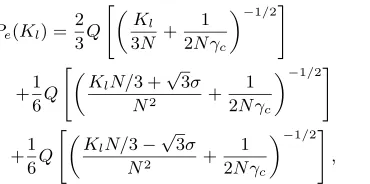
The bit errors in DS-CDMA systems communicating over AWGN channels is caused by the effect of multiple access interference and the AWGN. The BER of an asynchronous DS-CDMA system having received signals given by (1) can be closely approximated by [11]
Pe(Kl) = 23Q
Kl
3N + 1 2N γc
−1/2
+ 16Q
KlN/3 +√3σ
N2 +
1 2N γc
−1/2
+ 16Q
KlN/3−√3σ
N2 +
1 2N γc
−1/2
, (2)
whereγc = P Tc/N0 = Ec/N0represents the signal to noise ratio (SNR) per chip,Tcis the chip-duration, while the variableN repre-sents the spreading factor (number of chips per bit). In our further discourseN will be controlled as a function of the number of active users and the target BER. Furthermore, the parameterσcan be derived from the following equation [11]
σ2= (Kl+ 1)
N236023 +N
1 20+K36l
−201 −K36l
. (3)
In (2) the Gaussian Q-function is given by Q(x) =
1
√
2π ∞
x exp(−t2/2)dt.
... ...
λ∆t
λ∆t λ∆t
µ∆t 1−λ∆t
1−(λ+kµ)∆t
kµ∆t (k+ 1)µ∆t
λ∆t
(K−1)µ∆t 1−(K−1)µ∆t
[image:2.595.353.502.85.200.2]0 k−1 k k+ 1 K−1
Fig. 1. State transition diagram modelling the number of active interfering users with the aid of a Markov chain havingKstates.
The number of interfering users,Klcan be modelled with the aid of
a Markov chain havingKstates [8]. The state transition diagram mod-elling the number of users determining the interference level is shown in Fig.1, which represents aM/M/m/mqueueing system [8]. The arrival rate of new calls or usersλcorresponds to the probability of the event that a new interfering user is activated within a unit-length time-duration, while the average service time of1/µis the average duration of an active interfering connection. For theM/M/m/mqueueing
K=64, =0.35, =0.009, k=k
0 500 1000 1500 2000 2500 3000
Normalized time slots, n
0 10 20 30 40 50 60
Number
of
active
interfering
users,
k
(a) Time slot interval, [0, 3000]
K=64, =0.35, =0.009, k=k
1000 1200 1400 1600 1800 2000
Normalized time slots, n
0 10 20 30 40 50 60
Number
of
active
interfering
users,
k
(b) Time slot interval, [1000, 2000]
Fig. 2. Markov characteristics of the number of active interfering users.
system, the probability that there areKlactive interfering users (cus-tomers) can be expressed as [8]
pKl= λ µ
Kl
1
Kl! K−1
m=0 λµ m 1
m!
, Kl= 0,1, . . . , K−1, (4)
where the probability of simultaneously supportingKl=K−1users
[image:2.595.350.498.269.394.2]is known as theErlang B formula[8], which determines the call block-ing probabilityof the system considered.
Fig.2 shows number of active users generated by the above-mentioned Markov chain for the first 3000 normalized time slots (Fig.2(a)) and for the normalized time slots spanning the index-range of 1000 to 2000 (Fig.2(b)). The parameters used for the simulations wereλ= 0.35, µ= 0.009and the maximum number of users sup-ported wasK = 64. From Fig.2(a) and Fig.2(b) we can observe that the number of active interfering users is a slowly time-variant variable, fluctuating as a function of the normalized time slot index.
[image:2.595.76.261.299.391.2] [image:2.595.46.293.475.591.2]c=0 dB
N=8,16,24,40,56,80,112,120
0 10 20 30 40 50 60
Number of active users, Kl+1 10-5
10-4 10-3 10-2 10-1 100
BER,
[image:3.595.61.257.83.240.2]Pe
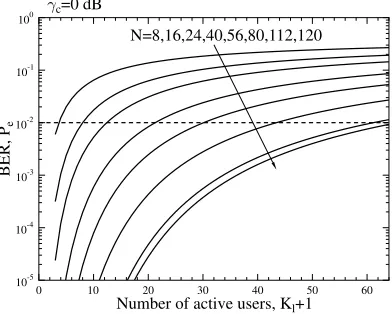
Fig. 3. BER performance versus the number of active users for the parameters ofγc = 0dBand spreading factors ofN = 8,16,24,40,56,80,112,120
computed from (2).
the spreading factors ofN = 8,16,24,40,56,80,112,120are em-ployed. From the results of Fig.3 we can infer following observa-tions.
• For a given spreading factor, the BER increases when supporting an increased number of active users;
• For a given number of users, the BER decreases upon increasing the value of the spreading factor;
• For a given target BER - for example forPE = 10−2 - and for a given number of active users, there exists a spreading factor, which results in a specific BER for the DS-CDMA system match-ing the target BER requirement. A DS-CDMA system usmatch-ing a higher spreading factor is capable of supporting a higher number of active users, than that using a lower spreading factor, while maintaining the target BER.
Therefore, based on the Markov chain characterized in Fig.2 and on the BER performance of the DS-CDMA system as a function of the number of active users shown in Fig.3, we argue that an appropriate spreading factor can be employed within a specific time slot for maxi-mizing the number of bits transmitted by this specific time slot, while maintaining the required BER performance. Furthermore, when the number of active users dynamically fluctuates, variable spreading fac-tors can be employed by the DS-CDMA system for achieving the max-imum throughput, while guaranteeing the required BER performance. In other words, VSF-assisted adaptive DS-CDMA system is capable of increasing the effective throughput of the system, while maintaining a given target BER.
III. ADAPTIVETRANSMISSIONSCHEME
In this section we propose and investigate a adaptive rate transmis-sion scheme based on VSF. Let us assume that each user transmits a block of data as shown in Fig.4. As shown in Fig.4, the data block is divided intoLframes. We assume that at the beginning of thelth frame there areKlinterfering users, which is thea prioriknowledge
for determining the required spreading factor and the corresponding transmission rate during thelth frame. Let us assume that each frame
consists of a constant number of chips, which is expressed asNf, i.e.
each frame has a constant duration ofNfTcseconds. Let us also as-sume that there aremspreading factors having values expressed as N1< N2< . . . < Nm, where each of them is a multiple ofNf.
Fur-thermore, let us assume that the target BER isPE. Then the required spreading factor of thelth frame and the corresponding number of bits conveyed by thelth frame can be determined as follows.
...
...
...
...
Frame 0 1 l L−1
Frame 1 2
Bit 0 Bl−1
δ
Klinterfering users
(Initial number of interfering users of thelth frame)
reference user
new interfering user
Fig. 4. Data structure of the transmitted signal in adaptive rate DS-CDMA systems using VSF-assisted adaptive rate transmissions.
• A specific spreading factor is selected from the set
{N1, N2, . . . , Nm} according to Equation (2) based on the number of interfering users,Kl, and on the target BER,PE, such
that the selected spreading factor’s value is as low as possible, while guaranteeing the required BER performance. We denote the selected spreading factor byNl(Kl, PE).
• Once the spreading factor,Nl(Kl, PE)of thelth frame was se-lected, the corresponding number of bits,Bl(Kl, PE), conveyed
by thelth frame can be determined as
Bl(Kl, PE) = Nf
Nl(Kl, PE). (5)
In [5] Goldsmith and Chua have shown that the highest effec-tive throughput can be achieved by using continuous rate adaptation. Hence, the results of [5] suggest that we should use as many differ-ent spreading factors as possible and, simultaneously, have a near-continuous spreading factors value set. Table I shows the design exam-ple for the appropriate choice of the spreading factors. In Table I we assumed that random spreading sequences having various length were employed, and that the frame’s length isNf = 24×3×5×7 = 1680
chips. As shown in Table I, we can obtain 40 different spreading fac-tors and hence can support 40 different transmission rates.
IV. THROUGHPUT ANDBER ANALYSIS
[image:3.595.324.536.152.256.2]Index Bits/frame Spreading factors Index Bits/frame Spreading factors
1 1 1680 21 42 40
2 2 840 22 48 35
3 3 560 23 56 30
4 4 420 24 60 28
5 5 336 25 70 24
6 6 280 26 80 21
7 7 240 27 84 20
8 8 210 28 105 16
9 10 168 29 112 15
10 12 140 30 120 14
11 14 120 31 140 12
12 15 112 32 168 10
13 16 105 33 210 8
14 20 84 34 240 7
15 21 80 35 280 6
16 24 70 36 336 5
17 28 60 37 420 4
18 30 56 38 560 3
19 35 48 39 840 2
20 40 42 40 1680 1
TABLE I
NUMBER OF BITS TRANSMITTED IN A FRAME BY ASSUMING THAT THE TOTAL NUMBER OF CHIPS PER FRAME ISNf= 1680 = 24×3×5×7WHEN
THE SPREADING FACTORS SEEN IN THE RIGHT COLUMN ARE EMPLOYED.
within a frame’s time duration by more than one is zero. Therefore, the probability that the number of interfering users remains unchanged, i.e. Kl, within a frame’s time duration can be expressed as
PKl=
1−λ ifKl= 0
1−λ−Klµ if1≤Kl≤K−2
1−Klµ ifKl=K−1
(6)
(c) When the number of active interfering users increases by one or decreases by one within thelth frame, we assume that this happens at the moment having a time difference ofδfrom the beginning of thelth frame (see Fig.4), whereδis assumed to be uniformly distributed over the interval[0, NfTc).
Based on the above assumptions, the effective throughput can be derived and is expressed as
B=
K−1
Kl=0 λ µ
Kl
1
Kl! K−1
m=0 λµ m 1
m!
Kl+ 1
Nl(Kl, PE)
+(λ−Klµ)×2 1
Nl(Kl, PE)
− λ µ
K−1
1 (K−1)!
K−1 m=0 λµ
m 1 m!
× λ
2Nl(K−1, PE) [bits/chip]. (7)
The average BER, when the effective throughput of (7) has been achieved, can be expressed as
Pe= K−1
Kl=0
pKlPˆe(Kl)
=
K−1
Kl=0 λ µ
Kl 1 Kl! K−1
m=0 λµ m
1
m!
×
λ
2[Pe(Kl) +Pe(Kl+ 1)]
+K2lµ[Pe(Kl) +Pe(Kl−1)] + (1−λ−Klµ)Pe(Kl)
− λ µ
K−1 1 (K−1)!
K−1 m=0 λµ
m
1
m!
×
λ
2[Pe(K−1) +Pe(K)]−λPe(K−1)
. (8)
Note that in (8)Pe(Kl), Pe(Kl+ 1)andPe(Kl−1)are functions ofNl(Kl, PE), since the spreading factor assumes different values in response to the time-variant number of active interfering users in the context of the VSF-assisted adaptive rate transmission scheme.
V. NUMERICALRESULTS ANDDISCUSSIONS
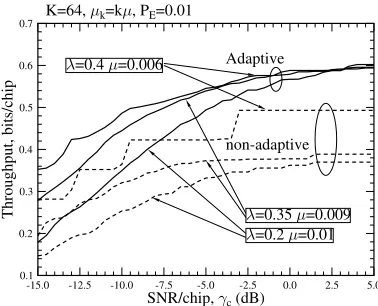
In this section we provide some performance results, in order to compare the throughput performance of the proposed adaptive rate and that of the conventional constant rate DS-CDMA transmission scheme. The spreading factors employed for adaptive rate transmissions are shown in Table I. Furthermore, in the context of the DS-CDMA sys-tem using constant rate transmissions we assumed that at any given SNR/chip value the specific spreading factor was used, which was ca-pable of maximizing the effective throughput, while guaranteeing the target BER performance, for the given distribution of the number of interfering users.
K=64, k=k , PE=0.01
Adaptive
non-adaptive =0.4 =0.006
=0.35 =0.009 =0.2 =0.01
-15.0 -12.5 -10.0 -7.5 -5.0 -2.5 0.0 2.5 5.0
SNR/chip, c(dB) 0.1
0.2 0.3 0.4 0.5 0.6 0.7
Throughput,
[image:5.595.65.254.78.231.2]bits/chip
Fig. 5. Throughput performance comparison of the constant spreading factor assisted non-adaptive CDMA scheme and the VSF-assisted adaptive DS-CDMA arrangement.
K=64, k=k , PE=0.01
Adaptive
non-adaptive =0.4 =0.006
=0.35 =0.009 =0.2 =0.01
-15.0 -12.5 -10.0 -7.5 -5.0 -2.5 0.0 2.5 5.0
SNR/chip, c(dB) 10-3
2 5
10-2
2 5
10-1
[image:5.595.65.255.315.468.2]BER
Fig. 6. BER performance comparison between the constant spreading factor
assisted non-adaptive DS-CDMA and the VSF-assisted adaptive DS-CDMA schemes, when they achieve the effective throughputs of Fig.5.
the system is capable of accommodating the interference level expe-rienced by activating an appropriate spreading factor according to the number of active interfering users at a given SNR/chip value. By con-trast, for the constant rate transmission scheme, only single spreading factor is employed at a given SNR/chip value, regardless of the number of users supported. Consequently, when the number of active interfer-ing users is low, the BER performance will be better than the target BER and hence the effective throughput is correspondingly lower than necessary. However, when the number of active interfering users is excessive, the BER of the received data is higher than the target BER. Hence the received data may have to be discarded without contributing to the effective throughput.
Fig.6 we show the resultant BER performance of the DS-CDMA system using both constant rate transmissions and the proposed adap-tive rate transmission scheme, when they achieve the effecadap-tive
through-put values shown in Fig.5. From the results of Fig.6 we observe that for each group of(λ, µ)values, the constant rate scheme has a lower BER, than the adaptive rate scheme, while the BER of the adaptive rate transmission scheme is closer to the target BER, than that of the constant rate transmission scheme. The results of Fig.6 demonstrate that neither the BER of the constant rate nor that of the adaptive rate transmission scheme fluctuates dramatically. Indeed, they both remain in the BER range of(0.001,0.01)for various of the SNR/chip value. The reason for observing a near-constant BER even for the constant rate transmission scheme is because we deliberately adjusted the data rate in response to the SNR/chip value experienced for the sake of fair comparison, although a practical constant-rate system is incapable of doing so. By contrast, the adaptive rate transmission scheme was capa-ble of adapting the data rate in response to both the SNR/chip value as well as the number of active interfering user supported at each specific SNR/chip value.
In conclusions, we have shown in this contribution that, when the number of active users in a DS-CDMA system can be modelled with the aid of a Markov chain and when the conventional matched filter based receiver is employed, an adaptive rate transmission scheme us-ing variable spreadus-ing factors (VSF) can be employed in response to the time-varying MUI level experienced. The VSF-assisted adaptive rate transmission scheme is capable of significantly increasing the sys-tem’s effective throughput.
REFERENCES
[1] G. L. Turin, “Introduction to spread-spectrum antimultipath techniques and their application to urban digital radio,”Proceedings of IEEE, vol. 68, pp. 328–353, March 1980.
[2] P. M. S. Affes, “A new receiver structure for asynchronous CDMA: STAR - the spatio-temporal array-receiver,”IEEE Journal on Selected Areas in
Communications, vol. 16, pp. 1411 – 1422, October 1998.
[3] B. Hochwald, T. L. Marzetta, and C. B. Papadias, “A transmitter diversity scheme for wideband CDMA systems based on space-time spreading,”
IEEE Journal on Selected Areas in Communications, vol. 19, pp. 48–60,
January 2001.
[4] S. Verdu,Multiuser Detection. Cambridge University Press, 1998. [5] A. J. Goldsmith and S. G. Chua, “Variable-rate variable-power MQAM
for fading channels,”IEEE Transactions on Communications, vol. 45, pp. 1218–1230, October 1997.
[6] M. S. Alouini and A. J. Goldsmith, “Capacity of Rayleigh fading chan-nels under different adaptive transmission and diversity-combining tech-niques,”IEEE Transactions on Vehicular Technology, vol. 48, pp. 1165– 1181, July 1999.
[7] L.-L. Yang and L. Hanzo, “Software defined radio assisted adaptive
broadband frequency hopping multicarrier DS-CDMA,”To appear in
IEEE Communications Magazine, vol. 40, March 2002.
[8] D. Bertsekas and R. Gallager,Data Networks. Englewood Cliffs, N.J. : Prentice Hall, 2nd ed., 1992.
[9] F. Adachi, M. Sawahashi, and H. Suda, “Wideband DS-CDMA for
next-generation mobile communications systems,” IEEE
Communica-tions Magazine, vol. 36, pp. 56–69, September 1998.
[10] E. L. Kuan and L. Hanzo, “Comparative study of adaptive-rate CDMA transmission employing joint-detection and interference cancellation re-ceivers,” inProceedings of IEEE VTC’2000, (TOKYO, JAPAN), pp. 71– 75, May 2000.
[11] J. M. Holtzman, “A simple, accurate method to calculate spread-spectrum multiple-access error probabilities,”IEEE Transactions on