DAML-S: Semantic Markup For Web Services
The DAML Services Coalition: Anupriya Ankolekar
, Mark Burstein
, Jerry R. Hobbs
, Ora Lassila , David L. Martin
, Sheila A. McIlraith
, Srini Narayanan
, Massimo Paolucci , Terry Payne
, Katia Sycara
, Honglei Zeng Abstract.
The Semantic Web should enable greater access not only to content but also to services on the Web. Users and software agents should be able to discover, invoke, compose, and monitor Web resources offering particular services and having particular properties. As part of the DARPA Agent Markup Language program, we have begun to develop an ontology of services, called DAML-S, that will make these functionalities possible. In this paper we describe the overall structure of the ontology, the service profile for advertising services, and the process model for the detailed description of the operation of services. We also compare DAML-S with several industry efforts to define standards for characterizing services on the Web.
1 Introduction: Services on the Semantic Web
Efforts toward the creation of the Semantic Web are gaining momentum [2]. Soon it will be possible to access Web resources by content rather than just by keywords. A significant force in this movement is the development of DAML—the DARPA Agent Markup Language [10]. DAML enables the creation of ontologies for any domain and the instantiation of these ontologies in the description of specific Web sites.
Among the most important Web resources are those that provide services. By “service” we mean Web sites that do not merely provide static information but allow one to effect some action or change in the world, such as the sale of a product or the control of a physical device. The Semantic Web should enable users to locate, select, employ, compose, and monitor Web-based services automatically.
To make use of a Web service, a software agent needs a computer-interpretable description of the service, and the means by which it is accessed. An important goal for DAML, then, is to establish a framework within which these descriptions are made and shared. Web sites should be able to employ a set of basic classes and properties for declaring and describing services, and the ontology structuring mechanisms of DAML provide the appropriate framework within which to do this.
This paper describes a collaborative effort by BBN Technologies, Carnegie Mellon University, Nokia, Stanford University, and SRI International to define just such an ontology. We call this language DAML-S. We first motivate our effort with some sample tasks. In the central part of the paper we describe the upper ontology for services that we have developed, including the ontologies for profiles, processes, and time, and thoughts toward a future ontology of process control. We then compare DAML-S with a number of recent industrial efforts to standardize a markup language for services.
The Robotics Institute, Carnegie Mellon University, Pittsburgh, PA
BBN Technologies, Cambridge, Massachusetts
Artificial Intelligence Center, SRI International, Menlo Park, California
Nokia Research Center, Burlington, Massachusetts
Knowledge Systems Laboratory, Stanford University, Stanford, California
2 Some Motivating Tasks
Services can be simple or primitive in the sense that they invoke only a single Web-accessible computer program, sensor, or device that does not rely upon another Web service, and there is no ongoing interaction between the user and the service, beyond a simple response. For example, a service that returns a postal code or the longitude and latitude when given an address would be in this category. Alternately, services can be complex, composed of multiple primitive services, often requiring an interaction or conversation between the user and the services, so that the user can make choices and provide information condition-ally. One’s interaction with www.amazon.com to buy a book is like this; the user searches for books by various criteria, perhaps reads reviews, may or may not decide to buy, and gives credit card and mailing information. DAML-S is meant to support both categories of services, but complex services have provided the primary motivations for the features of the language. The following four sample tasks will give the reader an idea of the kinds of tasks we expect DAML-S to enable [13, 14].
1. Automatic Web service discovery. Automatic Web service discovery involves the automatic loca-tion of Web services that provide a particular service and that adhere to requested constraints. For example, the user may want to find a service that sells airline tickets between two given cities and accepts a particular credit card. Currently, this task must be performed by a human who might use a search engine to find a service, read the Web page, and execute the service manually, to determine if it satisfies the constraints. With DAML-S markup of services, the information necessary for Web service discovery could be specified as computer-interpretable semantic markup at the service Web sites, and a service registry or ontology-enhanced search engine could be used to locate the services automatically. Alternatively, a server could proactively advertise itself in DAML-S with a service registry, also called middle agent [4, 24, 12], so that requesters can find it when they query the reg-istry. Thus, DAML-S must provide declarative advertisements of service properties and capabilities that can be used for automatic service discovery.
4. Automatic Web service execution monitoring. Individual services and, even more, compositions of services, will often require some time to execute completely. Users may want to know during this period what the status of their request is, or their plans may have changed requiring alterations in the actions the software agent takes. For example, users may want to make sure their hotel reservation has already been made. For these purposes, it would be good to have the ability to find out where in the process the request is and whether any unanticipated glitches have appeared. Thus, DAML-S should provide descriptors for the execution of services. This part of DAML-S is a goal of ours, but it has not yet been defined.
Any Web-accessible program/sensor/device that is declared as a service will be regarded as a service. DAML-S does not preclude declaring simple, static Web pages to be services. But our primary motivation in defining DAML-S has been to support more complex tasks like those described above.
3 An Upper Ontology for Services
The classService stands at the top of a taxonomy of services, and its properties are the properties normally associated with all kinds of services. The upper ontology for services is silent as to what the particular subclasses of Service should be, or even the conceptual basis for structuring this taxonomy, but it is expected that the taxonomy will be structured according to functional and domain differences and market needs. For example, one might imagine a broad subclass, B2C-transaction, which would encompass services for purchasing items from retail Web sites, tracking purchase status, establishing and maintaining accounts with the sites, and so on.
Our structuring of the ontology of services is motivated by the need to provide three essential types of knowledge about a service (shown in figure 1), each characterized by the question it answers:
¯ What does the service require of the user(s), or other agents, and provide for them? The answer to this question is given in the “profile7.” Thus, the classService presents a ServiceProfile
¯ How does it work? The answer to this question is given in the “model.” Thus, the classService is describedBy a ServiceModel
¯ How is it used? The answer to this question is given in the “grounding.” Thus, the class Service supports a ServiceGrounding
The propertiespresents, describedBy, and supports are properties of Service. The classes ServicePro-file, ServiceModel, and ServiceGrounding are the respective ranges of those properties. We expect that each descendant class ofService, such as B2C-transaction, will present a descendant class of Profile, be describedBy a descendant class of ServiceModel, and support a descendant class of Service-Grounding. The details of profiles, models, and groundings may vary widely from one type of service to another—that is, from one descendant class ofService to another. But each of these three classes provides an essential type of information about the service, as characterized in the rest of the paper.
The service profile tells “what the service does”; that is, it gives the type of information needed by a service-seeking agent to determine whether the service meets its needs (typically such things as input and output types, preconditions and postconditions, and binding patterns). In future versions, we will use logical rules or their equivalent in such a specification for expressing interactions among parameters. For instance, a rule might say that if a particular input argument is bound in a certain way, certain other input arguments may not be needed, or may be provided by the service itself. As DAML and DAML-S
ppreresesenents ts
supuppppor
t
rt
(howto cceses
wat i
t doees)s
ib dbbyy ow
itw orkrks)
ServiceModel ServiceGrounding
ServiceProfile
Resource
Service
p pr v
[image:4.612.130.473.75.230.2]es es
Figure 1: Top level of the service ontology
and their applications evolve, logical rules and inferential approaches enabled by them are likely to play an increasingly important role in models and groundings, as well as in profiles. See [5] for additional examples.
The service model tells “how the service works”; that is, it describes what happens when the service is carried out. For non-trivial services (those composed of several steps over time), this description may be used by a service-seeking agent in at least four different ways: (1) to perform a more in-depth analysis of whether the service meets its needs; (2) to compose service descriptions from multiple services to perform a specific task; (3) during the course of the service enactment, to coordinate the activities of the different participants; (4) to monitor the execution of the service. For non-trivial services, the first two tasks require a model of action and process, the last two involve, in addition, an execution model.
A service grounding (“grounding” for short) specifies the details of how an agent can access a service. Typically a grounding will specify a communications protocol (e.g., RPC, HTTP-FORM, CORBA IDL, SOAP, Java RMI, OAA ACL [12]), and service-specific details such as port numbers used in contacting the service. In addition, the grounding must specify, for each abstract type specified in theServiceModel, an unambiguous way of exchanging data elements of that type with the service (that is, the marshal-ing/serialization techniques employed). The likelihood is that a relatively small set of groundings will come to be widely used in conjunction with DAML services. Groundings will be specified at various well-known URIs.
Generally speaking, the ServiceProfile provides the information needed for an agent to discover a service. Taken together, theServiceModel and ServiceGrounding objects associated with a service provide enough information for an agent to make use of a service.
The upper ontology for services deliberately does not specify any cardinalities for the properties presents, describedBy, and supports. Although, in principle, a service needs all three properties to be fully characterized, it is possible to imagine situations in which a partial characterization could be use-ful. Hence, there is no specification of a minimum cardinality. Further, it should certainly be possible for a service to offer multiple profiles, multiple models, and/or multiple groundings. Hence, there is no specification of a maximum cardinality.
In general, there need not exist a one-to-one correspondence between profiles, models, and/or ground-ings. The only constraint among these three characterizations that might appropriately be expressed at the upper level ontology is that for each model, there must be at least one supporting grounding.
(Service groundings are not discussed further, but will be covered in greater depth in a subsequent publi-cation.)
4 Service Profiles
A service profile provides a high-level description of a service and its provider [21, 20]; it is used to request or advertise services with discovery/location registries. Service profiles consist of three types of information: a human readable description of the service; a specification of the functionalities that are provided by the service; and a host of functional attributes which provide additional information and requirements about the service that assist when reasoning about several services with similar capabilities. Service functionalities are represented as a transformation from the inputs required by the service to the outputs produced. For example, a news reporting service would advertise itself as a service that, given a date, will return the news reported on that date. Functional attributes specify additional information about the service, such as what guarantees of response time or accuracy it provides, or the cost of the service.
While service providers use the service profile to advertise their services, service requesters use the profile to specify what services they need and what they expect from such a service. For instance, a requester may look for a news service that reports stock quotes with no delay with respect to the market. The role of the registries is to match the request against the profiles advertised by other services and identify which services provide the best match.
Implicitly, the service profiles specify the intended purpose of the service, because they specify only those functionalities that are publicly provided. A book-selling service may involve two different func-tionalities: it allows other services to browse its site to find books of interest, and it allows them to buy the books they found. The book-seller has the choice of advertising just the book-buying service or both the browsing functionality and the buying functionality. In the latter case the service makes public that it can provide browsing services, and it allows everybody to browse its registry without buying a book. In contrast, by advertising only the book-selling functionality, but not the browsing, the agent discourages browsing by requesters that do not intend to buy. The decision as to which functionalities to advertise determines how the service will be used: a requester that intends to browse but not to buy would select a service that advertises both buying and browsing capabilities, but not one that advertises buying only.
The service profile contains only the information that allows registries to decide which advertisements are matched by a request. To this extent, the information in the profile is a summary of the information in the process model and service grounding. Where, as in the above example, the service does not advertise some of its functionalities, they will not be part of the service profile. But they are part of the service model to the extent that they are needed for achieving the advertised services. For example, looking for a book is an essential prerequisite for buying it, so it would be specified in the process model, but not necessarily in the profile. Similarly, information about shipping may appear within the process model but not the profile.
4.1 Description
Information about the service, such as its provenance or a text summary, is provided within the profile. This is primarily for use by human users, although these properties are considered when locating requested services.
4.2 Functionality Description
conditions result from the service including the expected and unexpected results of the service activity. The service is represented byinputandoutputproperties of the profile. The input property speci-fies the information that the service requires to proceed with the computation. For example, a book-selling service could require the credit-card number and bibliographical information of the book to sell. The out-puts specify the result of the operation of the service. For the book-selling agent the output could be a receipt that acknowledges the sale.
<rdf:Property rdf:ID="input"> <rdfs:comment>
Property describing the inputs of a service in the Service Profile </rdfs:comment>
<rdfs:domain rdf:resource="#ServiceProfile"/> <rdfs:subPropertyOf rdf:resource="#parameter"/> </rdf:Property>
While inputs and outputs represent the service, they are not the only things affected by the operations of the service. For example, to complete the sale the book-selling service requires that the credit card is valid and not overdrawn or expired. In addition, the result of the sale is not only that the buyer owns the book (as specified by the outputs), but that the book is physically transferred from the the warehouse of the seller to the house of the buyer. These conditions are specified by preconditionandeffect properties of the profile. Preconditions present one or more logical conditions that should be satisfied prior to the service being requested. These conditions should have associated explicit effects that may occur as a result of the service being performed. Effects are events that are caused by the successful execution of a service.
<rdf:Property rdf:ID="precondition">
<rdfs:domain rdf:resource="#ServiceProfile"/> <rdfs:range rdf:resource="#Thing"/>
</rdf:Property>
The service profile also provides a specific type of precondition called anaccessCondition, that is expected to be true for the service to succeed, but is not modified by the activity of the service. Access conditions are used when the access to the service is restricted to only some users: as, for example, services that are restricted to users affiliated to some organization. For instance, to access a classified news service a user needs to have some level of clearance, details about it would be specified as anaccessCondition. Finally, the profile allows the specification of whatdomainResourcesare affected by the use of the service. These domain resources may include computational resources such as bandwidth or disk space as well as more material resources consumed when the service controls some machinery. This type of resource may include fuel, or materials modified by the machine.
4.3 Functional Attributes
In the previous section we introduced the functional description of services. Yet there are other aspects of services that the users should be aware of. While a service may be accessed from anywhere on the Internet, it may only be applicable to a specific audience. For instance, although it is possible to order food for delivery from a Pittsburgh-based restaurant Web site in general, one cannot reasonably expect to do this from California. Functional attributes address the problem that there are properties that can be used to describe a service other than as a functional process. These properties are described below. geographicRadius The geographic radius refers to the geographic scope of the service. This may be at
degreeOfQuality This property provides qualifications for the service. For example, the following two sub-properties are examples of different degrees of quality, and could be defined within some addi-tional ontology.
serviceParameter An expandable list of properties that may accompany a profile description.
communicationThru This property provides a high-level summary of how a service may communicate, such as what agent communication language (ACL) is used (e.g., FIPA, KQML, SOAP). This sum-marizes the descriptions provided by the service grounding and are used when matching services; but is not intended to replace the detail provided by the service grounding.
serviceType The service type refers to a high-level classification of the service, for example B2B, B2C etc.
serviceCategory The service category refers to an ontology of services that may be on offer. High-level services could include Products as well as Problem-Solving Capabilities, Commercial Services, Information and so on.
qualityGuarantees These are guarantees that the service promises to deliver, such as guaranteeing to provide the lowest possible interest rate, or a response within 3 minutes, etc.
qualityRating The quality rating property represents an expandable list of rating properties that may accompany a service profile. These ratings refer to industry accepted ratings, such as the Dun and Bradstreet Rating for businesses, or the Star rating for Hotels. For example:
<!-- Dun and Bradstreet Rating --> <rdf:Property rdf:ID="dAndBRating">
<rdfs:subPropertyOf rdf:resource="#qualityRating" /> </rdf:Property>
As a result of the service profile, the user, be it a human, a program or another service, would be able to identify what the service provides, what conditions result from the service and whether the service is available, accessible and how it compares with other functionally equivalent services.
5 Modeling Services as Processes
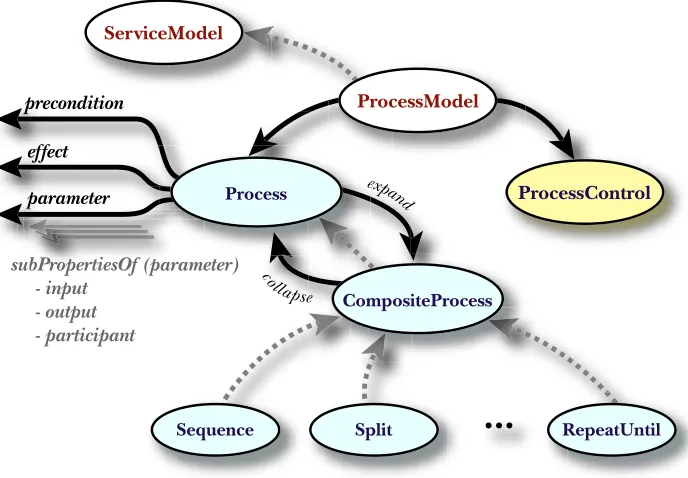
A more detailed perspective on services is that a service can be viewed as a process. We have defined a particular subclass ofServiceModel, the ProcessModel (as shown in figure 2), which draws upon well-established work in a variety of fields, such as AI planning and workflow automation, and which we believe will support the representational needs of a very broad array of services on the Web.
ServiceModel
ProcessControl ProcessModel
CompositeProcess
RepeatUntil Split
Sequence
eexx ex andd
co
a seee
di i precondition
parameter p
ff effect
subPropertiesOf (parameter)ubbPropertiesOf (parabPropertiesOf (par suubbPropertiesOf (pa
- input - output - participant
[image:8.612.129.473.74.313.2]Process
Figure 2: Top level of process modeling ontology
5.1 The Process Ontology
We expect our process ontology to serve as the basis for specifying a wide array of services. In developing the ontology, we drew from a variety of sources, including work in AI on standardizations of planning languages [9], work in programming languages and distributed systems [16, 15], emerging standards in process modeling and workflow technology such as the NIST’s Process Specification Language (PSL) [19] and the Workflow Management Coalition effort (http://www.aiim.org/wfmc), work on modeling verb semantics and event structure [17], previous work on action-inspired Web service markup [14], work in AI on modeling complex actions [11], and work in agent communication languages [12, 8].
The primary kind of entity in the Process Ontology is, unsurprisingly, a “process”.8 A process can have any number of inputs, representing the information that is, under some conditions, required for the execution of the process. It can have any number of outputs, the information that the process provides, conditionally, after its execution. Participants and other parameters may be specified; for example, the participants may include the roles in the event frame, such as the agents, patient, and instrument, whereas other parameters, especially for physical devices, might be rates, forces, and knob-settings. There can be any number of preconditions, which must all hold in order for the process to be invoked. Finally, the process can have any number of effects.
A process can often be viewed either as a primitive, undecomposable process or as a composite process, decomposable into other primitive or composite processes. Either perspective may be the more useful in some given context. Thus, a top-level PROCESS class has, as its sole subclass, COMPOSITEPROCESS, which in turn is subclassed by a variety of control structures.
More precisely, in DAML-S:
¯ Process
<rdfs:Class rdf:ID="Process">
<rdfs:comment> Top-level class for describing how a service works </rdfs:comment>
</rdfs:Class>
Class PROCESShas related propertiesparameter, input, output, participant, precondition, and (con-ditional)effect. Each of these properties ranges over a DAML object, which, at the upper ontology level, is not restricted at all. The properties input, output, and participant are categorized as sub-properties of parameter. Subclasses of PROCESS for specific domains can use DAML language elements to indicate more specific range restrictions, as well as cardinality restrictions for each of these properties.
The following is an example of a property definition: <rdf:Property rdf:ID="parameter">
<rdfs:domain rdf:resource="#Process"/>
<rdfs:range rdf:resource=""http://www.daml.org/2001/03/daml+oil#Thing"/> </rdf:Property>
In addition to its action-related properties, a PROCESShas a number of bookkeeping properties such asname(rdf:literal), address (URI), documentsread (URI), documentsupdated (URI), and so on.
¯ CompositeProcess
<daml:Class rdf:ID="CompositeProcess">
<daml:intersectionOf rdf:parseType="daml:collection"> <daml:Class rdf:about="#Process"/>
<daml:Restriction daml:minCardinality="1"> <daml:onProperty rdf:resource="#components"/> </daml:Restriction>
</daml:intersectionOf> </daml:Class>
<rdf:Property rdf:ID="components"> <rdfs:comment>
Holds the specific arrangement of subprocesses. </rdfs:comment>
<rdfs:domain rdf:resource="#CompositeProcess"/> </rdf:Property>
Composite processes are processes that have additional properties calledcomponents to indicate the ordering and conditional execution of the subprocesses from which they are composed. For instance, the composite process, SEQUENCE, has acomponents property that ranges over a PROCESSLIST(a list whose items are restricted to be simple or composite processes). In the process “upper ontology”, we have attempted to come up with a minimal set of process classes that can be specialized to describe a variety of Web services. This minimal set consists of Sequence, Split, Split + Join, Choice, Unordered, Condition, If-Then-Else, Iterate, Repeat-While, and Repeat-Until.
There are two fundamental relations between processes and composite processes. The EXPAND relation associates a Process with the CompositeProcess describing its component subprocesses, while its inverse, theCOLLAPSE relation represents the association of the CompositeProcess to its atomic Process form. Expanding is intended to provide a “glassbox” and collapsing a “blackbox” view of the process. The expanded version is likely to be used for service composition (both off-line and runtime) and the collapsed version for service execution.
The minimal set of composition templates (subclasses of CompositeProcess) is as follows:
Sequence : A list of Processes to be done in order. We use a DAML restriction to restrict the components of a Sequence process to be a List of subprocesses (simple and/or composite). <rdfs:Class rdf:ID="Sequence">
<daml:intersectionOf rdf:parseType="daml:collection"> <rdfs:Class> rdf:about="#Process" </rdfs:Class> <daml:Restriction>
<daml:onProperty rdf:resource="#components"/> <daml:toClass rdf:resource="#ProcessList"/> </daml:Restriction>
<daml:intersectionOf> </rdfs:Class>
Split : The components of aSplit process are a bag of sub-processes to be executed concurrently. No further specification about waiting or synchronization is made at this level.
<rdfs:Class rdf:ID="Split">
<daml:intersectionOf rdf:parseType="daml:collection"> <rdfs:Class> rdf:about ="#Process" </rdfs:Class> <daml:Restriction>
<daml:onProperty rdf:resource="#components"/> <daml:toClass rdf:resource="#ProcessBag"/> </daml:Restriction>
<daml:intersectionOf> </rdfs:Class>
Split is similar to other ontologies’ use of Fork, Concurrent, or Parallel. We use the DAML sameClassAs feature to accommodate the different standards for specifying this.
Unordered : Here a bag of processes can be executed in any order. No further constraints are specified. All processes must be executed.
Split+Join : Here the process consists of concurrent execution of a bunch of sub-processes with barrier synchronization. With Split and Split and Join, we can define processes that have partial synchronization (e.g., split all and join some sub-bag).
Choice : Choice is a composite process with additional properties “chosen” and “chooseFrom”. These properties can be used both for process and execution control (e.g., choose from “choose-From” and do “chosen” in sequence, or choose from “choose“choose-From” and do “chosen” in paral-lel) as well for constructing new subclasses like “choose at least n from m”, “choose exactly n from m”, “choose at most n from m”9, and so on.
Condition : Conditions are composite processes with an output property (conditionValue) whose range is a binary value. Conditions usually correspond to test actions, but they may be world states, resource levels, timeouts or other things affecting the evolution of processes.
This can be obtained by restricting the size of the Process Bag that corresponds to the “components” of the chosen and chooseFrom subprocesses using cardinality, min-cardinality, max-cardinality to get choose(n, m)(¼
If-Then-Else : The If-Then-Else class is a composite process that has properties “ifCondition”, “then” and “else” holding different aspects of the If-Then-Else composite process. Its seman-tics is intended as “Test If-condition; if True doThen, if False do Else.”
<rdf:Property rdf:ID="ifCondition">
<rdfs:comment> The if condition of an if-then-else </rdfs:comment> <rdfs:domain rdf:resource="#If-Then-Else"/>
<rdfs:range> rdf:resource ="#Condition" </rdfs:range> </rdf:Property>
<rdf:Property rdf:ID="then">
<rdfs:domain rdf:resource="#If-Then-Else"/> <rdfs:range rdf:resource="#CompositeProcess"/> </rdf:Property>
<rdf:Property rdf:ID="else">
<rdfs:domain rdf:resource="#If-Then-Else"/> <rdfs:range rdf:resource="#CompositeProcess"/> </rdf:Property>
Iterate : Iterate is a composite process whose next process property has the same value as the current process. Repeat is defined as a synonym of the iterate class. The repeat/iterate pro-cess makes no assumption about how many iterations are made or when to initiate, terminate or resume. The initiation, termination or maintainance condition could be specified with a whileCondition or an untilCondition as below.10
Repeat-Until : The Repeat-Until class is similar to the Repeat-While class in that specializes the If-Then-Else class where the “ifCondition” is the same as the untilCondition and different from the Repeat-While class in that the “else” (compared to “then”) property is the repeated process. Thus the process repeats till the untilCondition becomes true.
5.2 Process Control Ontology
A process instantiation represents a complex process that is executing in the world. To monitor and control the execution of a process, an agent needs a model to interpret process instantiations with three characteristics:
1. It should provide the mapping rules for the various input state properties (inputs, preconditions) to the corresponding output state properties.
2. It should provide a model of the temporal or state dependencies described by the sequence, split, split+join, etc constructs.
3. It should provide representations for messages about the execution state of atomic and composite processes sufficient to do execution monitoring. This allows an agent to keep track of the status of executions, including successful, failed and interrupted processes, and to respond to each appropri-ately.
We have not defined a process control ontology in the current version of DAML-S, but we plan to in a future version.
5.3 Time
For the initial version of DAML-S we have defined a very simple upper ontology for time. There are two classes of entities—instants and intervals. Each is a subclass of temporal-entity.
There are three relations that may obtain between an instant and an interval, defined as DAML-S properties:
1. TheStart-of property whose domain is the Interval class and whose range is an Instant. 2. TheEnd-of property whose domain is the Interval class and whose range is an Instant. 3. TheInside property whose domain is the Interval class and whose range is an Instant.
No assumption is made that intervals consist of instants.
There are two possible relations that may obtain between a process and one of the temporal objects. A process may be in an at-time relation to an instant or in a during relation to an interval. Whether a particular process is viewed as instantaneous or as occuring over an interval is a granularity decision that may vary according to the context of use. These relations are defined in DAML-S as properties of processes.
1. TheAt-time property: its domain is the Process class and its range is an Instant. 2. TheDuring property: its domain is the Process class and its range is an Interval.
Viewed as intervals, processes could have properties such as startTime and endTime which are syn-onymous (daml:samePropertyAs) with the Start-Of and End-Of relation that obtains between intervals and instants.
One further relation can hold between two temporal entities—the before relation. The intended se-mantics is that for an instant or interval to be before another instant or interval, there can be no overlap or abutment between the former and the latter. In DAML-S the Before property whose domain is the Temporal-entity class and whose range is a Temporal-entity.
Different communities have different ways of representing the times and durations of states and events (processes). For example, states and events can both have durations, and at least events can be instan-taneous; or events can only be instantaneous and only states can have durations. Events that one might consider as having duration (e.g., heating water) are modeled as a state of the system that is initiated and terminated by instantaneous events. That is, there is the instantaneous event of the start of the heating at the start of an interval, that transitions the system into a state in which the water is heating. The state continues until another instantaneous event occurs—the stopping of the event at the end of the interval. These two perspectives on events are straightforwardly interdefinable in terms of the ontology we have provided. Thus, DAML-S supports both.
6 Example Walk-Through
To illustrate the concepts described in this paper, we have developed an example of a fictitious book-buying service offered by the Web service provider, Congo Inc. Congo has a suite of programs that they are making accessible on the Web. Congo wishes to compose these individual programs into Web services that it offers to its users. We focus here on the Web service of buying a book, CongoBuy. In the DAML-S release, we present a walk-through that steps through the process of creating DAML-S markup for Congo11.
We take the perspective of the typical Web service provider and consider three automation tasks that a Web service provider might wish to enable with DAML-S: 1) automatic Web service discovery, 2) automatic Web service invocation, and 3) automatic Web service composition and interoperation. For the purposes of this paper, we limit our discussion to the second and third tasks.
6.1 Web Service Invocation
To automate Web Service Invocation, DAML-S markup must tell a program how to automatically construct an (http) call to execute or invoke a Web service, and what output(s) may be returned from the service. To enable such functionality, the process ontology in DAML-S provides markup to describe individual and composite Web-accessible programs as either simple or composite processes.
6.1.1 Define the Service as a Process
Congo Inc. provides the CongoBuy Web service to its customers. We view the CongoBuy Web service as a Process, i.e., it is a subclass of the class Process in the process ontology.
<rdfs:Class rdf:ID="CongoBuy"> <rdfs:subClassOf rdf:resource=
"http://www.daml.org/services/daml-s/2001/05/Process.daml#Process"/> </rdfs:Class>
Although the CongoBuy service is actually a predetermined composition of several of Congo’s Web-accessible programs, it is useful to initially view it as a black-box process. The black-box process, Con-goBuy has a variety of invocation-relevant properties, including input, (conditional) output and parameter. For example, input to the CongoBuy book-buying service includes the name of the book (bookName), the customer’s credit card number, and their account number and password. If the service being described is simple in that it is not the composition of other services or programs, then the service inputs are simply the set of inputs that must be provided in the service invocation. The outputs are the outputs returned from the service invocation. Note that these outputs may be conditional. For example the output of a book-buying service will vary depending upon whether the book is in or out of stock.
In contrast, if the service is composed of other services, as is the case with CongoBuy, then the rationale for specification of the inputs, outputs and parameters is more difficult, and the utility of these properties is limited. In the simplest case, the inputs and outputs of the black-box process can be defined to be the composition of all the possible inputs and all the possible (conditional) outputs of the simple services that the black-box process may invoke, taking every possible path through the composition of simple services. Note however that this is not a very exacting specification. In particular, the collection of outputs may be contradictory (e.g., one path of CongoBuy may lead to confirmation of a purchase, while another may lead to confirmation of no purchase). The conditions under which inputs and outputs arise are encoded exactly in the expand of this black-box process, and can be retrieved from the expanded process. The inputs, outputs and parameters for the black-box process are designed to be a useful shorthand. Thus, it
could be argued that the inputs and outputs should describe the most likely inputs and outputs through the system. However, in some cases, even this is difficult to define. For now, DAML-S leaves this decision up to the Web service provider.
The following is an example of one input to CongoBuy. Note that it is a subproperty of the property input of Process, from the process model.
<rdf:Property rdf:ID="bookName"> <rdfs:subPropertyOf rdf:resource=
"http://www.daml.org/services/daml-s/2001/05/Process.daml#input"/> <rdfs:domain rdf:resource="#CongoBuy"/>
<rdfs:range rdf:resource="http://www.w3.org/2000/10/XMLSchema#string"/> </rdf:Property>
An output can similarly be defined as a subproperty of the property output of Process. In a real book-buying service, this output would likely be conditioned on the book being in stock, or the customer’s credit card being valid, but to simplify our example, we assume Congo has an infinite supply of books, and infinite generosity.
<rdf:Property rdf:ID="eReceiptOutput"> <rdfs:subPropertyOf rdf:resource=
"http://www.daml.org/services/daml-s/2001/05/Process.daml#output"/> <rdfs:range rdf:resource="#EReceipt"/>
</rdf:Property>
In addition to input and output properties, each service has parameter properties. A parameter is something that affects the outcome of the process, but which is not an input provided by the invoker of the process. It may be known by the service, or retrieved by the service from elsewhere. For example, the fact that the customer’s credit card is valid, is a parameter in our CongoBuy process, and is relevant when considering the use of the CongoBuy, but it is not an input or output of CongoBuy.
<rdf:Property rdf:ID="creditCardValidity"> <rdfs:subPropertyOf rdf:resource=
"http://www.daml.org/services/daml-s/2001/05/Process.daml#parameter"/> <rdfs:range rdf:resource="#ValidityType"/>
</rdf:Property>
6.1.2 Define the Process as a Composition of Processes
Given the variability in the specification of inputs, outputs and parameters, it is generally insufficient to simply specify a service as a black-box process, if the objective is to automate service invocation. We must expand the black-box service to describe its composite processes. This is achieved by first defining the individual processes and then defining their composition as a composite process.
Define the Individual Processes
We first define each of the simple services in CongoBuy, i.e., LocateBook, PutInCart, etc.12 <rdfs:Class rdf:ID="LocateBook">
<rdfs:Class rdf:ID="PutInCart">
<rdfs:subClassOf rdf:resource="#CongoBuy"/> </rdfs:Class>
<rdf:Property rdf:ID="bookSelected"> <rdfs:subPropertyOf rdf:resource=
"http://www.daml.org/services/daml-s/2001/05/Process.daml#input"/> <rdfs:domain rdf:resource="#PutInCart"/>
<rdfs:range rdf:resource="http://www.w3.org/2000/10/XMLSchema#string"/> </rdf:Property>
Define the Composition of the Individual Processes
The composition of each of our simple services can be defined by using the composition constructs created in the process ontology, i.e., Sequence, Split, Split + Join, Unordered, Condition, If-Then-Else, Repeat-While, Repeat-Until. We first create an expand class and then construct the overall expand class recursively in a top- down manner.
<process:expand>
<rdfs:Class> rdfs:about ="#CongoBuy"</rdfs:Class>
<rdfs:Class> rdfs:about ="#ExpandedCongoBuy"</rdfs:Class> </process:expand>
Each process has a property called components (itself a bag of processes). The processes in the bag may be other simple or composite processes. As such, they recursively define the composition of simple processes that defines the black-box process CongoBuy.
The expanded CongoBuy process (ExpandedCongoBuy) is comprised of a sequence of two processes, a simple process that locates a book (LocateBook), and a complex process that buys the book (CongoB-uyBook). We define them as follows13:
<rdfs:Class rdf:ID="ExpandedCongoBuy">
<daml:intersectionOf rdf:parseType="daml:collection"> <daml:Class rdf:about=
"http://www.daml.org/services/daml-s/2001/05/Process.daml#Sequence"/> <daml:Restriction>
<daml:onProperty rdf:resource=
"http://www.daml.org/services/daml-s/2001/05/Process.daml#components"/> <daml:toClass>
<daml:Class>
<daml:intersectionOf rdf:parseType="daml:collection"> <daml:Restriction>
<daml:onProperty rdf:resource=
"http://www.daml.org/services/daml-s/2001/05/Process.daml#firstItem"/> <daml:toClass rdf:resource ="#LocateBook"/>
</daml:Restriction> <daml:Restriction>
<daml:onProperty rdf:resource=
"http://www.daml.org/services/daml-s/2001/05/Process.daml#secondItem"/> <daml:toClass rdf:resource ="#CongoBuyBook"/>
</daml:Restriction> </daml:intersectionOf> </daml:Class>
</daml:toClass> </daml:Restriction> </daml:intersectionOf> </rdfs:Class>
In the full Congo.daml example, CongoBuyBook is a composite process that is further decomposed, eventually terminating in a composition of simple processes. With this markup we complete our markup to enable automated service invocation.
6.1.3 Automated Service Composition and Interoperation
The DAML-S markup required to automate service composition and interoperation builds directly on the markup for service invocation. In order to automate service composition and interoperation, we must also encode the effects a service has upon the world, and the preconditions for performing that service. For example, when a human being goes to www.congo.com and successfully executes the CongoBuy service, the human knows that they have purchased a book, that their credit card will be debited, and that they will receive a book at the address they provided. Such consequences of Web service execution are not part of the input/output markup we created for automating service invocation.
The process ontology provides precondition and effect properties of a process to encode this infor-mation. As with our markup for automated service invocation, we define preconditions and effects both for the black-box process CongoBuy and for each of the simple processes that define its composition, and as with defining inputs and outputs, it is easiest to define the preconditions and effects for each of the simple processes first, and then to aggregate them into preconditions and effects for CongoBuy. The markup is analogous to the markup for input and (conditional) output, but is with respect to the properties precondition and (conditional) effect, instead.
7 Related Efforts
Industry efforts to develop standards for electronic commerce, and in particular for the description of Web-based services currently revolve around UDDI, WSDL, and ebXML [23]. There have also been company-specific initiatives to define architectures for e-commerce, most notably E-speak from Hewlett-Packard.
Nevertheless, we believe that DAML-S provides functionality that the other efforts do not. In com-parison to the DAML-S characterization of services, the industry standards mostly focus on presenting a ServiceProfile and a ServiceGrounding of services (to use DAML-S terminology). ServiceGroundings are supported by all the standards. However, they are limited with respect to DAML-S profiles in that they cannot express logical statements, e.g. preconditions and postconditions, or rules to describe dependen-cies between the profile elements. Input and output types are supported to varying extents. Furthermore, DAML-S supports the description of certain functional attributes of services, which are not covered in the other standards, such as qualityGuarantees and serviceType.
With respect to the four tasks of automatic Web service discovery, automatic Web service invocation, automatic Web service interoperation and composition, and automatic Web service execution monitoring that DAML-S is meant to support, the standards primarily enable the first and the second tasks to a certain extent. These standards are still evolving and it is unclear at present to what extent composition will be addressed. At the moment, the standards do not consider theServiceModel of a service and thus, they also do not support execution monitoring, as defined in this paper.
In the following sections, we look in greater detail at each of these technologies in turn and compare them to DAML-S.
7.1 UDDI
UDDI (Universal Description, Discovery and Integration) is an initiative proposed by Microsoft, IBM and Ariba to develop a standard for an online registry, and to enable the publishing and dynamic discovery of Web services offered by businesses [22]. UDDI allows programmers and other representatives of a business to locate potential business partners and form business relationships on the basis of the services they provide. It thus facilitates the creation of new business relationships.
The primary target of UDDI seems to be integration and at least semi-automation of business transac-tions in B2B e-commerce applicatransac-tions. It provides a registry for registering businesses and the services they offer. These are described according to an XML schema defined by the UDDI specification. A Web service provider registers its advertisements along with keywords for categorisation. A Web services user retrieves advertisements out of the registry based on keyword search. The UDDI search mechanism relies on pre-defined categorisation through keywords and does not refer to the semantic content of the adver-tisements. The registry is supposed to function in a fashion similar to white pages or yellow pages, where businesses can be looked up by name or by a standard service taxonomy as is already used within the in-dustry. UDDI attempts to cover all kinds of services offered by businesses, including those that are offered by phone or e-mail and similar means; in principle, DAML-S could do this, but it has not been our focus.
Technically speaking, each business description in UDDI consists of a businessEntity element, akin to a White Pages element describing the contact information for a business. A businessEntity describes a business by name, a key value, categorisation, services offered (businessService elements) and contact information for the business. A businessService element describes a service using a name, key value, cat-egorisation and multiple “bindingTemplate” elements. This can be considered to be analogous to a Yellow Pages element that categorises a business. A bindingTemplate element in turn describes the kind of access the service requires (phone, mailto, http, ftp, fax etc.), key values and tModelInstances. tModelInstances are used to describe the protocols, interchange formats that the service comprehends, that is, the technical information required to access the service. It is also used to describe the “namespaces” for the classifica-tions used in categorisation. Many of the elements are optional, including most of the ones that would be required for matchmaking or service composition purposes.
UDDI aims to facilitate the discovery of potential business partners and the discovery of services and their groundings that are offered by known business partners. This may or may not be done automatically. When this discovery occurs, programmers affiliated with the business partners program their own systems to interact with the services discovered. This is also the model generally followed by ebXML. DAML-S enables more flexible discovery by allowing searches to take place on almost any attribute of the Service-Profile. UDDI, in contrast, allows technical searches only on tModelKeys, references to tModelInstances, which represent full specifications of a kind of service.
UDDI does not support semantic descriptions of services. Thus, depending on the functionality offered by the content language, although agents can search the UDDI registry and retrieve service descriptions, a human needs to be involved in the loop to make sense of the descriptions, and to program the access interface.
7.2 WSDL
WSDL (Web Services Description Language) is an XML format, closely associated with UDDI as the language for describing interfaces to business services registered with a UDDI database. Thus, it is closer to DAML-S in terms of functionality than UDDI. Like DAML-S, it attempts to separate services, defined in abstract terms, from the concrete data formats and protocols used for implementation, and defines bindings between the abstract description and its specific realization [3]. However, the abstraction of services is at a lower level than in DAML-S.
Services are defined as sets of ports, i.e. network addresses associated with certain protocols and data format specifications. The abstract nature of a service arises from the abstract nature of the messages and operations mapped to a port and define its port type. Port types are reusable and can be bound to multiple ports [18]. There are four basic types of operations in WSDL: a one-way, a (two-way) request-response, a (two-way) solicit-response and a (one-way) notification message. A message itself is defined abstractly as a request, a response or even a parameter of a request or response and its type, as defined in a type system like XSD. They can be broken into parts to define the logical break-down of a message.
Messages and operations are defined abstractly and are thus reusable and extensible and correspond roughly to the DAML-S ServiceProfile. The service element itself incorporates both a ServiceProfile and ServiceGrounding information. WSDL service descriptions are not as expressive as DAML-S profiles. Preconditions, postconditions and effects of service access cannot be expressed within WSDL.
Like UDDI, WSDL does not support semantic description of services. WSDL focuses on the ground-ing of services and although it has a concept of input and output types as defined by XSD, it does not support the definition of logical constraints between its input and output parameters. Thus its support for discovery and invocation of services is less versatile than that of DAML-S.
7.3 E-speak
Hewlett-Packard is collaborating with the UDDI consortium to bring E-speak technology to the UDDI standard. E-speak and UDDI have similar goals in that they both facilitate the advertisement and discovery of services. E-speak is also comparable to WSDL in that it supports the description of service and data types [6]. It has a matching service that compares service requests with service descriptions, primarily on the basis of input-output and service type matching.
E-speak describes services (known as “Resources”) as a set of attributes within several “Vocabular-ies”. Vocabularies are sets of attributes common to a logical group of services. E-speak matches lookup requests against service descriptions with respect to these attributes. Attributes take common value types such as String, Int, Boolean and Double. There is a base vocabulary which defines basic attributes such as Name, Type (of value String only), Description, Keywords and Version. Currently, there is no semantic meaning attached to any of the attributes. Any matching which takes place is done over the service de-scription attributes which does not distinguish between any further subtypes. DAML-S had a much richer set of attributes; in DAML-S terminology, the input/output parameters, effects and additional functional attributes. In addition, dependencies between attributes and logical constraints on them are not expressible within E-speak.
7.4 ebXML
ebXML, being developed primarily by OASIS and the United Nations, approaches the problem from a workflow perspective. ebXML uses two views to describe business interactions, a Business Operational View (BOV) and a Functional Service View (FSV) [7] [23]. The BOV deals with the semantics of business data transactions, which include operational conventions, agreements, mutual obligations and the like be-tween businesses. The FSV deals with the supporting services: their capabilities, interfaces and protocols. Although ebXML does not concentrate on only Web services, the focus of this view is essentially the same as that of the current DAML-S effort.
It has the concept of a Collaboration Protocol Profile (CPP) “which allows a Trading Partner to ex-press their supported Business Processes and Business Service Interface requirements [such that they are understood] by other ebXML compliant Trading Partners”, in effect a specification of the services offered by the Trading Partner. A Business Process is a set of business document exchanges between the Trading Partners. CPPs contain industry classification, contact information, supported Business Processes, inter-face requirements etc. They are registered within an ebXML registry, in which there is discovery of other Trading Partners and the Business Processes they support. In this respect, UDDI has some similarities with ebXML. However, ebXML’s scope does not extend to the manner in which the business documents are specified. This is left to the Trading Partners to agree upon a priori by the creation of a Collaboration Protocol Agreement.
In conclusion, the kind of functionality, interoperability and dynamic matchmaking capabilities pro-vided by DAML-S is only partially supported, as the standards are currently positioned, by WSDL and UDDI. UDDI may become more sophisticated as it incorporates e-speak-like functionalities, but it will not allow automatic service interoperability until it incorporates the information provided by DAML-S.
8 Summary and Current Status
DAML-S is an attempt to provide an ontology, within the framework of the DARPA Agent Markup Lan-guage, for describing Web services. It will enable users and software agents to automatically discover, invoke, compose, and monitor Web resources offering services, under specified constraints. We have released an initial version of DAML-S. It can be found at the URL: http://www.daml.org/services/daml-s
We expect to enhance it in the future in ways that we have indicated in the paper, and in response to users’ experience with it. We believe it will help make the Semantic Web a place where people can not only find out information but also get things done.
Acknowledgments
The authors have profited from discussions about this work with Ron Fadel, Richard Fikes, Jessica Jenk-ins, James Hendler, Mark Neighbors, Tran Cao Son, and Richard Waldinger. The research was funded by the Defense Advanced Research Projects Agency as part of the DARPA Agent Markup Language (DAML) program under Air Force Research Laboratory contract F30602-00-C-0168 to SRI International, F30602-00-2-0579-P00001 to Stanford University, and F30601-00-2-0592 to Carnegie Mellon University. Additional funding was provided by Nokia Research Center.
References
[2] T. Berners-Lee, J. Hendler, and O. Lassila. The semantic web. Scientific American, 284(5):34–43, 2001.
[3] E. Christensen, F. Curbera, G. Meredith, and S. Weerawarana. Web Services Description Language (WSDL) 1.1. http://www.w3.org/TR/2001/NOTE-wsdl-20010315, 2001.
[4] K. Decker, K. Sycara, and M. Williamson. Middle-Agents for the Internet. In IJCAI97, 1997. [5] G. Denker, J. Hobbs, D. Martin, S. Narayanan, and R. Waldinger. Accessing information and services
on the daml-enabled web. In Proc. Second Int’l Workshop Semantic Web (SemWeb’2001), 2001. [6] E-Speak. E-Speak Architectural Specification Release A.0. http://www.e-speak.hp.com/media/
a0/architecturea0.pdf, 2001.
[7] ebXML. ebXML Web Site. http://www.ebXML.org/, 2000.
[8] T. Finin, Y. Labrou, and J. Mayfield. KQML as an agent communication language. In J. Bradshaw, editor, Software Agents. MIT Press, Cambridge, 1997.
[9] M. Ghallab et. al. Pddl-the planning domain definition language v. 2. Technical Report, report CVC TR-98-003/DCS TR-1165, Yale Center for Computational Vision and Control, 1998.
[10] J. Hendler and D. L. McGuinness. Darpa agent markup language. IEEE Intelligent Systems, 15(6):72–73, 2001.
[11] H. Levesque, R. Reiter, Y. Lesperance, F. Lin, and R. Scherl. GOLOG: A Logic programming language for dynamic domains. Journal of Logic Programming, 31(1-3):59–84, April-June 1997. [12] D. Martin, A. Cheyer, and D. Moran. The Open Agent Architecture: A Framework for Building
Distributed Software Systems. Applied Artificial Intelligence, 13(1-2):92–128, 1999.
[13] S. McIlraith, T. C. Son, and H. Zeng. Mobilizing the web with daml-enabled web service. In Proc. Second Int’l Workshop Semantic Web (SemWeb’2001), 2001.
[14] S. McIlraith, T. C. Son, and H. Zeng. Semantic web service. IEEE Intelligent Systems, 16(2):46–53, 2001.
[15] J. Meseguer. Conditional Rewriting Logic as a Unified Model of Concurrency. Theoretical Computer Science, 96(1):73–155, 1992.
[16] R. Milner. Communicating with Mobile Agents: The pi-Calculus. Cambridge University Press, Cambridge, 1999.
[17] S. Narayanan. Reasoning about actions in narrative understanding. In Proc. International Joint Conference on Artifical Intelligence (IJCAI’1999), pages 350–357. Morgan Kaufman Press, San Francisco, 1999.
[18] U. Ogbuji. Using WSDL in SOAP applications: An introduction to WSDL for SOAP programmers. http://www-106.ibm.com/developerworks/library/ws-soap/?dwzone=ws, 2001.
[19] C. Schlenoff, M. Gruninger, F. Tissot, J. Valois, J. Lubell, and J. Lee. The Process Specification Lan-guage (PSL): Overview and version 1.0 specification. NISTIR 6459, National Institute of Standards and Technology, Gaithersburg, MD., 2000.
[20] K. Sycara and M. Klusch. Brokering and matchmaking for coordination of agent societies: A survey. In A. e. a. Omicini, editor, Coordination of Internet Agents. Springer, 2001.
[21] K. Sycara, M. Klusch, S. Widoff, and J. Lu. Dynamic service matchmaking among agents in open information environments. ACM SIGMOD Record (Special Issue on Semantic Interoperability in Global Information Systems), 28(1):47–53, 1999.
[22] UDDI. The UDDI Technical White Paper. http://www.uddi.org/, 2000.
[23] D. Webber and A. Dutton. Understanding ebXML, UDDI and XML/edi. http://www.xml.org/fea-ture articles/2000 1107 miller.shtml, 2000.