Firethorn, Pyracantha coccinea Roem., is one of the most beautiful ornamental plants. In central Europe, the ornamental effect of firethorn has suffered severely since the 1980-ies because of the spread of the fungal disease of pome (scab disease) caused by Spilocaea pyracanthae (Otth) Arx (syn. Venturia pyracanthae Desm.), anamorph Fusicladiumpyracanthae (Otth) Rostr. (V������� & M�������� 1992).
MATERIALS AND METHODS
Selection of localities to evaluate the health state ofPyracantha coccinea. The sites for this evaluation were chosen so as to include the different types of urban greenery (streets, parks, parts of the road and rail network, urban spaces, special-purpose plan-tings) in selected towns in Slovakia. Plants from Arborétum Mlyňany, Zvolen, Nitra, Bratislava, Zlaté
Moravce, Topoľčany, Kováčová, Radošina, Sliač and Modra were evaluated in the year 2001 (10 localities with 34 sites). More plants from sites at Nitra and Bratislava were evaluated in 2002 (18 sites).
Taking of samples and evaluation of the level of damage to fruits of P. coccinea.
Samples were taken from March to October so that the first symptoms of the disease and each of its development stages could be recorded. At each site and according to an established time schedu-le, 100 fruits were collected from bottom, middle and top branches of a shrub and according to the cardinal points. The degree of damage to the fruit surface was classified by a five point scale: 0 – no visible damage on evaluated shrubs, fruits
are healthy;
1 – sporadic spots on infected fruits, different in size and shape; number of spots between one and three;
Scab Disease of Firethorn at Selected Localities in Slovakia
G������� JUHÁSOVÁ1, H����� IVANOVÁ1, K������� ADAMČÍKOVÁ1, M���� KOBZA1
and A����� ČEREVKOVÁ2
1Branch of Woody Plant Biology, Institute of Forest Ecology of the Slovak Academy of Sciences,
Nitra, Slovak Republic; 2Department of Plant Protection, Faculty of Agrobiology and Food
Resources, Slovak Agricultural University in Nitra, Nitra, Slovak Republic
Abstract
J�������G., I������ H., A��������� K., K���� M., Č�������� A. (2004): Scab disease of firethorn at selected localities in Slovakia. Plant Protect. Sci., 40: 42–48.
The health state of firethorn, Pyracantha coccinea, was evaluated in different types of functional urban greenery at locations in Slovakia during 2001 (34 sites) and 2002 (18 sites). The occurrence of scab disease, caused by the fungus Spilocaea pyracanthae, was recorded. The degree of damage to firethorn fruits was evaluated; it ranged from 3.6% to 98.8% (2001) and from 9.1% to 38.5% (2002). Germination of conidia of the fungus ranged between 42 and 50% at 24–25°C after 24 h, and from 49% to 61% after 48 h. The germination of conidia collected on differ-ent parts of the plants from July to September was compared. Conidia taken from olive-green spots on fruits in September had the highest germination (53–89%).
Keywords: Pyracantha coccinea; Spilocaea pyracanthae; Slovakia
2 – one third of the fruit surface covered with spots;
3 – half of the fruit surface covered with spots; 4 – spots covered nearly the entire surface of
in-fected fruits.
The damage to the fruits in % was calculated according to the Towsend-Heuberger formula (T������ & H�������� 1943):
100 . 5 ) . 4 ( ) . 3 ( ) . 2 ( ) . 1 ( ) . 0 ( × + + + + = N n n n n n P
where: N – number of evaluated fruits
n – number of damaged fruits in each of the
categories 0–4
P – stage of damage
Isolation and culture of the fungus. The fungus Spilocaea pyracanthae was isolated from infected firethorn fruits and cultured. Infected samples came from the sites Nitra, Botanical Garden (10. 10. 2002), Nitra, Novomeského Street (17. 10. 2002) and Bratislava, SAS Patrónka (13. 10. 2002). After surface sterilisation (0.15% NaClO, 20 min) the fruits were cut into small pieces (2–3 mm) and placed on the three solid media 3% maltose agar, 3% saccharose agar, and 3% potato dextrose agar in Petri dishes. These were incubated in the dark at 24–25°C and relative air humidity. The growth rate of the mycelium was measured every 24 h and was calculated from 10 repetitions.
Germination of conidia of the fungus. Fruits were colleted in July, August and September 2001 from the sites Nitra, Hornočermánska, Botanical Garden, Hviezdoslavova (27. 7., 10. 8., 26. 9., streets, park, urban spaces), Modra, Mariánske Square (27. 7., 31. 8., 25. 9., streets), Zvolen, Štúrova Street (12. 8., 10. 9., streets) and Zlaté Moravce, Bernolákova (28. 7. 10. 8., 13. 9., street). Conidia were taken from the olive-green and brown coatings on the fruit surface.
Dissolved 3% maltose agar was poured onto slides. After hardening of the medium, several drops of distilled water with fungal conidia were placed onto the medium. The slides were placed in desiccators kept at 24°C and the rate of germi-nation determined after 24 and 48 h using a light microscope Carl-Zeiss Jena. Differences in the mean number of germinated conidia sampled from sites with different types of functional greenery (green and brown spots) were subjected to analyses of vari-ation with two factors (functional type of greenery and month of sampling) with factors interaction. Post hoc tests were made by LSD test.
RESULTS
Occurrence and distribution of Pyracantha coccinea and Spilocaea pyracanthae
Scab disease occurred at all 10 localities and 52 sites.
Description of symptoms on leaves, branches and fruits of P. coccinea
[image:2.595.305.532.366.690.2]The fungus Spilocaea pyracanthae, the cause of pyracantha scab, brought about severe damage to firethorn. The fungus is a commonly widespread pest not only in Slovakia, but also in some areas of southern Europe (U������ & V���� 1968). Scab was manifested on fruits as a continual coating by a mycelium with conidiophores and conidia. Fru-its were infected even on young shrubs that were fruiting for the first or second time. The degree of damage is higher on older shrubs.
Figure 1. Fruits of Pyracantha coccinea damaged by the
fungus Spilocaea pyracanthaea. They become deformed
from May to the end of June, the second was usually at the end of summer. There were no significant differences between the germination rates of conidia taken in the same month but from different sites. On the other hand, significant dif-ferences in germination of conidia were observed comparing the months July, August and Septem-ber. The highest rate of conidia germination was found in September. Differences in germination were also recorded between conidia sampled on infected tissue with differently coloured spots. Germination of conidia taken from olive-green spots in September was the highest and ranged
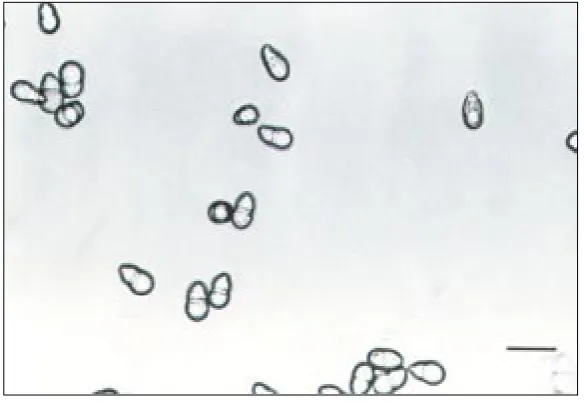
Figure 2. Conidia of Spilocaea pyracanthae
(bar = 25 µm)
A soft, later dark green mycelial layer is formed on fruits. Smooth, brown spots crack and turn into scabs at the end of May. The mycelium directly penetrates epidermal cells. The host defends it-self against deeper penetration of the mycelium by suberisation of the fruit flesh. At the site of infection the fruit stops to grow and becomes deformed, whereas healthy parts keep growing and, therefore, infected fruits are wrinkled and deformed (Figure 1).
The conidia are formed on infected organs, and spread by rain and air during the whole season. In our case, the first wave of infection occurred
Figure 3. Degree of damage to Pyracantha coccinea fruits by the fungus Spilocaea pyracanthae at the same sites but
in different years (2001 and 2002)
1 –Nitra, Botanical Garden 1; 2 –Nitra, Botanical Garden 2; 3 –Nitra, Priechodná Street; 4 –Nitra, Novomeského Street; 5 –Nitra, Hviezdoslavova Street 1; 6 –Nitra, Hviezdoslavova Street 2; 7 –Nitra, Hornočermánska Street; 8 – Bratisla-va, Trnavská Road; 9 –Bratislava, Radlinského Street; 10 –Bratislava, SAS Patrónka; 11 –Bratislava, Liberty Square; 12 –Bratislava, Kolár Square
1 2 3 4 5 6 7 8 9 10 11 12
Site 120
100
80
60
40
20
0
Pr
op
or
tio
n
of
d
am
ag
e
(%
) 2001
[image:3.595.95.464.490.667.2]from 53 to 89%. Conidia taken from spots in July and those taken from brown spots had the lowest germination, at 18–38%.
The fungus is spread during the growing season by conidia that are formed on short conidiophores. The conidia are brown or olive-green, smooth, straight, in the lower part enlarged and with one compartment. Conidia isolated from leaves and fruits are 7–11 × 14–34 µm in size (Figure 2).
A brown or black stroma with pseudoperithecia is formed in the thick mycelial layer on fruits and leaves from the end of October to the beginning of November. The pseudoperithecia we observed were 90–140 µm in size, asci were 60–90 × 8–14 µm, and ascospores 8–14 × 3–7 µm. The scab fungus overwinters in pseudoperithecia in leaf litter. The fruiting bodies mature in spring, depending on optimal conditions of temperature and humidity. Ascospores are the primary source of infection; they are released in April and May, always after intensive rain.
Degree of damage to fruits
The results of the evaluation in 2001of the degree of damage to firethorn fruits in different types of
[image:4.595.62.532.104.189.2]urban greenery are shown in Figure 3. The fun-gus caused damage to fruits, leaves and branches. Degree of damage to fruits was evaluated by the Townsend-Heuberger method. Fruits were infected with scab at all evaluated sites. The proportion of damaged fruits ranged from 3.6% to 98.8%. Fruits at the site Bratislava, Radlinského Street, had the lowest damage. The highest degree of damage was recorded at Nitra, Hviezdoslavova Street 2.
Table 1. Growth rate of mycelium of Spilocaea pyracanthaea on different media within 96 hours
Medium Minimum and maximum range of growth of mycelium (mm)
a�er 24 h a�er 48 h a�er 72 h a�er 96 h
Maltose agar 9.0–11.3 15.8–17.8 24.2–25.6 35.2–38.4
Saccharose agar 11.9–14.9 19.8–23.3 28.8–32.8 37.0–42.6
[image:4.595.306.529.200.368.2]Potato-dextrose agar 10.2–11.9 16.7–18.9 30.7–32.7 45.6–47.6
Figure 4. Germination rate on 3% maltose agar of
coni-dia of Spilocaea pyracanthae from selected localities
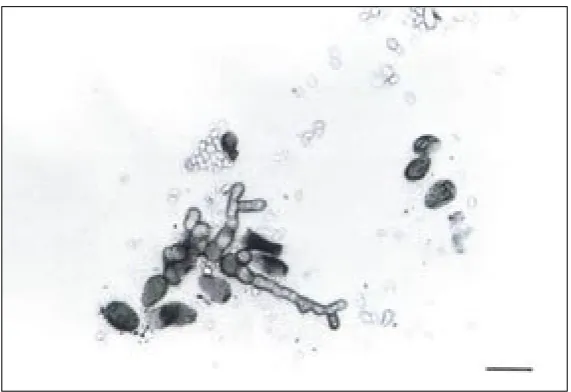
Figure 5. Beginning of germination of
coni-dia of Spilocaea pyracanthae on 3% maltose
agar at 24°C a�er 48 h of incubation (bar = 25 µm)
24 h 48 h
Germination of conidia after hours 60
40
20
0
G
er
m
in
at
io
n
ra
te
(
%
)
Modra Nitra
[image:4.595.63.349.560.756.2]Infection also occured in 2002, and the levels of damage to fruits at 18 sites of two localities (Bra-tislava and Nitra) ranged from 9.1% to 38.5%. The shrubs most severely damaged were at the site Nitra, Novomeského Street (38.5%), the lowest was found at site Nitra, Student Residence A. Bernolák (9.1%). The levels of damage by the disease on the same shrubs in 2001 and 2002 were compared and are shown in Figure 3.
Isolation and culture of Spilocaea pyracanthae
[image:5.595.286.529.86.215.2]The fungus was successfully isolated on all three media. After 8–10 d of culture the fungus sporulated as yellow or orange powder covering the media surface. Sporulation was intense on 3% Figure 6. Germination rate on 3% maltose agar of
co-nidia taken from brown spots on Pyracantha coccinea
fruits collected at different sites from July to September 2001
Figure 7. Germination rate on 3% maltose agar of
conidia taken from olive-green spots on Pyracantha
coccinea fruits collected at different sites from July to
September 2001
Figure 8. Two months old culture of Spilocaea
pyra-canthae
malt agar and 3% potato dextrose agar, while on 3% saccharose agar it was sparser.
There were only small differences between the media in growth rate of the mycelium. It was fast-est on potato dextrose agar after 96 h, although at the beginning (up to 48 h) the growth rate was slow. A very slow but symmetric growth rate was found on maltose agar (Table 1). Fruiting bodies with conidia were formed on the surface of the media after 2 months of culture (Figure 8).
Germination of conidia
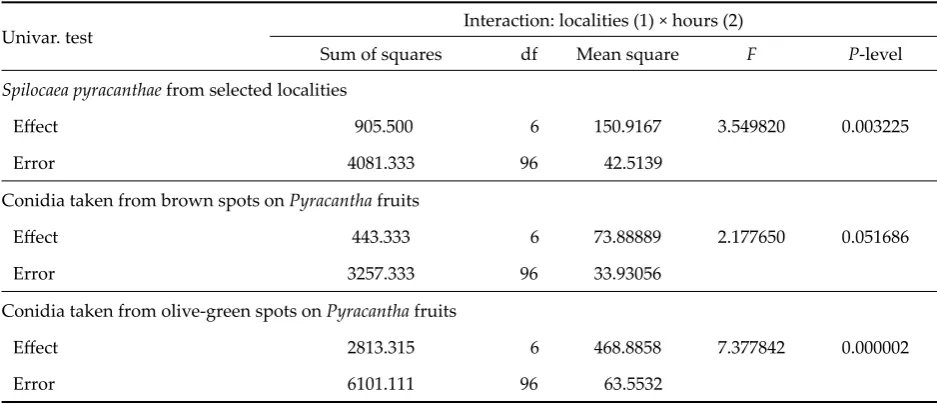
The germination rate of the conidia ranged between 42 and 50% at 24–25°C after 24 h. The number of germinating conidia increased after 48 h of incubation to 49–61%. There was no signi-ficant difference between the rates of germination of conidia from different sites (Figures 4 and 5). Statistical analyses of relevant data are shown in Table 2.
We compared the germination rate of conidia sampled from different sources from July to Sep-tember. Conidia taken from brown scabs had higher germination rates in this period. The germination rate in July ranged from 18 to 38%, in August from 38 to 49% and in September from 48% to 58% (Figure 6, Table 2). The germination of conidia from brown spots was independent from the factor month of sampling [F (6.96) = 2.18; P < 0.0517]. Conidia taken from olive-green spots on fruits had a much higher germination; the rates ranged from 29 to 45% in July, from 46 to 53% in August and from 53 to 89%
July August September
Germination of conidia in month 80 60 40 20 0 G er m in at io n ra te ( % ) Modra Nitra Zvolen Zlaté Moravce 100 80 60 40 20 0 G er m in at io n ra te ( % ) Modra Nitra Zvolen Zlaté Moravce
July August September
[image:5.595.62.292.87.215.2] [image:5.595.97.268.549.725.2]Table 2. Statistical analysis of differences in conidial germination of Spilocaea pyracanthae from selected localities,
of conidia taken from brown and olive-green spots on Pyracantha fruits
Univar. test Interaction: localities (1) × hours (2)
Sum of squares df Mean square F P-level
Spilocaea pyracanthae from selected localities
Effect 905.500 6 150.9167 3.549820 0.003225
Error 4081.333 96 42.5139
Conidia taken from brown spots on Pyracantha fruits
Effect 443.333 6 73.88889 2.177650 0.051686
Error 3257.333 96 33.93056
Conidia taken from olive-green spots on Pyracantha fruits
Effect 2813.315 6 468.8858 7.377842 0.000002
Error 6101.111 96 63.5532
agar. Isolation was successful on these three media at 24–25°C. Sporulation was intense on 3% maltose agar and 3% potato dextrose agar.
References
Č��� Z., K����� V., N���� J.B., Z���� J. (1981): Ze-mědelská fytopatologie 2. SZN, Prague.
G������� C.B. (1969): Opredelitel boleznej cvetočno dekorativnych rastenij. Urožaj, Minsk.
J������� G., V�������� E. (1993): Vplyv huby Spilocaea
pyracanthae (O�h) Arx na klíčivosť semien Pyracantha
coccinea Roem. z vybraných lokalít Slovenska. Ochr.
Rostl., 29: 309–311.
K����� Z., K������ Z., S������� Z., V���� J. (1974): Methods in plant pathology. Akadémiai Kiadó, Budapest.
T������ G.R., H�������� J.W. (1943): Methods for estimating losses caused by diseases in fungicide experiments. Plant Dis. Rep., 24: 340–343. U������ G. (1952): Növénykórtan. Akadémiai Kiadó,
Budapest.
U������ G., V���� J. (1968): Mezőgazdasági mikológia. Akadémiai Kiadó, Budapest.
V������� V., M�������� V. (1992): Stromy a kry 1. Príroda, Bratislava.
Received for publication February 24, 2004 Accepted a�er corrections May 24, 2004 in September (Figure 7, Table 2). Germination of
conidia from olive-green spots was dependent on both factors (month of sampling, types of functional greenery) [F (6.96) = 7.38; P < 0.0000].
DISCUSSION
The opinion of several authors (U������ 1952; U������ & V���� 1968; G������� 1969; ��� et al. 1981) that S. pyracanthae is a common and widespread pest not only in Slovakia, but also in the warmer parts of southern Europe has been confirmed. In both 2001 and 2002 we found the fungus at all 12 evaluated localities with 52 sites in Slovakia. The fungus had earlier been recorded over almost all of Slovakia, at 128 sites (J������� & V�������� 1993).
The fruits got gradually covered with a continu-ous mycelium with conidiophores and conidia. Dark colored spots were formed on fruits. Unequal growth of healthy and attacked tissues caused fruit deformation and cracking. Brown, concave necrotic spots of different size and shape were scattered over the leaves. On branches, early infection was expressed through light spots and cracks of the branch epiderm, later it caused cankers.
Súhrn
J�������G., I������ H., A��������� K., K���� M., Č�������� A. (2004): Chrastavitosť hlohyne šarlátovej na vybranych lokalitách Slovenska. Plant Protect. Sci., 40: 42–48.
V rokoch 2001–2002 sme zhodnotili zdravotný stav dreviny Pyracantha coccinea v rôznych typoch funkčnej zeleni na Slovensku. Zaznamenali sme výskyt huby Spilocaea pyracanthae. Zhodnotili sme stupeň poškodenia plodov hlohyne šarlátovej. Stupeň poškodenia sa pohyboval od 9,1 % do 38,5 %. Klíčivosť konídií huby sa pohybovala v rozpätí 42–50 % pri teplote 24–25 °C po 24 hodinách a 49–61 % po 48 hodinách kultivácie. Porovnali sme klíče-nie konídií zo zberov z rôznych typoch funkčnej zeleni sídiel v mesiacoch júl až september. Najvyššiu klíčivosť (53–89 %) mali konídie odobraté z olivovozelených škvŕn na plodoch v mesiaci august.
Klúčové slová: Pyracantha coccinea; Spilocaea pyracanthae; Slovensko
Corresponding author:
Doc. Ing. G������� J�������, CSc., Ústav ekológie lesa SAV Zvolen, Pobočka biológie drevín Nitra, Akademická 2, 949 01 Nitra, Slovenská republika