Abstract— The service-oriented approach is often used for modernizing information systems, offering solutions to create distributed and extensible platforms. Besides the technical characteristics, this transformation also implies changes from the point of view of human resources, i.e. new positions or roles, and even organization restructuring. This paper proposes a metamodelling perspective for representing traditional and service-oriented organizational structures, as well as the transformations necessary for migrating from one to another. We apply the resulted metamodel and tools to a service-oriented hydrology system, modelling the new kinds of users required for the modernization of water pollution management at a large scale, with the goal of creating a cyberinfrastructure based on information processing services provided by multiple institutions.
Index Terms— Distributed Systems, User Modelling, Model Driven Engineering, Service-Oriented Systems
I. INTRODUCTION
LTHOUGH human aspects are mainly targeted by social studies, they are also present in more formal approaches pertaining to project management, Human-Computer Interaction (HCI), business process management, adaptive systems or security access control. In HCI the aim is to model the human cognition, evaluate performance, learn from experience, and predict users’ behaviour and expectations [1]. Many distributed systems have been oriented towards the adaption to users’ preferences, therefore the necessity to define models of interoperation based on:
Common ontologies, like General User Modelling Ontology (GUMO) [2],
Languages, like the UserML mark-up language [3], and
Standards, like INCITS 359-2012
(http://www.incits.org) - for controlling the access security to information systems based on roles.
The link between the aspects related to organizational structures and information systems have also become tighter with the development of distributed systems that crosscut geographical and institutional boundaries [4].
Manuscript received March 11, 2014; revised March 27, 2014. This work was supported by the Romanian National Authority for Scientific Research, CNDI-UEFISCDI under Grant number 47/2012.
A.D. Ionita is with the Industrial Informatics and Automation Department, University POLITEHNICA of Bucharest, Spl. Independentei 313 Bucharest, 060042, Romania (phone: 4-021-4029113; e-mail: [email protected]).
M. Mocanu is with the Computer Science Department, University POLITEHNICA of Bucharest, Spl. Independentei 313 Bucharest, 060042, Romania (e-mail: [email protected]).
Viviani et al. identify two main problems that are addressed by such efforts: the evolution of the user model and the security and privacy challenges [5]. In this paper we are interested about the evolutivity issues, applied in the context of transforming a traditional information system to a service-oriented one, and introducing more task automation into the business processes. Stakeholders also represent one of the foundation concepts of Service Science and they are present in ontologies specific for service systems [6], with detailed classifications in various taxonomies [7].
This paper introduces a metamodelling perspective for abstracting the changes regarding the human aspects involved by evolution towards service-based systems (chapter II), with the aim to apply it for distributed water management cyberinfrastructures – discussed in chapter III. A case study is described in chapter IV, showing how the metamodel and its tools were applied for modelling the transformation of the existing pollution management systems towards an integrated service-oriented cyberinfrastructure at national level.
II. HUMAN ASPECTS OF SERVICE-ORIENTED SYSTEMS
A. The modernization perspective
Legacy systems modernization towards Service-Oriented Architecture (SOA) has spread as a viable solution for integration and interconnection, leading to a maintenance that is beyond changes caused by external factors, being performed at a large scale and planned in advance for a long time. Migration to SOA has a foundation of methods, strategies, tools and best practices, covering the entire life cycle, from assisting decisions to system implementation and deployment. A classification based on multiple levels of abstraction for performing the transformations from the source to the target system was proposed in [8]. It takes into account the technical aspects, but there are also approaches that consider the business perspective. The SMART method assesses the feasibility by analyzing costs and risks [9]. The SOAMIG tool suite based on model driven engineering [10] extensively covers the migration process and considers business modelling as one of the seven core disciplines of the approach.
The modernization often includes reengineering of business processes – due to their major integrative power, either descriptive or executable; there have been proposals to link the process tasks either to the legacy code [11] for a complete automation, or to their responsible persons, for manual assistance [12].
A change in the business process, determined by
A Metamodelling Perspective on the Users of a
Service-Oriented Hydrology System
Anca Daniela Ionita, Member, IAENG, and Mariana Mocanu
modernization, may have multiple effects on the organization structure, starting from individual roles and getting even to the establishment of different units and hierarchies. Moreover, in case of adopting SOA as the target architectural style, more difficulties may be originated from the fact that one often obtains Service-oriented Systems of Systems [13]. This involves the necessity to model changes across multiple organizations, because they interact within the same business process and influence each-other. Therefore, a traditional functional organization is considered one of the top 10 challenges for adopting SOA [14], and individual roles, responsibilities and even structure must be reconsidered along with the implementation strategy. The complex interdependencies and interactions among various agents of change can only be addressed with multiple models, corresponding to different views of the system.
B. The metamodeling perspective
In order to represent organizational changes, we defined a specific language for creating visual models accessible to people that are not software engineering specialists. The adopted solution was to introduce a new metamodel, with the semantics conforming to the application domain theoretical foundation, the abstract syntax specified in a generic environment, and a suggestive concrete syntax (i.e. notations).
We used Generic Modelling Environment (GME) [15], where a metamodel may be defined with diagrams represented in paradigm sheets that form a modelling paradigm. Several first class objects that may be used within the GME diagrams are: Atom – a non-divisible concept, Model – a collection of modelling elements, and Connection – a unidirectional relationship, associating two elements.
Our metamodel is composed of three parts:
- Organization Structure – with classical concepts from the organization charts;
- SOA Organization Structure - a role framework for the modernization target style, i.e. SOA;
- Organization Change - a set of modelling elements that characterize the necessary changes regarding the human resource management, based on the composition of the previous two parts, which represent the source and the target of the transformation.
They were organized as three modelling paradigms designed with GME, where the abstract and the concrete syntax of the metamodel were established. Then, a model editor with multiple aspects was generated and further configured, allowing us to create models correspondent to various points of view and to include or exclude certain modelling elements.
The OrganizationStructure paradigm contains concepts
like: Organization, OrganizationalUnit, Position, Role, and connections between them, like: RoleAssignment, Authority, Subordinate.
The SOA_OrganizationStructure paradigm contains
multiple hierarchies of roles, specific to Service-Oriented Systems, adopted after the classification from [16] and described on separate sheets, according to four main groups:
SOA_Design&QualityManagement, SOA_Development&
Evolution, SOA_Strategy&Governance and SOA_Support.
The OrganizationChange paradigm signifies the
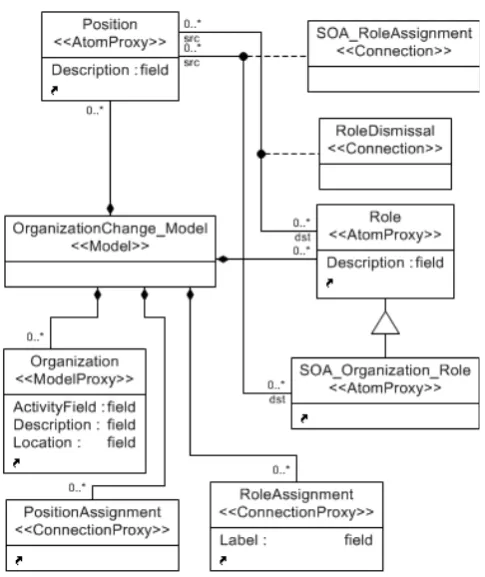
transition from the legacy to the modernized system and it consists of two sheets, for transformations regarding the roles and the organizational units respectively. The former is presented in Fig. 1. On the one hand, it contains references to concepts from the traditional organization structure and from the SOA-based one; they are represented in GME as proxies to modelling elements from the other two paradigms, having the stereotypes: <<AtomProxy>> or <<ConnectionProxy>>. On the other hand, it adds two new connections for modelling the transformations:
- SOA_RoleAssignment, as a relationship between Position and SOA_Organization_Role, and
- RoleDismissal, connecting Position and Role from the OrganizationStructure paradigm.
The OrganizationChange model from Fig. 1 aggregates
all the modelling elements that may appear in this kind of diagram and it has two aspects, for creating two different views: one showing all the transformations, and another one only including the new SOA roles.
C. Related Work and Discussion
[image:2.595.306.549.257.546.2]The specificity of our metamodel is that it introduces SOA roles and transformation relationships (assignment, dismissal), with the purpose to establish relationships between them and the modelling elements depicting the legacy. However, the part regarding the traditional organization structure includes basic domain concepts and has similarities to other approaches, like the Agent/Group/Role Model [17] or the ARIS organizational view metamodel, used for working with ARIS models in a model-driven way and for developing process analysis tools [18]. Apart from that, we adhere to the idea presented in Fig. 1. The paradigm sheet for transformations of roles, from the
[19], that a monolithic user model cannot be appropriate any more for systems characterized by a large distribution degree, and they have to be replaced by fragments that correspond to parts of the software with their particular use cases and actors.
In 2004 Object Management Group issued a Request for Proposals for an Organizational Structure Metamodel (OSM) - specification that is still pending. A language for structural and also behavioural description of an organization is given in [20], defining functions and predicates that combine delete and add operations, and covers the three phases of change: unfreezing, movement and refreezing [21].
A possible extension, suggested in [12] would be to assign tasks from the business process to their performers from the user model, by using a description of their competencies. For SOA modernization, such a description might be provided by the European Skill Card for the field of Information Service Science [22].
III. HUMAN ASPECTS OF DISTRIBUTED HYDROLOGY SYSTEMS
Natural resource management has benefited from the progress of information systems, evolving from islander approaches towards more and more integrated ones, with the possibility to collect and process large scale data, including geographical information. Moreover, data resources, computing infrastructure, networking capabilities and data collection capabilities (like earth observation or sensor networks), advanced visualization capabilities and distributed processing were reunited for creating cyberinfrastructures – as they were first named in 1998 [23]. They have been leveraged by advanced approaches like High Performance Computing, Multi-dimensional data processing, semantic Web and knowledge sharing, up to geospatial Cloud Computing. Two examples of cyberinfrastructures are: Iowa Watershed Data & Information System (http://iowadis.org/) and the Water Information System for Europe WISE (http://water.europa.eu/). Besides the technical part, cyberinfrastructures also take into account sociological aspects, and approaches that involve all the stakeholders in the decision process are currently promoted [24].
Besides the technical basis, a cyberinfrastructure is developed and maintained by a “human infrastructure” [25] that must align to the information technology support, share data and collaborate at a large scale. For the hydrology domain, the main stakeholders are:
water management organizations, water utility companies,
local and county administration units, main water users,
industrial players and
emergency county inspectorates.
Apart from that, public information and early warning services may also be offered to:
simple citizens,
non-governmental organizations, insurance companies,
planning authorities and risk modellers.
An important constraint of our design was to respect the reference data models defined as standards at the level of European Union. For creating a general framework, the European Parliament and the Council adopted the Infrastructure for Spatial Information in the European Community (INSPIRE) in May 2007. In our design we used the INSPIRE technical guidelines for: Geographical Names; Hydrography; Area Management / Restriction / Regulation Zones and Reporting Units; Production and industrial facilities; Utility and Government Services. They introduce types of actors interested in working with geographical information portals, like: data consumers and providers, plus representatives of industry, research, and government. The stakeholders are organized through Spatial Data Interest Communities (SDIC) and Legally Mandated Organizations (LMO) [26]. In case of hydrographical data, their main use cases are: mapping, reporting, modelling and spatial analyses. One should also note that, apart from pure administrative criteria, the organizational units working with the future integrated systems may pass across county and even national borders, accordingly to the river flow, therefore one needs to consider river basin authorities and even international river commissions. INSPIRE calls reporting units the areas that have to be observed, e.g. River Basin Districts (RBD) with international and national levels [27].
For aligning to the national regulations and practices, we also studied the organization structure of our national water authority, called The “Romanian Waters” National Administration ANAR (http://www.rowater.ro); it contains departments for water management, hydrotechnical construction, basin schemes and management plans, and emergency situations. The water quality reports are originated from the level of each river basin and integrated by ANAR. For accidental pollution warning, which is the objective of our system, the national authority has to respect a strict information and decision flow and to collaborate with water directorates, basin committees for emergency situations and operative centres, as well as with a general operative centre with permanent activity for emergency situations. ANAR also coordinates 11 river basin authorities, organized around the main hydrographical basins of the country. They are called water basin administrations and have compartments like: integrated management of water resources, water quality laboratories, dam security, protection against floods etc.
IV. CASE STUDY
A. The CyberWater System
The project continues the effort of developing integrated systems, especially oriented in our country towards flood management, through large projects like: SIMIN (Meteorological Integrated National System), DESWAT (Hydrological System for Warning and Forecasting) and WATMAN (Water Management Integrated System).
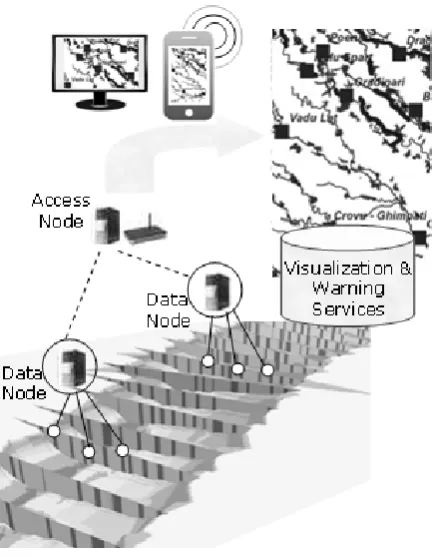
The CyberWater prototype collects information from nodes with 5 types of sensors, situated at selected locations, in the proximity of confluence points; it includes facilities for: water quality evaluation, pollution propagation estimation, pollution warning, and visualization on multiple screens (see Fig. 2). The decision support is based on predictions offered by an algorithm that models the real-time propagation of a pollution agent along the river course, using previously configured three-dimensional models of the river channel profile. The computation is triggered by exceeding the thresholds of certain water quality parameters, indicating the presence of chemical agents. The model has to be reconfigured after major hydrological events that may cause erosion, transportation or deposition phenomena.
B. Service-Based Architecture
The CyberWater prototype uses the ArcGIS platform delivered by Esri (http://www.arcgis.com) for collecting geospatial information from the sensor network and integrating it with detailed maps of the observed river basin.
This is preformed using three nodes (see Fig. 3):
1) ArcGIS Server, where we deploy REST services for sensor monitoring, data visualization and early warning;
2) ArcGIS Desktop and three of its components: ArcMap for editing hydrographical maps,
ArcToolbox for visualization and geo-processing and
ArcCatalog for managing data models, metadata and services,
3) ArcGIS Online for sharing data and maps based on the Esri Cloud environment.
The system also has a supplementary server, hosting the components for decision support and for modelling the pollutant propagation downstream, with the purpose of offering predictions used as an entry for the decision rules.
C. Modelling Human Aspects for CyberWater Adoption
The adoption of CyberWater also needs reengineering business processes, redefining the user models and therefore assigning new roles to employees from multiple institutions responsible with the river basin management. This topic is addressed below, based on the modelling paradigm presented in chapter II.
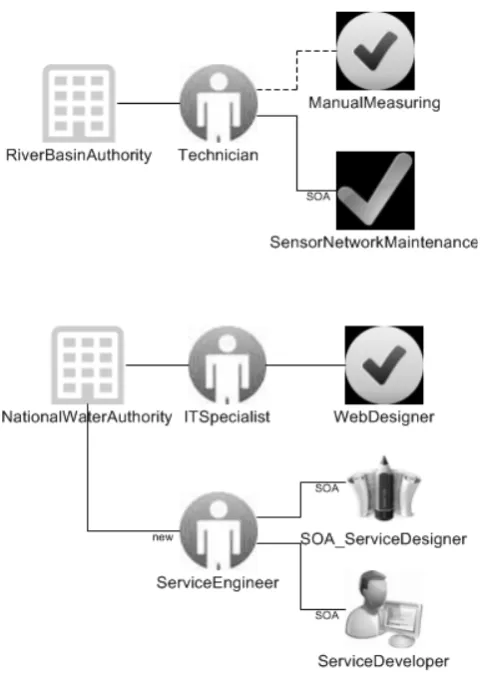
Fig. 4 shows a part of the CyberWater user model, indicating new and dismissed roles in respect to the traditional system that is currently active. We used the editor based on the OrganizationChange paradigm for modelling some of the changes involved in two generic institutions: the River Basin Authority and the National Water Authority.
[image:4.595.315.535.52.279.2]Generally, the authorities managing a particular water pollution accident, like RiverBasinAuthority from our model, use technicians that collect water in various ways, e.g. by dropping buckets over several places of a bridge. We called this role ManualMeasuring and it will not exist any more in the modernized system, so it is linked to the Technician with an interrupted line (i.e a RoleDismissal connection from Fig. 2). Instead, measurements are Fig. 3. The CyberWater Deployment Diagram.
[image:4.595.60.278.345.624.2]performed using wireless sensor networks, and someone occupying a position of technician can now be assigned to
the SensorNetworkMaintenance role. Its link with
Technician is blue and has the label “SOA”, because it is instantiated from another type of connection (i.e. SOA_RoleAssignment from Fig. 1).
Similarly, within the NationalWaterAuthority organization, the ITSpecialist position with the WebDesigner role is retained, but a new position is needed: ServiceEngineer, with the SOA_ServiceDesigner and SOA_ServiceDeveloper roles. The connection used in this case has the label “new”, showing that this is a new PositionAssignment.
The elements preserved from the legacy system are instances of concepts from the OrganizationStructure paradigm, like Organization and Position. The new roles are instances of SOA roles from the SOA_OrganizationStructure paradigm. For example, SensorNetwork Maintenance is of type SupportPersonnel, which is at the basis of the hierarchy: SOA_FrontEndRole,
SOA_SupportRole, SOA_Organization Role. The new
connections introduced between them show the users’ and the human resources’ transformations that are necessary for keeping up with the software and system evolution. We use this model for visualizing the new positions and roles, but also for assessing the complexity of change.
V. CONCLUSION
The paper presented a metamodel that abstracts the transformations involved in user model due to the changes of human aspects for evolving to SOA. It offers a view for creating organization change models, introducing specific details that are absent from the existing tools, generally based on tree-oriented charts.
An application of the modelling paradigm was presented for a case study of modernization towards a SOA-based cyberinfrastructure for river pollution management.
Further work related to the tools for modelling human aspects of software evolution may be oriented towards:
- developing model interpreters for business analysis and organizational restructuring recommendation;
- integrating the modelling tool in a business process management suite;
- replacing the paradigm for SOA roles with one representing another kind of modernization (e.g. migration to Cloud Computing environments), while reusing the other two paradigms;
- supporting the composition with a qualifications’ ontology for mapping people to positions based on semantic criteria;
- integrating the organization change modelling into a methodology and a tool suite for migrating legacy applications to service-oriented systems;
- composing the defined roles with access rights models for enterprise security systems.
ACKNOWLEDGMENT
We would like to thank Dr. Marian Muste from the University of Iowa, IIHR—Hydroscience & Engineering, for his valuable guidance in applying service-oriented technologies for solving real-world problems in the water management domain, and for adapting up-to-date solutions to our national specificities.
REFERENCES
[1] P. Biswas, “A Brief Survey on User Modelling in Human Computer Interaction”, in Speech, Image, and Language Processing for Human Computer Interaction: Multi-Modal Advancements, U. Tiwary and T. Siddiqui, Eds., Hershey, PA: Information Science Reference, 2012, pp. 1-19.
[2] D. Heckmann, T. Schwartz, B. Brandherm, M. Schmitz, and M. von Wilamowitz-Moellendorff, “GUMO: The General User Model Ontology,” in User Modeling, Springer, vol. 3538, 2005, pp. 428– 432.
[3] D. Heckmann and A. Krueger, “A user modeling markup language (userML) for ubiquitous computing”, in Proc. of the 9th international conference on User modeling (UM'03), P. Brusilovsky, A. Corbett, and F. de Rosis, Eds., Berlin, Heidelberg: Springer-Verlag, 2003, pp. 393-397.
[4] A. Rito Silva, T. Gonçalves, F. Rosa, A-J Berre and J. Øyvind Aagedal, “Organization, Information System and Distribution Modeling: An Integrated Approach”, in Proc. First International Enterprise Distributed Object Computing Workshop EDOC '97, Gold Coast, Qld., 1997, pp. 57-65.
[5] M. Viviani, N. Bennani, and E. Egyed-Zsigmond, “A Survey on User Modeling in Multi-Application Environments”, in Proc. Third International Conference on Advances in Human-Oriented and Personalized Mechanisms, Technologies and Services CENTRIC, Nice, 2010, pp. 111-116.
[image:5.595.49.292.391.737.2][6] M. Dragoicea, Th. Borangiu, J. F. e Cunha, V. E. Oltean, J. Faria, and St. Radulescu, “Building an Extended Ontological Perspective on Service Science”, Lecture Notes in Business Information Processing:
Proc. of International Conference on Exploring Services Science, IESS 2014, Geneva, Switzerland, 2014, pp. 17-30.
[7] I. P. Alexander, “A Taxonomy of Stakeholders. Human Roles in System Development”, International Journal of Technology and Human Interaction, vol. 1, no. 1, 2005, pp. 23-59.
[8] M. Razavian and P. Lago, “A Frame of Reference for SOA Migration”, Lecture Notes in Computer Science, vol. 6481, E. Di Nitto and R. Yahyapour, Eds., Berlin /Heidelberg: Springer, 2010, pp. 150-162.
[9] G. Lewis, E. Morris, S. Simanta and D. Smith, “SMART: Analyzing the Reuse Potential of Legacy Components in a Service-Oriented Architecture Environment”, Technical Note CMU/SEI-2008-TN-008, 2008.
[10] A. Fuhr, A. Winter, U. Erdmenger, T. Horn, U. Kaiser, V. Riediger and W. Teppe, “Model-Driven Software Migration - Process Model, Tool Support and Application”, in Migrating Legacy Applications: Challenges in Service-Oriented Architecture and Cloud Computing Environments, A.D. Ionita, M Litoiu and G. Lewis, Eds., Hershey, USA: IGI Global, 2013.
[11] H.M. Sneed, S. Schedl and S.H. Sneed, “Linking legacy services to the business process model”, in Proc. of the IEEE 6th International Workshop on the Maintenance and Evolution of Service-Oriented and Cloud-Based Systems (MESOCA), Riva Del Garda, Trento, Italy, 2012, pp. 17-26.
[12] M. Kirikova, “Flexibility of Organizational Structures for Flexible Business Processes”, in Proc. of the Conference on Advanced Information Systems Engineering CaiSE'05 workshops, vol. 1, Porto, Portugal, 2005.
[13] G.A. Lewis, E.J. Morris, S. Simanta and D.B. Smith, “Service Orientation and Systems of Systems”, IEEE Software, vol. 28, no. 1, 2011, pp. 58-63.
[14] S. Kanan and J. Page, “Service Oriented Architecture (SOA) Governance: Revolutionizing Business to Meet Customer Demands”,
A Knowledge-Driven Consulting White Paper, Hitachi Consulting Corporation, 2007.
[15] GME: Generic Modeling Environment Project, Available: http://www.isis.vanderbilt.edu/Projects/gme/.(URL)
[16] M. Kajko-Mattsson, G.A. Lewis and D.B.Smith, “A Framework for Roles for Development, Evolution and Maintenance of SOA-Based Systems”, in Proc. Of International Workshop on Systems Development in SOA Environments, ICSE Workshops, Minneapolis, 2007.
[17] J. Ferber, O. Gutknecht, C.M. Jonker, J.P. Müller and J. Treur, ”Organization Models and Behavioural Requirements Specification for Multi-Agent Systems“, in Multi-Agent System Organizations, Proc. of the 10’th European Workshop on Modelling Autonomous Agents in a Multi-Agent World, MAAMAW'01, Y. Demazeau and F. Garijo, Eds., 2001.
[18] P. S. Santos Jr., J. P. A. Almeida and T. L. Pianissolla, “Uncovering the organisational modelling and business process modelling languages in the ARIS method”, International Journal Business Process Integration and Management, vol. 5, no. 2, 2011, pp. 130-143.
[19] J. Vassileva, “Distributed User Modelling for Universal Information Access”, in Proc. of the 1st International Conference on Universal Access in Human-Computer Interaction (UAHCI), New Orleans, Louisiana, USA, C. Stephanidis, Ed., 2001, pp. 122-126.
[20] M. Hoogendoorn, C. M. Jonker, M. C. Schut and J. Treur, “Modeling Centralized Organization of Organizational Change”, Computational & Mathematical Organization Theory Journal, vol. 13, no. 2, June 2007, pp. 147 – 184.
[21] K. Lewin, Field Theory in Social Science, New York: Harper & Row, 1951.
[22] O. Zephir and S. Reiter, “Designing a Dynamic Competency Framework for the Service Science System Innovation Architect”,
Lecture Notes in Business Information Processing, vol. 82, 2011, pp 189-200.
[23] C. Yang, R. Raskin, M. Goodchild and M. Gahegan, “Geospatial Cyberinfrastructure: Past, present and future”, Computers, Environment and Urban Systems, vol. 34, no. 4, 2010, pp. 264-277. [24] M. Muste, D.A. Bennett, S. Secchi, J.L. Schnoor, A. Kusiak, N.J.
Arnold, S.K. Mishra, D. Ding and U. Rapolu, “End-to-End Cyberinfrastructure for Decision-Making Support in Watershed Management”, Journal of Water Resources Planning and Management, to be published.
[25] C. P. Lee, P. Dourish, and G. Mark, “The human infrastructure of cyberinfrastructure”, in Proc. of the 2006 20th anniversary conference
on Computer supported cooperative work (CSCW '06). ACM, New York, NY, USA, 2006, pp. 483-492.
[26] D2.8.I.8 INSPIRE Data Specification on Hydrography – Guidelines, European Commission Joint Research Centre Publication, April 2010. [27] D2.8.II/III.7 INSPIRE Data Specification on Environmental
Monitoring Facilities – Technical Guidelines, October 2013, European Commission Joint Research Centre Publlication.