Molecular Characterization of Snowdrop Lectin (GNA)
and its Comparison with Reported Lectin Sequences of
Amaryllidaceae
Saber Delpasand KHABBAZI
1, Allah BAKHSH
2, Cengİz SANCAK
1and Sebahattin ÖZCAN
11TARBIYOTEK Laboratories, Department of Field Crops, Faculty of Agriculture, University of Ankara, Dışkapı-Ankara, Turkey; 2Department of Agricultural Genetic Engineering, Faculty
of Agricultural Sciences and Technologies, Niğde University, Niğde, Turkey
Abstract
Khabbazi S.D., Bakhsh A., Sancak C., Özcan S. (2016): Molecular characterization of snowdrop lectin (GNA) and its comparison with reported lectin sequences of Amaryllidaceae. Czech J. Genet. Plant Breed., 52: 94–100.
Plant lectins have become efficient sources of insect resistance in crops. The present study was conducted to identify, amplify, clone and characterize the plant lectin gene GNA. The lectin, present in Galanthus nivalis
(snowdrop), is an agglutinin toxic to hemiptera. The attempt was made to elucidate the relationship of the lectin gene trGNA (GNA isolated and characterized from Turkey) with other previously cloned lectins having insec-ticidal activity and to ensure the presence of the conserved mannose-binding region/site in the gene sequence. The full-length cDNA of trGNA was 477 bp that contained a 333 bp open reading frame encoding 157 amino acid proteins with 23 amino acids of signal peptide. BLAST results showed that trGNA has 89–97% similarity with previously reported GNA sequences while it has 84–96% similarity with earlier reported GNA protein sequences. No intron was detected within the region of genomic sequence corresponding to trGNA full-length cDNA. According to the search results from the NCBI (National Centrer for Biotechnology Information database),
trGNA from Galanthus nivalis is most similar to the previously reported lectin sequences of Narcissus tazetta
with a similarity percentage of 87%. The obtained results are useful for engineering of plants with enhanced insecticidal activity against chewing and sucking insects, causing crop pests. In addition, medical application of lectins may also be considered.
Keywords: bioinformatics; biotic stress; Galanthus nivalis; gene cloning; gene sequence; insecticidal activity
According to estimations 13% of the incurred crop losses belong to the damage caused by insect pests (Gatehouse et al. 1992; Bakhsh et al. 2015). Al-though the efficacy of Bt (Bacillus thuringiensis) toxins against many pests, especially lepidopterans, has been established, no considerable effect of Bt toxins on phloem-feeding pest bugs, hoppers or aphids have been reported yet that have emerged as primary pests.
Plant lectins are being considered as a promising strategy to encode resistance against sap-sucking homopteran insects. Lectins inhibit the nutrient
absorption or disrupt the midgut cells by stimulating endocytosis and possibly other toxic metabolites pre-sent in the midgut (Czapla & Lang 1990; reviewed in Bakhsh et al. 2015). Lectins have variant binding specificities causing different toxic impacts. Differ-ent monocot mannose-binding lectins have been isolated from the families Amaryllidaceae, Araceae, Asparagaceae, Smilacaceae, Taxaceae, Iridaceae, and Orchidaceae.
endoplasmic reticulum. There are three conserved amino acid sequence motifs (QXDXVXNXY) existing in each subunit primarily reported by Van Damme
et al. (1991, 1992, 1993a, b, 1995). As the first lectin isolated from Amaryllidaceae, GNA lectin is different from other monocot and dicot lectins with respect to its molecular structure and very specific carbohydrate binding property (Van Damme et al. 1987). GNA
lectin such as garlic, onion and leek lectins is toxic to Hemiptera insects while no harmful impact on the mammalian oral system has been proved (Peumans & Van Damme 1996). GNA exhibits an exclusive specificity towards mannose when it binds to the terminal α-1-3-linked mannose; due to the absence of α-1-3-linked mannose in the mammalian brush border of the small intestine membrane and based on rat model studies it is not toxic to humans (Pusztai
et al. 1995, 1996; Vandenborre et al. 2011). The present study was conducted with an aim to isolate and characterize the plant lectin gene from snowdrop plants collected from areas of their natural distribution in Turkey. Furthermore, molecular and in-silico analysis was conducted to learn more about this gene and to establish the phylogenetic relation-ship between the isolated gene and earlier reported Amaryllidaceae lectin genes.
MATERIAL AND METHODS
Plant material. Snowdrop (Galanthus nivalis L.) plants were collected during the winter season from the domestic distribution areas of snowdrop in west-ern hills surrounding the city of Ankara, in the Central Anatolia Region, Turkey; fresh leaves were stored at –80°C after immediate freezing by liquid nitrogen treatment.
Chemicals and reagents. TRIzol® RNA isolation
reagents, RNase AWAY™ decontamination reagent enzymes, cDNA synthesis, plasmid mini prepara-tion, calf intestinal alkaline phosphatase (CIAP) and gel extraction kits were supplied by Thermo Fisher Scientific Inc., Waltham, USA; pGEM®-T Easy
Vec-tor was supplied by Promega Corp., Madison, USA; diethyl pyrocarbonate was supplied by Sigma-Aldrich Corp., St. Louis, USA.
Primer designing. The previously reported GNA
sequences were retrieved from NCBI database. All the reported sequences (M55555.1, M55556.1, M55557.1, M55558.1, M55559.1, AF413083.1, AF413084.1, AF413085.1, AF413086.1 and AF413087.1) were aligned to find the most similar regions upstream
and downstream the selected gene sequence. Se-lected 19 and 20 bp, respectively, forward and reverse primers were analysed by OLIGO 7 Primer Analysis Software (Molecular Biology Insights Inc., Colorado Springs, USA) to check hairpin structure, Tm, GC%, primer dimer and other requisite properties of prim-ers. Designed primers were ordered to synthesis (Integrated DNA Technologies Inc., Coralville, USA). Isolation of GNA lectin gene. Frozen plant leaf samples of snowdrop were subjected to total cellular RNA isolation following the TRIzol® RNA isolation
reagent product manual. Using the NanoDrop 1000 Spectrophotometer (Thermo Fisher Scientific Inc., Waltham, USA) quality and quantity of the isolated RNA were evaluated. Approximately 1 µg of the fresh isolated total cellular RNA was converted to cDNA following the protocol as described in the manual of RevertAid First Strand cDNA Synthesis Kit. cDNA was used as template to amplify GNA in PCR (poly-merase chain reaction). PCR was conducted using gene specific forward and reverse primers, 5'ATG-GCTAAGGCAAGTCTCC3' and 5'TCATTACTTT-GCCGTCACAA3' containing flanking sites of XhoI restriction enzyme (the incorporation of XhoI site was planned to be further used for cloning fragments into a binary vector). PCR was carried out by using Dream Taq DNA Polymerase, preceded by 3 min of initial denaturation (95°C). Subsequently 30 s of (95°C) denaturation, 30 s of (58°C) annealing and 1 min of (72°C) extension steps were programed for each of the 35 cycles applied, ending with 10 min of final extension at 72°C.
Molecular cloning and characterization of GNA lectin gene. To purify the GNA gene, PCR product was loaded in 1% (w/v) agarose gel. Precisely, the separated band of interest was excised from the gel and purified by Thermo Scientific Gene JET Gel Extraction Kit. The purified fragment was quantified and ligated into pGEM®-T Easy Vector (size 3.015 kb)
and further transferred to JM109 E.coli competent cells. To screen the positive colonies, ampicillin selection and blue white test were applied. Some of the white bacterial colonies were selected and were subjected to colony PCR. The positive colonies were grown in LB broth (Duchefa Biochemie B.V., Haar-lem, Netherlands) medium containing an appropri-ate antibiotic for overnight and using the plasmid mini preparation kit, plasmids were extracted. The restriction digestion reaction was conducted using the XhoI enzyme to excise a fragment of the GNA
plasmid was sent for sequencing (RefGen Corp. ,Ltd., Ankara, Turkey).
The obtained nucleotide sequence (called trGNA
gene) was then blasted to elucidate the sequence homologues in order to determine the ancestral relationship of the gene with other lectin genes. The prediction of ORFs (open reading frame), size and positions, nucleotide translation and presence of mannose-binding region was performed. The trGNA
gene sequence has been planned to be submitted to GenBank, NCBI to assign it an accession number.
RESULTS AND DISCUSSION
The forward and reverse primers contained flanking sites of XhoI. The PCR amplification results showed a 477 bp fragment of GNA genes using cDNA template from snowdrop (Figure 1A). The PCR fragment of 477 bp was eluted from agarose gel, purified and used as an insert to be ligated into pGEM®-T Easy
Vector (3.015 kb). Transformation of the ligated product (GNA gene + pGEM®-T Easy Vector) was
performed in JM109 E.coli cells. The presence of the cloned fragment was interpreted by a blue and white screening technique. The random white colony selection from LB plates showed that selected white colonies contained the gene of interest as revealed by colony PCR (Figure 1B). Restriction of the recom-binant plasmid with XhoI yielded two fragments of 3.015 kb (plasmid) and 477 bp (insert size) with the generation of sticky ends at both sites (Figure 1C).
The recombinant clones with the confirmed pres-ence of the gene of interest were sent for sequencing. The obtained sequence was called trGNA. Bio-informatics analysis of 477 bp query sequence was conducted. The full-length nucleotide sequence of
[image:3.595.304.531.127.322.2]GNA gene obtained was blasted, and subjected to the generation of sequence identity matrix and phyloge-netic tree construction to see the sequence homology of trGNA with previously reported GNA sequences
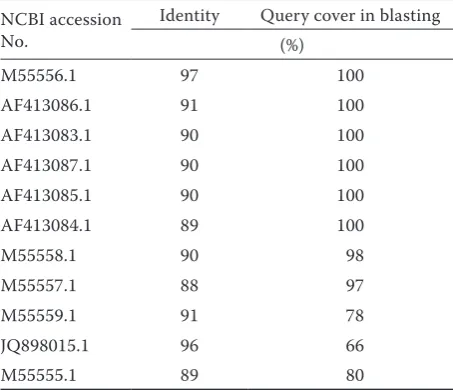
Table 1. BLAST results indicating the identity percentage of trGNA with other GNA sequences reported earlier
NCBI accession No.
Identity Query cover in blasting (%)
M55556.1 97 100
AF413086.1 91 100
AF413083.1 90 100
AF413087.1 90 100
AF413085.1 90 100
AF413084.1 89 100
M55558.1 90 98
M55557.1 88 97
M55559.1 91 78
JQ898015.1 96 66
[image:3.595.70.286.511.655.2]M55555.1 89 80
Figure 1. Amplification, cloning and further confirmation of trGNA (477 bp) in pGEM®-T Easy Vector: (A)
am-plification of trGNA from cDNA template of snowdrop leaf, (B) colony PCR to confirm positive clones of trGNA, (C) restriction digestion of the vector to excise trGNA
gene; GeneRuler100 bp DNA ladder was used to confirm the desired fragments
(Table 1). BLAST results showed that trGNA has 89−97% similarity with previously reported GNA
sequences while it has 84−96% similarity with earlier reported GNA protein sequences. The full-length cDNA of trGNA was 477 bp that contained 333 bp open reading frame encoding 157 amino acid proteins with 23 amino acids of signal peptide (Figure 2). The DNA sequence of trGNA is shown in Figure 2.
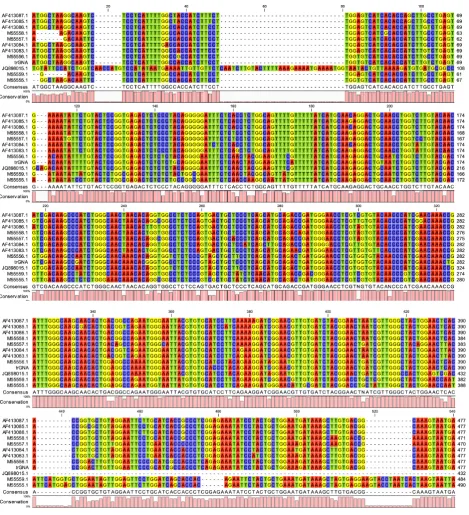
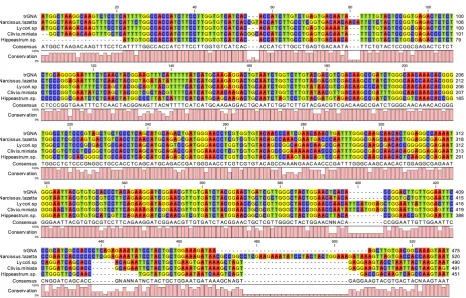
[image:4.595.65.535.211.727.2]The query sequence was also analysed in detail with respect to its ORF’s, putative start/stop codon, and multiple alignment of the DNA and protein se-quence (Figures 2–5). The sese-quence was subjected to search the conserved domains to learn more about the gene and to detect and get idea/positions of the presence of the conserved mannose-binding region in the query sequence.
Multiple alignment of the protein sequence of
trGNA with those of mannose-binding lectins from Amaryllidaceae was performed with the CLC Se-quence Viewer 7.6.1 (CLC Bio-Qiagen, Aarhus, Den-mark) using the published mannose-binding lectin sequences (Figure 5). Gaps were introduced for
op-timal alignment and maximal similarities between all compared sequences.
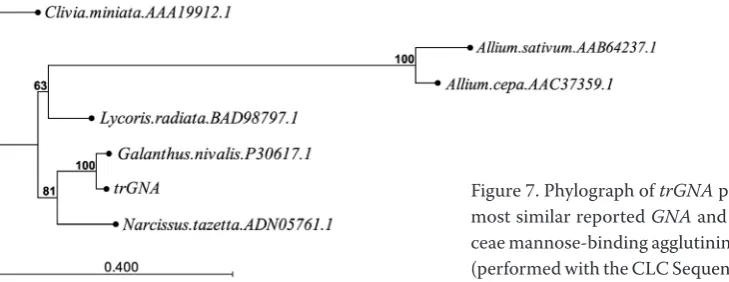
[image:5.595.66.533.93.391.2]The phylogenetic tree is based on the nucleotide sequences of previously cloned GNA genes, obtained from BLAST results at NCBI (Figure 6). The results from NCBI BLAST showed a high degree of similarity
Figure 4. In-silico analysis – multiple DNA sequence alignment indicating the presence of conserved sequence regions in some different Amaryllidaceae mannose-binding agglutinin lectins including Galanthus nivalis, Narcissus tazetta, Lycoris radiata, Clivia miniata, Allium cepa, Allium sativum (performed with the CLC Sequence Viewer 7.6.1 software)
[image:5.595.70.529.557.701.2]of trGNA with other reported GNA lectins. According to the protein sequence BLAST results of the trGNA
and some Amaryllidaceae mannose-binding lectins there is a close relationship which has been presented as a phylogenetic tree in Figure 7.
GNA lectin was isolated and characterized by Van Damme et al. (1987) and it has been used widely by researchers as an insecticidal gene since then. Primary structure of the gene was introduced in 1991 (Van Damme et al.). According to the homology blasting results of the present study there is a nucleotide iden-tity of 88-90% and amino acid ideniden-tity of 76−96% with sequences reported by Van Damme et al. (1991). The isolated trGNA protein sequence was compared with some published sequences of Amaryllidaceae species. Homology blasting with the previously published lec-tin sequences of Narcissus tazetta (Gao et al. 2011),
Lycoris radiata (Hayashi et al. 2005), Clivia miniata
(Van Damme et al. 1994), Allium cepa (Van Damme
et al. 1993a) and Allium sativum (Smeets et al. 1997) resulted in 82, 79, 75, 51 and 48% amino acid sequence identity, respectively.
According to the alignment table study, highly con-served motifs of QXDXNXVXY were confirmed in three positions on amino acid sequences of the studied
Amaryllidaceae lectins, remark the mannose-binding protein type in all the aforementioned lectin sequences. The results showed that the trGNA gene shares a percent homology of 97, 91, 90, 90, 90, 89, 90, 88, 91, 96 and 89% with already reported GNA sequences, in NCBI, M55556.1, AF413086.1, AF413083.1, AF413087.1, AF413085.1, AF413084.1, M55558.1, M55557.1, M55559.1, JQ898015.1 and M55555.1, respectively. Comparing the similarity between the isolated trGNA
and other lectin gene sequences revealed the similarity of 85–87% and 83% of trGNA with Narcissus tazetta
and Lycoris radiata agglutinin lectin genes, respectively. According to the results of NCBI nucleotide blasting,
trGNA isolated from Galanthus nivalis is most similar to the previously reported agglutinin lectin sequences of Narcissus tazetta with the similarity percentage of 87 and query cover of 95%.
[image:6.595.63.406.94.266.2]Thus, taking into consideration the enigmatic nature of lectins in sharing similar overall characteristic features despite varying identities and the potential of plant lectins in providing plants resistance against various insect pests, the search for more lectin genes has be-come a necessity. It has been found that the mannose-binding garlic lectins are closely related proteins sharing conserved mannose-binding regions (a feature of most
[image:6.595.69.434.616.757.2]Figure 7. Phylograph of trGNA protein sequence with the most similar reported GNA and some other Amaryllida-ceae mannose-binding agglutinin lectin protein sequences (performed with the CLC Sequence Viewer 7.6.1 software)
mannose-binding superfamilies of lectin), found to be encoded by homologues gene sequences. Thus, it can be concluded that the present research enabled to elucidate the presence of conserved mannose-binding regions and the relationship of the trGNA gene with the other previously cloned lectin genes already believed to be carrying insecticidal activity against various insect pests. Currently we are using trGNA in pCAMBIA1301 for controlling sucking pests in cotton.
Acknowledgements. The authors are grateful to The Scientific and Technological Research Council of Turkey (TUBITAK) – BIDEB for granting PhD. fellowship (2215) to Mr. S.D. Khabbazi.
References
Bakhsh A., Khabbazi S.D., Baloch F.S., Demirel U., Çalişkan M.E., Hatipoğlu R., Özcan S., Özkan H. (2015): Insect resistant transgenic crops: retrospect and challenges. Turkish Journal of Agriculture and Forestry, 39: 531–548. Czapla T.H., Lang B.A. (1990): Effect of plant lectins on the
larval development of European corn borer (Lepidoptera: Pyralidae) and Southern corn rootworm (Coleoptera: Chrysomelidae). Journal of Economic Entomology, 83: 2480–2485.
Gao Z.M., Wang W.Y., Li Q., Yuan Q.P. (2011): Cloning and functional characterization of a GNA-like lectin from Chinese Narcissus (Narcissus tazetta var. Chinensis Roem). Physiologia Plantarum, 142: 193–204.
Gatehouse A.M.R., Hilder V.A., Boulter D. (1992): Potential of plant derived genes in the genetic manipulation of the crops for insect resistance. In: Gatehouse A.M.R., Hilder V.A., Boulter D. (eds): Plant Genetic Manipulation for Crop Protection. Wallingford, CAB International: 155–181. Hayashi A., Saito T., Mukai Y., Kurita S., Hori T. (2005):
Genetic variation in Lycoris radiata var. radiata in Japan. Genes & Genetic Systems, 80: 199–212.
Peumans W.J., Van Damme E.J.M. (1996): Prevalence, bio-logical activity and genetic manipulation of lectins in foods. Trends in Food Science & Technology, 7: 132–138. Pusztai A., Ewen S.W.B., Grant G., Peumans W.J., Van
Damme E.J.M., Coates M.E., Bardocz S. (1995): Lectins and also bacteria modify the glycosylation of gut surface receptors in the rat. Glycoconjugate Journal, 12: 22–35. Pusztai A., Koninkx J., Hendriks H., Kok W., Hulscher S.,
Van Damme E.J.M., Peumans W.J., Grant G., Bardocz S.
(1996): Effect of the insecticidal Galanthus nivalis agglu-tinin on metabolism and the activities of brush boarder enzymes in the rat small intestine. The Journal of Nutri-tional Biochemistry,7: 677–682.
Smeets K., Van Damme E.J.M., Verhaert P., Barre A., Rouge P., Leuven F.V., Peumans W.J. (1997): Isolation, characterization and molecular cloning of the mannose-binding lectins from leaves and roots of garlic (Allium sativum L.). Plant Molecular Biology, 33: 223–234. Van Damme E.J.M., Allen A.K., Peumans W.J. (1987):
Iso-lation and characterization of a lectin with exclusive specificity towards mannose from snowdrop (Galanthus nivalis) bulbs. FEBS Letters, 215: 140–144.
Van Damme E.J.M., Kaku H., Perini F., Goldstein I.J., Peeters B., Yagi E., Decock B., Peumans W.J. (1991): Bio-synthesis, primary structure and molecular cloning of snowdrop (Galanthusnivalis L.) lectin. European Journal of Biochemistry, 202: 23–30.
Van Damme E.J.M., Smeets K., Torrekens S., Van Leuven F., Peumans W.J. (1992): Isolation and characterization of alliinase cDNA clones from garlic (Allium sativum L.) and related species. European Journal of Biochemistry, 209: 751–757.
Van Damme E.J.M., Smeets K., Engelborghs I., Aelbers H., Balzarini J., Pusztai A., Van Leuven F., Goldstein I.J., Peumans W.J. (1993a): Cloning and characterization of the lectin cDNA clones from onion, shallot and leek. Plant Molecular Biology, 23: 365–376.
Van Damme E.J.M., Smeets K., Torrekens S., Van Leuven F., Peumans W.J. (1993b): The mannose-specific lectins from ramsons (Allium ursinum L.) are encoded by three sets of genes. European Journal of Biochemistry, 217: 123–129. Van Damme E.J.M., Smeets K., Leuven F.V., Peumans W.J.
(1994): Molecular cloning of mannose-binding lectins from Clivia miniata. Plant Molecular Biology, 24: 825–830. Van Damme E.J.M., Goossens K., Smeets K., Van Leuven F.,
Verhaert P., Peumans W.J. (1995): The major tuber storage protein of Araceae species is a lectin (Characterization and molecular cloning of the lectin from Arum macula-tum L). Plant Physiology, 107: 1147–1158.
Vandenborre G., Smagghe G., Van Damme E.J.M. (2011): Plant lectins as defense proteins against phytophagous insects. Phytochemistry, 72: 1538–1550.
Received for publication April 27, 2016 Accepted after corrections September 12, 2016
Corresponding author: