Algorithm for Enumerating all Frequent Paths from
Structurally Compressed Tree-Structured Data
Tomoya Horibe, Yuko Itokawa, Tomoyuki Uchida, Yusuke Suzuki and Tetsuhiro Miyahara
Abstract—Extracting structural features common to large tree-structured data is a difficult issue with respect to time. When the input size decreases by structurally compressing large tree-structured data without loss of information, it leads to reduction in running time needed to extract structural features. Tree-structured data can be described by an edge-labeled ordered tree. We first introduce a compression tree representing an edge-labeled ordered tree structurally compressed based on a Lempel-Ziv compression scheme. Then, given a compression tree t obtained by structurally compressing an edge-labeled ordered tree T, we propose a time- and memory-efficient algorithm for enumerating all frequent paths in T without decompressingt. Finally, we discuss the implementation of the proposed algorithm on a computer, explain the experimental results obtained by applying it to artificial edge-labeled ordered trees, and provide discussion on its evaluation.
Index Terms—Enumeration algorithm, Structurally com-pressed edge-labeled ordered tree, Succinct representation
I. INTRODUCTION
Tree-structured data, such as Web documents, LATEX sources, and natural languages, can be described by edge-labeled ordered trees. An edge-labeled ordered tree is a rooted tree whose edges have labels and whose internal nodes have ordered children. Due to the rapid progress in networks and information technology, the amount of such tree-structured data increases daily. To find structural features common to large tree-structured data, time- and memory-efficient graph mining algorithms are needed.
To reduce the memory required to store an ordered tree, succinct data structures for ordered trees have been proposed [1], [2], [3], [4], [5], [7], [8], [10]. Specifically, a depth-first unary degree sequence (DFUDS) as a succinct representation of an ordered tree was proposed [7], [9]. For an ordered tree T, a DFUDS of T is a string of parentheses constructed in the depth-first traversal of T, in which the k-th ( and its
subsequent ) are output if the index of a node is k. By
taking ( to be ’0’ and ) to be ’1’, the DFUDS of an ordered tree can be handled as a bit string.
Itokawa et al. [5] proposed a structural compression algorithm for effectively compressing tree-structured data without loss of information that is based on a Lempel-Ziv (LZ) compression scheme. In an LZ compression scheme [14] for strings, such as LZSS [12], previously seen text is used as a dictionary, and phrases in the input text are replaced with references into the dictionary to achieve compression. For an edge-labeled ordered tree T and a its subgraph f having an ordered-tree structure, the
T. Horibe, T. Uchida, Y. Suzuki and T. Miyahara are with Department of Intelligent Systems, Hiroshima City University. Hiroshima, Japan, email: mb67018@e.,uchida@,y-suzuki@,[email protected]
Y. Itokawa is with Faculty of Psychological Science, Hiroshima Interna-tional University. 555-36 Kurose-Gakuendai, Higashi-Hiroshima, Hiroshima Japan e-mail: [email protected]
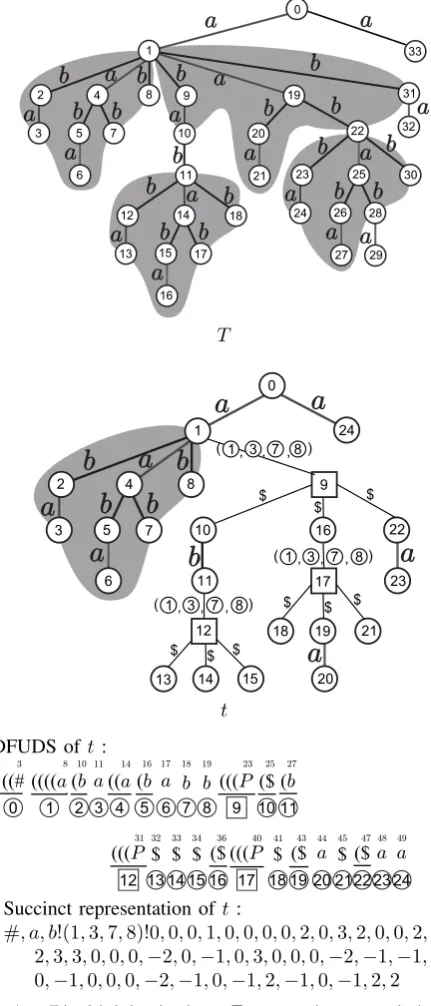
first occurrence of f in the depth-first traversal of T is used as an entry of a dictionary, and the subgraphs in T that are isomorphic to f are replaced with the reference into the entry of the dictionary to achieve compression. In this paper, for an edge-labeled ordered tree T, we introduce a compression tree, which is an edge-labeled ordered tree obtained by structurally compressing T based on an LZ compression scheme. We then define a succinct representation of a compression tree by extending DFUDS of an ordered tree. Figure 1 shows a compression tree t and its succinct representation. The compression tree t uses the subgraph f induced by the edge set {(1, b,2),(2, a,3),(1, a,4),(4, b,5),(5, a,6),(4, b,7),(1, b,8)}
as an internal dictionary. The edge-labeled ordered tree T in Fig. 1 is obtained by replacing nodes represented by the square and all incident edges with the subgraphf.
Next, given a compression treet obtained by structurally compressing an edge-labeled ordered treeT, we propose an efficient algorithm, called ENUFREQPATHS, for enumerating all frequent paths inT without decompressing t. ENUFRE
-QPATHS finds frequent paths from each node toward the root on a level-wise strategy w.r.t. the length of a path. Since a succinct representation of a given compression tree is provided using its DFUDS, ENUFREQPATHScan naturally use the succinct data structures in implementation using succinct data structure library (SDSL) [11]. Hence, ENUFRE
-QPATHS is time- and memory-efficient for enumerating all frequent paths from a given compression tree of an edge-labeled ordered tree.
This paper is organized as follows. In Sec. II, we introduce a compression tree obtained by structurally compressing an edge-labeled ordered tree based on an LZ compression scheme. We also define the succinct representation of a com-pression tree. In Sec. III, given a comcom-pression treetobtained by structurally compressing an edge-labeled ordered treeT, we present our time- and memory-efficient algorithm for enumerating all frequent paths inT without decompressing t. In Sec. IV, we explain the experimental results obtained by applying the proposed algorithm to artificial big data and discuss its efficiency. In Sec. V, we conclude this paper.
II. PRELIMINARIES
0
1
2
3 4
5
6 7
8 9
10
11
12
13 14
15 17
18 21
22
23
24 25
26
27 28
29 30 31 32
16
19
20
33
T
$
$ $ $
$ $
$ $ $ 2
3
4
5
6 7
8 9
10
11
12
13 14 15
16
17
18 19
20 21
22
23 (1 3 7 8, , , )
(1 3 7 8, , , ) (1 3 7 8, , , )
0
1 24
t
DFUDS oft :
3 8 10 11 14 16 17 18 19 23 25 27
0 1 2 3 4 5 6 7 8 9 1011
((((a
( ((# (b a((a(b a b b (((P ($ (b
34
31 32 33 36 40 41 43 44 45 4748
14
13 1516 17 18 1920212223 12
(((P $ $ $ ($ (((P $ ($ a $ ($a a
24
49
Succinct representation oft :
#, a, b!(1,3,7,8)!0,0,0,1,0,0,0,0,2,0,3,2,0,0,2,0,3,
2,3,3,0,0,0,−2,0,−1,0,3,0,0,0,−2,−1,−1,−1,
[image:2.595.57.273.54.558.2]0,−1,0,0,0,−2,−1,0,−1,2,−1,0,−1,2,2
Fig. 1. Edge-labeled ordered tree T, compression tree t obtained by structurally compressing T, DFUDS of tand succinct representation of
t. Gray regions inT show repeated occurrences of subgraph having same ordered-tree structure. Gray region intshows entry of its dictionary. In DFUDS of t, number in circle represents node ID oftand “P” denotes reference(1,3,7,8).
A. Compression Tree
An edge-labeled ordered tree T is a rooted tree whose internal nodes have ordered children and whose edges have labels. The node and the edge sets ofT are denoted asV(T)
and E(T), respectively. We denote an edge e ∈ E(T) as e = (u, a, v) such that the two endpoints ofe are nodes u andv and the label ofeis a.
Let a list (u, L, u1, u2, . . . , uk) consisting of an internal node u, consecutive children u1, u2, . . . , uk of u and label L be called a port list of an edge-labeled ordered tree T. For a port list h = (u, Lh, u1, u2, . . . , uk), u is called a
parent port of h and each nodeui (1 ≤i ≤k) is called a
child port of h. Two port lists h = (u, Lh, u1, u2, . . . , uk) andh′ = (v, Lh′, v1, v2, . . . , vℓ)of an edge-labeled ordered treeT are said to bedisjointif the following conditions are satisfied.
(1) {u1, u2, . . . , uk} ∩ {v1, v2, . . . , vℓ}=∅.
(2) Ifuandvare the same node,uk is older thanv1oru1 is younger thanvℓ.
For an edge-labeled ordered tree T and its internal node u, we denote the subgraph consisting of all descendants of u as T[u], that is, T[u] is the subtree of T hav-ing u as its root. For a subset U ⊆ V(T), we denote the subgraph induced by U as T[U], that is, T[U] = (U,{e| both endpoints ofe∈E(T)are in U}). For an in-ternal nodeuand a descendant v of u, we denote the path betweenu andv as Pu,v. Note thatPu,v is only one node if uandv are the same node. For an edge-labeled ordered treeT, areferenceof T is a list(v, v1, v2, . . . , vn)of nodes satisfying the following conditions.
(1) For eachi(1≤i≤n),viis a descendant of an internal nodev of T.
(2) For anyi, j(1≤i, j≤n),viis not a descendant ofvj and vice visa.
(3) For any i, j(1≤i < j≤n),vj appears aftervi in the depth-first traversal ofT.
We denote the set of all references of T as RT. For a reference L = (v, v1, v2, . . . , vn) of T, we denote the subgraph induced by the node set ∪w∈WV(Pv,w) as T⟨L⟩ called by a reference tree, where W is the set of leaves such that any leaf w ∈ W appears from v1 up to vn in the depth-first traversal of T but not included in V(T[vi])− {vi} for any1≤i≤n. In Fig. 1, for reference
(1,3,7,8), we give the reference tree t⟨(1,3,7,8)⟩ =
(
{1,2, . . . ,8},{(1, b,2),(2, a,3), . . . ,(1, b,8)}). A subset DT of RT is called a dictionary of T if for any
two distinct references L1 = (u, u1, u2, . . . , uℓ) and L2= (v, v1, v2, . . . , vr)of DT,V(T⟨L1⟩)∩V(T⟨L2⟩) =∅ except u and v. For example, in Fig. 1, for references (1,3,7,8),(1,10,22,31),(11,13,17,18), and (22,24,28,30) in T, the reference trees T⟨(1,3,7,8)⟩, T⟨(1,10,22,31)⟩, T⟨(11,13,17,18)⟩, and T⟨(22,24,28,30)⟩are isomorphic.
For a list or setS, we denote the number of elements in S as |S|.
Definition 1: (Hyper Tree) Let Λ be an alphabet, T =
(VT, ET)an edge-labeled ordered tree,HT a set of disjoint port lists ofT, andDT a dictionary ofT such thatΛ∩DT =
∅. Then, a triplet t = (Vt, Et, Ht) is called a hyper tree
obtained fromT, HT, and DT, where Vt, Et andHt are defined as follows.
(1) Vt=VT, (2) Et=ET−∪(v
0,v1,...,vr)∈HT{(v0, a1, v1), ...,(v0, ar, vr)},
and the label of each edgee∈ET is preserved inEt. (3) Ht = HT and each port list in Ht is labeled with a reference (w, w1, w2, . . . , wk) ∈ DT such that wk appears beforew1 on the depth-first traversal ofT. By modifying the LZ77 compression scheme for strings to a hyper tree, a compression tree is a hyper tree defined as follows.
Definition 2: (Compression Tree) A compression tree is
oc-currences of subgraphs having ordered-tree structures with references to the first occurrence of the subgraphs.
Figure 1 shows the compression tree t = ({0,1, . . . ,24},{(0, a,1),(1, b,2), . . . ,(0, a,24)},
{(1, P,10,16,22),(11, P,13,14,15),(16, P,18,19,21)})
of the edge-labeled ordered tree T, where P is reference
(1,3,7,8).
B. Succinct Representation of Compression Trees
In this subsection, we explain a succinct representation of a compression tree.
The DFUDS for an ordered tree T ofm edges is defined inductively as follows [7], [9]. The DFUDS of the tree consisting of only one node is ( ) . The DFUDS of an ordered tree T that hask subtreesT1, . . . , Tk is a sequence of parentheses constructed by concatenatingk+ 1 ( s, one
) ,k DFUDSs ofT1, . . . , Tk in this order (the initial ( of the DFUDS of each subtree has been removed). The resultant DFUDS is a sequence of balanced parentheses of length
2m. The sequence of parentheses, that is a DFUDS, can be interpreted as the result of visiting all nodes in preorder and outputtingk ( s for each node, whose degree isk, following
the one ) . The DFUDS is a succinct representation of an
ordered tree with no edge labels. But since ) occupies the rightmost position for each node in the DFUDS, we can modify the DFUDS of an ordered tree to the DFUDS of an edge-labeled ordered tree, using a hash function that returns the label of the edge incident to the node corresponding to each ) . To provide a succinct representation of a com-pression tree, we consider an underlying ordered tree for a compression tree. For a compression tree t = (Vt, Et, Ht), we call by anunderlying tree of t the edge-labeled ordered tree obtained fromtby applying the following replacements to all port lists oft. A port listh= (u, u1, u2, . . . , uk)∈Ht is replaced with an edge-labeled ordered tree as follows.
(1) Removehfromt.
(2) Construct an edge-labeled ordered tree s = ({u′, v, u′1, u2′, . . . , u′k}, Es) defined as follows. (a) v has u′ as the parent and u′1, u′2, . . . , u′k as the children in that order. (b) The edge betweenu′ andvis labeled with the reference of h and any edge between v and its child is labeled with the special symbol “$”. (3) Identify the parent port uand each child portui (1≤
i≤k)with the rootu′ofsand each leafu′i(1≤i≤k), respectively.
Definition 3: (Succinct Representations of Compression
Trees) The succinct representation of a compression treetis the DFUDS of the underlying tree oft.
Figure 1 shows the succinct representations of the edge-labeled ordered treeT and the compression tree t.
Hence, by using a succinct representation of a compres-sion tree, we can give a compact coding for a structured-compression of an edge-labeled ordered treeT as follows.
Definition 4: (Compact Coding for an Edge-Labeled
Or-dered Tree) LetT be an edge-labeled ordered tree. LetELT be the coding of the list of all edge labels in T which are sorted by occurrence order in the depth-first traversal of T. Let DT be the coding of a list of references in T which are sorted by occurrence order in the depth-first
traversal of T. Let CT be the coding of a compression tree t of T. Then, a compact coding of T is given by a sequence ofELT◦“!”◦DT◦“!”◦CT, denoted asCode(T) =
⟨ELT, DT, CT⟩, where◦is an operator of two concatenating sequences.
Since we createELT, DT andCT based on the depth-first traversal ofT, we can easily create hash functions that return the edge label or reference for each edge in the compression treetofT. Figure 1 shows the succinct representation of the compression treet.
III. ENUMERATIONALGORITHM FOREXTRACTING
FREQUENTPATHS INCOMPRESSIONTREES
For a compression tree t of an edge-labeled ordered tree T and an integerk(k≥1), a pathpintis k-frequentif p appears inT kor more times. Such an integer kis called a
minimum occurrence. We define an enumeration problem for
extracting all k-frequent paths in a given compression tree as follows.
Frequent-Paths Enumeration Problem
Instance: Compression tree t and minimum occurrence k(k≥1).
Problem: Enumerate all k-frequent paths in t without decompressingt.
Algorithm 1 presents our enumeration algorithm, called ENUFREQPATHS, for solving the frequent-paths enumeration problem. For a sequence S of length n on alphabet Λ, character c and integer i (0 ≤ i ≤ n−1), the functions rank and select used in ENUFREQPATHS are defined as follows.
(1) rankc(S, i) returns the number of occurrences of c in subsequenceS[0 :i].
(2) selectc(S, i) returns the i-th position of c from the beginning ofS.
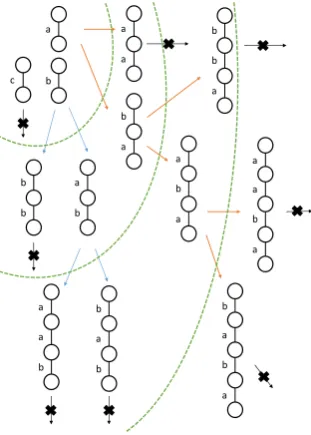
By using the SDSL [11], we can computerank andselect in constant time. When a compression treetand a minimum occurrencek are given, ENUFREQPATHS enumerates all k-frequent paths in t from each node toward the root oft on a level-wise strategy w.r.t. the length of a k-frequent path. Figure 2 shows an example of the enumeration process of k-frequent paths by using ENUFREQPATHS.
ENUFREQPATHS (Algorithm 1) has two procedures
GENOCCPOINTS (Procedure 2) and MAKECANDFREQ -PATHS (Procedure 3). For an edgee,parent(e)returns the parent edge of e, and function childrank(e) returns the index i such that e is the i-th child of the parent edge of e. For referenceL= (v, v1, v2, ..., vk)∈DT and an integer n (1 ≤n≤ k), a function dic(L, n) returns the indexvn. By using the SDSL, these operations on a compression tree can be executed in constant time.
To count the numbermof paths, which is isomorphic to a pathpand terminates at an indexiofCT, ENUFREQPATHS
a
b c
a a
a b
b b
b a
a b b
a b a
b a a
b a b
a b a a
[image:4.595.89.245.52.270.2]a b a b
Fig. 2. Tree representing process of enumeratingk-frequent paths.
Algorithm 1 ENUFREQPATHS
Require: A compact coding ⟨ELT, DT, CT⟩ of an edge-labeled ordered tree T and a minimum occurrence k(k≥1)
Ensure: The setF of allk-frequent paths in T
1: Z1=genOccP oints(⟨ELT, DT, CT⟩)
2: for allais inELT do
3: if∑(i,a,OP
i)∈Z1|OPi| ≥k then 4: P1=P1∪ {a}
5: end if
6: end for
7: F=P1 andln= 1 8: whilePln ̸=∅ do
9: Pln+1=∅
10: Cln+1=makeCandF reqP aths(Zln, Pln, P1) 11: for allp∈Pln and a∈P1do
12: if ∑(i,p◦a,OP
i)∈Cln+1|OPi| ≥kthen 13: Pln+1=Pln+1∪ {p◦a}
14: Zln+1=Zln+1∪ {(i, p◦a, OPi)}
15: end if
16: end for
17: F=F∪Pln+1 18: ln++
19: end while
20: return F
is, P1 is the set of all k-frequent paths, the length of each is 1. Next, by using Procedure MAKECANDFREQPATHS, ENUFREQPATHS recursively generates the set Cln+1 of all path-count triplets having candidate paths, the length of each isln+ 1 from setZ1 and setZln each of which has a path whose length isln. FromCln+1, ENUFREQPATHSconstructs the setPln+1ofk-frequent paths, the length of each isln+1 and setZln+1={(i, p, OPi)∈Cln+1|p∈Pln+1}. Finally, ENUFREQPATHS returns the set F of all k-frequent paths appearing inT from t.
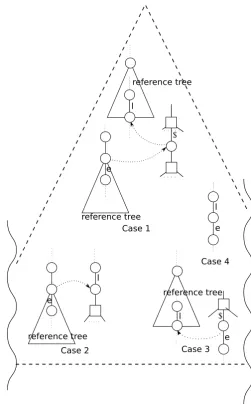
In ProcedureMAKECANDFREQPATHS, when we construct a candidate path whose length isln+ 1by expanding the k-frequent path whose length is ln, four cases are considered
Procedure 2GENOCCPOINTS
Require: The compact coding ⟨ELT, DT, CT⟩
Ensure: The setZ1of all path-count triplets, each of which has a path whose length is 1.
1: Z1=∅ andOPi =∅ for i(0≤i <|CT|) 2: for alli (0≤i <|CT|)do
3: ifCT[i]is inELT then
4: OPi =OPi∪ {i}
5: end if
6: ifCT[i]is inDT then
7: for allan edgej of reference tree T⟨CT[i]⟩do
8: OPj =OPj∪ {j}
9: end for
10: end if
11: end for
12: for alli (0≤i <|CT|)such thatCT[i] is inELT do
13: Z1=Z1∪ {(i, CT[i], OPi)} 14: end for
15: return Z1
(see Fig. 3). If we try to expand a path by appending an edge to the edge e incident to the root of a reference tree, we must consider two cases in which the label ofparent(e)
is ’$’ (case 1) or is included inELT (case 2). Otherwise, if eis not incident to the root of any reference tree, we must also consider two cases in which the label of the parent edge parent(e)is ’$’ (case 3) or is included inELT (case 4).
For example, in the compression tree t of Fig. 1, we consider the path from index 44 (the edge (19, a,20)) to index3(the root oft). Since reference having index44as the first argument does not exist inDT, we determine whether or not CT[parent(44)] is ’$’. From parent(44) = 43, CT[parent(44)] =CT[43] =’$’. We can see that expanding from the edge at index44is case 3. Hence, we obtainj= 43, u = dic(CT[parent(43)], childrank(43)) = dic(P,2) = 18, and OP′[18] = OP′[18] ∪ (18, ab,{40}). Because parent(14) is the root of the reference tree referred from the port list at index 40 and CT[parent(40) = 36] =’$’, we can apply the expansion of case 2. Next, we obtainq=
dic(CT[parent(36) = 23], childrank(36)) = dic(P,2) = 18andOP′[18] =OP′[18]∪(18, ab,{23}). Finally, we can obtain the path ’ababaa’ as the path from index 44 to the root.
We explain ENUFREQPATHS when a compression tree t in Fig. 1 and the minimum occurrence k = 5 are given. In line 1 of ENUFREQPATHS, ProcedureGENOCCPOINTS generates the following set Z1.
Z1={(8, a,{8}),(10, b,{10,23,31,40}), (11, a,{11,23,31,40}),(14, a,{14,23,31,40}),
(16, b,{16,23,31,40}),(17, a,{17,23,31,40}),
(18, b,{18,23,31,40}),(19, b,{19,23,31,40}),
(27, b,{27}),(44, a,{44}),(48, a,{48}),(49, a,{49})}
[image:4.595.47.290.289.604.2]Procedure 3 MAKECANDFREQPATHS
Require: A setZlnof path-count triplets, each of which has a path with lengthln, set Pln of k-frequent paths, the length of each isln, and set P1 ofk-frequent edges Ensure: The setZln+1 of path-count triplets each of which
has a path whose length isln+ 1 1: OPi′=∅ for i(0≤i <|CT|)
2: U =∅
3: for allp∈Pln do
4: for all(i, p, OPi)∈Zln do
5: if (rank(i) + 1, v1, ...vk)∈DT then
6: for all w∈OPi do
7: u=parent(w) 8: if CT[u] =′ $′ then
9: /* case 1 */
10: q=dic(CT[parent(u)], childrank(u))
11: U =U∪ {q}
12: OPq′=OPq′∪ {parent(u)}
13: else
14: /* case 2 */
15: U =U∪ {u}
16: OPu′ =OPu′ ∪ {u}
17: end if
18: end for
19: else ifCT[parent(i)] =′ $′ then
20: /* case 3 */
21: for all w∈OPi do
22: j =parent(i)
23: u=dic(CT[parent(j)], childrank(j)) 24: U =U∪ {select(u+ 1)}
25: OPu′ =OPu′ ∪∪w∈OP
i{select(u+ 1)}
26: end for
27: else
28: /* case 4 */
29: e=parent(i)
30: U =U∪ {e}
31: OPe′=OPe′∪OPi
32: end if
33: end for
34: end for
35: for allw∈U do
36: Zln+1=Zln+1∪ {(w, p◦CT[w], OPw′)}
37: end for
38: return Zln+1
int.
IV. EXPERIMENTALRESULTS ANDDISCUSSION
To discuss the efficiency of ENUFREQPATHS, we explain the experimental results obtained from applying ENUFREQ -PATHS to artificial big data, which were randomly generated, and discuss its efficiency.
A. Experimental Environments and Setting
We implemented ENUFREQPATHS on a PC with macOS 10.12 Sierra and 32GB memory and 4-GHz Intel Core i7 by using C++. In implementing ENUFREQPATHS, we use the SDSL[11] as the data structure for compression trees. We randomly created a set D of 1000 edge-labeled ordered
reference tree
$
l
reference tree e
Case 1 e
l
Case 4
reference tree
l $
Case 3 reference tree
l
e
Case 2
[image:5.595.306.558.48.454.2]e
Fig. 3. All case of extending path
trees containing from 2000 to 14000 nodes and having two edge labels. For each edge-labeled ordered treeT inD, we created a compression tree t of T that had 5 entries in the dictionaries. We denote the set of these 1000 compression trees asCT(D).
[image:5.595.47.284.112.582.2]B. Experimental Results and Discussion
Figure 4 shows a comparison of the running time of ENUFREQPATHSwhen eachT∈Dandt∈CT(D), which is the compression tree ofT, are given as inputs. We can see that ENUFREQPATHSgiven the compression treet∈CT(D)
0 10 20 30 40 50 60 70 80 90 100
0 2000 4000 6000 8000 10000 12000 14000
Ru
nn
in
g
tim
e[
s]
Number of nodes tree
[image:6.595.51.285.51.174.2]compression tree
Fig. 4. Number of nodes vs running time
0 10 20 30 40 50 60 70 80 90 100
0 20000 40000 60000 80000 100000 120000 140000
Ru
nn
in
g
tim
e[
s]
Number of occurrence points of frequent paths tree
[image:6.595.51.287.207.334.2]compression tree
Fig. 5. Number of occurrence points of frequent paths vs running time
0 20 40 60 80 100 120
0 2000 4000 6000 8000 10000 12000 14000 16000
Ru
nn
in
g
tim
e[
s]
Number of frequent paths tree
compression tree
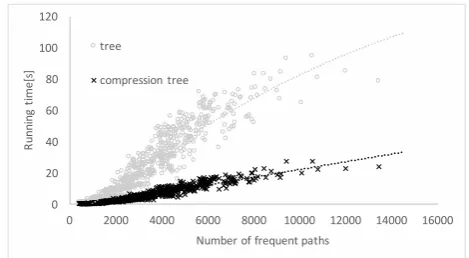
Fig. 6. Number of frequent paths vs running time
required for extracting all k-frequent paths from t is faster than that fromT by about 4.11 times.
Paths occurring in an entryl of a dictionary always occur in all port lists having L as the edge label. Hence, if the compression ratio becomes higher, the number of occurrence points of frequent paths in a compression tree decreases. This leads to reduction in memory usage and increase in enumeration speed of frequent paths in compression trees.
V. CONCLUSION
We have introduced a compression tree, which is obtained by replacing repeated occurrences of subgraphs having or-dered tree structures with references to the first occurrence point based on an LZ compression scheme, and presented a succinct representation of a compression tree. We then have proposed a time- and memory-efficient algorithm for enumerating all frequent paths in a given compression tree without decompression. To discuss the efficiency of the proposed algorithm, we explained the experimental results
obtained from applying the algorithm to artificial big data, which were randomly generated.
For future work, we will apply the proposed algorithm to real-world big data. By extending the proposed algo-rithm, we will develop more time- and memory-efficient algorithms for enumerating all frequent subgraphs having ordered-tree structures for a large set of compression trees and for enumerating all characteristic tree patterns having structured variables common to a given large set of edge-labeled ordered trees by extending the pattern the matching algorithm proposed by Itokawa et al. [6] and Suzuki et al.[13] for edge-labeled ordered trees to a matching algorithm for compression trees.
ACKNOWLEDGMENTS
This work was partially supported by Grant-in-Aid for Scientific Research (B) (Grant Number 26280087) and (C) (Grant Number 15K00313) from the Japan Society for the Promotion of Science (JSPS), Japan.
REFERENCES
[1] J. Barbay, L.C. Aleardi, M. He, J.I. Munro. Succinct representation of labeled graphs International Symposium on Algorithms and Com-putation, pp.316-328, 2007.
[2] D. Benoit, E. D. Demaine, J. I. Munro, and R. Raman. Representing trees of higher degree. Algorithmica, 43(4):275–292, 2005. [3] P. Ferragina, F. Luccio, G. Manzini, and S. Muthukrishnan. Structuring
labeled trees for optimal succinctness, and beyond. InProceedings of IEEE Symposium on Foundations of Computer Scie nce (FOCS), pages 184–196, 2005.
[4] R. F. Geary, N. Rahman, R. Raman, and V. Raman. A simple optimal representation for balanced parentheses. In CPM, pages 159–172, 2004.
[5] Y. Itokawa, K. Katoh, T. Uchida, and T. Shoudai. Algorithm using Expanded LZ Compression Scheme for Compressing Tree Structured Data, pages 333–346. Lecture Notes in Electrical Engineering. Springer, 2010.
[6] Y. Itokawa, M. Wada, T. Ishii, and T. Uchida. Pattern Matching Al-gorithm Using a Succinct Data Structure for Tree-Structured Patterns, pages 349–361. Lecture Notes in Electrical Engineering 110. Springer, 2012.
[7] J. Jansson, K. Sadakane, W.-K Sung. Ultra-succinct representation of ordered trees with applications Journal of Computer and System Sciences78, pp.619631, 2012.
[8] H.-I. Lu, C.-C. Yeh. Balanced parentheses strike back. ACM Transactions on Algorithms: Volume 4 Issue 3, 2008.
[9] J. I. Munro and V. Raman. Succinct representation of balanced parentheses and static trees.SIAM Journal on Computing, 31(3):762– 776, 2001.
[10] R. Raman, S.S. Rao. Succinct representations of ordinal trees. Space-efficient data structures, streams, and algorithms, Vol. 8066 of the series LNCS, pp.319-332, 2013
[11] SDSL: Succinct data structure library. http://simongog.github.io/sdsl/ [12] J. A. Storer and T. G. Szymanski. Data compression via textual
substitution.Journal of the ACM, 29(4):928–951, 1982.
[13] Y. Suzuki, T. Shoudai, T. Uchida and T. Miyahara. An efficient pattern matching algorithm for ordered term tree patterns. IEICE Trans. Fundamentals, E98-A(6):270–284, 2015.
[image:6.595.51.286.366.495.2]