Abstract—Conventional Travelling Salesman Problem
(TSP) solutions are based on the assumption that time of travel between nodes is wholly dependent on distance. But in practice, this is not so as road and traffic conditions help to determine time taken to travel between nodes. We introduce fuzzy based TSP solution where distance and road traffic conditions are fuzzy. Result of the fuzzy based solution for a case study show that using conventional TSP solution the average time to travel shortest path was 192min while with the fuzzy TSP solution, the average time was 177.66min. The result confirms the superiority of fuzzy TSP solutions over conventional TSP in solving real life TSP problems.
Index Terms—Traveling Salesman Problem, Fuzzy sets,
Modelling, Optimization
I. INTRODUCTION
HE travelling salesman problem (TSP) is a well known problem in optimization theory [1, 2, 3]. Traditional solutions to TSP problems assume that the distance between nodes solely determine the time of travel between nodes, but this is often not the case as the time of travel between nodes are often determined by road and traffic conditions. The issue of road conditions is very critical in most developing countries as significant numbers of roads are often in deplorable conditions and in severe state of disrepair. This often makes journey times to be double the normal time in excellent road conditions. Companies that supply their products or deliver raw materials to customers in several locations often need to optimize their supply routes in order to reach customers economically and reduce transportation cost, a significant part of the overall cost of goods and services.
The road and traffic conditions are quantities that are difficult to measure directly but could be qualified by linguistic variables such as good, excellent, poor etc. Hence, quantifying road and traffic conditions is fuzzy, vague and is dependent on human judgment. The fuzzy nature of road and traffic conditions means that fuzzy based solutions to TSP would provide a better solution to Travelling Salesman Problems.
Manuscript received April 06, 2017; revised April 15, 2017.
C.C. Nwobi-Okoye is with the Faculty of Engineering, Chukwuemeka Odumegwu Ojukwu University, Anambra State, Nigeria (phone: 234-0806-0013240; e-mail: cc.nwobiokoye@ coou.edu.ng).
S. Okiy is with the Petroleum Training Institute, Effurun, Nigeria (e-mail: [email protected]).
F.I. Obidike is with the Faculty of Engineering, Chukwuemeka
Fuzzy sets since its introduction in 1965 have been used extensively by engineers and scientists in solving problems where uncertainty is involved [4, 5]. Fuzzy sets have been used in solving mathematical programming problems since Zadeh and Bellman [6, 7] introduced fuzzy dynamic programming. Several authors such as Kumar and Gupta [8], Pang et al. [9], Dhanasekar et al. [10] and Pezhhan and Eghbal [11] applied fuzzy set theory to solving TSP. This research differs from the ones in literature because the study took the road and traffic conditions into consideration in model formulation.
The hub of the investigation is a company that produces engine oil used for lubricating vehicles and machinery located at Nnewi, Anambra State, Nigeria.
II. THEORETICAL BRIEF
A. The Traveling Salesman Problem
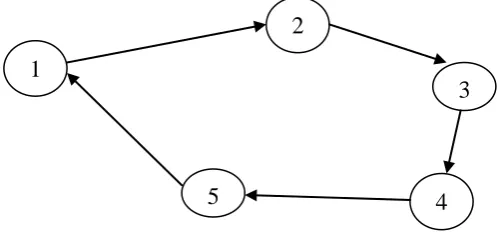
[image:1.595.310.559.483.603.2]The Traveling Salesman Problems (TSP) are a class of problems encountered in optimization in which a salesman is assumed to travel from a source city such as city 1 in Figure 1 and moves to several other cities and returns back to the starting or source city. The objective of the optimization problem is therefore to determine the route that minimizes the distance travelled by the salesman.
Figure 1: A typical traveling salesman problem
The mathematical formulation of the typical travelling salesman problem studied in this research is shown in Equation (1).
Minimize Z = dijxijt n
t=1
(1) n
j=1 n
i=1
Fuzzy Based Solution to the Travelling
Salesman Problem: A Case Study
Chukwuemeka C. Nwobi-Okoye, Member, IAENG , Stanley Okiy, Francis I. Obidike
T
1
2
3
1 to n
t = the time period, or step in the route between the stops xijt = 1 if the edge of the network from i to j is used in
step t of the route, 0 otherwise
dij = the distance or cost from stop i to stop j
The formulated optimization problem can be solved by brute force algorithm or any of the available optimization algorithms such as genetic algorithm, tabu search, ant colony optimization, branch and bound algorithm etc.
B. Fuzzy Sets
Fuzzy sets unlike crisp sets are characterized by degree of membership. For example in a crisp set of tall people, one can either belong to it or not. But in a fuzzy set of tall people the membership is characterized by values which range from 1 for complete membership to zero for non membership. Hence, giants may belong to this to a degree of one while dwarfs belong to this to a degree of zero.
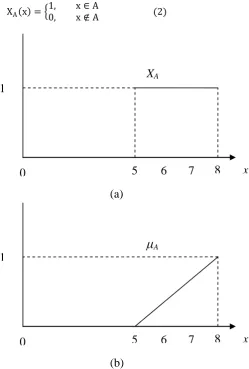
For a crisp set A representing tall people, an element x in the universe X representing persons is either a member of A or not. Mathematically this concept is illustrated thus:
[image:2.595.40.290.336.706.2]XA x = 1,0, x ∈ Ax ∉ A (2)
Figure 2: Graphical illustration of crisp and fuzzy set
Assuming humans can reach a maximum height of 8 feet. We can use this assertion to graphically illustrate the concept of crisp and fuzzy sets. Let us look at Figures 2a and 2b.
Let H denote a set of heights of people considered to be tall. Since the property tallness is Fuzzy, there is no unique membership function for H. Assuming that the maximum height for humans is eight feet as we have earlier asserted and anybody with a height equal to or less than five feet is not considered tall at all, the membership function denoted by μH is given by:
μH 8 = 1 (3) μH 5 = 0
According to Ross [12] a notation convention for fuzzy sets when the universe of discourse, X, is discrete and finite, is as follows for a fuzzy set A:
A = μA(x1) x1
+μA(x2) x2
+ ⋯
= μA(xi) xi i
(4)
When the universe X is continuous and infinite, the fuzzy set A is denoted as:
A = μA(x)
x (5)
III. METHODOLOGY
The TSP problem solved in this research consists of five cities similar to the model shown in Figure 1. The source is a city called Nnewi (City 1) where the salesman takes off from and moves to four other cities to deliver products to customers. The conventional TSP optimization model was used to determine the optimal route without taking the road and traffic conditions into consideration. Subsequently, a fuzzy-TSP model was formulated by taking the road and traffic conditions into consideration to obtain another optimal route for the salesman. In the fuzzy modeling, the concept of virtual distances was introduced. The virtual distance obtained from the fuzzy inference system was used in solving the TSP.
After the computations, the optimal routes determined through fuzzy and conventional methods, as well as the current route used by the salesman were tested by driving along the routes to determine the times taken to move along the routes. Test was carried out three times for each route. After the tests, the average time taken for each route was determined.
IV. RESULTS
The developed fuzzy model is shown in Figure 3. As shown in Figure 3, the inputs to the fuzzy inference system consist of the actual distance and the road condition. The output is the virtual distance.
1
0
5
6
7
8
X
Ax
(a)
1
0
5
6
7
8
μA
x
Figure 3: Fuzzy inference system
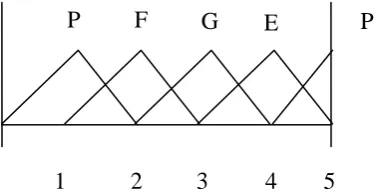
The road and traffic conditions were represented by five linguistic variables namely: poor (P), fair (F), good (G), excellent (E) and perfect (P). The route distances were represented by five linguistic variables namely: very short, short, medium, long, very long. The virtual distances were represented by ten linguistic variables namely: Vd1, Vd2, Vd3, Vd4, Vd5, Vd6, Vd7, Vd8, Vd9 and Vd10. The membership functions derived from the linguistic variables are shown in Figures 4, 5 and 6.
[image:3.595.47.236.302.399.2]Figure 4: Membership functions for road and traffic conditions
Figure 5: Membership functions for actual distances
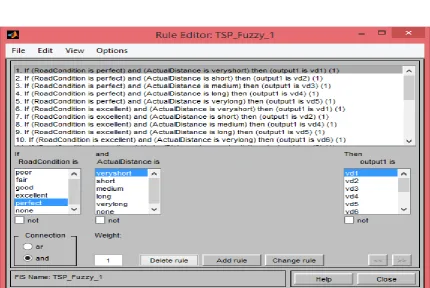
Twenty five rules were generated. A snippet of the rules generated is shown in Figure 7. The rules were generated based on the observed effects of road and traffic conditions on travel times.
For example if the road conditions is perfect, the time of travel could be obtained by the equation:
t = d s (6)
Where t = time of travel
When the road conditions deviates from this perfect condition, the time of travel could double in worst case scenarios and distance seems to double. This false distance is known as virtual distance.
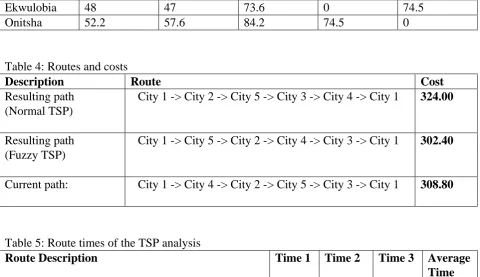
Matrices used for the TSP solutions are shown in Tables 1, 2 and 3.
Table 4 shows the routes and costs obtained from the normal TSP, the fuzzy TSP and the current route used by the salesman. As shown in Table 4, the least cost was obtained when fuzzy TSP was used while the highest cost was obtained by using normal TSP.
The times obtained from the routes used by the company used for the case study, the optimal route obtained from conventional TSP and fuzzy based TSP are shown in Table 5.
As Table 5 shows, the time taken to travel the optimal route obtained through fuzzy TSP was least followed by the time taken to travel the route used by the organization to deliver its products to the four cities, while the time taken to travel the along the optimal route obtained through the conventional TSP was highest. This shows that the fuzzy TSP solution performed better than the conventional TSP in situations where the road conditions are fuzzy. It is surprising that the route used by the company performed better than the optimal route prescribed by the conventional TSP. The reason could be because the organization has learned from experience over the years based on road and traffic conditions that certain routes though short takes longer time, hence they have devised to follow certain routes which coincidentally takes lower time to travel than the route prescribed by the conventional TSP.
V. CONCLUSIONS
The result reported in this research is quite interesting and would be very useful to industrial and business organizations and every organization involved in logistics and transportation. The study shows another novel way to apply fuzzy set theory to solve problems of daily life.
REFERENCES
[1] Hoffman, Karla L., Manfred Padberg, and Giovanni Rinaldi. "Traveling salesman problem." In Encyclopedia of operations research and management science, pp. 1573-1578. Springer US, 2013.
[2] Ouaarab, Aziz, Belaïd Ahiod, and Xin-She Yang. "Discrete cuckoo search algorithm for the travelling salesman problem." Neural
Fuzzy
Inference
System
Actual Distance
Road Condition
Virtual Distance
1
2
3
4
5
P
F
G
E
P
16
32
48
64
80
[image:3.595.44.243.447.539.2]salesman problem with traffic factors." Applied Soft Computing 13, no. 10 (2013): 4023-4037.
[4] Nwobi-Okoye, Chidozie Chukwuemeka, and Stanley Okiy. "Performance assessment of multi-input-single-output (MISO) production process using transfer function and fuzzy logic: A case study of soap production." Cogent Engineering 3, no. 1 (2016): 1257082.
[5] Nwobi-Okoye, Chidozie Chukwuemeka, Stanley Okiy, and Anthony Clement Igboanugo. "Performance evaluation of multi-input–single-output (MISO) production process using transfer function and fuzzy logic: Case study of a brewery." Ain Shams Engineering Journal 7, no. 3 (2016): 1001-1010.
[6] Esogbue, Augustine O., and Janusz Kacprzyk. "Fuzzy dynamic programming." Fuzzy sets in decision analysis, operations research and statistics (1998): 281-307.
[7] Bellman, Richard E., and Lotfi Asker Zadeh. "Decision-making in a fuzzy environment." Management science 17, no. 4 (1970): B-141. [8] Kumar, Amit, and Anila Gupta. "Methods for solving fuzzy
assignment problems and fuzzy travelling salesman problems with different membership functions." Fuzzy Information and Engineering 3, no. 1 (2011): 3-21.
[9] Pang, Wei, Kang-ping Wang, Chun-guang Zhou, and Long-jiang Dong. "Fuzzy discrete particle swarm optimization for solving traveling salesman problem." In Computer and Information Technology, 2004. CIT'04. The Fourth International Conference on, pp. 796-800. IEEE, 2004.
[10] Dhanasekar, S., S. Hariharan, and P. Sekar. "Classical Travelling Salesman Problem (TSP) based Approach to Solve Fuzzy TSP using Yager's Ranking." International Journal of Computer Applications 74, no. 13 (2013).
[11] Pezhhan, Elham, and Eghbal Mansoori. "A biologically inspired solution for fuzzy travelling salesman problem." In International Symposium on Artificial Intelligence and Signal Processing, pp. 277-287. Springer International Publishing, 2013.
[image:4.595.48.473.269.353.2][12] Ross, T. 2004. Fuzzy Logic with Engineering Applications. John Wiley & Sons Ltd, The Atrium, Southern Gate, Chichester, West Sussex PO19 8SQ, England.
Figure 6: Membership functions for virtual distances
Figure 7: Fuzzy rules
16
32
48
64
80
96
112
128
144
160
[image:4.595.49.480.386.674.2]Table 1: Actual distances matrix
Nnewi
Ihiala
Awka
Ekwulobia
Onitsha
Nnewi
0
31
40
24
27
Ihiala
31
0
69
47
42
Awka
40
69
0
27
43
Ekwulobia
24
47
27
0
43
Onitsha
27
42
43
43
0
Table 2: Fuzzy matrix
Nnewi
Ihiala
Awka
Ekwulobia
Onitsha
Nnewi
-
Poor
Fair
Poor
Fair
Ihiala
Poor
-
Good
Outstanding
Good
Awka
Fair
Good
-
Fair
Poor
Ekwulobia
Poor
Outstanding
Fair
-
Fair
Onitsha
Fair
Good
Poor
Fair
-
Table 3: Virtual distances matrix
Nnewi
Ihiala
Awka
Ekwulobia
Onitsha
Nnewi
0
60.6
72
48
52.2
Ihiala
60.6
0
102
47
57.6
Awka
72
102
0
73.6
84.2
Ekwulobia
48
47
73.6
0
74.5
[image:5.595.42.523.393.670.2]Onitsha
52.2
57.6
84.2
74.5
0
Table 4: Routes and costs
Description
Route
Cost
Resulting path
(Normal TSP)
City 1 -> City 2 -> City 5 -> City 3 -> City 4 -> City 1
324.00
Resulting path
(Fuzzy TSP)
City 1 -> City 5 -> City 2 -> City 4 -> City 3 -> City 1
302.40
Current path:
City 1 -> City 4 -> City 2 -> City 5 -> City 3 -> City 1
308.80
Table 5: Route times of the TSP analysis
Route Description
Time 1
Time 2
Time 3
Average
Time
Route Used by the organization
185
189
183
185.66
Optimal route found through conventional TSP
194
190
192
192.00