Abstract—The recent development on pervasive computing, sensors network and smart appliances has motivated the appearance of new technological domain called smart spaces. such spaces are defined as a physical space rich in equipments and software services that is capable of interacting with people in order to provide intelligent services to the user for improved comfort (quality of life), energy saving, security, and tremendous benefits for an elderly person living alone. Providing intelligent services requires the equipments to be sensitive to the context of use or context-awareness. The concept of context is a key enabling factor in such environment and understand it, establishing its components and modeling it are basic and important steps for the development of smart spaces. Previous works in such environments were unable to deal efficiently with context-awareness. In this paper we present both an ontology-based context and smart living room modeling.
Index Terms— Smart living room, Context, Modeling, Ontology.
I. INTRODUCTION
MART spaces is a research field under the banner
of pervasive and ubiquitous computing where devices dynamically and proactively (without explicit intervention of users) adapt their behavior to current context changes. So far, there is no explicit definition of smart spaces which are also called "smart environments" or "ambient intelligence". The most well-known definition of smart spaces is the one gave by D. Cook and S. Das of the MAVHome project in their book [1]: "Smart space is able to acquire and apply knowledge about its environment and to adapt to its inhabitants in order to improve their experience in that environment". The number of smart appliances and devices in the home and office has grown dramatically in recent years thanks to the tremendous evolution of embedded systems. Unfortunately, each component usually performs a single function and there is no synchronization with other components or the
S
Manuscript received July31, 2015; revised August 07, 2015. This work
was supported by the King Abdulaziz City for Science and Technology (KACST), KSA under Grant AC-35-95
Moeiz Miraoui is with Umm Al-Qura University, KSA (e-mail: mfmiraoui@ uqu.edu.sa).
Sherif El-etriby is with the Faculty of computers and information, Menoufia University. Egypt (e-mail:[email protected])
Chakib Tadj is with the Ecole de Technologie Superieure,
University of Quebec, Montreal, QC, Canada (e-mail: [email protected])
Abdulbasit Zaid Abid is with Umm Al-Qura University, KSA (e-mail: [email protected]).
environment. The principal objective of researches in this field is to move from environments filled with smart devices to smart environments. Previous solutions proposed suffer from three main drawbacks: a) interaction and cooperation between devices is missing, b) context definition and modeling are not clear enough and specific to some particular aspects of smart spaces, c) the services adaptation task is not aware or do not deal in depth with context-awareness which makes the devices able of acting autonomously on behalf of users. Our aim is to propose an ontology-based modeling of both smart living room environment and contextual information which enables common understanding of context and enhances its sharing.
The remainder of this paper is structured as follows. In section II we discuss some related works. Section III describes the overall environment of an exemplary smart living room. Section IV presents the ontology-based modeling of the smart living room and contextual information. Finally, Section V, draws the conclusions of this paper.
II. RELATED WORK
The development of an intelligent, independent and adaptable to changing conditions environment is a goal that has existed for decades. Research on this topic is more intense in recent years. Several researchers have worked on smart spaces such as homes, offices, universities, hospitals, hotels, cars and other private or public places. Context-awareness is an important characteristic of smart spaces and context modeling is a basic step for the development of such spaces. In this section we will focus only on ontology-based context modeling approaches in smart spaces. Among the earliest works on ontology-based context modeling, the SOUPA (standard ontology for ubiquitous and pervasive applications) [2]. SOUPA is composed of two sets of ontologies : SOUPA core ontologies and SOUPA extension ontologies. Core ontologies try to define a generic vocabulary which is universal for different pervasive computing applications. Extension ontologies (extended from SOUPA core ontologies) define additional ontologies to support specific kind of applications and provide examples for extending future ontologies. Pantsar-Syvaniemi et al. [3] proposed a
Ontology-Based Context Modeling for a Smart
Living Room
novel context ontology for smart spaces that exploits some parts from SOUPA [01] and enhances context-awareness with three dimensions: physical, digital and human. CoBrA (context broker agent) [4] is an architecture to support the development of context-aware systems in an intelligent space (smart house, smart car, etc…). In CoBrA where defined ontologies collections called COBRA-ONT for modeling contextual information in such intelligent spaces. COBRA-ONT are expressed with OWL which defines typical concepts associated with places, agents and events. Ontology plays a crucial role in CoBrA, it helps the context broker (server) to share contextual information with other agents and permit him to make context reasoning. The ontology is categorized in four classes: 1) physical place ontology, 2)agent (human or software) ontology, 3) agent localization agent ontology, 4) agent activity context ontology. SOCAM (Service-Oriented Context-Aware Middleware) [5] is an architecture for the building and rapid prototyping of context-aware services in intelligent environment. The context ontologies are divided into upper ontology which captures general context knowledge about the physical world and composed of: computational entity, location, user and activity. The domain-specific ontologies which are a collection of low level ontologies that defines the details of general concepts and their properties in each sub-domain. Abdulrazak et al. [6] presented an ontology for smart environments that takes into account the new notions namely the referentiality in terms of localization and temporality, and the problem of the environmental change. The design of their ontology was based on the general idea which states that, a being lives and interacts in an environment with a certain dynamic. From there, they extracted the major concepts of their top level ontology, which are: Being, Environment and Dynamic. Saleemi et al. [7] modeled and processed context information using their development tool and Nokia’s Smart-M3 architecture. They referred to all information that characterize the situation of a user as his context. They divided the user’s context in two broad categories, namely atomic context and inferred context. They modeled user’s context using six context dimensions: Time, Locality, Devices, Activity, Occupancy and Associations. They have defined an inference rule using a 3-clauses pattern. Ming Li [8] proposed a context model based on ontology for smart space composed of the top layer ontology model and the specific field onto- logy model. The top layer ontology model is the abstract of context information in smart space composed of seven classes: Person, Location,Time, Activity, Physical Entity, Virtual Entity, and Service, the specific field ontology model is the embodiment of the top layer ontology model in the specific field. He proposed a rule-based reasoning system for the adaptation task. Haesung Lee and Joonhee Kwo [9] modeled contexts which are generally distributed in smart home environment using the ontology technology. The set of modeled contexts includes home domain-based contexts and social
Most of proposed approaches of ontology-based context modeling do not offer a complete description of contextual information and do not cover all aspects of context in a smart space. Most of them were not based on a clear and concise definition of context. In order to propose more extensible and reusable ontologies, most of them suggest the use of two categories of ontologies. One composed of basic ontology concepts and the other is adapted according to the application domain. The core ontology (basic) differs from one method to another and its basic classes depend on the definition of context adopted by authors. The proposed models fails in presenting a generic ontology for context which cover all aspect of context in a smart space which could limit their usability and extensibility.
III. THE SMARTLIVINGROOM
A. Description
[image:3.595.56.266.481.638.2]An exemplary smart living room is composed of a set of equipments of three main types : a) appliance which can be smart TV, satellite receiver, heater, air conditioner and home cinema, b) Furniture which can be window blinds, a set of light lamps and sofa, c) communication device which can be a land-line phone or the user's mobile phone. All these devices should provide a set of services through different forms (or modes) to the user (s) occupying the living room. These services should take into account the user's preferences and triggered according to the current context collected from different sensors installed of the living room. (Figure 1).
Fig. 1. Basic components of an exemplary living room.
B. Scenario Description
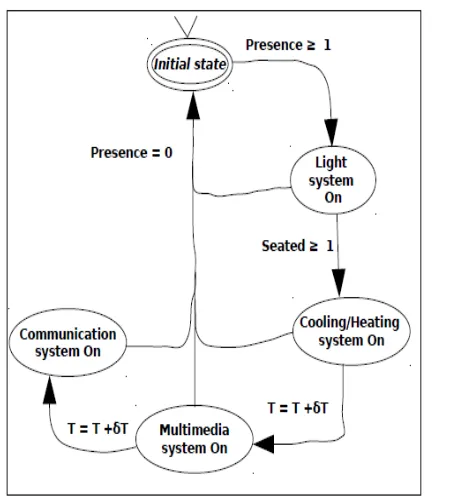
In the initial state of the living room, everything is off (TV, radio/music player, light, air conditioning, heater, window blinds closed, ...). At the entrance of the user and detection of his presence, the lighting system composed of the window blinds and light bulbs starts first to adjust the light to the preferences of the user and the current context. Then the heating and cooling system starts to set the room temperature to user's preference and according to the current context. the
former system will trigger only if the system perceives at least one user seated on the sofa to avoid wasting energy if the user makes a simple entry and exit from the living room without the intention of staying. Multimedia system then starts to turn on the TV or radio/music player and home cinema depending on the preferences of the user if he is alone or surrounded and finally the communication system starts to provide services tailored to the user's context such as forwarding the ring of an incoming call to the home cinema if the noise is too high in the living room or display a picture of a phone on the TV screen in order to attract user's attention.
[image:3.595.318.543.501.753.2]The dynamic aspect of the smart living room described in the above scenario can be modeled using a simple finite state machine to show the triggering order of equipments and services. There are two main states of the smart living room: empty and occupied, in the first state (initial and final state) the network sensors perceives that there is no one in the living room so all the equipments should be set off. As soon as the network sensors perceives the presence of one or more user, the smart living room moves to the state occupied which in turn contain four sub states describing the order of systems boot. The light system will start first and after perceiving at least one user seated on the sofa, the heating and cooling system will start and then (to be fixed in advance by the system developer according to the user's preferences) the multimedia system will start and finally (after a small period of time ) the communication system will start. At any time during the occupied state of the smart living room, if the network sensors perceives that there is no body (presence=0), the smart living room will transits directly to the empty state (Figure 2).
IV. ONTOLOGY-BASEDMODELING
Ontology is a set of structured concepts that are organized in a graph where relations can be either semantic relations or composition and heritage relations. The main objective of ontology is to model the set of knowledge of a given domain. This means to choose a manner for describing domain information in a form comprehensible by computers. It provides a representative vocabulary for a given domain and permits a consistent interpretation of data [17]. Ontology is a powerful tool for knowledge sharing, reuse and expression of complex situations compared to other data modeling techniques such as key-value, object oriented, logic, mark-up schema and graphical models [18,19]. In addition ontology supports formal logical reasoning over the situation ontology for consistency checking, subsumption reasoning and implicit knowledge inference.
A. Smart living room modeling
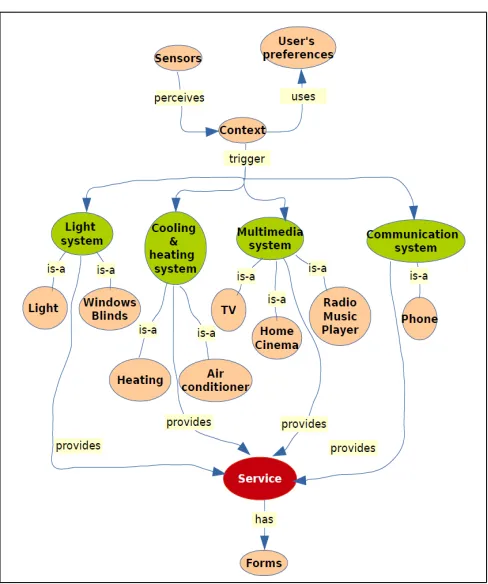
[image:4.595.305.549.56.348.2]A smart living room is composed of a set of equipments which can be appliances, furniture or communication devices. Each equipment provides a set of services to the users (occupants) through several forms taking into account their preferences. The basic concepts of a smart living room that we can extract from the description and the scenario above are : sensors, light system, cooling and heating system, multimedia system, communication system, user, user's preferences, services, service's forms and context. These concepts are related to each other in some ways. The context uses the user's preferences and perceived by the sensors network to trigger the light system, cooling and heating system, multimedia system and communication system. Each of these systems has a set of subclasses and can provide several services through different forms. Figure 3 shows a simplified ontology-based model of the smart living room and figure 4 shows a detailed one.
[image:4.595.46.291.596.756.2]Fig. 3. Simplified ontology-based model of the living room
Fig. 4. Detailed ontology-based model of the living room
B. Context modeling
Context-aware applications should provide proactively (without explicit user's intervention) adapted services to both users and applications according to the current context. Context-awareness is a basic concept of pervasive and ubiquitous computing as well as smart environment or ambient intelligence. From this reveals the importance of the concept of context which considered as a specific kind of knowledge that requires a good and clear understanding and specially a precise establishment of its components. One basic step before context modeling consists of clearly define context. Several definitions of context were proposed. Some of them were based on enumerating contextual information (localization, nearby people, time, date, etc.) like those proposed in [20,21,22]. Others were based on providing more formal definitions in order to abstract the term like the one proposed by Dey [23]. Most of these definitions were specific to a particular domain such as human-computer interaction and localization systems and need an adaptation effort to be used in a particular application. In our previous work [24] we have made a survey of existing definitions of context and proposed a service-oriented definition of context as follows: “Any information that triggers a service or changes the quality (form or mode) of a service if its value
changes.” This definition is sufficiently abstract and
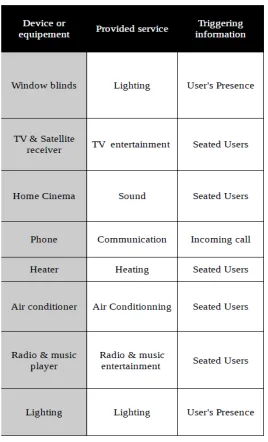
Based on this definition, The modeling process starts (first step) by specifying for each equipment of the smart living room the set of services that can be provided. For each service we should specify also the set of information which their change of values will trigger the service (Table 1).
TABLE I
SERVICESTRIGGERINGINFORMATION
The second step of the modeling process consists of specifying for each service the set of forms through which the services can be provided. We should also specify for each form of service the set of information which their change of values will change the form of a service. The set of these forms are fixed extensible according to how the living room should operate (Table 2).
TABLE II
SERVICESFORMCHANGINGINFORMATION
The third step of the modeling process consists of making the union of the two previous sets to get the final list of contextual information. This information will compose the global context and in our case will be composed of the following elements with their possible values (Table 3).
TABLE III
CONTEXTELEMENTSANDTHEIRPOSSIBLEVALUES
[image:5.595.102.236.176.397.2]Figure 4 shows the ontology-based model of context in our smart living room composed of the main concepts and relations between them.
Fig. 4. Ontology-based context model of the living room
V. CONCLUSIONANDFUTUREWORK
definition of context, 2) the proposed ontology is more generic and cover almost all concepts of context in a smart living room and 3) the modeling process is very simple and leads in an easy way to the elements of context. Our future work will focus on context reasoning for implicit knowledge inference and achieve a context-aware services adaptation based on first order logic.
ACKNOWLEDGMENT
This work is supported by the King Abdulaziz City for Science and Technology (KACST), KSA under Grant AC-35-95
REFERENCES
[1] D. Cook & S. Das, Smart environments: Technology, protocols and applications. John Wiley & Sons. ISBN: 0-471-54448-5. 424 p. 2004 [2] H. Chen, F. Perich, T.W. Finin and A. Joshi “Soupa : Standard Ontology
for Ubiquitous and Pervasive Applications”, In MobiQuitous, pages 258-267. IEEE Computer Society. 2004
[3] S. Pantsar-Syvaniemi,K. Simula, & E. Ovaska, Context-awareness in smart spaces, IEEE Symposium on Computers and Communications (ISCC) Riccione, 2010
[4] H. Chen, T. Finin and A. Joshi “:An Ontology for Context-aware Pervasive Computing Environments”, Knowledge Engineering Review, vol. 18, pp. 197-207, November. Springer Verlag. 2003
[5] T. Gu, X. H. Wang, H.K. Pung and D.Q. Zhang “An Ontology-based Context Model in Intelligent Environments”, In Proceedings of Communication Networks and Distributed Systems Modeling and Simulation Conference, San Diego, California, January 2004 [6] Abdulrazak, B., Chikhaoui, B., Gouin-Vallerand, C. and Fraikin, B.
(2010) ‘A standard ontology for smart spaces’, Int. J. Web and Grid Services, Vol. 6, No. 3, pp.244–268.
[7] M. Mohsin Saleemi, Natalia Díaz Rodríguez, Johan Lilius, Ivan Porres, A Framework for Context-Aware Applications for Smart Spaces. In: Sergey Balandin, Yevgeni Koucheryavi, Honglin Hu (Eds.), Proceedings of The 4th conference on Smart Spaces ruSMART 2011, Lecture Notes in Computer Science, 14–25, Springer, 2011.
[8] Ming Li, Ontology-Based Context Information Modeling for Smart Space 10th IEEE International Conference on Cognitive Informatics & Cognitive Computing (ICCI*CC ), 2011, pp. 278-283, Banff, AB [9] Haesung Lee and Joonhee Kwo Ontology Model-based Situation and
Socially-Aware Health Care Service in a Smart Home Environment International Journal of Smart Home Vol.7, No.5 (2013), pp.239-250
[10] Zachary Wemlinger, Lawrence Holder The COSE Ontology: Bringing the Semantic Web to Smart Environments ICOST'11 Proceedings of the 9th international conference on Toward useful services for elderly and people with disabilities: smart homes and health telematics pp. 205-209, 2011
[11] Moji Wei, Jianliang Xu, Hongyan Yun, Linlin Xu Ontology-Based Home Service Model, COMPUTER SCIENCE AND INFORMATION SYSTEMS 9(2):813-838 JUNE 2012
[12] Wan-rong Jih, Jane Yung-jen Hsu Agent-Based Context-Aware Service in a Smart Space Agent-Based Ubiquitous Computing, Atlantis Ambient and Pervasive Intelligence Volume 1, 2010, pp 131-146
[13] Xinhua Zhu, Yaxin Yu, Yuming Ou, Dan Luo, Chengqi Zhang, and Jiahang Chen System Modeling of a Smart-Home Healthy Lifestyle Assistant Agents and Data Mining Interaction Lecture Notes in Computer Science Volume 7607, 2013, pp 65-78
[14] C. Li, L. Sun, X. Hu. A context-aware lighting control system for smart meeting rooms. Systems Engineering Procedia, Volume 4, Information Engineering and Complexity Science - Part II, pp. 314–323, 2012 [15] P. Chahuara, F. Portet, M. Vacher: Making Context Aware Decision from
Uncertain Information in a Smart Home: A Markov Logic Network Approach. Fourth International Joint Conference on Ambient Intelligence, Dublin, 2013
[16] W. R. Jih and J. Y. Hsu. Agent-based Ubiquitous Computing, volume 1 of Atlantis Ambient and Pervasive Intelligence, chapter Agent-Based Context-Aware Service in a Smart Space, pp. 131 – 146. Atlantis Press, June 2009.
[17] Miraoui, M., Tadj, C. and Amar, C. B. Context modeling and context-aware service adaptation for pervasive computing systems, International Journal of Computer and Information Science and Engineering (llCISE) 2(3): 148-157. 2008
[18] T. Strang and C. Linnhoff-Popien “A Context Modeling survey”, In the first International Workshop on Advanced context modeling, Reasoning and management, UbiComp 2004.
[19] C. Bettini, O. Brdiczka, K. Henricksen, J. Indulska, D. Nicklas, A. Ranganathan, and D. Riboni, “A survey of context modelling and reasoning techniques,” Pervasive and Mobile Computing, vol. 6, no. 2, pp. 161–180, 2010
[20] S. Schilit and M. Theimer “Disseminating Active Map Information to Mobile Hosts”, IEEE Network, 8(5):22-32. 1994
[21] P.J. Brown, J.D. Bovey and X. Chen “Context-aware Applications: From the Laboratory to the Marketplace” IEEE Personal Communications, 4(5):58–64. 1997
[22] N. Ryan., J. Pascoe and D. Morse “Enhanced Reality Fieldwork:the Context-Aware Archaeological Assistant” Computer Applications in Archeology. 1997
[23] A.K. Dey “Understanding and Using Context” Journal of Personal and ubiquitous computing, Vol. 5, pp. 4-7. 2001