numerical optimisation
Muharrem D¨u˜genci1 and Mehmet Emin Aydin2
1
Karabuk University, Department of Industrial Engineering, Karabuk, Turkey,
2 University of the West of England, Department of Computer Science and Creative
Technologies, Bristol, UK
Abstract. Swarm intelligence offers useful instruments for developing collective behaviours to solve complex, ill-structured and large-scale prob-lems. Efficiency in collective behaviours depends on how to harmonise the individual contributions so that a complementary collective effort can be achieved to offer a useful solution. The harmonisation helps blend diversification and intensification suitably towards efficient collective be-haviours. In this study, two renown honeybees-inspired algorithms were analysed with respect to the balance of diversification and intensifica-tion and a hybrid algorithm is proposed to improve the efficiency accord-ingly. The proposed hybrid algorithm was tested with solving well-known highly dimensional numerical optimisation (benchmark) problems. Con-sequently, the proposed hybrid algorithm has demonstrated outperform-ing the two original bee algorithms in solvoutperform-ing hard numerical optimisa-tion benchmarks.
Keywords: swarm intelligence, numerical optimisation, Bee-inspired al-gorithms, diversification and intensification
1
Introduction
Swarm intelligence is known to be a family of approaches used for collective in-telligence in problem solving. Swarm inin-telligence frameworks such as ant colony, particle swarm, artificial bee colonies algorithms impose use of population of so-lutions, here-forth called swarm of individuals. The main benefit of population-based metaheuristic approaches, particularly swarm intelligence algorithms, is that the algorithms nicely harmonise local search activities around various neigh-bourhoods without guaranteeing to cover the whole search space. Therein, the local search is devised, to a certain extend, for intensifying the search and en-hancement activities are facilitated to diversify the search for managing change among neighbourhoods.
algorithm as focus as possible so that any particular local region would remain under-examined. A balanced/well-featured search algorithm should harmonise the actions for both diversification and intensification, which is required for ef-fective and efficient search. In fact, individual solution-driven search algorithms conduct more intensified search while population-driven algorithms are more diversifying by their nature. Hence, swarm intelligence algorithms do require in-tensification of the search in local regions as they deliver very diverse search by default. This feature applies to the algorithms developed inspiring of honeybees, where a number of ”bee algorithm (BA)” [24] and ”artificial bee colony (ABC)” [13] variants have been proposed to manage/handle such a harmony among var-ious search actions. In fact, varvar-ious hybrid algorithms are devised mainly for this purposes, where a verity of difficult problems can be solved with a more generalised search that well-featured with diverse and focus search activities, adequately [21], [3] [30]. However it is observed that the existing mechanics of BA and ABC algorithms do not sufficiently support intensification, which drives us to further investigations.
The main aim of this study is investigate how to improve search in original bee-inspired algorithms through diversification and intensification. The prop-erties in both BA and ABC algorithms are analysed first, and then efficiency through diversification and intensification is sought, next. Further details are provided in the following sections.
2
Relevant Works
On the other hand, [24] introduces their BAs algorithm with solving the same set of benchmarking numerical function with rather very lower dimensions, e.g. up to D=10. Likewise, [31] have also attempted to solve a number of benchmark functions including those considered in this study with up to 10 dimensions at most. The study by [12] has improved BAs algorithm with a pre-processing of particular initialisation algorithm and gained better results than both of [24] and [31] in solving the same set of benchmarks with up to 60 dimensions, where our results apparently outperform for all functions except Schwefel.
A number of other metaheuristic and/or swarm intelligence algorithms have also attempted to solve the benchmarks we considered, recently. Based on the relevance that the same functions have been attempted, it is decided to include these studies in the review to help grasp the difficulty of the problems attended. The authors of [8], [22], [29] and [32] have published their results for the bench-mark problems up to 30 dimensions using different variants of particle swarm optimisation, differential evolution and a particular algorithm so called monkey algorithm. Their results are apparently either not better than, or remain compet-itive with ours. Likewise, [11], [26] and [1] have introduced their approaches for 30 and 50 dimensions, where our approach usually outperforms them or remain competitive. None of the following references have attempted dimensions larger than 50, but, the majority of them have only considered up to 30, while our approach outperform them in major ([2, 6, 9, 17, 25]). These studies have mostly compared their result with those produced by [28] in which a comprehensive study is extensively reported on solving a number of numerical optimisation benchmarks. Most recently, [4] and [5] have implemented bee-inspired algorithms for a number of functions including the above mentioned ones, but, considering dimensions under 100 while we consider dimensions of 150.
3
Honeybee-inspired Algorithms
3.1 Bees Algorithm (BA)
Bees algorithm is another mainstream swarm intelligence algorithm inspired of natural honeybee colonies introduced by Pham and his associates [24],[31]. It looks like a typical population based optimisation algorithm in which solu-tions are considered as individual bees and are evaluated based on the fitness-function-like evaluation rules. The algorithm imposes a search procedure inspired of food/nectar exploration process by honeybees within the nature. An elitist ap-proach is followed to search through the most fruitful regions of the search space so that the optimum or a useful near optimum can be found as fast as possible without causing further complications. This algorithm has not only been used for solving numerical optimisation problems, e.g. benchmark functions, neural net-work training etc., but also been considered for solving a variety of combinatorial optimisation problems [18],[30].
Let X be a population of solutions, which is considered as a bee colony and let xi = {xi,j|i = 1, .., N;j = 1, .., D} represent solution i within this
set. Suppose that F(xi) is a function defined (fi : xi → R) to measure the quality/fitness of solutionxi. The initial population/swarm of bees is generated
usingxi,j=xi,min+ρ(xi,max−xi,min) wherexi,jis a data point forjthinput of
solutionxi initialised to be a random value within the range of [xi,min, xi,max]
normalised with the random number ofρ.
After generating the initial swarm, each individual bee is evaluated using the fitness function created based on the main objective of the problem tackled. The bees are, then, classified based on their performance/fitness; a set of elite bees,E
wherexe∈ E and xe={xe,j|e= 1, ..,|E|;j∈D} a set of moderate search bees,
Mwherexm∈ Mandxm={xm,j|m= 1, ..,|M|;j ∈D}and a set of employee
bees,J wherexk ∈ J andxk={xk,j|k= 1, .., N− |E − M|;j∈D}. Therefore,
X =E ∪ M ∪ J, whereNe=|E|,Nm=|M|and|J =N−(|E| − |M|). In order
for moving to the next generation, E ∈ X andM ∈ X are preserved ahead and the rest of the population, which are employee bees, are scraped.
The next step of producing the new generation imposes to create and deploy more supporting bees in the neighbourhood of each elite,xeand moderate,xm,
bees. Each individual elite bee,xe, is supported with a team of bees to further
explore within its neighbourhood. This extends the set of elite bees fromNe to
Ne×β, while the moderate search bees, xm, are also supported in the same
way, but with different predefined supporting team of bees. This also increases the size of moderate bee set to Nm×γ, where β and γ are predetermined
fixed numbers, to identify how many bees to be recruited in the neighbourhood of each elite and moderate bee, respectively. The supporting bees, which are deployed in the search regions of elite and moderate ones, are created with the rule of xi,j = xi,j +ρ δ, where ρ is a random number generated within the
range of (-1, 1) and δ is another predetermined fixed value to be the step-size of change in any input of a solution/ a bee. Once support teams of bees are deployed within corresponding search regions, the majority of the swarm of the next generation becomes complete. The remaining small portion of the new colony (around 20%) is randomly generated in the way of the initial random population. This procedure is repeated until a predetermined stopping criterion is met.
3.2 ABC algorithm
Let xi be a solution, defined as an input vector of N size considered as a
source of nectar. A population of different sources are initially generated using xi,j = xi,min+ρ(xi,max−xi,min), where i = 1, ..,N;j = 1, ..,D; xi,min and
xi,max are minimum and maximum values of ith input of xi source. Once the
whole population of the sources is generated completely, then, the nectar level of each source is determined to identify the quality of each, which becomes the fitness value of each solution. Following this step, the employed bees start operating on each source to search for sources with better quality using vi,j =
xi,j+φ(xi,j−xi,k), wherevi is the new source found following an interaction
between xi and kk, which is a randomly selected known source among many
within the colony of the generation. The difference calculated between the two sources is normalised with a randomly generated φ ∈ (−α, α). After the new source identified, a decision is made whether or not to adopt the new source to replace the original one. The ultimate fitness of a typical source decision is calculated using:
F(xi) =
( 1
1+f(xi) f(xi)≥0
1 +|f(xi)| otherwise
(1)
Onlooker bees start operations following complete by Employed bees. The main role of onlooker bees is to monitor the employed bees and taking the search further using a probabilistic process, where a probability ofpiis calculated
usingpi=
F(xi)
PN
i=1F(xi) for each individual candidate source and a roulette-wheel
selection rule is used to make a choice of a solution for further explorations. The neighbourhood of a chosen source is conducted with vi,j =xi,j+φ(xi,j−
xi,k) similar to employed bees. A small size memory is associated with each
further investigated source if any progress is achieved or not. A counter for each investigated source is created and run up to a predefined threshold. If no progress accomplished, then the source is removed from the colony.
Scout bees, then, follow onlookers to diversify the colony, randomly inserting new sources using the initial rule of source generation:xi,j=xi,min+ρ(xi,max−
xi,min). This generational process is repeated until a certain level of satisfaction is
reached. As part of the above-mentioned process, each individual solution/source can be included in the next generation via either of the following cases: (i) a source would remain without any change, (ii) an employed bee would generate a new solution, (iii) an onlooker bee may bring a new solution, (iv) a source would be found by both employed or onlooker bees, or (v) an investigated source is replaced with a new source as a result of non-improvement decision. It is a fact that each solution is attempted for improvement at least once, would be investigated with more attempts if the its fitness remains high.
4
Algorithms Revised
experimental analysis, both of the algorithms introduced above have been found with strengths and weaknesses with respect to diversification and intensification of search process. Both ABC and BA algorithms include freshly generated ran-dom solutions into the new generations to a certain level, where diversification of the search is achieved in this way. In addition, BA algorithm intensifies the search on fruitful sources, where further search attempts are organised around highly fitted sources/solutions, which intensifies the search further, while ABC uses memory-like mechanism to let scout bees intensify their search around cer-tain sources for a number of attempts until it is understood that the source is dried out. Afterwards, that source is deleted from the population.
On the other hand, both algorithms conduct search with few shortcomings, which have been considered, in this study, as the grounds of improvement to enhance the capabilities of above-mentioned bee-inspired algorithms. In this re-gard, BA algorithm uses a parameter to normalise the step-size, so-called envi-ronmental/neighbourhood factor and denoted withδ, in the previous sections. It is set to a fixed value at the initialisation stage and kept at the same value to the end of the search. This makes granularity of the step size coarse-grained in ap-proximating the optimum value, which drifts intensification away, and prevents the search to reach the optimum in most of the time. Another weakness of BA algorithm is the diminishing probability of having random solutions within the population, especially during the late stages of the search. This can escalate to disabling diversification at later stages. In the case of ABC, the weaknesses arise in two points; (i) the sources taken out of population are evaluated not based on the fitness, but, improvability, which can lead to disregard the useful solutions, (ii) in addition, some useful and very well-improved solutions can be decommis-sioned from the population since their improvability is reduced to 0 according the criteria adopted. Both of these weaknesses can drive the algorithm towards very unfertile region of search space. In the following subsections both of the algorithms have been revised to re-arrange the diversification and intensification of the search.
4.1 Bees Algorithm Revised (rBA)
The main revision envisaged for BA based on the shortcomings discussed above is to make step-sizes more adjustable and fine-tuned. This is identified to deal with the fixed-valued (constant)δwithin the update rule,xi,j=xi,j+ρ δ, where
xi,jis a single dimension of a complete solution andρis a random number within
the range of [-1, 1]. The fixed-valued parameter, δ, makes the approach coarse-grained and causes the step-size of a move not being easily adjustable for finer precisions. That would take much longer time to approximate. In order to avoid this shortcoming the update rule is revised as follows: xi,j = xi,j+ρ δ xi,j,
where δ is made to be a rate within the range of [0,1], and can be adaptive, too. Therefore, the new step-size calculated withδ xi,j will be more adjustable
and proportional to the range of (xmin, xmax) with which the algorithm can
4.2 ABC Algorithm Revised ( rABC)
Following the shortcomings discussed above, two revisions have been envisaged to improve standard ABC’s performance; one is to collect all results from all employed and onlooker bees and then apply roulette-wheel selection instead of original practice, and the other revision is to adopt a rank-based selection rule for the next generation, where 25% of top ranked solution from entire existing solution set, N +E, whereN denotes original bee colony andE is the number of generated solutions.
4.3 Hybrid Bees Algorithm (Hybrid)
This hybridisation is managed based on the framework of BA algorithm with im-plementing not only bee operations from BA algorithm but also all other above-mentioned updating rules. This hybrid algorithm systematically harmonises/reuses the updating rules given with equations (2) - (6) for generating new solutions/bees as well as neighbours for the existing elite and fit bees, where equation (2) is used for generating the initial swarm and independently exploring for better nectar sources while equations (3) - (6) are used to send supporting bees around each elite bee. It is expected to help diversify search with use of more optional neighbourhood functions, systematically supplied into the algorithm. It helps intensify search within local region using finer-grained update rules.
xi=xmin+ρ(xmax−xmin) for ∀i∈N (2)
xi=xi+ρ δ for ∀i∈N and δ∈R (3)
vi=xi+φ(xi−xk) for ∀i, k∈N (4)
xi=xi+ρ δxi for ∀i∈Nand δ∈[0,1] (5)
vi=xi+φ(xi−xk) for ∀i∈N andk∈Q1⊂N (6)
Equation (3), (4), (5), and (6) are the neighbourhood rules used, respectively, by the ordinary BA algorithm, the revised BA algorithm, ABC and revised ABC algorithms to explore around a local nectar source, which means a local region of the search space in optimisation context. The hybrid algorithm randomly selects one of these rules to generate a neighbouring solution of a particular elite solution, each time, to complete up supporting bees for each elite so that bees can be placed in the new generation. The moderate search bees use only equations (3) and (4) for generating their neighbouring solutions to complete number of supporting bees so as to place solutions in the next swarm while the independent bees explore with equation (2) for further generations of randomly searched nectars. The rest of algorithmic mechanics of this hybrid algorithm works in the same way as the ordinary Bee algorithm does until a certain satisfactory level is achieved.
5
Experimental Results
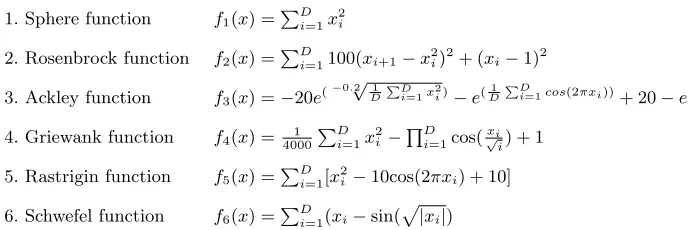
performance tests and analysis have been made using 6 numerical optimisation benchmarks, which are commonly used for the same purposes and given below. Obviously, all of these functions are multi-dimensional functions, which can also be considered as many-dimensional functions, where the tests have been con-ducted over their 5, 30, 60, 100 and 150 dimensions. The reason to opt with these dimensions is that the literature [21], [1, 2],[15],[31] reports solving these problems with similar dimensions, where 100 and 150 dimensions are exercised first time by this study. Two of the functions are know as uni-model, which means that they have only single optimum points while the other four are multi-model functions meaning that they can have multiple optimum points. These are all well-known and challenging benchmark functions used to test optimisation algorithms across the literature of this field. An extensive study on a number of numerical optimisation benchmarks including those considered below is reported in [28].
1. Sphere function f1(x) =PD i=1x
2
i
2. Rosenbrock function f2(x) =PD
i=1100(xi+1−x 2
i)2+ (xi−1)2
3. Ackley function f3(x) =−20e(−0.2
√1
D
PD
i=1x2i)−e(D1
PD
i=1cos(2πxi))+ 20−e
4. Griewank function f4(x) = 40001 PD i=1x
2
i −
QD i=1cos(
xi √
i) + 1
5. Rastrigin function f5(x) =PD i=1[x
2
i−10cos(2πxi) + 10]
6. Schwefel function f6(x) =PD
i=1(xi−sin( p
|xi|)
Parametric design details configured as follows:- the swarm size for all algo-rithms is 100, number of elite, moderate, supporting and independent bees are set to 5, 20, 40 and 30, for BA and Hybrid algorithms respectively. Non-improvability threshold is fixed at 200 operations for ABC while the neighbourhood factor is 0.1 for BA and 0.1xfor Hybrid. It can be observed that the revised versions of both BA and ABC algorithms have the same parametric values since the changes suggested is rather procedural than parametric. As a matter of fact, the neigh-bourhood structures of the algorithms, which is also a procedural difference, are indicated as follows: all algorithms use fixed-sized local neighbourhood, while BA has a rank-based random selection, ABC uses roulette-wheel selection and Hybrid adopts both in a systematic use. In addition, Hybrid algorithm selects mate-bees from top quartile when operating with revised ABC.
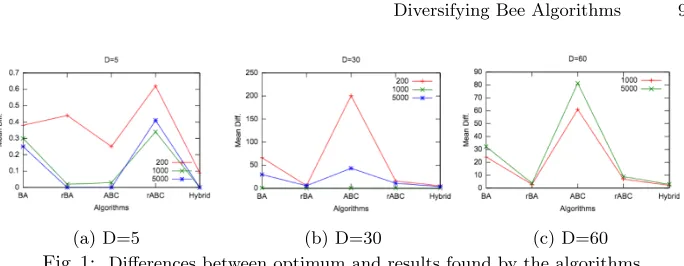
[image:8.612.134.479.290.405.2]The experimentation has been started with rather lower dimensions and grad-ually increased up in due course. The starting dimensions were 5 and 30 following the literature. All algorithms were run for 200, 1000 and 5000 iterations. Corre-sponding results are provided in [7]. Table 1 and 2 present the tabulated results for higher dimensions of the functions.
(a) D=5 (b) D=30 (c) D=60 Fig. 1: Differences between optimum and results found by the algorithms
approximate to the optimum in four functions, but struggle in solving Rosenbrok and Schwefel functions, despite that their performance improves in Rosenbrok function. These results indicate that Schwefel function clearly requires far more attention to better approximate.
D=60 5000 Iterations
Input Ranges Model Optimum BA rBA ABC rABC Hybrid Sphere (-100, 100) Uni 0.00 9.029 0.00 1.27E+04 3.90E-03 2.80E-45 Rosenbrock (-2.048, 2.048) Uni 0.00 792.867 58.882 2357.957 111.236 54.965 Ackley (-32.768, 32.768) Multi 0.00 19.512 3.24E-14 15.093 2.27E+00 3.95E-14 Griewank (-600, 600) Multi 0.00 792.867 58.882 2357.957 111.236 0.00 Rastrigin (-5.12, 5.12) Multi 0.00 792.867 58.882 2357.957 111.236 0.00 Schwefel (-500, 500) Multi -25,138.974 -14,996.00 -12,579.00 -8,554.00-19,540.00-14,726.00
Table 1:Experimental results by all 5 bee algorithms with 5000 iterations for 60-D benchmarks
Figure (1a), (1b), (1c) plot the differences between known optimum values and the achieved results averaged over all benchmark problems against the num-ber of iterations attempted, where the plots are categorised in dimensions. Figure (1a) and (1b) include the results for 200 iterations, while Figure (1c) does not include since 200 iterations remain too short for growing dimensions. All three figures clearly suggest that Hybrid algorithm outperforms all others and its ap-proximation goes closer to 0. On the other hand, revised algorithms perform better then the original algorithms in the same overall point of view, where rBA remains as the first runner after Hybrid. It is also observed that ABC performs much better when dimensions are lower. However, rABC, the revised ABC, is one of the competitors with Hybrid regardless of the growing dimensions.
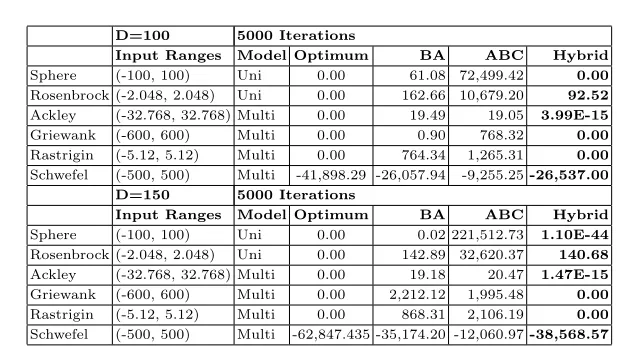
re-D=100 5000 Iterations
Input Ranges Model Optimum BA ABC Hybrid Sphere (-100, 100) Uni 0.00 61.08 72,499.42 0.00 Rosenbrock (-2.048, 2.048) Uni 0.00 162.66 10,679.20 92.52 Ackley (-32.768, 32.768) Multi 0.00 19.49 19.05 3.99E-15 Griewank (-600, 600) Multi 0.00 0.90 768.32 0.00 Rastrigin (-5.12, 5.12) Multi 0.00 764.34 1,265.31 0.00 Schwefel (-500, 500) Multi -41,898.29 -26,057.94 -9,255.25-26,537.00
D=150 5000 Iterations
[image:10.612.148.458.103.276.2]Input Ranges Model Optimum BA ABC Hybrid Sphere (-100, 100) Uni 0.00 0.02 221,512.73 1.10E-44 Rosenbrock (-2.048, 2.048) Uni 0.00 142.89 32,620.37 140.68 Ackley (-32.768, 32.768) Multi 0.00 19.18 20.47 1.47E-15 Griewank (-600, 600) Multi 0.00 2,212.12 1,995.48 0.00 Rastrigin (-5.12, 5.12) Multi 0.00 868.31 2,106.19 0.00 Schwefel (-500, 500) Multi -62,847.435 -35,174.20 -12,060.97-38,568.57
Table 2: Experimental results by all 5 bee algorithms with 3 levels of iterations for 100-D and 150-D benchmark functions
main behind this level of achievement with growing dimensions. All algorithms except Hybrid seem falling in a local optimum around 20.0 while solving Ack-ley function for dimensions of 100 and 150. Rosenbrock function is the second challenging benchmark among all, where the approximation of Hybrid remain just below 100 for 100-D and below 150 for 150-D cases. Clearly, Schwefel func-tion is the most challenging one since the approximafunc-tion of all algorithms stays far apart of the expected optimum. This hints that Schwefel function requires particular attention. A slight improvement is observed from the performance of both BA and ABC with growing iterations from 1000 to 5000, and 5000 to 10000, but, the level of improvement remains rather weaker. This suggests that the ap-proximation of both algorithms approach to the ultimate level of achievement, and beyond this level of iterations a significant improvement is not expected.
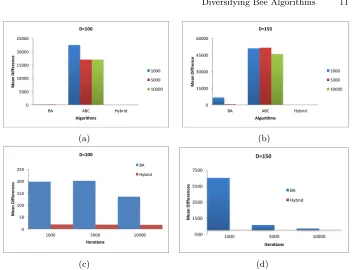
Figure 2a, 2b, 2c, and 2d, present the overall performance of BA, ABC and Hybrid algorithms indicated for the dimensions of 100 and 150. Similar to the previous cases depicted in Figure 1, the results of all the algorithms for all functions have been further processed to calculate the differences between the optima and the results produced, and then averaged accordingly. It is observed that, as suggested by Figure 2a, and 2c, ABC significantly underperforms in comparison to both BA and Hybrid, while Figure 2b, and 2d compare the per-formance of BA with Hybrid, where Hybrid significantly outperforms BA. The performance of BA improves with increasing number of iterations while Hybrid looks approximated to a steady state as suggested by Figure 2b and 2d noting that the averaged difference by Hybrid looks more substantial in 100-D cases than 150-D ones.
6
Conclusions
solv-(a) (b)
[image:11.612.132.485.95.365.2](c) (d)
Fig. 2: Averaged overall achievements by BA, ABC and Hybrid; (a) comparative results for 100-D cases (b) comparative results by all three for 150-D cases, (c) comparative results by BA and Hybrid only, for 100-D cases, (d) comparative results
by BA and Hybrid only, for 150-D cases
ing very high-dimensional numerical optimisation benchmarks. Revisions have been proposed for each algorithm for performance enhancement purposes. The results clearly suggested that revised versions of both BA and ABC (rBA and rABC) outperformed the original algorithms by large. Furthermore, a hybrid al-gorithm based on the original and their revised versions has been developed and tested, accordingly, resulting that the hybrid algorithm significantly improves the performance in solving very high-dimensional numerical optimisation bench-marks. This achievement is attained with better harmony induced in the hybrid algorithm, where both of rBA and rABC provided better intensification and randomly and systematically use of operators helped achieve improved diversifi-cation. This hybrid version is going to be tested for combinatorial optimisation problems as the next step of this research.
References
1. Alam, M. S., M. Md Islam, and K. Murase. Artificial bee colony algorithm with improved explorations for numerical function optimization. Intelligent Data Engineering and Automated Learning-IDEAL 2012. Natal, Brazil: Springer Berlin Heidelberg, 2012. 1-8.
2. Alam, M. S., Md. M. Islam, and X. Yao. Recurring two-stage evolutionary programming: A novel approach for numerical optimizaiton. IEEE Transactions on System, Man, and Cybernetics Part B: Cybernetics 41, no. 5 (2011): 1352-1365.
3. Aydin, M. E. Coordinating metaheuristic agents with swarm intelligence. Journal of Intelligent Manufacturing (Springer) 23, no. 4 (2012): 991-999.
5. Cui, L., Li, G., Zhu, Z., Lin, Q., Wen, Z., Lu, N., Wong, K.C. and Chen, J., ”A novel artificial bee colony algorithm with an adaptive population size for numerical function optimization”, Information Sciences, 414 (2017): 53-67.
6. Dogan, B., and T. Olmez. A new metaheuristics for numerical function optimization: Vortex search algorithm, Information Science 293 (2015): 125-145.
7. D¨u˜genci, M. ”Honeybees-inspired heuristic algorithms for numerical optimisation”, arXiv preprint (2015), arXiv:1504.05766.
8. Gong, W., Z. Cai, L. Jia, and H. Li. A generalized hybrid generation scheme of differential evolution for global numerical optimization. International Journal of Computational Intelligence and Applications 10 (2011): 35-65.
9. Guo, L., G.-G. Wang, A. H. Gandomi, A. H. Alavi, and H. Duan. A new improved krill herd algorithm for global numerical optimization. Neurocomputing 138 (2014): 392-402.
10. Hacbeyolu, M., B. Koer, and A. Arslan. Transfer Learning for Artificial Bee Colony Algorithm to optimize numerical functions. International Conference on Computer Engineering and Network Security (ICCENS’2012). Dubai, 2012.
11. Han, M., C. Liu, and J. Xing. An evolutionary membrane algorithm for global optimization problems. Information Sciences 276 (2014): 219-241.
12. Hussein, W. A., S. Sahran, and S. N. H. S. Abdullah. Patch-Levy-based initialization algorithm for Bees Algorithm. . Applied Soft Computing 23 (2014): 104-121.
13. Karaboga, D. An idea based on honey bee swarm for numerical optimisation. Technical Report, Computer Engineering Department, Erciyes University, Kayseri, Turkey, 2005.
14. Karaboga, D., and B. Akay. A comparative study of artificial bee colony algorithm. Applied Mathematics and Computation 214 (2009): 108-132.
15. Karaboga, D., and B. Basturk. A powerful and efficient algorithm for numerical function op-timization: artificial bee colony (ABC) algorithm. Journal of Global Optimization 39, no. 3 (2007): 459-471.
16. Karaboga, D., B. Gorkemli, C. Ozturk, and N Karaboga. A comprehensive survey: artificial bee colony (ABC) algorithm and applications. Artificial Intelligence Review 42, no. 1 (2014): 21-57. 17. Kashan, A. H. A new metaheuristic for optimization: Optics inspired optimization (OIO).
Com-puters and Operations Research 55 (2015): 99-125.
18. Keskin, T. E., M. Dugenci, and F. Kacaroglu. Prediction of water pollution using artificial neural networks in the study areas of Sivas, Karabuk and Bartin (Turkey). Environmental Earth Science, 2014.
19. Kiran, M. S., and M. Gunduz. A novel artificial bee colony-based algorithm for solving the numerical optimization problems. International Journal of Innovative Computing, Information and Control 8, no. 9 (September 2012): 6107-6121.
20. Kiran, M. S., and O. Findik. A directed artificial bee algorithm. Applied Soft Computing 26 (2015): 454-462.
21. Kong, X., S. Liu, Z. Ang, and L. Yong. Hybrid Artificial Bee Colony Algorith for Global Numer-ical Optimization. Journal of Computational Information Systems 8, no. 6 (2012): 2367-2374. 22. Liu, Y., B. Niu, and Y. Luo. Hybrid learning particle swarm optimizer with genetic disturbance.
Neurocomuting 151 (2015): 1237-1247.
23. Pan, Q. K., M. F. Tasgetiren, P. N. Suganthan, and T J. Chua. A discrete artificial bee colony algorithm for the lot-streaming flow shop scheduling problem. Information Sciences 181, no. 12 (2011): 2455-2468.
24. Pham, D. T., A. Ghanberzadeh, E. Koc, S. Otri, S. Rahim, and M. Zaidi. The bees algorithm - Anovel tool for complex optimisation. Intelligent Production Machines and Systems, 2006. 25. Piotrowski, A. P. Regardin the rankings of optimization heuristics based on artificially
con-structed functions. Information Sciences 297 (2015): 191-201.
26. Rahmani, R., and R. Yusof. A new simple, fast and efficient algorithm for global optimization over continuous search-space problems:Radial Movement Optimization. Applied Mathematics and Computation 248 (2014): 287-300.
27. Senyigit, E., M. Dugenci, M. E. Aydin, and M. Zeydan. Heuristic-based neural networks for stochastic dynamic lot sizing problem. Applied Soft Computing (Elsevier) 13, no. 3 (2013): 1331-1338.
28. Suganthan, P. N., et al. Problem definitions and evaluation criteria for CEC 2005 Special Session on real-parameter optimization. Technical Report, Computer Science, Nanyang Technological University, Singapore: KanGAL, IIT, Kanpur, 2005.
29. Xin, B., J. Chen, Z. H. Peng, and F Pan. An adaptive hybrid optimizer based on particle swarm and differential evolution for global optimization. Information Science (Science China) 53, no. 5 (May 2010): 980-989.
30. Yuce, B., D. T. Pham, M. S. Packianather, and E. Mastrocinque. An enhancement to the Bees Algorithm with slope angle computation and Hill Climbing Algorithm and its applications on scheduling and continuous-type optimisation problem. Production & Manufacturing Research 3, no. 1 (2015): 3-19.
31. Yuce, B., M. S. Packianather, E. Mastrocinque, D. T. Pham, and A. Lambiase. Honey bees inspired optimization method: the Bees Algorithm. Insects 4, no. 4 (2013): 646-662.