QUANTIFICATION OF THE COSTS AND BENEFITS (CB) OF
PROPERTY LEVEL FLOOD RISK ADAPTATION
MEASURES IN ENGLAND
ROTIMI DADA JOSEPH [BSc, MSc, MRICS, MCIOB] (STUDENT NO: 11018182)
A thesis submitted in partial fulfilment of the requirements of the University of the West of England, Bristol for the degree of Doctor of Philosophy (PhD)
March 2014
This work or any part thereof has not previously been submitted in any form to the University or to any other body whether for the purpose of assessment, publication or for any other purpose. Save for any express acknowledgements, references and/or bibliographies cited in the work, I confirm that the intellectual
content of the work is the result of my own efforts and no other person. The right of Rotimi Dada Joseph to be identified as author of this work is asserted in accordance with ss. 77 and 78 of Copyright, Designs and Patents Act
1988. At this date copyright is owned by the author.
Signature:………
ii
Studies in the UK and elsewhere have identified that flooding comes with diverse
impacts, ranging from significant financial costs (tangible) to social (intangible) impacts
on households. However, it is not feasible for government spending on structural flood
defences to adequately protect all at risk properties. Hence, the need for homeowners to
take action in the form of investing in property level flood risk adaptation (PLFRA)
measures to protect their properties has since been the subject of debate. However, the
take-up of PLFRA measures remains low, due to factors such as financial constraints,
aesthetics, emotional issues, and a lack of information on the actual cost and financial
benefit of investing in the measures. Notably, previous research in this area has failed to
include the value of intangible impacts such as health effects, meaning that the existing
models do not reflect the full benefits of PLFRA measures. This in part is due to the
inherent difficulty in monetising such intangible impacts. Nevertheless, evidence from
the literature, indicates that knowledge of such impacts may be important in
determining whether to invest in PLFRA measures.
Based on a synthesis of the literature, a conceptual framework of the costs and benefits
of PLFRA measures was developed. Data was collected through a questionnaire survey
of homeowners who had experienced flood damage to their properties during the 2007
summer flood event. This data was combined with secondary data of the actual cost of
reinstatement incurred in the aftermath of the 2007 flood event. By analysing these two
data sets, the additional costs of resistance and resilience measures for four property
types were established. The value of the intangible benefits of investing in PLFRA
measures was found to be £653 per household per year representing an increase of 8%
for resistance and 9% for resilience measures.
Decision support lookup tables (DSLT) were developed so that homeowners can
determine the cost effectiveness of PLFRA measures as pertaining to individual
buildings; insurers can assess the level of potential financial benefit of adopting PLFRA
measures by their customers, and perhaps offer incentives by way of premium reduction
to encourage homeowners to invest in the measure. Flood risk assessment surveyors can
determine the benefit cost ratio of taking up of PLFRA measures for their individual
clients; thereby, enhancing the robustness of their professional advice. Most
importantly, the DSLT has the potential to complement Government‘s effort in
iii
I am immensely grateful to many individuals and organisations for making the research
project a success through their untiring effort and active support such as lending their
time, ideas, talents, granting or facilitating access to participants and offering prayers.
Firstly, my appreciation goes to my Director of Studies, Professor David Proverbs for
instigating this research, his extreme commitment to the success of the research and his
great support and encouragement during tough times. His usual phrase „keep writing‟ was a huge encouragement. In addition, Dr Jessica Lamond‘s tireless effort in providing
guidance, support and comments as second supervisor was indispensable. The same
goes to Mr Peter Wassell my former Line Manager who was actively involved in the
early stage of the research, his criticism at the early stage helped shape the direction of
the research.
I would also like to express my gratitude to those victims of 2007 summer flood who
took the time to respond to the questionnaire survey. Your responses have really made a
vital contribution to the success of this research project. My appreciation goes to those
contractors who provided vital costing information used in the research. I acknowledge
the assistance of the Association of British Insurers (ABI) who granted permission to
use the 2007 flood event data for the research. Also I am grateful to those loss
adjuster/surveyors who provided feedback on the research findings.
None of this, of course, would have been possible without the ongoing support of
friends and family, including Pastor Adeyanju Bakare, Dr Kehinde Olojede, Mr Ian
Gibbs, Mr & Mrs Oluyemi, Mr Isiaka Adedeji, Miss Olayinka Adeleye, Dr Patrick
Manu, Mr Olaniyi Tiamiyu and Mr Gafaru Adedeji.
To my parents, special thanks to you for your prayers and support in spite of the
iv
This thesis is dedicated to Almighty God for granting me the grace to start and finish
this PhD programme. Finally, to my lovely daughter Victoria Omolola Joseph who
v
ABI Association of British Insurers
AEP Annual Exceedance Probability
ARC Actual Reinstatement Costs
BCIS Building Cost Information Services
BCR Benefit Cost Ratio
CASA Civil Aviation Safety Authority, Australia Government
CBA Cost Benefit Analysis
CMM Choice Modelling Methods
CMrs Cost of Resistance measures
CMrt Cost of Resilience measures
CPI Consumer Price Index
CVM Contingent Valuation Methods
DEFRA Department for Environment, Food and Rural Affairs DNRE Department of Natural Resources and Environment
DSLT Decision Support Lookup Table
DTLR Department for Transport, Local Government and Regions
EA Environment Agency
EAD Expected Annual Damage
ECD Expected Cumulative Damage
EIA Environmental Impact Assessment
EM-DAT Emergency Event Database
EU European Union
FDGiA Flood Defence Grand in Aid
FEPA Federal Environmental Protection Agency
FHRC Flood Hazard Research Centre
HMSO Her Majesty‘s Stationery Office
IRC Institute of Research in Construction
IRR Internal Rate of Return
NAO National Audit Office
NFF National Flood Forum
NPV Net Present Value
OECD Organisation for Economic Co-operation and Development
OFWAT Office of Water Services
OPW Office of Public Works
OST Office of Science and Technology
PLFRA Property Level Flood Risk Adaptation
PTSD Post Traumatic Stress Disorders
RICS Royal Institution of Chartered Surveyors
RII Relative Importance Index
RPM Revealed Preference Methods
SoP Statement of Principles
SPM Stated Preference Methods
SRC Subsequent Reinstatement Cost
TAC Temporary Alternative Accommodation Costs
TBCS Treasury Board of Canada Secretariat
UNIDO United Nations Industrial Development Organisation
UK United Kingdom
VAT Value Added Tax
WHO World Health Organisation
vi
Annual Exceedance Probability is the chance of a flood of a given size (or larger) occurring in any one year, usually expressed as a percentage. For example, if a peak flood discharge of 500 m3/s has an AEP of 5%, it means that there is a 5% chance (i.e. a 1 in 20 chance) of a peak discharge of 500 m3/s (or larger) occurring in any one year.
Benefit Cost Ratio – This is a ratio used in an attempt to identify the relationship between the cost and benefits of a proposed project. Benefit cost ratios are most often used to detail the relationship between possible benefits and costs, both quantitative and qualitative, of undertaking new projects or replacing old ones.
Choice Modelling Methods – Is a family of survey-based methodologies for modelling preferences for goods, where goods are described in terms of their attributes and of the levels that these take. Respondents are presented with various alternative descriptions of a good, differentiated by their attributes and levels, and are asked to rank the various alternatives, to rate them or to choose their most preferred. By including price/cost as one of the attributes of the goods, willingness to pay can be indirectly recovered from people‘s rankings, ratings or choices.
Contingent Valuation Methods - The contingent valuation method (CVM) is used to estimate economic values for all kinds of ecosystem and environmental services. It can be used to estimate both use and non-use values, and it is the most widely used method for estimating non-use values. The contingent valuation method involves directly asking people, in a survey, how much they would be willing to pay for specific environmental services. In some cases, people are asked for the amount of compensation they would be willing to accept to give up specific environmental services.
Cost Benefit Analysis – This is an analysis of the cost effectiveness of different alternatives in order to see whether the benefits outweigh the costs.
Expected Annual Damage this is the total value of potential damage, which can occur as a result of a flood event on annual basis.
Expected Cumulative Damage this is the aggregate value of potential damage, which can occur as a result of flood event over a certain period of time, for instance, in this research it was assumed to be over 20 years.
Floodplain this is the land adjacent to a river that is periodically inundated due to floods. The floodplain includes all land that is susceptible to inundation by the probable maximum flood event.
Intangible impacts – These are the impacts of flooding, which are not easy to express in monetary terms, for instance, stress of flooding, worrying about future flooding.
vii
structural and non-structural measures, which are installed to reduce or eliminate the damage effect of flooding on property.
Resilience measures – These are measures, which are installed to inside a property to minimise the damage caused by floodwaters entering the building
Resistance measures - These are measures installed to keep flood water out of the property.
Revealed Preference Methods - Revealed preference methods (RP) refer to the observation of preferences revealed by actual market behaviour and represents real-world evidence on the choices that individuals exercise. Revealed-preference methods use the relationship between some forms of individual behaviour (e.g., visiting a park or buying a house) and associated environmental attributes (e.g., of the park or the house) to estimate value.
Stated Preference Methods - Can measure the total economic value; that is, SPM incorporate both non-use value and option value. This characteristic has far-reaching potential as it implies that SPM can be used to value potential future or hypothetical (but realistic) goods and interventions.
viii
ABSTRACT ... II ACKNOWLEDGEMENTS ... III DEDICATION ... IV LIST OF ABBREVIATIONS ... V GLOSSARY ... VI TABLE OF CONTENTS ... VIII LIST OF FIGURES ... XVI LIST OF TABLES ... XVIII
CHAPTER ONE: GENERAL INTRODUCTION ... 1
1.1INTRODUCTION ... 1
1.2 RESEARCH CONTEXT AND JUSTIFICATION ... 7
1.3 AIM OF THE STUDY ... 11
1.4 OBJECTIVES OF THE STUDY ... 11
1.5 RESEARCH QUESTIONS ... 13
1.6 RESEARCH METHODOLOGY ... 13
1.7 LIMITATIONS OF THE STUDY ... 16
1.8 BENEFICIARIES ... 19
1.9 THESIS ORGANISATION ... 21
1.10 SUMMARY ... 24
CHAPTER TWO: A REVIEW OF HOUSEHOLDS LEVEL FLOOD RISK MANAGEMENT ... 26
2.1INTRODUCTION ... 26
2.2 TYPES OF FLOODING ... 26
2.2.1COASTAL FLOODING ... 28
2.2.2GROUNDWATER FLOODING ... 28
2.2.3RIVER FLOODING ... 28
2.2.4SURFACE WATER FLOODING... 29
2.2.5SEWER FLOODING ... 29
2.3 IMPACTS OF FLOODING ON HOUSEHOLDS ... 30
2.4 TANGIBLE IMPACTS OF FLOODING ON HOUSEHOLDS ... 31
2.4.1DIRECT TANGIBLE IMPACT ... 32
ix
2.5.1DIRECT INTANGIBLE IMPACTS OF FLOODING ON HOUSEHOLDS ... 39
2.6 IMPACT OF FLOOD CHARACTERISTICS ON DAMAGE TO PROPERTY ... 45
2.6.1FLOOD DEPTH ... 46
2.6.2FLOOD DURATION ... 46
2.7 PROPERTY-LEVEL FLOOD RISK ADAPTATION (PLFRA) MEASURES 47 2.7.1FLOOD RESISTANCE MEASURES ... 49
2.7.2FLOOD RESILIENCE MEASURES ... 51
2.7.3REVIEW OF GOVERNMENT PROPERTY LEVEL FLOOD ADAPTATION GRANT SCHEME ... 54
2.7.4BARRIERS TO UPTAKE OF RESISTANCE AND RESILIENCE MEASURES ... 54
2.7.5COSTS OF PROPERTY-LEVEL FLOOD RISK ADAPTATION MEASURES ... 55
2.7.6BENEFITS OF PROPERTY LEVEL FLOOD RISK ADAPTATION MEASURES ... 57
2.8 SUMMARY ... 59
CHAPTER THREE: THEORETICAL REVIEW OF THE CONCEPT OF COST BENEFIT ANALYSIS ... 60
3.1INTRODUCTION ... 60
3.2THE CONCEPT OF COST BENEFIT ANALYSIS (CBA) ... 61
3.2.1CRITICISM OF COST BENEFIT ANALYSIS ... 63
3.3 ORIGIN OF COST BENEFIT ANALYSIS ... 64
3.3.1ECONOMIC COST BENEFIT ANALYSIS ... 65
3.3.2SOCIAL COST BENEFIT ANALYSIS ... 66
3.3.3FINANCIAL COST BENEFIT ANALYSIS ... 67
3.3.4THE DECISION-MAKING PERSPECTIVE ... 68
3.4 THE USE OF COST BENEFIT ANALYSIS (CBA) IN THE UK ... 72
3.5 CLASSIFICATION OF COSTS IN CBA STUDY ... 76
3.5.1FINANCIAL COSTS ... 77
3.5.2SOCIAL COSTS ... 77
3.5.3OPPORTUNITY COSTS ... 77
3.6 REVIEW OF CBA VALUATION METHODS ... 78
3.7 STATED PREFERENCE METHODS (SPM) ... 80
3.7.1CONTINGENT VALUATION METHODS (CVM) ... 80
3.7.2THE BIASES OF CVM ... 82
x
3.7.5CHOICE MODELLING METHOD (CMM) VERSUS CONTINGENT VALUATION METHOD
(CVM) ... 89
3.8 CBA RESEARCH APPLICATIONS ... 90
3.8.1REVIEW OF EXISTING STUDIES OF CBA OF PLFRA MEASURES ... 91
3.8.2REVIEW OF EXISTING STUDY OF ASSESSMENT OF INTANGIBLE BENEFITS OF FLOOD PROTECTION MEASURES ... 95
3.9 QUANTIFICATION OF COSTS AND BENEFITS ... 97
3.10 SUMMARY ... 98
CHAPTER FOUR: CBA OF PROPERTY LEVEL FLOOD RISK ADAPTATION MEASURES: A CONCEPTUAL FRAMEWORK ... 100
4.1 INTRODUCTION ... 100
4.1.1A REVIEW OF THE EXISTING PLFRA MODELS ... 100
4.2 COST MODEL OF PLFRA MEASURES ... 101
4.2.1THE IMPACT OF FLOOD CHARACTERISTICS ON FLOOD DAMAGE ... 104
4.2.2EXPECTED FLOOD DAMAGE... 104
4.3 BENEFITS OF PLFRA MEASURES ... 105
4.3.1FLOOD PROBABILITY VARIABLE ... 106
4.3.2FLOOD SEVERITY VARIABLE ... 107
4.3.3CHOICE OF THE DISCOUNTING RATE ... 109
4.4 COMPARING COST AND BENEFITS OF PLFRA MEASURES ... 109
4.5 QUANTIFYING COSTS OF PLFRA MEASURES ... 113
4.6 QUANTIFYING VALUE OF BENEFITS OF PROPERTY LEVEL FLOOD ADAPTATION MEASURES ... 115
4.6.1TANGIBLE BENEFITS QUANTIFICATION ... 116
4.6.2INTANGIBLE BENEFITS QUANTIFICATION... 116
4.7 SUMMARY ... 117
CHAPTER FIVE: RESEARCH METHODOLOGY ... 119
5.1INTRODUCTION ... 119
5.2 RESEARCH APPROACH ... 120
5.2.1CHOICE OF QUESTIONNAIRE SURVEY ... 121
5.3 THE SUMMER 2007 FLOOD EVENT ... 121
5.4 CASE STUDY SITE SELECTION ... 123
xi
FLOOD DAMAGED PROPERTIES ... 126
5.6 QUESTIONNAIRE SURVEY DESIGN ... 130
5.6.1QUESTIONNAIRE DESIGN ... 131
5.6.2ELICITATION OF WTP USING CVM ... 135
5.6.3ADMINISTERING PILOT SURVEY ... 136
5.6.4ADMINISTERING MAIN QUESTIONNAIRE SURVEY FOR THE STUDY ... 137
5.7 DATA ANALYSIS ... 138
5.7.1ANALYSIS OF THE ACTUAL REINSTATEMENT COSTS ... 138
5.7.2ANALYSIS OF THE ADDITIONAL COSTS OF PLFRA MEASURES ... 139
5.7.3ANALYSIS OF WILLINGNESS TO PAY QUESTIONNAIRE ... 140
5.7.4BENEFIT COST RATIO (BCR) ANALYSIS ... 141
5.7.5CORRELATION ANALYSIS ... 142
5.7.6REGRESSION ANALYSIS OF THE DEVELOPED MODEL ... 143
5.8 ETHICAL CONSIDERATIONS ... 144
5.9 SUMMARY ... 146
CHAPTER SIX: QUANTITATIVE DATA ANALYSES ... 147
6.1 INTRODUCTION ... 147
6.2 SYNOPSIS OF DETAILED QUANTITATIVE DATA ANALYSES APPROACH ... 148
6.3 QUESTIONNAIRE RESPONSE RATE ... 150
6.3.1SOCIO-DEMOGRAPHIC CHARACTERISTICS... 151
6.4 OTHER DESCRIPTIVE DATA ANALYSIS ... 153
6.4.1RESIDENTIAL CHARACTERISTICS OF RESPONDENTS ... 154
6.4.2FLOOD EXPERIENCE OF RESPONDENTS ... 156
6.4.3RESPONDENTS‘ INTEREST IN RESEARCH FINDINGS ... 160
6.4.4DESCRIPTIVE STATISTICS OF MEAN RAW WILLINGNESS TO PAY (WTP) VALUES 160 6.4.5DESCRIPTIVE STATISTICS OF EXTRA EXPENSES INCURRED BY RESPONDENTS ... 161
6.5 HOMEOWNER’S PERCEPTION OF BENEFITS OF PLFRA MEASURES ... 163
6.5.1ANALYSIS OF RESPONDENT‘S PERCEIVED INTANGIBLE BENEFITS OF PLFRA MEASURES ... 163
6.5.2DISCUSSION ... 165
xii
6.7 ANALYSIS OF THE SEVERITY OF IMPACTS AND PSYCHOLOGICAL
EFFECT OF FLOODING ON HOUSEHOLDS ... 170
6.7.1ANALYSIS OF SEVERITY OF INTANGIBLE IMPACT OF FLOODING ON HOUSEHOLDS ... 171
6.7.2ANALYSIS OF PSYCHOLOGICAL EFFECT OF FLOODING ON HOUSEHOLDS ... 173
6.8 ANALYSIS OF WILLINGNESS TO PAY (WTP) VALUES ... 174
6.9 FACTORS AFFECTING WILLINGNESS TO PAY (WTP) VALUES ... 178
6.9.1WTP VALUES BY LOCATION ... 179
6.9.2WILLINGNESS TO PAY (WTP) BY HOUSEHOLD INCOME LEVELS ... 180
6.9.3WILLINGNESS TO PAY (WTP) BY OCCUPATION OF RESPONDENTS ... 182
6.9.4WILLINGNESS TO PAY (WTP) BY AGE ... 183
6.9.5WILLINGNESS TO PAY (WTP) BY NUMBER OF PEOPLE IN HOUSEHOLD ... 185
6.10 ANALYSIS OF THE REVISED WILLINGNESS TO PAY (WTP) VALUES ... 187
6.10.1DETERMINANTS OF WTP VALUES ... 188
6.11 SUMMARY ... 194
CHAPTER SEVEN: ANALYSIS OF THE ADDITIONAL COST OF PLFRA MEASURES ... 196
7.1 INTRODUCTION ... 196
7.2 ESTIMATION OF ADDITIONAL COST OF PLFRA MEASURES ... 196
7.3 ESTIMATION OF THE ADDITIONAL COST OF RESISTANCE MEASURES (CMRS) ... 199
7.3.1STAGE 1:RESISTANCE MEASURES REQUIRED PER PROPERTY ... 200
7.3.2STAGE 2:UNIT COST OF RESISTANCE MEASURES ... 202
7.3.3STAGE 3:THE ADDITIONAL COST OF RESISTANCE MEASURES (CMRS) ... 204
7.4 ESTIMATION OF THE ADDITIONAL COST OF RESILIENCE MEASURES (CMRT) ... 205
7.4.1ADDITIONAL COST OF RESILIENCE MEASURES ... 206
7.4.2STAGE 1:ANALYSIS OF TOTAL REINSTATEMENT COSTS ... 208
7.4.3STAGE 2:RE-PRICING OF ACTUAL SCHEDULE OF REPAIR FOR RESILIENCE MEASURE ... 211
7.4.4STAGE 3:ANALYSIS OF ADDITIONAL COST OF RESILIENCE MEASURE (CMRT) .... 212
7.5 ANALYSIS OF OTHER ASSOCIATED COSTS ... 216
xiii
... 219
7.5 OVERVIEW OF COMBINED COST SUMMARY OF PLRFA MEASURES ... 221
7.6 SUMMARY ... 222
CHAPTER EIGHT: ANALYSIS OF THE TANGIBLE BENEFITS OF PROPERTY LEVEL FLOOD RISK ADAPTATION MEASURES ... 224
8.1 INTRODUCTION ... 224
8.2 ANALYSIS OF THE TANGIBLE BENEFITS OF RESISTANCE AND RESILIENCE MEASURES ... 225
8.2.1ANALYSIS OF EXPECTED CUMULATIVE DAMAGE (ECD) AVOIDED FOR RESISTANCE MEASURES ... 227
8.2.2ANALYSIS OF EXPECTED CUMULATIVE DAMAGE (ECD) AVOIDED FOR RESILIENCE MEASURES ... 229
8.3 BENEFIT COST RATIO OF PLFRA MEASURES WITHOUT INTANGIBLE BENEFITS ... 233
8.3.1ANALYSIS OF BENEFIT COST RATIO (BCR) OF RESISTANCE MEASURES ... 233
8.3.2ANALYSIS OF BENEFIT COST RATIO (BCR) OF RESILIENCE MEASURE ... 235
8.4 SUMMARY ... 238
CHAPTER NINE: DEVELOPMENT OF CBA MODEL OF PLFRA MEASURES ... 240
9.1 INTRODUCTION ... 240
9.2 COMBINED TANGIBLE AND INTANGIBLE COST BENEFIT ANALYSIS MODEL ... 240
9.2.1EMPIRICAL BENEFITS OF PLFRA MEASURES TO HOMEOWNERS ... 241
9.3 CBA MODEL OF PROPERTY LEVEL FLOOD RISK ADAPTATION (PLFRA) MEASURES ... 242
9.3.1COST BENEFIT MODEL OF RESISTANCE MEASURES ... 243
9.3.2IMPACTS OF INCORPORATING INTANGIBLE BENEFITS IN THE CBA MODEL OF RESISTANCE MEASURES ... 244
9.3.3COST BENEFIT ANALYSIS (CBA) MODEL OF RESILIENCE MEASURES ... 245
9.4 SENSITIVITY ANALYSIS ... 250
9.5 SUMMARY ... 253
xiv
10.2 THE PRINCIPLE OF VALIDATION ... 254
10.3 VALIDATION OF MODEL ... 255
10.4 INTERNAL VALIDATION ... 256
10.4.1CONVERGENCE OF RESEARCH FINDINGS WITH PUBLISHED RESEARCH ... 256
10.4.2ACADEMIC VALIDATION OF RESEARCH FINDINGS ... 257
10.4.3CONVERGENCE OF PUBLISHED RESEARCH AND ACADEMIC VALIDATION ... 260
10.5 EXTERNAL VALIDATION ... 261
10.5.1REPLICATION ... 261
10.5.2CONVERGENT ANALYSIS ... 262
10.5.2.1 Results of the Participant Validation ... 264
10.5.3BOUNDARY SEARCH ... 271
10.6 SUMMARY ... 271
CHAPTER ELEVEN: CONCLUSIONS AND RECOMMENDATIONS ... 273
11.1 INTRODUCTION ... 273
11.2 EVALUATION AGAINST ORIGINAL AIM AND OBJECTIVES ... 273
11.2.1REVIEW OF RESEARCH OBJECTIVES ... 274
11.3 CONCLUSIONS OF THE RESEARCH ... 282
11.4 CONTRIBUTION TO KNOWLEDGE ... 284
11.4.1CONTRIBUTION OF THE CBA MODEL OF PLFRA MEASURES ... 284
11.4.2THE VALUE OF INTANGIBLE BENEFITS OF PLFRA MEASURES ... 285
11.4.3DISSEMINATION ... 285
11.5 IMPLICATIONS OF THE RESEARCH FINDINGS. ... 286
11.6 RECOMMENDATIONS FOR FURTHER RESEARCH ... 288
11.7 SUMMARY ... 289
REFERENCES ... 291
APPENDIX A-1: LETTER OF PERMISSION TO USE DATA FOR THE RESEARCH ... 316
APPENDIX A-2: TYPICAL COVER LETTER FOR MAIN SURVEY ... 317
APPENDIX A-3: QUESTIONNAIRE ... 318
APPENDIX A-4: SAMPLE REMINDER POSTCARD ... 323
APPENDIX B-1: RESEARCH SAMPLE BUILDING TYPOLOGY ... 325
APPENDIX B-2: NORMALITY TEST OF THE RAW WTP SURVEY DATA.. 329
xv
VALUES ... 337 APPENDIX C-1: MODEL MEDIAN BENEFIT OF RESILIENCE MEASURES FOR A BUNGALOW PROPERTY ... 339 APPENDIX C-2 MODEL MEDIAN BENEFIT OF RESILIENCE MEASURES FOR A DETACHED PROPERTY ... 339 APPENDIX C-3 MODEL MEDIAN BENEFIT OF RESILIENCE MEASURES FOR A SEMI-DETACHED PROPERTY ... 340 APPENDIX C-4 MODEL MEDIAN BENEFIT OF RESILIENCE MEASURES FOR A TERRACED PROPERTY ... 340 APPENDIX C-5: EFFECT OF LOW DISCOUNT RATE ON THE DEVELOPED CBA MODEL OF RESILIENCE MEASURES (3.5%) ... 341 APPENDIX D-1: SUMMARY OF KEY RESEARCH FINDINGS ... 342 APPENDIX D-2: RESEARCH FEEDBACK FORM – HOMEOWNER VERSION ... 347 APPENDIX D-3: RESEARCH FEEDBACK FORM – SURVEYOR/LOSS
xvi
FIGURE 1.1FLOW CHART OF RESEARCH PROCESS ADOPTED FOR THE STUDY ... 16
FIGURE 2.1INSTALLATIONS OF RESISTANCE FLOOD PROTECTION MEASURES ... 49
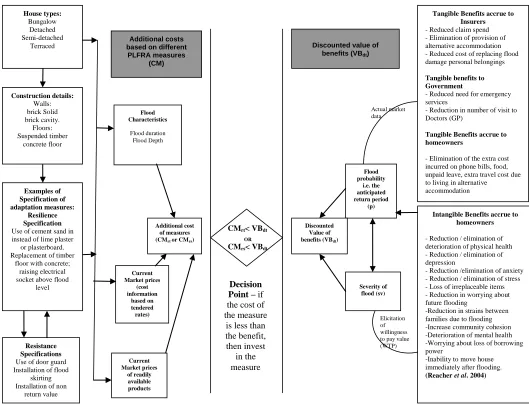
FIGURE 4.1ESTIMATION OF ADDITIONAL COST OF PROPERTY LEVEL FLOOD RISK ADAPTATION MEASURES INCLUDING FLOOD CHARACTERISTICS VARIABLES ... 103
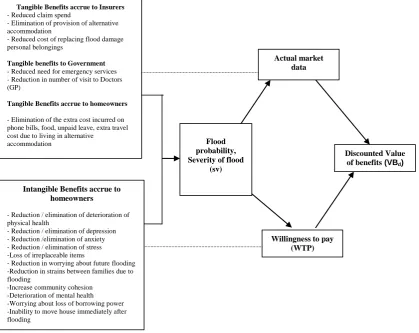
FIGURE 4.2VALUATION OF BENEFITS OF MEASURE USING CONTINGENCY VALUATION METHOD ... 106
FIGURE 4.3CONCEPTUAL FRAMEWORK OF CBAMODEL OF PLFRA MEASURES ... 112
FIGURE 4.4EXPECTED FLOOD DAMAGE CURVES WITH AND WITHOUT MEASURES ... 115
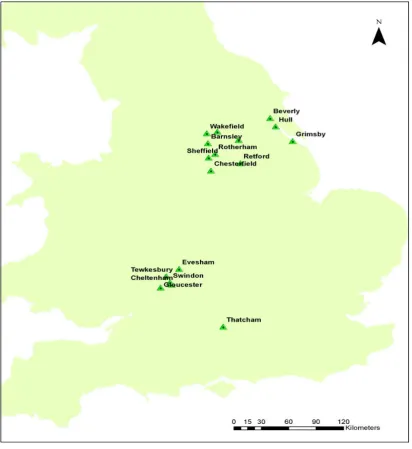
FIGURE 5.1SURVEY SITE LOCATIONS ... 125
FIGURE 6.1OUTLINE OF QUANTITATIVE DATA ANALYSIS ... 149
FIGURE 6.2MEAN WTP VALUES BASED INCOME LEVEL OF HOUSEHOLD INCOME EARNER ... 182
FIGURE 6.3MEAN WTP VALUES BASED ON RESPONDENTS‘ OCCUPATION ... 183
FIGURE 6.4MEAN WTP VALUES BASED ON RESPONDENTS‘ AGE ... 185
FIGURE 6.5MEAN WTP VALUES BASED ON NUMBER OF PEOPLE IN EACH HOUSEHOLD . 187 FIGURE 6.6HISTOGRAM OF STANDARDISED RESIDUAL ... 191
FIGURE 6.7NORMAL P-PPLOT OF STANDARDISED RESIDUALS ... 192
FIGURE 6.8SCATTERPLOT OF STANDARDISED RESIDUALS ... 192
FIGURE 7.1OVERVIEW OF THE PROCESS ADOPTED FOR ESTABLISHING THE ADDITIONAL COST OF PLFRA MEASURES... 198
FIGURE 7.2MEDIAN OF ACTUAL TRADITIONAL LIKE FOR LIKE REINSTATEMENT COSTS (ARC) ... 210
xvii
AND PROPERTY TYPES ... 214
FIGURE 7.5MEDIAN RESILIENT REINSTATEMENT COSTS (CMRT) BASED ON FLOOD DEPTH
AND PROPERTY TYPES ... 215
FIGURE 7.6MEDIAN OF SUBSEQUENT REINSTATEMENT COSTS (SRC) ASSUMING
RESILIENCE MEASURES HAD BEEN IMPLEMENTED ... 218 FIGURE 7.7MEDIAN OF ALTERNATIVE ACCOMMODATION COST (AAC) BASED ON FLOOD
xviii
TABLE 2.1BASIC CLASSIFICATIONS OF TANGIBLE IMPACT OF FLOODING ON HOUSEHOLDS
... 31
TABLE 2.2INTANGIBLE LOSSES/IMPACT OF FLOODING ON HOUSEHOLDS ... 40
TABLE 2.3RESISTANCE SPECIFICATION ADOPTED FOR THE RESEARCH ... 50
TABLE 2.4RESILIENCE MEASURES ... 53
TABLE 2.5COMPARISON OF MATERIAL COST OF TRADITIONAL AND RESILIENT REINSTATEMENT ... 56
TABLE 5.1TOWNS AND CITIES MOST AFFECTED BY THE SUMMER 2007 FLOOD EVENT .. 123
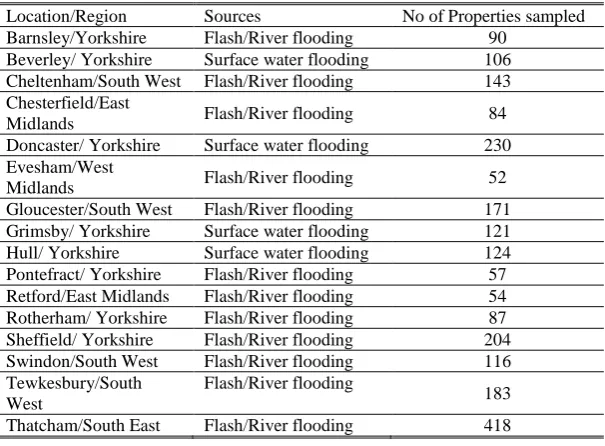
TABLE 5.2SELECTED LOCATIONS FOR EMPIRICAL ANALYSIS ... 124
TABLE 5.3LOSS ADJUSTER'S INSURANCE CLAIM DATASET ... 128
TABLE 6.1QUESTIONNAIRE RESPONSE RATES BY SURVEY LOCATIONS ... 150
TABLE 6.2RESPONDENTS AGE ... 152
TABLE 6.3STATISTIC OF RESPONDENTS‘ OCCUPATION ... 152
TABLE 6.4HOUSEHOLD INCOME LEVEL ... 153
TABLE 6.5PROPERTY TYPES ... 154
TABLE 6.6PROPERTY TENURE ... 155
TABLE 6.7TIME LIVE IN THE PROPERTY ... 155
TABLE 6.8DISTRIBUTION OF FLOOD DEPTH IN THE SAMPLED PROPERTY ... 156
TABLE 6.9DISTRIBUTION OF FLOOD DURATION IN THE SAMPLES PROPERTY ... 156
TABLE 6.10FLOOD WARNING SYSTEM ... 157
TABLE 6.11FLOOD WARNING DURATION ... 157
TABLE 6.12TEMPORARY ALTERNATIVE ACCOMMODATION ... 158
TABLE 6.13TIME SPENT IN ALTERNATIVE ACCOMMODATION ... 159
TABLE 6.14NUMBER OF TIMES BEING FLOODED PRE 2007 ... 159
TABLE 6.15NUMBER OF TIMES BEING FLOODED POST 2007 ... 160
TABLE 6.16RESPONDENTS WHO WANT SUMMARY FINDINGS ... 160
TABLE 6.17STATISTICS OF RAW SAMPLE WILLINGNESS TO PAY (WTP) ... 161
TABLE 6.18STATISTICS OF EXTRA EXPENSES INCURRED WHILE IN ALTERNATIVE ACCOMMODATION ... 162
TABLE 6.19DESCRIPTIVE STATISTICS AND INTER-RATER AGREEMENT INDICES FOR BENEFITS OF PLFRA MEASURES ... 164
xix
IMPORTANCE INDEX (RII) VALUES ... 172
TABLE 6.22RANKING OF THE FREQUENCY OF PSYCHOLOGICAL EFFECT OF FLOODING ON HOUSEHOLD ACCORDING TO RELATIVE IMPORTANCE INDEX (RII) VALUES ... 174
TABLE 6.23ANALYSIS OF MEAN WTP VALUES BY SURVEYED LOCATION ... 179
TABLE 6.24CORRELATION MATRIX FOR HOUSEHOLD INCOME LEVEL AND WTP VALUES ... 181
TABLE 6.25CORRELATION MATRIX FOR RESPONDENTS‘ AGE BRACKET AND WTP VALUES ... 184
TABLE 6.26CORRELATION MATRIX FOR RESPONDENTS‘ BASED ON NUMBER OF PEOPLE IN HOUSEHOLD AND WTP VALUES ... 186
TABLE 6.27MODEL SUMMARY OF REGRESSION ANALYSIS ... 190
TABLE 6.28SUMMARY STATISTICS FOR WTP TO AVOID IMPACT AND PSYCHOLOGICAL EFFECT OF FLOODING ON HOUSEHOLDS ... 194
TABLE 7.1RESISTANCE SPECIFICATION ADOPTED FOR THE RESEARCH ... 199
TABLE 7.2COMPONENT OF RESISTANCE MEASURES BASED ON PROPERTY TYPES ... 201
TABLE 7.3MEAN UNIT COST OF RESISTANCE MEASURES ... 203
TABLE 7.4COST OF RESISTANCE MEASURES (CMRS) BASED ON SPECIFICATION FOR EACH PROPERTY TYPES ... 205
TABLE 7.5STATISTICS OF ACTUAL TRADITIONAL REINSTATEMENT COSTS ... 209
TABLE 7.6DESCRIPTIVE STATISTICS OF THE SUBSEQUENT REINSTATEMENT COST (SRC) ... 217
TABLE 7.7STATISTICS OF ACTUAL TEMPORARY ALTERNATIVE ACCOMMODATION COST (TAC) ... 219
TABLE 7.8SUMMARY OF ADDITIONAL COSTS OF PLFRA MEASURES BASED ON DIFFERENT HOUSE TYPES, FLOOD DEPTHS AND DEPLOYMENT METHODS ... 222
TABLE 8.1EXPECTED CUMULATIVE DAMAGE (ECD) AVOIDED OVER 20 YEARS FOR RESISTANCE MEASURES... 229
TABLE 8.2EXPECTED CUMULATIVE DAMAGE (ECD) AVOIDED FOR BUNGALOW BASED ON RESILIENCE MEASURES ... 231
TABLE 8.3EXPECTED CUMULATIVE DAMAGE (ECD) AVOIDED FOR DETACHED PROPERTIES BASED ON RESILIENCE MEASURES ... 231
xx
PROPERTIES BASED ON RESILIENCE MEASURES ... 232
TABLE 8.6BENEFIT COST RATIO OF RESISTANCE MEASURES BASED ON DIFFERENT
PROPERTY TYPES AND DEPLOYMENT METHODS ... 234
TABLE 8.7BENEFIT COST RATIO OF RESILIENCE MEASURES BASED ON DIFFERENT HOUSE TYPES, VARYING FLOOD DEPTHS, FLOOD RETURN PERIOD AND FLOOD PROBABILITY
... 237
TABLE 9.1TOTAL ANNUAL EXTRA EXPENSES INCURRED WHILE IN ALTERNATIVE
ACCOMMODATION BASED ON FLOOD PROBABILITY (BTAN) ... 242
TABLE 9.2MEAN DISCOUNTED BENEFIT OF RESISTANCE MEASURES INCORPORATING VALUE OF INTANGIBLE BENEFITS ... 243 TABLE 9.3BENEFIT COST RATIO FOR RESISTANCE MEASURES INCORPORATING
INTANGIBLE BENEFITS ... 244 TABLE 9.4BENEFIT COST RATIO (BCR) FOR RESILIENCE MEASURES INCORPORATING THE
VALUE OF INTANGIBLE BENEFITS ... 249 TABLE 9.5IMPACT OF FLEXIBLE DISCOUNT RATE ON THE DEVELOPED CBA MODEL OF
RESILIENCE MEASURES (3.5%) ... 252
TABLE 10.1CITATIONS IN JOURNAL, CONFERENCE, REPORT AND DOCTORAL WORKSHOP PAPERS ... 261
TABLE 10.2HOMEOWNER‘S FEEDBACK ON REALISTIC OF WTP VALUE AND SIMPLICITY OF THE DSLT ... 265
TABLE 10.3HOMEOWNER‘S FEEDBACK ON USEFULNESS OF THE RESEARCH FINDINGS IN DECISION MAKING ON RESISTANCE AND RESILIENCE MEASURES ... 266
TABLE 10.4HOMEOWNER‘S FEEDBACK ON GENERAL USEFULNESS OF THE RESEARCH FINDINGS IN DECISION MAKING ON FLOOD PROTECTION MEASURES ... 266
TABLE 10.5LOSS ADJUSTER/SURVEYOR‘S FEEDBACK ON THE BENEFIT OF PLFRA AND THE SIMPLIFY OF THE DSLT ... 269
TABLE 10.6LOSS ADJUSTER/SURVEYOR‘S FEEDBACK ON THE USEFULNESS OF THE RESEARCH FINDINGS IN ADVISING HOMEOWNER ON INVESTING IN PLFRA MEASURES
1
CHAPTER ONE: GENERAL INTRODUCTION
1.1INTRODUCTION
Flooding is a global phenomenon that causes widespread devastation, economic
damages and loss of human life (Jha et al., 2012). During the past decade, reporting of incidents of natural disasters that meet Emergency Event Database (EMDAT) criteria
have increased six fold compared to the 1960s due mainly to an increase in small and
medium scale disasters (Guha-Sapir et al., 2006; Jha et al., 2012). The occurrence of floods is the most frequent among all these natural disasters. On a global scale, the
numbers of people affected by floods and the financial, economic and insured damages
have all increased (Ranger and Surminski, 2013). For instance, in 2010 alone, 178
million people were affected by floods (Jha et al., 2012). This increase is due to combinations of climate change, population growth and development pressures
(Environment Agency, 2003; Crichton, 2007a; Jones et al., 2013). Blunden and Arndt (2012), Field et al., (2012) asserted that almost 90% of natural disasters are hydro meteorological events such as droughts, storms and floods. Further, scientific evidence
suggests that global climate change will only increase the number of extreme events,
creating more frequent and intensified environmental emergencies (Field et al., 2012). Bogardi (2004) predicted that, globally, flooding could directly impact on over 54
million people per year by 2050 if mitigation efforts are not stepped up.
The global increase in the frequency of flooding has been reflected in the UK where,
currently in England alone, one in six properties or over 5.2 million properties are at
risk of flooding (Environment Agency, 2009). This includes 2.4 million properties
threatened by coastal and river flooding and a further 2.8 million affected by surface
2
significant risk of riverine or coastal flooding (1 in 75 years), and research has shown
that the situation is likely to worsen as average global temperatures increase and if
properties are continued to be built on floodplains (Soetanto et al., 2008b; Environment Agency, 2009).
Since 2000, there have been several major flood events in the UK, such as the
nationwide flooding in 2000; Boscastle flooding in 2004; Carlisle and North Yorkshire
flooding in 2005; the summer flood event in 2007; Cockermouth flooding in 2009 and
Cornwall flooding in 2010. These flood events have caused considerable damage to
properties, demanding significant financial sums for repairs and replacements. Apart
from physical damage to properties, floods have the potential to damage the physical
and mental health of households who are affected by them (WHO, 2002; Tapsell et al., 2003; Tunstall et al., 2006; Ranger et al., 2011).
In the aftermath of these flood events, UK insurers have paid out £4.5 billion to
customers whose homes or businesses have been hit by flooding (ABI, 2010). This
shows an increase of 200% on the £1.5 billion paid in the previous decade (ABI, 2010).
For instance, the 2007 summer flood resulted in insurers paying out £3 billion; the 2005
floods in Carlisle cost insurers over £272 million; and the Cumbria floods in November
2009 cost over £174 million. Reasons for the rise in flood costs include the increased
frequency and severity of flooding in the UK; inflations affecting construction materials
and labour; and the growing problem of surface water flooding (ABI, 2010). It had been
previously estimated that the total value of assets under flood risk exceeds £200 billion
3
Flood risk in the UK today is, therefore, greater than ever before. The UK Government
response to the increase in flood risk is reflected in the radical reviews of flood risk
management including; the Institution of Civil Engineers Learning to Live with Rivers, 2001; Department for Environment, Food and Rural Affairs (DEFRA) Making Space for Water, 2005; and the Foresight Project Future Flooding, 2004. These reviews have proposed less reliance on hard engineering solutions such as flood defence and a move
towards adaptation and resilience to flood risk (OST, 2004). Evans et al., (2004) stressed that there is a need for a conceptual shift in which flood risk management relies
less on Government intervention and more on an individuals‘ acceptance of
responsibility for managing flood risk at property level.
Whilst the Environment Agency, on behalf of the UK Government, is working on
increasing the number of properties protected from flooding by building new structural
defences and maintaining existing flood defences, it is estimated that about half of the
households currently in areas of significant risk of flooding may remain undefended
(Bichard and Kazmierczak, 2009). Therefore, given current government policy, there
has been growing support for property adaptation (Ali and Jones, 2013). The installation
of property-level flood risk adaptation measures represents a viable approach for these
households. In addition, the efficiency of flood protection by structural measures is
never absolute (a typical example is seen in New Orleans in the United States of
America in 2005) and is likely to decline with the increasing unpredictability and
severity of weather systems. It was acknowledged in Lloyd‘s report of 2008, that if no
action is taken to reduce potential flood risk on properties, losses from coastal flooding
for high risk properties could double by 2030, therefore, recommending that property
adaptation is vital given the potential future rate of climate change (Lloyd, 2008). In
4
effect of climate change are happening at the government and insurance industry levels;
however, homeowners appear not to be participating in the changes to reduce the impact
of flooding on households.
Flood impacts on households are both tangible and intangible in nature. Tangible flood
impacts are those impacts that can be monetised, such as the cost of replacing damaged
properties (Tapsell et al., 2002); whilst, the intangible impacts are those that cannot readily be valued but can be described in qualitative or quantitative terms, such as loss
of irreplaceable items or item of sentimental value (Environment Agency and DEFRA,
2004; Proverbs and Soetanto, 2004; JBA, 2005).
UK Insurers have a key role to play in helping society manage this risk through the
provision of cover for flood damage (Crichton, 2007b; Crichton, 2008). The UK is one
of the very few countries in the world where flood insurance remains an integral part of
property insurance. It has been identified that managing the risk of flooding is not the
responsibility of insurers alone (ABI, 2010). Arguably, insurers play an important part
of the UK flood risk management strategy, but not the panacea. While insurers are
experts at managing the financial risks of flooding, the liabilities of insurers are limited
to the reduction of tangible impacts of flooding on households; whilst, the intangible
impacts are left for homeowners and in some instances government to deal with.
Individual property owners need to take action by adapting their properties and
businesses to mitigate flood risk by taking necessary precautionary measures, such as
registering for national flood warning alert (Pitt, 2007; Halcrow, 2009) and by adapting
their properties to flood risk through the use of property level flood risk adaptation
5
adaptation can be effectively integrated into the built asset management framework
(Jones, 2012) because it is not considered as part of routine maintenance. Taking up
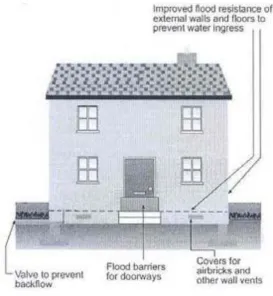
adaptation measures may be by investing in resistance measures, which are designed to
keep flood water out of properties, these involve, the use of demountable door guard;
airbrick covers; and fixing non-return value. Alternatively, where resistance measures
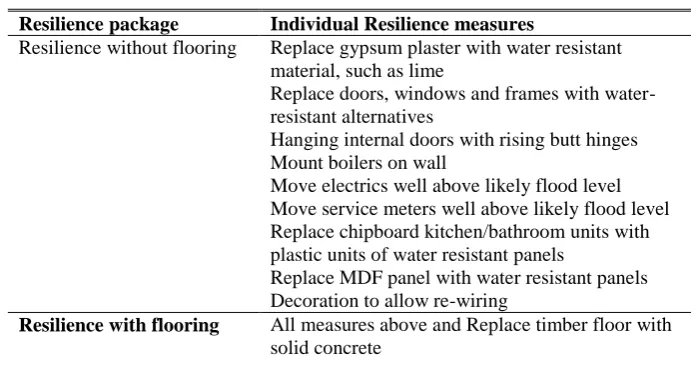
are not a viable option, resilience measures can be installed to protect properties against
flood risk; these are installed to reduce the damaging impact on the building fabric
(Joseph et al., 2011a), these involve, replacing timber floor with concrete; raising services meters above anticipated flood levels; raising sockets above flood levels.
The responsibility for managing flood risk in the UK must be shared between
homeowners, insurers, Government and construction professionals, to keep people, their
homes and their livelihoods safe. According to Thurston et al., (2008) a key to flood risk management strategy at households level is the take-up of adaptation measures both
in new developments and as part of repair after flood events. However, research has
shown that at-risk householders are reluctant to adopt resistance and resilience measures
in the aftermath of a flood event (Harries, 2007; ABI, 2010) for reasons such as
information barriers, emotional constraints, aesthetic considerations, timing issues and
lack of first-hand information on the costs and benefits of the adaptation measures
(Proverbs and Lamond, 2008).
Information on the cost and benefits of adaptation measures can be established by
applying the concept of cost benefit analysis (CBA) to the study of PLFRA measures.
The concept of CBA is such that a project should not be undertaken unless its cost is
6
scale or denominator, so that they can be compared with each other, even when some
benefits and costs are not traded on markets and, hence, have no established monetary
values (Brinkhuis-Jak et al., 2004). Prior to applying the concept of CBA in the study of PLFRA measures, detailed knowledge of the tangible and intangible impacts of
flooding is essential, so that the intangible impacts can be monetised. Due to the
difficulty in quantifying the value of intangible impacts, most previous studies have
tended to ignore the value of these impacts.
Full knowledge of the costs and benefits of PLFRA measures, which takes into account
the intangible impacts, will therefore be valuable for a number of purposes.
Homeowners need to know the costs and the subsequent benefits of investing in PLFRA
measures; this can encourage them to take action. Finance can be raised by extended
borrowing, the Council of Mortgage Lenders policy on the adaptation measures stated
that lenders should be sympathetic in this regard (Proverbs and Lamond, 2008).
Conversely, national and local governments and their associated agencies with
responsibility for flood risk management and implementation need to understand the
full financial implications of their spending decisions, particularly with regards to the
uptake of PLFRA measures and, therefore, need to have a national adaptation plan
(IPCC, 2012). Availability of a comprehensive CBA model, which includes both the
tangible and intangible impacts of flooding on households, has the potential to provide
government bodies with the required understanding and to supplement existing
knowledge.
Flood risk management at household level is a topic of growing public policy
7
and intangible) of flooding on households and subsequent incorporation of these
monetised impacts in the CBA model would have the potential to increase the quality of
information which homeowners require to make decisions on adaptation measures.
1.2 RESEARCH CONTEXT AND JUSTIFICATION
Flood risk management research cuts across many disciplines, such as physical sciences
aspects of short term flood prediction, engineering aspects of flood damage protection,
and social science considerations such as studies of vulnerability and economic damage
assessment. The current study is located broadly within the area of flood risk
management, but more specifically within the socio-technical discipline, with a specific
focus on flood impact assessment on households. Flood risk management research in
the UK context has focussed on preservation of life, the development of flood defences
and towards improving emergency response (Penning-Rowsell and Wilson, 2006).
Flood damage prevention is also a primary focus (Hall et al., 2003; Entec, 2005). Research into the impact of flooding in the UK has focused mostly upon the economic
costs to the insurer, government and society in general (Clark et al., 2002; JBA, 2005; Environment Agency and DEFRA, 2004; Environment Agency and DEFRA, 2005,
Wassell et al., 2009).
Damage to property, infrastructure and business has been studied in some detail by
Penning-Rowsell and others (Green et al., 1994; Penning-Rowsell et al., 2005; Penning-Rowsell and Wilson, 2006; Penning-Penning-Rowsell et al., 2010) to evaluate the costs and benefits of flood risk management programmes for the purpose of flood
protection/defence investment appraisal. Further, there has been a series of studies to
investigate the longer term stress and health impacts of flooding on the flooded
8
2004). Some insurance industry-funded study has been undertaken to examine the effect
of flooding on the cost of repairing individual properties (Black and Evans, 1999;
Soetanto et al., 2002b). Lamond (2008) argued that such studies were commissioned to allow insurers to assess their ultimate financial exposure to flood risk. Research into the
costs of flood resilient reinstatement of domestic properties was carried out on behalf of
the Association of British Insurers (ABI) (Wassell et al., 2009). The research was commissioned to evaluate the cost implication of Government‘s proposal of making it
compulsory through the use of Building Regulations 2010 in England and Wales to
reinstate flooded properties in a resilient manner. The shortcoming of this research is
that benefits of resilient measures were not considered, although the authors
acknowledged the fact that these measures are beneficial to both homeowners and
insurance companies. This current research, therefore, addresses the issues of tangible
and intangible benefits of adaptation measures.
In 2007, the Environment Agency and DEFRA jointly commissioned research to
investigate the economic benefits of using resistance and resilience measures. The
project was titled – ‗Developing the evidence base for flood resistance and resilience‟ (Thurston et al., 2008). The project was intended to provide analytical information for the wider Making Space for Water projects, encouraging and incentivising uptake of resistance products and resilience measures by households and businesses (Thurston et al., 2008). However, the authors acknowledged that the research did not take into account some of the less easily monetised benefits of flood risk adaptation measures,
such as reduced anxiety and improved social cohesion. In establishing the total benefits
of PLFRA measures for homeowners, these intangible benefits have to be included,
because these are impacts that affect households directly as compared to the tangible
9
that the intangible impacts are both large and more important to the households affected
than are the direct monetary losses.
The difficulties in the evaluation of intangible impacts of flooding on households have
been acknowledged by many authors (Green and Penning-Rowsell, 1989; Lekuthai and
Vongvisessomjai, 2001; Environment Agency and DEFRA, 2004; Werritty et al., 2007; Environment Agency, 2010,). For instance, Green and Penning-Rowsell (1989) referred
to them as the factors or considerations which are left out of CBA because they are
difficult to evaluate. Lekuthai and Vongvisessomjai (2001) argued that the subjective
nature of intangible impacts of flooding on households contributed to its difficulty in
evaluation.
Research by different stakeholders: industry and practitioners (Flood Repair Forum,
2006; Joseph et al., 2011b; Joseph et al., 2011a), academics (Soetanto et al., 2008b), Government, (Office of the Deputy Prime Minister, 2003; Bowker et al., 2007b; Thurston et al., 2008) and the insurance industry (ABI, 2003; ABI, 2006; Wassell et al., 2009) has examined the costs and effectiveness of installing property level resistance
and resilience measures. To some extent, this body of previous research provides a
confusing message for stakeholders by using simple illustrations of the fact that some
measures will pay back after a single flood. However, it also demonstrates that many
measures are not cost effective at certain flood return periods normally considered as
representing a significant flood risk. A major shortcoming of this research is a failure to
take into consideration the intangible benefits, which may have yielded different results.
In the light of these exclusions and with the wider acceptance by different authors that
the intangible impacts are large and important (Green and Penning-Rowsell, 1989;
10
2010), the need to develop a comprehensive systematic quantification of the costs and
benefits of PLFRA measures, which incorporate the monetised intangible impacts of
flooding on households within the CBA model has been identified.
Private flood insurance is the main source of funding for the reinstatement of flooded
residential property in the UK. Currently, there is no state provision for flood
reinstatement and, as part of an agreement between the ABI and the UK Government
(gentlemans‘ agreement known as the ―Statement of Principles‖), flood cover is
included as standard in domestic property insurance policy (Huber, 2004; Crichton,
2005a; Lamond et al., 2009a). However, in the light of the high costs of flooding events and the generally accepted view that flood events in the UK are becoming more
frequent and are likely to continue to do so (Environment Agency and DEFRA, 2004;
ABI, 2005), insurers are becoming less willing to cover properties at risk of flooding
(Crichton 2005b).
A majority of the insurance policies in the UK are policy of ‗indemnity‘ (meaning that
the insurer‘s liability is to put the insured back to the same financial position they were
prior to the damage/loss). Therefore, financing resistance or resilient measures during
reinstatement periods through the insurance provision is considered as ‗betterment‘, and
therefore will not be covered under the insurance policy. However, following the
summer 2007 flood event in the UK, the ABI (2007) called for a number of government
actions to reduce the cost of future flood events among, which is an increased focus on
increasing the resilience and reparability of homes and businesses. This is seen by the
ABI as an avenue to reduce risk and claim spend for the insurance industry. Therefore,
11
investment in PLFRA measures, will be beneficial to all stakeholders in managing flood
risks.
In relation to the aim of this research, there is a consensus that intangible impacts of
flooding on households are difficult to evaluate, and yet they are large and important.
However, there is an absence in the existing studies of a comprehensive CBA model of
PLFRA measures which take into consideration both tangible and intangible impacts of
flooding on households. Therefore, the major challenge of this project is to evaluate the
true benefits of PLFRA measures, not only in financial terms, but also with due regard
to the intangible impacts of flooding on households.
1.3 AIM OF THE STUDY
The aim of this research is to develop a CBA model of PLFRA measures.
1.4 OBJECTIVES OF THE STUDY
In order to achieve this aim, the following eight subsidiary objectives are to be
achieved:
1. To conduct a comprehensive literature review on the nature of flood events
worldwide and specifically in the UK, to contextualise their causes and impacts
with particular reference to impacts on households and to establish from
theoretical perspective measures to reduce or eliminate the identified flood
impacts.
2. To critically review the concept of CBA and its applicability to the study of
12
less monetised impacts (intangible) of flooding on households, with the aim of
incorporating it in the CBA model.
3. To develop a conceptual framework, specific to domestic property in the UK, of
the costs and benefits of property level flood risk adaptation measures based on
a synthesis of the extant literature.
4. To elicit domestic homeowners‘ willingness to pay (WTP) values in order to
reduce the intangible impacts of flooding on their households and subsequently
employ appropriate statistical analysis techniques with a view to exploring
factors which has potential to influence the WTP values and the adoption of
PLFRA measures,
5. To collect data on the actual reinstatement costs of flood damaged properties
affected during the 2007 summer flood event and establish the additional cost of
adopting PLFRA measures based on different property types, flood depth and
floor construction methods.
6. To establish the expected cumulative damage (ECD) avoided of PLFRA measures and
to subsequently use appropriate statistical analysis techniques to explore the
relationship between costs and benefits of the measures.
7. To test, refine and validate the CBA model towards its potential relevance for
practical application in flood risk management at household levels.
8. To draw conclusions from the findings of the study to provide a basis for
proposing implications for flood risk management at household levels and make
13
1.5 RESEARCH QUESTIONS
From the aim and objectives stated above, the key research questions that this research
set out to answer are as follows:
How to quantify and monetise the intangible impacts of flooding on households?
What is the value of intangible impacts of flooding on households?
What is the relationship between costs and benefits of adopting PLFRA
measures?
Do the benefits of PLFRA measures outweigh the associated costs?
1.6 RESEARCH METHODOLOGY
The driving forces for the choice of a research methodology in any study are not the
advantages or disadvantages associated with a particular method (Creswell, 2009). The
factor that influences the choice of one approach over another is the nature of the
research problem or the objectives of the study (Mertens, 2003; Creswell, 2009). For
instance, if the nature of the problem is such that the objective of the study is to test or
explain an existing theory, then the quantitative method is the best approach. However,
Creswell (2009) suggested that if a concept or phenomenon needs to be understood,
because minimal research has been done on it, then a qualitative approach should be
adopted. Further, due to the interdisciplinary nature of research, there may be a need to
combine both quantitative and qualitative methods in order to address the research
question and this is termed the mixed approach (Creswell, 2009). The research
paradigm for this study is quantitative in nature. The quantitative concept implies that
the reasoning of the research is largely deductive, involving the development of a
14
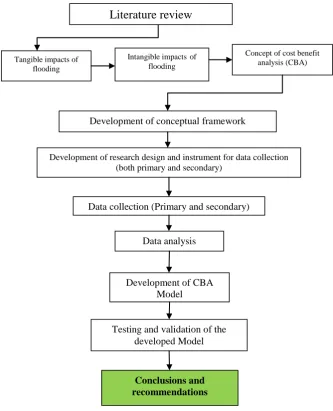
The research also involves a comprehensive literature review, consisting of relevant
journals, books, internet articles, thesis and government reports and papers. This is
necessary to identify knowledge gaps in the domain of flood risk management at
household levels, and the impacts of flooding on households with the intention to
identify measures to reduce the identified impacts and subsequently review costs and
benefits of the measures. Particular emphasis was laid on how to quantify intangible
impacts of flooding for the purpose of incorporating it in the CBA models of PLFRA
measures.
Following the literature review, the development of an appropriate conceptual
framework for reinforcing the future direction of the research was undertaken. This
conceptual framework was critical in addressing the key research questions and was
concerned with the cost of PLFRA measures and the benefit of the measures.
In view of the nature of investigation associated with this research work, and in addition
to the theoretical basis of this study involving the collection of data to draw deductive
conclusions, a survey technique was adopted for the study. Within the survey research
technique, samples were examined through specifically designed questionnaires (survey
instrument). Before embarking on the major survey, a pilot survey was undertaken,
acting as a ‗trial run‘ that can assist in ‗smoothing out‘ the survey instrument in order to
ensure that participants in the main survey did not experience any difficulties in
completing it. The primary aims of the pilot survey are to test the wording of the
questionnaire, identify ambiguous questions, test the intended technique for data
collection and measure the effectiveness of the potential response. Data was collected
through the survey questionnaire, which was distributed to homeowners that were
15
of actual reinstatement costs for the summer 2007 flood event was obtained and used
for the analysis. The data collected from the questionnaires in conjunction with the
actual reinstatement cost data were then analysed.
The research adopted statistical software (e.g. Statistical Package for the Social
Sciences (SPSS) in analysing the research data. Statistical analysis techniques including
correlation analysis, multivariate regression analysis and ratio analysis were used to
make inferences and draw conclusions on the data. Further inter-rater agreement tests
were carried out on the questionnaire data. Appropriate statistical analysis methods were
used resulting in the development of CBA models of PLFRA measures.
A process of validation was undertaken to establish whether the concepts and
methodologies used in developing the model were sound, and also to establish whether
the findings were reliable. Validation is important because it reflects the potential
objectivity and reliability of the model. Internal and external validation processes were
employed in testing the validity of the findings. External validation involves
homeowners to comment on the usefulness of the developed models. Subsequently,
flood risk management stakeholders including loss adjusters and surveyors were invited
to provide feedback on the usefulness of the findings.
Following the completion of validation process, conclusions were drawn and
recommendations made. Conclusions were also drawn to determine the extent to which
the research objectives developed in order to collectively satisfy the main research aim,
were accomplished or otherwise, further, limitations of the study were provided and
16
A flow chart summarising the research process and methodology is presented in Figure
1.1. A more detailed discussion of the methodological approach adopted for this
[image:36.595.139.473.157.569.2]research is presented in chapter five of this thesis.
Figure 1.1 Flow chart of research process adopted for the study
1.7 LIMITATIONS OF THE STUDY
This section focuses on the scope of the research project, which was anchored on the
literature review and the exploratory phase of the research. For the purpose of this
research, Scotland was excluded from data collection for practical and financial reasons
of access to participants, particularly with regards to the 2007 summer flood event data,
Tangible impacts of flooding
Intangible impactsof flooding
Concept of cost benefit analysis (CBA)
Development of conceptual framework
Development of research design and instrument for data collection (both primary and secondary)
Development of CBA Model
Testing and validation of the developed Model
Conclusions and recommendations
Data collection (Primary and secondary)
Data analysis
17
which was used in this research. The 2007 summer flood event did not affect Scotland;
therefore, data will not be available for the same period.
This study was set out to develop CBA model of PLFRA measures for residential
property in the UK by incorporating the value of intangible benefits of the measures in
the CBA model. Only domestic residential property was considered because many
business properties are not owner-occupied and it is unlikely that they will suffer similar
intangible impact of flooding as the domestic homeowners. Further, business properties
are always subject to different insurance provisions and the impacts of flood event on
business-occupier are completely different from domestic properties. The review of
extant literature has considered a wide range of international studies encompassing
different flooding types, flood impact and measures to reduce the impacts; the empirical
analysis has been strictly limited to domestic property. Other limitations of the research
are presented as follows:
The survey and the analysis were based on data from England, from locations flooded in
the summer 2007 event, which was limited to inland flooding, mainly river and surface
water flooding. The use of these locations was driven by the desire to use actual event
data as against using theoretical approach which is always based on assumptions. It has
not been possible in this research to test whether these results will hold true for another
flood event. However, a simple and comprehensive conceptual framework developed
for this research can allow for similar analysis to be carried out in any part of the
country.
It is, therefore acknowledged that due to the targeted samples, the results presented in
18
flood event, may be different if households who are at risk of flooding but not yet
experienced a flood event were included in the survey, as previous research has shown
that at risk residents will be willing to pay less than flooded residents to avoid flood
impacts on their households. However, the samples only included 9% who had been
flooded more than once and the remaining 91% only experienced flood on their
properties in 2007 and this was seen by most of the respondents as one off event. The
sample can be said to be a mix of flooded and at risk respondents; therefore, the value of
willingness to pay (WTP) by these respondents can be taken as representative of
floodplain residents.
The current economic situation in the UK has seen increase in inflation rates with no
increase in wages (The Monetary Policy Committee, 2013). This subsequently affects
the value of disposable income and may have affected the value of WTP stated by
respondents. The value of WTP may be different if there is no economic crisis in the
country during the course of carrying out this research.
The resistance and resilience specification used in the development of the costs and
benefits of PLFRA measures in this research is seen as another limitation of the
research. The ever increasing constant innovation in the development of resilience and
resistance materials and a maturing market may result in reduction in costs of resistance
and resilience measures due to competition, therefore the CBA presented in this
research may vary if other products are used. However, this limitation can be addressed
by the use of the developed conceptual framework, as the framework is expected to be
19
1.8 BENEFICIARIES
Walker (1997) has documented various ways to demonstrate originality, such as
development of new methodologies, tools and/or techniques, new areas of research, and
the application of existing theories to new areas or a new blend of ideas. It was observed
from the in-depth review of literature that a comprehensive CBA model of PLFRA
measures using real life flood event data, which takes into account the intangible impact
of flooding on households, is yet to be developed in England. Whilst extensive research
on the impact of flooding on households, communities and the nation at large has been
undertaken, together with benefits of flood and coastal risk management at government
levels, it would appear that no previous research has focused on the application of CBA
model to highlight to households the potential benefits that can be derived from
investing in flood risk adaptation measures at property-level in England. This may have
contributed to the low take-up of PLFRA measures among the floodplain homeowners.
By focusing on this particular gap, this study is building on the existing body of
knowledge on flood risk management by opening up a new area of research through the
application of an existing technique CBA to PLFRA measures. This, therefore,
represents a significant contribution to knowledge.
This research offers a model, which could be used by homeowners, flood management
stakeholders and researchers to systematically capture cost outlays on PLFRA measures
and use that as a basis for predicting the potential benefits of investing in PLFRA
measures in the following ways:
i. The recent call for the homeowners to take responsibility for flood risk
20
is expected to provide useful information on the costs and benefits of
adapting domestic property to flood risk. It is anticipated that the CBA
model developed in this study can be used by homeowners to make informed
decisions on adaptation measures to be adopted. This can eventually be used
as proof to insurance companies that adaptation measures have been
implemented, and could therefore be reflected in their insurance premium.
ii. Malcolm Cooper, director of pricing & underwriting for general insurance at
Legal & General (cited in Savage, 2011), explains how those considering
improvements to their property to reduce the impact of further flooding
could state their case to the insurer — by arranging for a flood risk
assessment to be completed and then implementing its recommendations.
The result of this study is a contribution to academic research through the
development of a new methodology for quantifying the intangible impacts.
Therefore, the model can be used by flood risk assessment companies in the
UK to establish the costs and benefits of adapting properties to flood risk,
thereby enhancing the insurability of their clients‘ home.
iii. Other stakeholders, such as loss adjusters and surveyors, can use the
information provided in this research to advise flood victims of the cost and
the eventual benefit of using the opportunity of flood event to adapt their
properties to future flood risk. It is expected that the position in the UK
insurance market may change in the near future due to the transition from the
Statement of Principles (SoP) to the Flood Re agreement (Joseph et al.,
2013), albeit the effectiveness of the ‗Flood Re‘ agreement is not yet
possible to predict. Under these circumstances the role of any useful
information which building professionals can use in encouraging appropriate