Evolving Science Communication:
learn, adapt, collaborate
26 and 27 March 2009
Introduction
In March 2009 the Science Communication Unit (SCU) at the University of the West of England, Bristol (UWE) hosted a symposium to investigate key issues around transferability and sustainability in science communication and public engagement. The symposium was designed for professionals in the field, specifically aiming to provide a platform for discussion between experts in both the practitioner and academic communities.
The symposium emerged following a major UK-wide project funded by the Wellcome Trust (via an Engaging Science Society Award) entitled Meet the Gene Machine. This project was led by the SCU, working with eight Science & Discovery Centres around the UK to stimulate discussion and debate with over 10,000 young adults on issues around genetic testing. Alongside this over 400 teachers took part in training on incorporating discussion of scientific issues in the classroom. The funding for the project has now ended, however Meet the Gene Machine continues to be delivered in the majority of participating Science & DIscovery Centres, and has also been taken up by new partners in other locations. Meet the Gene Machine has demonstrated that successful science communication activities can be transferable, collaborative and sustainable. The purpose of the Evolving Science Communication Symposium was to investigate these issues on a broader scale.
The following report documents the variety of sessions held at the symposium. Each invited speaker has provided a short summary of their contribution; a brief overview of the discussion that followed is also included.
The editors would like to thank all speakers and delegates who attended the symposium. They would also like to thank the runners Ann Grand, Daniel Keogh, Julianna Photopoulos and Margarida Sardo who offered organisational assistance across the two days. The support of Tom Anthony, Public Engagement Advisor at the Wellcome Trust, and funding from the Wellcome Trust is also gratefully acknowledged.
Karen Bultitude, Helen Featherstone
and
Clare Wilkinson
Science Communication Unit Faculty of Health and Life Sciences University of the West of England Bristol, UK.
Contents
Keynote address 5
Andrea Bandelli
Evolution: exploring public engagement as an evolution 8
of or addition to public understanding of science
Roland Jackson 8
Derek Bell 11
Collaboration: relationships for success including partners, 14
consortia and contagiousness of ideas and project formats
Paul Cox 14
Karen Bultitude 16
Adaptation: within venues, cultures and contexts 20
Jan Riise 20
Wendy Sadler 22
Demonstrating impacts: impact, metrics and going beyond evaluation 26
Ben Gammon 26
David Shakespeare 28
Repositories of knowledge: sharing knowledge to avoid reinventing the wheel 32
Sophie Duncan 32
Juliet Upton 35
Creating a Sustainable Future for Science Communication: forming partnerships, 38
linking theory and practice
Justin Dillon 38
Catherine Aldridge 40
Leslie Paterson 41
Savita Custead 41
Summary, Reflections and Next Steps 44
Attendees
Catherine Aldridge - Director, Catalyst Learning and Communication Ltd.
Tom Anthony - Public Engagement Advisor, Wellcome Trust
Andrea Bandelli - VU University
Emm Barnes - Science Outreach Officer, Royal Holloway, University of London
Philippa Bayley - Academic Liaison Officer, Centre for Public Engagement, University of Bristol
Teresa Belcher - Director, Science Communications Ltd
Derek Bell - Head of Education, Wellcome Trust
Isabelle Boscaro-Clarke - Head of Communications, Diamond Light Source
Sarah Bucknall - Public Relations Officer, Diamond Light Source
Martin Bull - Head of Communications, ISIS Pulsed Neutron and Muon Source, Science and Technology Facilities Council
Karen Bultitude - Senior Lecturer, Science Communication Unit, University of the West of England
Dariel Burdass - Education Manager, Society for General Microbiology
Frank Burnet - Frank Burnet: Science Communication Consulting
Sue Cavell - Head of Research and Evaluation, Techniquest
Lucy Chappell - Research Communications Manager, University of Reading
Paul Cox - Head of Science and Learning, National Marine Aquarium
Savita Custead - Director, Bristol Natural History Consortium
Luis Filipe de Oliveira Barbeiro - PhD student, King´s College London
Jennifer DeWitt - Research Associate, King’s College London
Justin Dillon - Senior Lecturer, King’s College London
Sophie Duncan - Deputy Director, National Coordinating Centre for Public Engagement
Nigel Eady - Science in Society Officer, British Science Association
Helen Featherstone - Research Fellow, Science Communication Unit, University of the West of England
Roland Jackson - Chief Executive, British Science Association
Colin Johnson - Vice-President, British Science Association
Diana Kaiser - Education and Outreach, BDI (Biomedical Diagnostics Institute)
Lorraine Kenny - Education and Outreach Manager, Thinktank
Maggie Leggett - Head, Centre for Public Engagement, University of Bristol
Andy Lloyd - Special Projects Manager, Centre for Life
Dom McDonald - Head of Public Engagement, Science Oxford
Rebeca Medrano Arnaez - Formal Learning Manager, At-Bristol
Rosalind Mist - SCORE, Royal Society
Kat Nilsson - Contemporary Science Manager, Science Museum, London
Cristina Olivotto - Educational Project Officer, Human Spaceflight Education Office, European Space Agency (ESA)
Leslie Paterson - Head of Public Engagement, Royal Academy of Engineering
Gillian Rendle - Research Councils UK
Jan Riise - Göteborg Center for Public Learning and Understanding of Science
Alison Rivett - South West Regional Officer, Institute of Physics
Wendy Sadler - Director, science made simple
David Shakespeare - Science Education Consultant, Square 2 Learning Ltd.
Lindsey Shaw Greening - Science Communicator, Science Connect, Milton Keynes Science Festival
Dianne Stilwell - Science and Education Communications Consultant
Wolfgang Streitenberger - Advisor to the Director General, European Commission - DG INFSO
Alice Taylor-Gee - Science in Society Manager, British Science Association
Maria Tennant - Science Communication Officer, British Heart Foundation
Jon Turney - Freelance writer and editor
Juliet Upton - Consultant, STEM Directories
Kathy Velander - Senior Lecturer, School of Life Sciences, Edinburgh Napier University
Louise Webb - Head of Skills Development, ASDC
Kenny Webster - Informal Learning Manager, Thinktank
List of acronyms
ACME – Advisory Committee on Mathematics Education
ASDC – The Association for Science & Discovery Centres (formerly Ecsite-UK)
BBC – British Broadcasting Corporation
CPD – Continuing Professional Development
DCSF – Department for Children, Schools and Families
E&E – Engagement and Enrichment
ECSITE – European Network of Science Centres and Museums
EPSRC – Engineering and Physical Sciences Research Council
ETB – Engineering and Technology Board
EUSCEA – European Science Events Association
ESRC – Economic and Social Research Council
GCSE – General Certificate in Secondary Education
GLO – Generic Learning Outcomes
HE/HEI – Higher Education/Institution
HEFCE – Higher Education Funding Council for England
IOP – Institute of Physics
MLA – Museums, Libraries and Archives
NCCPE – National Coordinating Centre for Public Engagement
NESTA – National Endowment for Science Technology and the Arts
NSEW – National Science and Engineering Week
PENCIL – Permanent European Resource Centre for Informal Learning
PEST – Public Engagement with Science and Technology
PUS – Public Understanding of Science
QCA – Qualifications and Curriculum Authority
RCUK – Research Councils UK
SEA – Science Enrichment Activity (see also STEM Ambassadors)
SLC – Science Learning Centre
STEM – Science Technology Engineering and Maths
Keynote address
Andrea Bandelli
Andrea Bandelli is a specialist in informal learning and science communication, and is currently director of the European Project ‘DECIDE’ - an international collaborative of science centers and museums to foster public participation in science and technology policy issues. In the last 10 years he has worked in different roles with several science centers, universities and public administration organisations in many European countries, the USA, South Africa and Brazil. His current academic field of research is how public consultations and dialogue processes inform the governance of science museums.
Transferability and Sustainability
The concepts of transferability and sustainability, when applied to science engagement activities, offer a number of stimuli for discussion.
I want to briefly mention two issues related to the concept of transferability: knowledge transfer and research translation.
Knowledge transfer refers to how knowledge crosses from one domain to another; but for us it is important to identify who are the people (and the institutional roles) instrumental for transferring knowledge. It requires also identifying the ‘brokers’, those who act on the fringe of networks. Research translation requires us to think about the ethics of science engagement. Speaking about HIV and AIDS at the second African Science Communication conference, Anthony MbeWu, director of the South African Medical Research Council said that ‘scientists are not activists’, they cannot apply pressure for a specific use of research results in policy. Maybe science communicators are activists, and it is certainly imperative to address the issue of ethical neutrality of science engagement (see for example http://scienceincommunity.wordpress.com/2008/12/04/ is-engagement-ethically-neutral/).
How activities, resources and ideas spread, replicate and change, is a fundamental aspect of sustainability. Of particular interest for this symposium is the concept of ‘contagiousness’. Here there are at least two issues of relevance:
Individualization
■ ■
Giving up control
■ ■
the long tail is made of many tight conversations within small groups. The consequence is that certain metrics do not mean much anymore: measures like ‘average user’, or ‘target groups’ for example. We should therefore rethink our concept of audience.
Giving up control means sharing the authority of what we do. From a project perspective, it means becoming familiar with concepts like: turning planning into coordination; open source resource sharing; a de-institutionalized approach. Projects like Decide and FUND (www. playdecide.org) are initial experiments in this direction, undertaken by ECSITE - the European network of science centers and museums.
Finally, I would like to mention the results of an exploratory action by UWE and ECSITE to investigate the concepts presented above and to understand what instruments enable transferability and sustainability in the case of (EU-funded) projects for science engagement. The key concepts that emerged from that study are:
Dynamic networks. It is necessary to accommodate dynamic partnerships and networks. We
■ ■
see that this concept is rather well established in the case of high level research projects, but for smaller scale projects it is usually an exception rather than the rule.
The presence and the role of the brokers. Who acts at the fringe?
■ ■
Structural involvement. Engagement activities should not be an ‘add on’ but an integral
■ ■
process for the parties involved.
Autonomous spreading. The capacity for an activity or a process to become an independent
■ ■
module that can easily adapt to a different setting.
In conclusion, three challenges lie ahead for discussion in the next two days: Raise the meaningfulness of what we do and strengthen our (social) responsibility;
■ ■
Acknowledge the political role that science engagement plays;
■ ■
Learn to recognize failure. We need new measures of success and impact, especially those
■ ■
Discussion
Following Andrea Bandelli’s keynote address the discussion focussed on two key areas. These were the value of failure and its contribution to learning and the role of science communicators as neutral facilitators or activists.
Delegates suggested that often there was a tendency to publish success, which could lead to mistakes in activities being repeated. A variety of reasons were suggested for this, including that it can be difficult to admit or publish failures, particularly when it may impact on future funding. There was a suggestion that the notion of having an acceptable rate of failure should be embraced. That learning from inevitable mistakes can be as valuable, if not more so, than hearing about only the success stories.
There was much discussion as to whether science communicators should be, or at least attempt to be, neutral. Some felt they had to try to be, or were commissioned to take neutral stance. Whilst there was also recognition that science itself is not value free. It was suggested that some science communication initiatives are unashamedly pro-science or have the objective of changing behaviour, it was also highlighted that being neutral is in itself a value statement.
Evolution: exploring public engagement as an evolution of or
addition to public understanding of science
This session provided speakers with a chance to explore the ‘bigger picture’ of science communication. Speakers were invited to unpick current thinking on the relationships between public understanding of science, science communication, and public engagement with science and technology.
Contributors: Roland Jackson, British Science Association, UK
Derek Bell, Wellcome Trust, UK
Chair: Karen Bultitude, Science Communication Unit at UWE, Bristol
Science and the Public
Roland Jackson, British Science Association, UK
Roland Jackson took up the post of Chief Executive of the British Science Association (formerly known as the British Association for the Advancement of Science) in 2002. He was educated at Oxford University, obtaining a degree in biochemistry in 1976, a doctorate in molecular immunology in 1979 and a postgraduate certificate in education in 1980. He taught science in secondary schools in Newmarket and Bristol for nine years, ultimately as Head of Science at Backwell School, Bristol. From 1989 to 1993 he was Education Adviser for ICI. He joined the Science Museum, London, in 1993 initially as Head of Education, and was appointed acting Head of Museum from 2001-2002.
There are many purposes for communicating with the public about science and technology. This communication is carried out through activities described as ‘science communication’, ‘science education’, ‘public understanding of science’, ‘public engagement with science’ or ‘public dialogue’. But these terms hide assumptions that are often, and legitimately, different.
Broadly speaking, there are three motivations for what we might call science communication, or public education and engagement in science, though they can overlap.
First; because it’s simply the right thing to do in our society. It is concerned with empowering citizens to understand the implications of science and technology and help shape their decisions about choices, enriching democratic representation.
For each of our activities we need to be clear and open about the primary motivation. The British Science Association is working towards a shared vision of a society in which people are able to access science, engage with it and feel a sense of ownership about its direction. But what are the barriers to achieving that vision?
Partly it’s the nature of science itself. At the root of many of our problems is a clear tension between science as a body of knowledge and practice owned and controlled by an expert community, and science as a wholly shared social enterprise in a democratic society. To maintain its authority science needs to be set apart from the general public, but to maintain its legitimacy and trust it needs to be publicly accessible and reflect public values. That is a real tension that is played out almost daily in the UK.
We have seen much of the post-Bodmer approach to the public understanding of science characterised as assuming a deficit of knowledge by the public, and much of the post-House of Lords approach similarly characterised as assuming a deficit of trust, both to be addressed by science communication. Nevertheless, things are changing, but they need to continue to change both with respect to the culture of science and to the culture of politics and the governance of science. I shall leave out from this discussion the broader question of public culture.
Scientific culture
The recent survey of the attitudes of scientists towards public engagement, commissioned by the Royal Society in 2006, showed that scientists view the purpose of this activity primarily in terms of informing the public. That is an important role for scientists, and one which many carry out with commitment and skill. Indeed the public themselves recognise scientists as a prime and trusted source of information about science. However, it is only half the picture. The public also demand that scientists ‘listen more to what ordinary people think’. This requires a reflexivity and indeed, at times, humility amongst the scientific community that is not widespread. As with their involvement in the more didactic forms of science communication, there are many scientists who demonstrate leadership in this respect, and yet involvement in this wider debate and discussion is still not seen as a fundamental part of being a scientist.
Political culture
In our evidence to the current House of Commons IUSS (Innovation, Universities, Science & Skills) Committee on ‘Putting science and engineering at the heart of policy’ we offered two substantive options for better use of public engagement in consultations, which we believe would be likely to lead both to more widespread public engagement and information, and to demonstrate more clearly public input to the policy process:
1. The deliberate and active use of significant policy consultations as opportunities for mass public education about the science and the associated issues.
2. The collecting of public views and ideas from much wider and more diverse sources than those of traditional stakeholder or structured intense deliberative processes.
Removing barriers to culture change
Culture change takes time but we should recognise what has already been achieved, which includes:
Increasing access to information about science (e.g. through the media and internet).
■ ■
Increasing access to opportunities to engage directly with scientists (through the programmes
■ ■
of many science-based organisations, and initiatives such as National Science and Engineering Week, science festivals, science centres and the activities of university departments and scientific institutes).
Signals from key funding organisations (e.g. Research Councils, The Wellcome Trust) that
■ ■
public engagement work is important.
Networks and programmes supporting science education such as the Science Learning Centres
■ ■
and STEMNET.
The UK Resource Centre and its championing of aspects of diversity.
■ ■
The Beacons for Public Engagement as means of encouraging culture change in the higher
■ ■
education sector.
The Sciencewise Expert Resource Centre with its emphasis on the culture of policy-makers.
■ ■
Interestingly, these are primarily enabling and catalytic systems rather than top-down mechanisms.
All these developments, and more, create a positive platform for further evolution and we now need to embed the thinking behind these activities. I leave you with three questions:
Which of these current systems and networks work well?
■ ■
Which could be improved and how?
■ ■
What gaps are not being addressed?
Competition Or Co-Existence: evolving relationships between formal
and informal education
Derek Bell, Wellcome Trust, UK
Derek took over as Head of Education at The Wellcome Trust in January 2009 after six and a half years as Chief Executive of The Association for Science Education. He has a wide range of interests in teaching and learning science and experience in teacher education.
It is not surprising to find a conference with a theme of evolution being run during a year in which the 200th Anniversary of Darwin’s birth and 150 years since the publication of On the origin of species, are being celebrated. It is perhaps more surprising that the conference is not focussed specifically on the biological concept. However, applying the concept to the communication of science provides an interesting metaphor.
In considering ways in which the communication of science has developed to go beyond the science community and academia reflects a changing environment in which a new species emerged: ‘public understanding of science’. The organism has adapted as time has gone on to become what is now referred to as science communication. However there are other species in the ecosystem with which science communication either competes or co-exists. One such species is ‘formal science education’ that all young people must receive from the ages of 5 to 16 as part of the National Curriculum in England, Wales and Northern Ireland. In Scotland and other developed countries, science, whilst not a statutory requirement, is considered a major element in the education of young people.
For years these two ‘species’ were largely separate but increasingly they have interacted more and more directly. The changes in attitudes towards science and its importance as part of our culture and as a driver of a knowledge based economy, however, have increasingly brought pressures for the two species – science communication and science education – to develop a productive co-existence.
Much progress has been made but there is still a good deal to be done. Young people spend less than ten per cent of their time in school studying science and there is much more science accessible through other sources. The challenge is to find ways in which the energies and resources that go into improving the two areas of activity can be harnessed to maximum effect. Importantly it should be stressed that they are distinct ‘species’ but I would hope that their relationship would evolve to become increasingly more and more symbiotic.
on Darwin for the BBC, and the ‘Routes Game’ and web-site. Clearly it is too soon to be able to measure the lasting effects of The Wellcome Trust’s Darwin 200 programme and it is on a scale that is out of reach for most organisations, but it is an opportunity to learn some lessons on how the interaction of formal and informal approaches might help to enhance public awareness, engagement and understanding of science.
In order to achieve this we need to keep evolving the relationship and explore other opportunities for such complimentary activities because in my view:
pupil engagement is public engagement - there are still barriers to be overcome;
■ ■
there are lessons to be learnt from across the interface between informal and formal
■ ■
education.
Discussion
The discussion which followed centred on a range of issues around ‘learning’. This included how learning is measured, described and perceived. The distinction between ‘formal’ and ‘informal’ education created debate, with a general sentiment amongst the participants that there is a symbiotic relationship between these two perspectives. The presentation of science as ‘fun’ within informal learning also caused much discussion, both around the appropriateness of this approach and the image it presents of science. Delegates raised concerns that selling science as fun was a disservice to both science, which can be inspiring on its own merits and forms part of our culture and society, and to students, who accept that not all work is fun or easy and who may end up with an unrealistic perception of what a scientific career involves.
Topics you may like to consider for further discussion:
■ How should public engagement continue to evolve?
■ What relationship should formal education have with science communication?
■ How do ideas about ‘fun’ impact on the work that you are involved in as a science communicator?
www.britishscienceassociation.org www.wellcome.ac.uk
Collaboration: relationships for success including partners,
consortia and contagiousness of ideas and project formats
Speakers in this session were invited to discuss relationships within science communication and how they can contribute to successful projects. Case studies were used to demonstrate different relationships and how they could affect projects.
Contributors: Paul Cox, National Marine Aquarium, Plymouth, UK
Karen Bultitude, Science Communication Unit at UWE, Bristol, UK
Chair: Gillian Rendle, Research Councils UK
The Value of Collaboration
Paul Cox, National Marine Aquarium, Plymouth, UK
Paul enjoyed a first career in investment banking but was inspired to make a career break through an obsession with SCUBA diving. Whilst studying for a degree in Marine Biology he worked at the National Marine Aquarium as a guide and in five years since graduating has moved up to Head of Science and Learning, picking up a Masters in Science Communication from UWE along the way.
The National Marine Aquarium was the first public aquarium in the UK to be set up as a charity and, as such, operates an education, research and conservation programme that strives to ‘inspire everyone to take action toward sustainability and conservation of the oceans’. The aquarium and associated programmes serve as the communication arm of the Plymouth Marine Sciences Partnership (PMSP), a group of seven leading marine science and technology research organisations.
As a resource-limited organisation with aspirations to secure a national profile as a Marine Learning Resources Centre, the National Marine Aquarium relies heavily upon partnership and collaborative projects. Collaboration is appreciated for bringing numerous benefit’s; it allows the organisation to access a wide range of skills as and when needed; it creates new opportunities for the generation of ideas and it has the potential to broaden the spectrum of funding opportunities. Overall, collaboration allows the organisation to increase its ‘punching weight’ and pursue its national and international ambitions.
will always be a new idea ready to come out of ‘left-field’. The trick is to establish the right balance between strategic planning and opportunism and not to close any doors too tightly. In looking more closely at potential collaborations, there are various levels of partnership, each of which brings its own potential barriers to success. These are highlighted in very general terms for the sake of discussion:
Locally-based partnerships can be subject to mis-alignment of objectives – there are, in all
■ ■
likelihood, not that many local organisations that have exactly the same remit as your own and therefore compromise is often required in setting up joint projects and defining outcomes. On a national scale, it may be easier to identify partners with more closely aligned objectives,
■ ■
but it is not uncommon to run into a ‘battle of the brands’ situation where we all want to be equal partners but someone wants to be ‘the most equal’!
Internationally, there are some excellent opportunities but it would be dishonest to pretend
■ ■
that there are not barriers created by communication and cultural differences. Language is obviously a barrier in Europe but also keeping a project running long distance can mean resorting to telephone conferences and web-chats which, especially when combined with language difficulties, can be time-consuming and unproductive.
The PENCIL project, coordinated by ECSITE and funded through the EU 6th Framework programme (see www.xplora.org) is an example of a project that involved all three of the aforementioned levels of partnership. The project was coordinated at an international level between 14 science centres, each of whom conducted an individual pilot project. The aim for the pilot project run by the National Marine Aquarium was to create resources and tools for the UK national curriculum on the subject of climate change through the engagement of a pool of local and national teachers and scientists. The three-year project resulted in the production of Climate Lab (www.climate-lab.co.uk).
So what are the success criteria? A number of ‘Criteria of Innovation and Quality’ can be viewed in the final report on the PENCIL project, available through the Xplora portal. From a personal point of view, there are perhaps three main criteria that all good partnerships must have: 1. The partners need to have matching objectives – it is important to elucidate and agree these
from the outset. It is sometimes too easy to assume that a partner wants to achieve the same thing as you do but as the project progresses, the goals can diverge to a point that the success of the project is threatened or your desired outcomes are diluted.
2. There must be chemistry between partners – success does very often rest upon the chemistry between two individuals rather than organisations. This has the potential to cause problems if people move on and it can play havoc with your desire to be strategic.
3. The partnerships must be symbiotic – parasitism is rarely sustainable with a restricted pool of ‘hosts’ so a good partnership must work for all partners and benefit all partners.
Meet the Gene Machine
Karen Bultitude, Science Communication Unit at UWE, Bristol, UK
Karen Bultitude is a Senior Lecturer in Science Communication at the University of the West of England, Bristol. She is one of nine national EPSRC Public Engagement mentors and works across a wide range of audiences, methods and media. In 2008 she was awarded the Joshua Phillips Prize for Innovation in Science Engagement.
Following from the wider overview provided by Paul Cox, this synopsis will focus on a specific case study example in order to draw out particular issues around collaborations. In particular, this case study investigates the benefits and challenges of large scale programmes involving multiple science centre partners.
Meet the Gene Machine is a lively drama and discussion event designed to raise awareness of the ethical implications raised by advances in medical genetics. The project was delivered across the UK between October 2006 and March 2008 and was funded by the Wellcome Trust. Working with eight UK science and discovery centres, the project was managed by the Science Communication Unit at UWE and consisted primarily of a discussion activity using drama to stimulate debate about genetic testing amongst students aged 14 – 19 years.
In addition to the live event for school pupils, the activity involved twilight teacher CPD
(continuing professional development) sessions as well as extensive classroom resources. In total, over 10,455 pupils participated in a live discussion event, with 498 teachers undergoing CPD training.
The external evaluation of the programme (involving 132 teachers) found that over 90% of teachers judged the discussion to be ‘engaging’, whilst 99.2% agreed that it was a ‘good use of students time’. Most impressively, 100% agreed that they ‘would involve students in a similar event again.’
Collaboration Models
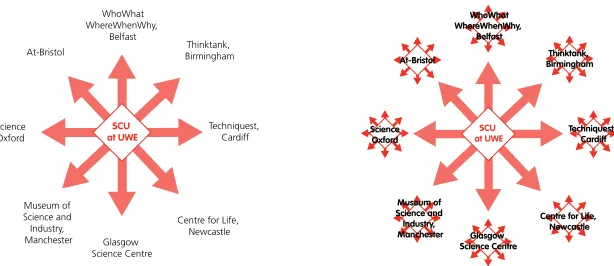
So in many ways the successful model was more like a multi-hub approach, as demonstrated in
Figure 2.
Challenges
There were of course many key challenges associated with maintaining such partnerships which were encountered within the programme, primarily:
High staff turnover within many of the partner institutions
■ ■
Delegation from ‘management’ to ‘delivery’ staff (sometimes without the appropriate briefing/
■ ■
skills development)
Maintaining effective communication between the various institutions and staff involved
■ ■
To overcome these challenges a high level of adaptability was required – in some cases this involved running additional training sessions for staff who joined various partner centres at later stages of the delivery phase. Cost savings made elsewhere, and the large scale of the MGM programme, meant this unexpected element could be absorbed. However additional training sessions may not always be easy to achieve, so teams planning to undertake work with multiple science centres over an extended period of time should plan in a contingency factor for this element.
SCU at UWE
At-Bristol BirminghamThinktank,
Techniquest, Cardiff WhoWhat
WhereWhenWhy, Belfast
[image:21.421.54.361.69.202.2]Centre for Life, Newcastle Science Oxford Museum of Science and Industry, Manchester Glasgow Science Centre
Figure 1 - Simple 'hub and spoke' model of collaboration
SCU at UWE
At-Bristol BirminghamThinktank,
Techniquest, Cardiff WhoWhat
WhereWhenWhy, Belfast
Centre for Life, Newcastle Science Oxford Museum of Science and Industry, Manchester Glasgow Science Centre
Multi-level external evaluation was integrated from the beginning of the project. This was crucial in incorporating the opinions of students, teachers, presenters and management staff and meant that issues were highlighted as they arose, and adjustments could be made for each subsequent stage.
Different communication methods were attempted e.g. a monthly newsletter that highlighted key ideas/learning from different centres. This made some attempt towards a two-way
communication facility within the project team (science centres were encouraged to submit ideas or experiences), although admittedly there were occasionally difficulties in getting content from all of the partners.
Clearly defined contracts were a bureaucratic burden in the early days however made a significant difference later in the project.
Sustainability and contagiousness
The most critical indicator of success is that the programme continues to be delivered by various science centres well after the core funding has come to an end. The venues involved have judged Meet the Gene Machine to be worthwhile enough to continue delivering at their own expense, and now that word of the activity has spread, some schools are even willing to contribute directly to the costs involved. In fact new science centres have even come on board, both within the UK and internationally, adding to the reach and success of the programme. Through the project evaluation various reasons for the successful sustainability of the event format were identified:
MGM built on existing strengths and motivations of the partners involved.
■ ■
Each centre was provided with central support (training, resources etc.) but still maintained
■ ■
ownership of their own event format and structure.
The main costs were in the initial development: once the programme was running in a
■ ■
particular centre it was very easy to continue – which represents great added value for all concerned.
Resources
Further information about MGM is available for public download from the Resources section of the SCU website (www.scu.uwe.ac.uk). There you can find:
a copy of the script
■ ■
the teacher’s resource pack
■ ■
presenter materials
■ ■
full evaluation materials
Discussion
The discussion following this session centred on the practicalities of collaboration. There was general agreement that collaboration was valuable and preferential in certain settings, for example where funders or the projects’ overall quality required it. However, delegates discussed a number of aspects raised by the two speakers, including how useful and practical it can be to have legal contracts agreed between the partners; organisational processes that can aid and make more efficient the selection of partners for collaboration and the implications for Intellectual Property and ownership of project outcomes.
Topics you may like to consider for further discussion:
■ How does your own organisation select and works with its partners, could this process be improved?
■ What potential benefits does collaborating on projects offer for your work? Is it an area you plan to expand?
■ Why you might have concerns or constraints around collaborating and how these can be overcome?
www.national-aquarium.co.uk www.scu.uwe.ac.uk
Adaptation: within venues, cultures and contexts
This session showcased science communication activities that have successfully moved on from their initial focus by transferring to new venues, cultures and contexts. Speakers highlighted how and why these activities were able to adapt to their new circumstances.
Contributors: Jan Riise, Göteborg Center for Public Learning and Understanding
of Science, Sweden
Wendy Sadler, science made simple, UK
Chair: Kat Nilsson, The Dana Centre, UK
Adaption
Jan Riise, Göteborg Center for Public Learning and
Understanding of Science, Sweden
Jan Riise is the president of European Science Events Association, EUSCEA, and a project manager for science communication projects. Currently Jan works with the Göteborg Center for Public Learning and Understanding of Science, as well as in European ‘science in society’ projects, funded by the European Commission, under the EU’s Framework 7 funding programme.
This article takes a case study approach to considering the theme of ‘adaptation’, based on my work within the Göteborg Center for Public Learning and Understanding of Science, the International Science Festival Göteborg and the European Science Events Association, EUSCEA.
Reaching across cultures
Shared learning – the Science Events perspective
Science festivals and events are becoming common place throughout Europe, with activities ranging from one-off celebrations of science in a local area to national ‘science and technology weeks’ and similar. EUSCEA (the European Science Events Association, http://www.euscea. org/) aims to support and encourage the exchange experiences about the organisation of such informal learning events. In 2003-05 EUSCEA carried out an extensive survey among some 25 of its members. The result was published in the ‘white book’, Science Communication Events in Europe, that was released at the ‘Communicating European Research’ conference in Brussels in November 2005. The survey included an analysis of the purpose and philosophy statements of the included science festivals and events. Practically all events had some statement regarding ‘raising the awareness of science’ – formulated in different ways and different languages, but with basically that content. However, almost all festivals also had additional purposes; thus ‘adapting’ the science communication idea to local and/or regional and national needs and objectives. Such goals include ‘city marketing’, ‘networks between industry and academy’, ‘national coverage’ and ‘meeting-places for scientists’.
As a case in point, the first Science Festival in Göteborg was arranged in 1997, since then it has been arranged on an annual basis in April or May (thus adapting to other events, public holidays etc). Relatively soon it reached an audience of about 100,000 visits per festival and 300-500 individual activities, a level that makes it one of the biggest science events in Europe.
How to ensure adaptability within an activity
2WAYS is funded by the European Commission and overseen by EUSCEA. It is a two year project involving 30 partner organisations and members of EUSCEA, who are working in pairs across the network. The objective is to create a resource of interactive presentations of contemporary life sciences research which will then be made available to the wider community. This approach involves applying and testing the adaptability of science communication activities in several dimensions.
First of all, each partner within the 2WAYS programme will adapt relatively advanced scientific objectives, methods and language to contexts that are familiar to public audiences and selected target groups. Secondly, the activities themselves will then be adapted to formats – and locations – that encourage interactivity, dialogue and engagement. Thirdly, the presentations must be adapted – or adaptable – to possible future events and presenters. Part of the project is the production of a ’cook-book’, instructions and guidelines explaining how to recreate the presentations in alternative venues. Finally, the presentations will be available in a format that makes evaluation possible and meaningful. We recognise that it is important to assess the impact of the work and at least get some indications if the adapted presentations were interesting and entertaining.
Adaptation through the choice of venue
Marketing professionals at business schools tell us that there are 4 ‘P’s’ that can be considered for a better market penetration, i.e. in our case reaching a larger part of the selected target group. The four P’s are Product, Price, Place and Promotion – and these aspects of dissemination can each be adapted to the intended outcome. In the science communication case, ’Price’ is frequently not an issue since many activities are funded externally, thereby provided free to the participants. ‘Product’ means, for example, the adaptation of a lecture to something more easily accessible by the target audience, such as a discussion or interactive workshop. ’Promotion’ is about the resources spent on telling the target group that there is something going on. It is however in ‘Place’ that a real opportunity for adaptation occurs - an opportunity to change the outcome of our efforts just by thinking about which location it is delivered in.
The potential advantages provided by changing the location of the event are demonstrated by visitor evaluations made at the International Science Festival Göteborg. Feedback indicates that the choice of venue has an impact regarding the visitors’ profile in terms of age, education and place of living. Most encouraging were the results from the ‘science festival tent’ in a park close to one of the main pedestrian and shopping areas: in two consecutive evaluations this location had more young people from underprivileged suburbs than on average. This is a traditionally hard-to-reach audience, but by merely changing the location of the activities to somewhere more amenable to the participants, the increase in participation was noticeable. This result certainly supports the perspective that we should consider ‘adaptation’ of events in as wide a context as possible.
‘visualise – the beauty of science’. A non-verbal science show -
adaptation and evolution in action
Wendy Sadler, science made simple, UK
Wendy Sadler is the Director of ‘science made simple’, a science communication company that specialises in inspirational and interactive science performances, and in working with researchers on translating their research to a wider audience. Wendy was awarded the EU Descartes Prize for ‘innovative action in science communication’ in 2007.
science made simple is a company with three parts to its mission: to inspire the next generation of scientists and engineers
■ ■
to engage a wider public with STEM as part of popular culture
■ ■
to be a STEM translation service between researchers and the public
Much of our work is done using what could be classed as ‘traditional’ science shows – that is, interactive performances showing live demonstrations, using volunteers and engaging the audience with mass experiments or multi-media activities. These shows are usually run by one presenter and are designed to work in a school hall location with very little control over the theatrical facilities that will be available.
In 2005 two thoughts collided to create an idea for a new kind of science show. Through work we had done with the British Council overseas we had found that when working through a translator you use much less verbal communication and are more reliant on the impact of the demonstration and your non-verbal communication techniques. Secondly, some research I completed on the long-term impact of science shows suggested that visually ‘curious’ demonstrations are the ones that remain in the memory most effectively. We combined these two ideas together and added in some further inspiration from seeing large-scale demos set beautifully to music by a German group called ‘Physikanten’.
Phase 1
With support from NESTA and the IOP as part of Einstein Year (the UK arm of the International Year of Physics in 2005) we decided to try out this new format. The aims of the show were to create a science–based performance that would reach new audiences, cross language barriers, push the boundaries of our own creative skills and then to evaluate the approach and share the results with other practitioners.
The show in its first phase was all about the demonstrations, with the performer staying fairly discreet, being on stage simply to activate the demonstration. Popular favourites were taken and scaled up or cameras were used to project smaller but enticing demonstrations onto large screens. Each ‘chapter’ of the show had a different scientific theme and was concluded with a video montage of where the phenomena occurred in the real world. We wanted to ensure that the show wasn’t just about flash-bang-wow equipment, wanting it to showcase the beauty of simple and small things as well.
The evaluation was positive on many aspects such as the emotive potential of the show, the novel format and the use of music and cameras. In addition, the perceived novelty of people seeing these effects live on stage rather than just filmed earlier and shown on screen was popular. However, there were large technical problems and the audiences did not like the remoteness of the presenter, who had no interaction or engagement with the audience. As well as realising that we needed much more help on the technical production of the show, we also realised that we needed some artistic direction to ensure the audience engaged with the performer on the stage as well as the demonstrations themselves.
Phase 2
a stronger narrative. In addition, students on the technical courses at the College became our technical team. The College valued this opportunity as the challenges we had in staging science demonstrations in this way gave them a completely novel set of learning opportunities for their students. The College were keen to promote the performance as part of their Welsh showcase at the Edinburgh International Fringe Festival and we secured additional financial support for this performance from the EPSRC.
In its second phase the show consisted of two performers assuming likeable characters where there was some rivalry on ‘who could do the best experiment’. The performers (who are both scientists by background, not actors) received additional training in physical theatre techniques and clowning to build their skills for the new roles.
The show was a huge success at Edinburgh, becoming an official ‘fringe sell-out’. We were short-listed from over 300 acts for a Total Theatre Award for ‘experimentation’. The Welsh College sold more tickets for our show than all their other Welsh performances put together, and the show then proceeded to visit 9 countries as part of the British Council’s ‘Beautiful Science’ project, reaching over 11,000 people and performing in theatres of 300-500 seats.
Phase 3
After completing the European tour, the Scottish Executive supported taking the show to Edinburgh again and then to a further 3 theatre venues in other areas of Scotland. For this stage the Welsh College worked with us to make the production more cost effective for theatres. The characters and content of the show were again reviewed by a different ‘guest director’, resulting in the show being more fluid, with better positioning of each experiment within the overall narrative. However, despite having some money to subsidise the tour we found it very difficult to get small to medium sized theatres to book the show. Often their seating capacity would not generate enough income for them to cover the costs of bringing us in and therefore they would not take the risk on an ‘unknown’ theatre company. Visualise:re-loaded was then taken to Edinburgh Fringe 2008 where again ticket sales were good and we achieved a four- and five-star review from the key broadsheets.
Thoughts on the future
The show has been proven to adapt well to new audiences to science – and audiences who prefer to learn in a very visual, non-verbal way (whether that be non-English speaking audiences or people with special educational needs). However we are unsure whether it can become commercially viable without further significant investment in marketing and tour booking. The main problem therefore of adaptation has not been adapting the content of what we offer, but in adapting our brand and reputation so that theatres have confidence that the public will buy tickets for this kind of show.
Discussion
Participants were keen to discuss the benefits and constraints of audience targeting, which whilst excluding some audiences from a particular activity, was seen to be a useful tool. Visualise, as an example, prompted discussion around similarities between science communication initiatives and artistic endeavours. Delegates highlighted the frequent conflict of having dual aims in science communication: both learning and evoking an emotive response. Contrasting this with a theatre production or other creative experiences where the audience is free to leave with their own ideas, integrating the experience into their own current thinking. It was recognised there may be some useful learning to come from the creative arts in terms of how quality is assessed and how artists accept that each audience member walks away with a unique and personal experience.
Topics you may like to consider for further discussion:
■ How didactic are the science communication activities you are involved with?
■ How could activities you have developed be amenable to evolution and change by others?
■ What professional and personal ramifications might the utilisation or the adaptation of your work have for you?
Demonstrating impacts: impact, metrics and going
beyond evaluation
Evaluation of science communication projects is now the norm, but what does evaluation tell us about the impacts of these activities on participants and deliverers? Speakers in this session were asked to discuss the latest thinking on capturing the impacts of science communication activities and how this links to evaluation.
Contributors: Ben Gammon, Ben Gammon Consulting, UK
David Shakespeare, Square 2 Learning Ltd, UK
Chair: Ros Mist, Science Community Representing Education, UK
Assessing long-term impact of science engagement:
Can it be done yet?
Ben Gammon, Ben Gammon Consulting, UK
Ben Gammon worked for 15 years at the Science Museum as Head of Visitor Research and then as Head of Learning. He sat on the MLA’s steering group guiding the development of their Inspiring Learning for All framework and developed systems for assessing learning from Science Museum exhibitions and live interpretation. Ben is now an independent consultant specialising in interpretive planning and visitor research.
Understanding the long-term impact of science engagement activities (SEAs) is clearly important. Yet making reliable and valid assessments of such long-term impact is far from straightforward. Most studies which have been conducted are of questionable use since they have been conducted ahead of any clear understanding of what impact can reasonably be expected. To put it another way, we do not really understand what it is we are looking for nor how to look so it is hardly surprising that we are struggling to find it.
Over what time period should the impact of an SEA be measurable – weeks, months, years,
■ ■
decades?
How much impact is deemed to be enough? If one person out of an audience of 10,000
■ ■
shows evidence of impact is this enough? If not one person then what number: 10, 100, 1,000? And how much impact should be observed per person for the initiative to be deemed successful? Does any evidence whatsoever count as enough?
How much more impact should an SEA costing £1 million expect to deliver compared to one
■ ■
costing just £10,000?
How should such long-term impact manifest itself? Is simply remembering the experience
■ ■
enough? Does everything we remember have a significant impact upon us or is some of what we can recall merely trivial episodes?
Can we recall everything that has had a significant impact upon us? How much of your formal
■ ■
schooling can you actually recall? Does the fact that you cannot recall a great deal of it mean that it has had no impact or simply that you can no longer recall when that change occurred to your attitudes or understanding?
The true value of science engagement is often said to be its capacity to inspire interest, yet research has consistently shown that most of the people taking part in such activities are already interested in science and are attending in order to sustain that interest. How then do we assess the vital role of science engagement in sustaining interest given that there will be little or no change to measure?
How do we untangle impact of the particular SEA we are seeking to study from the myriad of other experiences which will have effects (both positive and negative) upon the same indicators we are likely to use? How should we take account of the very different pre and post SEA experiences and interests of our visitors? How do we determine what has been caused by the SEA and what is caused by TV programmes, experiences in school, books, web-pages etc? Remember that our visitors will spend vastly far more time watching TV, surfing the internet, reading books, newspapers and magazines than they will have spent engaged in the SEA. We are looking for a small signal against a very large amount of background noise.
Without a robust theoretical model of the impact a successful SEA should have over a specific period of time it is impossible to draw any meaningful conclusions from any long-term studies. Other more practical questions are also sorely in need of an answer:
Is it reasonable to expect science communicators without professional training and with
■ ■
extremely limited resources of time and money to try and conduct complex longitudinal studies? Or should these studies really be done by professional academic researchers? Is the data collected from a study of long-term impact actually of any use to anyone? Is it
■ ■
Unless a sponsor knows not only whether but also why a particular initiative was successful
■ ■
how will they know what in future is a good project to fund?
If science communicators and their sponsors cannot identify why something was successful or unsuccessful then what is the point of assessing the long-term impact? The money will already have been spent and without an understanding of what needs to be changed and what preserved, nothing has been achieved.
This is not to say that there is no value to assessing the long-term impact of science engagement. Rather it is an attempt to highlight that at present we do not know what we are looking for, how to look for it or really why we are conducting these studies. This is not so much a matter of putting the cart before the horse. It is more like trying to hitch the horse to the cart before the wheel has been invented.
Do we know what we want? Will we know if we get it? Issues in
evaluating science enhancement and enrichment activities provided
for schools
David Shakespeare, Square 2 Learning Ltd, UK
David Shakespeare is a science education consultant to teachers, schools and organisations such as the DCSF STEM Programme, the QCA, STEMNET and the Science Learning Centres network. His work includes evaluation of the impact of educational initiatives from the teacher/ school perspective, and the development of strategies to align the aspirations of science-related educational support providers with those of schools and their learners.
Evaluation is a determination of worth or significance, and involves criteria against a set of standards. In the field of science enhancement & enrichment (E&E) activities provided for schools, it is a lack of criteria and standards which currently hampers effective evaluation of this provision. Unfortunately, it would be very problematic to develop common standards to try and fit all types of E&E. But worse still, what is missing in many cases is a lack of clearly-defined, achievable objectives to set out a provider’s own standard for what they are hoping to achieve. For a given E&E activity in a school, the provider and school are both responsible for trying to gauge impact, but too often neither party decides on meaningful objectives against which to measure progress. However, there is a possible solution – and it lies with both the provider and the school. For E&E providers (and those who fund them), there are many reasons to support in-school E&E activity, and they seem to centre on (one or more of):
Engaging and enthusing young people about science
Science teachers themselves would generally agree with this list. However, that would disguise the fact that teachers are likely to expect a greater emphasis on certain objectives than others (e.g. ‘For this year group, at this point in the school term, we want to improve attitudes to science but are less concerned about influencing subject choices’). Teachers are also just as likely to have other objectives in mind - such as raising the achievement of certain groups of pupils, or to satisfy their school’s requirements to work with outside agencies, and so on. Either way, the broad nature of the provider’s initial objectives and the possibility that the school has different objectives creates a misalignment - meaning that there is no clearly agreed standard against which to compare, thus making it difficult to assess progress at all.
Looking at how the most limited evaluations are carried out by providers, they may involve a simple head-count (e.g. ‘We provided for 1,252 pupils last year’), or uptake numbers (e.g. ‘We are working with 53 schools in 11 local authority areas’), or re-bookings (e.g. ‘23 schools asked us back two years running’). They may also take as evidence the instantaneous or anecdotal response of pupils and teachers (e.g. ‘The pupils had a great day and seemed to get a lot out of it’); or ticks and comments from on-the-day questionnaires. While all these play a part, they are simple measures of throughput and reaction to the activity, and have far less to say about learning, potential changes of behaviour and the ultimate outcome for the participant – even though that may be what was desired in the first place by the provider and those that fund them.
Evaluation methodology in schools is different. In recent years, ‘assessment for learning’ pedagogy and self-evaluation approaches mean that state schools have evaluation closer to the heart of what they do. Effective teaching involves tightly defined objectives for each lesson – and teachers try to gauge pupil progress against them. Periodic assessment information is analysed and used to inform future provision. Through well-established self-evaluation processes, science departments in schools are more used to looking for evidence of the effects they may be having. Curiously, these approaches to evaluation are not applied by many schools when E&E providers visit – and it is an opportunity missed.
To move on from where we are, providers could be:
Frequently asking themselves ‘How often, and at which stages, do we try and gauge
■ ■
the longer-term effect of what we are doing in this activity – i.e. not just the reaction of participants, but their learning, changed behaviour and final outcomes?’
Considering the question ‘What’s in it for me?’ at all levels to help express their initial
■ ■
objectives for the activity (i.e. What’s in it for pupils, teachers and schools?).
Explicitly promoting these initial objectives and referring them to any school with whom they
■ ■
start to work.
Asking these schools about their objectives for the E&E activity – and negotiating a sense of
■ ■
Asking the school about the part they can play in gauging progress (e.g. in the case above,
■ ■
using the Year 10 course uptake data, perhaps cross-referenced to those who indicated earlier their intention to take Applied Science); asking schools how the provider can help them in the process; and agreeing how and when a review will be undertaken together.
This all requires a small but significant cultural shift by the provider, and more negotiation before provision. While it also appears to put more work on the school, I believe many teachers recognise the importance of evaluation – and will feel it helps improve their decisions regarding the use of external provision of E&E.
This is not, however, a perfect (or a cheaper) solution to the issues. Longer-term evaluation is always more ‘messy’ and requires greater commitment. But unless we recognise that objectives and intended outcomes are not one-size-fits-all as defined by a provider, but that they are specific to the provider-school relationship, we will all find it hard to assess if E&E activities are worthwhile.
In future, I would hope the questions ‘Do we know what we want? Will we know if we get it?’ are part of the first conversations between a provider and a school when it comes to science enhancement and enrichment – and any answers should then be meaningful to both of them.
Discussion
The discussion began with a number of delegates agreeing that evaluation as it currently stands is less than ideal. Delegates probed and made suggestions around how critically projects should be reviewed and compared, the pros and cons of internal vs. external evaluation, the need to acknowledge failure and the value in publicising evaluation findings more widely. Differing evaluation requirements placed on scientists who communicate, as opposed to science communicators, provoked consideration and delegates also discussed the role that funders might play in encouraging higher quality evaluation as opposed to simply commissioning more projects. In this session, as well as others, the role of Generic Learning Outcomes was suggested as a mechanism to frame evaluation across the field however consensus was not reached as to whether this would answer the questions posed by the speakers in this session.
Topics you may like to consider for further discussion:
■ What approaches do you or your organisation take to evaluation?
■ How much you think mistakes as well as successes are shared across the science communication field?
Repositories of knowledge: sharing knowledge to avoid
reinventing the wheel
In this session participants were asked to share how their projects and activities were recorded and documented so that others can potentially learn from their experiences. Speakers used examples from their own work to examine existing instances of documentation and sharing knowledge, whilst also looking at how this could be taken forward in the future.
Contributors: Sophie Duncan, National Co-ordinating Centre for Public
Engagement (NCCPE), UK,
Juliet Upton, the STEM Directories, UK
Chair: Maggie Leggett, Centre for Public Engagement, University of Bristol, UK
The NCCPE project
Sophie Duncan, National Co-ordinating Centre for Public Engagement (NCCPE), UK
Sophie has worked in public engagement for over 15 years, and is the Deputy Director of the National Co-ordinating Centre for Public Engagement – a large scale project to enable the public to play a more interactive role in the work of higher education institutions. A physicist, she has worked at the Science Museum, NESTA and the BBC, where she managed the creation and delivery of national learning campaigns including People’s War and Breathing Places.
The Beacons for Public Engagement
The National Co-ordinating Centre for Public Engagement is part of the Beacons for Public Engagement project, which was launched in April 2008. The project is made up of the NCCPE and six Beacons: Newcastle and Durham, Manchester, CUE East (UEA), UCL, Wales and Edinburgh Beltane. This four year project is funded by the UK higher education funding councils, Research Councils UK and the Wellcome Trust. The NCCPE is also supported by the youth volunteering charity ‘v’, to deliver a strategic project linked to student volunteering. The NCCPE is a partnership between the University of Bristol and the University of the West of England (UWE). A key part of our role is to co-ordinate, capture and share learning between the Beacons and beyond.
we have three strategic aims:
1. To inspire a shift in culture
Support universities in bringing about strategic change that embeds public engagement
■ ■
Identify, develop and disseminate evidence-informed practice
■ ■
2. To increase capacity for public engagement
Broker and encourage the sharing of effective practice
■ ■
Capture learning from the Beacons and beyond and share it widely
■ ■
3. To build effective partnerships
Encourage partners to embed public engagement in their work
■ ■
Inform, influence and interpret policy
■ ■
Raise the status of public engagement
■ ■
Repositories of knowledge
How do we make use of the many resources, evaluations etc that are already out there? There are a number of factors that influence our ability to learn from what others have done. These include:
Time:
■
■ How much time do we have to access the multitude of content that could inform our approach?
Accessibility:
■
■ How easy is it to find relevant research and then apply it to our own situation? Motivation:
■
■ Many of us want to learn from other people’s work - but not always. Sometimes we are captivated by an idea we really believe will work, and we dismiss evidence to the contrary with the belief that our idea is different in an essential way from previous projects. I call this the ‘passion of the pioneer’. People are constantly creating new ideas and new ways of approaching issues. To some extent many of us want to reinvent the wheel – and reinvent it in a way that revolutionises how we travel.
The importance of people:
■
■ People are really important in the process of learning. Talking to someone for ten minutes about their project can enable you to learn things that would never be captured in a case study or report. It can also help you apply the knowledge gained.
How can we at the NCCPE develop shared learning?
Networks and events:
■
– those with passion and experience who can help mediate the available content and connections for people. Our events programme will focus on creating opportunities for shared learning, and provide opportunities to develop relevant resources for the sector
Action research:
■
■ We will be running an action research group process – where groups of people from across the UK will be engaged in group discussions around the question: 'Why should and how can universities embed public engagement?' Actions will emerge from these discussions – either group actions (e.g. commissioning a piece of research) or individual actions (to be played out within the participant’s institution). These actions will be reflected on by the group. At key points the groups will be brought together alongside others who have not engaged in the process, to reflect on what has been learnt, and to explore emergent themes. This may lead to the creation of new groups and projects, and the process continues.
Content:
■
■ Part of our work is to create an evidence base for public engagement – in order to help validate its importance and relevance to HEIs, communities and academics, staff and students.
Syntheses not encyclopedias:
■
■ With such a wealth of content currently available we need to ensure that we provide syntheses of this knowledge – providing helpful pointers for people – without the need to read through many pages of reports etc. Even our syntheses will be summarised into headline documents for those with little time, but lots of interest. It has been mentioned in other sessions that it would be helpful to synthesise some of the findings from evaluation of public engagement activities – and this is something we are keen to explore.
People not reports:
■
■ Whilst reports are important, we all know that it is people who really help make content relevant and accessible.
Stories not stats:
■
■ Stories not stats: Stories are really important – they are what people remember. Whilst statistics are important for a whole host of reasons, stories make the statistics matter. If I tell you that 4000 people volunteered to help with the People’s War project it doesn’t really sound very significant. However one of those volunteers was Arthur. Arthur heard a call for people to contribute their World War Two story to the People’s War archive. He shared one of his stories at his local museum and enjoyed it so much that he decided to volunteer to help other people record their memories. When the BBC roadshow moved on, the museum set up a stand for Arthur to continue to gather stories. Arthur went on to develop IT skills, and was hugely effective in encouraging others to take part in the project. Arthur was an amazing volunteer – but he wasn’t the only one. Over 4000 other volunteers like Arthur were engaged i