INTRODUCTION AND BACKGROUND OF STUDY
Malaysia’s fi rst formal science and technology policy was introduced in 1986 (National Science and Technology Policy II 2000–2010 [NST-PII] 2000). One of the major programs of this policy was the provision of greater opportunities for interactions between industry and public research institutions. Its aim was to increase economic development at a national level in tandem with support for Malaysia’s industrializa-tion program. Since its incepindustrializa-tion, the government has been proactive in seeking industry collaboration and cooperating in enhancing several economic and industrialization programs. For instance, a greater focus on research and development (R&D) projects that involve industry has been refl ective of this new policy implementation (NSTPII 2000). The policy was originally formulated by the Malaysian National Scientifi c and Research Council, membership of which consists of both govern-ment and industry representatives (NSTPII 2000).
agenda for an increasingly turbulent and unpredictable global market-place (Dodgson 2000; Martin and Scott 2000).
Indeed, this led to recognition of the role that universities could play in shaping and enhancing existing government and industry policies and programs (Abd Razak and Saad 2007). Malaysian universities have since been actively encouraged to participate more in R&D activities and to be entrepreneurial through knowledge transfer partnerships, for example, between industry and government bodies. In fact, some of the local public universities have set up, or are in the process of setting up, commercial arms of their own (namely, private holding companies). This idea of the ‘entrepreneurial university’, as stated by Etzkowitz and Leydesdorff (1997, 1999) and later reiterated by Leydesdorff (2000), is a unique feature of the triple helix model as a dynamic process and evolutionary model for enhanc-ing innovation. The Malaysian government has also awarded research uni-versity status to four top national universities designated under the Ninth Malaysia Plan, to be the country’s fi rst full-fl edged research universities (Abd Razak and Saad 2007). 1
This study, which examines the challenges arising in the evolution of the triple helix institutional system in the context of the Malaysian socio-eco-nomic environment, comprises four key sections. The fi rst section provides an overview of the existing literature on the triple helix model. The second discusses the evolutionary process followed by the triple helix system in general and more specifi cally in Malaysia. The third section investigates the issues and challenges facing Malaysian institutions in the course of their evolution as key actors within theimplementation of the triple helix model. A fourth and fi nal section concludes with a brief note on the way forward for the development of the triple helix system in Malaysia and other devel-oping countries.
KEY FEATURES OF THE TRIPLE HELIX MODEL
The dynamic nature of the triple helix model allows a fl exibility and integrative function which becomes embedded in the interfaces of the interlocking helical relationships. For example, industry gains some of the values derived from universities through a sharing of research knowl-edge. This further encourages research links and collaboration between private fi rms and universities in order to deliver goods or services to the general public and society, thereby attaining mutual, common, long-term strategic goals of socio-economic growth (Etzkowitz and Leydes-dorff 1997). Industries also develop an academic dimension and begin to appreciate the value of research, sharing and disseminating knowledge within their own cultures through, for instance, the provision of higher skill and knowledge levels. In addition to performing their traditional functions, the stakeholders of the triple helix also engage in enhancing the roles of the other spheres by practicing values derived from the heli-cal partners (Etzkowitz and Leydesdorff 2001). This conjoint dynamic behavioural process model also means the long-term objectives become synergistic to each other and complement the partners. This partner coordination and cooperation is considered central to the success of the triple helix model.
Another main argument for the triple helix model is the emphasis on the importance of academia in the capitalization of knowledge. Accord-ing to Etzkowitz and Leydesdorff (1997), in the existAccord-ing dynamic macro environment, universities are changing their mission, establishing new relationships with industry and becoming more entrepreneurial. Etzkow-itz et al. (2000, 326) defi ne this new type of university as the ‘amalgam of teaching and research, applied and basic, entrepreneurial and scholas-tic interests’. However, to fulfi l this new role, universities are expected to obtain some business skills to effectively carry out activities, such as commercializing their research, setting up their own start-ups and hav-ing a concrete business plan (Abd Razak and Saad 2007). As highlighted by many authors, such as Leydesdorff and Etzkowitz (1998), Martin (2000), Harman (2002) and Calvert and Patel (2003), universities are increasingly undertaking entrepreneurial tasks and creating opportuni-ties through business development.
one country, and indeed from one context, to another. For instance, a developing country like Malaysia might require a reduced role for the government and a greater role for other institutional bodies such as local public universities, whereas in others, a more active and enhanced role from the government is needed (Abd Razak and Saad 2007). In brief, according to Etzkowitz (2003), the triple helix model comprises three basic elements:
1. A prominent role for the university in innovation, on a par with industry and government in a knowledge-based society. In Malaysia, the government is striving to encourage universities to be actively involved in research and commercialization (Sunday Star 2007).2
2. A movement towards collaborative relationships among the three major institutional spheres, in which the innovation policy is an outcome of interactions among the spheres rather than a prescrip-tion from the government or an internal development within an industry. Several authors have attempted to highlight the complex-ity of collaborative relationships in the context of developing coun-tries, such as Saad and Zawdie (2005) for Algeria; Sutz (2000) for Latin America; and Malairaja (2003) for Malaysia.
3. In addition to fulfi lling their traditional functions, each institutional sphere also ‘takes the role of the other’ (Etzkowitz 2003, 309).
EVOLUTION OF THE TRIPLE HELIX INSTITUTIONAL SYSTEM
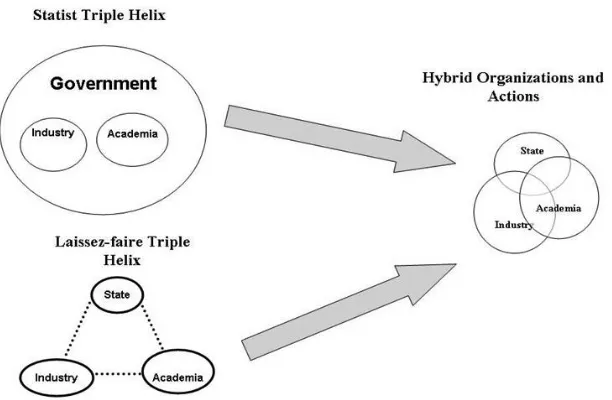
According to Etzkowitz (2003, 302), the transition of the triple helix model starts ‘from two opposing positions: a statist model of govern-ment controlling academia and industry, and a laissez-faire model, with industry, academia, and government separate and apart from each other, interacting only modestly across strong boundaries’. The next stage in the evolutionary process is the hybrid form of triple helix in which each institutional sphere keeps its own distinctive characteristics and at the same time also assumes the role of the others. The signpost in the evolu-tionary process underlying the triple helix system is graphically depicted in Figure 11.1.
exploit the potential knowledge-generating activities within universities as both teaching and research tend to be far removed from industry needs and universities do not have any incentive to engage in the commercialization of research (Etzkowitz 2003).
As for the laissez-faire triple helix model, governments, universities and industry operate independently as separate institutional spheres (Etzkowitz 2003). The fi rms are expected to operate completely apart from each other in competitive relationships and are only linked through market forces. The government’s role is limited to dealing with only those problems that can be regarded as market failures (Etzkowitz 2003). In this model, industry is the driving force, with the other two spirals acting as ancillary supporting structures. In the laissez-faire triple helix model, the individualistic mentality is more prominent and creates a type of ‘heroic’ entrepreneur. The advantage of this model is that industry will be able to grow without any undue interventions by the govern-ment. However, the main downside is related to the diffi culty for the three institutional spheres to interact in a way that would maximize the synergy in the relationship, and therefore benefi t from value inherent in each sphere.
[image:5.612.156.462.123.323.2]A third transition is the hybrid triple helix model where each institu-tional sphere keeps its own distinctive characteristics while at the same time being able to assume the role of the other (Etzkowitz 2003). All three spheres within this model will be able to interact and collaborate
Figure 11.1 Evolution of the triple helix system.
with one another actively in order to promote strong innovation activi-ties. All of them will gain values from each other which can help them achieve common long-term strategic goals. However, the problem with the hybrid triple helix is that its emergence as an institutional system could be elusive, as it involves a complex process based on high lev-els of commitment, understanding and trust between all three spheres (Abd Razak and Saad 2007; Saad, Zawdie and Malairaja 2008). The next section discusses the application of the triple helix model to the Malaysian context.
EVOLUTION OF THE TRIPLE HELIX INSTITUTIONAL SYSTEM IN MALAYSIA
The Malaysian government started to recognize in its second National Science and Technology Policy the increasing importance of the collabo-ration between universities, government agencies and private industrial partners (NSTPII 2000; Malairaja and Zawdie 2008). This is regarded as an attempt by the government to shift the national economy from a labour-intensive manufacturing base to a knowledge economy; therefore, in concordance with the demands of the turbulent and increasingly com-petitive environment of the twenty-fi rst century. The government has, for instance, developed several means to promote strong links among universities, industry and government through funded programs such as the intensifi cation of research in priority areas (IRPA), which is central to the completion of the Eighth Malaysian Plan (2001).
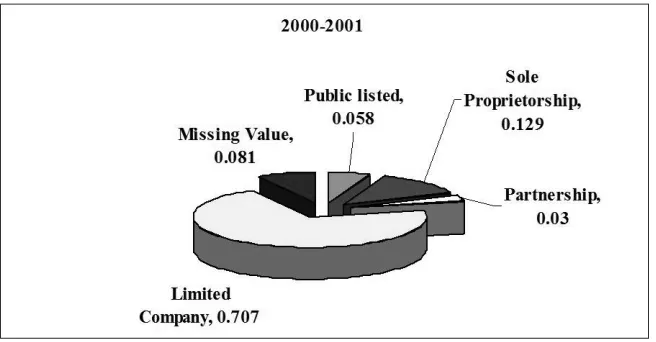
The Malaysian government started to also acknowledge the impor-tance for industries and universities to be less dependent (on the govern-ment) and to become more active in promoting innovation. For example, the percentage of innovating fi rms in the manufacturing sector (35 per cent) has exceeded that of Portugal (26 per cent) and Spain (29 per cent; see Malaysian Science and Technology Information Centre [MASTIC] 2004). However, the rate of innovation in other European countries such as Ireland (74 per cent), Denmark (71 per cent) and Germany (69 per cent) was signifi cantly higher than that of Malaysia. The survey conducted by MASTIC for the period 2000–2001 also indicates that, in general, large-sized fi rms are more innovative than the smaller fi rms, where they account for 25 per cent of the total number of innovating fi rms. However, the number of smaller fi rms active in innovation is, as illustrated in Figures 11.2 and 11.3, considerably higher than the corresponding fi gure of 1.8 per cent for the 1997–1999 period (MAS-TIC 2004). There is also clear evidence from Figures 11.2 and 11.3 that the percentage of innovating entrepreneurs (sole proprietorship) has increased dramatically from 0.5 per cent to 12.9 per cent.
for the university in the creation and diffusion of knowledge and innovation. There is, in the context of Malaysia, evidence of entrepreneurial behaviour as some of the local public universities have set up or are in the process of setting up commercial arms (a private holding company). An example of this is the establishment of USains Holdings (the university’s commercial arm) by the University Sains Malaysia (Malairaja 2003). Furthermore, the Malaysian government has recently conferred research university status to its top four local universities which are designated under the Ninth Malaysia Plan to be the country’s fi rst full-fl edged research universities.3
Figure 11.2 Ownership structure of innovating fi rms (1997–1999).
Source: MASTIC (2004).
Figure 11.3 Ownership structure of innovating fi rms (2000–2001).
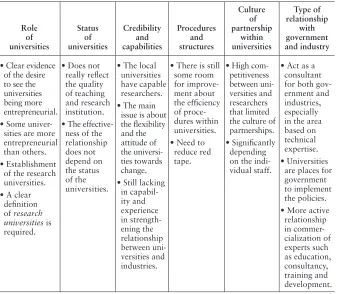
[image:7.612.144.472.355.526.2]Studies by Abd Razak and Saad (2007) and Malairaja and Zawdie (2008) have provided some further evidence suggesting that universities in Malaysia are being perceived by their partners as being of good quality, credible and capable researchers. The majority of the respondents in the interviews in this study stated that universities in Malaysia are determined to launch active relationships with the industrial sector. However, accord-ing to Abd Razak and Saad (2007), these relationships are more related to educational development, consultancy and training. The university is seen by respondents, from both the government and industry, as a key institu-tion that can provide consultainstitu-tions and advice (mostly based on techni-cal expertise). In fact, the government also uses universities to implement its policies (Abd Razak and Saad 2007). For example, the government is using the universities to implement its policies in increasing the number of researchers, IT workers and researchers for the country to achieve its Vision 20204 (MASTIC 2004). Table 11.1 provides a summary of how Malaysian universities are perceived by their partners. Further explana-tions regarding the table are given in the research methodology section.
Table 11.1 Current Perceptions of Malaysian Universities
Role of universities Status of universities Credibility and capabilities Procedures and structures Culture of partnership within universities Type of relationship with government and industry Clear evidence •
of the desire to see the universities being more entrepreneurial.
Some univer-•
sities are more entrepreneurial than others.
Establishment •
of the research universities.
A clear •
defi nition of research universities is required.
Does not •
really refl ect the quality of teaching and research institution. The effective-•
ness of the relationship does not depend on the status of the universities. The local • universities have capable researchers. The main •
issue is about the fl exibility and the attitude of the universi-ties towards change. Still lacking • in capabil-ity and experience in strength-ening the relationship between uni-versities and industries.
There is still •
some room for improve-ment about the effi ciency of proce-dures within universities. Need to • reduce red tape. High com-• petitiveness between uni-versities and researchers that limited the culture of partnerships.
Signifi cantly •
depending on the indi-vidual staff.
Act as a •
consultant for both gov-ernment and industries, especially in the area based on technical expertise.
Universities •
are places for government to implement the policies. More active • relationship in commer-cialization of experts such as education, consultancy, training and development.
sian context. For the purpose of this study, semi-structured interviews were used to elicit information from managers.5 The interview questions were semi-structured as they can include specifi c and closed questions in order to obtain specifi c information or confi rm facts about open-question answers. They were also aimed at encouraging the interviewees to provide an extensive or developmental answer which may be used to obtain deep and rich data (Eisenhardt 1989).
The samples for the interviews were taken from the three spheres of the triple helix: the government (government ministries and agen-cies), universities (researchers, deputy vice-chancellors and staff from research management centres) and industries (managers and executives). All of the eighteen respondents constituting the sample were carefully selected to represent the position of stakeholders in the evolving tri-ple helix institutional culture in Malaysia. The university respondents were from seven different universities of which four are categorized as research universities. From the government sphere, there were seven respondents in total, of which fi ve were from different government agencies6 and the other two from the Ministry of Science, Technology and Innovation (MOSTI). There were four respondents from industry: two from local and two from international multinational corporations (MNCs).
LINKS WITHIN TRIPLE HELIX INSTITUTIONAL SYSTEM IN MALAYSIA
To evaluate the type and quality of links existing within the triple helix institutional system in Malaysia, the discussion is divided into two sub-themes which investigate the current situation and views on effectiveness of the links in Malaysia.
[image:10.612.144.470.122.356.2]All the respondents suggested, and agreed, that links between the three key spheres exist in Malaysia. According to a senior general manager of a commercial arm of one of the local universities, there are several govern-ment agencies such as the Invest Penang and PSDC7 striving and working towards improving the relationship between university and industry. The type of collaboration (in this particular case, for an MNC) as highlighted by a senior manager of manufacturing and training is more inclined to develop programs on training and educating staff at universities. He elabo-rated that the company has given a monthly salary for lecturers to con-duct training programs especially related to fi bre optics as the industry is very new. For Sharma, Garg and Wani (2004), it is the university’s role to prepare and make available trained manpower with the right type and level of knowledge, attitude and skill base needed by the industry. Further-more, effective utilization of resources and interactions between industry
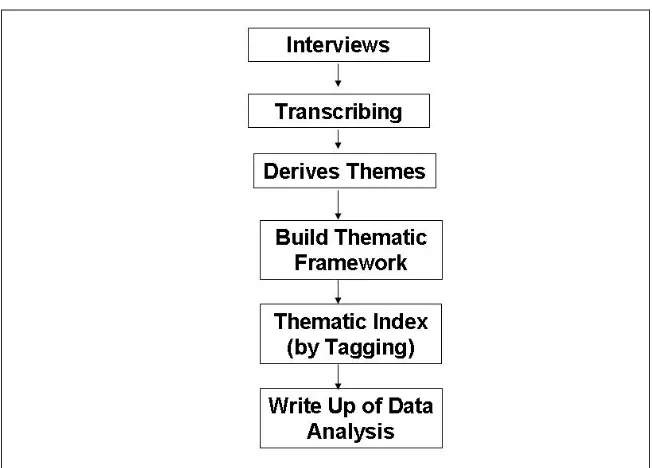
Figure 11.4 The process of data analysis.
ies on the triple helix relationships in Malaysia.
Having acknowledged that the relationships between university-in-dustry-government exist, all respondents believe that there is still sig-nifi cant room for improvement and it is not yet at a satisfactory level, as suggested by the deputy vice-chancellor of a local university: ‘It is moving, but we need a more speedy progress to deliver this especially with RM98 activities’. This view, as illustrated in the following quote, was also echoed by a senior government offi cer: ‘We need the improve-ment, from our Seventh and Eighth Malaysian Plan, therefore, in our Ninth Malaysian Plan, hopefully it will be more about commercializa-tion, demand and supply’.
The current nature of the links is essentially related to the technical training, education and professional development, especially with MNCs. This type of relationship is also identifi ed by a senior manager of an MNC who claimed that they have hired some university lecturers even though they do not have hands-on experience on knowledge transfer, training and developing new products.
The preceding discussion highlights the following three major fi ndings regarding the implementation of triple helix relationships between key institutions in Malaysia:
1. Links between the university, industry and government exist; how-ever, their level and effectiveness remain uncertain.
2. There is still signifi cant room for improvement although for certain industries like Biotech the links are blossoming.
3. The current nature of the links is more about the technical training, education and professional development, especially with MNCs.
CHALLENGES ARISING IN THE EVOLUTION OF THE TRIPLE HELIX INSTITUTIONAL SYSTEM IN MALAYSIA
issues are summarized in the following with supporting verbatim evi-dence from respondents.
Technological and Human Resources Factors
Malaysian universities are lagging behind in terms of expertise in the devel-opment of new and advanced technologies, such as fi bre-optic technologies. As emphasized by a senior manager of an MNC, most Malaysian universi-ties are not well prepared and do not even have the resources and equip-ment to develop new and innovative technologies. This was also noted by Schramm (2004), who argues that research, especially in life sciences, com-puting and engineering, has not been successfully commercialized largely due to bureaucracy and lack of applied skills and resources in universities.
All the respondents also highlighted the lack of human resources in sci-ence and technology development as an ongoing issue for Malaysia. A reso-lution from the Malaysian Science and Technology Convention (MASTEC) identifi ed, in 2003, several issues related to human resources development in the country. These issues, which include the low supply in skills devel-opment, inappropriate policy instruments to encourage in-house employee training and the inadequate supply of lecturers and instructors in skills development, were perceived to be the main causes for the lack of human resources in science and technology. The number of researchers, despite an increase from 15.5 to 18.0 researchers per 10,000 between 2000 and 2002, remains relatively low when compared to international standards (MASTIC 2004).
Policies, Procedures and Processes within the University
Universities are faced with the dilemma and debate about the balance between teaching and research responsibilities. According to a fellow researcher working for an MNC, universities are having problems manag-ing resources and time between research and teachmanag-ing.
Universities also face the issue of infl exibility of staffi ng policies that prevent them from hiring the right staff for the right jobs. One of the main diffi culties is related to the lack of experts in technology transfer, which is crucial for the relationship to ensue with the industrial sector. Furthermore, according to a senior manager of a university’s commercial arm, these fac-tors have contributed to the quality and speed of work of the university, as the staff is only allowed 40 per cent of its time for consultancy. It takes academic staff two years to do what the full-time staff can do in one year.
Commercialization Issues
(from industry) is needed. However, the existing regulations and practices related to the funding and loan applications remain very rigid and need to be changed and improved.
The preceding factors are mainly related to the issue of links between academic and industrial actors, as suggested by Danell and Perrson (2003), for whom a region needs a critical mass of interacting academic and industrial actors in order to develop technologically and prosper in economic terms.
Relationship between the Main Stakeholders and Spheres
On the whole, there are issues of misperceptions related to the nature of the actual relationship and its parameters and boundaries. The indus-try perceives university staff as being ‘too theoretical’ (senior manager of MNC) and not having ‘suffi cient practical knowledge about real-life situations’ (senior government offi cer of a government agency). Accord-ing to a senior government offi cer, this lack of exposure and knowl-edge about industry has affected the nature of their relationship and the type of collaboration with their industrial and academic partners. Furthermore, universities appear to be unable to prioritize the strategic research areas which correspond to the industry’s interests. It is evident that the engineering and science faculties are receiving more demand for collaboration from industry (through consultancy and research projects) as opposed to the social science faculties. However, it can be risky and inappropriate for this type of relationship to emerge only in certain fac-ulties and not in others.
The perception of universities by the industry also affects the relation-ships between the university and its main partners. For instance, small and medium enterprises (SMEs) often perceive universities as ‘ivory towers’. A signifi cant number of industry managers still consider overseas researchers are much more capable than locals. There is also a feeling that no formal procedures are embedded in order to harness a continuity that will promote long-term relationships between universities, government and industry. The relationship is very much based on, as one respondent put it, a ‘need-by-need basis’.
Work Cultures
The apparent difference in work cultures between the universities, indus-try and the government was raised by several respondents as an impor-tant issue in managing the interrelationships in the tripartite model of the helix model. One of the main issues in work cultures is the response time (timeliness) especially between the universities and industry. The CEO of a state investment agency highlighted that timeliness is the biggest barrier in the relationship. According to a senior manager of one MNC, it is simply because universities and their staff are not ready, or do not fully compre-hend the work culture of industry.
This difference between cultures is also raised by a senior manager of a university’s commercial arm, for whom ‘industry wants things very quickly at their pace of time, however, we (the university) always insist that we need to take into consideration our teaching responsibilities, which is the major duty for Malaysian academics, whether we like it or not.’
Intellectual Property (IP)
There is also evidence that the Malaysian government is planning to set up a broad intellectual property (IP) policy. However, some concerns about the clarity of this policy and its guidelines have been expressed by represen-tatives from key stakeholders from the university, government and industry spheres. Current IP policies and practices are seen as signifi cantly affecting the nature of relationships between the universities, industry and the gov-ernment. This view is clearly echoed by the following quote from one senior government offi cial:
IP is the most important barrier. In Malaysia we don’t have a clear IP guideline. There is like fi fty-fi fty partnership. However, for both the industry and universities, they are still confused with the IP require-ments. It is because the IP awareness in Malaysia is still low. We basi-cally need clearer guidelines.
Government Policies
order to achieve this aim. That is, as a result of lack in clarity [as] every ministry is doing its own things.
CONCLUSION
From the fi ndings and discussion in this chapter, it is obvious that the Malaysian government continues to behave as the dominant sphere in the development of knowledge and innovation. Both academia and industry remain dependent upon the government in terms of overall coordination, objectives, planning and resources. However, the respondents from uni-versities cited in the study raised concerns regarding clarity from govern-ment sources. This, as discussed earlier, corresponds to a statist triple helix model. However, the universities and industry are still operating separately and they are only linked through the market need which is a key feature of a laissez-faire triple helix (Etzkowitz 2003).
Although all the institutions have made an effort to move the triple helix relationship into the next transition, there are still key issues and challenges that need to be overcome. For example, efforts should be made to address issues such as commercialization, IP policy and differences in work cultures. It is clear that the situation has been improving for the past ten years with the introduction of policies aimed, to a certain extent, at strengthening the role of universities and their links with their immediate external environ-ment. However, there is no doubt that the government, industry and uni-versities need to work closer with one another. All respondents agree that there is still a long way to go and a strong commitment is clearly required from all parties for the successful implementation of the triple helix institu-tional system in Malaysia. This study has provided seven key areas which can form a platform for interrelational development between the partners for the Malaysian context and therefore provide a public policy agenda for the successful implementation of the triple helix model.
NOTES
1. Each university received RM50 million (U.S.$15 million) for research, devel-opment and commercialization activities (Sunday Star 2007).
3. Each university received RM50 million (U.S.$15 million) for research, devel-opment and commercialization activities (Sunday Star 2007).
4. Vision 2020 is a program dedicated to Malaysia’s aspiration to be a fully developed country by the year 2020.
5. According to Saunders et al. (2000), managers in developing countries are more likely to agree to be interviewed than to complete questionnaires. 6. The fi ve agencies are:Invest Penang (a state investment agency),
Malay-sian Technology Development Corporation Sdn Bhd (MTDC), Small and Medium Industries Development Corporation (SMIDEC), Malaysian Agri-culture Research and Development Institute (MARDI) and Kulim High Tech Corporation (owned by a state government).
7. Penang Skills and Development Centre. 8. Ninth Malaysian Plan.
REFERENCES
Abd Razak, A., and M. Saad. 2007. ‘The role of universities in the evolution of the triple helix culture of innovation network: The case of Malaysia’. Interna-tional Journal of Technology Management and Sustainable Development 6 (3): 211–225.
Aronson, J. 1994. ‘A pragmatic view of thematic analysis’. Qualitative Report 2 (1). http://www.nova.edu/ssss/QR/BackIssues/QR2–1/aronson.html (accessed 1 June 2007).
Calvert, J., and P. Patel. 2003. ‘University–industry research collaborations in the UK: Bibliometric trends’. Science and Public Policy 30 (2): 85–96.
Danell, R., and O. Persson. 2003. ‘Regional R&D activities and interactions in the Swedish triple helix’. Scientometrics 58 (2): 205–218.
Dodgson, M. 2000. The management of technological innovation: An interna-tional and strategic approach. Oxford: Oxford University Press.
Eighth Malaysia Plan. 2001. ‘2001–2005 economic planning unit, prime minister’s department, Malaysia’. http://www.epu.jpm.my (accessed 20 August 2008). Eisenhardt, K. M. 1989. ‘Building theories from case studies research’. Academy of
Management Review 14 (4): 532–550.
Etzkowitz, H. 2002. ‘Incubation of incubators: Innovation as a triple helix of universi-ty-industry-government networks’. Science and Public Policy 29 (2): 115–128. . 2003. ‘Innovation in innovation: The triple helix of
university-industry-government relation’. Social Science Information 42 (3): 293–338.
Etzkowitz, H., and M. Klofsten. 2005. ‘The innovating region: Toward a theory of knowledge-based regional development’. R&D Management 35 (3): 243–255. Etzkowitz, H., and L. Leydesdorff. 1995. ‘The triple helix:
University-industry-gov-ernment relations. A laboratory for knowledge-based economic development’.
EASST Review. European Society for the Study of Science and Technology 14 (1): 18–36.
. 1997. Universities in the global knowledge economy: The triple helix of university-industry-government relations. London: Cassell Academic.
. 1998. ‘The triple helix as a model for innovation studies’. Science and Public Policy 25 (3): 195–203.
. 1999. ‘The future location of research and technology transfer’. Journal of Technology Transfer 24 (2–3): 111–123.
metheus 20 (2): 143–158.
Leininger, M. M. 1985. ‘Ethnography and ethnonursing: Models and modes of qualitative data analysis’. In Qualitative research methods in nursing, ed. M. M. Leininger, 33–72. Orlando, FL: Grune and Stratton.
Leydesdorff, Loet. 2000. ‘The triple helix: An evolutionary model of innovations’.
Research Policy 29 (2): 243–256.
Leydesdorff, L., and H. Etzkowitz. 1998. ‘The triple helix as a model for innova-tion studies’. Science and Public Policy 25 (3): 195–203.
Malairaja, C. 2003. ‘Learning from the Silicon Valley and implications for tech-nological leapfrogging—the experience of Malaysia’. International Journal of Technology Management and Sustainable Development 2 (2): 73–95.
Malairaja, C., and G. Zawdie. 2008. ‘Science parks and university–industry col-laboration in Malaysia’. Technology Analysis and Strategic Management 20 (6): 727–739.
Malaysian Science and Technology Information Centre. 2004. Malaysian science and technology indicators 2004 report. Ministry of Science, Technology and Innovation (MOSTI).
Martin, Michaela, ed. 2000. The management of university–industry relations: Five institutional case studies from Africa, Europe, Latin America and the Pacifi c Region. Paris: International Institute for Educational Planning, UNESCO Martin, S., and J. T. Scott. 2000. ‘The nature of innovation market failure and the
design of public support for private innovation’. Research Policy 29 (4–5): 437–447. National Science and Technology Policy II 2000–2010. 2000. ‘Building competi-tiveness in a knowledge-driven economy’. Unpublished manuscript, Academy of Sciences, Malaysia.
Ritchie, J., and J. Lewis. 2003. Qualitative research practice: A guide for social science students and researchers. Thousand Oaks, CA: Sage.
Saad, M. 2004. ‘Issues and challenges arising from the application of innovation strategies based on the triple helix culture: Experience of the incubation system in Algeria’. International Journal of Technology Management and Sustainable Development 3 (1): 17–35.
Saad, M., and G. Zawdie. 2005. ‘From technology transfer to the emergence of a triple helix culture: The experience of Algeria in innovation and technological capability development’. Technology Analysis and Strategic Management 17 (1): 1–15.
Saad, M., G. Zawdie and C. Malairaja. 2008. ‘Triple helix strategy for universities in developing countries: The experiences in Malaysia and Algeria’. Science and Public Policy 35 (6): 431–443.
Schramm, C. J. 2004. ‘Accelerating technology transfer and commercialisation’. Paper presented at IP Commercialisation and Research Spinouts Conference, Boston, MA, 4 November.
Sunday Star. 2007. ‘Boost for research’. 19 August, 4.
Sutz, J. 2000. ‘The university-industry-government relations in Latin America’.
Research Policy 29 (2): 279–290.
Taylor, S. J., and R. Bogdan. 1984. Introduction to qualitative research methods: The search for meanings. New York: John Wiley and Sons.