A Model For Generating Better Explanations
Peter van Beek
Department of Computer Science University of Waterloo
Waterloo, Ontario C A N A D A N2L 3G1
A b s t r a c t
Previous work in generating explanations from advice- giving systems has demonstrated that a cooperative sys- tem can and should infer the immediate goals and plans of an utterance (or discourse segment) and formulate a response in light of these goals and plans. The claim of this paper is that a cooperative response may also have to address a user's overall goals, plans, and preferences among those goals and plans. A n algorithm is intro- duced that generates user-specific responses by reasoning about the goals, plans and preferences hypothesized about a user.
1. I n t r o d u c t i o n
What constitutes a good response? There is general agreement that a correct, direct response to a question may, under certain circumstances, be inadequate. Pre- vious work has emphasized that a good response should be formulated in light of the user's immediate goals and plans as inferred from the utterance (or discourse seg- ment). Thus, a good response may also have to (i) assure the user that his underlying goal was considered in arriving at the response (McKeown, Wish, and Matthews 1985); (ii) answer a query that results from an inappropriate plan indirectly by responding to the underlying goal of the query (Pollack 1986); (iii) pro- vide additional information aimed at preventing the" user from drawing false conclusions because of violated expectations of how an expert would respond (Joshi, Webber, and Weischedel 1984a, 1984b).
The claim of this paper is that a cooperative response can (and should) also address a user's overall goals, plans, and preferences among those goals and plans. We wish to show that an advice seeker may also expect the expert to respond in light of, not only the immediate goals and plans of the user as expressed in a query, but also in light of (i) previously expressed goals or prefer- ences, (ii) goals that may be inferred or known from the user's background, and (iii) domain goals the user may be expected to hold. If the expert's response does not consider these latter type of goals the result may mislead or confuse the user and, at the least, will not be cooperative.
As one example, consider the following exchange between a student and student-advisor system.
User: Can I enroll in CS 375 (Numerical Analysis)?
System: Yes, but CS 375 does involve a lot of FOR- T R A N programming. You may find Eng 353 (Technical Writing) and CS 327 (AI) to be useful courses.
The user hopes to enroll in a particular course to help fulfill his elective requirements. But imagine that in the past the student has told the advisor that he has strong feelings about not using F O R T R A N as a pro- gramming language. If the student-advisor gives the simple response of "Yes" and the student subsequently enrolls in the course and finds out that it involves heavy doses of F O R T R A N programming, the student will probably have justifiably bad feelings about the student- advisor. The better response shown takes into account what is known about the user's preferences. Thus the system must check if the user's plan as expressed in his query is compatible with previously expressed goals of the user. The system can be additionally cooperative by offering alternatives that are compatible with the user's preferences and also help towards the user's intended goal of choosing an elective (see response).
responses. A l o n g with new cases where a response must be modified to not be misleading, we show how the cases e n u m e r a t e d in (Joshi 1984a) can be effectively computed given the model of the user. W e also show how the user model allows us to compare alternatives and select the better one, all with regards to a specific user, and how the algorithm allows the responses to be computed in a d o m a i n i n d e p e n d e n t m a n n e r . In sum- mar),, computing a response requires, among other things, the ability to provide a correct, direct answer to a query; explain the failure of a query; compute better alternatives to a user's plan as expressed in a query; and recognize when a direct response should be modified and m a k e the appropriate modification.
2. T h e U s e r M o d e l
Our model requires a database of d o m a i n d e p e n d e n t plans and goals. W e assume that the goals of the user in the i m m e d i a t e discourse are available by methods such as specified in ( A l l e n 1983; Carberry 1983; L i t m a n and Allen 1984; Pollack 1984, 1986). The model of a user contains, in addition to the user's i m m e d i a t e discourse goals, fiis background, higher d o m a i n goals, and plans specifying how the higher d o m a i n goals will be accomplished. In the student-advisor d o m a i n , for example, the user model will initially contain some default goals that the user can be expected to hold, such as avoiding failing m a r k s on his p e r m a n e n t record. It will also contain those goals of the user that can be inferred or known from the system's knowledge of the user's background, such as the attainment of a degree." New goals and plans will be a d d e d to the model (e.g. the student's preferences or intentions) as they are derived from the discourse. For example, if the user displays or mentions a predilection for numerical analysis courses this would be installed in the user model as a goal to be achieved.
3. T h e A l g o r i t h m
Explanations and predictions of people's choices in everyday life are often founded on the assumption of h u m a n rationality. A l l e n ' s (1983) work in recognizing intentions from natural language utterances makes the assumption that "people are rational agents who are' capable of forming and executing plans to achieve their goals" (see also Cohen and Levesque 1985). Our algo- .'-ithm reasons about the user's goals and plans according to some postulated guiding principles of action to which a reasonable agent will try to adhere in deciding between competing goals and methods for achieving those goals. If the user does not "live up" to these prin- ciples, the response generated by the algorithm will include how the principles are violated and also some alternatives that are better (if they exist) because they do not violate the principles. Some of these principles
will be m a d e explicit in the following description of the algorithm (see van Beek 1986 for a m o r e complete description).
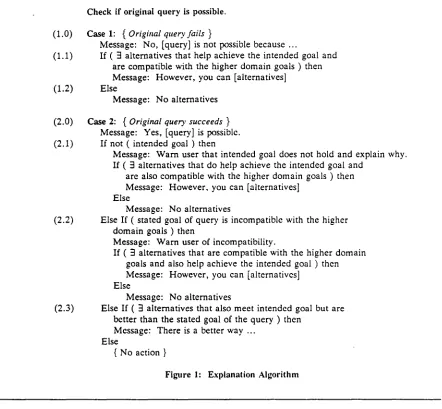
The algorithm begins by checking whether the user's query (e.g. "Can I enroll in CS 375?") is possible or not possible (refer to figure 1). If the query is not possible, the user is informed and the explanation includes the reasons for the failure (step 1.0 of algorithm). A l t e r n a - tive plans that are possible and help achieve the user's intended goal are searched for and presented to the user. But before presenting any alternative, the algo- rithm, to not mislead the user, ensures that the alterna- five is compatible with the higher d o m a i n goals of the user (step 1.1).
If the query is possible, control passes to step 2.0, where the next step is to d e t e r m i n e whether the stated goal does, as the user believes, help achieve the intended goal. G i v e n that the user presents a plan that he believes will accomplish his intended goals, the sys- tem must check i f the plan succeeds in its intentions (step 2.1 of algorithm). A s is shown in the algorithm, if the relationship does not hold or the plan is not execut- able, the user should be informed. H e r e it is possible to provide additional unrequested information necessary to achieve the goal (cf. A l l e n 1983).
In planning a response, the system should ensure that the current goals, as expressed in the user's queries, are compatible with the user's higher d o m a i n goals (step 2.2 in algorithm). F o r example, a plan that leads to the a t t a i n m e n t of one goal m a y cause the n o n - a t t a i n m e n t of another such as when a previously formed plan becomes invalid or a subgoal becomes impossible to achieve. A user m a y expect to be informed of such consequences, particularly if the goal that cannot now be attained is a goal the user values highly.
(1.0)
(1.1)
(1.2)
(2.0)
(2.1)
(2.2)
(2.3)
Check if original query is possible.
Case 1: { Original query fails }
Message: No, [query] is not possible because ...
If ( 3 alternatives that help achieve the intended goal and are compatible with the higher d o m a i n goals ) then Message: However, you can [alternatives]
Else
Message: N o alternatives
Case 2: { Original query succeeds } Message: Yes, [query] is possible. If not ( intended goal ) then
Message: W a r n user that intended goal does not hold and explain why. If ( 3 alternatives that do help achieve the intended goal and
are also compatible with the higher domain goals ) then Message: However, you can [alternatives]
Else
Message: No alternatives
Else If ( stated goal of query is incompatible with the higher d o m a i n goals ) then
Message: W a r n user of incompatibility.
If ( 3 alternatives that are compatible with the higher d o m a i n goals and also help achieve the intended goal ) then Message: However, you can [alternatives]
Else
Message: No alternatives
Else If ( 3 alternatives that also meet intended goal but are better than the stated goal of the query ) then
Message: There is a better way ... Else
{ No action }
Figure 1: Explanation Algorithm
4. A n E x a m p l e
Until now we have discussed a model for generating better, user-specific explanations. A test version of this model has been implemented in a student-advisor domain using Waterloo U N I X Prolog. Below we present an example to illustrate how the algorithm and the model of the user work together to produce these responses and to illustrate some of the details of the implementation.
Given a query by the user, the system determines whether the stated goal of the query is possible or not possible and whether the stated goal will help achieve the intended goal. In the hypothetical situation shown in figure 2, the stated goal of enrolling in CS572 is pos- sible and the intended goal of taking a numerical analysis course is satisfied 1. The system then considers
the background of the user (e.g. the courses taken), the background of the d o m a i n (e.g. what courses are offered) and a query from the user (e.g, "Can I enroll in CS572?"), and ensures that the goal of the query is com- patible with the attainment of the overall d o m a i n goal.
In this example, the user's stated goal of enrolling in a particular course is incompatible with the user's higher
[image:3.612.69.511.87.496.2]Scenario:
The user asks about enrolling in a 500 level course. Only a certain n u m b e r of 500 level courses can be credited towards a degree and the user has already taken that n u m b e r of 500 level courses.
Stated goal: Intended goal: Domain goal:
Enroll in the course.
T a k e a numerical analysis course. G e t a degree.
User:
Can I enroll in CS 572 (Linear A l g e b r a ) ?
System:
Yes, but it will not get you further towards your degree since you have already met your 500 level requirement. Some useful courses would be CS 673 (Linear P r o g r a m m i n g ) and CS 674 ( A p p r o x i m a t i o n ) .
Figure 2: Example from student advisor domain
d o m a i n goal of achieving a degree because several preconditions fail. T h a t is, given the b a c k g r o u n d of the user the goal of the query to enroll in CS572 will not help achieve the d o m a i n goal. Knowledge of the incom- patibility and the failed preconditions are used to form • the first sentence of the system's response.
To suggest better alternatives, the system goes into a planning stage. There is stored in the system a general plan for accomplishing the higher d o m a i n goal of the user. This plan is necessarily incomplete and is used by the system to track the user by instantiating the plan according to the user's particular case. The system con- siders alternative plans to achieve the user's intended goal that are compatible with the d o m a i n goal. For this particular example, the system discovers other courses the user can add that will help achieve the higher goal.
To actually generate better alternatives and to check whether the user's stated goal is compatible with the user's d o m a i n goal, a module of the i m p l e m e n t e d sys- tem is a H o r n clause theorem prover, built on top of Waterloo Unix Prolog, with the feature that it records a history of the deduction. The theorem prover generates possible alternative plans by performing deduction on the goal at the level of the user's query. T h a t is, the goal is "proven" given the "actions" (e.g. enroll in a course) and the "constraints" (e.g. prerequisites of the course were taken) of the domain. In the example of figure 2, the expert system has the following Horn
clauses in its knowledge base: course (cs673, numerical) course (cs674. numerical)
F i g u r e 3 shows a portion of the simplified d o m a i n plan for getting a degree. Consider the first clause of the counts_.for_credit predicate. This clause states that a course will count for credit if it is a 500 level course and fewer than two 500 level course have a l r e a d y been counted for credit (since in our hypothetical world, at most two 500 level courses can be counted for credit towards a degree). The second clause is similar. It states the conditions under which a a 600 level course can be counted for credit.
get_degree(Student, A c t i o n ) < -
receive_credit(Student, Course, A c t i o n ) ; g e t d e g r e e ( S t u d e n t , []);
receive credit (Student, Course, A c t i o n ) < - counts_for_credit (Student, Course), enrolled (Student, Course, credit, A c t i o n ) , d o w o r k (Student, Course),
passing_grade (Student, Course); receive_credit (Student, Course, A c t i o n ) < -
enrolled (Student, Course, credit, []),
enrolled (Student, Course, incomplete, A c t i o n ) , complete_work (Student, Course),
passing_grade (Student, Course);
counts_for_credit (Student, Course) < - is_500_level (Course).
500_level_taken (Student, N), It (N, 2); counts for credit (Student, Course) < -
is_600_level (Course).
600_level_taken (Student, N), It (N, 5);
Figure 3: Simplified domain plan for course domain.
the history of the deduction will show why. In this example, enrolling in CS673 is a valid step in a plan for achieving a degree.
Recall that the system will generate alternative plans even if the user's query is a valid plan in an attempt to find a better solution for the user. The (possibly) multi- ple alternative plans are then potential candidates for presenting to the user. These candidates are pruned by ranking them according to the heuristic of "which plan would get the user further towards his goals". Thus, the better alternatives are the ones that help satisfy multiple g o a l s or multiple subgoals 2. One way in which the sys- tem can reduce alternatives is to employ previously derived goals of the user such as those that indicate cer- tain preferences or interests. In the course domain, for instance, the user m a y prefer taking numerical analysis courses. For the example in figure 2, the suggested alternatives of CS673 and CS674 help towards the user's goal of getting a degree and the user's goal of taking numerical analysis courses and so are preferable 3.
5. Joshi Revisited
The discussion in the previous section showed how our model can recognize when a user's plan is incompa- tible with his domain goals and present better alternative plans that are user-specific. H e r e we present examples of how our model can generate the responses e n u m e r a t e d by Joshi. The examples further illustrate how the addition of the user's overall goals allows us to compare and select better alternatives to a user's plan.
Figure 4 shows two different responses to the same question: "Can I drop CS 577?" The student asking the question is doing poorly in the course and wishes to drop it to avoid failing it. The goals of the query are passed to the Prolog implementation and the response gen- erated depends on these goals, the information in the model of the user, and on external conditions such as deadlines for changing status in a course. For example purposes, the domain information is read in from a file (e.g. c o n s u l t ( e x a m p l e _ l ) ) . Figure 3 shows the clausal representation of the d o m a i n goals and plans used in this example (the representations for the goal of avoid- ing a failing m a r k are not shown but are similar).
2 Part of our purpose is to characterize domain independcnt criteria for "bettemess". Domain dependent knowledge could also be used to further reduce the alternatives displayed to the user. For example, in the course domain a rule of the form: "A mandatory, course is preferable to a non-mandatory course", may help eliminate presentation of certain options.
3 Note that in this example the user's intended goal also in- dicates a preference. Other user preferences may have been previously specificed: these would be used to influence the response in a similar faslfion.
%
% Can A r i a d n e drop CS 577? %
?consult(example_l);
? q u e r y ( c h a n g e s t a t u s ( a r i a d n e , 577, credit, nil), not fail(ariadne, 577, A c t i o n ) ) ;
Yes, c h a n g e _ s t a t u s ( a r i a d n e , 577, credit, nil) is possible. But, not fail(ariadne, 577, _461) is not achieved since...
is_failing(ariadne, 577) However, you can ...
change_status(ariadne, 577, credit, incomplete) This will also help towards receive_credit
%
% Can A n d r e w drop CS 577? %
?consult (exam pie...2);
q u e r y ( c h a n g e s t a t u s ( a n d r e w , 577, credit, nil), not_fail(andrew, 577, A c t i o n ) ) ;
Yes, c h a n g e s t a t u s ( a n d r e w , 577, credit, nil) is possible. But, there is a better way ...
change_status(andrew, 577, credit, incomplete) Because this will also help towards receive_credit
Figure 4: Sample responses
Example 1: In this example, the stated goal is possible, but it fails in its intention (dropping the course doesn't enable the student to avoid failing the course). This is case 2.1 of the algorithm. The system now looks for alternatives that will help achieve the student's intended goal and determines that two alternative plans are possi- ble: the student could either change to audit status or take an incomplete in the course. The plan to take an incomplete is presented to the user because it is con- sidered the best of the two alternatives; it will allow the student to still achieve another of his goals: receiving credit for the course.
6. Future Work and Conclusion
Future work should include incorporation of existing methods for inferring the user's goals from an utterance and also should include a component for mapping between the Horn clause representation used by the pro- gram and the English surface form.
An interesting next step would be to investigate com- bining the present work with methods for varying an explanation from an expert system according to the user's knowledge of the domain. In some domains it is desirable for an expert system to support explanations for users with widely diverse backgrounds. To provide this support an expert system should also tailor the con- tent of its explanations according to the user's knowledge of the domain. An expert system currently being developed for the diagnosis of a child's learning disabilities and the recommendation of a remedial pro- gram provides a good example (Jones and Poole 1985). Psychologists, administrators, teachers, and parents are all potential audiences for explanations. As well, members within each of these groups will have varying levels of expertise in educational diagnosis. Cohen and Jones (1986; see also van Beck and Cohen) suggest that the user model begin with default assumptions based on the user's group and be updated as information is exchanged in the dialogue. In formulating a response, the system determines the information relevant to answering the query and includes that portion of the information believed to be outside of the user's knowledge.
We have argued that, in generating explanations, we can and should consider the user's goals, plans for achieving goals, and preferences among these goals and plans. Our implementation has supported the claim that this approach is useful in an expert advice-giving environment where the user and the system work cooperatively towards common goals through the dialo- gue and the user's utterances may be viewed as actions in plans for achieving those goals. We believe the present work is a small but nevertheless worthwhile step towards better and user-specific explanations from expert systems.
7. Acknowledgements
This paper is based on thesis work done under the supervision of Robin Cohen, to whom I offer my thanks for her guidance and encouragement. Financial support is acknowledged from the Natural Sciences and Engineering .Research Council of Canada and the University of Waterloo.
8. References
Allen, J. F., 1983, "Recognizing Intentions from Natural Language Utterances," in Computational Models of Discourse, Ed. M. Brady and R. C. Berwick, Cambridge: MIT Press.
Carberry, S., 1983, 'Tracking User Goals in an Information-Seeking Environment," Proceedings of National Conference on Artificial Intelligence, Wash- ington, D.C.
Cohen, P. R. and Levesque, H. J., 1985, "Speech Acts and Rationality," Proceedings of ACL-85, Chicago, Ill.
Cohen, R. and Jones, M., 1986, "Incorporating User Models into Expert Systems for Educational Diag- nosis," Department of Computer Science Research Report CS-86-37, University of Waterloo, Waterloo, Ont.
Jones, M. and Poole, D., 1985, "An Expert System for Educational Diagnosis Based on Default Logic," Proceedings of the Fifth International Conference on Expert Systems. and Their Applications, Avignon, France.
Joshi, A., Webber, B., and Weischedel, R., 1984a, "Living up to Expectations: Computing Expert Responses," Proceedings of AAAI-84, Austin, Tex.
Joshi, A., Webber, B., and Weischedel, R., 1984b, "Preventing False Inferences," Proceedings of COLING-84, lOth International Conference on Compu- tational Linguistics, Stanford, Calif.
Litman, D. J. and Allen, J. F., 1984, "A Plan Recogni- tion Model for Subdialogue in Conversations," University of Rochester Technical Report 141, Rochester, N.Y.
McKeown, K. R., Wish, M., and Matthews K., 1985, "Tailoring Explanations for the User," Proceedings of IJCAI-85, Los Angeles, Calif.
Pollack, M. E., 1984. "Good Answers to Bad Questions: Goal Inference in Expert Advice-Giving," Proceed- ings of CSCSI-84, London, Ont.
Pollack, M. E., 1986, "A Model of Plan Inference that Distinguishes Between the Beliefs of Actors and Observers," Proceedings of ACL-86, New York, N.Y.
van Beck, P., 1986, "A Model for User-Specific Expla- nations from Expert Systems/' M. Math thesis, pub- lished as Department of Computer Science Research Report CS-86-42, University of Waterloo, Waterloo, Ont.