Kinetics of CO Oxidation over Pt-Modi
fi
ed CuO Nanocatalysts
Luu C. Loc
1,+, Nguyen Tri
2, Hoang T. Cuong
1and Ha C. Anh
2 1Institute of Chemical Technology, Vietnam Academy of Science and Technology,01 Mac Dinh Chi Str., Ho Chi Minh City, 70100 Vietnam
2Ho Chi Minh City University of Technology, Vietnam National University - Ho Chi Minh City,
268 Ly Thuong Kiet Str., Ho Chi Minh City, 70100 Vietnam
Three Pt-CuO nanocatalysts PtCu/Al, PtCu/CeAl and PtCu/Ce have been successfully prepared. The characterization of the catalysts was examined by X-ray powder diffraction (XRD), transmission electron microscopy (TEM), X-ray energy dispersive analysis (EDS), temperature-programmed reduction (TPR), nitrogen physisorption measurements, and IR-CO adsorption. The kinetics of CO oxidation using these catalysts was studied in a gradientlessflow-circulating system at 398498 K. The obtained kinetic equation confirmed that the reaction proceeds in medium surface coverage with the participation of CO molecules and oxygen atoms. [doi:10.2320/matertrans.MA201545]
(Received January 30, 2015; Accepted May 29, 2015; Published August 25, 2015)
Keywords: carbon monoxide oxidation, kinetics, platinum-modified copper oxide nanocatalysts
1. Introduction
The advantage of low-temperature oxidation is to reduce fuel consumption for conversion of large volume of polluted air. Metal oxides and multioxide owning high activity and thermal stability are considered as alternative catalyst for the existing expensive noble metals. In fact, promising results were obtained by adding a small amount of noble metals to metal oxide catalysts. Particularly, the highest activity
in oxidation of CuO/CeO2 catalysts modified with Pt is
rationalized by the strong link between the Pt with CuO/
CeO2.1)The synergic effects between metal oxides and noble
metals results in the increase of reducibility, which may enhance the oxygen transfer from the metallic oxides to the noble metals.2)
Research on kinetics of oxidation of single CO on noble
metal and oxide catalysts have intensively studied.311)
Among various forms of suggested kinetic equations for the oxidation of CO, power-law kinetic expressions were
repeatedly proposed. Indeed,first-order of oxygen and
zero-order of CO concentrations for CO oxidation on bulk copper
oxide were reported by Garner et al.3) In contract, over a
silica-supported copper oxide catalyst,first-order of CO and
zero-order of oxygen concentrations were observed and
Eley-Rideal mechanism was proposed.4)In addition, a power-law
rate equation was found to satisfactorilyfit the experimental
data of carbon monoxide oxidation with CO at partial pressure ranging from 0.0015 to 0.0125 atm over CuO
supported on nanosized CeO2.5)Kinetics of CO oxidation in
the CO-PROX process (H2-rich gases) has been investigated
in afixed-bed reactor by Caputoet al.6)and a power-law rate
equation was found. On the basis of Langmuir-Hinshelwood mechanism, the following expression for the reaction rate of
CO oxidation on CuO/£-Al2O3 was proposed by Vannice
et al.:7)
r¼k KCOPCO
ffiffiffiffiffiffiffiffiffiffiffiffiffiffiffi
KO2PO2 p
ð1þKCOPCOþ ffiffiffiffiffiffiffiffiffiffiffiffiffiffiffiKO2PO2 p
Þ2 ð1Þ
wherePCO,PO2 are the partial pressures of CO and O2;KCO
and KO2-adsorption coefficients for CO and O species,
respectively. However, order of O2pressure was found to be
near zero and the equation became power-law kinetic expressions:7)
r¼kðKCOPCOÞ0:7 ð2Þ
In our previous publications,8,9) oxide catalysts 10 mass%
CuO/£-Al2O3 (Cu/Al), 10 mass% CuO/20 mass% CeO2+
£-Al2O3 (Cu/CeAl) have been reported to be the most
active and stable catalysts in the complete oxidation of CO. Furthermore, high active catalysts at low temperature reaction
was obtained when Pt of 0.1 mass% was introduced to CuO
catalysts.10) The kinetics of deep oxidation of CO8) and
p-xylene and its mixtures with CO9) over Cu/Al and Cu/
CeAl have been investigated at the temperature range of 473 543 K. The following rate equations were achieved for deep
oxidation of sole CO:8)
rCO¼ kCOPCOP 0:5
O2
ð1þk1PO0:25þk3PCO2Þ
ð3Þ
and p-xylene:9)
rxyl¼
kxylPxylPO0:25
ðP0:5
O2 þk3PCO2þk4Pxylþk5PH2OÞ
ð4Þ
It has been revealed that a complicated mutual effect associated with the formation of new intermediates takes
place in the simultaneous oxidation of CO and p-xylene to
change the reaction kinetics. The following rate equations
were obtained for deep oxidation of CO andp-xylene in their
mixture on the Cu/CeAl catalyst:9)
ri ¼ k
iPiPO0:25
ð1þk1PO0:25þk2PCOþk3PCO2þk4Pxylþk5PH2OÞ
ki PCOPxyl
ð1þk2PCOÞð1þk6PCOPxylÞ ð5Þ
where ri* reaction rate of CO or p-xylene oxidation in
their mixture; ki*,ki** constants; Pi partial pressure of i
components;i-CO orp-xylene.
The aim of this study is to establish the kinetics of CO
oxidation using Pt-modified CuO catalysts.
+Corresponding author, E-mail: lcloc@ict.vast.vn
Special Issue on Nanostructured Functional Materials and Their Applications
2. Experimental Procedure
Two catalysts: 0.1 mass% Pt+10 mass% CuO/£-Al2O3
(PtCu/Al) and 0.1 mass% Pt+10 mass% CuO/(20 mass%
CeO2+69.9 mass% £-Al2O3) (PtCu/CeAl) have been
pre-pared by sequential impregnations as described in our
previous works.10,12) Catalyst 0.1 mass% Pt+7.5 mass%
CuO/CeO2 (PtCu/Ce) was prepared by the urea nitrates
combustion method described by H. Matralis et al.11)
with molar ratios of urea/nitrate=4.17. Ce(NO3)3·6H2O,
Cu(NO3)2·3H2O, H2PtCl6·6H2O complex, urea (CO(NH2)2)
and £-Al2O3 were purchased from Merck. All of the
precursors were used without further purification. The IR
spectra were recorded from apparatus NicoletSpectrometer
460 in the range of 4000400 cm¹1 with a resolution of
4 cm¹1. The catalyst samples were pretreated in a pure
oxygen flow of velocity 5 L/h for 1 h at 873 K for metal
oxide catalyst and at 573 K for Pt containing sample. The
kinetics of CO oxidation was studied in a gradientless fl
ow-circulating system at 398498 K. Ranges of initial partial
pressures of CO, O2 and CO2 were 2.520, 35140 and 0
25(hPa), respectively. The follow gas have been used: O2
(99.999%); N2(99.999%); Air (21 mol%O2+79 mol%N2);
mixture CO (6 mol%)+N2 (94 mol%); and mixture CO2
(6 mol%)+N2(94 mol%).
3. Results and Discussions
3.1 Physico-chemical characteristics and activity of the obtained catalysts
Physico-chemical characteristics of catalysts were
previ-ously reported.12) Briefly, from XRD pattern of catalysts
(Fig. 1), alumina exists in an amorphous state, cerium oxide
exists in crystalline state of cubic fluorite structured CeO2
(2ª=28.6°, 33°, 47.4°, 56.3°, 59°, 69.4°, 76.7° and 79°).13)
The significantly weak intensity CeO2 peaks in PtCu/CeAl
catalyst indicated that the interaction of CeO2 with Al2O3
resulted in cerium oxide to be crystallized in small
agglomerate. The XRD patterns of PtCu/CeAl and PtCu/
Ce showed very weak CuO reflections. This can be explained
by the existing of copper oxide phase in a highly divided or amorphous state on the surface of ceria or the formation of
solid solution.11) At the same time on PtCu/Al catalyst,
copper oxide exits in a state of good crystalline. In all samples the characteristic peaks of Pt with low intensity were observed. From Table 1 and TEM image (Fig. 2), platinum
exists infine dispersed state with particle size of 13 nm. The
EDS image of PtCu/Ce catalyst (Fig. 3(a)) show that Cu and
Cr are fairly evenly distributed on the surface of CeO2. On
the surface of PtCu/CeAl catalyst (Fig. 3(b)), the different
regions of metal particles distribution can be observed; Pt and
Cu are concentrated more on CeO2 than on £-Al2O3. TPR
diagram on all CuO-based catalysts modified by Pt, showed
only the peak of CuO reduction while the characteristic peak of Pt did not appear, probably due to its very low
concentration.12)Thus, in comparison with non-Pt modified
catalysts8)the addition of Pt did not change the character in
XRD pattern of the sample Cu/Al. Instead, it enhanced the
reducibility of catalysts by decreasing reduction temperature
and increasing reduction extent KRed (Table 1), further
enhancing the activity of catalysts. When 0.1 mass% of Pt
was introduced to the Cu/Al catalyst, the temperature for
50%-conversion of CO reduced from 498 K to 438 K, and the
temperature for 100%-conversion of CO reduced from 573 K
to 548 K. Similarly, the PtCu/CeAl catalyst was capable of
converting 50% CO at 362 K and 100% CO even at 383 K
(15 K lower than that for Cu/CeAl catalyst).
It has been shown in Table 1, compare to PtCu/Al
catalyst, the CeO2-contained catalysts (PtCu/CeAl and
PtCu/Ce) offered much higher activity in CO oxidation,
the temperature for 50%-conversion of CO was as low as
358462 K (80 K lower than that of the catalysts without
CeO2). The results might come from the fact that in catalysts
containing CeO2the copper oxide exists in a highly divided
or amorphous state.
3.2 Kinetics of CO oxidation over the obtained catalysts
The Arrhenius plot of CO oxidation rate (rCO), logrCO
versus 1/Tis nonlinear, showing that the reaction rate obeyed
a fractional rational equation rather than a power law one (Fig. 4). The dependence of reaction rate upon CO partial pressure for all the catalysts was nearly linear (Fig. 5).
[image:2.595.314.540.66.300.2]Fig. 1 XRD patterns of catalysts: (1) PtCu/Al; (2) PtCu/CeAl; (3) PtCu/ Ce (Pt-Pt; Cu-CuO; Al-Al2O3; CuAl-CuAl2O4; Ce-CeO2).
Table 1 The values of surface specific area (SBET), crystal size of CeO2 at 2ª=28.6° (dCeO2) and CuO at 2ª=35° (dCuO), particle size of Pt determined from TEM imagine (dPt), maximum reduction temperature (Tmax), reduction extent (KRed) and temperatures for 50%conversion of CO (T50) of the catalysts.
Catalysts SBET, m2/g
dCeO2, nm
dCuO, nm
dPt, nm
Tmax, K
Kred,
%
T50, K
PtCu/Al 95.9 ® 18.8 13 547, 673 36.7 438
PtCu/Ce 14.8 11.8 n.d 13 457, 487,
818, 960 32.2 358
PtCu/CeAl 80.1 7.1 n.d ¯1 528 45.8 362
[image:2.595.304.550.401.480.2]Therefore, it is conclusive that CO pressure appears in the
numerator of kinetic equation infirst power. The convex form
of dependence of reaction rate versus O2 partial pressure in
Fig. 6 indicates that oxygen concentration appeared in both the numerator and denominator of kinetic equation. The
concave shape of the conversion curves, rCO versus CO
conversion (XCO), revealed that the reaction was inhibited by
at least one of the products.14)The dependence of 1/rCO vs
PCO2 is linear (Fig. 7), meaning that PCO2 appeared in the
denominator of kinetic equation in power of unit. Thus, the reaction rate in general form should be described by the following equation:
rCO¼ kCOP
n1
COPOn22
ð1þk1POm12 þk2P m2
COþk3Pm3CO2Þ2¡
ð6Þ
Where: kCO, k1, k2, k3 - constants of kinetic equation; 2¡
-surface coverage;PCO,PO2,PCO2- partial pressures of CO, O2
and CO2, respectively. The optimal coincidence between
experimental and calculated results has been observed
when n1=m2=m3=1; n2=m1=0.5; ¡=0.5, k2=0
and reaction rate is described in form of eq. (3).
The values of the kinetic constants of eq. (3) were given in Table 2. The error of the calculation of the reaction rates
via eq. (3) was 1922%. Results in Table 2 showed that the
remarkable higher value of kCO was obtained on CeO2
-contained catalysts referring to high catalytic activity.
In comparison with non-Pt modified catalysts,8) the
addition of Pt does not change the form of kinetic equation and expression (3) is the common equation for CO oxidation
(a)
(b)
(c)
Fig. 2 TEM images of the catalysts: (a) PtCu/Al; (b) PtCu/CeAl; (c) PtCu/Ce.
Fig. 4 The Arrhenius plot of CO oxidation rate, logrCOversus 1/T, over the catalysts: (1) PtCu/Al; (2) PtCu/CeAl and (3) PtCu/Ce atXCO=0.4;
PCO=3 hPa;PO2¼104hPa;PCO2¼2hPa. (a)
(b)
[image:3.595.69.267.67.527.2] [image:3.595.314.542.70.394.2] [image:3.595.317.536.454.587.2]on CuO-based catalysts under tested conditions. However, it
reduced activation energy of the reaction (reflected in the
decrease of the value of ECO), subsequently increased the
activity of Pt containing catalysts and lowered the
temper-ature region of reaction. Moreover, on the Pt-modified
catalysts, value oxygen adsorption constants (k2) is much
lower than that of non-modified catalyst,8) indicating the
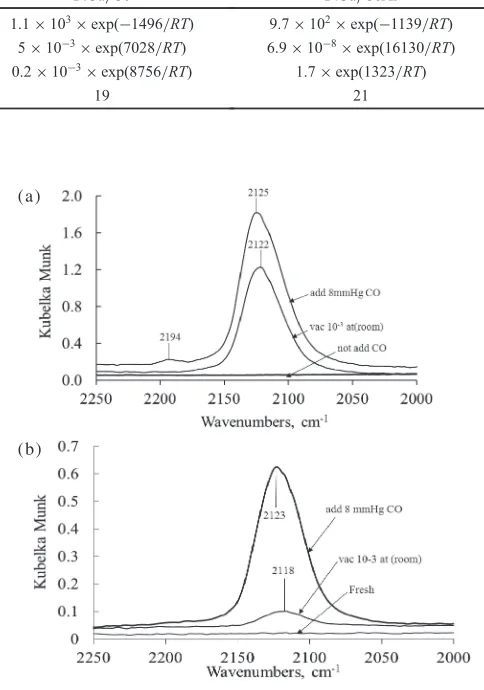
relatively strong adsorption of CO. It is likely that the presence of Pt make oxidation degree of copper becomes lower. Indeed, IR spectra of CO-adsorption showed
charac-teristic bands Cu+CO on PtCu/Al sample slightly shifted to
the shorter wavenumber region as seen on the Cu/Al sample
(2123 cm¹1 compared to 2125 cm¹1) (Fig. 8). It has been
demonstrated that shifts in CO band frequencies have often
been related to the change in exposed Cu surface planes.15)
4. Conclusion
Kinetic studies of CO oxidation over three Pt-modified
CuO nanocatalysts were performed. The experimental results provided that characteristics of the carriers and Pt additive affected the properties, activity, and adsorption capacity of catalysts. However, form of the kinetic equation was kept intact. On these catalysts the reaction proceeds in the average coverage with participation of CO molecules and oxygen
Fig. 5 Rate of CO oxidation (rCO) versus the partial pressure of CO (PCO) over the catalysts: (1) PtCu/Al; (2) PtCu/CeAl and (3) PtCu/Ce at
T=448 K;XCO=0.4;PO2¼104hPa;PCO2¼2hPa.
Fig. 6 Rate of CO oxidation (rCO) versus the partial pressure of O2(PO2) for catalysts: (1) PtCu/Al; (2) PtCu/Ce; and (3) PtCu/CeAl atT=448 K;
XCO=0.4;PCO=3 Pa;PCO2¼2hPa.
[image:4.595.47.546.85.149.2]Fig. 7 The dependence of reversed values of reaction rate (1/rCO) on partial pressure of CO2(PCO2) for catalysts: (1) PtCu/Al; (2) PtCu/Ce; and (3) PtCu/CeAl at T=448 K; XCO=0.4; PCO=3 hPa; PO2¼ 104hPa.
Table 2 The values of the kinetic constants in the eq. (3).
Catalysts PtCu/Al PtCu/Ce PtCu/CeAl
kCO, mol·g¹1·h¹1·hPa¹1.5 4.2©exp(¹1421/RT) 1.1©103©exp(¹1496/RT) 9.7©102©exp(¹1139/RT)
k1, hPa¹0.5 10¹7©exp(13846/RT) 5©10¹3©exp(7028/RT) 6.9©10¹8©exp(16130/RT)
k3, hPa¹1 2©10¹16©exp(30302/RT) 0.2©10¹3©exp(8756/RT) 1.7©exp(1323/RT)
Variance,% 22 19 21
R=1.987 cal.mol¹1.K¹1; k
i=k0i©exp(¹Ei/RT); Ei(cal.mol¹1)
(a)
(b)
[image:4.595.305.547.95.440.2] [image:4.595.62.279.181.335.2] [image:4.595.63.279.404.543.2] [image:4.595.61.277.612.739.2]atoms. Furthermore, CeO2 depressed the formation of
massive CuO leading to the increase in catalyst reduction
and reaction rate. Addition of 0.1 mass% Pt decreased the
activation energy of the reaction and increased CO adsorption, leading increased the activity of CuO-based catalysts.
Acknowledgments
This work was supported by the Vietnam National Foundation for Science and Technology Development (NAFOSTED) under grand No. 104.03-2012.60.
REFERENCES
1) C. R. Jung, A. Kundu, S. W. Nam and H.-I. Lee:Appl. Catal. A331
(2007) 112120.
2) M. Ferrandon: Ph.D. Dissertation, Royal Institute of Technology, Stockholm, (2001).
3) W. E. Garner, F. S. Stone and P. F. Tiley:Proc. R. Soc. A221(1952) 472489.
4) R. A. Prokopowicz, P. L. Silveston, R. R. Hudgins and D. E. Irish: React. Kinet. Catal. Lett.37(1988) 6370.
5) J. L. Ayastuy, A. Gurbani, M. P. González-Marcos and M. A. Gutiérrez-Ortiz:Ind. Eng. Chem. Res.48(2009) 56335641.
6) T. Caputo, L. Lisi, R. Pirone and G. Russo:Ind. Eng. Chem. Res.46
(2007) 67936800.
7) K. I. Choi and M. A. Vannice:J. Catal.131(1991) 2235.
8) L. C. Loc, H. T. Cuong, N. Tri and H. S. Thoang:J. Exper. Nanosci.6
(2011) 631640.
9) L. C. Loc, N. Tri, H. T. Cuong, H. S. Thoang, Y. A. Agafonov, N. A. Gaidai, N. V. Nekrasov and A. L. Lapidus:Kinet. Catal.55(2014) 611 619.
10) L. C. Loc, D. T. T. Mai, N. Tri, H. T. Cuong, B. T. Huong and H. S. Thoang: J. Chem.48(2010) 8489 (in Vietnamese).
11) G. Avgouropoulos, T. Ioannides and H. Matralis:App. Catal. B: Env.
56(2005) 8793.
12) L. C. Loc, N. Tri, H. T. Cuong, H. M. Nam and H. C. Anh:Adv. Nat. Sci.: Nanosci. Nanotechnol. 6 (2015) doi:10.1088/2043-6262/6/1/ 015011.
13) H. I. Chen and H. Y. Chang:Solid State Commun.133(2005) 593 598.
14) S. G. Bashkirova and S. L. Kiperman: Kinet. i Katal.11(1970) 631 637 (in Russian).