Basic Deformation Mechanism of Bcc Titanium-Based Alloy of Gum Metal
Yasushi Kamimura
1,*, Satoru Katakura
1, Keiichi Edagawa
1, Shin Takeuchi
2, Shigeru Kuramoto
3and Tadahiko Furuta
41Institute of Industrial Science, The University of Tokyo, Tokyo 153–8505, Japan 2Tokyo University of Science, Tokyo 162–8601, Japan
3Ibaraki University, Hitachi 316–8511, Japan
4Toyota Central R & D Laboratory, Nagakute 480–1192, Japan
Single crystals and cold-swaged polycrystalline specimens of Gum Metal of Ti-36Nb-2Ta-3Zr-0.3O (mass %) have been compressed with the stress-relaxation test in the temperature range from 77 K to 450 K. In both single crystals and cold-swaged specimens, the yield stress de-creases with increasing temperature rapidly to the room temperature and then gently above it forming a plateau at high temperature. The activa-tion analysis of plastic deformaactiva-tion showed that the applied shear stress dependence of activaactiva-tion enthalpy and that of activaactiva-tion volume for single crystals and those for cold swaged specimens are almost identical if we shift the stress scale by about 120 MPa, meaning that the basic deformation mechanism is common to both samples. The above results are contradictory with the previously proposed non-dislocation defor-mation mechanism at the ideal shear strength, but consistent with the established features of usual bcc alloys, i.e., the defordefor-mation is governed by the Peierls mechanism at low temperature and by defect hardening at high temperature. τχ − χ and ψ − χ relations of single crystals showed a typical slip asymmetry seen in bcc metals, where slip in Gum Metal belongs to the {112} slip type as in binary Ti-Nb single crystals reported previously (S. Hanada et al.: Metall. Trans. A 16 (1985) 789). Yielding by massive {332}〈113〉 twin formation in single crystals at low tempera-tures was observed for the first time in Gum Metal. [doi:10.2320/matertrans.M2016191]
(Received May 25, 2016; Accepted June 28, 2016; Published July 29, 2016)
Keywords: titanium-niobium based bcc alloy, Gum metal, deformation mechanism, Peierls mechanism, slip asymmetry, solid solution harden-ing
1. Introduction
In 2003, Saito et al. reported new bcc Ti-based alloy which possesses multi-functional properties of ultra-high strength, high deformability, low elastic modulus, as well as Invar and Elinbar behavior after severe plastic deformation1). The alloy was named as Gum Metal for its large elastic strain due to very low elastic modulus and very high yield strength; in-situ XRD and EBSP analyses showed that the large elastic defor-mation was not accompanied by phase transfordefor-mation nor twin formation2). The alloy was designed so that the valence electron number is 4.24, a bond order value of 2.87 and d electron-orbital energy level of 2.45, although Talling et al. reported that those parameters alone are not sufficient to de-fine Gum Metal3). In recent years, Gum Metal attracted con-siderable interest as bio-medical applications due to its excel-lent mechanical properties and highly biocompatible charac-teristics4–6).
The most striking feature of Gum Metal is that the defor-mation mechanism has been interpreted to be not the disloca-tion glide process but a dislocadisloca-tion-free shear process at the ideal shear strength, forming special defects called giant faults7) or nanodisturbances8). Bobylev et al. suggested a mechanism of nanograin formation due to giant fault defor-mation in Gum Metal9). The dislocation-free deformation is considered to realize under the conditions: (1) ideal shear strength is quite low due to the low elastic modulus which occurs as a phonon softening near the phase boundary of β– and α–phases10), (2) due to the presence of high concentration of interstitial oxygen atoms also of deformation produced nanometer sized ω-phase particles11), the dislocation glide stress becomes higher than the ideal shear strength and (3)
due also to the presence of high concentration of oxygen, stress-induced martensitic transformation from β to α is sup-pressed12–14). Nucleation and evolution of nanodisturances in Gum Metal is theoretically proposed15). Bobylev et al. sug-gested that the non-planar splitting of screw dislocations in Gum Metal lowers the mobility of the dislocation16). Mean-while, Chrzan et al. predicted the large spreading of disloca-tion core of screw dislocadisloca-tion in elastically anisotropic bcc crystal of Gum Metal17).
In-situ compression experiment of nanopillars of cold-swaged Gum Metal showed no significant dislocation activi-ty, though stress–induced β to α martensitic transformation was sometimes observed18). Liu et al. showed by in-situ X-ray scattering technique the specific deformation mecha-nism of two kinds of deformation induced spatially confined martensitic transformation, β → α and β → δ, in a Gum Met-al19). In contrast, in-situ deformation experiments for an-nealed Gum Metal samples, dislocation slip activity with low mobility of screws was reported14,20,21). Thus, it seem that at least the initial stage of deformation of annealed Gum Metal occurs via dislocation glide process.
In order to clarify the deformation mechanism of any crys-tal, it is quite important to perform the activation analysis based on the temperature and strain-rate dependences of the plastic deformation. If the slip deformation occurs by the ide-al shear process at the ideide-al shear strength, the deformation process is in principle athermal, and the temperature depen-dence of the yield stress should be as weak as that of the shear modulus. Surprisingly, however, no activation analysis has ever been made, until the present authors performed the de-tailed experiments for single crystals and also for cold swaged-polycrystalline sample of Gum Metal. The results showed that deformation process of Gum Metal is quite con-sistent with those for transition bcc metal alloys so far report-*
ed. In the present paper, detailed results and discussions are presented, though preliminary results have already been re-ported in Ref. 22).
2. Experimental Procedures
2.1 Deformation experiments
The alloy composition of Gum Metal used was Ti- 36(23)Nb-2(0.6)Ta-3(2)Zr-0.3(1.2)O (mass % (mol %)). Sin-gle crystals were grown by the floating zone method in an Ar atmosphere from polycrystalline rods of the mother alloy pro-duced by powder metallurgy23). Compression specimens with a size typically of 1 × 1 × 2 mm3 were cut from single crystals which had been solution-treated followed by water-quenched. Three kinds of orientations of compression axis were chosen so that the maximum shear stress acts close to {112}T〈111〉, {112}AT〈111〉 or {110}〈111〉 system, where subscripts T and AT mean that the shear direction on {112} plane is in the twin-ning direction and the anti-twintwin-ning direction, respectively. These three single crystals will be denoted as S1, S2 and S3, respectively. Compression experiments for 90% cold-swaged specimens were also performed. From a cold-swaged poly-crystalline rod of 4 mm diameter, compression specimens with a similar size as single crystal specimens were cut out. After polishing the surfaces, the specimens were compressed at a strain rate of 4 × 10⁻⁴ s−1 and at temperatures between 77 K and 450 K in a cryostat or in an electric furnace.
Since the work hardening rate of Gum Metal is small, it is convenient to perform temperature change test to obtain tem-perature dependence of the yield stress, i.e., the difference of the yield stresses at two temperatures before and after the temperature change was estimated from the difference of the flow stress before the temperature change and that after the temperature change. In most of the temperature change tests, we started with the room temperature test and finished also with the room temperature test, and the difference of the ini-tial and final yield stresses was used to correct the data in between them by an interpolation procedure. The small work hardening rate is also convenient to evaluate the strain-rate sensitivity of the initial flow stress from the stress relaxation curve obtained by stopping the crosshead.
After deformation, surface deformation markings on single crystals were observed by optical microscopy and SEM. Transmission electron microscopy observation was also made for some deformed single crystals after mechanical thinning followed by ion-milling, but the deformation structures ob-served were essentially the same as those previously reported in literature without providing us with any new information, and hence we do not describe the results in this paper.
2.2 Thermal activation analysis
The thermally activated deformation rate is written by an Arrhenius rate equation (see, e.g. Ref. 24)):
˙
ε=ε˙0exp −k∆H
BT . (1)
Here, ΔH is the activation enthalpy as a function of the effec-tive stress acting on the thermal activation sites determining the deformation rate and kBT has the usual meaning. The pre-exponential factor ε˙0 contains the density of thermal
acti-vation sites, the frequency factor for the thermal actiacti-vation event and the strain produced by an activation event. The pre-exponential factor can be functions of the stress, strain and temperature, but compared with the large effect of the change of the exponent as functions of effective stress and temperature on the deformation rate, the change of pre-expo-nential factor may be neglected. Usually, the activation anal-ysis is performed on the assumption of the constant pre-expo-nential factor, and then using the obtained results, the con-stancy of the exponent ΔH/(kBT) values at different tempera-tures is checked to rationalize the assumption. The activation volume is obtained by the equation
v∗(τ)=− ∂∆H
∂τ T =kBT ∂τ ∂ln ˙γ
−1
T
(2)
the activation enthalpy by
∆H(τ)=− ∂ln ˙γ ∂(1/(kBT)) τ
=kBT2 ∂ln ˙γ
∂T τ
=−kBT2 ∂τ
∂T γ˙ ∂τ ∂ln ˙γ
−1
T .
(3)
Here, τ is the resolved shear stress and γ˙ is the shear strain rate. To make accurate analysis for the temperature dence, we have to take into account the temperature depen-dence of the modulus; however, we neglected this correction because the present alloy possesses quite small temperature coefficient of the modulus as mentioned below.
2.3 Mechanical spectroscopy measurement
In order to clarify the temperature dependence of the Young s modulus of the swaged polycrystalline samples and to clarify the state of the interstitial oxygen atoms, we have performed mechanical spectroscopy measurement over a wide temperature range. The cold-swaged polycrystalline rod was cut into a strip with thickness of 0.46 mm, width of 2.6 mm and length of 30 mm. Mechanical spectroscopy mea-surement was made with the cantilever (16 mm) mode at three frequencies, 0.31 Hz, 1.00 Hz and 3.16 Hz, with a strain amplitude of 5 × 10⁻⁴ at temperatures between 133 K and 573 K at a heating rate of 2 K/min by use of Rheological Solid Analyzer (RSA-G2) of TA Instruments, Inc.
3. Results
3.1 Temperature dependence of the yield stress and that of the strain rate sensitivity
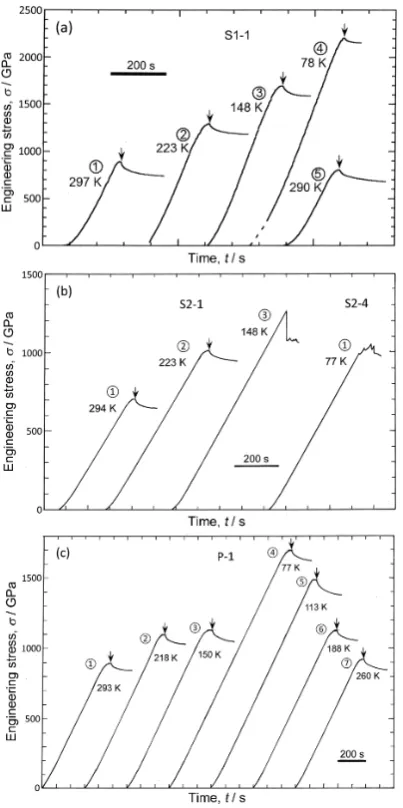
Figure 1 (a), (b) and (c) show examples of temperature change tests for single crystals and cold-swaged polycrystal-line specimen, where the yielding curve at each temperature is followed by a stress relaxation curve. Every stress relax-ation curve could well be fitted by an exponential decay from which we could estimate the strain rate sensitivity value ∂σ/∂lnε˙ . As seen in the figure, yielding curves of S2 speci-men at low temperatures (S2-1③ and S2-4①) are not smooth but serrated, which is due to twin formation, as discussed lat-er. The same was true for S3 single crystal specimens. In Fig. 2 are plotted temperature dependence of the yield stress-es for three single crystals, S1, S2 and S3, and for cold-swaged polycrystalline sample by different colors, and for
[image:2.595.307.549.220.326.2]different specimens of the same sample by different marks. Orientations of compressive axis of single crystals are given in the inset stereograph, where the primary slip direction is the common [111] direction. We should note that the tem-perature dependence of cold-swaged polycrystalline sample is considerably different for different specimens plotted by different marks. This is because the structure of the cold-swaged rod sample was not homogeneous particularly in the radial direction of the rod, while the compression specimens were taken at different distances from the center of the swaged rod. The strain rate sensitivity values for the four kinds of samples are also plotted by the same symbols in the lower part of Fig. 1 with an enlarged vertical scale.
The common features of the temperature dependence of the yield stress by smooth yielding curve for different sam-ples are that the yield stress decreases rapidly with increasing temperature up to the room temperature but then it decreases gently above the room temperature tending to leveling-off. The plots with downward arrows in Fig. 2 assigned as TWIN indicate the maximum stress of serrated yielding in S2 and S3
samples, where the length of the arrows show the amount of stress drop at the first serration. In specimens which had ex-perienced pre-deformation by slip at higher temperatures in the temperature change test, the first serration stress was higher and the amount of stress drop was larger. The strain-rate sensitivity value gradually increases with decreasing temperature towards a maximum at low temperature around 100 K.
3.2 Deformation markings on specimen surfaces
Typical deformation markings produced on the surfaces of single crystals accompanying smooth yielding are shown in Fig. 3. In S1 and S2 specimens, the slip markings are mostly parallel to the maximum shear stress planes of (¯211)T and
(¯1¯12)AT, respectively. Meanwhile, the slip markings of S3 Fig. 1 Yielding curve followed by stress-relaxation curve in temperature
change test for (a) a single crystal of S1 orientation, (b) two single crystals of S2 orientation and (c) a cold-swaged polycrystalline specimen. Encir-cled numbers show the sequence of temperature change test. Arrows indi-cate the positions at which cross-head was stopped.
Fig. 2 Temperature dependence of the yield stress for four kinds of sam-ples, S1, S2, S3 single crystals and cold-swaged polycrystalline speci-mens plotted by different colors. Plots of the same color and the same mark are for the same specimen subjected to temperature change test. In the lower part are plotted strain-rate sensitivity values for each sample by the same symbol as those for yield stress.
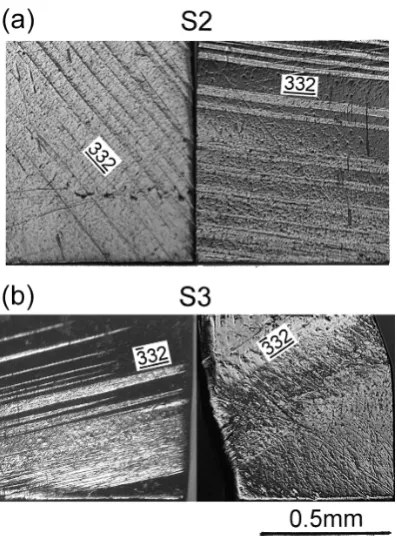
[image:3.595.325.529.63.300.2] [image:3.595.69.271.68.473.2] [image:3.595.314.541.393.521.2]specimen are not straight but considerably wavy and the aver-age slip plane is in between (¯101) and (¯211)T planes; the aver-age slip plane deviates about 20 degrees towards (¯211)T from the maximum shear stress plane and is approximately indexed as (¯523). The deformation markings after the serrated yield-ing at 77 K for S2 and S3 syield-ingle crystals taken from two or-thogonal side surfaces are given in Fig. 4. Crystallographic analysis of those deformation bands and the shape change of S3 single crystal are consistent with that those shear bands are {332}〈113〉 twins. The {332}〈113〉 twins have been widely observed to occur in β-phase TiNb binary alloys with the Nb concentration between 36 to 44 mass% Nb25). This type of twinning is accompanied by shuffling of one half of atoms, and the theoretical twinning shear strain is 0.3526). From the shape change of a thick deformation band in Fig. 4 (b), the shear strain is estimated to be about 0.29, which seems to be consistent with the theoretical value considering the assump-tion of the homogeneous twining inside the band for the esti-mation. Twin deformation is anisotropic for shear directions. For compression axis near 〈111〉, the Schmid factor for {332}〈113〉T is quite small, and hence in S1 specimen no twin was observed even at 77 K., as already confirmed by Hanada et al. for binary Ti-Nb alloys25).
3.3 CRSS-T relations
Based on the observed slip systems, temperature depen-dence of the critical resolved shear stress (CRSS) for each slip in three single crystals S1, S2 and S3 are plotted in Fig. 5 together with the critical shear stress for twinning formation at 77 K in S2 and S3 single crystals. For the activation analy-sis, we need to estimate the resolved shear stress for deforma-tion of polycrystalline samples. Since the severely cold-swaged polycrystalline Gum Metal possesses very strong
〈110〉 fiber texture along the rod direction or the compression axis, we used the Schmid factor of 0.471 for {¯211}T 111 slip for 〈110〉 compression. The temperature dependence of CRSS for polycrystalline sample is also given in Fig. 5.
3.4 Activation analysis
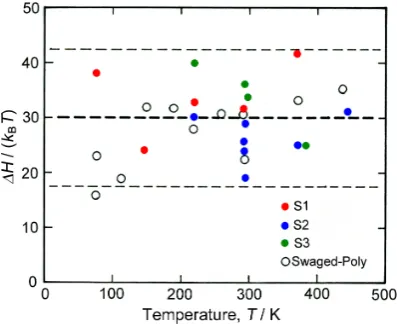
Based on the strain rate sensitivity values in Fig. 2 and the temperature dependence of CRSS in Fig. 5, we have calculat-ed the activation volume by eq. (2) and activation enthalpy by eq. (3). These two values are plotted in Fig. 6 as a function of the applied shear stress. To check the validity of the activation analysis on the assumption of the constant pre-exponential factor, exponent value at each temperature was calculated by using the relation ΔH/(kBT) = −(v∗/kB)(∂τ/∂T). The obtained exponent values are plotted in Fig. 7. Though the data are largely scattered due to the uncertainty of the determination of (∂τ/∂T) value from the limited number of the data, and to the uncertainty of determination of (∂τ/∂γ˙ ) value from the relaxation curve, the exponent values distribute around 30, which is the typical value reported for bcc transition metal single crystals24).
Both the activation enthalpy and activation volume are small at high stress and increases gradually with decreasing stress and then rapidly towards infinity asymptotically. Due to the scatter of the data, no clear distinction can be made among single crystals with different orientations, but there is obvious difference of asymptotic stresses between single crystals and cold-swaged polycrystalline samples. Asymptotic shear stress for single crystals is around 250 MPa, while that of swaged polycrystalline specimens is around 370 MPa, about 120 MPa higher. These asymptotic values are regarded as the internal stress, and the effective stress contributing to the thermal ac-tivation process is the difference of the applied stress and the internal stress. To evaluate the work hardening component, we should compare the CRSS of cold-swaged sample with the CRSS of (¯211)T[111] slip of single crystal, which is about 150 MPa, see Fig. 5.
3.5 Temperature dependence of Young s modulus and internal friction
Figure 8 shows the temperature dependence of the storage modulus (corresponding to Young s modulus) and that of the loss modulus due to internal friction. The origin of the initial decreases of the modulus and the loss modulus starting at 150 K is not known but may be due to some experimental artefact. A large decrease of the storage modulus and a large increase of the loss modulus with a peak at high temperature are considered to be due to the Snoek relaxation of interstitial oxygen atoms. The Young s modulus in the temperature range between −100 C and +100 C is about 46 GPa. It has already been clarified that the elastic modulus of Gum Metal decreas-es drastically after severe plastic deformation1,27). Since the severely cold-swaged sample has a strong 〈110〉 texture, the effect of severe cold work on the Young s modulus is evaluat-ed by comparing the Young s modulus of 〈110〉 single crystal of similar composition, which was reported to be 60 GPa at room temperature23). Thus, the Young s modulus decreases about 23% by severe plastic deformation. Temperature coef-ficient of the Young s modulus between −100 C and +100 C is calculated to be −7.7 × 10⁻⁵/K, which is quite small as Fig. 4 {332}〈113〉 twin bands produced on two orthogonal side surfaces of
(a) S2 and (b) S3 specimens compressed at 77 K.
[image:4.595.70.269.67.337.2]non-magnetic alloy, as already reported1,28). The relaxation peak at around 500 K will be discussed later.
4. Discussion
4.1 Deformation mechanism of single crystals
The temperature dependence of the yield stress of the pres-ent Gum Metal single crystals, i.e. steep temperature dence at low temperatures and gentle temperature depen-dence at high temperatures, are common to bcc transition metal alloys, e.g. Nb-based substitutional alloys29) and Nb-oxygen solid solution alloys30). Also, the very small acti-vation volume less than 10b3 at low temperature and high stress is the common feature of bcc pure metals31,32) as well as solid solution alloys29,30), which is characteristic of the dis-location glide governed by the Peierls mechanism. These re-sults together with the in-situ observation of screw-disloca-tion glide controlled deformascrew-disloca-tion as menscrew-disloca-tioned in Introduc-tion clearly indicate that the deformaIntroduc-tion of single crystals of bcc Ti-based Gum Metal is basically governed by the Peierls mechanism at low temperature and alloy hardening mecha-nism at high temperature. Furthermore, as seen in Fig. 5, {112}〈111〉 slip asymmetry that is commonly observed in any bcc metal single crystals33) is also observed in the present bcc Gum Metal single crystals, i.e., CRSS of {112}AT〈111〉 slip is higher than that of {112}T〈111〉 slip. The reported stacking faults named giant faults7) or nanodisturbaces8) observed by high resolution electron microscopy, mentioned in Introduc-tion, occurred mostly on {112} plane in 〈111〉 direcIntroduc-tion, which is consistent with the presently observed slip systems. Thus, those faults are most probably produced as a result of dissoci-ation of edge dislocdissoci-ation segments produced by {112}〈111〉 slip.
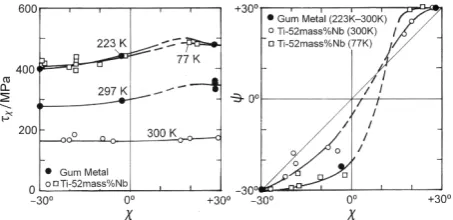
The plastic anisotropy of bcc single crystals is represented by τχ − χ and ψ − χ relations, where angles χ and ψ are the angles between the maximum shear stress plane in the prima-ry [111] slip direction and (¯101) plane, and that between the observed average slip plane and (¯101) plane, respectively. τχ is the shear yield stress resolved onto the maximum shear Fig. 5 Temperature dependence of critical resolved shear stress for single
crystals with orientations S1, S2 and S3, and that for cold-swaged poly-crystalline sample having strong 〈110〉 fiber texture for which the stress was resolved onto {112}T〈110〉 system.
Fig. 6 (a) Activation volumes calculated by eq. (2) plotted against resolved shear stress for four kinds of samples. (b) Activation enthalpy calculated by eq. (3) for four kinds of samples plotted against resolved shear stress.
Fig. 7 Calculated exponent values at various temperatures for four kinds of samples.
[image:5.595.323.525.66.297.2] [image:5.595.68.272.67.274.2] [image:5.595.48.292.345.457.2] [image:5.595.69.268.524.686.2]stress plane (not onto the observed average slip plane) in the primary 〈111〉 slip direction33). The sign of both χ and ψ is defined as that +30 corresponds to {112}AT plane and −30 to {112}T plane. In all bcc metals, τ+30◦> τ−30◦ at any
tempera-ture. In Fig. 9, we plot our Gum Metal data on τχ − χ and ψ − χ diagrams by closed circles together with the results by Hanada et al.25) for Ti-52 mass%Nb bcc alloy single crystals by open marks. It is found that the results of Gum Meal are similar to those of binary Ti-Nb binary bcc alloy. For bcc met-als including B2 ordered alloys, the slip behavior is classified basically into two types, {110} slip type and {112} slip type33). In the former type typically seen in pure Fe and Mo, as the temperature is lowered down to the helium temperature, the slip planes of single crystals with any χ value converge to {110} or ψ = 0 , whereas in the latter type seen in Li-65 mol%Mg alloy and B2 compound of AgMg and CuZn, the slip planes converge to {112} planes, mostly to {112}T, i.e. ψ = −30 , except for orientations near χ = +30 . The results in Fig. 9 indicate that Ti-based bcc metals belong to the {112} slip type. Anti-twinning shear to twinning shear asymmetry ratio of CRSSs of {112} slip in the present result is about 1.3 at room temperature. The asymmetry of the CRSS should be reflected on the tension-compression anomaly of the yield stresses. From the results of Takesue et al. for 〈100〉 single crystal23), the yield stress in tension and that in compression at room temperature are 670 MPa and 1070 MPa, respective-ly, which results in τ−30◦ = 311 MPa and τ+30◦ = 504 MPa; the
anisotropy ratio is 1.6 which is considerably larger than the present result. It is not known the origin of such difference, but one possible origin may be in the multiple slip effect of the 〈100〉 specimen. 〈100〉 axis is the stable orientation for compression but unstable orientation for tension, and so yielding of 〈100〉 single crystal for compression takes place by multiple slips while yielding by compression by single slip. Since the cold-swaged polycrystalline samples have 〈110〉 strong texture, the tension-compression asymmetry of the yield stress is expected if their yield stress is governed by slip deformation. The yield stress of the present Gum Metal in tension is reported to be 1100 MPa27) and that in compres-sion in the present result is around 930 MPa, the ratio being about 1.2, slightly smaller than 1.3 for single crystals, but if we subtract the same work hardening component from both samples, the ratio becomes 1.25, almost consistent with the results of single crystals. All the above results of the slip de-formation behavior of the present Gum Metal single crystals are not at all special but quite consistent with those of the
previously reported bcc alloys
At low temperatures, non-slip deformation was observed in S2 and S3 samples. Takesue et al. reported that the tensile deformation in 〈110〉 direction at room temperature of single crystal Gum Metal showed a pseudoelastic behavior, which was attributed to β ↔ α martensitic transformation23). In Ti-Nb based bcc alloys without oxygen addition, α martensite plates as well as ω precipitates were reported to be pro-duced34), and the superplasticity by the reversible β ↔ α transformation was reported widely (e.g. Refs. 35), 36)). However, no α phase formation was detected by in-situ XRD measurements in the elastic region for Gum Metal27). Yang et al. reported in quenched Ti-22.4Nb-0.73Ta-2.0Zr-1.34O (mol%) alloy deformed by compression, stress-induced α phase and {112}〈111〉 twins were formed after aging at 300 C37). Those produced α phase and twins are of micro-scopic scale, and no massive stress-induced phase formation as presented in Fig. 4 has been reported for Gum Metal. The habit plane of the stress-induced phase in Fig. 4 is different from those of α phase38) and usual {112}〈111〉 twin, but is consistent with {332}〈113〉 twin. {312}〈113〉 twin formation was reported, in addition to α -phase and ω-phase, by Yang et al. in deformed microstructure of Gum Metal39), but massive {332}〈113〉 twin formation determining the macroscopic yield stress of Gum Metal at low temperature was first ob-served in this paper.
4.2 Deformation mechanism of cold swaged polycrystal-line Gum Metal
Although slip deformation has been recognized in solution treated Gum Metal samples by several groups as mentioned before, non-dislocation deformation mechanism seems to have been believed widely for severely cold-swaged Gum Metal. However, in recent years, several research groups pub-lished disputable papers for non-dislocation mechanism. Tall-ing et al. showed that elastic modulus of Gum Metal is about a double of the previously predicted value and the observed yield stress is too low to deform via ideal shear process with-out large stress concentration40). Xing et al. showed that elas-tic energy coefficient of the screw dislocation should be near-ly zero as e/a ratio reaches 4.2, implying a low CRSS for glide in Gum Metal41). Yang et al. investigated deformation mechanism in Ti-22.4Nb-0.73Ta-2Zr-1.34O (mol%) alloy and concluded that the dominant deformation mechanism changes with increasing strain, i.e., tangling of dislocations, kink band formation and shear band formation42). Ab-initio calculations of ideal shear strength for {112}〈111〉 shear in model β-phase Ti3Nb is 1.6 GPa43), which is 3.5 times higher than the shear yield stress of cold-swaged samples. Plancher et al. suggested a phase transformation assisted nano-twin-ning, and dislocations are generated at high plastic strain to accommodate the misorientations of structural blocks44). Guo et al. showed by detailed TEM observation the existence of dislocations, twins and ω-phase, and suggested that structure changes and the local orientation changes with increasing strain are due to dislocation activity45,46).
As reported in detail in this paper, two facts, i.e, quite large temperature dependence of the yield stress at low tempera-tures and very small activation volume at high stresses, are obviously contradictory with the notion that the deformation Fig. 9 τχ − χ and ψ − χ relations for the present single crystals and those for
Ti-52 mass%Nb single crystals obtained by Hanada et al.25)
[image:6.595.56.283.69.179.2]of cold-swaged Gum Metal is due to non-dislocation process at the ideal shear strength. Furthermore, both the activation volume vs. stress and the activation enthalpy vs. stress rela-tions for cold-swaged Gum Metal are almost identical with those of single crystals if we shift the data of the swaged sam-ples to the left by about 120 MPa; this difference is interpret-ed as the increase of internal stress by the work hardening due to deformation induced ω-phase particles and α -martensite platelets, as well as dislocations. Although no direct evidence for the dislocation activity in cold-swaged samples has been obtained, the above facts indicate strongly that the basic de-formation mechanism is the same for single crystals and cold-swaged polycrystalline samples, i.e., Peierls mechanism for screw dislocation below room temperature and mainly defect hardening mechanism above the room temperature.
4.3 Contribution of oxygen interstitials
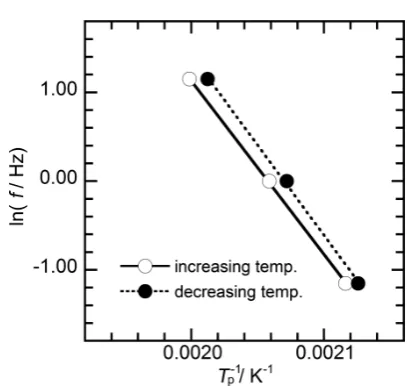
In order to discuss the role of interstitial oxygen atoms in the strength of Gum metal, internal friction measurement is useful. Subtracting the background from the loss modulus curve in Fig. 8, we plot the temperature dependence of the high temperature internal friction peaks at three frequencies in Fig. 10. As reported in several papers on oxygen internal friction peak in Ti-Nb based bcc alloys47–51), the width of the peak is almost double of the single Debye peak and so the peak should be composed of several components. For binary Ti-Nb bcc alloys, Florêncio et al.47) and Almeida et al.48) de-composed the wide peaks into six components, and Yin et al.49) into four components. In those oxygen peaks in binary alloys, the peak curves have more or less some structures. In contrast, the oxygen peaks in Fig. 10 have almost struc-ture-less, and hence we have not tried to decompose the curve into components. We simply apply the Arrhenius equation f = (2πτ0)−1exp[ − H/(kBTp)] for the peak temperature Tp. From the Arrhenius plot in Fig. 11 for increasing temperature data and decreasing temperature data, we obtain the average value of τ−01 = 6.5 × 10¹⁸ s−1 and H = 2.7 × 10⁻¹⁹ J (1.7 eV). Yin et al. obtained the activation enthalpy H for the peak tempera-ture for various oxygen contents from 0.16 to 3.1 mass% in Ti-(24.3 − 25.2) mol%Nb alloys, and found that H increases linearly from 2.4 × 10⁻¹⁹ J to 3.0 × 10⁻¹⁹ J (1.5 eV to 1.85 eV) with increasing oxygen content up to 3.2 mol%O49). H value in the present Gum Metal is almost consistent with the result of the binary Ti-Nb alloy. The peak height tanδ ≒ 0.02 in Fig. 10 is also consisitent with the relation between the peak height and the oxygen content tanδ = 0.02 × Omol% obtained
by the same authors49). Furthermore, the frequency factor for the oxygen peak in binary Ti-Nb binary alloy was reported to be of the order of 1017 s−1 50), several orders of magnitude larger than those of Snoek peaks of pure bcc metals, as in the present result. As a result, oxygen peaks in Ti-Nb alloys, as well as in Gum Metal, do not satisfy the established relation of Tp(K) = 362H (eV) for the Snoek peak52). Such a large frequency factor indicates that the relaxation is not a simple relaxation process but some complex process in alloys.
The similarity between the TiNb binary alloys and Gum Metal for the oxygen internal friction peak as mentioned above, together with the fact that no oxygen peak appears in TiNb alloy with low Nb concentration50), indicates that the oxygen peak in Gum Metal is due to stress-induced reorienta-tion of oxygen atom at Nb sites. While the peak width is dou-ble of the Debye peak; oxygen Snoek peak height of the pres-ent Gum Metal is only one-third of that in Nb-O with the same oxygen content53). Thus, the relaxation strength of oxy-gen atoms in Ti-Nb based alloys, including Gum Metal, is lower than that of oxygen in Nb. Yin et al. estimated the tetragonal strain by oxygen atom in Ti-Nb-O alloy is about two third of Nb-O alloy49).
4.4 Strengthening mechanisms of Gum Metal at room temperature
We first discuss the yield strength of single crystals. Since the present single crystals were water-quenched from high temperature, the density of ω-phase precipitates was low and the stress-induced α -plates formation was suppressed by the presence of oxygen, and the shear yield strength at room tem-perature, at which the necessary effective stress for kink-pair formation is low, is mainly due to solid solution hardening by substitutional atoms of 23 mol%Nb and by interstitial atoms of 1.2 mol%O. Besse et al. studied the effect of oxygen on the strength and reported that yield strength of oxygen free poly-crystalline Ti-based alloy with otherwise the same composi-tion as the present Gum Metal exhibits double yielding be-havior where the first yielding is due to stress-induced reori-entation of α -phase existing in oxygen free crystal, and the second yielding by slip which occurs at 280 MPa14). Neglect-Fig. 10 Snoek relaxation peaks for three frequencies of the present
cold-swaged polycrystalline sample.
[image:7.595.65.281.59.190.2] [image:7.595.323.527.61.254.2]ing the strengthening components by other defects including grain boundary hardening component and using the Taylor factor of 3, the shear yield stress component by substitutional solid solution hardening in our Gum Metal is about 90 MPa. Thus, the difference between the average shear yield stress of single crystals, 300 MPa and the substitutional hardening component of 90 MPa, i.e. 210 MPa, should be due to the solution hardening by 1.2 mol% interstitial oxygen. Since no data are available for interstitial solution hardening in Ti-Nb based bcc alloy, we compare the above result with reported oxygen and other interstitial hardening in Nb and its alloys. Loomis and Gerber54) reported that CRSS of Nb single crys-tal increases linearly wih O+N+C concentration up to 0.2 mol% with a hardening rate of 170 MPa/mol%(O+N+C). Miura et al.55) showed that CRSS of Nb-4.55 mol%O is 600 MPa with the average hardening rate of 130 MPa/ mol%O, while in Nb-20Ta-O single crystals CRSS increases linearly with oxygen concentration with a rate of 240 MPa/ mol%O. The present result of the average hardening rate of 175 MPa/mol%O seems consistent with the above results.
For cold-swaged Gum Metal, about 150 MPa of work hardening component is added. Thus, we conclude that the strengthening contributions to cold-swaged Gum Metal are 20% from substitutional solution hardening, 47% from inter-stitial solution hardening and 33% from work hardening.
5. Conclusion
Deformation mechanism of Gum Metal was investigated by deformation experiments over a wide temperature range for single crystals and cold-swaged polycrystalline samples. The results are contradictory with the previously proposed non-dislocation deformation at the ideal shear strength, but quite consistent with the established features of deformation behavior of bcc alloys: (1) strongly temperature dependent yield stress below the room temperature by the Peierls mech-anism, (2) weak temperature dependent yield stress above the room temperature by alloy hardening mechanism, as well as work hardening, and (3) {112} slip asymmetry in the defor-mation behavior of single crystals.
Discussion are made of the contributions to the room tem-perature high strength of cold-swaged Gum Metal by three hardening mechanisms, substitutional solution hardening, in-terstitial solution hardening and work hardening.
Acknowlegment
The authors are grateful to Mr. T. Aikawa of TA Instru-ment, Japan for his assistance in the experiments.
REFERENCES
1) T. Saito, T. Furuta, J.H. Hwang, S. Kuramtoto, K. Nishino, N. Suzuki, R. Chen, A. Yamada, K. Ito, Y. Seno, T. Nonaka, H. Ikehara, N. Naga-sako, C. Iwamoto, Y. Ikuhara and T. Sakuma: Science 300 (2003) 464.
2) N. Sakaguchi, N. Niinomi, T. Akahori, J. Takeda and H. Toda: Mater. Sci. Eng. C 25 (2005) 363.
3) R.J. Talling, R.J. Dashwood, M. Jackson and D. Dye: Scr. Mater. 60 (2009) 1000.
4) J. Málek, F. Hnilica, J. Vaselý and B. Smola: Mater. Charact. 84 (2013) 225.
5) D.M. Gordin, R. Ion, C. Vasilescu, S.I. Drob, A. Cimpean and T. Glori-ant: Mater. Sci. Eng. C 44 (2014) 362.
6) M. Tanaka, M. Takemoto, S. Fujibayashi, T. Kawai, S. Yamaguchi, T. Kizuki, T. Matsushita, T. Kokubo, T. Nakamura and S. Matsuda: J. Ma-ter. Sci. MaMa-ter. Med. 25 (2014) 635.
7) S. Kuramoto, T. Furuta, J.H. Hwang, K. Nishino and T. Saito: Metall. Mater. Trans., A Phys. Metall. Mater. Sci. 37 (2006) 657.
8) M.Y. Gutkin, T. Ishizaki, S. Kuramoto and I.A. Ovid ko: Acta Mater. 54 (2006) 2489.
9) S.V. Bobylev, T. Ishizaki, S. Kuramoto and I.A. Ovid ko: Scr. Mater. 65 (2011) 668.
10) M. Tane, S. Akita, T. Nakano, K. Hagihara, Y. Umakoshi, M. Niinomi, H. Mori and H. Nakajima: Acta Mater. 58 (2010) 6790.
11) T. Yano, Y. Murakami, D. Shindo and S. Kuramoto: Acta Mater. 57 (2009) 628.
12) R.J. Talling, R.J. Dashwood, M. Jackson and D. Dye: Acta Mater. 57 (2009) 1188.
13) M. Tane, T. Nakano, S. Kuramoto, M. Hara, M. Niinomi, N. Takesue, T. Yano and H. Nakajima: Acta Mater. 59 (2011) 6975.
14) M. Besse, P. Castany and T. Gloriant: Acta Mater. 59 (2011) 5982.
15) M.Y. Gutkin, T. Ishizaki, S. Kuramoto, I.A. Ovid ko and N.V. Skiba:
Int. J. Plast. 24 (2008) 1333.
16) S.V. Bobylev, T. Ishizaki, S. Kuramoto and I.A. Ovid ko: Phys. Rev. B
77 (2008) 094115.
17) D.C. Chrzan, M.P. Sherbume, Y. Hanlumyuang, T. Li and J.W. Morris, Jr.: Phys. Rev. B 82 (2010) 184202.
18) E.A. Withey, A.M. Minor, D.C. Chrzan, J.W. Morris, Jr. and S. Kura-moto: Acta Mater. 58 (2010) 2652.
19) J.P. Liu, Y.D. Wang, Y.L. Hao, H.L. Wang, Y. Wang, Z.H. Nie, R. Su, D. Wang, Y. Ren, Z.P. Lu, J.G. Wang, D. Hui and R. Yang: Acta Mater. 81 (2014) 476.
20) E. Withey, M. Jin, A. Minor, S. Kuramoto, D.C. Chran and J.W. Morris, Jr.: Mater. Sci. Eng. A 493 (2008) 26.
21) P. Castany, M. Besse and T. Gloriant: Phys. Rev. B 84 (2011) 020201.
22) Y. Kamimura, S. Katakura, K. Edagawa, S. Takeuchi, S. Kuramoto and T. Furuta: Mater. Trans. 56 (2015) 2084.
23) N. Takesue, Y. Shimizu, T. Yano, M. Hara and S. Kuramoto: J. Crys. Growth 311 (2009) 3319.
24) T. Suzuki and S. Takeuchi: Chapter 1 in Crystal Lattice Defects and
Dislocation Dynamics (editor: R. A. Vardanian, Nova Science Pub., New York, 2001) p. 1.
25) S. Hanada, M. Ozeki and O. Izumi: Metall. Trans. A 16 (1985) 789.
26) A.G. Crocker: Acta Metall. 10 (1962) 113.
27) T. Furuta, S. Kuramoto, J. Hwang, K. Nishino and T. Saito: Mater. Trans. 46 (2005) 3001.
28) S. Kuramoto, T. Furuta, J. Hwang, K. Nishino and T. Saito: Mater. Sci. Eng. A 442 (2006) 454.
29) B.L. Mordike: Phys. Status Solidi 35 (1976) 303 (a).
30) K.V. Ravi and R. Gibala: Acta Metall. 18 (1970) 623.
31) E. Kuramoto, Y. Aono and K. Kitajima: Scr. Metall. 13 (1979) 1039.
32) S. Takeuchi, T. Hashimoto and K. Maeda: Trans. JIM 23 (1982) 60. 33) T. Suzuki, S. Takeuchi and H. Yoshinaga: Chapter 6 in Dislocation
Dy-namics and Plasticity (Springer-Verlag, Berlin 1991) p. 77. 34) X. Tang, T. Ahmed and H.J. Rack: J. Mater. Sci. 35 (2000) 1805.
35) S. Miyazaki, H.Y. Kim and H. Hosoda: Mater. Sci. Eng. A 438–440 (2006) 18.
36) H.Y. Kim, T. Sasaki, K. Okutsu, J.I. Kim, T. Inamura, H. Hosoda and S. Miyazaki: Acta Mater. 54 (2006) 423.
37) Y. Yang, G.P. Li, G.M. Chen, H. Wang, M. Zhang, F. Xu and K. Yang:
Scr. Mater. 58 (2008) 9.
38) J.W. Morris, Jr., Y. Hanlumyuang, M. Sherburne, E. Withey, D.C. Chr-zan, S. Kuramoto, Y. Hayashi and M. Hara: Acta Mater. 58 (2010) 3271.
39) Y. Yang, G.P. Li, G.M. Cheng, Y.L. Li and K. Yang: Appl. Phys. Lett. 94 (2009) 061901.
40) R.J. Talling, R.J. Dashwood, M. Jackson, S. Kuramoto and D. Dye: Scr. Mater. 59 (2008) 669.
41) H. Xing, J. Sun, Q. Yao, W.Y. Guo and R. Chen: Appl. Phys. Lett. 92 (2008) 151905.
42) Y. Yang, S.Q. Wu, G.P. Li, Y.L. Li, Y.F. Lu, K. Yang and P. Ge: Acta Mater. 58 (2010) 2778.
43) N. Nagasako, R. Asahi and J. Hafner: Phys. Rev. B 85 (2012) 024122.
44) E. Plancher, C.C. Tasan, S. Sandloebes and D. Raabe: Scr. Mater. 68 (2013) 805.
45) W. Guo, M.Z. Quadir and M. Ferry: Metall. Mater. Trans., A Phys. Metall. Mater. Sci. 44 (2013) 2307.
46) W. Guo, M.Z. Quadir, S. Moricca, T. Eddows and M. Ferry: Mater. Sci. Eng. A 575 (2013) 206.
47) O. Florêncio, W.J.F. Botta, C.R. Grandini, H. Tejima and J.A.R. Jordão:
J. Alloy. Compd. 211–212 (1994) 37.
48) L.H. Almeida, C.R. Grandini and R. Caram: Mater. Sci. Eng. A 521–
522 (2009) 59.
49) F. Yin, L. Yu and D. Ping: Mater. Sci. Eng. A 521–522 (2009) 372.
50) Z.C. Zhou, J.Y. Xiong, S.Y. Gu, D.K. Yang, Y.J. Yan and J. Du: J. Alloy. Compd. 509 (2011) 7356.
51) J.M. Chaves, O. Florêncio, P.S. Silva, Jr., P.W.B. Marques and S.G. Schneider: J. Alloy. Compd. 616 (2014) 420.
52) M. Weller: J. Phys. 6 (1969) C8.
53) K. Schulze, E. Grallath and M. Weller: Z. Metallk. 72 (1981) 439. 54) B.A. Loomis and S.B. Gerber: Scr. Metall. 4 (1970) 921.