Intermetallic Compound Nanoparticles Dispersed on the Surface
of Oxide Support as Active and Selective Catalysts
Takayuki Komatsu
1,+and Shinya Furukawa
21Department of Chemistry and Materials Science, Tokyo Institute of Technology, Tokyo 152-8551, Japan 2Department of Chemistry, Tokyo Institute of Technology, Tokyo 152-8551, Japan
Preparation of nanoparticles of intermetallic compounds and their application to various catalytic reactions are summarized. On the surface of silica support, single-phase nanoparticles of intermetallics with various combinations of elements were obtained by co-impregnation and/or successive impregnation procedures. On alumina support, its strong interaction with metal species requires another preparation procedure, liquid-phase reduction, to obtain intermetallic nanoparticles with high liquid-phase purity. Most of the particles formed on both supports had diameters of 3³20 nm. Thus prepared intermetallic nanoparticles were used as catalysts for various reactions such as H2-D2 equilibration, selective hydrogenation, dehydrogenation, oxidation and isomerization. The catalytic activity and selectivity of nanoparticles differed from each other depending on the combination and composition of two elements. In some cases, the intermetallic catalysts gave much higher activity and/or selectivity than their component monometallic catalysts. The unique catalytic properties of intermetallic compounds were discussed in terms of the electronic and geometric factors compared with pure metals. [doi:10.2320/matertrans.MF201408]
(Received December 1, 2014; Accepted January 8, 2015; Published February 20, 2015)
Keywords: intermetallic compound, nanoparticle, catalyst, bimetallic catalyst, selective hydrogenation, preferential oxidation
1. Introduction
Intermetallic compounds (IMCs) are known to have various unique characteristics as bulk materials. The surface of IMCs, where catalytic reactions would proceed, also has unique characteristics because of their specific crystal structure and the electronic interaction between two compo-nent elements. Though electrocatalytic properties of IMCs have recently been attracting much attention as an electrode material for fuel cells, studies on their catalytic properties have been limited in terms of the variations of compounds and reactions and insufficient in terms of explanations of their unique catalyses.
There have been a number of reports1) on bimetallic catalysts prepared by loading two metal components (X and Z) on the surface of oxide support (MOx). Usually, one element, X, acts as an active component and the other, Z, as an additive to improve the catalytic properties of X as in the case of Pt-Sn/Al2O3 reforming catalyst. In some reports on
X-Z/MOxbimetallic catalysts, the authors mentioned about the formation of IMC between X and Z, for example, PtSn IMC in Pt-Sn/SiO2.2)However, X-Z/MOx catalysts usually consist of a mixture of species containing X and/or Z such as pure metal X or Z, alloys, IMCs, oxides of X or Z, composite oxides of X and Z, etc. in the form of isolated particles, core-shell particles, islands of Z on the surface of X, etc. Therefore, it is hard to know the catalytic properties of one component species from the experimental results obtained on such mixture catalysts. Therefore, we have prepared single-phase IMCs to clarify their intrinsic catalytic properties. Bulk IMCs were easily prepared by melting two component metals of stoichiometric composition. IMC thus prepared could be crashed into small particles with their size in micrometer range. For the development of highly active catalysts, IMC particles must have their size in nanometer range. Therefore,
we have tried to prepare nanoparticles of single-phase IMCs fixed on the surface of support materials.
Though the catalytic properties of hydrogen storage compounds, for example LaNi5,3) was studied more than
thirty years ago, there has been very few reports where the single-phase IMCs were prepared to evaluate their perform-ance as catalysts.4,5) We started to work on the catalysis by
IMCs in 19966) with bulk Co-based compounds. Then we
succeeded to prepare single-phase particles of Ni-Sn IMCs having their diameter smaller than 15 nm on silica gel.7)
Afterward, we have investigated various supported IMC particle catalysts. Because a part of our work was already summarized,8)we describe here the unique catalytic proper-ties of IMCs focusing on the results obtained recently.
2. Preparation of Intermetallic Nanoparticles
Like usual metal catalysts, IMC particles tend to agglomerate to form larger particles at high temperatures, where various catalytic reactions proceed in measurable rates. The agglomeration decreases the number of metal atoms exposed on the surface of IMC particles, leading to the decrease in catalytic activity. To keep their particle size small, IMC particles should be attached on the surface of support materials. We have prepared IMC particles using mainly silica support. Recently, to enhance the performance of IMC catalysts, other oxides such as alumina have also been used for the support. To confirm the formation of nanosize IMC particles, X-ray diffraction (XRD) is an essential tool though the diffraction pattern will be broad and ambiguous when the particle size is a few nanometer. Transmission electron micrograph (TEM) would be applied to know the particle size distribution. If selected-area electron diffraction,9,10)
nanobeam diffraction11)and energy-dispersive X-ray analysis
are equipped with TEM, crystal structure of each particle might be identified. IMC catalysts described hereafter were essentially identified by XRD with ICDD database.
+Corresponding author, E-mail: komatsu.t.ad@m.titech.ac.jp Special Issue on Advanced Metallic Materials for Catalysis
2.1 Nanoparticles on silica support
The support material should have large specific surface area to accommodate a large number of nanometer-size IMC particles on its surface with sufficient distance between the particles. In addition, it should not interact strongly with metal species, X and/or Z in the case of XnZmIMC, because
the strong interaction wouldfix the metal speciesfirmly at a specific site. The immobilized particles of X do not have a chance to react with Z to form IMC. Therefore, we first selected silica gel as a support. Silica gel has sufficiently large surface area as catalyst support and is one of the inert materials having very weak interaction with metal species. We used Cariact G6 silica gel (Fuji Silysia Co.) having a specific surface area of 500 m2g¹1.
2.1.1 Impregnation procedure
Impregnation is the commonly used procedure to prepare supported metal catalysts. A metal precursor (salt or complex) dissolved in a specific amount of solvent (often water) is added to support material to make the support totally wet without visible liquid remaining (pore-filling impregnation12)). The solvent adsorbed in the pores of support is then vaporized and the remaining solid is calcined in air and finally reduced in hydrogen to obtain metal particles on the support surface. The catalyst thus prepared is expressed as metal/support, hereafter. To synthesize IMC particles between elements X and Z, there are two impregnation techniques. One is to follow the procedure above by using the solution containing precursors of both X and Z. The other is to prepare X/support first and subsequently Z is loaded onto X/support. The former is called co-impregnation and the latter successive impregna-tion. Figure 1 shows XRD patterns of Pd-M/SiO2 prepared
by the successive impregnation through Pd/SiO2.13)When M
was Zn, Sn, In, Ge or Fe, only the diffraction peaks of aimed compounds were observed, indicating that all the Pd particles reacted with M atoms to form each IMC. The crystallite sizes of IMCs estimated using Scherrer’s equation were 6 nm for the parent Pd and 9³50 nm for IMCs. Through the preparation of various IMC/SiO2catalysts, we have attained
the information that it is not so hard to obtain Pd-based single-phase IMC particles compared with other metal-based IMCs. As a whole, the co-impregnation provides higher possibility to form single-phase IMCs, whereas the succes-sive impregnation is advantageous to form particles with homogeneous size.
2.1.2 CVD procedure
In the case of Ni-Sn IMCs, the impregnation procedures did not give the single-phase compound. Then chemical vapor deposition (CVD) was applied as follows.7)First, Ni/
SiO2 was prepared by the pore-filling impregnation. The
vapor of Sn(CH3)4 was fed with flowing H2 onto Ni/SiO2
at temperatures around 500 K. Hydrogenolysis of Sn(CH3)4
into methane and Sn0 was catalyzed by Ni to deposit tin predominantly on Ni surface. Subsequent hydrogen treatment at higher temperatures accelerated the solid-phase reaction between Ni and Sn to form IMCs, Ni3Sn, Ni3Sn2or Ni3Sn4,
as single-phase particles.
Mesoporous silica, MCM-41, was used as a support with the purpose of obtaining Pt-Ge intermetallic particles of uniform size.14)CVD procedure was adapted with Pt/
MCM-41 and Ge(CH3)4 vapor. Pt-Ge/MCM-41 thus prepared
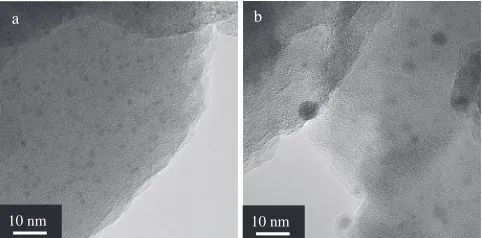
contained 0.7 mass% Pt with Pt/Ge atomic ratio of 1.3. TEM images of Pt-Ge/SiO2and Pt-Ge/MCM-41 are shown
in Fig. 2. Metal particles highly homogeneous in size were observed on MCM-41. Because their particle size (1.4 nm) was smaller than the pore diameter of MCM-41 (2.6 nm), Pt-Ge particles would be located inside the pores though the formation of single-phase Pt-Ge IMC was not clear because metal particles were too small for XRD identification. On the contrary, particles with 1³6 nm diameters were formed on silica. The similar homogeneous particles of Ni3Ge were also
obtained inside the pores of MCM-41.15)
2.2 Nanoparticles on alumina support
As mentioned above, metal particles would migrate on the almost neutral silica to facilitate the reaction between two metal elements to form IMC. However, because of its neutral nature, it is hardly expected that silica significantly modifies the electronic state of IMC particles and/or affects the reaction by its intrinsic catalytic activity. Alumina, widely used for industrial catalysts, has acid and base centers, which would participate in the reaction as catalytically active sites as well as affect the electronic state of IMC. We expected that by these effects, IMC/Al2O3would give improved catalytic
properties compared with IMC/SiO2.
Fig. 1 XRD patterns of Pd-based IMCs supported on silica with their crystallite sizes in parentheses.
10 nm
b
10 nm
a
[image:2.595.310.540.72.281.2] [image:2.595.307.548.329.448.2]Probably because of the strong interaction with metal particles, it was much difficult to obtain single-phase IMC particles on alumina than on silica. Then we took the third preparation procedure, liquid-phase reduction. In this prepa-ration, various reductants are used instead of gaseous hydrogen. The simultaneous reduction of both metal pre-cursors would be desirable for the mixing of two elements in atomic level, facilitating the IMC formation. A wide variation of reductants will supply a wide range of reduction potential and increase the possibilities for IMC formation even on alumina. We observed that the use of LiBH4, possessing much
higher reduction potential than H2, as a reductant drastically
enhanced the formation of desired intermetallic phases.9)For
the preparation of Pt3Co/Al2O3, although H2 reduction at
673 K gave mixture of Pt3Co and pure Pt phases, LiBH4
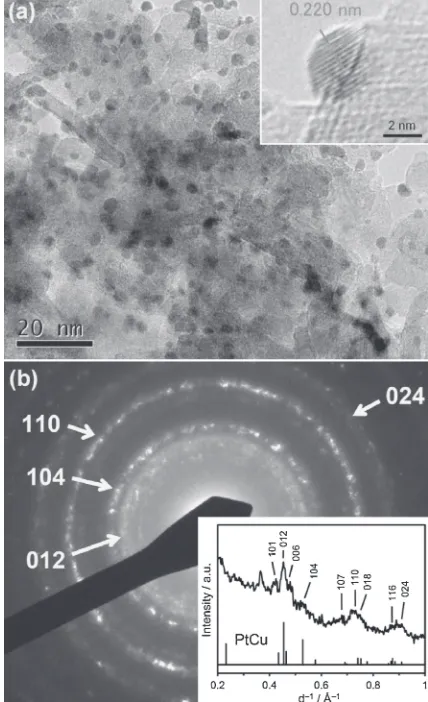
reduction at 353 K afforded the formation of single phase Pt3Co on Al2O3(Fig. 3). Several IMC catalysts such as PtCu/
Al2O3 and Pd3Pb/Al2O3 were obtained with high phase
purities by employing LiBH4 reduction. It should be noted
that liquid-phase reduction has another advantage compared to the traditional H2 reduction. Since liquid-phase reduction
is performed at much lower temperature (typically<373 K) than H2 reduction (>673 K), sintering of metallic particles
hardly occurs. Therefore, sufficiently small intermetallic nanoparticles (LiBH4reduction, 2³5 nm; H2reduction, 15³
25 nm), i.e., much higher metal dispersion, can be obtained. The example of PtCu/Al2O3is shown in Fig. 4.
3. Catalytic Reactions
In this chapter, we describe the difference in catalytic activity and selectivity between IMC and pure metal catalysts in some reactions with a focus on the results obtained after our previous review.8)
3.1 H2-D2equilibration
One of the important functions of metal catalysts is the activation of hydrogen molecules. When metal catalysts are used for the hydrogenation reaction with gaseous hydrogen, the ability to dissociate H2and the amount and strength of the
adsorption often determine the performance of the catalysts. H2-D2 equilibration is simple but useful test reaction for
evaluating such ability of the metal catalysts. We have measured the rate of H2-D2 equilibration on various
intermetallic catalysts and found that almost all the IMCs showed lower activity than either of their component, monometallic catalysts.6,1418) Only exception was found in unsupported Pt3Ti and PtTi3, which exhibited much higher
activity than Pt.19)
3.2 Hydrogenation
The low activity of IMCs to dissociate H2indicates that the
amount and geometric distribution of adsorbed H-atoms are limited on IMC surface. Therefore, we expected that IMCs could be effective catalysts for some hydrogenations which Fig. 3 (a) TEM images and (b) SAED pattern of Pt3Co/Al2O3prepared by
liquid-phase reduction with LiBH4. Fig. 4 (a) TEM images and (b) SAED pattern of PtCu/Al
[image:3.595.61.279.69.411.2] [image:3.595.319.533.73.424.2]require selective attack of hydrogen to obtain desired products. Examples of such reactions are shown in Fig. 5, partial hydrogenation of alkyne to alkene (i) and that of diene to alkene (ii), and chemoselective hydrogenation at a specific functional group (iii). Wefirst studied the selectivity of intermetallic catalysts for the partial hydrogenation of acetylene into ethylene. This reaction is utilized to remove acetylene impurity from ethylene feed in various industrial processes such as polyethylene production. Many IMC catalysts, CoGe,6) Pt3Ge,16) Ni3Sn2/SiO217) etc., showed
higher selectivity to ethylene than their component, mono-metallic catalysts. As shown in Fig. 6, Pd3Bi/SiO2was found
to be promising because it gave high selectivity of 80 C-%at 95% acetylene conversion in the presence of excess amount of ethylene.20)Osswaldet al.4)also reported that unsupported PdGa and Pd3Ga7IMCs were more selective than Pd/Al2O3.
We applied Pd3Bi/SiO2 also to the formation of trans
[image:4.595.333.520.71.171.2]-stilbene through the partial hydrogenation of diphenylacetyl-ene into cis-stilbene and its subsequent isomerization (Fig. 7).trans-Stilbene is one of the important raw materials for the production of liquid crystals, organic light-emitting diodes, etc. Figure 8 shows that the combination of Pd3Bi/
SiO2 and H-USY zeolite (a) gave trans-stilbene yield of
70 mol-%, whereas that of Pd/USY and H-USY (b) gave fully hydrogenated diphenylethane as the main product at higher conversion.21)
When a molecule having two different functional groups is hydrogenated, chemoselective hydrogenation of one func-tional group could proceed on special catalysts. An example of chemoselective hydrogenation is shown in Fig. 9. This reaction is so-called catalytic transfer hydrogenation (CTH), where p-nitrostyrene is hydrogenated by hydrogen from methylcyclohexene (or methanol used for a solvent) to form p-aminostyrene, which is an important intermediate for fine chemicals production. The formation of undesired p
-ethyl-nitrobenzene and p-ethylaniline has to be minimized. As shown in Table 1, Pd/SiO2gave mainlyp-ethylnitrobenzene
and p-ethylaniline without the formation of p -aminosty-lene.10) Pd5Ga3, PdGa and PdZn were not selective for p
-aminostyrene formation. However, Pd13Pb9, Pd3Bi, and PdFe
gave p-aminostyrene as a main product. In the case of Rh-based catalysts, Rh/SiO2 did not have measurable activity,
whereas intermetallic catalysts such as RhPb2, RhPb, RhBi,
etc. on silica showed significant activity and extremely high selectivity top-aminostyrene.
HC CH H2C CH2 H3C CH3 (i)
(ii)
(iii)
NO2 NH2 NO2
Fig. 5 Examples of selective hydrogenation.
0 20 40 60 80 100 Acetylene conversion (%) 100
80
60
40
20
0
−20
Ethylene selectivity (C-%)
Pd/SiO2
Pd-Ag/SiO2
Pd3Bi/SiO2
Fig. 6 Hydrogenation of acetylene in the presence of excess ethylene (C2H2/C2H4/H2=1/16/2) at 343 K.
diphenyl-acetylene
trans-stilbene
cis-stilbene
diphenyl-ethane H2
H2 H
2 H2
Fig. 7 Reaction route for the hydrogenation of diphenylacetylene.
0 50 100 150 200
Reaction time, t/min 100
80
60
40
20
0
Conversion (%), selectivity (mol%)
0 100 200 300 400
Reaction time, t/min 100
80
60
40
20
0
Conversion (%), selectivity (mol%)
(a)
(b)
Fig. 8 Reaction of diphenylacetylene on the mixture of (a) Pd3Bi/SiO2 and H-USY at 353 K, and (b) Pd-USY and H-USY at 333 K. ( ) diphenylacetylene conversion, selectivity to ( )cis-stilbene, ( ) trans-stilbene and ( ) diphenylethane.
NO2
+
NO2
NH2
NH2
p-nitrostyrene
p -ethyl-nitrobenzene
p-aminostyrene
p-ethylaniline CH3OH
4-methyl-1-cyclohexene
[image:4.595.91.246.71.154.2] [image:4.595.90.246.185.324.2] [image:4.595.343.507.209.463.2] [image:4.595.317.535.534.633.2]3.3 Dehydrogenation
Dehydrogenation of butane into more useful butenes was carried out on Pt-based IMC catalysts.22) To control the
deactivation by coke formation (carbonaceous deposit), H2
was mixed in feed gas with molar ratio of C4H10/H2=2/7.
On Pt/SiO2 and supported Pt-based IMCs, main products
were methane, ethane and propane with butene selectivity lower than 5 C-%, indicating that hydrogenolysis was dominantly accelerated. On the other hand, Pt3Sn/SiO2gave
butenes as the main product with 38 C-% selectivity. In the case of Pt-bimetallic catalyst, the addition of second metal was proposed to decrease surface Pt ensemble sites to control hydrogenolysis.23) We tested Pt-Sn/SiO2 catalysts with Sn/
(Pt+Sn) atomic ratio of 0³0.65. A small amount of tin (ratio=0.05) enhanced the butene selectivity as could be explained by the decrease in Pt ensembles. However, the selectivity increased drastically at the ratio around 0.3, where XRD showed the formation of single-phase Pt3Sn. This
indicates an intrinsic high selectivity of Pt3Sn IMC.
Oxidative dehydrogenation of organic compounds is thermodynamically advantageous to nonoxidative one. It would be possible to obtain high conversion at low temperatures under oxidative conditions. However, combus-tion into CO and CO2proceeds as an inevitable side reaction.
To obtain the dehydrogenated products in high yield, the combustion must be minimized. The oxidative dehydrogen-ation of hydrocarbons has been widely studied on oxide catalysts like bismuth molybdates, whereas noble metal catalysts have been scarcely reported.24)We carried out the oxidative dehydrogenation of 1-butene into 1,3-butadiene, demanding raw material of synthetic rubber, on Pd-based intermetallic catalysts.13)Several IMCs such as PdIn, Pd
3Fe
and PdBi supported on silica showed higher selectivity to butadiene than Pd/SiO2.
Oxidative dehydrogenation of amine into imine is an important reaction because imines are used in the production of medicines. Supported transition metal catalysts such as Ru/hydroxyapatite25)and Au/CeO226)have been reported to
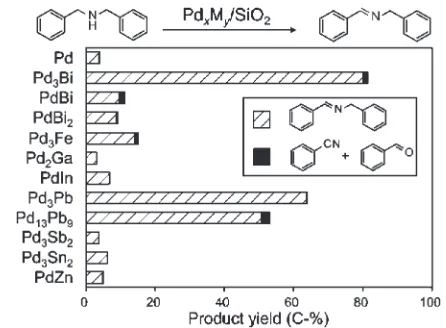
be effective in this reaction, but their applicability to various amines are limited. We tried to catalyze the oxidative dehydrogenation of dibenzylamine into N-benzylideneben-zylamine by Pd-based IMCs supported on silica (Fig. 10).27) Pd/SiO2showed low conversion, whereas Pd3Bi, Pd3Pb and
Pd13Pb9 showed much higher conversion exceeding 50%.
Products consisted mainly of the aimed imine. Among the highly active intermetallic catalysts, Pd3Pb/SiO2gave almost
100 C-% selectivity. The support materials gave strong influence on the activity of Pd3Pb; for example, the intrinsic
activity, rate of amine conversion per weight of Pd3Pb,
obtained on Pd3Pb/MgO was ten times higher than that on
Pd3Pb/SiO2.
3.4 Oxidation
Preferential oxidation of CO in excess H2 (PROX) has
attracted attention of many researchers because PROX is an important reaction to purify H2for H2-O2fuel cell because a
trace amount of CO will deactivate its Pt electrode. CO shift reaction roughly removes CO as CO2 followed by PROX
to reduce CO concentration below 10 ppm. We carried out PROX reaction on various Pt-based IMCs supported on silica (Fig. 11) and found that Pt3Co/SiO2 and PtCu/SiO2 were
much more active than Pt/SiO2 especially at low
temper-atures.28) These IMCs were stable under the PROX
conditions without the formation of bulk oxides regardless of the presence of oxygen in the feed. As shown in Fig. 12, alumina was found to be better support than silica for PtCu intermetallic catalyst though the liquid-phase reduction29) procedure was required to obtain single-phase PtCu on alumina.30)IR spectra measured under the reaction condition showed the presence of bicarbonate species. From the fact that the bicarbonate was also observed in the absence of H2in
the reactant mixture, hydroxyl groups on alumina surface was considered to be involved in the reaction by supplying hydrogen to form bicarbonate intermediate. Similar role of hydroxyl groups on alumina was reported for Pt/£-Al2O3
[image:5.595.313.536.68.232.2]PROX catalyst.31)
Table 1 CTH reaction ofp-nitrostyrene (NS) on Pd- and Rh-based IMC catalysts.*1
Catalyst
NS conv.
(%)
Selectivity (mol-%)*2
AS EN EA
PdM/SiO2
Pd 100 0 63 26
Pd5Ga3 14 0 82 18
Pd13Pb9 10 93 5 2
Pd3Bi 10 43 27 25
PdZn 7 0 >99 0
PdGa 5 0 >99 0
PdFe 2 55 45 0
RhMA/SiO2
Rh <1 0 >99 0
RhPb2 94 93 6 1
RhPb 38 94 0 0
Rh3Pb2 15 >99 0 0
RhBi 14 >99 0 0
Rh2Sn 6 >99 0 0
*1Catalyst, 0.15 g (Pd and Rh) or 0.25 g (Pd-M and Rh-MA);T=343 K; t=1 h.
[image:5.595.46.291.93.327.2]*2AS:p-aminostyrene, EN:p-ethylnitrobenzene, EA:p-ethylaniline.
3.5 Isomerization
In section 3.2, the formation of trans-stilbene was achieved using a mixture of Pd3Bi/SiO2 and H-USY
catalysts for the partial hydrogenation of diphenylacetylene into cis-stilbene and its isomerization into trans-stilbene, respectively. Recently, we found that the combination of Pd3Bi/SiO2 with RhSb/SiO2 gave trans-stilbene yield of
88 mol-% (Fig. 13).11)This indicates the high selectivity of
intermetallic RhSb for the isomerization ofcis-stilbene in the presence of hydrogen.
4. Factors Determining Catalytic Properties of IMC
As mentioned above, IMCs possess unique catalytic activity and selectivity compared with monometallic cata-lysts. This would be caused by the difference in the crystal structure and electronic state. In the case of usual alloy, solid solution, between elements X and Z, a part of X atoms are replaced by Z atoms in a random manner, keeping the crystal structure of metal X essentially unchanged. On the surface of alloy, a few X and Z atoms may be mixed with each other in atomic scale like IMC. However, most of the surface will consist of islands of X with few Z atoms on them and/or islands of Z. The island of X is considered to be a small crystallite of pure metal X, where geometric state is scarcely affected by Z atoms. Moreover, the electronic influence by
neighboring Z atoms would be limited to the interface of the islands. In the case of IMCs, however, X and Z atoms often create the crystal structure totally different from that of pure metal affecting the surface geometry. In addition, every X atom has some neighboring Z atoms, which will generate strong electronic interaction between X and Z. As a result, IMC should have unique catalytic properties caused by the geometric and electronic factors, which are much stronger than those in usual alloys. In this chapter, we will discuss on how these factors determine the catalytic properties of IMCs.
4.1 Electronic factor
Catalytic activity of Ni3M-type IMCs was studied for H2
-D2 equilibration.32) In this study, we prepared unsupported
Ni3M particles as shown in Fig. 14(a) with particle diameter
of 5³20 µm instead of supported nanoparticles. From XPS spectra of valence band region (Fig. 14(b)), we calculated d band center for each compound as indicated by vertical lines. H2-D2equilibration was carried out at 353³527 K to obtain
the activation energy. Figure 15 shows the relation between the activation energy and the d band center. Though Ni3M
catalysts have various lattice systems: cubic (Ni and Ni3Ge),
hexagonal (Ni3Sn and Ni3Ti), orthorhombic (Ni3Ta), and
tetragonal (Ni3Nb), the data points showed an obvious,
positive correlation, that is, the activation energy decreased 353 393 433 473
Reaction temperature, T/K 100
80
60
40
20
0
[image:6.595.335.518.70.220.2]CO conversion (%)
Fig. 11 PROX reaction on (©) Pt, ( ) Pt3Co, ( ) PtCu, ( ) Pt3Tl2, ( ) Pt3Fe, ( ) Pt3Sn and ( ) PtGe supported on SiO2. Reactant mixture: CO(2.0%), O2(2.0%), H2(35%) and He (balance).
100
80
60
40
20
0
300 350 400 450 500
Reaction temperature, T/K
CO conversion (%)
(a)
(b) (c)
Fig. 12 Effect of supports and preparation methods on CO conversion in PROX reaction on (a) PtCu/Al2O3and (b) PtCu/SiO2prepared by liquid-phase reduction and (c) Pt-Cu/Al2O3by impregnation.
0 20 40 60 80 100
0 50 100 150 200
Conversion and selectivity (%)
[image:6.595.76.262.71.223.2]Reaction time, t/min
Fig. 13 Reaction of diphenylacetylene on the mixture of Pd3Bi/SiO2and RhSb/SiO2 at 333 K. ( ) diphenylacetylene conversion, selectivity to ( )cis-stilbene, ( )trans-stilbene and ( ) diphenylethane.
Intensity (a.u.) Intensity (a.u.)
(a) (b)
[image:6.595.307.547.272.424.2] [image:6.595.87.252.278.406.2]with decreasing the d band center. With the help of calculated local density of d states for Sn/Ni(111),33)we would explain this correlation as follows (Fig. 16). The Ni valence band becomes broader by the formation of Ni3M intermetallics. As
a result, d band center shifts to lower energy as already shown in Fig. 14(b). Ni and Ni3M dissociatively adsorb
hydrogen to generate · bonding and·* anti-bonding states. The lower d band center in Ni3M means the lower energy of
both · and ·* states. Therefore, ·* state in Ni3M will be
populated to a higher degree than that in pure Ni, indicating weaker Ni-H bonds on Ni3M. Because the activation energy
of H2-D2equilibration will corresponds to the energy barrier
for desorption as shown in Fig. 16(b), Ni3M having weaker
Ni-H bonds will give the lower activation energy.
The high selectivity of Pd3Bi/SiO2for the partial
hydro-genation of acetylene (see 3.2) was explained also by the electronic factor.20) IR spectra of CO adsorbed on Pd3Bi/
SiO2 showed absorption peak of linear CO at 2065 cm¹1,
whereas it appeared at 2090 cm¹1 on Pd/SiO2. Because
Bi does not adsorb CO, the difference in peak position corresponds to the difference in electronic state of Pd. The lower peak position on Pd3Bi indicates higher electron
density of Pd atoms in Pd3Bi. The higher electron density
would make the adsorption of ethylene weaker, resulting in its immediate desorption from Pd3Bi before it is further
hydrogenated into ethane.
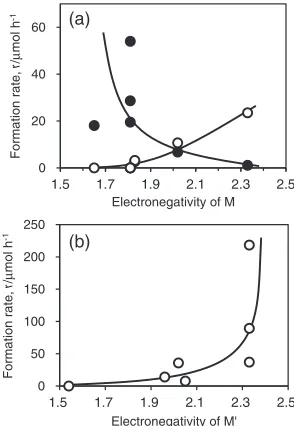
As mentioned in 3.2, Pd-M IMCs have good selectivity also for the chemoselective hydrogenation of p-nitrostyrene intop-aminostyrene.10)Figure 17 shows the relation between the formation rate of each product and the Allred-Rochow electronegativity of element M. With increasing the electro-negativity, the formation rate of p-ethylnitrobenzene, an undesirable by-product, decreased and that ofp-aminostyrene increased. On Rh-M IMCs, the similar correlation was observed for p-aminostyrene formation. Results of some control experiments indicated the following reaction routes; the hydrogenation of nitro group proceeds through proton from activated methanol, whereas the hydrogenation of C=C bond proceeds through hydrogen atom from methylcyclo-hexene. Therefore, the increase in the rate ofp-aminostyrene formation would be caused by the creation of active sites for methanol activation. Such active sites will be the adjacent two metal atoms with different electronegativity as in the case of Rh-Pb adjacent site on the surface of RhPb2. IMCs will
be selective catalysts for various chemoselective reactions if we can take advantage of their controllability in surface electronic state.
4.2 Geometric factor
In the case of IMC between X and Z, usually the surface of particle will frequently consist of both X and Z atoms. When only X can adsorb CO, it will be linear CO species because bridged and three-fold CO species requiring two or more adjacent X atoms will not be formed on isolated X atoms. In fact, we have observed the disappearance of bridged and three-fold CO species for various intermetallic cata-lysts.10,15,30,34,35)
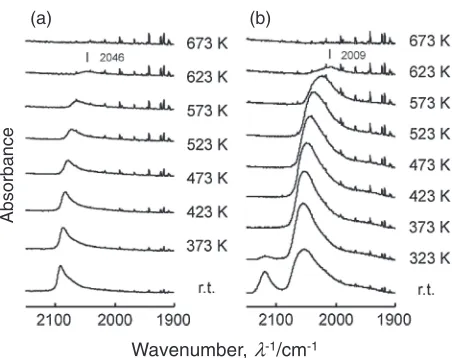
For PROX reaction, the arrangement of surface atoms obviously governs the activity of PtCu/Al2O3.30) As shown
in Fig. 18, higher temperatures than 623 K will be necessary to remove CO molecules adsorbed on Pt/Al2O3. The strong
adsorption of CO retards the adsorption of O2 molecules to
[image:7.595.65.274.65.226.2]make Pt catalyst inactive at low temperatures. On PtCu Fig. 15 Relation between apparent activation energy for H2-D2
equilibra-tion on Ni and Ni3M IMCs and their potentials of d band center.
(a)
(b)
Fig. 16 Energy diagram of the electronic state of Ni-H(D) bonding.
(b) (a)
0 50 100 150 200 250
1.5 1.7 1.9 2.1 2.3 2.5
Electronegativity of M' 0
20 40 60
1.5 1.7 1.9 2.1 2.3 2.5
Electronegativity of M
Formation rate,
r
/
μ
mol h
-1
Formation rate,
r
/
μ
mol h
[image:7.595.353.500.70.283.2]-1
[image:7.595.56.278.266.434.2]intermetallic catalyst, Cu atoms adsorbed CO, which can be seen as a small absorption peak at 2120 cm¹1. This CO was easily removed below 373 K. The resultant bare Cu atoms will have a chance to adsorb oxygen to trigger the reaction with CO adsorbed on the neighboring Pt atom. Thus on the surface of IMCs, two different reactants can be adsorbed side-by-side to proceed the reaction. In the case of usual supported metal catalysts, the interface between metal particle and support surface could be the similar active site, where metal and support adsorb different reactant molecules. The rate of reaction, however, would be much higher on IMC surface because every metal atom is surrounded by the other metal atoms to create the active sites.
5. Conclusion
The following conclusions were elucidated from the experimental results obtained in the preparation of single-phase nanoparticles of intermetallic compounds and their application as catalysts for various reactions.
Intermetallic nanoparticles between two elements are obtained on the surface of oxide support by several preparation procedures, depending on the combination of two elements and the nature of support. A variety of compounds are easily obtained as single-phase nanoparticles on silica, whereas alumina requires the sophisticated procedure of liquid-phase reduction using two metal precursors having the reduction potentials close to each other. Catalytic properties of IMCs differ greatly from those of component pure metals. In addition, the change in composition of IMCs and the use of different support also alter the catalytic properties extensively. In various reactions, some IMCs possess higher activity and selectivity than their component, monometallic catalysts probably because the electronic and/or geometric states of surface atoms betterfit ideal active sites for each reaction. There exist a large number of IMCs, indicating that IMC has extremely wide tunability for their geometric and electronic factors. Then we will obtain better catalysts out of them if we can further clarify how these factors affect their catalytic properties and manipulate them considerably.
Acknowledgments
A part of this work was supported by JSPS KAKENHI Grant Number 23360353 and 26820350. We thank the Center for Advanced Materials Analysis Tokyo Institute of Tech-nology for their assistance in TEM analysis.
REFERENCES
1) V. Ponec and G. C. Bond:Catalysis by Metals and Alloys,Stud. Surf. Sci. Catal.95(1995) 437716.
2) F. M. Dautzenberg, J. N. Helle, P. Biloen and M. H. Sachtler:J. Catal.
63(1980) 119128.
3) T. Takeshita, W. E. Wallace and R. S. Craig:J. Catal.44(1976) 236 243.
4) J. Osswald, K. Kovnir, M. Armbrüster, R. Giedigkeit, R. E. Jentoft, U. Wild, Yu. Grin and R. Schlögl:J. Catal.258(2008) 219227.
5) A. P. Tsai, S. Kameoka and Y. Ishii:J. Phys. Soc. Jpn.73(2004) 3270 3273.
6) T. Komatsu, M. Fukui and T. Yashima:Stud. Surf. Sci. Catal. 101
(1996) 10951104.
7) A. Onda, T. Komatsu and T. Yashima:J. Catal.201(2001) 1321.
8) T. Komatsu and A. Onda:Catal. Surv. Asia12(2008) 615.
9) S. Furukawa, K. Ozawa and T. Komatsu:RSC Adv.3(2013) 23269 23277.
10) S. Furukawa, Y. Yoshida and T. Komatsu:ACS Catal.4(2014) 1441 1450.
11) S. Furukawa, A. Yokoyama and T. Komatsu: ACS Catal.4(2014) 35813585.
12) T. Komatsu, K. Inaba, T. Uezono, A. Onda and T. Yashima:Appl. Catal. A Gen.251(2003) 315326.
13) S. Furukawa, M. Endo and T. Komatsu:ACS Catal.4(2014) 3533 3542.
14) T. Komatsu, K. Sou and K. Ozawa:J. Mol. Catal.319(2010) 7177.
15) T. Komatsu, T. Kishi and T. Gorai:J. Catal.259(2008) 174182.
16) T. Komatsu, S. Hyodo and T. Yashima:J. Phys. Chem. B101(1997) 55655572.
17) A. Onda, T. Komatsu and T. Yashima:Phys. Chem. Chem. Phys.2
(2000) 29993005.
18) T. Komatsu and Y. Fukui:Appl. Catal. A: Gen.279(2005) 173180.
19) T. Komatsu, D. Satoh and A. Onda:Chem. Commun. (2001) 1080 1081.
20) T. Komatsu and T. Gorai: Ext. Abst. 14th Int. Congr. Catal., ed. by S. H. Moon (2008, Seoul) OB-31.
21) T. Komatsu, K. Takagi and K. Ozawa:Catal. Today164(2011) 143 147.
22) S. Furukawa, A. Tamura, K. Ozawa and T. Komatsu:Appl. Catal. A General469(2014) 300305.
23) H. D. Lanh, G. Lietz, H. S. Thoang and J. Volter:React. Kinet. Catal. Lett.21(1982) 429432.
24) Y. She, J. Han and Y. H. Ma:Catal. Today67(2001) 4353.
25) K. Mori, K. Yamaguchi, T. Mizugaki, K. Ebitani and K. Kaneda:
Chem. Commun. (2001) 461462.
26) L. Aschwanden, T. Mallat, F. Krumeich and A. Baiker:J. Mol. Catal. A: Chem.309(2009) 5762.
27) S. Furukawa, A. Suga and T. Komatsu:Chem. Commun.50(2014) 32773280.
28) T. Komatsu and A. Tamura:J. Catal.258(2008) 306314.
29) H. Takahashi, Y. Sunagawa, S. Myagmarjav and A. Muramatsu:Catal. Surv. Asia9(2005) 187192.
30) T. Komatsu, M. Takasaki, K. Ozawa, S. Furukawa and A. Muramatsu:
J. Phys. Chem. C117(2013) 1048310491.
31) M. J. Kahlich, H. A. Gasteiger and R. J. Behm:J. Catal.171(1997) 93 105.
32) S. Furukawa, K. Ehara, K. Ozawa and T. Komatsu:Phys. Chem. Chem. Phys.16(2014) 1982819831.
33) E. Nikolla, J. Schwank and S. Linic:J. Am. Chem. Soc.131(2009) 27472754.
34) A. Onda, T. Komatsu and T. Yashima:J. Catal.221(2003) 378385.
35) T. Komatsu and H. Ikenaga:J. Catal.241(2006) 426434.
(a) (b)
Wavenumber, λ-1/cm-1
[image:8.595.57.283.67.246.2]Absorbance