Language Independent Morphological Analysis
Yamashita, Tatsuo and Matsumoto, Yuji
Graduate School of Information Science
Nara Institute of Science and Technology
{
tatuo-y, matsu} @is. aist-nara, ac.jp
Abstract
This paper proposes a framework of language inde- pendent morphological analysis and mainly concen- trate on tokenization, the first process of morpholog- ical analysis. Although tokenization is usually not regarded as a difficult task in most segmented lan- guages such as English, there are a number of prob- lems in achieving precise treatment of lexical entries. We first introduce the concept of morpho-fragments, which are intermediate units between characters and lexical entries. We describe our approach to resolve problems arising in tokenization so as to attain a language independent morphological analyzer.
1 Introduction
The first step in natural language processing is to identify words in a sentence. We call this process a morphological analysis. Various languages exist in the world, and strategies for morphological analysis differ by types of language. Conventionally, mor- phological analyzers have been developed in one an- alyzer for each language approach. This is a lan- guage dependent approach. In contrast, We propose a framework of language independent morphologi- cal analysis system. We employ one analyzer for
any language approach. This approach enables a
rapid implementation of morphological analysis sys- tems for new languages.
We define two types of written languages: one is a segmented language, and the other is a non-
segmented language. In non-segmented languages
such as Chinese and Japanese, since words are not separated by delimiters such as white spaces, tok- enization is a important and difficult task. In seg- mented languages such as English, since words are seemingly separated by white spaces or punctuation marks, tokenization is regarded as a relatively easy task and little attention has been paid to. Therefore, each language dependent morphological analyzer has its own strategy for tokenization. We call a string defined in the dictionary lexeme. From an algorith- mic point of view, tokenization is regarded as the process of converting an input stream of characters into a stream of lexemes.
We assume that a morphological analysis consists of three processes: tokenization, dictionary look-
up, and disambiguation. Dictionary look-up
gets
a string and returns a set of lexemes with part-of- speech information. This implicitly contains lemma- tization. Disambiguation selects the most plausible sequence of lexemes by a use of a rule-base model or a hidden Markov model (HMM)(Manning and Schiitze, 1999). Disambiguation i s already language independent, since it does not process strings
di-
rectly
and therefore will not be taken up. On the other hand, tokenization and dictionary look-up are language dependent and shall be explained more in this paper.We consider problems concerning tokenization of segmented languages in Section 2. To resolve these problem, we first apply the method of non- segmented languages processing to segmented lan- guages (Section 3). However, we do not obtain a satisfactory result. Then, we introduce the con- cept of morpho-fragments to generalize the method of non-segmented language processing (Section 4). The proposed framework resolves most problems in tokenization, and an efficient language independent part-of-speech tagging becomes possible.
2 P r o b l e m s o f T o k e n i z a t i o n i n S e g m e n t e d L a n g u a g e s
In segmented languages such as English, tokeniza- tion is regarded as a relatively easy task and little attention has been paid to. When a sentence has clear word boundaries, the analyzer just consults the dictionary look-up component whether strings between delimiters exist in the dictionary. If any string exists, the dictionary look-up component re- turns the set of possible parts-of-speech. This string is known as graphic word which is defined as "a string of contiguous alphanumeric characters with space on either side; may include hyphens and apostrophes, but no other punctuation marks" (Ku~era and Fran- cis, 1967).
Sentence Dr. Lee and John's son go to the McDonald's in New York.
Characters IDIrl. I ILFe[el lalnldl IJlo[hJal'[sl Islolal lglol Nol ]t[hlel IMlc]Dlolnlall]dl'lm] Iilnl INlelul fflo]rlkl. I
Graphic [Drl I ]Lee I land I IJohn'sl Isonl ]go I Itol Ithel ]McDonald's[ linl ]Newl IYork].l Words
Lexemes [Dr.[ ILee I landl ]John]'s[ Isonl Igo] Itol ]thel IScDonald'sl ]inl tNew York].l
Morpho-
fragments IDr['[ ILeel landl [Johnl'lsl Isonl Igol Itol Ithel ]McDonaldl'[s] linl [Newl IYork].l
Figure 1: Decomposition of Sentence in English
Sentence (He is home for holiday.)
Characters [ ~ [ ~ [z~k[ ~ t "C" I')~ I~" I L t "C [ ~ I ~ ] o
Morpho-
fragments
V I'J I
I L. I
I
I
I o
Figure 2: Decomposition of Sentence in Japanese
"Graphic Words" in Figure 1) and searches the dic- tionary for these graphic words. However, in prac- tice, we want a sequence of lexemes (see the line labeled "Lexemes" in Figure 1). We list two major problems of tokenization in segmented languages be-
low (examples in English). We use the term segment
to refer to a string separated by white spaces.
1. Segmentation(one segment into several lex- emes):
Segments with a period at the end (e.g, "Calif." and "etc.") suffer from segmentation ambigu- ity. The period can denote an abbreviation, the end of a sentence, or both. The problem of sen- tence boundary ambiguity is not easy to solve
(Palmer and Hearst, 1997). A segment with
an apostrophe also has segmentation ambiguity. For example, "McDonald's" is ambiguous since this string can be segmented into either "Mc- Donald / Proper noun" + " 's / Possessive end- ing" or "McDonald's / Proper noun (company name)". In addition, "boys' " in a sentence "... the boys' toys ..." is ambiguous. The string can be segmented into either "boys' / Plural posses- sive" or " b o y s / P l u r a l Noun" ÷ " ' / Punctu- ation (the end of a quotation)" (Manning and Schiitze, 1999). If a hyphenated segment such as "data-base," "F-16," or "MS-DOS" exists in the dictionary, it should be an independent lex- eme. However, if a hyphenated segment such as "55-years-old" does not exist in the dictionary, hyphens should be treated as independent to- kens(Fox, 1992). Other punctuation marks such
as "/" or "_" have the same problem in "OS/2" or "max_size" (in programming languages).
2. Round-up(several segments into one lexeme): If a lexeme consisting of a sequence of segments such as a proper noun (e.g., "New York") or a phrasal verb (e.g., "look at" and "get up") exists in the dictionary, it should be a lexeme. To handle such lexemes, we need to store multi- segment lexemes in the dictionary. Webster and Kit handle idioms and fixed expressions in this
way(Webster and Kit, 1992). In Penn Tree-
bank(Santorini, 1990), a proper noun like "New York" is defined as two individual proper nouns "New / NNP" ÷ "York / NNP," disregarding round-up of several:segments into a lexeme.
The definition of lexemes in a dictionary depends on the requirement of application. Therefore, a sim- ple pattern matcher is not enough to deal with lan- guage independent tokenization.
Non-segmented languages do not have a delimiter between lexemes (Figure 2). Therefore, a treatment of further segmentation and rounding up has been well considered. In a non-segmented language, the analyzer considers all prefixes from each position in the sentence, checks whether each prefix matches the lexeme in the dictionary, stores these lexemes in a graph structure, and finds the most plausible sequence of lexemes in the graph structure. To find the sequence, Nagata proposed a probabilistic lan- guage model for non-segmented languages(Nagata, 1994)(Nagata, 1999).
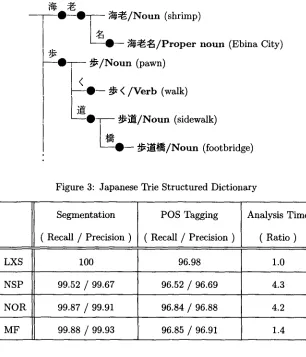
[image:2.612.98.524.68.318.2]non-segmented languages in the process of morpho- logical analysis appears in the way of the dictionary look-up. The standard technique for looking up lex- emes in Japanese dictionaries is to use a trie struc- ture(Fredkin, 1960)(Knuth, 1998). A trie structured dictionary gives all possible lexemes that start at a given position in a sentence effectively(Morimoto
and Aoe, 1993). We call this method of word
looking-up as "common prefix search" (hereafter CPS). Figure 3 shows a part of the trie for Japanese
lexeme dictionary. The results of CPS for " ~ j ~ ~'7 ~ o "(I go to Ebina.) are " ~ j ~ " and " ~ . " To get all possible lexemes in the sentence, the analyzer
has to slide the start position for CPS to the right by character by character.
3 A N a i v e A p p r o a c h
A simple method that directly applies the mor- phological analysis method for non-segmented lan- guages can handle the problems of segmented
languages. For instance, to analyze the sen-
tence, "They've gone to school together," we first delete all white spaces in the sentence and get "They'vegonetoschooltogether." Then we pass it to the analyzer for non-segmented languages. However, the analyzer may return the result as "They / 've / gone / to / school / to / get / her / ." inducing a spurious ambiguity. Mills applied this method and tokenized the medieval manuscript in Cornish(Mills,
1998).
We carried out experiments to examine the in- fluence of delimiter deletion. We use Penn Tree- bank(Santorini, 1990) part-of-speech tagged cor- pus (1.3M lexemes) to train an HMM and ana- lyze sentences by HMM-based morphological ana- lyzer MOZ(Yamashita, 1999)(Ymashita et al., 1999). We use a bigram model for training it from the cor- pus. Test data is the same as the training corpus. Table 1 shows accuracy of segmentation and part-of- speech tagging. The accuracy is expressed in terms of recall and precision(Nagata, 1999). Let the num- ber of lexemes in the tagged corpus be Std, the num- ber of lexemes in the output of the analyze be Sys,
and the number of matched lexemes be M.
Recall
is defined as M/Std,
precision
is defined as M/Sys. The following are the labels in Table 1 (sentence for- mats and methods we use):L X S We isolate all the lexemes in sentences and apply the method for segmented languages to the sentences. This situation is ideal, since the problems we discussed in Section 2 do not exist. In other words, all the sentences do not have segmentation ambiguity. We use the results as the baseline. Example sentence:
"Itu ' s u M r . u L e e u ' s u p e n u •"
N S P We remove all the spaces in sentences and
apply the method for non-segmented lan- guages to the sentences. Example sentence:
"It ' sMr. L e e ' s p e n . "
N O R Sentences are in the original normal format. We apply the method for non-segmented lan-
guages to the sentences. Example sentence:
"It ' S u M r . u L e e ' s u p e n . "
Because of no segmentation ambiguity, "LXS" performs better than "NSP" and "NOR." The fol- lowing are typical example of segmentation errors. The errors originate from conjunctive ambiguity and disjunctive ambiguity(Guo, 1997).
conjunctive ambiguity The analyzer recognized "away, .... ahead," "anymore," and '~orkforce"
as "a way," "a head," "any more," and '~ork
force," respectively. In the results of "NSP," the
number of this type of error is 11,267.
disjunctive a m b i g u i t y The analyzer recognized "a tour," "a ton," and "Alaskan or" as "at our," "at on," and "Alaska nor," respectively. In the results of "NSP," the number of this type of er- ror is 233.
Since only "NSP" has disjunctive ambiguity, "NOR" performs better than "NSP." This shows that white spaces between segments help to decrease segmenta- tion ambiguity.
Though the proportional difference in accuracy looks slight between these models, there is a con- siderable influence in the analysis efficiency. In the cases of "NSP" and "NOR," the analyzer may look up the dictionary from any position in a given sen- tence, therefore candidates for lexemes increase, and the analysis time also increase. The results of our experiments show that the run time of analyses of
"NSP" or "NOR" takes about 4 times more than that of "LXS."
4 M o r p h o - f r a g m e n t s : T h e B u i l d i n g B l o c k s
Although segmented languages seemingly have clear word boundaries, there are problems of further seg- mentation and rounding up as introduced in Section 2. The naive approach in Section 3 does not work well. In this section, we propose an efficient and so- phisticated method to solve the problems by intro- ducing the concept of
morpho-/ragments.
We also show that a uniform treatment of segmented and non-segmented languages is possible without induc- ing the spurious ambiguity.4.1 D e f i n i t i o n
,
O--O,
" ~ / N o u n (shrimp)I ~ • - - " ~ / P r o p e r n o u n (Ebina City)
~ / N o u n (pawn)
/
• - - -:~ ( / V e r b (walk)
• i ? ~ / N o u n (sidewalk)
I
~ • - - , : ~ / N o u n (footbridge)LXS
NSP
NOR
MF
Figure 3: Japanese Trie Structured Dictionary
Segmentation POS Tagging Analysis Time
( Recall / Precision ) ( Recall / Precision ) ( Ratio )
100 96.98 1.0
99.52 / 99.67 96.52 / 96.69 4.3
99.87 / 99.91 96.84 / 96.88 4.2
99.88 / 99.93 96.85 / 96.91 1.4
Table 1: Results of Experiments
characters and lexemes (see Figure 1 and Figure 2). MFs are well defined tokens which are specialized for language independent morphological analysis.
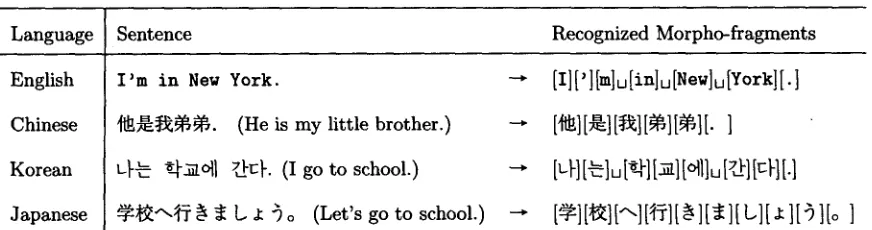
For example, in English, all punctuation marks are MFs. Parts of a token separated by a punctu- ation mark such as "He," "s," and the punctuation mark itself, . . . in "He's" are MFs. The tokens in a compound lexeme such as "New" and "York" in "New York" are also MFs. In non-segmented lan- guages such as Chinese and Japanese, every single character is a MF. Figure 4 shows decomposition of sentences into MFs (enclosed by "[" and "]") for sev- eral languages. Delimiters (denoted " J ' ) are treated as special MFs t h a t cannot start nor end a lexeme. Once the set of MFs is determined, the dictio- nary is compiled into a trie structure in which the edges are labeled by MFs, as shown in Figure 5 for English and in Figure 3 for Japanese. A trie struc- ture ensures to return all and only possible lexemes starting at a particular position in a sentence by a one-time consultation to the dictionary, resulting in an efficient dictionary look-up with no spurious am- biguity.
When we analyze a sentence of a non-segmented language, to get all possible lexemes in the sentence, the analyzer slides the position one character by one character from the beginning to the end of the sentence and consults the trie structured dictionary (Section 2). Note t h a t every character is a MF in non-segmented languages. In the same way, to an- alyze a sentence of a segmented language, the an- alyzer slides the position one MF by one MF and consults the trie structured dictionary, then, all pos- sible lexemes are obtained. For example, in Figure 5, the results of CPS for "'m in ..." are ... and "'m," and the results for "New York is ..." are "New" and
"New York."
[image:4.612.157.463.71.428.2] [image:4.612.187.439.73.230.2]Language Sentence Recognized Morpho-fragments
English
Chinese
Korean
Japanese
I'm in New York.
~ J ~ . (He is my little brother.)
L~--~ ~ o t I ~c~. (I go to school.)
- ~ g [ ~ ~ $ b .~ ~) o (Let's go to school.)
[Zl['][mlu[±nlu[Newlu[Yorkl[.]
-* ]
- * ]
Figure 4: Recognition of Morpho-fragments
0 - - I/Pronoun
A W I
1
I
' / P u n c t u a t i o n
m
A ' m / V e r b
S
0 - - 's/Possessive ending
N e w
0 ,
New/Adjective
Y o r k
" ' 0 w A N e w _ Y o r k / P r o p e r
noun
Figure 5: English Trie Structured Dictionary
4.2 How to Recognize Morpho-fragments
T h e problem is t h a t it is not easy t o identify the complete set of MFs for a segmented language. We do not make effort to find out the minimum and com- plete set of MFs. Instead, we decide to specify all the possible delimiters and punctuation marks ap- pearing in the dictionary, these may separate MFs or become themselves as MFs. By specifying the fol- lowing three kinds of information for the language under consideration, we attain a pseudo-complete MF definition. T h e following setting not only sim- plifies the identification of MFs but also achieves a uniform framework of language dependent morpho- logical analysis system.
1. T h e language type:
T h e languages are classified into two groups:
segmented and non-segmented languages.
"Language type" decides if every character in the language can be an MF. In non-segmented language every character can be an MF. In segmented language, punctuation marks and sequences of characters except for delimiters can be an MF.
2. T h e set of the delimiters acting as boundaries: These act as boundaries of MFs. However, these can not be independent MFs (can not start nor end a lexeme). For example, white spaces are delimiters in segmented languages.
3. T h e set of the p u n c t u a t i o n marks and other symbols:
These act as a b o u n d a r y of MFs as well as an MF. Examples are an apostrophe in "It's," a period in "Mr.," and a hyphen in "F-16."
• Using these information, the process of recogniz- ing MFs becomes simple and easy. T h e process can be implemented by a finite state machine or a simple p a t t e r n matcher.
T h e following is the example of the definition for English:
1. Language type: segmented language
2. Delimiters: white spaces, tabs, and carriage- returns
3. P u n c t u a t i o n marks: [.] [,][:] [;] ['] ["l [-] . " "[0] [1] [2]. • •
[image:5.612.88.560.67.405.2] [image:5.612.119.555.70.185.2]every character is an MF. The following is the ex- ample for Japanese and Chinese.
1. Language type: non-segmented language
2. Delimiters: not required
3. Punctuation marks: not required
Though Korean sentences are separated by spaces into phrasal segments, Korean is a non-segmented language essentially, since each phrasal segment does not have lexeme boundaries. We call this type of lan- guages incompletely-segmented languages. German is also categorized as this type. The following is the example for Korean.
1. Language type: non-segmented language
2. Delimiters: spaces, tabs, and carriage-returns
3. Punctuation marks: not required
In incompletely-segmented languages, such as Ko- rean, we have to consider two types of connection of lexemes, one is "over a delimiter" and the other is "inside a segment" (Hirano and Matsumoto, 1996). If we regard delimiters as lexemes, a trigram model can make it possible to treat both types.
The definition gives possible starting positions of MFs in sentences of the language and the same morphological analysis system is usable for any lan- guage.
We examined an effect of applying the morpho- fragments to analysis. Conditions of the experiment are almost the same as "NOR." The difference is that we use the morpho-fragments definition for En- glish. The row labeled "MF" in Table 1 shows the results of the analysis. Using the morpho-fragments decreases the analysis time drastically. The accuracy is also better than those of the naive approaches.
Well studied language such as English may have a hand tuned tokenizer which is superior to ours. However, to tune a tokenizer by hand is not suitable to implement many minor languages.
4.3 Implementation
We implement a language independent morphologi- cal analysis system based on the concept of morpho- fragments(Yamashita, 1999). With an existence of tagged corpus, it is straightforward to implement part-of-speech taggers. We have implemented sev- eral of such taggers. The system uses an HMM. This is trained by a part-of-speech tagged corpus. We overview the setting and performance of tagging for several languages.
English
An HMM is trained by the part-of-speech tagged corpus part of Penn Treebank(Santorini, 1990) (1.3 million morphemes). We use a tri- gram model. The lexemes in the dictionary are
taken from the corpus as well as from the en- try words in Oxford Advanced Learner's Dictio- nary(Mitton, 1992). The system achieves 97% precision and recall for training data, 95% pre- cision and recall for test data.
Japanese
An HMM is trained by Japanese part-of-speech tagged corpus(Rea, 1998) (0.9 million mor-
phemes). We use a trigram model. The
lexemes in the dictionary are taken from the corpus as well as from the dictionary of ChaSen(Matsumoto et al., 1999), a freely avail- able Japanese morphological analyzer. The sys- tem achieves 97% precision and recall for train- ing and test data.
C h i n e s e
An HMM is trained by the Chinese part-of- speech tagged corpus released by CKIP(Chinese Knowledge Information Processing Group, 1995) (2.1 million morphemes). We use a bi- gram model. The lexemes in the dictionary are taken only from the corpus. The system achieves 95% precision and recall for training data, 91% precision and recall for test data.
5 R e l a t e d W o r k a n d R e m a r k s
We address two problems of tokenization in seg- mented languages: further segmentation and round- up. These problems are discussed by several authors including Mills(Mills, 1998) Webster & Kit(Webster and Kit, 1992). However, their proposed solutions are not language independent.
To resolve the problems of tokenization, we first apply the method of non-segmented languages pro- cessing. However, this causes spurious segmenta- tion ambiguity and a considerable influence in the analysis times. Therefore, we propose the concept of morpho-fragments that minimally comprises the lexemes in a language. Although the idea is quite simple, our approach avoids spurious ambiguity and attains an efficient look-up of a trie structured dic-
tionary. In conclusion, the concept of morpho-
fragments makes it easy to implemented language independent morphological analysis.
R e f e r e n c e s
Chinese Knowledge Information Processing Group, 1995. ~ ~;~[ ~ [~ ~z ~ ~ ~.~ ~ ~ ~ ~ ~ _~ ~j]. Academia Sinica Institute of Information Science. in Chinese.
Christopher Fox, 1992. Lexical Analysis and Sto- plists, chapter 7, pages 102-130. In Frakes and
Baeza-Yates (Frakes and Baeza-Yates, 1992).
Edward Fredkin. 1960. Trie memory. Communica- tions of the ACM, 3(9):490-500, September. Jin Guo. 1997. Critical tokenization and its prop-
erties. Computational Linguistics, 23(4):569-596, December.
Yoshitaka Hirano and Yuji Matsumoto. 1996. A proposal of korean conjugation system and its ap- plication to morphological analysis. In Proceed- ings of the 11th Pacific Asia Conference on Lan- guage, Information and Computation (PACLIC 11), pages 229-236, December.
Donald E. Knuth. 1998. The Art of Computer Pro-
gramming : Sorting and Searching, volume 3.
Addison-Wesley, second edition, May.
Henry Ku~era and W. Nelson Francis. 1967. Com- putational Analysis of Present-Day American En- glish. Brown University Press.
Christopher D. Manning and Hinrich Schiitze. 1999.
Foundations of Statistical Natural Language Pro- cessing. The MIT Press.
Yuji Matsumoto, Akira Kitauchi, Tatsuo Yamashita, and Yoshitaka Hirano, 1999. Japanese Mor- phological Analysis System ChaSen version 2.0
Manual. NAIST Technical Report NAIST-IS-
TR99009, April.
Jon Mills. 1998. Lexicon based critical tokenization: An algorithm. In Euralex'98, pages 213-220, Au- gust.
Roger Mitton, 1992. A Description of A Computer- Usable Dictionary File Based on The Oxford Ad- vanced Learner's Dictionary of Current English.
K. Morimoto and J. Aoe. 1993. Two trie structures for natural language dictionaries. In Proceedings of Natural Language Processing Pacific Rim Sym- posium, pages 302-311.
Masaaki Nagata. 1994. A stochastic japanese mor- phological analyzer using a forward-dp backward- a* n-best search algorithm. In COLING-9$, vol- ume 1, pages 201-207, August.
Masaaki Nagata. 1999. A part of speech estimation method for japanese unknown words using a sta- tistical model of morphology and context. In 37th Annual Meeting of the Association for Computa- tional Linguistics, Proceedings of the Conference,
pages 277-284, June.
David D. Palmer and Marti A. Hearst. 1997. Adap- tive multilingual sentence boundary disambigua- tion. Computational Linguistics, 23(2):241-267, June.
Real World Computing Partnership, 1998. RWC Text Database Report. in Japanese.
Beatrice Santorini, 1990. Part-of-Speech Tagging Guidelines for the Penn Treebank Project (3rd Re- vision, 2nd printing), June.
Jonathan J. Webster and Chunyu Kit. 1992. Tok- enization as the initial phase in nip. In COLING- 92, volume 4, pages 1106-1110, August.
Tatsuo Yamashita, 1999. MOZ and LimaTK Man- ual NAIST Computational Linguistics Labora- tory, <http://cl.aist-nara.ac.jp/-tatuo-y/ma/>, August. in Japanese.