Unit C o m p l e t i o n for a C o m p u t e r - a i d e d Translation
S y s t e m
P h i l i p p e L a n g l a i s , G e o r g e F o s t e r a n d G u y L a p a l m e R A L I / D I R O
U n i v e r s i t 6 d e M o n t r e a l C . P . 6128, s u c c u r s a l e C e n t r e - v i l l e M o n t r a l ( Q u b e c ) , C a n a d a , H 3 C 3 J 7
{ f elipe,f o ster, lapalme } @iro. umontreal, ca
Typing
A b s t r a c t
This work is in the context of TRANSTYPE, a sys- tem that observes its user as he or she types a trans- lation and repeatedly suggests
completions
for the text already entered. The user may either accept, modify, or ignore these suggestions. We describe the design, implementation, and performance of a pro- totype which suggests completions of units of texts that are longer than one word.1 I n t r o d u c t i o n
TRANSTYPE is part of a project set up to explore an appealing solution to Interactive Machine Trans-
lation
(IMT). In constrast to classical IMT systems, where the user's role consists mainly of assisting the computer to analyse the source text (by answering questions about word sense, ellipses, phrasal attach- ments, etc), in TRANSTYPE the interaction is direct- ly concerned with establishing the target text.Our interactive translation system works as fol- lows: a translator selects a sentence and begins typ- ing its translation. After each character typed by the translator, the system displays a proposed com- pletion, which may either be accepted using a spe- cial key or rejected by continuing to type. Thus the translator remains in control of the translation process and the machine must continually adapt it- s suggestions in response to his or her input. We are currently undertaking a study to measure the extent to which our word-completion prototype can improve translator productivity. The conclusions of this study will be presented elsewhere.
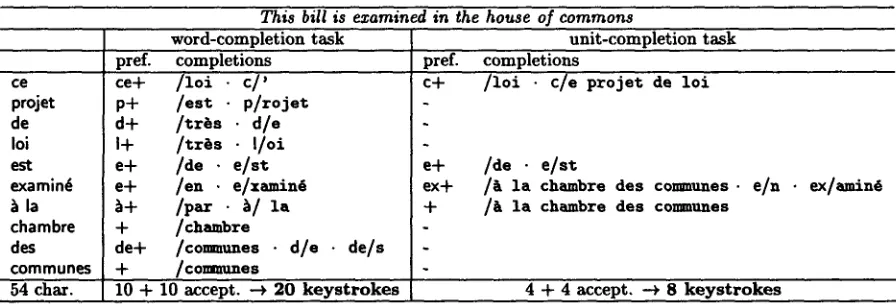
The first version of TrtANSTYPE (Foster et al., 1997) only proposed completions for the current word. This paper deals with predictions which ex- tend to the next several words in the text. The po- tential gain from multiple-word predictions can be appreciated in the one-sentence translation task re- ported in table 1, where a hypothetical user saves over 60% of the keystrokes needed to produce a translation in a word completion scenario, and about 85% in a "unit" completion scenario.
In all the figures that follow, we use different fonts to differentiate the various input and output:
italics
are used for the source text, sans-serif for characters typed by the user and t y p e w r i t e r - l i k e for charac- ters completed by the system.
The first few lines of the table 1 give an idea of how TransType functions. Let us assume the unit s- cenario (see column 2 of the table) and suppose that the user wants to produce the sentence "Ce projet
de loi est examin~ ~ la chambre des communes" as a
translation for the source sentence "This
bill is ex-
amined in the house of commons".
The first hypoth- esis that the system produces before the user enters a character is l o i(law).
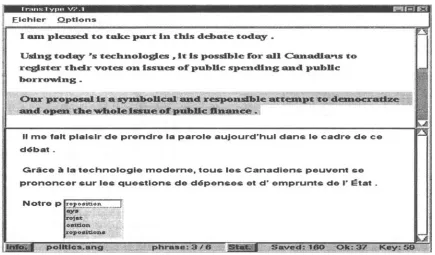
As this is not a good guess from TRANSTYPE the user types the first character (c) of the words he or she wants as a translation. Taking this new input into account, TRANSTYPE then modifies its proposal so that it is compatible whith what the translator has typed. It suggests the desired sequence ce projet de Ioi, which the user can simply validate by typing a dedicated key. Con- tinuing in this way, the user and TRANSTYPE alter- nately contribute to the final translation. A screen copy of this prototype is provided in figure 1.2 T h e C o r e E n g i n e
The core of TRANSTYPE is a completion engine which comprises two main parts: an evaluator which assigns probabilistic scores to completion hypotheses and a
generator which uses the evaluation function
to select the best candidate for completion.2.1 T h e E v a l u a t o r
The evaluator is a function p(t[t', s) which assigns to each target-text unit t an estimate of its probability given a source text s and the tokens t' which precede t in the current translation of s. 1 Our approach to modeling this distribution is based to a large extent on that of the IBM group (Brown et al., 1993), but it differs in one significant aspect: whereas the IB- M model involves a "noisy channel" decomposition, we use a linear combination of separate prediction- s from a language model
p(tlt ~)
and a translation model p(tls ). Although the noisy channel techniqueThis bill is examined in the house of commons
word-completion task unit-completion task
ce projet
de Ioi est examin~
chambre des communes
preL completions c e + / l o i • C/' p+ / e s t • p / r o j e t
d + / t r b s • d / e I + / t = ~ s • I / o i
e + / d e • e / s t e + / e n • e/xamin6 ~ + / p a r • ~ / 1~ + /chambre
de+ /co,~unes • d / e
+ /communes
•
de/s
pref. completions
c-l- /loJ. • c / e pro j e t de 1oi
e + / d e • e / s t
ex+ / ~ l a chambre des communes.
+ /b l a chambre d e s con~unes
e / n • e x / m i n ~
Table 1: A one-sentence session illustrating the word- and unit-completion tasks. The first column indicates the target words the user is expected to produce. The next two columns indicate respectively the prefixes typed by the user and the completions proposed by the system in a word-completion task. The last two columns provide the same information for the unit-completion task. The total number of keystrokes for both tasks is reported in the last line. + indicates the acceptance key typed by the user. A completion is denoted by a/13 where a is the typed prefix and 13 the completed part. Completions for different prefixes are separated by •.
is powerful, it has the disadvantage that p(slt' , t) is more expensive to compute than p(tls ) when using IBM-style translation models. Since speed is cru- cial for our application, we chose to forego the noisy channel approach in the work described here. Our linear combination model is described as follows:
pCtlt',s) = pCtlt') a ( t ' , s ) + pCtls)
[1
-exit',s)] (1)
• ~ • • v J
language translation
where a(t', s) E [0, 1] are context-dependent inter- polation coefficients. For example, the translation model could have a higher weight at the start of a sentence but the contribution of the language mod- el might become more important in the middle or the end of the sentence• A study of the weightings for these two models is described elsewhere• In the work described here we did not use the contribution of the language model (that is, a(t', s) = O, V t', s).
Techniques for weakening the independence as- sumptions made by the IBM models 1 and 2 have been proposed in recent work (Brown et al., 1993; Berger et al., 1996; Och and Weber, 98; Wang and Waibel, 98; Wu and Wong, 98). These studies report improvements on some specific tasks (task-oriented limited vocabulary) which by nature are very differ- ent from the task TRANSTYPE is devoted to. Fur- thermore, the underlying decoding strategies are too time consuming for our application• We therefore use a translation model based on the simple linear in- terpolation given in equation 2 which combines pre- dictions of two translation models - - M s and M~ - - both based on IBM-like model 2(Brown et al., 1993). Ms was trained on single words and Mu, described
in section 3, was trained on both words and units.
- - _ ( 2 )
word unit
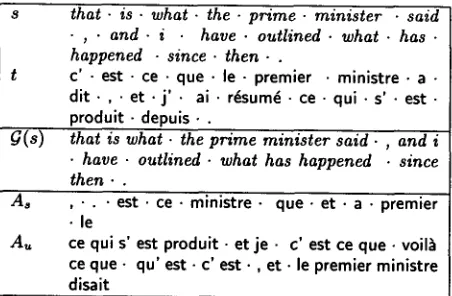
where Ps and Pu stand for the probabilities given re- spectively by Ms and M~. G(s) represents the new sequence of tokens obtained after grouping the to- kens of s into units. The grouping operator G is illustrated in table 2 and is described in section 3.
2 . 2 T h e G e n e r a t o r
[image:2.612.119.567.85.237.2]t h a t . is • w h a t . the . p r i m e , m i n i s t e r . said • a n d . i • h a v e . o u t l i n e d • w h a t . h a s . happened . s i n c e • t h e n . .
c' - est. c e - q u e , le- premier - ministre, a - d i t . , . e t . j ' , ai. r4sum4- ce. q u i . s ' - est- produit - depuis • .
g(s)
that is what • the p r i m e m i n i s t e r said • , and i • have . outlined • what has happened • since then • .As
A~
• • • e s t • c e • m i n i s t r e • q u e . e t • a • p r e m i e r l i e
c e q u i s' e s t p r o d u i t • e t j e - c ' e s t c e q u e . v o i l ~ c e q u e • q u ' e s t - c ' e s t • , e t • le p r e m i e r m i n i s t r e d i s a i t
Table 2: Role of the generator for a sample pair of sentences (t is the translation of s in our corpus). G(s) is the sequence of source tokens recasted by the grouping operator G. A8 indicates the 10 best tokens according to the word model, A u the 10 best units according to the unit model.
3 M o d e l i n g U n i t A s s o c i a t i o n s
Automatically identifying which source words or groups of words will give rise to which target words or groups of words is a fundamental problem which remains open. In this work, we decided to proceed in two steps: a) monolingually identifying groups of words t h a t would be b e t t e r handled as units in a giv- en context, and b) mapping the resulting source and target units. To train our unit models, we used a segment of the Hansard corpus consisting of 15,377 pairs of sentences, totaling 278,127 english token- s (13,543 forms) and 292,865 french tokens (16,399 forms).
3.1 F i n d i n g M o n o l i n g u a l U n i t s
Finding relevant units in a text has been explored in m a n y areas of natural language processing. Our ap- proach relies on distributional and frequency statis- tics computed on each sequence of words found in a training corpus. For sake of efficiency, we used the suffix array technique to get a compact representa- tion of our training corpus. This m e t h o d allows the efficient retrieval of arbitrary length n-grams (Nagao and Mori, 94; Haruno et al., 96; Ikehara et al., 96; Shimohata et al., 1997; Russell, 1998).
T h e literature abounds in measures t h a t can help to decide whether words t h a t co-occur are linguisti- cally significant or not. In this work, the strength of association of a sequence of words w [ = w l , . . . , w n is computed by two measures: a likelihood-based one p(w'~) (where g is the likelihood ratio given in (Dun- ning, 93)) and an entropy-based one e(w'~) (Shimo- h a t a et al., 1997). Letting T stand for the training text and m a token:
p ( w ~ ) = argming(w~, u S 1 ) (3)
ie]l,n[
e(w'~) = 0 . 5 x +k
~ r n l w , ~ m e T h ( Ireq(w'~ m) k Ir~q(wT) ]
Intuitively, the first measurement accounts for the fact t h a t parts of a sequence of words t h a t should be considered as a whole should not appear often by themselves. T h e second one reflects the fact t h a t a salient unit should appear in various contexts (i.e. should have a high entropy score).
We implemented a cascade filtering strategy based on the likelihood score p, the frequency f , the length l and the entropy value e of the sequences. A first filter
(.~"1
(lmin, fmin, Pmin,
e m i n ) ) removes any sequence s for which l ( s ) < lmin or p ( s ) < Pmin or e ( s ) < e,nin or f ( s ) < f m i n . A second filter (~'2) removes sequences that are included in pre- ferred ones. In terms of sequence reduction, apply- ing ~1 (2, 2, 5.0, 0.2) on the 81,974 English sequences of at least two tokens seen at least twice in our train- ing corpus, less t h a n 50% of them (39,093) were fil- tered: 17,063 (21%) were removed because of their low entropy value, 25,818 (31%) because of their low likelihood value.3.2 M a p p i n g
Mapping the identified units (tokens or sequences) to their equivalents in the other language was achieved by training a new translation model (IBM 2) us- ing the EM algorithm as described in (Brown et al., 1993). This required grouping the tokens in our training corpus into sequences, on the basis of the unit lexicons identified in the previous step (we will refer to the results of this grouping as the s e q u e n c e - based c o r p u s ) . To deal with overlapping possibilities, we used a dynamic programming scheme which opti- mized a criterion C given by equation 4 over a set S of all units collected for a given language plus all sin- gle words. G(w~) is obtained by returning the p a t h t h a t maximized B ( n ) . We investigated several C- criteria and we found C~--a length-based measurc to be the most satisfactory. Table 2 shows an o u t p u t of the grouping function.
O i l i = o
B ( i ) = argmax
/~[1,i[ ,w~_les
)
+ B ( i - I - 1)
(4)
[image:3.612.80.306.87.235.2]source unit (s)
we have 1748
we must 720
this bill 640
people of canada 282
mr. speaker : 269
what is happening 190
of course , 178
is it the pleasure of the house to 14
adopt the the world
child care
the free trade agreement
post-secondary education
the first time
the canadian aviation safety board
the next five years
the people of china
f(8) target units ([a,p])
[nous,0.49] [avons,0.41] [, nous avons,0.07]
[nous devons,0.61] [il rant,0.19] [nous,0.14]
[ce projet de 1oi,0.35] [projet de loi .,0.21] [projet de loi,0.18] [les canadiens,0.26] [des canadiens,0.21] [la population,0.07] [m. le prdsident :,0.80] [a,0.07] [h la,0.06]
Ice qui se passe,0.21] Ice qui se,0.16] [et,0.15]
[dvidemment ,0.26] [naturellement,0.08] [bien stir,0.08]
[plait-il h la chambre d' adopter,0.49] [la motion ?,0.42] [motion
?,0.04]
201 [le monde,O.46] [du monde,O.33] lie monde entier,O.19]
86 lies garderies,O.59] [la garde d' enfants,O.23] [des services de
garde d' enfants,O.13]
75 [1' accord de libre-dchange,O.96] [la ddcision du gatt,O.04] 66 [1' euseignement postsecondaize,O.75] [1' dducation postsec-
ondaire,O.15] [des fonds,O.06]
62 [la premiere fois,l.00]
36 lie bureau canadien de la s~urit~ adrienne,O.55] [du bureau cana- dien de la sdcurit~ adrienne,O.31] [1' un,O.14]
26 [au cours des cinq prochaines ann~es,O.53] [cinq prochaines an- ndes,O.27] [25 milliards de d ollars,O.lO]
17 [le peuple chinois,0.38] [la population chinoise,0.25] [les chi-
nois,O.13]
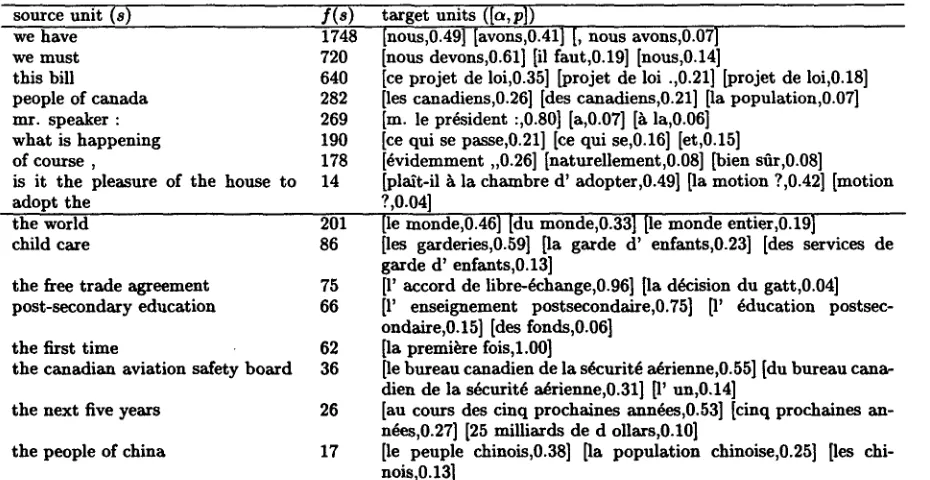
Table 3: Bilingual associations. The first column indicates a source unit, the second one its frequency in the
training corpus. The third column reports its 3-best ranked target associations (a being a token or a unit, p being the translation probability). The second half of the table reports NP-associations obtained after the filter described in the text.
We investigated three ways of estimating the pa- rameters of the unit model. In the first one, El, the translation parameters are estimated by apply- ing the EM algorithm in a straightforward fashion over all entities (tokens and units) present at least twice in the sequence-based corpus 2. The two next methods filter the probabilities obtained with the Ez method. In E2, all probabilities
p(tls )
are set to 0 whenever s is a token (not a unit), thus forcing the model to contain only associations between source units and target entities (tokens or units). In E3 any parameter of the model t h a t involves a token is removed (that is, p(tls ) = 0 if t or s is a token). The resulting model will thus contain only unit as- sociations. In both cases, the final probabilities are renormalized. Table 3 shows a few entries from a unit model (Mu) obtained after 15 iterations of the EM-algorithm on a sequence corpus resulting from the application of the length-grouping criterion (dr) over a lexicon of units whose likelihood score is above 5.0. The probabilities have been obtained by appli- cation of the method E2.We found many partially correct associations
Cover the years/au fils des, we have/nous,
etc) t h a t illustrate the weakness of decoupling the unit iden- tification from the mapping problem. In most cas-2The entities seen only once are mapped to a special "un- known" word
es however, these associations have a lower proba- bility t h a n the good ones. We also found few er- ratic associations
(the first time/e'dtait, some hon.
members/t,
etc) due to distributional artifacts. It is also interesting to note t h a t the good associations we found are not necessary compositional in nature(we must/il Iaut, people of canada/les canadiens, of
eourse/6videmment,
etc).3.3 F i l t e r i n g
[image:4.612.110.575.87.327.2]model spared ok good n u u
1 baseline - model 1 48.98 0 0 747 0
2 b a s e l i n e - model 2 5 1 . 8 3 0 0 7 4 7 0
3 E1 + ~'1(2, 2, 0, 0.2) 50.98 527 1702 5 626
4 E 1 + ~ ' 1 ( 2 , 2 , 5 , 0 . 2 ) 51.61 596 2149 5 658 5 E1 + ~-~ (2, 2, 5, 0.2) + 9r2 51.72 633 2265 5 657
6 E2 + ~'~(2,2,0,0.2) 51.39 514 1551 43 578
7 £2 + ~-~ (2, 2, 5, 0.2) 51.99 470 1889 46 614 8 E2 + ~'~(2,2,5,0.2) + ~'2 52.12 493 1951 46 606 9 E3 + ~-1(2, 2, 0, 0.2) 51.07 577 1699 43 588 10 E2 + ~-1(2, 2, 5, 0.2) 51.47 629 2124 46 618 11 E 2 + ~ ' ~ ( 2 , 2 , 5 , 0 . 2 ) + ~ ' 2 51.68 665 2209 46 615
12 ~1 -}- .~1 (2, 2, 5, 0.2) -}- .~2 -}-
~:NP
52.83 416 1302 4 56413 E2 + ~'1(2, 2, 5, 0.2) +
~NP
53.12 439 1031 228 425 14 £2 + ~'~ (2, 2, 5, 0.2) + 5r2 + ~'NP 53.16 458 1052 199 43915 ~3 -{- ~ : 0.4 -}- ~-1(2, 2, 5, 0.2) 4-
.~NP
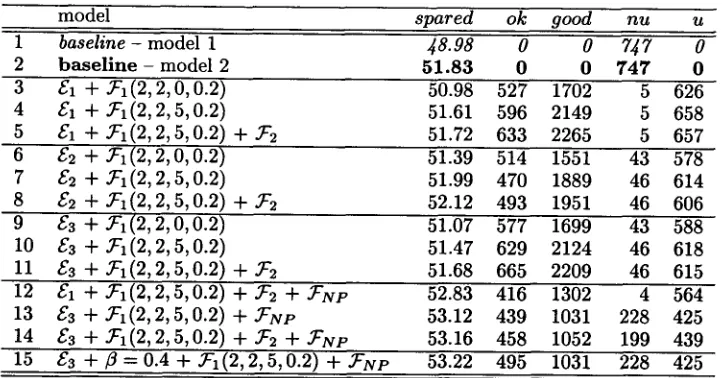
53.22 495 1031 228 425Table 4: Completion results of several translation models, spared: theoretical proportion of characters saved; ok: number of target units accepted by the user; good: number of target units t h a t matched the expected whether they were proposed or not; nu: number of sentences for which no target unit was found by the translation model; u: number of sentences for which at least one helpful unit has been found by the model, but not necessarily proposed.
More t h a n half of the 3,154 remaining NP-sequences contain only two words.
4
R e s u l t s
We collected completion results on a test corpus of 747 sentences (13,386 english tokens and 14,506 french ones) taken from the Hansard corpus. These sentences have been selected randomly among sen- tences t h a t have not been used for the training. Around 18% of the source and target words are not known by the translation model.
T h e baseline models (line 1 and 2) are obtained without any unit model (i.e. /~ = 1 in equation 2). T h e first one is obtained with an IBM-like model 1 while the second is an IBM-like model 2. We observe t h a t for the pair of languages we considered, model 2 improves the amount of saved keystrokes of almost 3% compared to model 1. Therefore we made use of alignment probabilities for the other models.
T h e three next blocks in table 4 show how the p a r a m e t e r estimation m e t h o d affects performance. Training models under the C1 m e t h o d gives the worst results. This results from the fact t h a t the word- to-word probabilities trained on the sequence based corpus (predicted by Mu in equation 2) are less ac- curate t h a n the ones learned from the token based corpus. T h e reason is simply that there are less oc- currences of each token, especially if m a n y units are identified by the grouping operator.
In methods C2 and C3, the unit model of equation 2 only makes predictions pu(tls ) when s is a source u- nit, thus lowering the noise compared to m e t h o d £1.
We also observe in these three blocks the influence of sequence filtering: the more we filter, the b e t t e r the results. This holds true for all estimation meth- ods tried. In the fifth block of table 4 we observe the positive influence of the NP-filtering, especially when using the third estimation method.
T h e best combination we found is reported in line 15. It outperforms the baseline by around 1.5%. This model has been obtained by retaining all se- quences seen at least two times in the training cor- pus for which the likelihood test value was above 5 and the entropy score above 0.2 (5rl (2, 2, 5, 0.2)). In terms of the coverage of this unit model, it is in- teresting to note t h a t among the 747 sentences of the test session, there were 228 for which the model did not propose any units at all. For 425 of the re- maining sentences, the model proposed at least one helpful (good or partially good) unit. The active vo- cabulary for these sentences contained an average of around 2.5 good units per sentence, of which only half (495) were proposed during the session. T h e fact that this model outperforms others despite it- s relatively poor coverage (compared to the others) may be explained by the fact that it also removes part of the noise introduced by decoupling the i- dentification of the salient units from the training procedure. Furthermore, as we mentionned earlier, the more we filter, the less the grouping scheeme presented in equation 4 remains necessary, thus re- ducing a possible source of noise.
[image:5.612.137.498.84.273.2]E i c h l e r C ) p t l o n s
l a m p l e a s e d t o t ~ l c e ] p a r t i n t h i s d e b a t e t o d W .
U s i n g r o d W " s t e c h n o l o g i e s , i t i s p o s s i b l e f o r a l l C ~ m ~ d i a ~ s t o r e g i s t e r t h e i r v o t e s o n i s s t l e s o f p u b l i c s p e n d i n g a n d p u b l i c I ) o r r o ~ v i n g .
II m e f a l t p l a l e l r d e p r e n d r e l a p a r o l e a u J o u r d ' h u i d a n a l e c a d r e d e ¢ e d ~ b a t .
G r ~ i c e & l a t e c h n o l o g l e m o d e r n e , t o u e l e a C a n a d l e n = p e u v e n t 6 e
p r o n o n c e r s u r l e = ; q u e s t i o n = d e d 6 p e n = e = = e t d" e r n p r u n t a d e I" I ~ t a t .
N o t r e p
Figure 1: Example of an interaction in TRANSTYPE with the source text in the top half of the screen. The target text is typed in the bottom half with suggestions given by the menu at the insertion point.
that it also removes part of the noise that is intro- duced by dissociating the identification of the salient units from the training procedure. ~ r t h e r m o r e , as we mentioned earlier, the more we filter, the less the grouping scheme presented in equation 4 remains necessary, thus further reducing an other possible source of noise.
5
Conclusion
We have described a prototype system called TRANSTYPE which embodies an innovative ap- proach to interactive machine translation in which the interaction is directly concerned with establish- ing the target text. We proposed and tested a mech- anism to enhance TRANSTYPE by having it predic- t sequences of words rather than just completions for the current word. The results show a modest improvement in prediction performance which will serve as a baseline for our future investigations. One obvious direction for future research is to revise our current strategy of decoupling the selection of units from their bilingual context.
A c k n o w l e g m e n t s
TRANSTYPE is a project funded by the Natural Sci- ences and Engineering Research Council of Canada. We are undebted to Elliott Macklovitch and Pierre Isabelle for the fruitful orientations they gave to this work.
References
Adam L. Berger, Stephen A. Della Pietra, and Vin- cent J. Della Pietra. 1996. A maximum entropy approach to natural language processing.
Compu-
tational Linguistics, 22(1):39-71.
Peter F. Brown, Stephen A. Della Pietra, Vincen- t Della J. Pietra, and Robert L. Mercer. 1993. The mathematics of machine trmaslation: Pa- rameter estimation.
Computational Linguistics,
19(2):263-312, June.Ted Dunning. 93. Accurate methods for the statis- tics of surprise and coincidence.
Computational
Linguistics, 19(1):61-74.
David A. Evans and Chengxiang Zhai. 1996. Noun- phrase analysis in unrestricted text for informa- tion retrieval. In
Proceedings of the 34th Annu-
al Meeting of the Association for Computational
Linguistics, pages 17-24, Santa Cruz, California.
George Foster, Pierre Isabelle, and Pierre Plamon-don. 1997. Target-text Mediated Interactive Ma- chine Translation.
Machine Translation, 12:175-
194.Pascale Fung. 1995. A pattern matching method for finding noun and proper noun translations from noisy parallel corpora. In
Proceedings of the 33rd
Annual Meeting of the Association for Compu-
tational Linguistics, pages 236-243, Cambridge,
Massachusetts. [image:6.612.114.549.74.329.2]tal translation utilizing constituent boundray pat-
terns. In Proceedings of the 16th International
Conference On Computational Linguistics, pages 412-417, Copenhagen, Denmark.
Eric Gaussier. 1995. Modles statistiques et patron-
s morphosyntaxiques pour l'extraction de lcxiques bilingues. Ph.D. thesis, Universit de Paris 7, jan- vier.
Masahiko Haruno, Satoru Ikehara, and Takefumi Yamazaki. 96. Learning bilingual collocations by
word-level sorting. In Proceedings of the 16th In-
ternational Conference On Computational Lin- guistics, pages 525-530, Copenhagen, Denmark. Kuang hua Chen and Hsin-Hsi Chen. 94. Extract-
ing noun phrases from large-scale texts: A hybrid
approach and its automatic evaluation. In Pro-
ceedings of the 32nd Annual Meeting of the Asso- ciation for Computational Linguistics, pages 234- 241, Las Cruces, New Mexico.
Satoru Ikehara, Satoshi Shirai, and Hajine Uchino. 96. A statistical method for extracting uinterupt- ed and interrupted collocations from very large
corpora. In Proceedings of the 16th International
Conference On Computational Linguistics, pages 574-579, Copenhagen, Denmark.
Julian Kupiec. 1993. An algorithm for finding noun phrase correspondences in bilingual corpora. In
Proceedings of the 31st Annual Meeting of the Association for Computational Linguistics, pages 17-22, Colombus, Ohio.
Dekang Lin. 99. Automatic identification of non-
compositional phrases. In Proceedings of the 37th
Annual Meeting of the Association for Computa- tional Linguistics, pages 317-324, College Park, Maryland.
I. Dan Melamed. 1997. Automatic discovery of non- compositional coumpounds in parallel data. In
Proceedings of the 2nd Conference on Empirical Methods in Natural Language Processing, pages 97-108, Providence, RI, August, lst-2nd.
Makoto Nagao and Shinsuke Mori. 94. A new method of n-gram statistics for large number of n and automatic extraction of words and phrases
from large text data of japanese. In Proceedings
of the 16th International Conference On Com- putational Linguistics, volume 1, pages 611-615, Copenhagen, Denmark.
Franz Josef Och and Hans Weber. 98. Improving statistical natural language translation with cate-
gories and rules. In Proceedings of the 36th Annu-
al Meeting of the Association for Computational Linguistics, pages 985-989, Montreal, Canada. Graham Russell. 1998. Identification of salient to-
ken sequences. Internal report, RALI, University of Montreal, Canada.
Sayori Shimohata, Toshiyuki Sugio, and Junji
Nagata. 1997. Retrieving collocations by co-
occurrences and word order constraints. In Pro-
ceedings of the 35th Annual Meeting of the Asso- ciation for Computational Linguistics, pages 476- 481, Madrid Spain.
Keh-Yih Su, Ming-Wen Wu, and Jing-Shin Chang. 1994. A corpus-based approach to automatic com-
pound extraction. In Proceedings of the 32nd An-
nual Meeting of the Association for Computation- al Linguistics, pages 242-247, Las Cruces, New Mexico.
Ye-Yi Wang and Alex Waibel. 98. Modeling with structures in statistical machine translation. In
Proceedings of the 36th Annual Meeting of the Association for Computational Linguistics, vol- ume 2, pages 1357-1363, Montreal, Canada. Dekai Wu and Hongsing Wong. 98. Machine trans-
lation with a stochastic grammatical channel. In
Proceedings of the 36th Annual Meeting of the Association for Computational Linguistics, pages 1408-1414, Montreal, Canada.
Dekai Wu. 1995. Stochastic inversion transduc- tion grammars, with application to segmentation, bracketing, and alignment of parallel corpora. In