T h e A c q u i s i t i o n of Lexical K n o w l e d g e f r o m C o m b i n e d
M a c h i n e - R e a d a b l e D i c t i o n a r y S o u r c e s
Antonio Sanfilippo*
C o m p u t e r Laboratory, University of Cambridge New M u s e u m Site, Pembroke Street
Cambridge CB2 3QG, UK Antonio.Sanfilippo~cl.cam.ac.uk
Victor Poznatlski
I R I D I A , Universit~ Libre de Bruxelles 50 Avenue F. Roosevelt, CP 194/6
B-1050 Bruxelles, Belgique v i c p o z ~ i s l . v u b . a c . b e
Abstract
This p a p e r is concerned with the question of how to e x t r a c t lexical knowledge from Machine- Readable Dictionaries (MRDs) within a lexi- cal d a t a b a s e which integrates a lexicon devel- o p m e n t environment. Our long t e r m objective is the creation of a large lexical knowledge base using s e m i a u t o m a t i c techniques to recover syn- tactic and semantic information from MRDs. In doing so, one finds t h a t reliance on a single M R D source induces inadequacies which could be efficiently redressed through access to com- bined M R D sources. In the general case, the integration of information f r o m distinct MRDs remains a p r o b l e m hard, p e r h a p s impossible, to solve without the aid of a complete, linguisti- cally m o t i v a t e d d a t a b a s e which provides a ref- erence point for comparison. Nevertheless, ad- vances can be m a d e by a t t e m p t i n g to correlate dictionaries which are not too dissimilar. In keeping with these observations, we describe a software package for correlating MRDs based on sense merging techniques and show how such a tool can be employed in augmenting a lexical knowledge base built f r o m a conventional M R D with thesaurus information.
1 I n t r o d u c t i o n
Over the last few years, the utilization of machine read- able dictionaries (MRDs) in compiling lexical compo- nents for N a t u r a l Language Processing (NLP) systems has awakened the interest of an increasing n u m b e r of re- searchers. T h i s trend has largely arisen from the recog- nition t h a t access to a large scale Lexical Knowledge Base ( L K B ) is a s i n e qua n o n for real world applica- tions of N L P systems. C o m p u t e r - a i d e d acquisition of lexical knowledge from MRDs can be m a d e to satisfy this prerequisite in a m a n n e r which is b o t h time- and cost- effective. However, to maximize the utility of M R D s in *The research reported in this paper was carried out at the Computer Laboratory (University of Cambridge) as part of an ongoing study on the acquisition of lexical knowledge from machine-readable dictionaries within the ACQUILEX project, ESPRIT BRA 3030.
N L P applications, it is necessary to overcome inconsis- tencies, omissions and the occasional errors which are c o m m o n l y found in M R D s (Atkins el al., 1986; Atkins, 1989; Akkerman, 1989; Boguraev & Briscoe, 1989). This goal can be p a r t l y achieved by developing tools which m a k e it possible to correct errors and inconsistencies contained in the information structures automatically derived from the source M R D before these are stored in the L K B or t a r g e t lexicon (Carroll & Grover, 1989). This technique is nevertheless of little avail in redress- ing inadequacies which arise from lack of information. In this case, m a n u a l supply of the missing information would be too time- and labour-intensive to be desirable. Moreover, the information which is missing can be usu- ally obtained f r o m other M R D sources. Consider, for ex- ample, a situation in which we wanted to a u g m e n t lexical representations available f r o m a conventional dictionary with thesaurus information. T h e r e can be little doubt t h a t the integration of information f r o m distinct MRD sources would be far more convenient and appropriate t h a n reliance on manual encoding.
result since the information with respect to which a sense correlation is being sought m a y generalize across closely related word senses. Third, a close inspection of infelici- tous matches provides a b e t t e r understanding of specific difficulties involved in the task and m a y help develop solutions. Finally, the construction of a linguistically m o t i v a t e d d a t a b a s e aimed to facilitate the interrogation of combined M R D sources would be highly enhanced by the availability of new tools for lexicology. Partial as it m a y be, the possibility of m a p p i n g MRDs onto each other through sense-merging techniques should thus be seen as a step forward in the right direction.
T h e goal of this p a p e r is to describe a software pack- age for correlating word senses across dictionaries which can be straightforwardly tailored to an individual user's needs, and has convenient facilities for interactive sense matching. We also show how such a tool can be em- ployed in augmenting a lexical knowledge base built from a conventional M R D with thesaurus information.
2
Background
Our point of departure is the Lexical D a t a Base (LDB) and LKB tools developed at the C o m p u t e r L a b o r a t o r y in Cambridge within the context of the A C Q U I L E X project. T h e LDB (Carroll, 1990) gives flexible access to M R D s and is endowed with a graphic interface which provides a user-friendly environment for query formation and information retrieval. It allows several dictionaries to be loaded and queried in parallel.
| [ - 1 ~ L d o c e / _ S e m / _ I n t e r O u e r quer~j
p r o n
I
s3
Add
C l e a r Undo T e m p l a t e . . .
R e a d . . . W r i t e . . . P r i n t . . .
s y n sem
I1 genus box
Takes Type OR HOT 1OH
l i p NP 2 Unaccusative make c a u s e 5H
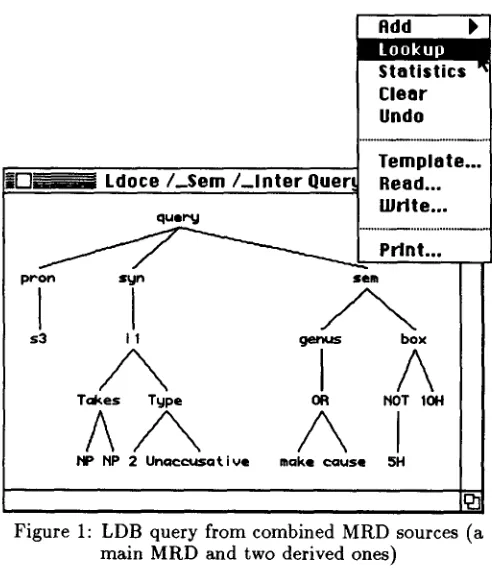
Figure 1: LDB query from combined M R D sources a main M R D and two derived ones)
Until recently, this facility has been used to extract in- formation from combined M R D sources which included a main dictionary and a n u m b e r of dictionaries derived from it. For example, the information needed to build LKB representations for English verbs (see below) was
p a r t l y obtained by running LDB queries which combined information from the L o n g m a n Dictionary of Contempo- rary English ( L D O C E ) and two other dictionaries de- rived from LDOCE: LDOCE_Inter and LDOCE_Sem. LDOCE_Inter was derived by a translation program which m a p p e d the g r a m m a r codes of L D O C E entries into theoretically neutral intermediate representations (Boguraev & Briscoe, 1989; Carroll & Grover, 1989). LDOCE_Sem was derived by extracting genus terms from dictionary definitions in L D O C E (Alshawi, 1989; Vossen, 1990). Figure 1 provides an illustrative example of an LDB query which combines these MRD sources. We used these LDB facilities for running queries from combined M R D sources which included more than one M R D - - i.e. L D O C E and the Longman Lexicon of Con- t e m p o r a r y English ( L L O C E ) , a thesaurus closely related to L D O C E .
T h e LKB provides a lexicon development environment which uses a t y p e d graph-based unification formalism a s representation language. A detailed description of the L K B ' s representation language is given in papers by Copestake, de Paiva and Sanfilippo in Briscoe et al.
(forthcoming); various properties of the system are also discussed in Briscoe (1991) and Copestake (1992). The LKB allows the user to define an inheritance network of types plus restrictions associated with them, and to create lexicons where such types are assigned to lexi- cal templates extracted through LDB queries which give word-sense specific information. Consider, for exam- ple, the lexical t e m p l a t e relative to the first L D O C E sense of the verb delight in (1) where sense specific infor- mation is integrated with a reference to the LKB type STRICT-TRANS-SIGII which provides a general syntactic and semantic characterization of strict transitive verbs. 1
(1) d e l i g h t L _ 2 _ I STRICT-TI~NS-SIGN
< c a t : r e s u l t : r e s u l t : m - f e a t s : d i a t h e s i s > = I N D E F - O B J
< c a t : r e s u l t : r e s u l t :m-f e a t s : r e g - m o r p h > = T R U E
< c a t : a c t i v e : s e m : a r g 2 > - E - H U M A N
< s e n s e - i d : d i c t i o n a r y > - " L D O C E "
< s e n s e - i d : i d b - e n t r y - n o > = " 9 3 3 5 " < s e n s e - i d : s e n s e - n o > I "1".
W h e n loaded into the LKB, the lexical t e m p l a t e above will expand into a full syntactic and semantic rep- resentation as shown in Figure 2; this representa- tion arises from integrating sense-specific information with the information structure associated with the type
S T R I C T - T R A N S - S I G N f i
XThe type specification INDEF-0BJ in (1) corresponds to the LDB value Unaccusative (see Figure 1) and marks tran- sitive verbs which are amenable to the indefinite object alter- nation, e.g. a book which is certain to delight them vs. a book
which is certain to delight. Information concerning diathesis
alternations is also derived from LDOCElnter. The value TRUE for the attribute reg-morph indicates that delight has
regular morphology. OBJ and E-ItlJI~N are sorted variables for individual objects.
[image:2.612.55.301.381.665.2][ strlct-trane~lgn
ORTH:dellght
CAT: RESULt: [atdct-lntrans-cat RESULT: [sent-rat
CAT-TYPE: sent
M-FEATS: [sent-m-feats DIATHESIS: Indef-obj
REG-MORPH: true]]
DIRECTION: forward
ACTIVE: [nlPslgn SEM: ,c1>]] DIRECTION: backward
ACTIVE: [dlr-obJ-np-slgn SEM:,=2>]] SEM: [ atrlot-trans-sem
IND:,c0> =eve
PREO:and ARGI : [verb-formula
IND:<0>
PRED: dallght_l_2 1 ARG I : ,cO>] ARG2: [blnary-formula
IND: ,=0> PRED: and
ARGI : ,~1> =[p-agt-lornmla IND: ,c0=, PRED:p-,gt ARG 1 : ,c0=, ARG 2: obj ] ARG2: ~2> = [p-pat-formula
IND: <0> PRED:p-pat ARG 1: ,c0> ARG2:e-human ]]] S E N S E - I D ~'e-n s'-~l- "J'] ]
Figure 2: L K B entry for sense 1 of the verb
delight
in L D O C ELexieal t e m p l a t e s such as the one in (1) are generated through a user definable conversion function - - a facil- ity included in the L K B - - which makes it possible to establish correspondences between information derived through LDB queries and L K B types. For example, information relative to selectional restrictions for tran- sitive verbs (e.g. e-human and
obj
in (1)) is encoded by establishing a correspondence between the value for the individual variables of the subject and object roles in L K B representations and the values retrieved from the relevant L D O C E entry for box codes 5 and 10 (see Figure 1). Similarly, the assignment of verb types (e.g. STRICT-TRANS-SIGN) to verb senses is carried out by re- lating L K B types for English verbs - - a b o u t 30 in the current i m p l e m e n t a t i o n (Sanfilippo, forthcoming) - - to subcategorization p a t t e r n s retrieved from LDOCE_Inter. For example, if a verb sense in LDOCE_Inter were asso- ciated with the information in (2), the conversion func- tion would associate the lexical t e m p l a t e being generated with the type STRICT-TRANS-SIGN.(2) ((Cat V) (Takes NP NP) ...)
Needless to say, the a m o u n t of information specified in LKB entries will be directly proportional to the amount of information which can be reliably e x t r a c t e d through LDB queries. W i t h respect to verbs, there are several of roles is computed in terms of entailments of verb meanings which determine the most (p-agt) and least (p-pat) agentive event participants for each choice of predicate; see Figures 4 and 5 for illustrative example. This approach reproduces the insights of Dowty's and Jackendoff's treatments of thematic information (Dowty, 1991; Jackendoff, 1990) within a neo- Davidsonian approach to verb semantics (Sanfilippo, 1990).
ways in which the representations derived from tem- plates such as the one in (1) can be enriched. In the simplest case, additional information can be recovered from a single M R D source either directly or through translation p r o g r a m s which allow the creation of derived dictionaries where information which is somehow con- tained in the source M R D can be made more explicit. This technique m a y however be insufficient or inappro- priate to recover certain kinds of information which are necessary in building an adequate verb lexicon. Consider the specification of verb class semantics. This is highly instrumental in establishing subcategorization and reg- imenting lexically governed g r a m m a t i c a l processes (see Levin (1989), Jackendoff (1990) and references therein) and should be thus included within a lexicon which sup- plied adequate information a b o u t verbs. For example, a verb such as
delight
should be specified as a m e m b e r of the class of verbs which express emotion, i.e. psycholog- ical verbs. As is well known (Levin, 1989; Jackendoff, 1990), verbs which belong to this semantic class can be classified according to the following parameters:* affect is positive
(admire, delight),
neutral(experi-
ence, interest)
or negative(fear, scare)
• stimulus a r g u m e n t is realized as object and experi- encer as subject, e.g.
admire, experience, fear
• stimulus argument is realized as subject and expe-riencer as object, e.g.
delight, interest, scare
Psychological verbs with experiencer subjects are 'non- causative'; the stimulus of these verbs can be considered to be a 'source' to which the experiencer 'reacts emc, tively'. By contrast, psychological verbs with stimulu,, subjects involve 'causation'; the stimulus argument ma3 be consided as a 'causative source' by which the experi. encer participant is 'emotively affected'. Six subtypes o psychological verbs can thus be distinguished accordint to semantic properties of the stimulus and experience: arguments as shown in (3) where the verbdelight
is spec ified as belonging to one of these subtypes.(3)
S T I M U L U Snon-causative source non-causative source non-causative source neutral,
causative source positive,
causative source negative, causative source
E X P E R I E N C E R
neutral,
reactive, emotive positive,
reactive emotive negative,
reactive, emotive neutral,
affected, emotive positive,
affected, emotive negative,
affected emotive
E X A M P L E
experience
admire
fear
interest
delight
Correct classification of m e m b e r s of the six ver classes in (3) through LDB queries which used as soure a s t a n d a r d dictionary (e.g. L D O C E ) is a fairly hopele~, pursuit. S t a n d a r d dictionaries are simply not equippe to offer this kind of information with consistency an exhaustiveness. Furthermore, the technique of creatin derived dictionaries where the information contained i a main source M R D is m a d e more explicit is unhel[ ful in this case. For example, one approach would b
[image:3.612.112.318.58.361.2]to derive a dictionary from L D O C E where verbs are or- ganized into a network defined by IS-A links using the general approach to t a x o n o m y formation described by Amsler (1981). Such an approach would involve the for- m a t i o n of chains through verb definitions determined by the genus t e r m of each definition. Unfortunately, the genus of verb definitions is often not specific enough to supply a taxonomic characterization which allows for the identification of semantic verb classes with consistency and exhaustiveness. In L D O C E , for example, the genus of over 20% of verb senses (about 3,500) is one of 8 verbs:
cause, make, be, give, put, take, move, have; m a n y of
the word senses which have the same genus belong to distinct semantic verb classes. This is not to say t h a t verb taxonomies are of no value, and in the final sec- tion we will briefly discuss an i m p o r t a n t application of verb taxonomies with respect to the assignment of se- mantic classes to verb senses. Nevertheless, the achieve- ment of adequate results requires techniques which re- classify entries in the same source MRD(s) rather t h a n making explicit the classification 'implicit' in the lexi- cographer's choice of genus term. Thesauri provide an alternative semantically-motivated classification of lexi- cal items which is most naturally suited to reshape or a u g m e n t the taxonomic structure which can be inferred from the genus of dictionary definitions. T h e L L O C E is a thesaurus which was developed from L D O C E and there is substantial overlap (although not identity) be- tween the definitions and entries of b o t h MRDs. We decided to investigate the plausibility of semi-automatic sense correlations with L D O C E and L L O C E and to ex- plore the utility of the thesaurus classification for the classification of verbs in a linguistically motivated way.
3 D C K : A F l e x i b l e T o o l f o r C o r r e l a t i n g W o r d S e n s e s A c r o s s M R D s
Our immediate goal in developing an environment for correlating M R D s was thus to merge word senses, and in particular verb senses, from L D O C E and LLOCE. More generally, our aim was to provide a Dictionary Corre- lation Kit ( D C K ) containing a set of flexible tools t h a t can be straightforwardly tailored to an individual user's needs, along with a facility for the interactive match- ing of dictionary entries. Our D C K is designed to cor- relate word senses across pairs of M R D s which have been m o u n t e d on the LDB (henceforth source-dict and
destination.dict) using a list of comparison heuristics.
Entries from the source-dict and destination-dict are compared to yield a set of correlation structures which describe matches between word senses in the two dictio- naries. A function is provided t h a t converts correlation structures into entries of a derived dictionary which can be mounted and queried on the LDB.
3.1 General Functionality o f D C K
E n t r y fields in the source-dict and destination-dict are compared by means of comparators. These are func- tions which take as input normalized field information
extracted from the entries under analysis, and return two values: a score indicating the degree to which the
two fields correlate, along with an advisory datum which indicates what kind of action to take. T h e objective of each match is to produce a correlation structure con- sisting of a source-dict sense and a set of destination-dict sense/score pairs representing possible matches. Prior to converting correlation structures into derived dictionary entries, the best m a t c h is selected for each correlation structure on the basis of the c o m p a r a t o r scores. When there is ambiguity as to the best match, a correlation di-
alog window pops up t h a t allows the user to peruse the
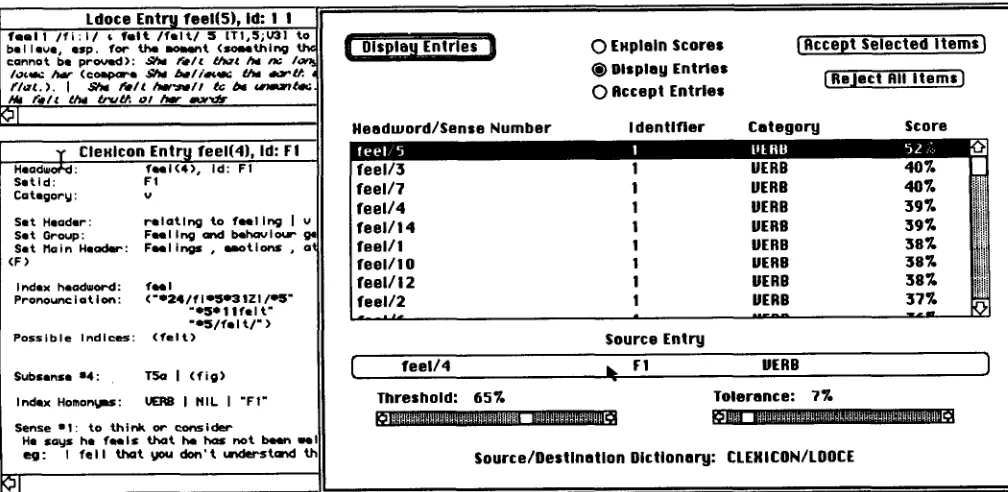
candidate matches and manually select the best match (see Figure 3).
3.2 C u s t o m i s l n g D C K
T w o categories of information must be provided in order to correlate a pair of new L D B - m o u n t e d dictionaries:
* functions which normalize dictionary-dependent field values, and
* dictionary independent c o m p a r a t o r s which provide matching heuristics.
Field values describing the same information may be labeled differently across dictionaries. For example, pro- nouns m a y be tagged as Pron in the part-of-speech field of one dictionary and Pronoun in part-of-speech field of another dictionary. It is therefore necessary to provide normalizing functions which convert dictionary-specific field values into dictionary-independent ones which can be compared using generic comparators.
C o m p a r a t o r s take as arguments pairs of normalized field values relative to the senses of the two MRDs un- der comparison, and return a score associated with an advisory d a t u m which indicates the course of action to be followed. T h e score and advisory d a t u m provide an index of the degree of overlap between the two senses.
3.3 D e t e r m i n i n g t h e B e s t Sense
A correlation structure contains a list of destination-dict sense/score pairs which indicate possible matches with the corresponding source-dict sense. T h e most appro- priate m a t c h can be determined automatically using two user-provided parameters:
1. the threshold, which indicates the minimal accept- able score t h a t a c o m p a r a t o r list must achieve for a u t o m a t i c sense selection, and
2. the tolerance, which is the m i n i m u m difference be- tween the top two scores t h a t must be achieved if the top sense with the highest score is to be selected. T h e sense/score pair with the highest score is a u t o m a t - ically selected if:
A. the advisory d a t u m provides no indication t h a t the correlation should be queried,
B. the score relative to a single match exceeds the threshold, or
C. the score relative to two or more matches exceeds
the threshold, and the difference between the top two scores exceeds the tolerance.
Ldoce Entr~ feel(5), Id: I I
f e l l l / f i : l / t f e l t / f e l t / 3 [ T I , 5 ; U 3 ] t o bel l a v e , a s p . f o r t h e i m e e n t ( s o l e t h l n g th¢ c a n n o t be p r o v e d ) : ~ f e / ¢ ~ ¢ Pkl fac /o~.
Io¢o,= ~ (colip<ma ~ l b e / / e c ~ e ; the .~¢~'tt.
f / ¢ z L ). I $h4 f e l t h.w'mw/! ,*~ be ~ , * e . ;
T clexlcon Entr~l feel(4), Id: FI
Headwo/~d: f e e l ( 4 ) , i d : F I S e t l d :
C a t e g o r y : S e t Header: S e t Group: Set Main Header: ( F )
I n d e x headword: P r o n e u n o l a t l o n :
P o s s i b l e I n d i c e s : F I v
r e l a t i n g t o f e e l I n g I v F e e l I n g and b41houlour Feel i n g s , e m o t i o n s , a~
f e e I
( ' ' 2 4 / f 1 " 5 " 3 IZl/s%i:- " ' 5 e l I f e l t" " ~ / f e l t / = )
( f e l t )
S u b l i n s e e4: TSo I ( f i g ) Index Homonyms: VERB I N I L I " F t " Sense e l : t o t h i n k o r ( ~ o n s i d e r
He s a y s he f e e l s t h a t he has n o t been we e g : I f e l l t h a t ~ d o n ' t u n d e r s t a n d t h
oi
Xeodword/Sense Number
0 Explain Scores [Accept Selected items} 0 Display [ntrlas
[Reject All Items] 0 Accept Entries
I dentlfler Category Score
f e e l / 3 f e e l / 7 f e e l / 4 f e e l / 1 4 f e e l / l f e e l / I O f e e l / 1 2 f e e l l 2
I VERB 40%
I VERB 40%
I VERB 39%
I VERB 39%
I VERB 38%
I VERB 38%
I VERB 38%
I VERB 37%
Source Entry
(
f e e l l 4 itThreshold: 65%
~ t l el I , ! r ,'Ill
FI VERB
Tolerance: 7%
Source/Destlnatlon Dictionary: CLEXICON/LDOCE
Figure 3: Sample interaction with correlation dialog
3.4 T h e C o r r e l a t i o n D i a l o g
T h e correlation dialog allows the user to examine correla- tion structures and select none, one or more destination- dict senses to be m a t c h e d with the source-dict sense un- der analysis. A typical interaction can be seen in Fig- ure 3. A scrollable window in the centre of the dia- log box provides information a b o u t the destination-dict senses and their associated scores. Single clicking the mouse b u t t o n on one or more rows makes t h e m the cur- rent selection. T h e large b u t t o n above the threshold and tolerance indicators summarizes source-dict sense infor- mation. Clicking on this b u t t o n invokes an LDB query window which inspects the source-dict sense (cf. b o t t o m left window in Figure 3).
T h e dialog can be in one of three modes:
• Explain Scores - - the m o d e specific key pops up a window for each destination-dict sense in the cur- rent selection, explaining how each score was ob- tained f r o m the comparators;
• Display Entries - - the m o d e specific key invokes s t a n d a r d LDB browsers on the destination-dict senses in the current selection (cf. top-left window in Figure 3), and
• Accept Entries - - the mode specific key terminates the dialog and accepts the current selection as the best match.
T w o additional b u t t o n s on the top right of the dialog box allow the current selection to be accepted independent of the current mode, or all senses to be rejected (i.e. no m a t c h is found). At the b o t t o m of the screen, two ' t h e r m o m e t e r s ' allow the user to adjust the threshold and tolerance p a r a m e t e r s dynamically.
4
Using D C K
We run D C K with L L O C E as source-dict and L D O C E as destination-dict to produce a derived dictionary, LDOCE_Link, which when loaded together with L D O C E would allow us to form L D O C E queries which inte- grated thesaurus information f r o m L L O C E . T h e work was carried out with specific reference to verbs which express 'Feelings, Emotions, Attitudes, and Sensations' and 'Movement, Location, Travel, and T r a n s p o r t ' (sets ' F ' and ' M ' in L L O C E ) . Correlation structures were de- rived for 1194 verb senses (over 1/5 of all verb senses in L L O C E ) using as m a t c h i n g p a r a m e t e r s degree of overlap in g r a m m a r codes, definitions and examples, as well as equality in headword and part-of-speech. After some trim runs, correlations a p p e a r e d to yield best results when all p a r a m e t e r s were assigned the same weight ex- cept the c o m p a r a t o r for 'degree of overlap in examples' which was set to be twice as d e t e r m i n a n t t h a n the oth- ers. Tolerance was set at 7% and threshold at 65%. The r a t e of interactions through the correlation dialog was a b o u t one for every 8-10 senses. It took a b o u t 10 hours running time on a Macintosh I I c x to complete the work, with less t h a n three hours' worth of interactions.
[image:5.612.85.589.64.310.2]by L D O C E sense). (4) a L L O C E
float[I0] to stay on or very near the surface of a liquid, esp. water
b L D O C E
float 2 v 1 [10;T1] to (cause to) stay at the top of a liquid or be held up in the air without sinking water
O n e way to redress this kind of inadequate match would be to augment D C K with a lexical rule module cater- ing for diathesis alternations which m a d e it possible to establish a clear relation between distinct syntactic re- alizations of the same verb. For example, the transitive and intransitive senses of
float
could be related to each other via the 'cansative/inchoative' alternation. This augmentation would be easy to implement since infor- mation about amenability of verbs to diathesis alterna- tions is recoverable from LDOCE_Inter, as shown below forfloat
(Ergative is the term used in L D O C E - I n t e r to characterize verbs which likefloat
are amenable to the causative/inchoative alternation).(5) (float)
(I 2)
( 2 1 <
((Cat Y)(Takes NP NP)(Type 2 Ergative)))
(2 2 ...
Notice, incidentally, t h a t even though D C K yielded an incorrect sense correlation for the verb entry float, the information which was inherited by L D O C E from L L O C E through the correlation link was still valid. In LLOCE, float is classified as a verb whose set, group and main identifiers are: floating-and-sinking, Shipping and Movement-location-travel-and-transport. This infor- mation is useful in establishing the semantic class of b o t h the transitive and intransitive uses of float. This is also true in those rare cases where D C K incorrectly preferred a sense m a t c h to another as shown below for the first L L O C E sense of behave which D C K linked to the third L D O C E sense r a t h e r t h a n the first. Ei- ther sense of behave is adequately characterized by the set, group and main identifiers 'behaving', 'Feeling-and- behaviour-generally', and 'Feelings-emotions-attitudes- and-sensations' which L D O C E inherits from L L O C E through the incorrect sense correlation established by DCK.
(6) a L L O C E
b e h a v e 1 [L9] to do things, live, etc. usu in a s t a t e d way: She behaved with great courage when h e r husband died ... b L D O C E
b e h a v e v 1 [L9] to act; bear oneself: She behaved with great courage . . . . 3 [L9] (of things) to act in a particular way: /t can behave either as an acid or
as a salt ... c D C K Correlation
L L O C E b e h a v e 1 = L D O C E b e h a v e 3
5
L K B E n c o d i n g of L e x i c a l K n o w l e d g e
f r o m C o m b i n e d M R D S o u r c e s
LDOCE_Link was derived as a list of entries consisting of correlated L L O C E - L D O C E sense pairs plus an explicit reference to the corresponding set identifier in LLOCE, as shown in (7).
(7) ((amaze)
(LL F237 < a m a z e < 0 ) ) ((desire) (2 I < <)
(SN0 I)(LL F6 < desire < I) (SN0 2)(LL F6 < desire < 2))
Loading L D O C E with L D O C E _ L i n k makes it possible to form L D O C E queries which include thesaurus informa- tion from L L O C E (i.e. the set identifiers). T h e integra- tion of thesaurus information provides adequate means for developing a semantic classification of verbs. With respect to psychological verbs, for example, the set iden- tifiers proved to be very helpful in identifying members of the six subtypes described in (3). T h e properties used in this classification could thus be used to define a hierar- chy of thematic types in the L K B which gave a detailed characterization of argument roles. This is shown in the lattice fragment in Figure 4 where the underlined types correspond to the role types used to distinguish the six semantic varieties of psychological predicates. 3
T h e correspondence between L L O C E set identifiers and the thematic role types shown in Figure 4 m a d e it possible to create word-sense templates for psychological verbs from L D B queries which in addition to providing information a b o u t morphological paradigm, subcatego- rization patterns, diathesis alternations and selectional restrictions, supplied t h e m a t i c restrictions on the stimu- lus and experiencer roles. Illustrative LKB entries rela- tive to the six verb s u b t y p e s described in (3) are shown in Figure 5.
6
F i n a l R e m a r k s
th-alfected th-reacUve th-sentlent Is p-pat p-_agt th-soume
\
. n ~ O e - e-an~tive
Figure 4: LKB types for thematic roles of psychological verbs
[ s t r i o t - t r a n x i g n ORTH:experlence CAT strlct-trans-cat
SE~: [ strtct-trans-sem I
IND: ,cO> =eve PRED:and ARG11verl0-tormula | ARG2: [binary-forrnuia
INO: <0> PRED: and
ARG1 : <1> =[pagt-formula
PRED: p-agt-react Ive-e motive] ARG2: <2> = [p-pat-formula
PRED: p-pat-soume-no-cause]]]]
[ ,qrict-tran,,-ilgn ORTH: admire CAT I strict-trans-cat I SICM: [strlet-trans-sem IND: <0> = eve PRED: and ARG11verb-formula | ARG2: [blnary-lormula
IND: ,~.0~ PRED: and
ARG1 : <1> : [pagt-formula
PRED: p-agt- p o s - r e a d i v H mot Ive] ARG2: <2> - [p-pat-formula
PRED: p p i t - s o u me-no-cause]]]]
[ strict-tmne4ign ORTH:fear CAT strlct-trana-cat SEMI: [ strmt-tran',-sem ]
IND: <0> =eve PRED:and
ARG11verb-tormula I ARG2: [binary-formula
IND: <0> PRED: and
ARG1 : <1> = [p-agt-formula
PRED: p-agt-neg-reac, tlve-ernotive] ARG2: <2> = [p-pat-formula
PRED: ppat-sou me-no-caun]]]]
[ strk:t-tranHIgn ORTH:lntereet
CATlstrlct'trans'cat I
SEM: [etrtct-t fans,4Jem- IND: <0> = eve PRED:and ARG1
ARG2: [binary-formula IND: ~0> PRED: and
ARG1: <1> = [pagt-formul,, PRED: pagt-cause] ARG2: <2> = ~-pat-lorrrmla
PRED: p- pat-affect ed-emotlve]]]]
[strict-trans-slgn ORTH:dellght
CATlstrlct'trans'eat I
SEM: [stMct-trans-sem
IND: <0> = eve PRED:and ARGI Iver~tormula I ARG2: [binary-formuls
IND: <0~,
PRED: and
ARG1 : <1> = [IPIKit-lormull
PRED: pagt-pos-cauee] ARG2: <2> = [p-pat-formula
PRED: iP Imt-pos-alfected-emotlve]]]]
[ strict-t rans-slgn ORTH:scare
CATIst rlct'trans'cat ]
SEM': [strlct-trans.~em IND: <0> = eve PRED:and
ARGI Iverb-tormula I ARG2: [binary-formula
IND: <0> PRED: and
ARG1 : <1> = [IPagt-formula PRED: p-agt-neg-cause] ARG2: <2> = [p-pat-formula
PRED: p-pat..neg-affeeted-emotlve]]]]
Figure 5: Sample LKB entries for psychological verb subtypes
[image:7.612.175.537.66.256.2] [image:7.612.106.574.282.660.2]parent nodes. We expect that this use of verb taxon- omy should provide a significant solution for the lack of sense-to-sense correlations due to differences in size. A c k n o w l e d g e m e n t s
We are indebted to Ted Briscoe, John Carroll and Ann Copestake for helpful comments and technical ad- vice. Many thanks also to Victor Lesk for mounting the LLOCE index and having a first go at correlating LLOCE and LDOCE.
R e f e r e n c e s
Akkerman, E. An Independent Analysis of the LDOCE Grammar Coding System. In Boguraev, B. & T. Briscoe (eds.) Computational Lexicography for Nat-
ural Language Processing. Longman, London, 1989.
Amsler, R. A. A Taxonomy for English Nouns and Verbs. In Proceedings of the 19th ACL, Stanford, pp. 133-138, 1981.
Alshawi, H. Analysing the Dictionary Definitions. In Boguraev, B. & Briscoe, T. (eds.) Computa- tional Lexicography for Natural Language Process-
ing. Longman, London, 1989.
Atkins, B. Semantic ID Tags: Corpus Evidence for Dic- tionary Senses. In Advances in Lexicology, Proceed- ings of the Third Annual Conference of the Centre for the New OED, University of Waterloo, Water- loo, Ontario, 1987.
Atkins, B. Building a Lexicon: the Contribution of Lexicography. Unpublished ms., Oxford University Press, Oxford, 1989.
Atkins, B., J. Kegl & B. Levin. Explicit and Implicit Information in Dictionaries. In Advances in Lexicol-
ogy, Proceedings of the Second Annual Conference
of the Centre for the New OED, University of Wa- terloo, Waterloo, Ontario.
Atkins, B. & B. Levin. Admitting Impediments. In Zernik, U. (ed.) Lexical Acquisition: Using On-Line
Resources to Build a Lexicon., forthcoming.
Boguraev, B. & T. Briseoe. Utilising the LDOCE Grammar Codes. In Boguraev, B. & Briscoe, T. (eds.) Computational Lexicography for Natural Lan-
guage Processing. Longman, London, 1989.
Boguraev, B. & J. Pustejovsky. Lexieal Ambiguity and the Role of Knowledge Representation in Lexicon Design. In Proceedings of the COLIN, Helsinki, Fin- land, 1990.
Briscoe, T. Lexical Issues in Natural Language Pro- cessing. In Klein, E. & F. Veltman (eds.). Natural
Language and Speech, Springer-Verlag, pp. 39-68,
1991.
Briscoe, T., A. Copestake and V. de Paiva (eds.)
Default Inheritance within Unification-Based Ap-
proaches to the Lexicon. Cambridge University
Press, forthcoming.
Calzolari, N. & E. Picchi. A Project for Bilingual Lex- teal Database System. In Advances in Lexicology,
Proceedings of the Second Annual Conference of the Centre for the New OED, University of Waterloo, Waterloo, Ontario, pp. 79-82, 1986.
Carroll, J. Lexical Database System: User Manual, AC-
QUILEX Deliverable 2.3.3(a), ESPRIT BRA-3030, 1990.
Carroll, J. & C. Grover. The Derivation of a Large Computational Lexicon for English from LDOCE. In Boguraev, B. & Briscoe, T. (eds.) Computa- tional Lexicography for Natural Language Pwcess-
ing. Longman, London, 1989.
Copestake, A. (1992) The ACQUILEX LKB: Repre- sentation Issues in Semi-Automatic Acquisition of Large Lexicons. This volume.
Dowty, D. Thematic Proto-Roles and Argument Selec- tion. Language 67, pp. 547-619, 1991.
Jackendoff, R. Semantic Structures. MIT Press, Cam- bridge, Mass, 1990.
Klavans, J. COMPLEX: A Computational Lexicon for Natural Language Systems. In Proceeding of the
COLIN, Itelsinki, Finland, 1988.
Levin, B. Towards a Lexieal Organization of English
Verbs. Ms., Dept. of Linguistics, Northwestern Uni-
versity, 1989.
MeArthur, T. Longman Lexicon of Contemporary En-
glish. Longman, London, 1981.
Parsons, T. Events in the Semantics of English: a Study
in Subatomic Semantics. MIT press, Cambridge,
Mass, 1990.
Procter, P. Longman Dictionary of Contemporary En-
glish. Longman, London, 1978.
Sanfilippo, A. Grammatical Relations, Thematic Roles
and Verb Semantics. PhD thesis, Centre for Cog-
nitive Science, University of Edinburgh, Scotland, 1990.
Sanfilippo, A. LKB Encoding of Lexical Knowledge from Machine-Readable Dictionaries. In Briscoe, T., A. Copestake and V. de Paiva (eds.) Default Inheritance within Unification-Based Approaches to
the Lexicon. Cambridge University Press, forthcom-
ing.
Vossen, P. A Parser-Grammar for the Meaning De-
scriptions of LDOCE, Links Project Technical Re-