PARALLEL MULTIPLE C O N T E X T - F R E E GRAMMARS, FINITE-STATE
TRANSLATION SYSTEMS, AND POLYNOMIAL-TIME R E C O G N I Z A B L E
SUBCLASSES OF LEXICAL-FUNCTIONAL GRAMMARS
Hiroyuki Seki
t tRyuichi Nakanishi t
Yuichi Kaji t
Sachiko Ando t
Tadao Kasami $t
t Department of Information and Computer Sciences, Faculty of Engineering Science, Osaka University 1-1 Machikaneyama, Toyonaka, Osaka 560, Japan
:~ Graduate School of Information Science, Advanced Institute of Science and Technology, Nara 8916-5 Takayama, Ikoma, Nara 630-01, Japan
Internet: [email protected]
A b s t r a c t
A number of grammatical formalisms were intro- duced to define the syntax of natural languages. Among them are parallel multiple context-free grammars (pmcfg's) and lexical-functional gram- mars (lfg's). Pmcfg's and their subclass called multiple context-free grammars (mcfg's) are nat- ural extensions of cfg's, and pmcfg's are known to be recognizable in polynomial time. Some sub- classes of lfg's have been proposed, but they were shown to generate an AlP-complete language. Fi- nite state translation systems (fts') were intro- duced as a computational model of transforma- tional grammars. In this paper, three subclasses of lfg's called nc-lfg's, dc-lfg's and fc-lfg's are introduced and the generative capacities of the above mentioned grammatical formalisms are in- vestigated. First, we show t h a t the generative capacity of fts' is equal to t h a t of nc-lfg's. As relations among subclasses of those formalisms, it is shown t h a t the generative capacities of de- terministic fts', dc-lfg's, and pmcfg's are equal to each other, and the generative capacity of fc-lfg's is equal to t h a t of mcfg's. It is also shown t h a t at least one Af79-complete language is generated by fts'. Consequently, deterministic fts', dc-lfg's and fc-lfg's can be recognized in polynomial time. However, fts' (and nc-lfg's) cannot, if P ¢ AfT 9.
1 I n t r o d u c t i o n
A number of grammatical formalisms such as lexical-functional grammars (Kaplan 1982), head grammars (Pollard 1984) and tree adjoining
grammars (Joshi 1975)(Vijay-Shanker 1987) were
introduced to define the syntax of natural lan- guages. On the other hand, there has been much effort to propose well-defined computa- tional models of transformational grammars. One of these is the one to extend devices which oper- ate on strings, such as generalized sequential ma- chines (gsm's) to devices which operate on trees. It is fundamentally significant to clarify the gen- erative capacities of such grammars and devices.Parallel multiple context-free grammars (pm-
cfg's)
andmultiple context-free grammars (mcfg's)
were introduced in (Kasami 1988a)(Seki 1991) as natural extensions of cfg's. T h e subsystem oflin-
ear context-free rewriting systems (Icfrs')
(Vijay- Shanker 1987) which deals with only strings is the same formalism as mcfg's. T h e class of cfl's is properly included in the class of languages gen- erated by pmcfg's, which in turn is properly in- cluded in the one generated by mcfg's. The class of languages generated by pmcfg's is properly included in that of context-sensitive languages (Kasami 1988a). Pmcfg's have been shown to be recognized in polynomial time (Kasami 1988b)(Seki 1991).A tree transducer
(Rounds 1969) takes a tree as an input, starts from the initial state with its head scanning the root node of an input. Ac- cording to the current state and the label of the scanned node, it transforms an input tree into an o u t p u t tree in a top-down way. Afinite state
translation system (fts)
is a tree transducer with its input domain being the set of derivation trees of a cfg (Rounds 1969)(Thatcher 1967). A num- ber of equivalence relations between the classes of yield languages generated by fts' and other computational models have been established (En- gelfriet 1991)(Engelfriet 1980)(Weir 1992). Espe- cially, it has been shown t h a t the class of yield languages generated by finite-copying fts' equals to the class of languages generated by lcfrs' (Weir 1992), hence by mcfg's.cursively enumerable languages even though the underlying cfg's are restricted to regular gram- mars. In ( G a z d a r 1985)(Kaplan 1982)(Nishino 1991), subclasses of lfg's were proposed in order to guarantee the recursiveness ( a n d / o r the effi- cient recognition) of languages generated by lfg's. However, these classes were shown to generate an A / P - c o m p l e t e language (Nakanishi 1992).
In this paper, three subclasses of lfg's called nc-lfg's, dc-lfg's and fc-lfg's are proposed, two of which can be recognized in polynomial time. Moreover, this p a p e r clarifies the relations a m o n g the generative capacities of pmcfg's, fts' and these subclasses of lfg's.
In nc-lfg's, a functional schema either speci- fies the vMue of a specific attribute, say atr, im- mediately (Tart = val) or specifies t h a t the value of a specific a t t r i b u t e of a node v is equal to the whole f-structure of a child node of v (Tatr =l).
An nc-lfg is called a dc-lfg if each pair of rules P] : A --~ aa and P2 : A --~ a2 whose left-hand sides are the same is inconsistent in the sense t h a t there exists no f-structure t h a t locally sat- isfies both of the functional s c h e m a t a of Pl and those of p2. Intuitively, in a dc-lfg G, for each pair (tl, t2) of derivation trees in G, if the f-structure and nonterminal of the root of tl are the same as those of t2, then t] and t2 derive the same termi- nal string.
Let G be an nc-lfg. A multiset M of nonter- minals of G is called an S P N multiset in G if the following condition holds:
Let M = { { A 1 , A 2 , ' . . , A n } } be a mul- tiset of nonterminals where different Ai's are not always distinct. There exist a derivation tree t and a subset of nodes V = {v],v2,...,v,~} of t such t h a t the label o f v i is Ai (1 < i < n) and the f- structures of vi's are the same with each other by functional s c h e m a t a of G.
If the n u m b e r of SPN multisets in G is finite, then G is called an fc-lfg.
Our main result is t h a t the generative capac- ity of nc-lfg's is equal to t h a t of fts'. As relations among proper subclasses of the above mentioned formalisms, it is shown t h a t the generative capac- ities of dc-lfg's, deterministic fts' and pmcfg's are equal to each other, and the generative capacity of fc-lfg's is equal to t h a t of mcfg's. It is also shown t h a t a (nondeterministic) fts generates an Af:P-complete language.
2
Parallel M u l t i p l e C o n t e x t - F r e e
G r a m m a r s
A parallel multiple context-free grammar (pmcfg) is defined to be a 5-tuple G = ( N, T, F, P, S) which satisfies the following conditions (G1) through (Gh) (Kasami 1988a)(Seki 1991).
( G 1 ) N is a finite set of nonterminal symbols. A positive integer d(A) is given for each nonter- minal symbol A • N.
( G 2 ) T is a finite set of terminal symbols which is disjoint with N.
( G 3 ) F is a finite set of functions satisfying the following conditions. For a positive integer d, let (T*) a denote the set of all the d-tuples of strings over T. For each f • F with arity a(f), positive integers r ( f ) and di(f) (1 _< i < a(f)) are given, and f is a total function from (T*) dl(:) x (T*) d2(f) ×... x (T*)da(f) (1) to
I
T * ) ' ( : ) which satisfies the following condition fl). Let• i = ( z i l , z i 2 , . . . , zid,(S))
denote the ith a r g u m e n t of f for 1 < i < a(f). ( f l ) For 1 < h < r ( f ) , the h t h c o m p o n e n t of
f , denoted by f[h], is defined as;
f[h]
[Xl, f~2,-" -, Xa(f)] = OCh,OX#(h,O)rl(h,o)Oth,1• .'ah,nh_lXu(h,nh_l)n(h,nh_Dah,n~ (2.1) where ah,k • T* for 0 < k <_ nh, 1 < # ( h , j ) <_ a(f) and 1 <_ ~(h,j)
<_ dt~(h,j)(f)
for O ~ j ~_ nh --1.
( G 4 ) P is a finite set of productions of the form A ---* f [ A 1 , A 2 , . . . , A a ( y ) ] where A, A a , A 2 , . . . , A a ( / ) • N, f • F, r ( f ) = d(A) and di(f) = d(Ai) (1 < i < a(f)). I f a ( f ) = 0, i.e., f • (T*) r(f), the production is called a terminating production, otherwise it is called a nonterminating production.
( G h ) S • N is the initial symbol, and d(S) = 1. If all the functions of a pmcfg G satisfy the following Right Linearity condition, then G is called a multiple context-free grammar (mcfg). [ R i g h t L i n e a r i t y ] For each xlj, the total num-
ber of occurrences of xij in the right-hand sides of (2.1) from h = 1 through r ( f ) is at most one.
T h e language generated by a pmcfg G = (N, T, F, P, S) is defined as follows. For A • N , let us define LG(A) as the smallest set satisfying the following two conditions:
( L 1 ) If a t e r m i n a t i n g production A --* & is in P , then ~ • LG(A).
( L 2 ) If A --~ f [ A 1 , A 2 , . . . , A a ( y ) ] • P and (~i • LG(Ai) ~1 < i < a(f)), then
Define L ( G ) a=La(S). L ( G ) is called the par- allel multiple context-free language (pmcfl) gen- erated by G. If G is an mcfg, L ( G ) is called the multiple context-free language (mcfl) generated by G.
E x a m p l e 2 . 1 ( K a s a m i 1988a): Let G E X 1 ~--- (N, T , F , P , S ) , N = {S}, T = { a } , F = { f ~ , f } , P = {r] : S --~ fa, ro : S --* f[S]}, where f~ = a , f [ ( x ) ] = xx. G E x l is a pmcfg but is not an mcfg since the function f does not satisfy Right Linearity. T h e language generated b y GEx~ is {a 2" In > 0}, which cannot be generated by a n y mcfg (see L e m m a 6 of ( K a s a m i 1988a)).
T h e e m p t y string is denoted by ¢.
E x a m p l e 2.2: Let GEx2 = (N, T, F, P, S) be a pmcfg, where N = { S , A ) , T = {a,b}, F = {g[(Xl,X2) ] ---- XlX2, fa[(Xl,X2)] -~ (xla, x2a),
= y , = a n d , P =
- --*
{Po : S g[A], Pl : A ---* f~[A], Pz : A --* fb[A], P3 : A ---* f~}. Note t h a t GEx2 is an mcfg. L (GEx2) = { w w I w E {a, b)*}.
L a m i n a 2 . 1 ( K a s a m i 1988b)(Seki 1991): Let C be a pmcfg. For a given string w, it is decidable whether w E L (G) or not in t i m e polynomial of I~1, where
I~1
denotes the length of w.3
F i n i t e S t a t e
T r a n s l a t i o n S y s t e m s
A set ~ of symbols is a ranked alphabet if, for each cr E ~, a unique non-negative n u m b e r p(c~) is associated, p(cr) is the rank of ~. For a set X , we define free algebra T~.(X) as the smallest set such that;* T~: ( X ) includes X .
• If p(~) = 0 for cr E ~, then ~ E T~(X). • If p(o') = n ( > 1) for a E, ~ and t l , . . . , E
7-~.(X), then t-= or(t1,.., tn) E T ~ ( X ) . t~ is called the root symbol, or shortly, the root of t.
Hereafter, a t e r m in 7"~ (X) is also called a tree, and we use terminology of trees such as subtree, node and so on.
Let G - (N, T, P, S) be a context-free gram- m a r (cfg) where N , T, P and S are a set of non- terminal symbols, a set of terminal symbols, a set of productions and the initial symbol, respec- tively. A derivation tree in cfg G is a t e r m defined as follows.
( T 1 ) Every a E T is a derivation tree in G. ( T 2 ) Assume t h a t there are a production p :
A ---* X 1 . . . X , ~ (A E N, X I , . . . , X n E N U T ) in P and n derivation trees t l , . . . t , ~ whose roots are labeled with P l , . . . , pn, respectively, and
• i f X i E N, then pl is a production Xi --~ " ", whose left-hand side is Xi, and
• i f X i E T , t h e n p i = t i = X i .
T h e n p ( t l , . . . , t,~) is a derivation tree in G. ( T 3 ) There are no other derivation trees. Let T~(G) be the set of derivation trees in G, and 7¢s(G) C 7¢(G) be the set of derivation trees whose root is labeled with a production of which left-hand side is the initial symbol S. Clearly, T~s(G) C_ T~(¢) holds. R e m a r k t h a t 7¢s(G) is a multi-sorted algebra, where the nonterminals are sorts, and the terminals and the labels of produc- tions are operators.
A tree transducer (Rounds 1969) defines a m a p p i n g from trees to trees. Since we are mainly interested in the string language generated by a tree transducer, a "tree-to-string" version of transducer defined in (Engelfriet 1980) is used in this paper. For sets Q and X , let
Q[X]~{q[x] l q e Q,x e X).
A tree-to-string transducer (yT-transducer or simply transducer) is defined to be a 5-tuple M = (Q, ~., A, q0, R) where (1) Q is a finite set of states, (2) ~ is an input ranked alphabet, (3) A is an output alphabet, (4) q0 E Q is the initial state, and (5) R is a finite set of rules of the form
q[c~(xl,..., xn)] --* v
w h e r e q e Q, e = a n d v e (Z uQ[{xl, . . . , xn}])*. If a n y different rules in R have differ- ent left-hand sides, then M is called deterministic (Engelfriet 1980).
A configuration of a y T - t r a n s d u c e r is an ele- m e n t in (A U Q[T~.(¢)])*. Derivation of M is de- fined as follows. Let t --- a l q [ a ( t l , . . . , tn)]a2 be a configuration where a l , a2 E (A U Q[T~.(¢)])*, q E Q, ~ E ~, p(a) = n and Q , . . . , t n E T~.(¢). Assume t h a t there is a rule q [ c r ( x l , . . . , Xn)] --* V in R. Let t ~ be obtained from v by substituting t ] , . . . , tn for x l , . . . , xn, respectively, then we de- fine t ~ M ultra2 • Let : : ~ be the reflexive and transitive closure of :=~. If t =¢.~ t ~, then we say t ~ is derived from t. If there is no w E A* such t h a t t ~ w, then we say no output is derived from t.
A tree-to-string finite state translation sys- tem (yT-fts or fts) is defined by a y T - t r a n s d u c e r M and a cfg G, written as ( M , G ) (Rounds 1969)(Thatcher 1967).
We define y L ( M , G ) , called the yield lan- guage generated by yT-fts (M, G), as
Engelfriet i n t r o d u c e d a subclass of fts' called finite-copying fts' as follows (Engelfriet 1980): Let ( M , G ) be an fts with o u t p u t a l p h a b e t A and initial state q0, t be a derivation tree in G a n d t ~ be a subtree of t. A s s u m e t h a t there is a derivation a : q0[t] = ~ w. Now, delete from this derivation a all the derivation steps which operates on t t. This leads to the following new derivation which keeps t ~ u n t o u c h e d ;
! *
: q0[t]
w h e r e w i • A* f o r l < i < n + l .
T h e state sequence of t ! in derivation a is defined to be ( q i ~ , . . . , q i . ) . Derivation a has copying-bound k if, for every subtree of t, the length of its state sequence is at m o s t k. An fts (M, G) is a finite-copying, if there is a c o n s t a n t k a n d for each w • y L ( M , G), there is a deriva- tion tree t in G a n d a derivation q0[t] ~ w with c o p y i n g - b o u n d k. It is k n o w n t h a t the d e t e r m i n - ism does n o t weaken the generative c a p a c i t y of finite-copying fts' (Engelfriet 1980).
We note t h a t an fts (M, G) can be considered to be a model of a t r a n s f o r m a t i o n a l g r a m m a r : A d e e p - s t r u c t u r e of a sentence is represented by a derivation tree of G, and M can be considered to t r a n s f o r m the d e e p - s t r u c t u r e into a sentence (or its surface structure).
4 S u b c l a s s e s o f L e x i c a l - f u n c t i o n a l g r a m m a r s
A simple subclass of lfg's, called r-lfg's, is in- t r o d u c e d in (Nishino 1992), which is shown to generate all the recursively e n u m e r a b l e languages (Nakanishi 1992). Here, we define a nondeter- ministic copying Ifg (nc-lfg) as a p r o p e r subclass of r-lfg's. A n nc-lfg is defined to be a 6-tuple G = (N, T, P, S, N~t~, A~tr~) where: (1) N is a fi- nite set of nonterminal symbols, (2) T is a finite set of terminal symbols, a n d (3) P is a finite set of annotated productions. Sometimes, a n o n t e r m i n a l symbol, a terminal s y m b o l and an a n n o t a t e d pro- d u c t i o n are a b b r e v i a t e d as a nonterminal, a ter- minal a n d a production, respectively, i 4) S • N is the initial symbol, (5) Nat~ is a finite set of at-
tributes, a n d (6) A~tm is a finite set of atoms. A n e q u a t i o n of t h e f o r m T atr =~ (atr • Nat,) is called an S (structure synthesizing) schema, a n d an e q u a t i o n of t h e f o r m T atr .-= val (atr • Natr, val • A~tm) is called a V (im- mediate value) schema. A functional schema is either an S s c h e m a or a V schema.
E a c h p r o d u c t i o n p • P has t h e following form:
p : A -~ B1 B2 ... Bq, (4.2) E v ESl Es2 " " Esq
where A • N, B 1 , B 2 , . " , B q • N U T . E v is a finite set of V s c h e m a t a and E s j (1 _< j <_ q) is a singleton of an S schema. A --~ B 1 B 2 " . . Bq in
(4.2) is called t h e underlying production of p. Let P0 be t h e set of all t h e u n d e r l y i n g p r o d u c t i o n s of P . Cfg Go = (N, T, P0, S) is called t h e underlying
c/g o/ C.
A n f-structure of G is recursively defined as a set F -=- {(atrl, call), (atr2, val2>,..., latrk, valk)} where atr], atr2,..., and atrk are distinct at- tributes, a n d each of vail, val2,." ", and valk is an a t o m or an f-structure. W e say t h a t vali (1 < i < k) is the value of atri in F a n d write F.atri -= vali. For a cfg G' = ( N ~, T', P~, S~), derivation re- lations in G ~, d e n o t e d by A ::~a' a a n d A =~* G ~
(A • N ' , a • ( N ' u T ' ) * ) are defined in the usual way.
Suppose Go = i N, T, P0, S) is t h e u n d e r l y i n g cfg of an nc-lfg G = (N, T, P, S, Nat,, Aa,m). Let t be a derivation tree in Go. (In 4.,7. a n d 8., the label of a leaf of a derivation tree is allowed to be a n o n t e r m i n a l . ) E v e r y internal node v in t has an f-structure, which is called t h e f - s t r u c t u r e of v a n d w r i t t e n as Fv. If an u n d e r l y i n g p r o d u c t i o n P0 : A ~ B I " . B q • P0 is applied at v, t h e n v is labeled with either P0 itself, or p ( • P ) of which P0 is the u n d e r l y i n g p r o d u c t i o n , if necessary. Let vi be t h e i t h child o f v (1 < i < q). We define t h e values of b o t h sides of a functional s c h e m a a t t a c h e d to t h e s y m b o l in p (on v) as follows:
* the value of T atr(atr • Nat,) is Fv.atr,
• t h e value of + in an S s c h e m a is Fv~ if t h e S s c h e m a is a t t a c h e d to the i(1 _< i _< q)th s y m b o l in t h e r i g h t - h a n d side of p, a n d
• the value of a t o m atm in a V s c h e m a is arm itself.
We say t h a t v satisfies functional s c h e m a t a if for each functional s c h e m a lls = rib of p, t h e val- ues of lls a n d r/s on v are defined a n d equals with each other. In this case, it is also said t h a t Fv locally satisfies t h e functional s c h e m a t a of p. N O T E : Because t h e m e a n i n g of a V s c h e m a is in- d e p e n d e n t of the position where it is a n n o t a t e d , V s c h e m a t a are a t t a c h e d to t h e left-hand side in this paper.
For a n o n t e r m i n a l A E N a n d a sentential form a E i N t_J T)*, let t be a derivation tree of a derivation A =** Go a. I f all internal nodes in t satisfy functional s c h e m a t a , t h e n a is said to be derived from A a n d w r i t t e n as A =~* a a . In this case, the tree t is called a derivation tree of A:=~* G a. We also call t a derivation tree (of a ) in G simply.
T h e language generated by an nc-lfg G, de- n o t e d by LIG), is defined as L(G) = {w e T * [ S ~ * w I. G
N O T E : In t h e definition of nc-lfg, even if
"Esj (1 < j < q) is a ' s i n g l e t o n of an S schema"
Fcount :[COunt :[COunt : e ]]~ S
a b c
~otmt :[count : eli
%°
Figure 1: A derivation tree of aabbccdd
" E s j (1 < j < q) is either a singleton of an S schema or an empty set",
the generative capacity of nc-lfg is not changed.
E x a m p l e 4.1: Let G ~ x s = (N, T, P, S, Nat,, A~tm) be an nc-lfg where N = { S , A , B } , T = {a, b,c, d}, Nat~ = {count}, Aatrn = {e}, and pro-
ductions in P are;
p l l : s {T coA, t=l _ {T c o u B t = l } '
P12 : A ~ a { T couAt = ~ } b,
p ~ : B - ~ ~
iT
couBtM} d,
P14 : {T c o A t
e} ~ ~
P " : {T e o u ~ t = e} -~ ~
T h e language generated by G E x s is L ( G E x s ) = {a'~bncnd n In > 0}. Figure 1 shows a derivation tree of S ~ * GEX3 aabbccdd in GEXS.
E x a m p l e 4.2: Let G s x 4 = (N, T, P, S, N , t , , A~tm) be an nc-lfg where g = {S}, T = Ca}, N , t , = {log}, A,tm = {e}, and productions in P are;
: s iT _ {T J = l } ,
p22
: { T loS= e }
~ a.T h e language generated by GEX4 is L ( G E x 4 ) =
{a2" ]n >
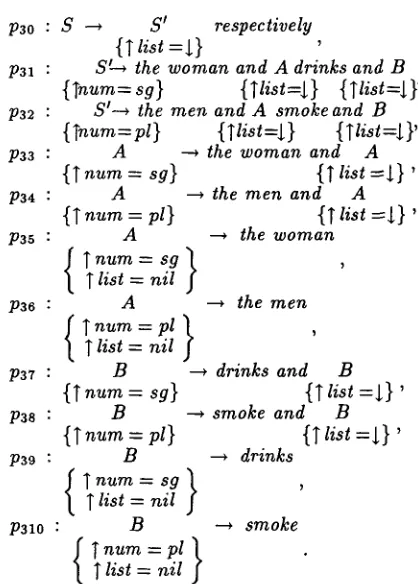
0}.E x a m p l e 4.3: Let GEX5 = (N, T, P, S, Na~,, Aatm) be an nc-lfg where N = { S , S ' , A , B } , T = {the, woman, men, and, drinks, smoke, respec- tively}, N . t , = { h u m , list}, A . t m = { s g , p l , n i l } ,
and productions in P are;
P3o : S --* S t respectively {T list = l }
P31 :
P32 : p33 : p34 :
P 3 5 :
S~---* the w o m a n and A drinks and B { T n u m = s g } {Tlist=l} {Tlist=l}'
S~--* the m e n and A smoke and 13 { T n u m = p l } {Tlist=~} {Tlist=~}'
A ~ the w o m a n and A { T n u m = sg} { r list = . [ } '
A ~ the m e n and A { T n u m = pl } {T list = ~ } '
A ~ the w o m a n T n u m = sg
T list = nil )
p3~ : A ---. the m e n T n u m = pl
T list = nil )
pz7 : B --* drinks and B
{T n~,m = ~g} {T list
=~}'
P38 : B --~ smoke and B
{ T h u m = pl }
iT
list = l } ' p39 : B ---. drinks{ T n u m = sg T list = nil )
p310 : B ---+ smoke
T h u m = pl T list = nil )
G ~ x s generates "respectively" sentences such as "the woman and the men drinks and smoke re- spectively".
For a set X of functional schemata, X is con- sistent iff neither the following (1) nor (2) holds. (1) {T atr = Call, T atr = val2 } c X
for some atr E Na,, and some vall,val2 E Aatm such t h a t call # val2.
(2) iT atr = val, T atr =~} _C X
for some atr E Nat~ and some val E Aatm. Productions p l , ' ' ' , P n are consistent iff Ul<i<_n E (0 is consistent where E (/) is the set of functional schemata of Pl. If productions are not consistent then they are called inconsistent.
An nc-lfg G is called a deterministically copy- ing Ifg (dc-lfg), if any two productions A --+ a l and A --+ a2 whoes left-hand sides are the same are inconsistent.
Suppose G = ( N , T , P, S, Nat,, Aatm) is an nc-lfg. Let { { e l , e 2 , - ' . , e n } } denote the multi- set which consists of elements el, e2," • •, en t h a t are not necessarily distinct. An S P N (SubPhrase N o n t e r m i n a l ) multiset in G is recursively defined as the following 1 through 3:
1. {{S}} is an SPN multiset.
[image:5.612.328.537.62.354.2]• .', Ah ~ O:h be consistent productions. For each atr E Nat,, let MS~,~ be the multi- set consisting of all the nonterminals which appear in a l , ' ' ' , a h and have an S schema T atr --l. If MSat~ is not empty, then MS~t~ is also an SPN multiset.
3. There is no other SPN multiset.
An nc-lfg such that the number of SPN multisets in G is finite is called a finite-copying lfg (fc-lfg).
E x a m p l e 4.4: Consider G E X s in Example 4.1. Productions /912 and P14 are inconsistent with each other and so are P13 and Ply. SPN multisets in GEX3 a r e {{S}} and { { A , B ) ) . Hence GEXS is a dc-lfg and is an fc-lfg. GEX5 is also a dc-lfg and is an fc-lfg by the similar reason. Similarly, GEX4 in Example 4.2 is a dc-lfg. SPN multisets in C~x~ are {{S}}, {{S, S}), {{S, S, S, S)}, .... Hence GEx4 is not an fc-lfg.
N O T E : L (GExs) is generated by a tree adjoining grammar. Suppose t h a t a sentence has three or more phrases which have co-occurrence relation like the one between the subject phrase and the verb phrase in the "respectively" sentence. Tree adjoining grammars can not generate such syntax while fc-lfg's or dc-lfg's can, although the authors do not know a natural language which has such syntax so far.
By L e m m a 2.1 and T h e o r e m 8.1, fc-lfg's are polynomial-time recognizable. Hence, it is desir- able t h a t whether a given lfg G is an fc-lfg or not is decidable. Fortunately, it is decidable by the following lemma.
L e m m a 4.1: For a given nc-lfg G, it is decid- able whether the number of SPN multisets in G is finite or infinite.
Proof. The problem can be reduced to the boundedness problem of Petri nets, which is known to be decidable (Peterson 1981).
5
O v e r v i e w
o f t h e
R e s u l t s
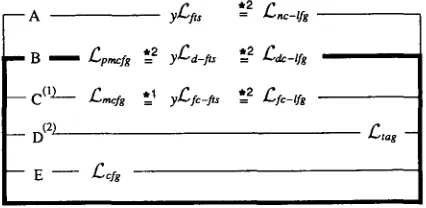
Let ~'nc-lfg, ~'dc-lfg and ~-'fc-lfg denote the classes of languages generated by nc-lfg's, dc-lfg's and fc-lfg's, respectively, and let y~#,, Y~.d-fts and YElc-#s denote the classes of yield languages gen- erated by fts', deterministic fts' and finite-copying fts', respectively. Let l:vmcla and £:mcfg be the classes of languages generated by pmcfg's and mcfg's, respectively. Also let £:ta9 be the class of language generated by tree adjoining grammars.
Inclusion relations among these classes of languages are summarized in Figure 2. An equiv- alence relation *1 is shown in (Weir 1992). Re- lations *2 are new results which we prove in this paper. We also note that all the inclusion rela-
tions are proper; indeed,
0 l
{ a l a 2 a 3 a 4 1 n >_ E D - E
a . . . a 2 a2m_la2m [ n > n n _ E C - D for m > 3, (by (Vijay-Shanker 1987).) {a 2" In > 0} e S - C,
(by (Kasami 1988a)(Seki 1991).)
A relation B ~ A is shown in (Engelfriet 1980). By L e m m a 2.1, all languages in the region enclosed with the bold line are recognizable in polynomial time. On the other hand, it is shown in this paper that Unary-3SAT, which is known to be A/P-complete (Nakanishi 1992), is in A. Hence, if ~ ~ A/~, then Unary-3SAT E A - B and the languages generated by fts' (or equivalently, nc- lfg's) are not recognizable in polynomial time in general.
6
G e n e r a t i v e
C a p a c i t y o f fts'
6.1 D e t e r m i n i s t i c f t s 'Here, the proof of an inclusion relation yEd-#s C_ /:vmc/g is sketched.
Let (M, G) be a deterministic yT-fts where M = ( Q , ~ , A , q l , R ) and G = ( N , T , P , S ) . , We assume t h a t Q = { q l , - - - , q l } , T = { a l , . . . an} and P = { P l , . . . , P m } . Since the input for M is the set of derivation trees of G, we assume t h a t = { P l , . - . ,Pro, a l , . . . , an} without loss of gen- erality.
We will construct a pmcfg G I -=- ( N ~, T ~, F', P ' , S') such t h a t y L ( M , G) ---- L ( G ' ) N A*. Since /:pmc/g is closed under the intersection with a regular set (Kasami 1988a)(Seki 1991), it follows t h a t y L ( U , G) E £'pmclg. Let T ' = A td {b} where b is a newly introduced symbol and let
N ' = { S ' , R I , . . . , R m , A I , . . . , A n }
where d(Ri) = d ( A j ) = t for 1 < i <_ m and 1 < j <_ n. Productions and functions of G ~ will be constructed to have the following property.
- - A y~/t, *=2 ~,~c-lfg
- - B ~
£?~:~ .__2 y£~_:,,
.__2 £~_,:~ - - c o L - £.~:~ *j y£:~-:. *=2 :-.:o-,:,_ _ D (2)
- - E - - £cr~
l:,a~ - -
[image:6.612.321.534.534.638.2]P r o p e r t y 6.1: T h e r e is ( a ~ , . . . ,a~) e L G , ( R h ) (resp. L G , ( A h ) ) such that
each of a , , , . . . , a s ~ does not contain b, and every remaining a t , , . . . , a,~ contains b
if and only if there is a derivation tree t of G such that the root is Ph (resp.
ah)
and{
qs, [t] ==>~ c~s~ (1 < j < u) no o u t p u t is derived from q,~[t] (1 _< j < v).D
The basic idea is to simulate the move of tree transducer M which is scanning a symbol Ph (resp. ah) with state ql by the ith component of the nonterminal R h (resp. A h ) of pmcfg G I. Dur- ing the move of M , it may happen that no rule is defined for a current configuration and hence no o u t p u t will be derived• T h e symbol b is intro- duced to represent such an undefined move ex- plicitly.We define R S ( X ) ( X E N tO T ) as follows. { R h [ t h e left-hand side of Ph is X }
R S ( X ) = if X E N
{ A h } if X = ah E T . Productions and functions are defined as follows.
S t e p 1: For each production Ph : Iio --'*
Y~ " " Yk ( Yo ~ N , Y= E N t o T for 1 < u < k) of cfg G, construct nonterminating produc- tions
Rh -+ [ & , . . . , zk]
for every Z~ E RS(Y~) (1 < u < k), where fph is defined as follows: For 1 < i < g,
• if the transducer M has no rule whose left- hand side is q i ~ a h ( X l , . . . , xk)], then
(6.a)
h • ' '
• if M has a rule
-+
• " ai,n,-lq~(i,,~,_D[x~4~,,,_D] a~,n,, then
f p [ i ] [ • x
h ~ .. , 5:k] __a • ei,ox~,(i,o),7(i,o)ei,] (6.4)• " " Ot-,ni--lglz",ni--l'rl'i,ni--l'Ogi,ni~, (1, ) [ )
where = (1 < , < k).
(Since M is deterministic, there exists at most one rule whose left-hand side is q i ~ h ( ' " ")] and hence the above construction is well defined•) S t e p 2: For each ah E T , construct a terminat- ing production
Ah -"+ fah
where f~h is defined as follows: For 1 < i < i,• if M has no rule whose left-hand side is
qi[ah],
then~a~[i] ~--b.
• i f M has a rule qi[ah] --+ hi, then f [ ~ & a i . S t e p 3: For each R h E RS(S), construct S' --+
/fi~st[Rh] where /fi,st[(x], . . . , x l ) ] ~ x ] . Intu- itively, the right-hand side of this production corresponds to the initial configuration, that is, M is in the initial state ql and scanning the root symbol Ph of a derivation tree, where the left-hand side of Ph is the initial symbol S.
T h e pmcfg G I constructed above satisfies P r o p e r t y 6.1. Its proof is found in (Kaji 1992) and omitted in this paper. By P r o p e r t y 6.1, we obtain the following lemma.
L e m m a 6 . 1 : y l : d _ f , s C f f . p m c f g .
0
The reverse inclusion relation l:p,~c/g C_ Y~.d-B, can be shown in a similar way, and the following theorem holds•
T h e o r e m 6.2: yf-.d./,s : E-pmcfg•
0
6 . 2 N o n d e t e r m i n i s t i c f t s '
In this section, the generative capacity of nonde- terministic yT-fts' is investigated, from the view- point of computational complexity• We have al- ready shown t h a t
Y~.d-~s : ~.pmcfg,
and hence every language in this class can be recognized in time polynomial of the length of an input string• Our result here is: there is a nondeterministic fts t h a t generates an A/'~-complete language• In the following, a language called U n a r y - 3 S A T , which is ArT'-complete (Nakanishi 1992), is considered, and then it is shown to belong to yL:/,a.A U n a r y - 3 C N F is a (nonempty) 3CNF in which the subscripts of variables are represented in unary. A positive literal xi in a 3CNF is rep- resented by 1i$ in a Unary-3CNF. Similarly , a negative literal --xl is represented by 12#. For example, a 3CNF
( x i v x2 v ~xa) A (xa V ~ x ] v ~x~) is represented by a Unary-3CNF
15115111# A I 1 1 5 1 # I i # .
U n a r y - 3 S A T is the set of all satisfiable Unary- 3CNF's.
Next, we construct a nondeterministic yT-fts (M, G) t h a t generates Unary-3SAT. Define a cfg G = ( N , T , P , S) where N = { S , T , F } , T = {e} and the productions in P are as follows:
r s s : S - - + S r s T : S--+ T r s F : S - + F "rTT : T--+ T r T F : T--+ F.
?'Te : T--+ e r F T : F - + T ? ' F F : F - - + F
Let M = (Q, E, A, qo, R) where q = {qo,q~,qt, qa}, ~ { r S S , . . . ,rFe},
z~ = { L ^ , $ , # } .
Since there are many rules in R, we will use an ab- breviated notation. For example, following four rules
qaIrTelXll-~ 15, q~[rTe(X)] ~ 1# q d r F ~ t X ) ] +
15,
qo[rF~(X)] -~ 1 #are abbreviated as "q~[rT~(X)] = q~[rF~(X)] --* 15 or 1 # ' . By using this notation, the rules in R are defined as follows.
q0[r~(~)] -~ qo[~] A q0[x] qo[r~s(~)] -~ q & ] q0[~sr(~)] = q0[~sv(~)] = q~[r~r(~)]
= q~[rSF(X)] --~ qdx]q~[x]q~[x] or
q~[x]qt[x]qa[x]
orqa[x]qa[x]qt[x]
q,[r**(x)] = q & . ~ ( ~ ) ] -* lq,[~] or 1~
q,[rr,(~)] ~ 1,
q,[r~,(~)] = q , [ r ~ ( ~ ) ] -* lq,[x] or 1 #
q,[rF~(x)]---+ 1 # qo[rr~(~)] = qo[rr~(~)] = qoirF~(~)]
= qa[rFF(X)]
lqa[X]
or 15 or 1 #qo[r~c(x)] = q . [ r ~ ( ~ ) ] ++ 1, or 1 # .
T h e readers can easily verify that this yT-fts generates Unary-3SAT.
7 E q u i v a l e n c e o f f-'nc-lfg a n d Y £ f t s First, we show £,~c-lfg C_ Y£qt~. For a given nc- lfg G = (N, T, P, S, Nat,, A~m), an equivalent fts (M, G I) is constructed in the following way.
Let t be a derivation tree in lfg G and the f-structure of the root node of t be F = { ( a t r l , F 1 ) , . . . , (atr,~,Fn)}. F is represented by a derivation tree r = p , p ( T l , ' - . , rn) in G', where ri (1 < i < n) is a derivation tree in G' which rep- resents Fi recursively. And sp is a set of produc- tions such that F locally satisfies the functional schemata of all productions in sp. M transforms r into the yield of t, i.e., the terminal string ob- talned by concatenating the labels of leaves, in a top-down way.
[ T R A N S 7.11 Let N = { A 1 , ' " , A m } , S = A1 and Nat, = { a t r l , - . . , atr,~}. Define SP as the set of all consistent subsets of P.
S t e p 1: G' = ( N ' , { d } , P ' , S ' ) , where N ' = {S,plsp e S P } U {S'} and
P ' = {p',p : S,p ---* S ' - . . S ' t
u { p ; = ~ . . . : s ' --+ Ss, l,p e s P }
u{p~,m
:~s' -+ deC:_/}.
For a derivation tree r in G' and a node v ' is applied, the snbtree rooted by the where p,p
ith child of v represents the value of a t t r i b u t e atr i.
S t e p 2: M = ( Q , E , T , q l , R ) is defined as fol- lows.
Define Q = { q l , . . . , qm}. A state qj (1 < j _< m) corresponds to nonterminal A t in N. Define E --
{ d } w h e r e p ( p ' . , ) = p ( p
.... .~)
= ' = and p(d) = O. And define R by the following (i) through (iii).(i) q j ~ . . . .
.,(x)]
-~ qj[x] (1 _< j < m) belongs to R for each sp • SP.(ii) Let r be a derivation tree in G '. When plsp is the production applied at the root of r and a state of M is q,o, M chooses a production p whose left-hand side is Auo , if exists, in sp. N O T E : Since productions in sp are consis- tent, there is an f-structure, which locally sat- isfies the functional schemata of all produc- tions in sp.
For each production p E sp in S P
p : A~o --* a0 A m a l . . . O t L - 1 At, L aL E v {~ atrv~ =~} ... {~ atrvL =~}
where A~z E N and al E T*(0 < l < L), the following rule belongs to R:
q#o~tsp(Xl, , *',xn)]
-~ " 0 q , , [ X ~ , ] " I . . - " L - - l q , ~ [ X , ~ ] ~ . (7.5)
(iii) No other rule belongs to R.
Next, Y£~s C_ £~c-zf9 is shown. For a given fts (M, G), the following algorithm constructs an nc-lfg G' such t h a t L(G') --- y L ( M , G).
[ T R A N S 7.2] Suppose t h a t a given fts (M, G) is G -- (N, T, P, S) and M -- (Q, E, A, ql, R) where Q = { q l , q 2 , ' " , q m } . Let n be the maximum length of the right-hand side of a production in P. Define an nc-lfg G I = ( N', A, P', S I, N~r,
Aatm)
as follows.S t e p 1: N ' = { C [ J ] I C • N , l g j < m }
u{aI~l la • T, 1 < j <_ m},
S' = S [11,
Nat~ = {atri I1 < i < n} U {rule}, and Aatm = {PIP is the label of
a production in P}. A derivation tree t = p ( t l , ' " ,th) in G is rep- resented by an f-structure {(rule, p),(atrl, El), • ".,(atrh, Fh)} of G' where Fi (1 < i < h) is an f-structure which represents the subtree ti recursively.
S t e p 2: A move when M at state qj reads a symbol p which is the label of a production p : C --+ . . . , can be simulated by a production in G ~ whose left-hand side is C[J]
{T ute = p}"
Formally, the set P~ of productions of G I is con- structed as follows.
(i) Let p : C --* X1 "" Xh be a production in P where C E N, Xi E N U T (1 < i < h), and let:
qj[p(x],...,
Xh)]
--~ ajoq,7,,
[z~,,,
]aj,...q,7,zj [X~,,L ' ]O~jL,
be a rule in R where ~ k E A* (0 < k < Lj), q'Tj~ E Q, and xvj~ e t X l , ' " , X h } ( 1 < l <
L j).
Then, the following production belongs to P~:
y [ r / j l ] V[nJLj]
C[J] 7...40tjo-~vjl Otjl "'" AI~jLj OtjLj"
{Trute = p) {Tatr ,
{Tatr j
(ii) Let qj[a] ---* flj be a rule in R where a 6 T and flj 6 A*. Then the production a[J] --~ flj belongs to P ' .
(iii) No other production belongs to P ' .
By T R A N S 7.1 and T R A N S 7 . 2 , the fol- lowing theorem is obtained. A formal proof is found in (Nakanishi 1993).
T h e o r e m 7.1: f~nc-lfg = Y~'fts. C o r o l l a r y 7.2: ~'dc-lfg ---- Y~.d-fts.
Proof. In T R A N S 7.1, if G is a dc-lfg, then no sp E S P contains distinct productions whose left-hand sides are the same and hence the con- structed transducer M becomes deterministic by the construction. Conversely, in T R A N S 7.2, if M is deterministic, then there exist no consistent productions p~ and p~ in P~ whose left-hand sides are the same and hence the constructed nc-lfg is a dc-lfg.
8 E q u i v a l e n c e o f ~ f c - l f g a n d £~mcfg To prove f~fc-lfg C Lmcfg, we give an al- gorithm which translates a given fc-lfg G = (N, T, P, S, Nat,, Aatm) into an mcfg G I such t h a t L (G') = L (G).
[ T R A N S 8] We explain the algorithm by us- ing the fc-lfg
GEX3
in Example 4.1. An mcfg G' = (N', T, F, P ' , S) is constructed as follows. S t e p 1: N ' = (the set of nonterminals whichhas a one-to-one correspond- ence with the set of S P N multi- sets in G)
= {(S), ( A , B ) }
(for GEx3 in Example 4.1) P ' = ¢, and
F = ¢ .
S t e p 2: For each SPN multiset M0 = {{A1,A2, • " . , A k } } of G, consider every tuple (pl,P2, " " , P k ) of productions in P whose left- hand sides are A1, A2,'", Ak respectively and which are consistent. (Suppose that, if we write an SPN multiset as {{A1, A2,. " , Ak}}, then Aj's are arranged according to a pre- defined total order < on N, t h a t is,
A1
< A2 <_ "'" <_ Ak hold.) For an SPN multiset {{A, B}} in GEX3, the following two pairs of productions have to be considered:b p12 : A ---* a {TcouAt,~
PI3 : B ~ c B d ,
{Tcount --~}
p14:
{Tcoun
A = e}
pls : {Tc°u B = e }
For ( P l , P 2 , ' " , P k ) , a production p' and a function f of G' are constructed and added to P ' and F , respectively as follows.
The multiset M of the nonterminals appearing in the right-hand side of some pj (1 < j < k) are partitioned into multisets M1, M2," -., Mh with respect to the S schemata attached to the nonterminals in pj's. T h a t is, (11//1, M 2 , - " , Mh) are the coarsest partition of M such t h a t for each M,, (1 < u < h), the fol- lowing condition holds.
Each nonterminal in M~, has the same S schema.
By the definition, each M= (1 < u < h) is an SPN multiset in G. _Construct a p r o d u c t i o n o f mcfg p ' : hit0 --* f[M1, f f I 2 , ' " , Mh] where M= is the nonterminal of G' which corresponds to M=(1 < u < h). A d d p ' to P ' and f to F where f is defined as follows. Suppose pj : Aj ~ a j o B j l a j l "'' BjL~ajL~ (1 < j < k)
where Aj E N, Bfl E N ( 1 < l < Lj) and ajz E T* (0 < l < Lj), and l e t - -
= (1 < < h)
where Cu, E N ( 1 < v < su). Then, for 1 < j < k, the j t h component f[J] of f is:
_ A
f[J]
(X-l,
x 2 , " " ' , Xh ) = o t j o Y j l Otjl Yj2 "" • Y j L j OtjLjwhere x-u = ( x u l , x u 2 , ' " , x u s . ) ( 1 < u < h). For j (1 <_ j < k) and l (1 _< l _< n j ) , if
z~
sides are A and B, and their S s c h e m a t a are the same. Thus, we construct the following mcfg production:
(A, B) --* f l [(A, B)] where f l [(Xl, x2)] =
(aXlb,
cx2d). Consider the following pair of productions as a n o t h e r example:{ p~ : A --* a {TatrB ~ : ~ }
bD{Tatr2
---* c D
P'2 : B {TatrA=£} {TatrC=j,}
{1"air2 --,L}T h e multiset of nonterminals in the right- hand sides are partitioned into M1 =
I{
A, B}} (forarT1)
andM~
= {{C,D,
D}} foratr2).
For(p~,p~),
the following mcfg production is constructed:(A, B) --+ g [(A, B), (C, D, D)]
where g [(x11, x12), (=21, X22,
x23)]~--(ax12bx22,
xilx .lc 3).
V]
E x a m p l e 8.1: T R A N S 8 translates fc-lfg
GEx3
in E x a m p l e 4.1 into an equivalent mcfgG~x 3 = (N',T, F, P', S I)
where N ' , S' are those illustrated in T R A N S 8, F ={fo[(xl,x2)] =
XlX2, f l [ ( X l , X 2 ) ] =(aXlb, cx2d),
f2 --- (~',~')}, and, P ' = { ( S ) --+fo[(A,B)], (A,B) --*
fl [(A, B)],
(A, B) --~ f2}.
0
T h e o r e m 8.1: ~rncfg = E f c - l f g .
Proof: £yc-tfg C £mcf9
can be proved by T R A N S 8. Conversely, for a given mcfg G, an fc-lfg G' such t h a t L (G') = L (G) can be con- structed in a similar way to T R A N S 8. Detailsare found in (Ando 1992). [1
9 C o n c l u s i o n
In this paper, we introduce three subclasses of lfg's, two of which can be recognized in polyno- mial time. Also this p a p e r clarifies the relations between the generative capacities of those sub- classes, pmcfg's and fts'.
R e f e r e n c e s
Ando, S. et al. 1992. "Subclasses of Lexical- Functional Grammars Which Are Recognizable in Polynomial Time", IEICE Technical Report,
COMP92-44.
Engelfriet, J. and Heyker, L. 1991. "The String Gen- erating Power of Context-Free Hypergraph Gram- mars", J. Comput. & Syst. Sci., 43:328-360. Engelfriet, J., Rosenberg, G. and Slutzki, G. 1980. "Tree Transducers, L Systems, and Two-Way Ma- chines", J. Comput. & Syst. Sei., 20:150-202.
Joshi, A.K., Levy, L. and Takahashi, M. 1975 "Tree Adjunct Grammars", J. of Comput. & Syst. Sci., 10:136-163.
Gazdar, G. and Pullum, G.K. 1985. "Computa- tionally Relevant Properties of Natural Languages and Their Grammars", New Generation Computing, 3:273-306.
Kaji, Y. et al. 1992. "Parallel Multiple Context- Free Grammars and Finite State Translation Systems ", IEICE Technical Report, C O M P 9 2 - 3 4 .
Kaplan, R. and Bresnan, J. 1982. "Lexical- Functional Grammar",
The Mental Representation
of Grammatical Relations,
J.Bresnan (ed.), MIT press:173-281.Kasami, T. et al. 1988a. "Generalized Context-Free Grammars and Multiple Context-Free Grammars", Trans. IEICE, J 7 1 - D - I , 5:758-765.
Kasami, T. et al. 1988b. "On the Membership Prob- lem for Head Language and Multiple Context-Free Languages, Trans. IEICE, J 7 1 - D - I , 6:935-941. Nakanishi, R. et al. 1993. "On the Generative Capacity of Tree Translation Systems and Lexi- cal Functional-Grammars", Technical Paper of FAI, Japanese Society for Artificial Intelligence, S I G -
FAI-9202.
Nakanishi, R. et al. 1992. "On the Generative Capac- ity of Lexical-Functional Grammars", IEICE Trans. Inf. and Syst., 75-D, 7:509-516.
Nishino, T. 1991. "Mathematical Analysis of Lexical- Functional Grammars --Complexity, Parsability, and Learnability--", Language Research Institute, Seoul National University.
Nishino, T. 1992. "Relating Attribute Grammars and Lexical-Functional Grammars", Information Sci- ences, 66:1-22.
Peterson, J.L. 1981. "Petri Net Theory and the Mod- eling of Systems", Prentice-Hall.
Pollard, C.J. 1984. "Generalized Phrase Structure Grammars, Head Grammars and Natural Language", Ph.D. dissertation, Stanford University.
Rounds, W.C. 1969. "Context-Free Grammars on Trees", Proc. of ACM STOC:143-148.
Seki, H. et al. 1991. "On Multiple Context- Free Grammars", Theoretical Computer Science, 88,
2:191-229.
Thatcher, J.W. 1967. "Characterizing Derivation Trees of Context-Free Grammars through a Gener- alarization of Finite Automata Theory". J. Comput. & Syst. Sci., 1:317-322.
Vijay-Shanker, K. 1987. "A Study of Tree Adjoining Grammars", Ph.D. thesis, University of Pennsylva- nia.
Vijay-Shanker, K., Weir, D.J. and Joshi, A.K. 1987. "Characterizing structural descriptions produced by various grammatical formalisms", Proc. of 25th meeting of Assoc. Comput. Ling. :104-111.
Weir, D.J. 1988. "Characterizing Mildly Context- Sensitive Grammar Formalisms", Ph.D. thesis, Uni- versity of Pennsylvania.