An Integrated Framework for Semantic and Pragmatic
Interpretation 1
Martha E. Pollack Artificial Intelligence Center
SRI International 333 Ravenswood Ave Menlo Park, CA 94025, USA
Fernando C.N. Pereira
Cambridge Computer Science Research Centre SRI International
Suite 23, Millers Yard, Mill Lane Cambridge CB2 1RQ, England
Abstract
We report on a mechanism for semantic and prag- matic interpretation t h a t has been designed to take advantage of the generally compositional na- ture of semantic analysis, without unduly con- straining the order in which pragmatic decisions are made. To achieve this goal, we introduce the idea of a conditional interpretation: one that de- pends upon a set of assumptions about subsequent pragmatic processing. Conditional interpretations are constructed compositionally according to a set of declaratively specified interpretation rules. The mechanism can handle a wide range of pragmatic phenomena and their interactions.
1
I n t r o d u c t i o n
Compositional systems of semantic interpretation, while logically and computationally very attrac- tive [6,20,26], seem unable to cope with the fact that the syntactic form of a a utterance is not the only source of information about its mean- ing. Contextual information--information about the world and about the history of a discourse-- influences not only an utterance's meaning, but even its preferred syntactic analysis [3,5,7,16]. O f course, context also influences the interpretation (or meaning in context) of the utterance, in which, for example, referring expressions have been re- solved.
One possible solution is to move to an integrated system of semantic and pragmatic interpretation, defined recursively on syntactic analyses that are 1 T h i s research has b e e n funded by D A R P A u n d e r Con- tract N00039-84-C-0524, and b y a gift from the S y s t e m s Development F o u n d a t i o n as p a r t of a coordinated research effort with the C e n t e r for the S t u d y of Language a n d In- formation, Stanford University. We would like to t h a n k David Israel, FLay Perrault, and S t u a r t Shieber for their helpful discussions regarding this work.
neutral a b o u t those decisions that depend upon context. In this approach, a least-commitment grammar m a y be used to produce neutral repre- sentations that can be reconfigured later. Such a g r a m m a r might, for example, leave quantifiers in place [30], attach all prepositional phrases low and right [22], and bracket to the right all com- pound nominals. 2 These neutral analyses can then serve as input to a system t h a t produces inter- pretations (and not meanings) in a nearly com- positional manner, in that the interpretation of a phrase a is a function of the interpretations of its syntactic constituents together with its context of utterance.
This model of semantic interpretation assumes that contextual information is available whenever it is needed for deciding among alternative inter- pretations. However, this is often not the case: questions about the interpretation of some con- stituent of an utterance might be answerable only when information about the interpretation of syn- tactically distant constituents becomes available. Familiar examples of this can be found, for in- stance, in sentences with quantifier scoping ambi- guities and in sentences that include intrasenten- tial anaphora. The so-called donkey sentences [9] exhibit both these phenomena.
These difficulties do not necessitate a complete abandonment of compositionality. To take advan- tage of the generally compositional nature of se- mantic analysis without constraining unduly the order in which pragmatic decisions are made, we assign to phrases conditional interpretations, 2Tllere are reasons to suspect t h a t ultinmtely syntactic analysis should be incorporated into the s a m e stage of pro- cessing as semantic a n d pragnuLtic analysis; in particular, it is difficult to develop syntactically neutral representations for certain constructions s u c h as conjunction.
which represent the dependence of a phrase's inter- pretation on assumptions about subsequent prag- matic processing. Conditional interpretations are built compositionally according to declaratively specified interpretation rules.
The interpretation mechanism we discuss here has been implemented in Prolog as part of the Candide system, a multimodal tool for knowledge acquisition. Incorporating both a graphical inter- face and a processor for English discourse, Can- dide allows a user of the Procedural Reasoning System (PITS) [10] to build and maintain proce- dural networks in a natural way. Procedural net- works, an essential part of PRS's knowledge base, encode the information about procedures that is used by PItS for reasoning about and performing tasks in any given domain. The current version of Candide has been used to construct networks for malfunction procedures for NASA's space shuttle. Further details of the Candide system will be pre- sented elsewhere [24].
2
C o n d i t i o n a l
I n t e r p r e t a t i o n s
In our approach to semantic and pragmatic in- terpretation, conditional interpretations separate the context-independent aspects of an interpreta- tion from those that are context-dependent. Each conditional interpretation consists of a sense and a [possibly empty] set of assumptions. As a first approximation, one might think of the sense of a phrase as representing purely semantic informa- tion, that is, information that can be adduced solely from the linguistic content of the phrase, no matter in which context the phrase has been ut- tered. The assumptions then represent constraints relating the phrase's sense to its ultimate interpre- tation. A complete interpretation has an empty assumption set, indicating that all of its depen- dencies on context have been resolved.
The present version of the theory allows for two kinds of assumptions. A bind assumption intro- duces a new parameter in an interpretation and places constraints on the binding of the parameter to individuals in the context. A restrict assump- tion does not introduce a new parameter, but in- stead further restricts the way in which an existing parameter can be bound.
These concepts are illustrated by the following conditional interpretation of the sentence "The jet failed":
[["The jet failed"] =
(fail(z), {bind(z, def, jet)})
(:)
The first element of the interpretation is the sense fail(z), while the second is the set of assump- tions containing a single assumption whose infor- mal reading is that z should be bound to some- thing of the sort jet according to the constraints of definite reference.3
T h e
I n t e r p r e t a t i o n
P r o -
c e s s
The process of semantic and pragmatic interpre- tation computes complete interpretations of sen- tences from least-commitment parse trees. Two types of rules govern the interpretation pro- cess: semantic.interpretation rules and pragmatic- discharge, rules.
Semantic-interpretation rules specify the con- ditional interpretation of a phrase in terms of the conditional interpretations of its constituents. Compositionality is enforced by making semantic- interpretation rules sensitive only to the syntac- tic types of a phrase and its constituents, as well as to the types of assumptions in the conditional interpretations associated with the constituents; semantic-interpretation rules are not sensitive to the senses of the constituents.
Pragmatic-discharge rules change the condi- tional interpretation of a phrase by specifying how assumptions in the conditional interpretation may be eliminated with respect to the context of utter- ance. For example, one discharge rule applies to assumptions constraining a parameter to be bound as a definite reference. This rule allows an assump- tion of the form bind(v, def, T) to be discharged, provided that there is a unique contextually avail- able entity of sort T. The effect of applying the definite discharge rule to an interpretation (S, A) is twofold: the bind assumption operated upon is removed from the set of assumptions A; the sense S is changed to reflect the binding. For instance, if the rule were applied to the interpretation in (1), and if the context of utterance C contained a unique available entity j of sort jet, the resulting interpretation would be
~fail(j),q~) (2)
discharge relation:
discharge(C,
(fail(z), {bind(z,
def, jet)}),
(/air(j), ~), C'),
where C is the discourse context before the as- sumption is discharged, while C I is the resulting discourse context.
Semantic-interpretation rules are obligatory in that some semantic-interpretation rule associated with a given syntactic rule must be applied to any phrase analyzed by the syntactic rule. In contrast, the application of pragmatic-discharge rules is op- tional, although discharging a particular assump- tion too early or too late m a y lead to a dead end
in the interpretation process. Applying the same
discharge rule at different points in the interpreta- tion process for some utterance m a y lead to alter- native interpretations, as w e shall illustrate with the examples in Sections 6 and 7.
Given a sentence and its syntactic analy- sis, the interpretation process applies semantic- interpretation and pragmatic-discharge rules, ac- cording to their applicability conditions, to con- struct the derivation of a complete interpretation of the sentence. In Candide, this process resem- bles a syntax-directed translation system [1]. In- terpretation starts at the root node of the anal- ysis tree. For each node of the tree, the inter- pretation process selects an appropriate semantic- interpretation rule and calls itself recursively for each of the node's daughters. Interpretations are constructed on return from the recursion, and pragmatic-discharge rules are optionally applied in a discharge cycle that follows each application to a node of a semantic-interpretation rule.
Lexical ambiguity, multiple semantic-interpre- tation rules for a given syntactic construction, op- tional application of discharge rules, and alter- native ways of discharging a given assumption. are all sources of nondeterrninism in the interpre- tation process, which need to be somehow con- trolled. In Candide, we adopted four simple con- trol tactics: overall depth-first search, early dis- charge of assumptions, breadth-first search for al- ternative bindings of a discharged parameter, and bounds on assumption percolation wherever it can be shown t h a t an assumption would not be dis- chargeable outside a certain syntactic domain. For lack of space, a fuller discussion of these heuristics will be conducted elsewhere [24].
4
T h e D i s c o u r s e
C o n t e x t
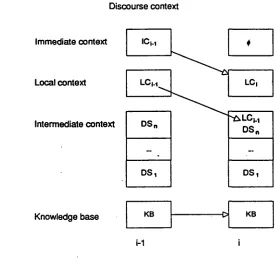
Pragmatic-discharge rules need access to a dis- course context that encodes information about rel- evant world knowledge and the discourse history. Although our framework for semantic and prag- matic interpretation can accommodate alternative representations of the discourse context, the spe- cific discharge rules we have written and incorpo- rated into the Candide system rely on a particular representation comprising four parts: immediate con~ez4, local contez~, global contezt, and a knowl- edge base.
During the analysis of a sentence, the immediate context contains detailed information about the entities referred to in that sentence; it is used pri- marily for resolving intrasentential anaphora. The local context generally contains detailed informa- tion a b o u t the immediately preceding sentence, 4 while the global context includes somewhat less detailed information about entities referred to throughout longer stretches of the discourse. We use the local context primarily for pronoun resolu- tion, following the theory of centering introduced by Grosz et aL[12]. T h e global context is employed primarily for the resolution of definite anaphora, and is structured as a stack to m a k e use of the theory of focusing. Each element of the global- context stack is itself a list of entries containing information about the entities referred to in a dis- course segment [13]. W e refer to the top element of the global context as the intermediate contezt.
Individual discharge rules used in processing a sentence can extend the immediate context for that sentence. For instance, the rule mentioned earlier that binds a parameter as a definite refer- ence acids to the irmnediate context an entry for the entity to which the parameter is bound. When the assumption in (1) is discharged, resulting in the interpretation in (2), an entry for j must be added to the immediate context. T h e entry will include the sort of j (jet) and the surface position of that phrase in the sentence (subject).
Discourse context
Immediate
context
J
Local context
J
Intermediate
context
LCI.I~ LCI J
DS.
DS~
-,~LC H
DS.
. .
DS~
Know e00e o
I K8 I
i-1
Figure 1: Updating the Discourse Context
be cleared in preparation for the next sentence. F o r the moment, we shall assume that the knowl- edge base is static, although it will ultimately have to be reorganizable dynamically so as to reflect a language user's current perspective.
In fact, the update function can be rather more complex. For example, if the current utterance is recognized to be the s t a r t of a subordinate dis- course segment, a new, e m p t y element can be pushed onto the global-context stack after the lo- cal context has been merged into the previous top element. We shall discuss the discourse-context update function further elsewhere [24].
5
A Simple D i s c o u r s e
T h e following simple discourse will provide our first illustration of the interpretation mechanism and, in particular, the t r e a t m e n t of reference and coreference:
The j e t failed. (3)
Close the manifold.
In the subsequent sections, we shall turn to more complex examples t h a t provide further insight into the way in which pragmatic processes can interact
with one another affecting syntactic and semantic decisions.
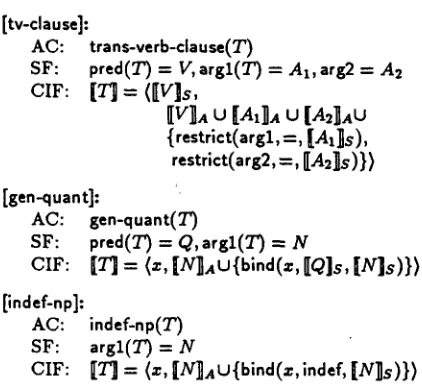
T h e three semantic-interpretation rules given in Figure 2 are needed in the example. Recall that the interpretation process is driven by semantic- interpretation rules, which apply compositionaUy to phrases. Each such rule has three parts: an ap-
plicability
condition (AC), a set of selection f~nc- tions (SF), and a condflionai-interpretation func. tion (CIF). T h e applicability condition specifies the syntactic type of phrase to which the seman- tic interpretation rule applies; it is stated in terms of a predicate on trees. 5 The selection func- tions specify how to access the constituents of the phrase to which the rule is to he applied. Fi- nally, the conditional-interpretation function de- fines the conditional interpretation of the phrase as a function of the conditional interpretations of its constituents. A conditional-interpretation function will often depend separately on the sense and assumptions of a conditional interpretation I, for which we use the notations Is and IA, respec- tively.Figure 3 shows an annotated tree e represent- 5The meanings of the predicates on trees used in this p a p e r should be clear from their names.
[image:4.612.140.415.80.343.2]r (fail0). ¢)
1 (fai/(a), {bind(a, argl, device), restrict(argl, •,fl})
2 (fail(a). {bind(a, argl, device)}> ¢
I
failed
3 (b, {bind(b, def, jet)})
4 the 5 qet, 0)
iet
Figure 3: Interpretation of "The j e t failed"
[iv-clause]:
AC:
intrans-verb-clause(T )
SF:
pred(T)
= V,argl(T)
= A CIF: IT] = (~VIs, [VIA U [A]AU{restrict(argl,
=, [A]s) })[def-np]:
AC:
def-np(T)
SF:argl(T)
= NCIF: [~I = (z, [N]A U {bind(z, def,[N]s)})
[lex]:
AC: lex-ltem(T) SF:
wordstem(T)
= W CIF: I T ] = IwFigure 2: Semantic-Interpretation Rules I
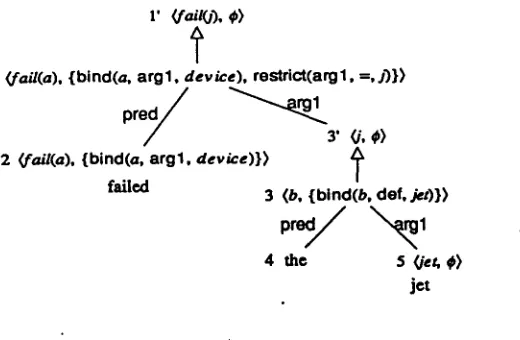
ing the derivation of a complete interpretation of the first sentence in (3). Conditional interpreta- tions of constituents of the complete sentence are shown above the root nodes of the corresponding subtrees.
Semantic-interpretation rule [lex] applies to lex- ical subtrees (Nodes 2 and 5 in Figure 3 ~) associ- tures of lexlcal-functional grammar [4] than to the usual surface c o n s t i t u e n t s t r u c t u r e . T h e s a m p l e a n a l y s e s h a v e b e e n e x t r s m e l y simplified for e x p e s i t o r y reasons; t e r m i n a l nodes, in particular, a p p e a r in t h e trees s i m p l y as t h e corre- s p o n d i n g word, b u t their a c t u a l r e p r e s e n t a t i o n , as required by i n t e r p r e t a t i o n rule [lex], h a s two b r a n c h e s : wordstem for t h e a c t u a l root f o r m o f t h e terminal, cat for its s y n t a c t i c category. Finally, tree n o d e s relevant to t h e discussion are n u m b e r e d for ease of reference.
7Node 4 is also lexical, b u t defudte d e t e r m i n e r s con- t r i b u t e only to t h e i n t e r p r e t a t i o n of t h e i r m o t h e r n o u n
ating with each wordstem W conditional interpre- tations Iw according to the lexicon. The lexical entries relevant to the current discussion are:
/jet = (jet, ¢)
/fail = (fail(z), {bind(z,
argl,
device)})In the conditional interpretation of a c o m m o n noun, the sense is always a sort term. T h e assump- tion set m a y be empty, as it is for ~jet" above, but for a relational noun it will contain hind assump- tions for the relation's arguments, binding param- eters occurring in the sort term.
The lexical entries for verbs and the structural rules that combine a verb with its subject and complements must refer, through assumptions, to the grammatical functions that provide the argu- ments of the predicates that represent the senses of verbs (roughly the govcrnable grammatical func- tions of lexical-functional g r a m m a r [4,27]). Since we are not defending any particular theory of g r a m m a r in this paper, we shall skirt a theoretical and terminological minefield by naming the gram- matical functions relevant to our purposes argi for i = 1 , . . . , n, and calling them simply "argu- ments." Arguments are used as edge labels in our analyses, as well as in bind and restrict assump- tions, and their intended interpretation should be clear from the examples we are discussing.
[image:5.612.176.436.83.253.2]pretation effectively encodes the information t h a t things t h a t fail are devices, s
Because the local tree rooted at Node 3 repre- sents a definite noun phrase, rule [def-np] applies to it in a straightforward fashion, yielding the con- ditional interpretation
(b, (bind(b, def, jet)})
(4)
T h a t is, "the jet" is interpreted as b under the as- sumption t h a t b can be bound in accordance with the constraints of definite reference to an entity of sort
jet.
As mentioned earlier, a pragmatic-discharge rule
may
be used whenever it is applicable to some conditional interpretation in context. In the cur- rent example, the rule for discharging the bind as- sumption is applicable to the conditional interpre- tation in (4), and it is actually used in the deriva- tion to determine a referent for the definite noun phrase.The process of resolving a definite reference is of course quite complex [5,11,28,29], and the rule t h a t discharges assumptions to bind a parameter as a definite reference must reflect this complex- ity. For the moment, let us assume t h a t there is only one entity of the correct sort available for def- inite reference (perhaps introduced in a preceding portion of the discourse): the j e t identified as j. The pragmatic discharge rule can thus bind the parameter b to j , extend the immediate context accordingly, and delete the bind assumption from the list of assumptions in the current conditional interpretation. T h e resulting conditional interpre- tation of the string "the jet" is (j, ~b), shown in Figure 3 above Node 3 ~.
Finally, consider the interpretation of the whole sentence. Rule [iv-clause] applies to the parse tree for the sentence, specifying t h a t its sense is the sense of the predicate (pred) constituent, namely
fail(a),
and t h a t its set of assumptions is the union of (i) the assumptions from its predicate constituent, (ii) the assumptions from its argu- ment (argl) constituent, and (iii) the new assump- tion restrict(argl, =, j ) , where j is the sense of the argument constituent. The restrict assumption, which arises from the sentence's syntactic form, applies to whatever parameter is to be bound as the first argument of the sense of the sentenc~ in STile conditional i n t e r p r e t a t i o n s h o w n above Node 2 in the figure h a s a new p a r a m e t e r , Q, s u b s t i t u t e d for the vari- able z of the lexical e n t r y because p a r a m e t e r s introduced t h r o u g h b i n d a s s u m p t i o n s in distinct appllcAtious of seman- tic interpretation-rules in a derivation m u s t be themselves distinct.this case, a, as specified by the bind assumption inherited from the predicate constituent. The re- strict assumption further constrains the binding of this parameter by requiring t h a t it be equated with the entity j.
T h e interpretation process is completed after the two remaining assumptions are discharged, as indicated a t the top of Figure 3. 9 They can be discharged successfully in parallel: binding a to j is legitimate because j is a jet, and
jet
is a subsort ofdevice.
Before the next sentence is processed the discourse context needs to be updated, as de- scribed earlier.T h e second sentence of our example is "Close the manifold"; we shall be concerned primarily with the way in which the reference resolution problem is handled. The conditional interpreta- tion for the definite noun phrase "the manifold" is
(c, {bind(c, def,
manifold)})
(5)
Discharging the bind assumption here requires the use not only of world knowledge - - namely, that each jet is attached to one and only one manifold - - but also of knowledge of the discourse h i s t o r y - - namely t h a t there is a single salient jet in context, the one identifed as j. The latter information can be derived from the discourse context, while the former must be encoded in the knowledge base. This information is sufficient to resolve the ref- erence in the sentence under consideration: "the manifold" refers to the manifold t h a t is attached to j. Hence the interpretation we derive from (5) is
(,.,+,),
CO)
where m is the unique manifold attached to jet j. For use in constraining subsequent reference, the discourse context must be updated with the infor- mation t h a t m has the restricted sort :
manifold I
Az.attached-~o(z,j),
wheresip is
the subsort of s whose elements satisfy property P.6
Q u a n t i f i e r S c o p e
We shall now turn to the kind of interactions in pragmatic processing that challenge compositional systems. In this section we shall discuss an exam- ple of quantifier scope ambiguity; following that, we shall give an example of our analysis of donkey sentences, involving interactions between quanti- fier scoping and reference resolution.
The following sentence illustrates the quantifier scoping problem in its simplest form:
Every driver controls a jet. (7)
This sentence might be given either a wide-scope existential (3V) interpretation, in which all the drivers control the same jet, or a narrow-scope ex- istential (V3) interpretation, in which each driver controls its own, possibly different, jet.
[tv-clause]:
AC: trans-verb-clause(T)
SF: pred(T) = V, argl(T) = A1, arg2 = A2 CIF:
[T] = (IV]s,
[vh
u [A~h u [AZ]AU {restrlct(argl,--, [A1]s), restrlct(arg2, =, [A2]s)}) [gen-quant]:AC: gen-quant(T)
SF: pred(T) = Q, argl(T) = N
ClF: IT] = (x, [N]Au{bind(z, [Q]s, [NIs)}) [indef-np]:
AC: indef-np(T) SF: argl(T) = N
CIF: [T] = (z, [N]AU{bind(z, indef, IN]s)})
Figure 4: Semantic-Interpretation Rules II Interpreting (7) requires additional rules of se- mantic interpretation, shown in Figure 4, and the lexical entry
/control =
( co,,~rols( z, y ),
{bind(z, argl,device),
bind(y, arg2,
device)})
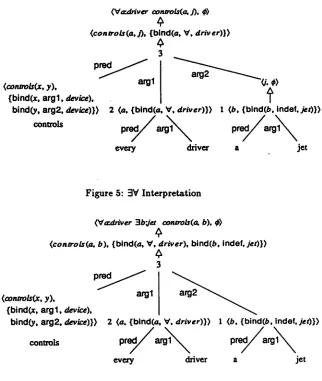
Derivations of the 3V and the V'~ interpretations are shown in Figures 5 and 6, respectively.
[image:7.612.68.279.298.494.2]In both derivations, the general noun phrase "every driver" is interpreted at Node 2 by rule [gen-quant] and the indefinite noun phrase "a jet"
is interpreted at Node 1 by rule [indef-np]. How- ever, the two derivations differ as to where the indefinite-reference assumption is discharged. In Figure 5 the assumption is discharged immediately after its introduction. The resulting sense is a new entity j of sort
jet.
The same 3V reading could also be derived by allowing the indefinite-reference assumption to percolate up to Node 3, but then discharging it before the generalized quantifier as- sumption. In either case, the immediate context is updated at the time of the discharge with an entry for the new entity j.Somewhat more interesting is the derivation of the ~ reading, shown in Figure 6. The indefinite- reference assumption is allowed to percolate to Node 3, where the generalized-quantifier assump- tion is discharged. This discharge applies a quan- tifier to its scope, but it also selects some sub- set of the outstanding indefinite-reference assump- tions in the current conditional interpretation and discharges them, by existential quantification of the respective parameters, within the scope of the generalized quantifier. In our example, the rule converts the conditional interpretation
( con~rots( a, b ),
{bind(a,V,
driver),
bind(b, indef, je0} ) into the completed interpretation{Ya :
driver 3b :jet controls(a, b ), qb)
• 7
A D o n k e y S e n t e n c e
We can now discuss the more complicated inter- actions between assumptions occurring in donkey sentences. Our example will be the sentence:
Every driver controlling a jet closes it. (8) Clearly, this sentence has an interpretation in which, for every driver controlling a jet, the driver closes the jet. However, it is difficult to see how this interpretation can be derived compositionally. The weU-recognized problem is that, in the in- tended reading, the indefinite noun phrase % jet" has narrower scope than the determiner "every," forcing its interpretation to be part of the sort term translating the nominal "driver controlling a jet." But this means that the interpretation of the pronoun "it" will be outside the scope of the indefinite "a jet."
(mnuv/s(x, y),
{bind(x, argl, d~/ce), bind(y, arg2, d~/ce)})
controls
(V~r.arriver ~mrols(~ D. ~) (controls(a, j), {bind(a, V, driver)})
¢
3
2 (a, {bind(a, V, driver)l) I (b, {bind(b, indef, jet)})
p r ~ a r g l ~
pred/argl~
every driver a jet
Figure 5: ~ Interpretation
(mntro/s(x, y),
{bind(x, argl, dev/ce), bind(y, arg2. d~/m)})
controls
(Va~river
3b:jet controls(a, b), ~)(controls(a, b ), {bind(,*, V, driver), bind(b, indof, jet)})
¢
3
1 (b, {bind(b, indef, jet)})
a jet
2 (a,
{bind(a, V, driver)})or./o\
every driver
Figure 6: V'~ Interpretation
noun phrase to discharge in a particular way bind assumptions derived from singular noun phrases occurring in the general noun phrase, and a pro- noun resolution rule that discharges a pronoun- introduced bind assumption by replacing the as- sumption's p a r a m e t e r with the parameter bound by the assumption for a possible antecedent of the pronoun.
Figure 7 shows a simplified derivation of an interpretation of sentence (8), with some of the less interesting assumptions discharged immedi- ately after their introduction rather than being listed explicitly. Before discussing the main points of this example we need to explain our somewhat nonstandard representation of [reduced] relative clauses, as in the compound nominal "driver con- trolling a jet" (Node 2). A relative clause is rep- resented as a main clause but has one of its argu-
ment positions filled by a nominal (the head noun modified by tile relative clause) instead of a noun phrase. T h e discharge rule discussed in Section 5 t h a t combines a verb argument with its filler then has two versions: one in which the filler sense is an entity, already described, and one in which the filler sense is a sort. In the latter case, the rule produces an interpretation whose sense is the filler sort restricted by the sense of the clause. In the foregoing example, the sort-filler discharge rule is applied to the interpretation
( controis( z, b ),
[image:8.612.156.478.67.448.2]4 ' " (Vb;jet 'Ca : (dr/verl Zx.conwols(x, b)) closes(a, b), ~b)
÷
4"" CCa : (driver I kx.conwols(x, b )) closes(a, b ), {bind(b, V, jet)I)
4' (Va : (driver I Zx.controls(x, b )) closes(a, c), {bind(b, V, jet),
bind(c, pron, neuter)})
¢
4 (closes(a, c), {bind(a, V, driver l~x.controlxOc, b), {bind(b, indef, jet)}),
bind(c, pron. neuter)})
closes argl (c. {bind(c. pron. neuter)}) it
3 (a, {bind(a, V, driver I ~ . c o n t r o l s ( x , b), {bind(b, Indef, jet)})})
every 2 (driver I ~.x.contro ls(x, b ), {bind(b, indef, jet)I)
controls driver 1 (b, {bind(b, indef, jet)})
a jet
F i g u r e 7: I n t e r p r e t a t i o n o f a D o n k e y S e n t e n c e
to p r o d u c e t h e r e s t r i c t e d sort
( driveflAx.controls( z, b ), {bind(b, indef, jet)})
A f t e r these preliminaries, we can go on to t h e m a i n p o i n t o f t h e example. T h e first o b s e r v a t i o n to m a k e is t h a t t h e sentence has an a l t e r n a t i v e ( a l b e i t unlikely) i n t e r p r e t a t i o n in which "a j e t " is t a k e n to refer to a specific j e t t h a t every d r i v e r controls. T h i s i n t e r p r e t a t i o n would be d e r i v e d b y d i s c h a r g i n g t h e c o r r e s p o n d i n g indefinite-reference a s s u m p t i o n a t Nodes 1 or 2 in the d e r i v a t i o n . 1° W e shall a s s u m e t h a t this is n o t done, and t h a t the indefinite-reference a s s u m p t i o n is therefore avail- able a t N o d e 3.
So far bind a s s u m p t i o n s have been given as triples of a p a r a m e t e r , a b i n d i n g criterion (derived from a d e t e r m i n e r ) , a n d a s o r t r e s t r i c t i o n for the p a r a m e t e r . In fact, a f o u r t h c o m p o n e n t o f depen-
10 A third interpretation is also possible, in which "a jet" is interpreted as a narrow-scope (no nreferential) existential, and "it" is interpreted as having an extrasentential refer- ent. Limitations in Candide's handling of nonreferential indefinites preclude this reading, but a somew|mt different rule system will generate all three readings correctly [23].
dencies is in general required, a set of o t h e r as- s u m p t i o n s t h a t t h e given a s s u m p t i o n m a y d e p e n d on. 11 A n a s s u m p t i o n a ( t h e dependent a s s u m p - tion) depends on a n o t h e r a s s u m p t i o n ~ ( t h e inde- pendent a s s u m p t i o n ) whenever the p a r a m e t e r for ]~ occurs in t h e sort c o n s t r a i n t of ~. For the lan- guage f r a g m e n t u n d e r discussion, a would be the bind a s s u m p t i o n for a c o m p l e x noun p h r a s e and t h e b i n d a s s u m p t i o n for a noun phrase within a p r e p o s i t i o n a l p h r a s e or relative clause in t h e com- plex n o u n phrase. F o r c o r r e c t b i n d i n g o f quanti- fied p a r a m e t e r s , s e m a n t i c i n t e r p r e t a t i o n and dis- c h a r g e rules m u s t m a i n t a i n the i n v a r i a n t t h a t as- s u m p t i o n s on which a given a s s u m p t i o n d e p e n d s can occur o n l y in its set o f dependencies. Con- sequently, whenever a d e p e n d e n t a s s u m p t i o n c~ is i n t r o d u c e d a n y o t h e r a s s u m p t i o n on which it d e p e n d s m u s t be moved i n t o <~'s dependencies, t h e r e b y b e c o m i n g inaccessible to discharge rules. If a is l a t e r discharged, t h e a s s u m p t i o n s in its set of d e p e n d e n c i e s again become accessible to dis-
[image:9.612.122.459.75.368.2]charge rules. Semantic interpretation must be modified to fit this analysis. For instance, rule [gen-quant], given earlier, should be instead [gen-quant']:
AC: gen-quant(T)
SF: pred(T) -- Q, argl(T} -- N
CIF: [T] = (z, {bind(z, [Q]s, [ N ] s , IN]A)}) In Figure 7, this rule is applied at Node 3.
Capture may occur whenever a generalized- quantifier assumption with a nonempty set of de- pendencies D is discharged. Any indefinite as- sumption in D may be captured by turning it into a universal-quantification assumption and putting it into the set of assumptions for the new con- ditional interpretation. In our example, the in- definite assumption for "a jet" is captured in the discharge of the universal assumption for "every driver...", from Node 4 to Node 4' in the deriva- tion. The resulting assumption is now Universal. If this assumption were discharged immediately, there would be no way of discharging the pronoun assumption as an intrasentential anaphoric refer- ence. Instead the pronoun resolution rule is ap- plied to discharge the pronoun assumption, caus- ing identification of the pronoun parameter c with the jet parameter b. The resulting conditional in- terpretation is 4". Finally, the remaining assump- tion can be discharged by quantification leading to the complete interpretation at Node 4 ~a.
The example shows how assumptions allow in- teractions between reference and quantification to be left unresolved until all the necessary informa- tion becomes available. Early discharge of the assumption for "a driver" blocks the desired in- terpretation for the pronoun "it"; capture makes available the attributive use of "a driver ~" at an ap- propriate point for its identification with the direct object of "close."
8
R e l a t e d R e s e a r c h
Strictly compositional approaches to semantic in- terpretation, such as Montague grammar [19], have so far proved inadequate for dealing with interactions between meaning and context; rea- sons for this are noted in Section 1. Our ap- proach can be thought of as a generalization of the compositional mechanism of Cooper storage [6], or of its computational analogue developed by Woods [30]. Alternative approaches that attempt to address these interactions include discourse- representation theory (DRT) [14,18] and Barwise's partial-valuation approach [2].
In DRT, the interpretation of a sentence is derived in a compositional manner from an intermediate representation called a discourse- representation structure (DRS). Itowever, the rules that have been developed for constructing DRSs are not themselves compositional. Accord- ing to the DRS-construction rules presented by Kamp [18], the DRS for a phrase is found only as a by-product of finding the DRS for the embed- ding discourse. In particular, DRS-construction rules apply only after the relative scope of noun phrases and anaphoric bindings have been deter- mined. It is conceivable that our notion of con- ditional interpretation might be reexpressible in DRT terms, leading to a compositional system for DRS construction.
Barwise [2] uses the notion of partial valuation, that is, partial assignments of values to variables, to analyze the sorts of interactions exemplified by the donkey sentences. Similar comments apply to Webber's work [29]. In addition, none of the afore- mentioned accounts has been concerned with as wide a range of phenomena as is currently h a w died in Candide. 12 One of the motivations for our work has been to see how Barwise's direct- interpretation approach could be turned into a two-stage one in which phrases are first "com- piled" into conditional interpretations, which are then "executed" by applying pragmatic-discharge rules.
ally. Both systems first build partial interpreta- tions of sentences, and then a t t e m p t to solve a collection of associated pragmatic problems. Pun- dit does the latter in an overly constrained way, with the result that it cannot handle systemati- cally the sort of interactions exemplified by the donkey sentences. Tacitus, on the other hand, casts all the pragmatic problems as theorems to be proved; the result is an underconstrained control strategy. We believe t h a t the generally composi- tional approach developed in Candide enables us to avoid b o t h these extremes.
9
Further
W o r k
We have developed a mechanism of semantic and pragmatic interpretation t h a t relaxes the con- straints of compositional semantics just-enough to allow pragmatic information to play its neces- sary role in the derivation of sentence interpreta- tions. Central to the mechanism are conditional interpetations, which allow us to separate con- straints on interpretation t h a t depend only on syn- tactic structure, represented by the sense compo- nent of the conditional interpretation, from those that depend on pragmatic choices, represented by the assumption component. T h e interpreta- tion process is carried out by a combination of semantic-interpretation rules, which build condi- tional interpretations of phrases on the basis of lexical and syntactic information, and pragmatic- discharge rules, which satisfy assumptions on the basis of discourse and domain information. While the system we have implemented deals with a va- riety of semantic and pragmatic phenomena, of which only a few were discussed in this paper, it can only be seen as a first limited instantiation of a system architecure that requires much further work. We shall mention now a few of the directions that might be pursued in developing the architec- ture further.
At the most theoretical level, it is interesting to note the formal similarity of our interpretation rules to rules in "deductive ~ models of program- ruing language semantics [25]. It is also interest- ing to consider the connection between conditional interpretations and the relational theory of mean- ing from situation semantics [3]. These two simi- larities might be fruitful in developing a semantic justification for our formal interpretation rules in terms of constraints on interpretation relations.
The applicability of discharge rules depends in many cases on the compatibility of expected and
supplied sorts for relation arguments. In gen-
eral, these sorts m a y be parameterized by assump- tion parameters, and some semantic interpretation problems not considered here suggest that higher- order parameterized types, instead of first-order sorts, m a y be needed. A suitable notion of type subsumption for such higher-order parameterized types [15] would be useful. More generally, the whole architecture would benefit from a semanti- cally grounded treatment of parameters and pa- rameterized objects.
Other pragmatic processes associated with dis- charge rules, such as those for reference resolution, also must be able to reason with parameterized objects--for example in checking the uniqueness of a dependent object relative to arbitrary parame- ter assignments. Ultimately, the proper treatment of singular noun phrases in context will require a closer connection between assumptions and [pa- rameterized] fragments of the discourse context.
References
[1] A. V. Aho, R. Sethi, and J. D. Ullman. Compil- ers: Principles, Techniques and Tools. Addison- Wesley, Reading, Massachusetts, 1985.
[2] J. Barwise. Noun phrases, generalized quanti- tiers and anaphora. In P. G~xdenfors, editor,
Generalized Quantifiers: Linguistic and Logical Approaches, pages 1-29, D. Reidel, Dordrecht, Netherlands, 1987.
[3] J. Barwise and J. Perry. Situations and Attitudes.
MIT Press, Cambridge, Massachusetts, 1983. [4] J. Bresnan and R. Kaplan. Lexical-functional
.grammar: a formal system for grammatical repre- sentation. In J. Bresnan, editor, The Mental Rep- resentation of Grammatical R~lations, pages 173- 281, MIT Press, Cambridge, Massachusetts, 1982.
[5] D. Caxter. Interpreting Anaphors in Natural Lan. guage Tezts. Ellis Horwood, Chichester, England, 1987.
[6] R. Cooper. Quantification and Syntactic Theory.
D. Reidel, Dordrecht, Netherlands, 1983. [7] S. Crain and M. Steedman. On not being led up
the garden path: the use of context by the psycho- logical syntax processor. In D. Dowty, L. Kart- tunen, and A. Zwicky, editors, Natural Language Parsing: Psychological, Computational, and The- oretical Perspectives, pages 320-358, Cambridge University Press, Cambridge, England, 1985. [8] D. A. Dahl, M. S. Palmer, and R. J. Passonneau.
~4th Annual Meeting of the Association for Com- putational Linguistics, pages 131-139, Stanford, California, 1987.
[9] P. Geach. Reference and Generality. Cornell Uni- versity Press, Ithaca, New York, 1962.
[10] M. P. Georgeff and A. L. Lansky. Procedu- ral knowledge. Proceedings of the IEEE, Special Issue on Knowledge Representation, 1383-1398, 1986.
[11] B. J. Grosz. The Representation and Use of Fo- cus in Dialogue Understanding. Technical Re- port 151, SRI International, Menlo Park, Ca., 1977.
[12] B. J. Grosz, A. K. Joshi, and S. Weiustein. Pro- viding a unified account of definite noun phrases in discourse. In Proveedings o] the 21st An- nual Meeting of the Association for Computa. tional Linguistics, pages 44-50, Cambridge, Mas- sachusetts, 1983.
[13] B. J. Grosz and C. L. Sidner. Attention, inten- tions, and the structure of discourse. Computa- tional Linguistics, 12(3):175-204, 1986.
[14] F. Guenthner, H. Lehmann, and W. Schonfeld. A theory for the representation of knowledge. IBM Journal of Research and Development, 30(1):39- 56, January 1986.
[15] R. Harper, F. Honsel], and G. Plotkin. A frame- work for defining logics. In Proceedings of the Sec- ond Symposium on Logic in Computer Science,
Cornell University, IEEE, Ithaca, New York, 1987.
[16] J. R. Hobbs. Interpretation az abduction. In Pro- ceedings of the £6th Annual Meeting of the As- sociation for Computational Linguistics, Buffalo, New York, 1988.
[17] J. R. Hobbs. Overview of the TACITUS project.
Computational Linguistics, 12(3), 1986.
[18] H. Kamp. A theory of truth and seman- tic interpretation. In J. A. G. Groenendijk, T. M. V. Janssen, and M. B. J. Stokhoi~ edi- tors, Formal Methods in the Study o] Language,
pages 277-322, Mathematisch Centrum, Amster- dam, Netherlands, 1981.
[19] R. Montague. The proper treatment of quantifi- cation in ordinary English. In R. H. Thomason, editor, Formal Philosphy, Yale University Press, 1973.
[20] R. C. Moore. Problems in logical form. In Pro- ceedings o] the 19th Meeting o] the Association for Computational Linguistics, pages 117-124, Stan- ford, California, 1981.
[21] M. S. Palmer, D. A. Dahl, R. J. Schiffman, L. Hirschman, M. Linebarger, and J. Dowding. Recovering implicit information. In Proceedings of the ~.~th Annual Meeting of the Association
, [ 2 2 ]
for Computational Linguistics, pages 10-19, New York, 1986.
F. C. Pereira- Logic for Natural Language Anal- ysis. Technical Report 275, SRI International, Menlo Park, California, 1983.
[23] F.C. Pereira- Towards a deductive theory of sen- tence interpretation. Unpublished manuscript.
[24] F.C. Pereira and M. E. Pollack. A compositional, declarative system for semaattic and pragmatic in- terpretation. In preparation.
[25] G. D. Plotkin. A Structural Approach to Oper- ational Semantics. Lecture notes DAIMI FN-19, Aarhus University, Aarhus, Denmark, September 1981.
[26] L. K. Schubert and F. 3. Pelletier. From English to logic: context-free computation of 'conven- tional' logical translation. Computational Lin- guistics, 8(1):26-44, 1982.
[27] P. Sells. Lectures on Contemporary Syntactic Theories. Volume 3 of CSLI Lecture Not~, Cen-
ter for the Study of Language and Information, Stanford University, Stanford, California, 1985. Distributed by University of Chicago Press.
[28] C. L. Sidner. Focusing in the comprehension of definite anaphora- In Computational Mod- els of Discourse, MIT Press, Cambridge, Mas- sachusetts, 1983.
[29] B. L. Webber. So what can we talk about now? In Computational Models of Discourse,
MIT Press, Cambrige, Ms., 1983.
[30] W. A. Woods. Semantics and quantification in natural language question answering. In M. Yovits, editor, Advances in Computers, Vol.