A Composite Kernel Approach for Dialog Topic Tracking with
Structured Domain Knowledge from Wikipedia
Seokhwan Kim, Rafael E. Banchs, Haizhou Li
Human Language Technology Department Institute for Infocomm Research
Singapore 138632
{kims,rembanchs,hli}@i2r.a-star.edu.sg
Abstract
Dialog topic tracking aims at analyzing and maintaining topic transitions in on-going dialogs. This paper proposes a com-posite kernel approach for dialog topic tracking to utilize various types of do-main knowledge obtained from Wikipedia. Two kernels are defined based on history sequences and context trees constructed based on the extracted features. The ex-perimental results show that our compos-ite kernel approach can significantly im-prove the performances of topic tracking in mixed-initiative human-human dialogs.
1 Introduction
Human communications in real world situations interlace multiple topics which are related to each other in conversational contexts. This fact sug-gests that a dialog system should be also capable of conducting multi-topic conversations with users to provide them a more natural interaction with the system. However, the majority of previous work on dialog interfaces has focused on dealing with only a single target task. Although some multi-task dialog systems have been proposed (Lin et al., 1999; Ikeda et al., 2008; Celikyilmaz et al., 2011), they have aimed at just choosing the most proba-ble one for each input from the sub-systems, each of which is independently operated from others.
To analyze and maintain dialog topics from a more systematic perspective in a given dialog flow, some researchers (Nakata et al., 2002; Lagus and Kuusisto, 2002; Adams and Martell, 2008) have considered this dialog topic identification as a sep-arate sub-problem of dialog management and at-tempted to solve it with text categorization ap-proaches for the recognized utterances in a given turn. The major obstacle to the success of these approaches results from the differences between
written texts and spoken utterances. In most text categorization tasks, the proper category for each textual unit can be assigned based only on its own content. However, the dialog topic at each turn can be determined not only by the user’s inten-tions captured from the given utterances, but also by the system’s decisions for dialog management purposes. Thus, the text categorization approaches can only be effective for the user-initiative cases when users tend to mention the topic-related ex-pressions explicitly in their utterances.
The other direction of dialog topic tracking ap-proaches made use of external knowledge sources including domain models (Roy and Subramaniam, 2006), heuristics (Young et al., 2007), and agen-das (Bohus and Rudnicky, 2003; Lee et al., 2008). These knowledge-based methods have an advan-tage of dealing with system-initiative dialogs, be-cause dialog flows can be controlled by the sys-tem based on given resources. However, this as-pect can limit the flexibility to handle the user’s responses which are contradictory to the system’s suggestions. Moreover, these approaches face cost problems for building a sufficient amount of re-sources to cover broad states of complex dialogs, because these resources should be manually pre-pared by human experts for each specific domain. In this paper, we propose a composite kernel to explore various types of information obtained from Wikipedia for mixed-initiative dialog topic tracking without significant costs for building re-sources. Composite kernels have been success-fully applied to improve the performances in other NLP problems (Zhao and Grishman, 2005; Zhang et al., 2006) by integrating multiple individual ker-nels, which aim to overcome the errors occurring at one level by information from other levels. Our composite kernel consists of a history sequence and a domain context tree kernels, both of which are composed based on similar textual units in Wikipedia articles to a given dialog context.
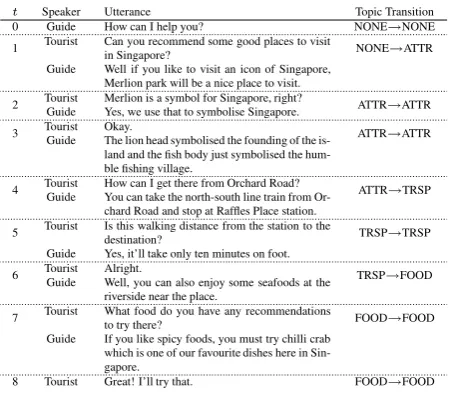
t Speaker Utterance Topic Transition 0 Guide How can I help you? NONE→NONE 1 Tourist Can you recommend some good places to visitin Singapore? NONE→ATTR
Guide Well if you like to visit an icon of Singapore, Merlion park will be a nice place to visit.
2 TouristGuide Merlion is a symbol for Singapore, right?Yes, we use that to symbolise Singapore. ATTR→ATTR 3 TouristGuide Okay.The lion head symbolised the founding of the is- ATTR→ATTR
land and the fish body just symbolised the hum-ble fishing village.
4 TouristGuide How can I get there from Orchard Road?You can take the north-south line train from Or- ATTR→TRSP chard Road and stop at Raffles Place station.
5 Tourist Is this walking distance from the station to thedestination? TRSP→TRSP Guide Yes, it’ll take only ten minutes on foot.
6 TouristGuide Alright.Well, you can also enjoy some seafoods at the TRSP→FOOD riverside near the place.
7 Tourist What food do you have any recommendationsto try there? FOOD→FOOD Guide If you like spicy foods, you must try chilli crab
which is one of our favourite dishes here in Sin-gapore.
[image:2.595.72.297.60.257.2]8 Tourist Great! I’ll try that. FOOD→FOOD
Figure 1: Examples of dialog topic tracking on Singapore tour guide dialogs
2 Dialog Topic Tracking
Dialog topic tracking can be considered as a clas-sification problem to detect topic transitions. The most probable pair of topics at just before and after each turn is predicted by the following classifier:
f(xt) = (yt−1, yt), where xt contains the input
features obtained at a turn t,yt ∈ C, and C is a
closed set of topic categories. If a topic transition occurs att,ytshould be different fromyt−1.
Oth-erwise, bothytandyt−1have the same value. Figure 1 shows an example of dialog topic tracking in a given dialog fragment on Singapore tour guide domain between a tourist and a guide. This conversation is divided into three segments, sincef detects three topic transitions att1,t4and
t6. Then, a topic sequence of ‘Attraction’, ‘Trans-portation’, and ‘Food’ is obtained from the results.
3 Wikipedia-based Composite Kernel for Dialog Topic Tracking
The classifierf can be built on the training exam-ples annotated with topic labels using supervised machine learning techniques. Although some fun-damental features extracted from the utterances mentioned at a given turn or in a certain number of previous turns can be used for training the model, this information obtained solely from an ongoing dialog is not sufficient to identify not only user-initiative, but also system-initiative topic transi-tions.
To overcome this limitation, we propose to leverage on Wikipedia as an external knowledge source that can be obtained without significant
effort toward building resources for topic track-ing. Recently, some researchers (Wilcock, 2012; Breuing et al., 2011) have shown the feasibility of using Wikipedia knowledge to build dialog sys-tems. While each of these studies mainly focuses only on a single type of information including cat-egory relatedness or hyperlink connectedness, this work aims at incorporating various knowledge ob-tained from Wikipedia into the model using a com-posite kernel method.
Our composite kernel consists of two different kernels: a history sequence kernel and a domain context tree kernel. Both represent the current di-alog context at a given turn with a set of relevant Wikipedia paragraphs which are selected based on the cosine similarity between the term vectors of the recently mentioned utterances and each para-graph in the Wikipedia collection as follows:
sim(x, pi) = |φφ((xx))||·φφ((ppi) i)|,
where x is the input, pi is the i-th paragraph in
the Wikipedia collection, φ(pi) is the term vector
extracted frompi. The term vector for the inputx, φ(x), is computed by accumulating the weights in the previous turns as follows:
φ(x) = α1, α2,· · · , α|W|∈R|W|,
whereαi = Phj=0 λj·tfidf(wi, u(t−j)), ut is
the utterance mentioned in a turnt,tfidf(wi, ut)
is the product of term frequency of a word wi in utand inverse document frequency of wi, λis a
decay factor for giving more importance to more recent turns, |W| is the size of word dictionary, and his the number of previous turns considered as dialog history features.
After computing this relatedness between the current dialog context and every paragraph in the Wikipedia collection, two kernel structures are constructed using the information obtained from the highly-ranked paragraphs in the Wikipedia.
3.1 History Sequence Kernel
The first structure to be constructed for our com-posite kernel is a sequence of the most similar paragraph IDs of each turn from the beginning of the session to the current turn. Formally, the se-quenceSat a given turntis defined as:
S = (s0,· · ·, st),
Since our hypothesis is that the more similar the dialog histories of the two inputs are, the more similar aspects of topic transtions occur for them, we propose a sub-sequence kernel (Lodhi et al., 2002) to map the data into a new feature space de-fined based on the similarity of each pair of history sequences as follows:
Ks(S1, S2) =
X
u∈An
X
i:u=S1[i]
X
j:u=S2[j]
λl(i)+l(j),
whereAis a finite set of paragraph IDs,S is a fi-nite sequence of paragraph IDs,uis a subsequence ofS,S[j]is the subsequence with thei-th charac-ters ∀i ∈ j,l(i)is the length of the subsequence, andλ∈(0,1)is a decay factor.
3.2 Domain Context Tree Kernel
The other kernel incorporates more various types of domain knowledge obtained from Wikipedia into the feature space. In this method, each in-stance is encoded in a tree structure constructed following the rules in Figure 2. The root node of a tree has few children, each of which is a subtree rooted at each paragraph node in:
Pt={pi|sim(xt, pi)> θ},
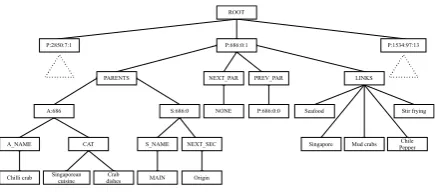
whereθis a threshold value to select the relevant paragraphs. Each subtree consists of a set of fea-tures from a given paragraph in the Wikipedia col-lection in a hierarchical structure. Figure 3 shows an example of a constructed tree.
Since this constructed tree structure represents semantic, discourse, and structural information extracted from the similar Wikipedia paragraphs to each given instance, we can explore these more enriched features to build the topic tracking model using a subset tree kernel (Collins and Duffy, 2002) which computes the similarity between each pair of trees in the feature space as follows:
Kt(T1, T2) =
X
n1∈NT1
X
n2∈NT2
△(n1, n2),
where NT is the set of T’s nodes, △(n1, n2) =
P
iIi(ni)·Ii(n2), andIi(n)is a function that is
1 iff thei-th tree fragment occurs with root at node
nand 0 otherwise.
3.3 Kernel Composition
In this work, a composite kernel is defined by com-bining the individual kernels including history se-quence and domain context tree kernels, as well as
<TREE>:=(ROOT <PAR>...<PAR>) <PAR>:=(PAR_ID <PARENTS>
<PREV_PAR><NEXT_PAR><LINKS>) <PARENTS>:=(‘PARENTS’ <ART><SEC>)
<ART>:=(ART_ID <ART_NAME><CAT_LIST>) <ART_NAME>:=(‘ART_NAME’ ART_NAME) <CAT_LIST>:=(‘CAT’ <CAT>...<CAT>)
<CAT>:=(CAT_ID *)
<SEC>:=(SEC_ID <SEC_NAME><PARENT_SEC> <PREV_SEC><NEXT_SEC>) <SEC_NAME>:=(‘SEC_NAME’ SEC_NAME) <PARENT_SEC>:=(‘PRN_SEC’, PRN_SEC_ID) <PREV_SEC>:=(‘PREV_SEC’, PREV_SEC_NAME) <NEXT_SEC>:=(‘NEXT_SEC’, NEXT_SEC_NAME) <PREV_PAR>:=(‘PREV_PAR’, PREV_PAR_ID) <NEXT_PAR>:=(‘NEXT_PAR’, NEXT_PAR_ID) <LINKS>:=(‘LINKS’ <LINK>...<LINK>)
[image:3.595.308.526.318.414.2]<LINK>:=(LINK_NAME *)
Figure 2: Rules for constructing a domain context tree from Wikipedia: PAR, ART, SEC, and CAT are acronyms for paragraph, article, section, and category, respectively
Figure 3: An example of domain context tree
the linear kernel between the vectors representing fundamental features extracted from the utterances themselves and the results of linguistic preproces-sors. The composition is performed by linear com-bination as follows:
K(x1, x2) =α·Kl(V1, V2) +β·Ks(S1, S2) +γ·Kt(T1, T2),
where Vi, Si, and Ti are the feature vector,
his-tory sequence, and domain context tree ofxi,
re-spectively,Klis the linear kernel computed by
in-ner product of the vectors,α,β, andγ are coeffi-cients for linear combination of three kernels, and
α+β+γ = 1.
4 Evaluation
and tourists. All the recorded dialogs with the total length of 21 hours were manually transcribed, then these transcribed dialogs with 19,651 utterances were manually annotated with the following nine topic categories: Opening, Closing, Itinerary, Ac-commodation, Attraction, Food, Transportation, Shopping, and Other.
Since we aim at developing the system which acts as a guide communicating with tourist users, an instance for both training and prediction of topic transition was created for each turn of tourists. The annotation of an instance is a pair of previous and current topics, and the actual number of labels occurred in the dataset is 65.
For each instance, the term vector was gener-ated from the utterances in current user turn, previ-ous system turn, and history turns within the win-dow sizesh= 10. Then, the history sequence and tree context structures for our composite kernel were constructed based on 3,155 articles related to Singapore collected from Wikipedia database dump as of February 2013. For the linear ker-nel baseline, we used the following features: n-gram words, previous system actions, and current user acts which were manually annotated. Finally, 8,318 instances were used for training the model.
We trained the SVM models using SVMlight 1 (Joachims, 1999) with the
follow-ing five different combinations of kernels: Kl
only,KlwithPas features,Kl+Ks,Kl+Kt, and Kl+Ks+Kt. The threshold valueθfor selecting
P was 0.5, and the combinations of kernels were performed with the same α, β, or γ coefficient values for all sub-kernels. All the evaluations were done in five-fold cross validation to the man-ual annotations with two different metrics: one is accuracy of the predicted topic label for every turn, and the other is precision/recall/F-measure for each event of topic transition occurred either in the answer or the predicted result.
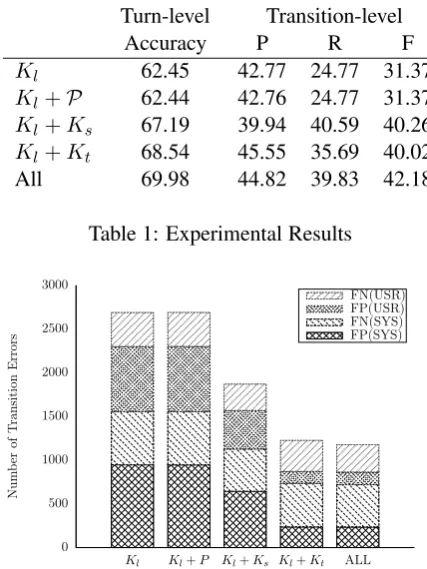
Table 1 compares the performances of the five combinations of kernels. When just the para-graph IDs were included as additional features, it failed to improve the performances from the baseline without any external features. However, our proposed kernels using history sequences and domain context trees achieved significant perfor-mances improvements for both evaluation metrics. While the history sequence kernel enhanced the coverage of the model to detect topic transitions,
1http://svmlight.joachims.org/
Turn-level Transition-level
Accuracy P R F
Kl 62.45 42.77 24.77 31.37 Kl+P 62.44 42.76 24.77 31.37 Kl+Ks 67.19 39.94 40.59 40.26 Kl+Kt 68.54 45.55 35.69 40.02
[image:4.595.306.520.62.347.2]All 69.98 44.82 39.83 42.18
Table 1: Experimental Results
0 500 1000 1500 2000 2500 3000
Kl Kl+P Kl+Ks Kl+Kt ALL
Num
b
er
of
T
ransition
Errors
[image:4.595.306.529.65.160.2]FP(SYS) FN(SYS) FP(USR) FN(USR)
Figure 4: Error distibutions of topic transitions: FN and FP denotes false negative and false posi-tive respecposi-tively. USR and SYS in the parentheses indicate the initiativity of the transitions.
the domain context tree kernel contributed to pro-duce more precise outputs. Finally, the model combining all the kernels outperformed the base-line by 7.53% in turn-level accuracy and 10.81% in transition-level F-measure.
The error distributions in Figure 4 indicate that these performance improvements were achieved by resolving the errors not only on user-initiative topic transitions, but also on system-initiative cases, which implies the effectiveness of the struc-tured knowledge from Wikipedia to track the top-ics in mixed-initiative dialogs.
5 Conclusions
References
P. H. Adams and C. H. Martell. 2008. Topic detection and extraction in chat. InProceedings of the 2008 IEEE International Conference on Semantic Com-puting, pages 581–588.
D. Bohus and A. Rudnicky. 2003. Ravenclaw: dia-log management using hierarchical task decomposi-tion and an expectadecomposi-tion agenda. InProceedings of the European Conference on Speech, Communica-tion and Technology, pages 597–600.
A. Breuing, U. Waltinger, and I. Wachsmuth. 2011. Harvesting wikipedia knowledge to identify topics in ongoing natural language dialogs. InProceedings of the IEEE/WIC/ACM International Conference on Web Intelligence and Intelligent Agent Technology (WI-IAT), pages 445–450.
A. Celikyilmaz, D. Hakkani-T¨ur, and G. T¨ur. 2011. Approximate inference for domain detection in spoken language understanding. In Proceedings of the 12th Annual Conference of the Interna-tional Speech Communication Association (INTER-SPEECH), pages 713–716.
Michael Collins and Nigel Duffy. 2002. New rank-ing algorithms for parsrank-ing and taggrank-ing: Kernels over discrete structures, and the voted perceptron. In Pro-ceedings of the 40th annual meeting on association for computational linguistics, pages 263–270. S. Ikeda, K. Komatani, T. Ogata, H. G. Okuno, and
H. G. Okuno. 2008. Extensibility verification of ro-bust domain selection against out-of-grammar utter-ances in multi-domain spoken dialogue system. In Proceedings of the 9th INTERSPEECH, pages 487– 490.
T. Joachims. 1999. Making large-scale SVM learn-ing practical. In B. Sch¨olkopf, C. Burges, and A. Smola, editors, Advances in Kernel Methods -Support Vector Learning, chapter 11, pages 169– 184. MIT Press, Cambridge, MA.
K. Lagus and J. Kuusisto. 2002. Topic identification in natural language dialogues using neural networks. InProceedings of the 3rd SIGdial workshop on Dis-course and dialogue, pages 95–102.
C. Lee, S. Jung, and G. G. Lee. 2008. Robust dia-log management with n-best hypotheses using di-alog examples and agenda. InProceedings of the 46th Annual Meeting of the Association for Com-putational Linguistics: Human Language Technolo-gies, pages 630–637.
B. Lin, H. Wang, and L. Lee. 1999. A distributed architecture for cooperative spoken dialogue agents with coherent dialogue state and history. In Pro-ceedings of the IEEE Automatic Speech Recognition and Understanding Workshop (ASRU).
Huma Lodhi, Craig Saunders, John Shawe-Taylor, Nello Cristianini, and Chris Watkins. 2002. Text
classification using string kernels. The Journal of Machine Learning Research, 2:419–444.
T. Nakata, S. Ando, and A. Okumura. 2002. Topic de-tection based on dialogue history. InProceedings of the 19th international conference on Computational linguistics (COLING), pages 1–7.
S. Roy and L. V. Subramaniam. 2006. Automatic gen-eration of domain models for call centers from noisy transcriptions. In Proceedings of COLING/ACL, pages 737–744.
G. Wilcock. 2012. Wikitalk: a spoken wikipedia-based open-domain knowledge access system. In Proceedings of the Workshop on Question Answer-ing for Complex Domains, page 5770.
S. Young, J. Schatzmann, K. Weilhammer, and H. Ye. 2007. The hidden information state approach to di-alog management. In Proceedings of the Interna-tional Conference on Acoustics, Speech and Signal Processing (ICASSP), pages 149–152.
Min Zhang, Jie Zhang, Jian Su, and Guodong Zhou. 2006. A composite kernel to extract relations be-tween entities with both flat and structured features. InProceedings of the 21st International Conference on Computational Linguistics and the 44th annual meeting of the Association for Computational Lin-guistics, pages 825–832.