Bootstrapping Entity Translation on Weakly Comparable Corpora
Taesung LeeandSeung-won Hwang Department of Computer Science and Engineering Pohang University of Science and Technology (POSTECH)
Pohang, Republic of Korea
{elca4u, swhwang}@postech.edu
Abstract
This paper studies the problem of mining named entity translations from compara-ble corpora with some “asymmetry”. Un-like the previous approaches relying on the “symmetry” found in parallel corpora, the proposed method is tolerant to asymme-try often found in comparable corpora, by distinguishing different semantics of rela-tions of entity pairs to selectively prop-agate seed entity translations on weakly comparable corpora. Our experimental results on English-Chinese corpora show that our selective propagation approach outperforms the previous approaches in named entity translation in terms of the mean reciprocal rank by up to 0.16 for or-ganization names, and 0.14 in a low com-parability case.
1 Introduction
Identifying and understanding entities is a cru-cial step in understanding text. This task is more challenging in the presence of multilingual text, because translating named entities (NEs), such as persons, locations, or organizations, is a non-trivial task. Early research on NE trans-lation used phonetic similarities, for example, to mine the translation ‘Mandelson’→‘曼 德 尔 森’[ManDeErSen] with similar sounds. However,
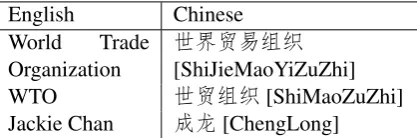
not all NE translations are based on translitera-tions, as shown in Table 1—Some translatranslitera-tions, especially the names of most organizations, are based on semantic equivalences. Furthermore, names can be abbreviated in one or both lan-guages, e.g., the ‘World Trade Organization’ (世
界贸易组织) can be called the ‘WTO’ (世贸组
织). Another challenging example is that, a
trans-lation can be arbitrary, e.g., ‘Jackie Chan’→ ‘成 龙’ [ChengLong]. There are many approaches
English Chinese
World Trade Organization
世界贸易组织
[ShiJieMaoYiZuZhi]
WTO 世贸组织[ShiMaoZuZhi]
[image:1.595.313.522.206.275.2]Jackie Chan 成龙[ChengLong]
Table 1: Examples of non-phonetic translations.
that deal with some of these challenges (Lam et al., 2007; Yang et al., 2009), e.g., by combin-ing phonetic similarity and a dictionary. How-ever, arbitrary translations still cannot be handled by examining the NE pair itself. Corpus-based ap-proaches (Kupiec, 1993; Feng, 2004), by mining external signals from a large corpus, such as par-enthetical translation “成龙(Jackie Chan)”,
com-plement the problem of transliteration-based ap-proaches, but the coverage of this approach is lim-ited to popular entities with such evidence.
The most effective known approach to NE translation has been a holistic framework (You et al., 2010; Kim et al., 2011; You et al., 2012) com-bining transliteration- and corpus-based methods. In these approaches, both 1) arbitrary translations and 2) lesser-known entities can be handled, by propagating the translation scores of known enti-ties to lesser-known entienti-ties if they co-occur fre-quently in both corpora. For example, a lesser-known entity Tom Watson can be translated if Mandelson and Tom Watson co-occur frequently in an English corpus, and their Chinese transla-tions also co-occur frequently in a Chinese corpus, i.e., if the co-occurrences in the two corpora are “symmetric”.
A research question we ask in this paper is: What if comparable corpora are not comparable enough to support thissymmetryassumption? We found that this is indeed the case. For exam-ple, even English and Chinese news from the same publisher may have different focus– the Chi-nese version focuses more on ChiChi-nese Olympic
teams and Chinese local news. In the presence of such asymmetry, all previous approaches, building upon symmetry, quickly deteriorate by propagat-ing false positives. For example, co-occurrence of Mandelson and Tom Watson may not appear in a Chinese corpus, which may lead to the translation of Tom Watson into another Chinese entity Gor-don Brown which happens to co-occur with the Chinese translation of Mandelson.
Our key contribution is to avoid such false propagation, by discerning the semantics of rela-tions. For example, relations between Mandelson and Tom Watson, should be semantically differ-ent from Chinese relations between ‘戈登·布朗’
(Gordon Brown) and ‘曼德尔森’ (Mandelson). A
naive approach would be finding documents with a similartopicsuch as politics, and scientific dis-covery, and allowing propagation only when the topic agrees. However, we found that a topic is a unit that is too coarse for this task because most articles on Mandelson will invariably fall into the same topic1. In clear contrast, weselectively prop-agateseed translations, only when the relations in the two corpora share the same semantics.
This selective propagation can be especially ef-fective for translating challenging types of enti-ties such asorganizationsincluding the WTO used with and without abbreviation in both languages. Applying a holistic approach (You et al., 2012) on organizations leads to poor results, 0.06 in terms of the F1-score. A naive approach to in-crease the precision would be to consider multi-type co-occurrences, hoping that highly precise translations of some type, e.g., persons with an F1-score of 0.69 (You et al., 2012), can be prop-agated to boost the precision on organizations. In our experiments, this naive multi-type prop-agation still leads to an unsatisfactory F1-score of 0.12. Such a low score can be explained by the following example. When translating ‘WTO’ using the co-occurrence with ‘Mandelson’, other co-occurrences such as (London, Mandelson) and (EU, Mandelson) produce a lot of noise because the right translation of WTO does not share much phonetic/semantic similarity. Our understanding of relation semantics, can distinguish “Mandelson was born inLondon” from “Mandelsonvisitedthe WTO”, to stop false propagations, which gener-ates an F1-score 0.25 higher than the existing
ap-1The MRR for organization names achieved by a topic
model-based approach was 0.15 lower than our best.
proaches.
More formally, we enableselective propagation of seed translations on weakly comparable cor-pora, by 1) clarifying the detailed meaning of rela-tional information of co-occurring entities, and 2) identifying the contexts of the relational informa-tion using statement-level context comparison. In other words, we propagate the translation score of a known translation pair to a neighbor pairif the semantics of their relations in English and Chinese corpora areequivalentto accurately propagate the scores. For example, if we know ‘Russia’→‘俄罗 斯’(1)andjoin→加入(2), then from a pair of
state-ments “Russia(1)joins(2)the WTO(3)” and “俄罗斯(1)
加入(2)世贸组织(3)”, we can propagate the
trans-lation score of (Russia, 俄罗斯)(1) to (WTO, 世
贸组织)(3). However, we do not exploit a pair of
statements “Russia joined the WTO” and “俄罗斯 谴责(2’) 摩洛哥” because 谴责(2’) does not mean
join(2). Furthermore, we mine a similar
English-Chinese document pair that can be found by com-paring the entity relationships, such as “Mandel-son visited Moscow” and “Mandel“Mandel-son met Alexei Kudrin”, within the English document and the Chinese document to leverage similar contexts to assure that we use symmetric parts.
For this goal, we first extract relationsamong entities in documents, such as visitandjoin, and mine semantically equivalent relations across the languages, e.g., English and Chinese, such as join→加入. Once these relation translations are mined, similar document pairs can be identified by comparing each constituent relationship among entities using their relations. Knowing document similarity improves NE translation, and improved NE translation can boost the accuracy of document and relationship similarity. This iterative process can continue until convergence.
2 Related Work
This work is related to two research streams: NE translation and semantically equivalent relation mining.
Entity translation
Existing approaches on NE translation can be cat-egorized into 1) transliteration-based, 2) corpus-based, and 3) hybrid approaches.
Transliteration-based approaches (Wan and Ver-spoor, 1998; Knight and Graehl, 1998) are the foundations of many decent methods, but they alone suffer from ambiguity (e.g., 史 蒂 夫 and 始第夫 have the same sounds) and cannot
han-dle non-transliterated cases such as ‘Jackie Chan (成龙[ChengLong])’. Some methods (Lam et al., 2007; Yang et al., 2009) rely on meanings of con-stituent letters or words to handle organization name translation such as ‘Bank of China (中 国 银行)’, whose translation is derived from ‘China
(中 国)’, and ‘a bank (银 行)’. However, many
names often originate from abbreviation (such as ‘WTO’); hence we cannot always leverage mean-ings.
Corpus-based approaches (Kupiec, 1993; Lin et al., 2008; Jiang et al., 2009) exploit high-quality bilingual evidence such as parenthetical transla-tion, e.g., “成龙(Jackie Chan)”, (Lin et al., 2008),
semi-structural patterns (Jiang et al., 2009), and parallel corpus (Kupiec, 1993). However, the cov-erage of the corpus-based approaches is limited to popular entities with such bilingual evidences. On the other hand, our method can cover entities with monolingual occurrences in corpora, which signif-icantly improves the coverage.
The most effective known approach is a holis-tic framework that combines those two ap-proaches (You et al., 2012; You et al., 2010; Kim et al., 2011). You et al. (2010; 2012) leverage two graphs of entities in each language, that are gen-erated from a pair of corpora, with edge weights quantified as the strength of the relatedness of en-tities. Then, two graphs are iteratively aligned us-ing the common neighbors of two entities. Kim et al. (2011) build such graphs using the context sim-ilarity, measured with a bag of words approach, of entities in news corpora to translate NEs. How-ever, these approaches assume the symmetry of the two graphs. This assumption holds if two corpora are parallel, but such resources are scarce. But our approach exploits comparable parts from corpora.
0 0.1 0.2 0.3
0 10 20 30 40 50
N
o
rm
a
li
z
e
d
O
c
c
u
rr
e
n
c
e
Weeks WTO
[image:3.595.323.512.64.190.2]荃䍨㓴㓷
Figure 1: Dissimilarity of temporal distributions of ‘WTO’ in English and Chinese corpora.
Other interesting approaches such as (Klemen-tiev and Roth, 2006; Kim et al., 2012) rely on tem-poral distributions of entities. That is, two entities are considered to be similar if the two entities in different languages have similar occurrence distri-butions over time. However, the effectiveness of this feature also depends on the comparability of entity occurrences in time-stamped corpora, which may not hold as shown in Figure 1. In clear con-trast, our method can find and compare articles, on different dates, describing the same NE. More-over, our method does not require time stamps.
Semantically similar relation mining
Recently, similar relation mining in one language has been studied actively as a key part of automatic knowledge base construction. In automatically constructed knowledge bases, finding semanti-cally similar relations can improve understanding of the Web describing content with many different expressions. As such an effort, PATTY (Nakas-hole et al., 2012) finds similar relations with al-most the same support sets–the sets of NE pairs that co-occur with the relations. However, because of the regional locality of information, bilingual corpora contain many NE pairs that appear in only one of the support sets of the semantically identi-cal relations. NELL (Mohamed et al., 2011) finds related relations using seed pairs of one given lation; then, using K-means clustering, it finds re-lations that are semantically similar to the given relation. Unfortunately, this method requires that we set K manually, and extract relations for each given relation. Therefore, this is unsuitable to sup-port general relations.
in multiple languages for given seed pairs of a re-lation. Because this approach finds seed pairs in Wikipedia infoboxes, the number of retrievable re-lations is restricted to five. Kim et al. (2010) seek more diverse types of relations, but it requires par-allel corpora, which are scarce.
3 Framework Overview
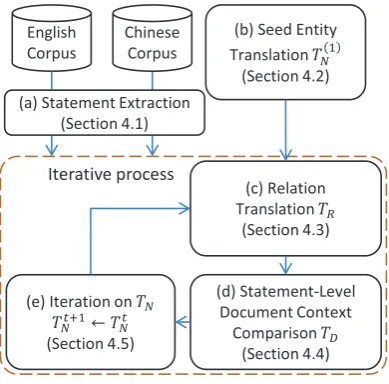
In this section, we provide an overview of our framework for translating NEs, using news cor-pora in English and Chinese as a running example. Because such corpora contain asymmetric parts, the goal of our framework is to overcome asym-metry by distinguishing the semantics of relations, and leveraging document context defined by the relations of entities.
(e) Iteration on ܶே
ܶே௧ାଵ՚ ܶே௧
(Section 4.5)
(c) Relation Translation ܶோ
(Section 4.3)
(d) Statement-Level Document Context
Comparison ܶ (Section 4.4) (b) Seed Entity Translation ܶேଵ
(Section 4.2)
Iterative process
English Corpus
Chinese Corpus
[image:4.595.84.279.293.485.2](a) Statement Extraction (Section 4.1)
Figure 2: Framework overview.
For this purpose, we build a mutual bootstrap-ping framework (Figure 2), between entity trans-lation and retrans-lation transtrans-lation using extracted re-lationships of entities (Figure 2 (a), Section 4.1). More formally, we use the following process:
1. Base condition (Figure 2 (a), Section 4.2): Ini-tializing TN(1)(eE, eC), a seed entity translation
score, whereeE is an English entity, and eC is
a Chinese entity. TN(1) can be initialized by
pho-netic similarity or other NE translation methods.
2. Iteration: ObtainingTNt+1usingTNt.
1) Using TNt, we obtain a set of relation
translations with a semantic similarity score,
Tt
R(rE, rC), for an English relation rE and a
Chinese relationrC (Figure 2 (b), Section 4.3)
(e.g.,rE =visitandrC =访问).
2) UsingTt
N andTRt, we identify a set of
seman-tically similar document pairs that describe the same event with a similarity scoreTDt(dE, dC)
wheredE is an English document anddC is a
Chinese document (Figure 2 (c), Section 4.4). 3) Using TNt,TRt andTDt, we computeTNt+1, an
improved entity translation score (Figure 2 (d), Section 4.5).
Each sub-goal reinforces the result of others in the(t+ 1)-th iteration, and by iteratively running
them, we can improve the quality of translations. Note that, hereinafter, we omit(t)for readability when there is no ambiguity.
4 Methods
In this section, we describe our method in de-tail. First, we explain how we extract statements, which are units of relational information, from documents in Section 4.1, and how we obtain seed name translations in Section 4.2. Next, we present our method for discovering relation translations across languages in Section 4.3. In Section 4.4, we use the name translations and the relation trans-lations to compare document contexts which can boost the precision of NE translation. In Sec-tion 4.5, we describe how we use the resources obtained so far to improve NE translation.
4.1 Statement Extraction
We extract relational statements, which we exploit to propagate translation scores, from an English news corpus and a Chinese news corpus. A rela-tional statement, or simply astatement is a triple
(x, r, y), representing a relationship between two
names, x and y. For example, from
“Mandel-son recently visited Moscow,” we obtain this state-ment: (Mandelson, visit, Moscow). We follow a standard procedure to extract statements, as sim-ilarly adopted by Nakashole et al. (2012), using Stanford CoreNLP (Klein and Manning, 2003) to lemmatize and parse sentences. Here, we refer readers to existing work for further details because this is not our key contribution.
4.2 Seed Entity Translation
We need a few seed translation pairs to initi-ate the framework. We build a seed transla-tion score TN(1)(eE, eC) indicating the
similar-ity of an English entsimilar-ity eE and a Chinese
en-tity eC using an existing method. For
TN(1)(Mandelson,曼德尔森[ManDeErSen]). In this work, we adopted (You et al., 2012) with (Lam et al., 2007) as a base translation matrix to build the seed translation function. We also use a dictio-nary to obtain non-NE translations such as ‘gov-ernment’. We use an English-Chinese general word dictionary containing approximately 80,000 English-Chinese translation word pairs that was also used by Kim et al. (2011) to measure the sim-ilarity of context words of entities.
4.3 Relation Translation
We need to identify relations that have the equiv-alent semantics across languages, (e.g., visit→访 问), to enable selective propagation of translation scores. Formally, our goal is to measure a pair-wise relation translation score TR(rE, rC) for an
English relationrE ∈ RE and a Chinese relation rC ∈RCwhereRE is a set of all English relations
andRC is a set of all Chinese relations.
We first explain a basic feature to measure the similarity of two relations, its limitations, and how we address the problems. A basic clue is that re-lations of the same meaning are likely to be men-tioned with the same entity pairs. For example, if we have (Mandelson, visit, Moscow) as well as (Mandelson, head to, Moscow) in the corpus, this is a positive signal that the two relations may share the same meaning. Such NE pairs are called sup-port pairsof the two relations.
We formally define this clue for relations in the same language, and then describe that in the bilin-gual setting. Asupport intersectionHm(ri, rj), a
set of support pairs, for monolingual relations ri
andrjis defined as
Hm(ri, rj) =H(ri)∩H(rj) (1)
where H(r)is the support setof a relationr
de-fined as H(r) = {(x, y)|(x, r, y) ∈ S}, andS is
eitherSE, a set of all English statements, orSC, a
set of all Chinese statements that we extracted in Section 4.1.
Likewise, we can define a support intersection for relations in the different languages using the translation scoreTN(eE, eC). For an English
rela-tionrE and a Chinese relationrC, Hb(rE, rC) ={(xE, xC, yE, yC)|
TN(xE, xC)≥θ
andTN(yE, yC)≥θ
for(xE, rE, yE)∈SE
and(xC, rC, yC)∈SC}
(2)
whereθ= 0.6is a harsh threshold to exclude most
of the false translations byTN.
Finally, we define a support intersection, a set of support pairs between two relationsriandrjof
any languages,
H(ri, rj) =
Hb(ri, rj) ifri∈REandrj ∈RC Hb(rj, ri) ifrj ∈REandri∈RC Hm(ri, rj) otherwise
(3) Intuitively,|H(ri, rj)|indicates the strength of
the semantic similarity of two relations ri and rj of any languages. However, as shown in
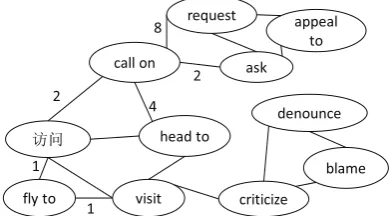
Ta-ble 2, we cannot use this value directly to mea-sure the similarity because the support intersection of semantically similar bilingual relations (e.g., |H(head to,访问)| = 2) is generally very low, and normalization cannot remedy this problem as we can see from |H(visit,访问)| = 27 and
|H(visit)|= 1617.
Set Cardinality
H(visit) 1617
H(访问) 2788
H(visit,访问) 27
[image:5.595.342.493.352.422.2]H(head to,访问) 2 Table 2: Evidence cardinality in the corpora.
䇯䰞
visit head to call on
denounce
criticize
blame ask
request appeal to
fly to
8
2
1 1
2
4
Figure 3: Network of relations. Edges indicate that the relations have a non-empty support section, and edge labels show the size of the inter-section.
[image:5.595.318.513.471.579.2]inter-䇯䰞
visit head to
visit-cluster
denounce
criticize
blame
criticize-cluster
call on 10
6
fly to 2
call on ask request appeal
to
[image:6.595.85.279.65.172.2]request-cluster
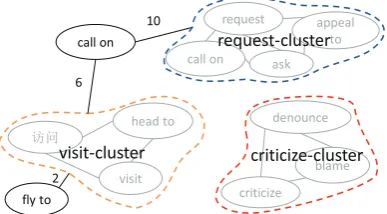
Figure 4: Relation clusters and a few individual relations. Edge labels show the size of the inter-section.
connected. To exploit this feature, we use a ran-dom walk-based graph clustering method.
Formally, we use Markov clustering (Van Don-gen, 2000) on a graph G = (V, E) of relations,
whereV = RE ∪RC is a set of all English and
Chinese relations. An edge(ri, rj) indicates that
two relations in any languages are similar, and its weight is quantified by a sigmoid function on a linear transformation of |H(ri, rj)|that was em-pirically found to produce good results.
Each resultant cluster forms a set of bilingual similar relations,c={rc1, ..., rcM}, such as
visit-cluster, which consists ofvisit,head to, and访问
in Figure 4. However, this cluster may not contain all similar relations. A relation may have multi-ple meanings (e.g.,call on) so it can be clustered to another cluster, or a relation might not be clus-tered when its support set is too small (e.g., fly to). For such relations, rather than assigning zero similarity tovisit-relations, we compute a cluster membership function based on support pairs of the cluster members and the target relation, and then formulate a pairwise relation translation score.
Formally, we learn the membership function of a relation r to a cluster c using support
vec-tor regression (Joachims, 1999) with the follow-ing features based on the support set of clusterc, H(c) = ∪r∈cH(r), and the support intersection
ofrandc,H(r, c) =∪r∗∈cH(r, r∗).
• f1(r, c) = |H(r, c)|/|H(r)|: This quantifies the degree of inclusion,H(c)∈H(r).
• f2(r, c) = |H(r, c)|/|H(c)|: This quantifies the
degree of inclusion,H(r)∈H(c).
• f3(r, c) = |H
within(r, c)|/|Hwithin(c)|: This is a variation off2 that considers only noun phrase
pairs shared at least once by relations inc.
• f4(r, c) = |H
within(r, c)|/|Hshared(c)|: This is a variation off2 that considers only noun phrase
pairs shared at least once by any pair of relations.
• f5(r, c) = |{r∗ ∈ c|H(r, r∗) > 0}|/|c|: This is the degree of connectivity to the cluster mem-bers.
where Hwithin(r, c) = ∪r∗∈cH(r, c) ∩H(r, r∗),
the intersection, considering translation, of H(r)
and noun phrase pairs shared at once by rela-tions in c, Hwithin(c) = ∪r∗∈cH(r∗, c − {r∗}),
andHshared(c) = ∪r∗∈RE∪RCH(r
∗, c), the noun
phrase pairs shared at once by any relations. The use of Hwithin and Hshared is based on the obser-vation that a noun phrase pair that appear in only one relation tends to be an incorrectly chunked en-tity such as ‘World Trade’ from the ‘World Trade Organization’.
Based on this membership functionS(r, c), we
compute pairwise relation similarity. We consider that two relations are similar if they have at least one cluster that the both relations belong to, which can be measured with S(r, c). More formally, pairwise similarity of relationsriandrjis defined
as
TR(ri, rj) = max c∈C S(r
i, c)·S(rj, c) (4)
whereCis a set of all clusters.
4.4 Statement-level Document Context Comparison
A brute-force statement matching approach often fails due to ambiguity created by ignoring con-text, and missing information inTNorTR.
There-fore, we detect similar document pairs to boost the statement matching process. Unlike the pre-vious approaches (e.g., bag-of-words), we focus on the relationships of entities within documents using the extracted statements.
Formally, we compute the similarity of two statements sE = (xE, rE, yE) and sC = (xC, rC, yC)in different languages as follows:
TS(sE, sC) =TN(xE, xC)TR(rE, rC)TN(yE, yC)
(5) With this definition, we can find similar statements described with different vocabularies in different languages.
English documentdi
Eand a Chinese documentdjC
based on their statementsSEi andSjC, respectively:
TD(diE, djC) = ∑
(sE,sC)∈BTS(s i,r E , s
j,r C )
|Si
E|+|SEi | − |B|
(6)
whereB ⊂SiE×SCj is a greedy approximate
solu-tion of maximum bipartite matching (West, 1999) on a bipartite graphGB = (VB = (SEi , SCj), EB)
with edge weights that are defined by TS. The
maximum bipartite matching finds a subset of edges in SEi ×SCj that maximize the sum of the
selected edge weights and that do not share a node as their anchor point.
4.5 Iteration onTN
In this section, we describe how we use the state-ment similarity function TS, and the document
similarity functionTD to improve and derive the
next generation entity translation functionTN(t+1).
We consider that a pair of an English entityeEand
a Chinese entityeC are likely to indicate the same
real world entity if they have 1) semantically sim-ilar relations to the same entity 2) under the same context. Formally, we define an increment func-tion as follows.
∆TN(eE, eC)= ∑
di E
∑
djC
TD(di, dj) max
(sE,sC)∈B∗
TS(sE, sC)
(7) whereB∗is a subset ofB ⊂SEi ×SCj such that the
connected statements mentioneEandeC, andBis
the greedy approximate solution of maximum bi-partite matching for the setSEi of statements ofdiE
and the setSCj of statements ofdjC. In other words, B∗ is a set of matching statement pairs
mention-ing the translation targeteE and eC in the
docu-ment pair. Then, we use the following equation to improve the original entity translation function.
TN(t+1)(eE, eC) = (1−λ)
∆TN(eE, eC) ∑
e∗
C∆TN(eE, e
∗ C)
+λTN(eE, eC) (8)
where λ is a mixing parameter in[0,1]. We set
λ= 0.6in our experiments.
With this update, we obtain the improved NE translations considering the relations that an en-tity has to other entities under the same context to achieve higher precision.
5 Experiments
In this section, we present experimental settings and results of translating entity names using our methods compared with several baselines.
5.1 Data and Evaluation
We processed news articles for an entire year in 2008 by Xinhua news who publishes news in both English and Chinese, which were also used by Kim et al. (2011) and Shao and Ng (2004). The English corpus consists of 100,746 news articles, and the Chinese corpus consists of 88,031 news articles. The news corpora are not parallel but comparable corpora, with asymmetry of entities and relationship as the asymmetry in the number of documents also suggest. Examples of such lo-cality in Xinhua news include the more extensive coverage of Chinese teams in the Olympics and domestic sports in the Chinese news. Our frame-work finds and leverages comparable parts from the corpora without document-content-external in-formation such as time stamps. We also show that, under the decreasing comparability, our method retains higher MRR than the baselines.
We follow the evaluation procedures used by You et al. (2012) and Kim et al. (2011) to fairly and precisely compare the effectiveness of our methods with baselines. To measure perfor-mance, we use mean reciprocal rank (MRR) to evaluate a translation functionT:
M RR(T) = 1
|Q|
∑
(u,v)∈Q 1
rankT(u, v) (9)
whereQis the set of gold English-Chinese
trans-lation pairs(u, v)andrankT(u, v) is the rank of T(u, v)in{T(u, w)|wis a Chinese entity}. In ad-dition, we use precision, recall, and F1-score.
Person Organization MRR P. R. F1 MRR P. R. F1
TN(2) 0.80 0.81 0.79 0.80 0.53 0.56 0.52 0.54
TN(1) 0.77 0.80 0.77 0.78 0.44 0.49 0.44 0.46 TS
[image:8.595.74.290.60.176.2]P H+P 0.73 0.70 0.67 0.69 0.14 0.17 0.04 0.06 TP HM +P 0.68 0.70 0.68 0.69 0.08 0.31 0.08 0.12 THB 0.71 0.59 0.59 0.59 0.37 0.29 0.29 0.29 TDict 0.09 1.00 0.09 0.17 0.17 1.00 0.17 0.30
Table 3: Evaluation results of the methods.
5.2 Baselines
We compare our methods with the following base-lines.
• TP HS +P(You et al., 2012) is a holistic method
that uses a transliteration method as base translations, and then reinforces them to achieve higher quality. This method uses only a single type of entities to propagate the translation scores.
• TP HM +P is the holistic method revised to use
naive type propagation that uses multi-ple types of entities to reinforce the transla-tion scores.
• THBis a linear combination of transliteration
and semantic translation methods (Lam et al., 2007) tuned to achieve the highest MRR.
• TDict is a dictionary-only method. This
dic-tionary is used by bothTHBandTN.
Only the translation pairs of scores above 0.35 are used forTP H+P to maximize the F1-score to
measure precision, recall and F1-score. For our method TN(t), we use the result with (t) = 1,
the seed translations, and (t) = 2, which means
that only one pass of the whole framework is per-formed to improve the seed translation function. In addition, we use translation pairs with scores above 0.05 to measure precision, recall, and F1-score. Note that these thresholds do not affect MRRs.
5.3 NE Translation Results
We show the result of the quantitative evaluation in Table 3, where the highest values are boldfaced, exceptTDict which shows 1.00 precision because
it is a manually created dictionary. For both the person and organization cases, our method TN(2)
outperforms the state-of-the-art methods in terms
English name
TN(2) TN(1) THB
[image:8.595.307.526.61.179.2] [image:8.595.316.514.225.362.2]Mandelson 曼曼曼德德德尔尔尔森森森
[ManDeErSen] 曼[ManDeErSen]曼德曼德德尔尔尔森森森 曼德曼曼[ManDeErSen]德德尔尔尔森森森
WTO 世世世贸贸贸组组组织织织
[ShiMaoZuZhi] 上合组织[ShangHeZuZhi] 巴解组织[BaJieZuZhi]
White House 白白白宫宫宫
[BaiGong] 加州[JiaZhou] 加州[JiaZhou]
Microsoft 微微微软软软公公公司司司
[WeiRuanGongSi]
美国司法部 [MeiGuoSiFaBu]
米罗诺夫
[MiLuoNuoFu]
Table 4: Example translations from the different methods. Boldface indicates correct translations.
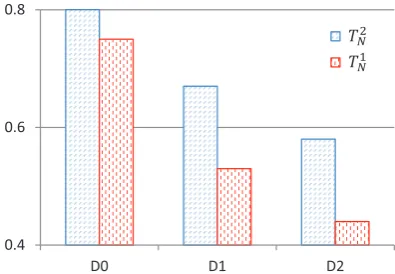
0.4 0.6 0.8
D0 D1 D2
t=2
t=1 ܶேଶ
ܶேଵ
Figure 6: MRR with decreasing comparability.
of precision, recall, F1-score and MRR. With only one iteration of selective propagation, the seed translation is improved to achieve the 0.09 higher MRR.
The baselines show lower, but comparable MRRs and F1-scores for persons that mostly con-sist of transliterated cases. However, not all trans-lations have phonetic similarity, especially orga-nization names, as the low F1-score of TP HS +P,
0.06, for organizations suggests. The naive multi-type propagation TP HM +P shows decreased MRR
for both persons and organizations compared to the single-type propagationTS
P H+P, which shows
a negative influence of diverse relation semantics of entities of different types. THB achieves a
bet-ter MRR thanTP H+P due to the semantic
transla-tion of organizatransla-tion names. However, despite the increased recall ofTHBover that ofTDict, the
pre-cision ofTHBis unsatisfactory becauseTHBmaps
abbreviated names such as ‘WTO’ with other NEs. On the other hand, our method achieves the high-est MRR and precision in both the person and or-ganization categories.
As shown in Table 4,THBtranslates ‘WTO’
The European Union (EU) Trade Commissioner (1) Peter Mandelson traveled to Moscow on Thursday for talks on … Mandelson said it is a priority to see (2) Russia join the WTO, …
⅗ⴏ䍨᱃ငઈ (1) ᖬᗇᴬᗧቄ14ᰕ〻ࡽᖰ㧛ᯟ、, …ᗧቄ൘㹼ࡽਁ㺘Ⲵ༠᰾ѝ䈤,
(2) ״㖇ᯟ࣐ޕц䍨㓴㓷ᱟ⅗ⴏՈݸ㘳㲁Ⲵһ亩ѻа, …
(Peter Mandelson, traveled to, Moscow)
(ᖬᗇᴬᗧቄ, 〻ࡽᖰ, 㧛ᯟ、)
(Russia, join, WTO)
(״㖇ᯟ, ࣐ޕ, ц䍨㓴㓷)
1) 2)
Figure 5: Example of similar document pairs.
Moreover, the use of the corpora by TN(1) could
not fix this problem, and it finds another organi-zation related to trade, ‘上合组织’ (Shanghai
Co-operation Organization). In contrast, our selective propagation method TN(2), which uses the wrong seed translation by TN(1), ‘上 合 组 织’
(Shang-hai Cooperation Organization), successfully trans-lates the WTO using statements such as (Russia, join, WTO), and its corresponding Chinese state-ment (俄罗斯, 加入, 世贸组织). Similarly, both
the baseline THB and the seed translation TN(1)
matched Microsoft to incorrect Chinese entities that are phonetically similar as indicated by the underlined text. In contrast,TN(2)finds the correct
translation despite the phonetic dissimilarity.
5.4 NE Translation Results with Low Corpus Comparability
We tested the methods using less comparable data to evaluate the robustness with the following de-rived datasets:
• D0: All news articles are used.
• D1: January-December English and July-December Chinese articles are used.
• D2: April-September English and July-December Chinese articles are used.
Figure 6 shows the MRR comparisons of our method TN(2) and TN(1) on all test entities.
Be-cause the commonly appearing NEs are decreas-ing, the performance decline is inevitable. How-ever, we can see that the MRR of the seed trans-lation method drops significantly on D1 and D2, whereas our method shows 0.14 higher MRR for both cases.
5.5 Similar Documents
In this section, we show an example of similar documents in Figure 5. Both articles describe the same event about the visit of Mandelson to Moscow for the discussion on the joining of Rus-sia to the WTO. The extracted statements are the exact translations of each corresponding part as in-dicated by the arrows. We stress this is an extreme case for illustration, where the two sentences are almost an exact translation, except for a minor asymmetry involving the date (Thursday in En-glish, and 14th in Chinese). In most similar doc-uments, the asymmetry is more significant. The seed translation scoreTN1(WTO,世贸组织)is not
enough to match the entities. However, the context similarity, due to other similar statements such as (1), allows us to match (2). This match helps trans-lation of ‘WTO’ by inspecting the organization that Russia considers to join in both documents.
6 Conclusions
This paper proposed a bootstrapping approach for entity translation using multilingual relational clustering. Further, the proposed method could finds similar document pairs by comparing state-ments to enable us to focus on comparable parts of evidence. We validated the quality of our approach using real-life English and Chinese corpora, and its performance significantly exceeds that of pre-vious approaches.
Acknowledgment
References
Donghui Feng. 2004. A new approach for english-chinese named entity alignment. In Proceedings of the Conference on Empirical Methods in Natural Language Processing EMNLP, pages 372–379.
Long Jiang, Shiquan Yang, Ming Zhou, Xiaohua Liu, and Qingsheng Zhu. 2009. Mining bilingual data from the web with adaptively learnt patterns. In
Joint Conference of the ACL and the IJCNLP, pages 870–878, Stroudsburg, PA, USA.
T. Joachims. 1999. Making large-scale SVM learning practical. In B. Sch¨olkopf, C. Burges, and A. Smola, editors,Advances in Kernel Methods - Support Vec-tor Learning. MIT Press, Cambridge, MA, USA.
Seokhwan Kim, Minwoo Jeong, Jonghoon Lee, and Gary Geunbae Lee. 2010. A cross-lingual anno-tation projection approach for relation detection. In
COLING, pages 564–571, Stroudsburg, PA, USA.
Jinhan Kim, Long Jiang, Seung-won Hwang, Young-In Song, and Ming Zhou. 2011. Mining entity trans-lations from comparable corpora: a holistic graph mapping approach. In CIKM, pages 1295–1304, New York, NY, USA.
Jinhan Kim, Seung won Hwang, Long Jiang, Young-In Song, and Ming Zhou. 2012. Entity transla-tion mining from comparable corpora: Combining graph mapping with corpus latent features. IEEE Transactions on Knowledge and Data Engineering, 99(PrePrints).
Dan Klein and Christopher D. Manning. 2003. Ac-curate unlexicalized parsing. InProceedings of the 41st Annual Meeting on Association for Computa-tional Linguistics - Volume 1, ACL ’03, pages 423– 430, Stroudsburg, PA, USA. Association for Com-putational Linguistics.
Alexandre Klementiev and Dan Roth. 2006. Named entity transliteration and discovery from multilin-gual comparable corpora. In Proceedings of the main conference on Human Language Technol-ogy Conference of the North American Chapter of the Association of Computational Linguistics, HLT-NAACL ’06, pages 82–88, Stroudsburg, PA, USA. Association for Computational Linguistics.
Kevin Knight and Jonathan Graehl. 1998. Machine transliteration. Comput. Linguist., 24(4):599–612, December.
Julian Kupiec. 1993. An algorithm for finding noun phrase correspondences in bilingual corpora. In
ACL, pages 17–22, Stroudsburg, PA, USA.
Wai Lam, Shing-Kit Chan, and Ruizhang Huang. 2007. Named entity translation matching and learn-ing: With application for mining unseen transla-tions.ACM Trans. Inf. Syst., 25(1), February.
Dekang Lin, Shaojun Zhao, Benjamin Van Durme, and Marius Pasca. 2008. Mining parenthetical transla-tions from the web by word alignment. InACL.
Thahir Mohamed, Estevam Hruschka, and Tom Mitchell. 2011. Discovering relations between noun categories. InEMNLP, pages 1447–1455, Ed-inburgh, Scotland, UK., July.
Ndapandula Nakashole, Gerhard Weikum, and Fabian M. Suchanek. 2012. PATTY: A Taxonomy of Relational Patterns with Semantic Types. In
EMNLP.
Patrick Schone, Tim Allison, Chris Giannella, and Craig Pfeifer. 2011. Bootstrapping multilin-gual relation discovery using english wikipedia and wikimedia-induced entity extraction. In ICTAI, pages 944–951, Washington, DC, USA.
Li Shao and Hwee Tou Ng. 2004. Mining new word translations from comparable corpora. InCOLING, Stroudsburg, PA, USA.
S. Van Dongen. 2000.Graph Clustering by Flow Sim-ulation. Ph.D. thesis, University of Utrecht, The Netherlands.
Stephen Wan and Cornelia Maria Verspoor. 1998. Au-tomatic english-chinese name transliteration for de-velopment of multilingual resources. InACL, pages 1352–1356, Stroudsburg, PA, USA.
Douglas Brent West. 1999. Introduction to graph the-ory (2nd edition). Prentice Hall.
Fan Yang, Jun Zhao, and Kang Liu. 2009. A chinese-english organization name translation system using heuristic web mining and asymmetric alignment. In
Joint Conference of the ACL and the IJCNLP, pages 387–395, Stroudsburg, PA, USA.
Gae-won You, Seung-won Hwang, Young-In Song, Long Jiang, and Zaiqing Nie. 2010. Mining name translations from entity graph mapping. InEMNLP, pages 430–439, Stroudsburg, PA, USA.