Improving Text Simplification Language Modeling
Using Unsimplified Text Data
David Kauchak Middlebury College Middlebury, VT 05753
Abstract
In this paper we examine language mod-eling for text simplification. Unlike some text-to-text translation tasks, text simplifi-cation is a monolingual translation task al-lowing for text in both the input and out-put domain to be used for training the lan-guage model. We explore the relation-ship between normal English and simpli-fied English and compare language mod-els trained on varying amounts of text from each. We evaluate the models intrin-sically with perplexity and extrinintrin-sically on the lexical simplification task from Se-mEval 2012. We find that a combined model using both simplified and normal English data achieves a 23% improvement in perplexity and a 24% improvement on the lexical simplification task over a model trained only on simple data. Post-hoc anal-ysis shows that the additional unsimplified data provides better coverage for unseen and raren-grams.
1 Introduction
An important component of many text-to-text translation systems is the language model which predicts the likelihood of a text sequence being produced in the output language. In some problem domains, such as machine translation, the trans-lation is between two distinct languages and the language model can only be trained on data in the output language. However, some problem do-mains (e.g. text compression, text simplification and summarization) can be viewed as monolingual translation tasks, translating between text varia-tions within a single language. In these monolin-gual problems, text could be used from both the input and output domain to train a language model. In this paper, we investigate this possibility for text
simplification where both simplified English text and normal English text are available for training a simple English language model.
Table 1 shows the n-gram overlap proportions
in a sentence aligned data set of 137K sentence pairs from aligning Simple English Wikipedia and English Wikipedia articles (Coster and Kauchak, 2011a).1 The data highlights two conflicting
views: does the benefit of additional data out-weigh the problem of the source of the data? Throughout the rest of this paper we refer to sentences/articles/text from English Wikipedia as
normal and sentences/articles/text from Simple
English Wikipedia assimple.
On the one hand, there is a strong correspon-dence between the simple and normal data. At the word level 96% of the simple words are found in the normal corpus and even forn-grams as large as
5, more than half of then-grams can be found in
the normal text. In addition, the normal text does represent English text and contains manyn-grams
not seen in the simple corpus. This extra informa-tion may help with data sparsity, providing better estimates for rare and unseenn-grams.
On the other hand, there is still only modest overlap between the sentences for longern-grams,
particularly given that the corpus is sentence-aligned and that 27% of the sentence pairs in this aligned data set are identical. If the word distributions were very similar between simple and normal text, then the overlap proportions be-tween the two languages would be similar re-gardless of which direction the comparison is made. Instead, we see that the normal text has more varied language and contains moren-grams.
Previous research has also shown other differ-ences between simple and normal data sources that could impact language model performance including average number of syllables, reading
1http://www.cs.middlebury.edu/˜dkauchak/simplification
n-gram size: 1 2 3 4 5 simple in normal 0.96 0.80 0.68 0.61 0.55 normal in simple 0.87 0.68 0.58 0.51 0.46
Table 1: The proportion of n-grams that overlap
in a corpus of 137K sentence-aligned pairs from Simple English Wikipedia and English Wikipedia.
complexity, and grammatical complexity (Napoles and Dredze, 2010; Zhu et al., 2010; Coster and Kauchak, 2011b). In addition, for some monolin-gual translation domains, it has been argued that it is not appropriate to train a language model using data from the input domain (Turner and Charniak, 2005).
Although this question arises in other monolin-gual translation domains, text simplification rep-resents an ideal problem area for analysis. First, simplified text data is available in reasonable quantities. Simple English Wikipedia contains more than 60K articles written in simplified En-glish. This is not the case for all monolingual translation tasks (Knight and Marcu, 2002; Cohn and Lapata, 2009). Second, the quantity of sim-ple text data available is still limited. After pre-processing, the 60K articles represents less than half a million sentences which is orders of mag-nitude smaller than the amount of normal English data available (for example the English Gigaword corpus (David Graff, 2003)). Finally, many recent text simplification systems have utilized language models trained only on simplified data (Zhu et al., 2010; Woodsend and Lapata, 2011; Coster and Kauchak, 2011a; Wubben et al., 2012); improve-ments in simple language modeling could translate into improvements for these systems.
2 Related Work
If we view the normal data as out-of-domain data, then the problem of combining simple and nor-mal data is similar to the language model do-main adaption problem (Suzuki and Gao, 2005), in particularcross-domain adaptation(Bellegarda, 2004) where a domain-specific model is improved by incorporating additional general data. Adapta-tion techniques have been shown to improve lan-guage modeling performance based on perplexity (Rosenfeld, 1996) and in application areas such as speech transcription (Bacchiani and Roark, 2003) and machine translation (Zhao et al., 2004), though no previous research has examined the
lan-guage model domain adaptation problem for text simplification. Pan and Yang (2010) provide a sur-vey on the related problem of domain adaptation for machine learning (also referred to as “transfer learning”), which utilizes similar techniques. In this paper, we explore some basic adaptation tech-niques, however this paper is not a comparison of domain adaptation techniques for language mod-eling. Our goal is more general: to examine the relationship between simple and normal data and determine whether normal data is helpful. Previ-ous domain adaptation research is complementary to our experiments and could be explored in the future for additional performance improvements.
Simple language models play a role in a va-riety of text simplification applications. Many recent statistical simplification techniques build upon models from machine translation and uti-lize a simple language model during simplifica-tion/decoding both in English (Zhu et al., 2010; Woodsend and Lapata, 2011; Coster and Kauchak, 2011a; Wubben et al., 2012) and in other lan-guages (Specia, 2010). Simple English language models have also been used as predictive features in other simplification sub-problems such as lexi-cal simplification (Specia et al., 2012) and predict-ing text simplicity (Eickhoff et al., 2010).
Due to data scarcity, little research has been done on language modeling in other monolin-gual translation domains. For text compression, most systems are trained on uncompressed data since the largest text compression data sets con-tain only a few thousand sentences (Knight and Marcu, 2002; Galley and McKeown, 2007; Cohn and Lapata, 2009; Nomoto, 2009). Similarly for summarization, systems that have employed lan-guage models trained only on unsummarized text (Banko et al., 2000; Daume and Marcu, 2002).
3 Corpus
simple normal sentences 385K 2540K words 7.15M 64.7M vocab size 78K 307K
Table 2: Summary counts for the simple-normal article aligned data set consisting of 60K article pairs.
Woodsend and Lapata, 2011). We downloadedall
articles from Simple English Wikipedia then re-moved stubs, navigation pages and any article that consisted of a single sentence, resulting in 60K simple articles.
To partially normalize for content and source differences we generated a document aligned pus for our experiments. We extracted the cor-responding 60K normal articles from English Wikipedia based on the article title to represent the normal data. We held out 2K article pairs for use as a testing set in our experiments. The extracted data set is available for download online.2
Table 2 shows count statistics for the collected data set. Although the simple and normal data contain the same number of articles, because nor-mal articles tend to be longer and contain more content, the normal side is an order of magnitude larger.
4 Language Model Evaluation: Perplexity
To analyze the impact of data source on simple English language modeling, we trained language models on varying amounts of simple data, nor-mal data, and a combination of the two. For our first task, we evaluated these language models us-ing perplexity based on how well they modeled the simple side of the held-out data.
4.1 Experimental Setup
We used trigram language models with interpo-lated Kneser-Kney discounting trained using the SRI language modeling toolkit (Stolcke, 2002). To ensure comparability, all models were closed vo-cabulary with the same vovo-cabulary set based on the words that occurred in the simple side of the training corpus, though similar results were seen for other vocabulary choices. We generated differ-ent models by varying the size and type of training
2http://www.cs.middlebury.edu/˜dkauchak/simplification
100 150 200 250 300 350
0.5M 1M 1.5M 2M 2.5M 3M
perplexity
total number of sentences simple-only normal-only simple-ALL+normal
Figure 1: Language model perplexities on the held-out test data for models trained on increasing amounts of data.
data:
- simple-only: simple sentences only - normal-only: normal sentences only
- simple-X+normal: X simple sentences
com-bined with a varying number of normal sen-tences
To evaluate the language models we calculated the model perplexity (Chen et al., 1998) on the simple side of the held-out data. The test set con-sisted of 2K simple English articles with 7,799 simple sentences and 179K words. Perplexity measures how likely a model finds a test set, with lower scores indicating better performance.
4.2 Perplexity Results
Figure 1 shows the language model perplexi-ties for the three types of models for increasing amounts of training data. As expected, when trained on the same amount of data, the language models trained on simple data perform signifi-cantly better than language models trained on nor-mal data. In addition, as we increase the amount of data, the simple-only model improves more than the normal-only model.
However, the results also show that the normal data does have some benefit. The perplexity for thesimple-ALL+normal model, which starts with
[image:3.595.313.515.65.209.2]100 150 200 250 300
0.5M 1M 1.5M 2M 2.5M
perplexity
[image:4.595.313.520.63.208.2]number of additional normal sentences simple-50k+normal simple-100k+normal simple-150k+normal simple-200k+normal simple-250k+normal simple-300k+normal simple-350k+normal
Figure 2: Language model perplexities for com-bined simple-normal models. Each line represents a model trained on a different amount of simple data as normal data is added.
To better understand how the amount of sim-ple and normal data impacts persim-plexity, Figure 2 shows perplexity scores for models trained on varying amounts of simple data as we add increas-ing amounts of normal data. We again see that normal data is beneficial; regardless of the amount of simple data, adding normal data improves per-plexity. This improvement is most beneficial when simple data is limited. Models trained on less simple data achieved larger performance increases than those models trained on more simple data.
Figure 2 also shows again that simple data is more valuable than normal data. For ex-ample, the simple-only model trained on 250K sentences achieves a perplexity of approximately 150. To achieve this same perplexity level start-ing with 200K simple sentences requires an ad-ditional 300K normal sentences, or starting with 100K simple sentences an additional 850K normal sentences.
4.3 Language Model Adaptation
In the experiments above, we generated the lan-guage models by treating the simple and normal data as one combined corpus. This approach has the benefit of simplicity, however, better perfor-mance for combining related corpora has been seen by domain adaptation techniques which com-bine the data in more structured ways (Bacchiani and Roark, 2003). Our goal for this paper is not to explore domain adaptation techniques, but to determine if normal data is useful for the simple language modeling task. However, to provide an-other dimension for comparison and to understand
95 100 105 110 115 120 125 130
simple-only 0.2 0.4 0.6 0.8 normal-only
perplexity
[image:4.595.78.283.64.208.2]lambda
Figure 3: Perplexity scores for a linearly interpo-lated model between the simple-only model and the normal-only model for varying lambda values.
if domain adaptation techniques may be useful, we also investigated a linearly interpolated language model.
A linearly interpolated language model com-bines the probabilities of two or more language models as a weighted sum. In our case, the in-terpolated model combines the simple model esti-mate,ps(wi|wi−2, wi−1), and the normal model
esti-mate,pn(wi|wi−2, wi−1), linearly (Jelinek and
Mer-cer, 1980; Hsu, 2007): pinterpolated(wi|wi−2, wi−1) =
λ pn(wi|wi−2, wi−1) + (1−λ)ps(wi|wi−2, wi−1)
where0≥λ≥1.
Figure 3 shows perplexity scores for vary-ing lambda values rangvary-ing from the simple-only model on the left withλ = 0to the normal-only
model on the right withλ = 1. As with the
pre-vious experiments, adding normal data improves improves perplexity. In fact, with a lambda of 0.5 (equal weight between the models) the per-formance is slightly better than the aggregate ap-proaches above with a perplexity of 98. The re-sults also highlight the balance between simple and normal data; normal data is not as good as simple data and adding too much of it can cause the results to degrade.
5 Language Model Evaluation: Lexical Simplification
extrinsi-Word: tight
Context: With the physical market astightas it has been in memory, silver could fly at any time. Candidates: constricted, pressurised, low, high-strung, tight
[image:5.595.312.516.155.297.2]Human ranking: tight, low, constricted, pressurised, high-strung
Figure 4: A lexical substitution example from the SemEval 2012 data set.
cally based on the lexical simplification task from SemEval 2012 (Specia et al., 2012).
Lexical simplification is a sub-problem of the general text simplification problem (Chandrasekar and Srinivas, 1997); a sentence is simplified by substituting words or phrases in the sentence with “simpler” variations. Lexical simplification ap-proaches have been shown to improve the read-ability of texts (Urano, 2000; Leroy et al., 2012), are useful in domains such as medical texts where major content changes are restricted, and they may be useful as a pre- or post-processing step for gen-eral simplification systems.
5.1 Experimental Setup
Examples from the lexical simplification data set from SemEval 2012 consist of three parts: w, the
word to be simplified;s1, ..., si−1, w, si+1, ..., sn,
a sentence containing the word; and,r1, r2, ..., rm,
a list of candidate simplifications forw. The goal
of the task is to rank the candidate simplifications according to their simplicity in the context of the sentence. Figure 4 shows an example from the data set. The data set contains a development set of 300 examples and a test set of 1710 examples.3
For our experiments, we evaluated the models on the test set.
Given a language modelp(·)and a lexical
sim-plification example, we ranked the list of candi-dates based on the probability the language model assigns to the sentence with the candidate simplifi-cation inserted in context. Specifically, we scored each candidate simplificationrj by
p(s1... si−1 rj si+1... sn)
and then ranked them based on this score. For ex-ample, to calculate the ranking for the example in Figure 4 we calculate the probability of each of:
With the physical market asconstrictedas it has been ... With the physical market aspressurisedas it has been ... With the physical market aslowas it has been ... With the physical market ashigh-strungas it has been ... With the physical market astightas it has been ...
with the language model and then rank them by their probability.We do not suggest this as a
com-3http://www.cs.york.ac.uk/semeval-2012/task1/
0.24 0.26 0.28 0.3 0.32 0.34 0.36
0.5M 1M 1.5M 2M 2.5M 3M
kappa rank score
total number of sentences simple-only normal-only simple-ALL+normal
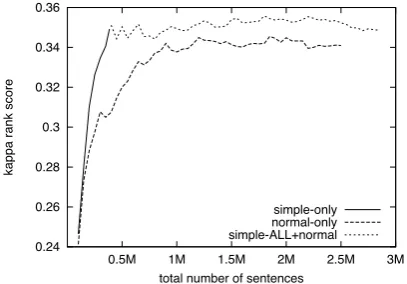
Figure 5: Kappa rank scores for the models trained on increasing amounts of data.
plete lexical substitution system, but it was a com-mon feature for many of the submitted systems, it performs well relative to the other systems, and it allows for a concrete comparison between the lan-guage models on a simplification task.
To evaluate the rankings, we use the metric from the SemEval 2012 task, the Cohen’s kappa coeffi-cient (Landis and Koch, 1977) between the system ranking and the human ranking, which we denote the “kappa rank score”. See Specia et al. (2012) for the full details of how the evaluation metric is calculated.
We use the same setup for training the language models as in the perplexity experiments except the models are open vocabulary instead of closed. Open vocabulary models allow for the language models to better utilize the varying amounts of data and since the lexical simplification problem only requires a comparison of probabilities within a given model to produce the final ranking, we do not need the closed vocabulary requirement.
5.2 Lexical Simplification Results
0.24 0.26 0.28 0.3 0.32 0.34 0.36
0.5M 1M 1.5M 2M 2.5M
kappa rank score
[image:6.595.312.517.65.209.2]number of additional normal sentences normal-only simple-100k+normal simple-150k+normal simple-200k+normal simple-250k+normal simple-300k+normal simple-350k+normal simple-ALL+normal
Figure 6: Kappa rank scores for models trained with varying amounts of simple data combined with increasing amounts of normal data.
unlike the perplexity results, simply appending ad-ditional normal data to the entire simple data set does not improve the performance of the lexical simplifier.
To determine if additional normal data im-proves the performance for models trained on smaller amounts of simple data, Figure 6 shows the kappa rank scores for models trained on differ-ent amounts of simple data as additional normal data is added. For smaller amounts of simple data adding normal data does improve the kappa rank score. For example, a language model trained with 100K simple sentences achieves a score of 0.246 and is improved by almost 40% to 0.344 by adding all of the additional normal data. Even the perfor-mance of a model trained with 300K simple sen-tences is increased by 3% (0.01 improvement in kappa rank score) by adding normal data.
5.3 Language Model Adaptation
The results in the previous section show that adding normal data to a simple data set can im-prove the lexical simplifier if the amount of simple data is limited. To investigate this benefit further, we again generated linearly interpolated language models between the simple-only model and the normal-only model. Figure 7 shows results for the same experimental design as Figure 6 with vary-ing amounts of simple and normal data, however, rather than appending the normal data we trained the models separately and created a linearly inter-polated model as described in Section 4.3. The best lambda was chosen based on a linear search optimized on the SemEval 2012 development set.
For all starting amounts of simple data,
0.24 0.27 0.3 0.33 0.36 0.39 0.42
0.5M 1M 1.5M 2M 2.5M
kappa rank score
[image:6.595.77.283.65.209.2]number of additional normal sentences simple-100k simple-150k simple-200k simple-250k simple-300k simple-350k simple-ALL
Figure 7: Kappa rank scores for linearly inter-polated models between simple-only and normal-only models trained with varying amounts of sim-ple and normal data.
lating the simple model with the normal model re-sults in a large increase in the kappa rank score.
Combining the model trained on all the simple data with the model trained on all the normal data achieves a score of 0.419, an improvement of 23% over the model trained on only simple data. Al-though our goal was not to create the best lexical simplification system, this approach would have ranked 6th out of 11 submitted systems in the SemEval 2012 competition (Specia et al., 2012).
Interestingly, although the performance of the simple-only models varied based on the amount of simple data, when these models are interpolated with a model trained on normal data, the perfor-mance tended to converge. This behavior is also seen in Figure 6, though to a lesser extent. This may indicate that for some tasks like lexical sim-plification, only a modest amount of simple data is required when combining with additional normal data to achieve reasonable performance.
6 Why Does Unsimplified Data Help? For both the perplexity experiments and the lexi-cal simplification experiments, utilizing additional normal data resulted in large performance im-provements; usingallof the simple data available, performance is still significantly improved when combined with normal data. In this section, we investigate why the additional normal data is ben-eficial for simple language modeling.
6.1 Moren-grams
Perplexity test data Lexical simplification simple normal % inc. simple normal % inc. 1-grams 0.85 0.93 9.4% 0.74 0.78 6.2% 2-grams 0.66 0.82 24% 0.34 0.54 56% 3-grams 0.39 0.57 46% 0.088 0.19 117%
Table 3: Proportion ofn-grams in the test sets that
occur in the simple and normal training data sets.
trained using a smoothed version of the maximum likelihood estimate for an n-gram. For trigrams,
this is:
p(a|bc) = count(abc) count(bc)
wherecount(·)is the number of times then-gram
occurs in the training corpus. For interpolated and backoff n-gram models, these counts are
smoothed based on the probabilities of lower or-der n-gram models, which are in-turn calculated
based on counts from the corpus.
We hypothesize that the key benefit of addi-tional normal data is access to moren-gram counts and therefore better probability estimation, partic-ularly for n-grams in the simple corpus that are
unseen or have low frequency. For n-grams that
have never been seen before, the normal data pro-vides some estimate from English text. This is particularly important for unigrams (i.e. words) since there is no lower order model to gain infor-mation from and most language models assume a uniform prior on unseen words, treating them all equally. Forn-grams that have been seen but are
rare, the additional normal data can help provide better probability estimates. Because frequencies tend to follow a Zipfian distribution, these rare
n-grams make up a large portion of n-grams in
real data (Ha et al., 2003).
To partially validate this hypothesis, we exam-ined then-gram overlap between the n-grams in the training data and the n-grams in the test sets
from the two tasks. Table 3 shows the percentage of unigrams, bigrams and trigrams from the two test sets that are found in the simple and normal training data.
For alln-gram sizes the normal data contained
more test setn-grams than the simple data. Even
at the unigram level, the normal data contained significantly more of the test set unigrams than the simple data. On the perplexity data set, the 9.4% increase in word occurrence between the simple and normal data set represents an over 50% reduc-tion in the number of out of vocabulary words. For
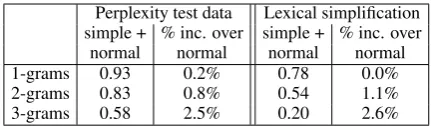
Perplexity test data Lexical simplification simple + % inc. over simple + % inc. over normal normal normal normal
1-grams 0.93 0.2% 0.78 0.0%
2-grams 0.83 0.8% 0.54 1.1%
[image:7.595.73.291.63.116.2]3-grams 0.58 2.5% 0.20 2.6%
Table 4: Proportion ofn-grams in the test sets that
occur in thecombination of both the simple and normal data.
largern-grams, the difference between the simple
and normal data sets are even more pronounced. On the lexical simplification data the normal data contained more than twice as many test trigrams as the simple data. These additionaln-grams
al-low for better probability estimates on the test data and therefore better performance on the two tasks.
6.2 The Role of Normal Data
Estimation of rare events is one component of lan-guage model performance, but other factors also impact performance. Table 4 shows the test set
n-gram overlap on the combined data set of simple and normal data. Because the simple and normal data come from the same content areas, the simple data provides little additional coverage if the nor-mal data is already used. For example, adding the simple data to the normal data only increases the number of seen unigrams by 0.2%, representing only about 600 new words. However, the eximents above showed the combined models per-formed much better than models trained only on normal data.
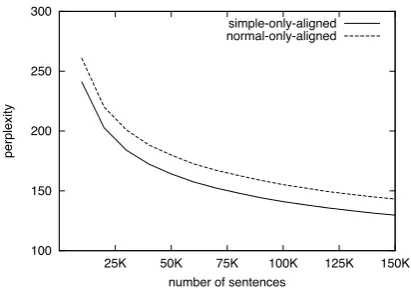
This discrepancy highlights the key problem with normal data: it is out-of-domain data. While it shares some characteristics with the simple data, it represents a different distribution over the lan-guage. To make this discrepancy more explicit, we created a sentence aligned data set by align-ing the simple and normal articles usalign-ing the ap-proach from Coster and Kauchak (2011b). This approach has been previously used for aligning English Wikipedia and Simple English Wikipedia with reasonable accuracy. The resulting data set contains 150K aligned simple-normal sentence pairs.
100 150 200 250 300
25K 50K 75K 100K 125K 150K
perplexity
[image:8.595.77.283.64.208.2]number of sentences simple-only-aligned normal-only-aligned
Figure 8: Language model perplexities for mod-els trained on increasing data sizes for a simple-normal sentence aligned data set.
sentences represent the same content, the language use is different between simple and normal and the normal data performs consistently worse.
6.3 A Balance Between Simple and Normal
Examining the optimal lambda values for the lin-early interpolated models also helps understand the role of the normal data. On the perplexity task, the best perplexity results were obtained with a lambda of 0.5, or an equal weighting between the simple and normal models. Even though the nor-mal data contained six times as many sentences and nine times as many words, the best model-ing performance balanced the quality of the simple model with the coverage of the normal model.
For the simplification task, the optimal lambda value determined on the development set was 0.98, with a very strong bias towards the simple model. Only when the simple model did not provide dif-ferentiation between lexical choices will the nor-mal model play a role in selecting the candidates. For the lexical simplification task, the role of the normal model is even more clear: to handle rare occurrences not covered by the simple model and to smooth the simple model estimates.
7 Conclusions and Future Work
In the experiments above we have shown that on two different tasks utilizing additional normal data improves the performance of simple English lan-guage models. On the perplexity task, the com-bined model achieved a performance improvement of 23% over the simple-only model and on the lexical simplification task, the combined model achieved a 24% improvement. These
improve-ments are achieved over a simple-only model that usesallsimple English data currently available in this domain.
For both tasks, the best improvements were seen when using language model adaptation tech-niques, however, the adaptation results also indi-cated that the role of normal data is partially task dependent. On the perplexity task, the best results were achieved with an equal weighting between the simple-only and normal-only model. How-ever, on the lexical simplification task, the best results were achieved with a very strong bias to-wards the simple-only model. For other simplifi-cation tasks, the optimal parameters will need to be investigated.
For many of the experiments, combining a smaller amount of simple data (50K-100K sen-tences) with normal data achieved results that were similar to larger simple data set sizes. For ex-ample, on the lexical simplification task, when using a linearly interpolated model, the model combining 100K simple sentences with all the normal data achieved comparable results to the model combining all the simple sentences with all the normal data. This is encouraging for other monolingual domains such as text compression or text simplification in non-English languages where less data is available.
References
Michiel Bacchiani and Brian Roark. 2003. Unsuper-vised language model adaptation. InProceedings of ICASSP.
Michele Banko, Vibhu Mittal, and Michael Witbrock. 2000. Headline generation based on statistical trans-lation. InProceedings of ACL.
Jerome R. Bellegarda. 2004. Statistical language model adaptation: Review and perspectives. Speech Communication.
Or Biran, Samuel Brody, and Noe ´mie Elhadad. 2011. Putting it simply: A context-aware approach to lexi-cal simplification. InProceedings of ACL.
Thorsten Brants, Ashok C. Popat, Peng Xu, Franz J. Och, and Jeffrey Dean. 2007. Large language models in machine translation. In Proceedings of EMNLP.
Raman Chandrasekar and Bangalore Srinivas. 1997. Automatic induction of rules for text simplification. Knowledge Based Systems.
Stanley Chen, Douglas Beeferman, and Ronald Rosen-feld. 1998. Evaluation metrics for language mod-els. In DARPA Broadcast News Transcription and Understanding Workshop.
Trevor Cohn and Mirella Lapata. 2009. Sentence com-pression as tree transduction. Journal of Artificial Intelligence Research.
William Coster and David Kauchak. 2011a. Learning to simplify sentences using Wikipedia. In Proceed-ings of Text-To-Text Generation.
William Coster and David Kauchak. 2011b. Simple English Wikipedia: A new text simplification task. InProceedings of ACL.
Hal Daume and Daniel Marcu. 2002. A noisy-channel model for document compression. InProceedings of ACL.
Christopher Cieri David Graff. 2003.
En-glish gigaword. http://www.ldc.
upenn.edu/Catalog/CatalogEntry. jsp?catalogId=LDC2003T05.
Carsten Eickhoff, Pavel Serdyukov, and Arjen P. de Vries. 2010. Web page classification on child suitability. InProceedings of CIKM.
Michel Galley and Kathleen McKeown. 2007. Lex-icalized Markov grammars for sentence compres-sion. InProceedings of HLT-NAACL.
Le Quan Ha, E. I. Sicilia-Garcia, Ji Ming, and F. J. Smith. 2003. Extension of Zipf’s law to word and charactern-grams for English and Chinese. Compu-tational Linguistics and Chinese Language Process-ing.
Bo-June Hsu. 2007. Generalized linear interpolation of language models. InIEEE Workshop on ASRU.
Frederick Jelinek and Robert Mercer. 1980. Interpo-lated estimation of markov source parameters from sparse data. InProceedings of the Workshop on Pat-ter Recognition in Practice.
Kevin Knight and Daniel Marcu. 2002. Summariza-tion beyond sentence extracSummariza-tion: a probabilistic ap-proach to sentence compression. Artificial Intelli-gence.
J. Richard Landis and Gary G. Koch. 1977. The mea-surement of observer agreement for categorical data. Biometrics.
Gondy Leroy, James E. Endicott, Obay Mouradi, David Kauchak, and Melissa Just. 2012. Improving per-ceived and actual text difficulty for health informa-tion consumers using semi-automated methods. In American Medical Informatics Association (AMIA) Fall Symposium.
Courtney Napoles and Mark Dredze. 2010. Learn-ing simple Wikipedia: A cogitation in ascertain-ing abecedarian language. In Proceedings of HLT/NAACL Workshop on Computation Linguistics and Writing.
Tadashi Nomoto. 2009. A comparison of model free versus model intensive approaches to sentence com-pression. InProceedings of EMNLP.
Sinno Jialin Pan and Qiang Yang. 2010. A survey on transfer learning. IEEE Transactions on Knowledge and Data Engineering.
Ronald Rosenfeld. 1996. A maximum entropy ap-proach to adaptive statistical language modeling. Computer, Speech and Language.
Lucia Specia, Sujay Kumar Jauhar, and Rada Mihal-cea. 2012. Semeval-2012 task 1: English lexical simplification. InJoint Conference on Lexical and Computerational Semantics (*SEM).
Lucia Specia. 2010. Translating from complex to sim-plified sentences. InProceedings of Computational Processing of the Portuguese Language.
Andreas Stolcke. 2002. SRILM - An extensible lan-guage modeling toolkit. InProceedings of ICSLP.
Hisami Suzuki and Jianfeng Gao. 2005. A compara-tive study on language model adaptation techniques. InProceedings of EMNLP.
Jenine Turner and Eugene Charniak. 2005. Super-vised and unsuperSuper-vised learning for sentence com-pression. InProceedings of ACL.
Kristian Woodsend and Mirella Lapata. 2011. Learn-ing to simplify sentences with quasi-synchronous grammar and integer programming. InProceedings of EMNLP.
Sander Wubben, Antal van den Bosch, and Emiel Krahmer. 2012. Sentence simplification by mono-lingual machine translation. InProceedings of ACL.
Mark Yatskar, Bo Pang, Cristian Danescu-Niculescu-Mizil, and Lillian Lee. 2010. For the sake of sim-plicity: Unsupervised extraction of lexical simplifi-cations from Wikipedia. InProceedings of NAACL.
Bing Zhao, Matthias Eck, and Stephan Vogel. 2004. Language model adaptation for statistical machine translation with structured query models. In Pro-ceedings of COLING.