Effect of the Polymerized Complex Process on Doping Limit
of Thermoelectric Na
xCo
1yM
yO
2(
M
¼
Mn
, Ni)
Mikio Ito
1and Tomoya Nagira
21
Department of Materials Science and Processing, Graduate School of Engineering, Osaka University, Suita 565-0871, Japan
2Department of Adaptive Machine Systems, Graduate School of Engineering, Osaka University, Suita 565-0871, Japan
The thermoelectric NaxCoO2ceramics partially substituted by Mn or Ni at the Co site were synthesized by a polymerized complex (PC)
process and subsequent pressureless sintering. The effects of the PC process and the partial substitution on the NaxCoO2phase formation and
their thermoelectric properties were investigated. For NaxCo1yMnyO2, the sintered samples were composed of the single phase of-NaxCoO2
without any second phases up toy¼0:10. On the other hand, the X-ray diffraction analysis showed that small peaks from the CoNiO2phase
were clearly detected in the pattern of the NaxCo0:90Ni0:10O2. However, the Ni content in thephase matrix of the NaxCo1yNiyO2synthesized
by the PC process was about 1.9 times greater than that of the ceramic sample prepared by the conventional solid state reaction method, indicating that the PC process is effective for expanding the doping level. Both the Seebeck coefficient and the electrical resistivity were increased by the Mn and Ni substitutions over the entire temperature range, and the dimensionless figure of merit was improved by these substitutions, especially by the Ni substitution.
(Received October 21, 2004; Accepted May 16, 2005; Published July 15, 2005)
Keywords: NaxCoO2, polymerized complex method, doping level, partial substitution, lattice parameter, Seebeck coefficient, electrical
resistivity, dimensionless figure of merit
1. Introduction
Several electrically conductive oxides, such as
(Zn1xAlx)O, BaSrPbO3, NaxCoO2, etc., have been
recog-nized as potential candidates for a new thermoelectric material.1–6)These thermoelectric oxides can be used at high temperatures without deterioration of their performance due to oxidation, and their production costs are comparatively low. The thermoelectric NaxCoO2 shows three types of
crystal structures depending on thexvalue; P3 type (-phase, 1:1x1:2), P2 type (-phase, 1:0x1:4) and O3 type (-phase, 1:8x2:0).7,8) The P2 type -Na
xCoO2
has a large Seebeck coefficient despite its metallic con-ductivity and a good thermoelectric performance as an electrically conductive oxide.
In order to produce the thermoelectric NaxCoO2, the
authors tried to synthesize the pressurelessly-sintered NaxCoO2 polycrystal using the polymerized complex (PC)
method.9) The PC process is a chemical solution process, which was originally outlined by Pechini10)and modified by Kakihana et al.,11) and quite effective for mixing the constituent elements (Na and Co) at an atomic level and obtaining fine powder precursors. The NaxCoO2 polycrystal
synthesized by sintering of the powder precursor showed a high chemical homogeneity and a fine microstructure, resulting in the significant improvement of the thermoelectric properties as compared to the ceramic sample prepared by the conventional solid state reaction (SSR) method.9) On the
other hand, the substitution of metal atoms at the Na or Co site (Na or Co site doping) is also expected to be effective for improving the thermoelectric performance of NaxCoO2. The
substitution of several 3d transition metals at the Co site was tried using the SSR process.12)However, except for Mn, the concentration of the substitutive elements in the NaxCoO2
phase was quite lower than the nominal composition and large amount of second phases associated with the substit-utive metals precipitated, resulting in a deterioration of the
thermoelectric performance, especially in the case of the Ni and Fe substitutions. The PC process is also expected to be effective for promoting the substitution of 3d transition metals, such as Ni, etc., for the Co site, because the constituent elements can be mixed at an atomic level during the PC process, as described above. Based on this consid-eration, in this study, the substitution at the Co site by Mn and Ni, which were easy and difficult to be substituted during the SSR process, respectively, was tried using the PC process. The effects of the PC process on the acceleration of the substitution were evaluated, and the influences of the Co site doping on the thermoelectric properties of NaxCoO2 were
investigated.
2. Experimental Procedure
Polycrystalline ceramic samples of NaxCo1yMyO2 (M¼
Mn and Ni;y¼0, 0.03, 0.05 and 0.10) were prepared by the polymerized complex method. Citric acid and ethylene glycol were added in the proportion of 4 moles and 180 moles, respectively, for each mole of metal cations. NaNO3,
Co(NO3)26H2O, Mn(NO3)36H2O and Ni(NO3)36H2O
ac-cording to the nominal composition of Na1:7Co1yMyO2were
dissolved in ethylene glycol by heating and stirring at 473 K. The solution was heated at 473–573 K. During the heating process, the formation of the polymer between ethylene glycol and the metal citrate complexes was promoted. When the colloidal solution was condensed, it became highly viscous. This viscous polymeric product was then decom-posed into a fine powder at 573–723 K. The powder precursor was calcined at 1073 K for 18 ks in air to enhance the crystallization and eliminate the organic contents. The
calcined powder was compacted at a pressure of
5:6102MPa and then sintered at 1153 K for 72 ks in air under the powder bed with the same composition as the powder sample. The xvalues in NaxCoO2 for the sintered
ceramic samples were about 0.55. The crystal structures of
Special Issue on Thermoelectric Conversion Materials
the ceramic samples were examined by X-ray diffraction (XRD) analysis using Cu Kradiation. The lattice param-eters were measured based on the results of the powder XRD analysis. The electrical resistivity,, and Seebeck coefficient, S, were measured in the direction parallel to the pressed plane from 400 K to 1073 K in air by the ordinary four probe dc method in air using computer-controlled equipment. The thermal diffusivity, D, was measured by the laser flash method using the thermal constant analyzer (ULVAC TC-7000) and the specific heat, Cp, was measured using a
differential scanning calorimeter (Shimazu DSC-50). The thermal conductivity, , was calculated from the thermal diffusivity,D, the specific heat,Cp, and the density,d, using
the equation ¼DCpd. The microstructure and
composition of the ceramic samples were examined by scanning electron microscopy (SEM) and energy dispersive X-ray spectroscopy (EDX).
[image:2.595.309.544.278.757.2]3. Results and Discussions
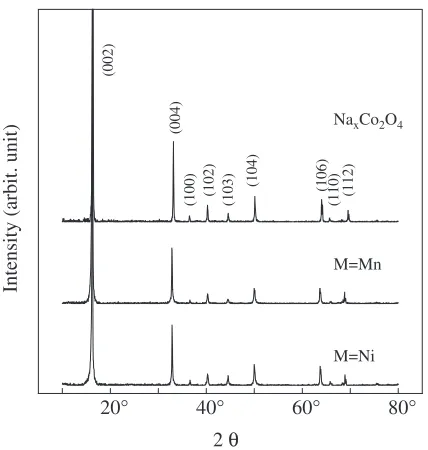
Figure 1 shows the XRD patterns of the NaxCoO2 and
NaxCo0:95M0:05O2 (M¼Mn and Ni) ceramic samples
syn-thesized by the PC method. All the ceramic samples were only composed of the -NaxCoO2 phase, and no second
phases were detected in their XRD patterns. For the Mn substitution, the ceramic sample with y¼0:10 was also found to be the single phase of-NaxCoO2, as well as in the
case of the Mn-substituted SSR ceramic sample.12)On the other hand, in the XRD pattern of the Ni-substituted ceramic sample withy¼0:10, several peaks from the CoNiO2phase
appeared, indicating the nominal composition of
NaxCo0:90Ni0:10O2 was beyond the Ni soluble limit in the
phase. However, for the Ni-substituted SSR ceramic sample withy¼0:05, the CoNiO2phase was clearly detected in its
XRD pattern. These facts indicate that the substitution of Ni at the Co site was promoted using the PC process. During the PC process, the constituent metals, such as Na, Co, Mn and
Ni, form metal citrate complexes, and then the formation of the polymer between ethylene glycol and the metal citrate complexes occurs. Therefore, each metal is uniformly dis-tributed throughout the polymer in the ion state. When the organic content is removed by subsequent heating, these constituent metals can be mixed on an atomic level and finally form the powder precursor of the desired-NaxCoO2
phase. Thus, the mixing of the constituent metals on an atomic level is considered to accelerate the dissolution of the substitutive elements.
Figure 2 shows SEM photographs of the cross sections of the sintered (a) non-substituted NaxCoO2, (b) NaxCo0:95
-Mn0:05O2and (c) NaxCo0:95Ni0:05O2. For the non-substituted
ceramic sample (a), the crystal grains were around 10mmin diameter, and the relative density of the sintered body was
20° 40° 60° 80°
NaxCo2O4
M=Mn
Intensity (arbit. unit)
2 θ
M=Ni
(002)
(004)
(100) (102) (103)
(104) (106) (110) (112)
Fig. 1 XRD patterns of the sintered NaxCoO2and NaxCo0:95M0:05O2(M¼
Mn and Ni).
Fig. 2 SEM photographs of cross sections of the sintered (a)
[image:2.595.63.277.531.756.2]about 96%, which was slightly higher than that of the SSR ceramic sample of about 93%. In the Mn-substituted ceramic sample (b), there were no second phases, which is quite consistent with the result of the XRD analysis. Most of the crystal grains were about 2–5mm in diameter and a fine microstructure compared to that of the non-substituted ceramic sample could be obtained by Mn substitution. When the Mn-substituted ceramic samples were synthesized by the SSR process, the microstructure was finer than that of the non-substituted ceramic sample, showing the same behavior as the PC ceramic sample. On the other hand, in the case of the Ni-substituted ceramic sample, although the ceramic sample was the single phase of -NaxCoO2 in the XRD
pattern, there were several CoNiO2 particles around 1mmin
diameter. However, the amount of the CoNiO2second phase
was quite low, and most of the Ni atoms are considered to be substituted at the Co sites. An EDX analysis was performed on several areas of the NaxCoO2 matrix of these ceramic
samples. The xvalues in the NaxCoO2 of the Mn- and
Ni-substituted ceramic samples were found to be about 0.55, indicating that the Mn and Ni substitution did not have any significant influence on the Na content of the sintered samples. The Mn content of the NaxCoO2matrix of the
Mn-substituted ceramic sample was almost the same as that of the nominal composition. For the Ni-substituted ceramic sample,
the Ni content corresponding to around y¼0:06 was
detected by EDX analysis, which is about 1.9 times greater than that of the Ni substituted SSR ceramic sample.12)Based on these experimental results of the XRD and EDX analyses, it was found that the PC process was effective for increasing the content of the substitutive element, Ni, in the NaxCoO2
matrix.
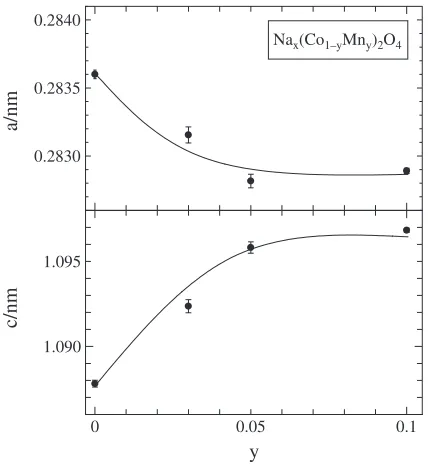
Figures 3 and 4 show thea-axis andc-axis parameters of the NaxCo1yMnyO2 and the NaxCo1yNiyO2 ceramic
sam-ples, respectively, synthesized by the PC method. Thea-axis andc-axis parameters of NaxCoO2 decreased and increased,
respectively, by both the Mn- and Ni-substitutions. It was
also found that the change in these parameters of the Mn-substituted ceramic samples were significant when compared to those of the Ni-substituted ceramic samples. The ionic radii of Mn2þ, Ni2þ and Co3þ were 0.083, 0.069 and 0.054 nm, respectively.13)Although the true valences of Mn and Ni in the NaxCoO2 matrix could not be clarified in this
study, the significant changes in the a-axis and c-axis parameters of the Mn-substituted ceramic samples are considered to be associated with the large difference between the ionic radii of Mn and Co. The changes in the lattice parameters resulting from the Mn and Ni substitutions must cause a lattice strain in the NaxCoO2 phase. The fine
microstructure obtained in the Mn- and Ni-substituted ceramic samples shown in Fig. 2 may be associated with the lattice strain induced by the Ni and Mn solution. Figure 5 shows the rate of change in thea-axis andc-axis parameters of the NaxCo1yNiyO2ceramic samples, as compared to that
of the NaxCo1yNiyO2 ceramic samples synthesized by the
SSR method. The rate of change in the a-axis and c-axis parameters of the ceramic sample synthesized by the PC process was found to be significantly greater than that of the conventional SSR ceramic samples. This fact also suggests that the PC process is effective for accelerating the Ni substitution of the Co site in the NaxCoO2phase. This effect
of the PC process is considered applicable for the substitution of other 3d transition metals, which was difficult in the SSR process, indicating the possible improvement of the thermo-electric properties of the NaxCoO2phase due to expansion of
the doping levels.
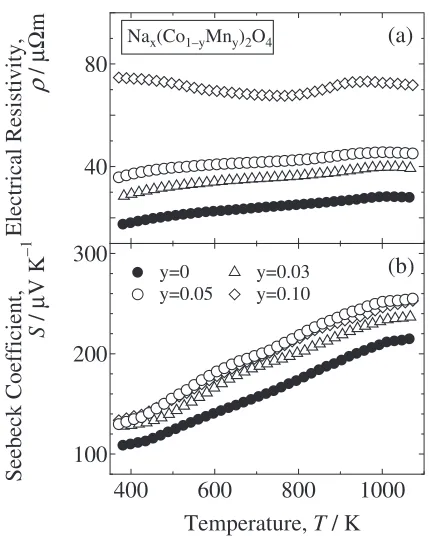
Figure 6 shows the temperature dependence of (a) the electrical resistivity,, and (b) the Seebeck coefficient,S, of the sintered NaxCo1yMnyO2. The electrical resistivity of the
ceramic sample monotonously increased with the increasing
y value. The Seebeck coefficient was also monotonously
enhanced by increasingytoy¼0:05. Based on these results, it is considered that the Mn substitution resulted in a reduction of the carrier concentration in the ceramic sample.
0.2830 0.2835 0.2840
0 0.05 0.1
1.090 1.095
y
a/nm
c/nm
Nax(Co1–yMny)2O4
Fig. 3 a-axis andc-axis parameters of the sintered NaxCo1yMnyO2.
0.2830 0.2835 0.2840
0 0.05 0.1
1.090 1.095
y
a/nm
c/nm
Nax(Co1–yNiy)2O4
[image:3.595.320.534.70.304.2] [image:3.595.63.277.536.768.2]On the other hand, though the relative densities of these Mn-substituted ceramic samples were almost the same as that of the ceramic sample without substitution, the Mn substitution resulted in the fine microstructure of the sintered bodies as compared to the non-substituted ceramic sample, as shown in Fig. 2. Besides that, the solution of Mn atoms also caused the change in the lattice parameters of the -NaxCoO2 phase,
suggesting that a lattice strain was induced in the
Mn-substituted ceramic samples. It is considered that these fine microstructure and induced lattice strain also contributed to the increase in the electrical resistivity. For the ceramic sample with y¼0:10, the electrical resistivity was signifi-cantly high over the entire temperature range, and its temperature dependence was different from those of the other ceramic samples. Besides that, the Seebeck coefficient of this ceramic sample was almost the same as that of the ceramic sample withy¼0:05, and further increase in theS values did not occur. As mentioned above, the ceramic sample withy¼0:10was only composed of the-NaxCoO2
[image:4.595.63.282.70.311.2]phase without any second phases. Based on these facts, the Mn substitution is considered to have a significant influence not only on the carrier concentration, but also on other electrical properties, such as the carrier effective mass, etc. Figure 7 shows the temperature dependence of (a) the electrical resistivity, , and (b) the Seebeck coefficient, S, of the sintered NaxCo1yNiyO2. The electrical resistivity of
the ceramic samples monotonously increased with the increasing y value, as well as that of the Mn-substituted ceramic samples. In the case of the Ni-substituted ceramic samples withy¼0:05and 0.10, small particles of the second phase, CoNiO2, were precipitated in the NaxCoO2 matrix.
The dispersion of the CoNiO2 particles was also ascribed to
the increase in the electrical resistivity, especially for the ceramic sample with y¼0:10. On the other hand, the Seebeck coefficient increased with the increasingyup toy¼ 0:05, and then decreased in the ceramic sample with y¼0:10. Based on the results of Fig. 7, the Ni substitution is considered to reduce the carrier concentration as well as the Mn substitution. As described above, both the Mn and Ni substitutions resulted in shrinkage of the a-axis and the expansion of the c-axis. These changes in the lattice 0.20
0.10 0.00
0 0.1
0.00 0.20 0.40
y
|
(a–a
0
) /a
0
|
100
(c–c
0
)/c
0
100
Nax(Co1–yNiy)2O4
SSR method
PC method
0.05
Fig. 5 Rate of change in the a-axis and c-axis parameters of the
NaxCo1yNiyO2 versus that of the NaxCo1yNiyO2 ceramic samples
synthesized by the SSR method.
40
80
400
600
800
1000
100
200
300
Temperature,
T
/ K
Electrical Resistivity,
ρ
/
µΩ
m
y=0
(a)
Seebeck Coefficient,
S
/
µ
V K
–1
(b)
y=0.05
y=0.03 y=0.10
Nax(Co1–yMny)2O4
Fig. 6 Temperature dependence of (a) the electrical resistivity,, and
(b) the Seebeck coefficient,S, of the sintered NaxCo1yMnyO2.
20
40
60
400
600
800
1000
100
200
300
Temperature,
T
/ K
Electrical Resistivity,
ρ
/
µΩ
m
y=0
(a)
Seebeck Coefficient,
S
/
µ
V K
–1
(b)
y=0.05
y=0.03 y=0.10
Nax(Co1–yNiy)2O4
Fig. 7 Temperature dependence of (a) the electrical resistivity,, and
[image:4.595.316.534.72.344.2] [image:4.595.62.277.372.640.2]parameters may also affect the electrical properties. There-fore, the effects of the substitution of 3d transition metals at the Co site on the electrical transport properties of NaxCoO2
should be investigated in detail in the future.
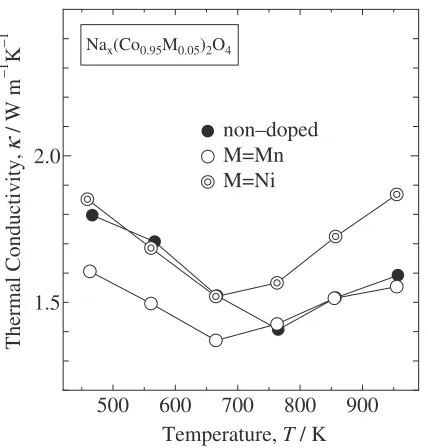
Figure 8 shows the temperature dependence of the thermal conductivity, , of the non-doped NaxCoO2 and the Nax
-Co0:95M0:05O2 (M¼Mn and Ni) ceramic samples. For the
NaxCo0:95Mn0:05O2, the thermal conductivity of the ceramic
sample was lower than that of the non-substituted ceramic sample in the lower temperature range below 700 K, which is considered to be caused by enhancement of the phonon scattering due to the fine microstructure shown in Fig. 2(b). On the other hand, in the higher temperature range, the values of the Mn-substituted ceramic sample were almost the same as those of the non-doped ceramic sample. The Ni-substituted ceramic sample showed a thermal conductivity greater than that of the non-doped ceramic sample above 700 K. For the Ni-substituted SSR ceramic samples, the
precipitation of a large amount of the CoNiO2 phase
significantly increased the thermal conductivity, indicating that the thermal conductivity of the CoNiO2phase is higher
than that of the NaxCoO2 phase.12)In addition, the relative
density of the Ni-substituted ceramic sample was 2% higher than that of the non-substituted ceramic sample. The small amount of CoNiO2 and the slight increase in the relative
density are considered to contribute to the increase in thermal conductivity. However, it is difficult to explain the high thermal conductivity of the Ni-substituted ceramic sample compared to the non-substituted ceramic sample only by these CoNiO2 precipitation and increase in the relative
density. Based on this consideration, it is suggested that there is another mechanism increasing the thermal conductivity of the Ni-substituted ceramic sample, which has not been clarified yet in this study. For the NaxCo0:90Ni0:10O2
synthesized in this study, thevalues were almost the same as those of the ceramic sample withy¼0:05. It is considered
that the dispersion of fine CoNiO2 particles due to the PC
process suppresses the increase in the thermal conductivity caused by an increase in the amount of the precipitated CoNiO2 phase.
Figure 9 shows the temperature dependence of the dimensionless figure of merit,ZT, of the non-doped NaxCoO2
and the NaxCo0:95M0:05O2 (M¼Mn and Ni) ceramic
samples. TheZT values of both the Mn- and Ni-substituted ceramic samples were greater than those of the non-doped ceramic sample over the entire temperature range, because the Svalues were significantly enhanced by the Mn and Ni substitution in spite of the increase in the values. The enhancement effect of the Ni substitution on the ZT values was greater when compared to that of the Mn substitution. For the conventional SSR method, the Ni substitution significantly decreased the figure of merit due to its small doping level and precipitation of a large amount of the CoNiO2phase. These results indicate that the thermoelectric
performance of NaxCoO2can be improved by expanding the
doping level of metals that are difficult to dissolve in the NaxCoO2 phase through the SSR process. Thus, the PC
process, which can accelerate the dissolution of substitutive metals in the NaxCoO2 phase, was found to be effective for
improving the performance of the thermoelectric NaxCoO2.
4. Conclusion
The polymerized complex process was applied to the synthesis of thermoelectric NaxCoO2with Mn and Ni doping.
All the Mn-substituted ceramic samples were the single phase of-NaxCoO2, and the Mn contents in the matrix were
quite consistent with that of the nominal composition. For the Ni-substituted ceramic samples, the Ni content in the matrix was 1.9 times greater than those of the ceramic samples prepared by the conventional SSR method, indicating that the PC process is effective for expanding the doping level. The
500
600
700
800
900
1.5
2.0
Temperature,
T
/ K
Thermal Conductivity, / W m
κ
–1
K
–1
non–doped
M=Mn
Nax(Co0.95M0.05)2O4
M=Ni
Fig. 8 Temperature dependence of the thermal conductivity,, of the
non-doped NaxCoO2 and the NaxCo0:95M0:05O2 (M¼Mn and Ni) ceramic
samples.
600 800 1000
0.0 0.5 1.0
[image:5.595.65.279.69.293.2]Temperature, T / K
Figure of Merit,
ZT M=Mn
M=Ni
Nax(Co0.95M0.05)2O4
non–doped
Fig. 9 Temperature dependence of the dimensionless figure of merit,ZT,
of the non-doped NaxCoO2and the NaxCo0:95M0:05O2(M¼Mn and Ni)
[image:5.595.318.530.73.290.2]a-axis and c-axis parameters decreased and increased, respectively, by both substitutions, especially by the Mn substitution. These substitutions resulted in an increase in the Seebeck coefficient and the electrical resistivity, suggesting that the carrier concentration was reduced by the Mn and Ni doping. For the Ni substitution, the thermoelectric perform-ance was significantly improved using the PC process as compared to the conventional SSR process due to expansion of the doping level of Ni.
REFERENCES
1) M. Ohtaki, T. Tsubota, K. Eguchi and H. Arai: J. Appl. Phys.79(1996)
1816–1818.
2) S. Katsuyama, Y. Takagi, M. Ito, K. Majima, H. Nagai, H. Sakai, K
Yoshimura and K. Kosuge: J. Appl. Phys.92(2002) 1391–1398.
3) M. Yasukawa and N. Murayama: J. Mater. Sci. Lett.16(1997) 1731–
1734.
4) I. Terasaki, Y. Sasago and K. Uchinokura: Phys. Rev. B56(1997)
R12685–R12687.
5) M. Ohtaki and E. Maeda: J. Jpn. Soc. Powder Powder Metall.47(2000)
1159–1164.
6) M. Ito, T. Nagira, Y. Tsuchiya, S. Katsuyama, K. Majima and H. Nagai:
J. Jpn. Soc. Powder Powder Metall.49(2002) 406–411.
7) C. Fouassier, G. Matejka, J.-M. Reau and P. Hagenmuller: J. Solid State
Chem.6(1973) 532–537.
8) H. Yakabe, K. Fujita, K. Nakamura and K. Kikuchi: Proc. 17th Int. Conf. Thermoelectrics, Nagoya (1998) 551–558.
9) M. Ito, T. Nagira, D. Furumoto, S. Katsuyama and H. Nagai: Scr.
Mater.48(2003) 403–408.
10) M. Pechini: U. S. Patent No.3, 330, 697, July 11 (1967).
11) M. Kakihana, M. Yoshimura, H. Mazaki, H. Yasuoka and L. Borjesson:
J. Appl. Phys.71(1992) 3904–3910.
12) M. Ito, T. Nagira, Y. Oda, S. Katsuyama, K. Majima and H. Nagai:
Mater. Trans.43(2002) 601–607.
13) T. Inui, A. Nakahara, O. Yamauchi and Y. Yoshikawa:Kaitei Kagaku,