Representing Constraints with Automata
F r a n k M o r a w i e t z a n d T o m C o r n e l l S e m i n a r fiir S p r a c h w i s s e n s c h a f t
U n i v e r s i t £ t T i i b i n g e n W i l h e l m s t r . 113 7 2 0 7 4 T i i b i n g e n , G e r m a n y
{frank, cornell}~sfs, nphil,
uni-tuebingen, de
A b s t r a c t
In this paper we describe an approach to constraint based syntactic theories in terms of finite tree a u t o m a t a . The solutions to constraints expressed in weak monadic sec- ond order (MSO) logic are represented by tree a u t o m a t a recognizing the assignments which make the formulas true. We show t h a t this allows an efficient representation of knowledge about the content of con- straints which can be used as a practical tool for grammatical theory verification. We achieve this by using the intertrans- latability of formulae of MSO logic and tree a u t o m a t a and the embedding of MSO logic into a constraint logic programming scheme. The usefulness of the approach is discussed with examples from the realm of Principles-and-Parameters based parsing.
1 I n t r o d u c t i o n
In recent years there has been a continuing inter- est in computational linguistics in b o t h model theo- retic syntax and finite state techniques. In this pa- per we a t t e m p t to bridge the gap between the two by exploiting an old result in logic, t h a t the weak monadic second order (MSO) theory of two successor functions (WS2S) is decidable (Thatcher and Wright 1968, Doner 1970). A "weak" second order theory is one in which the set variables are allowed to range only over finite sets. There is a more powerful result available: it has been shown (Rabin 1969) t h a t the strong monadic second order theory (variables range over infinite sets) of even countably m a n y successor functions is decidable. However, in our linguistic ap- plications we only need to quantify over finite sets, so the weaker theory is enough, and the techniques cor-
respondingly simpler3 The decidability proof works by showing a correspondence between formulas in the language of WS2S and tree a u t o m a t a , devel- oped in such a way t h a t the formula is satisfiable iff the set of trees accepted by the corresponding au- t o m a t o n is nonempty. While these results were well known, the (rather surprising) suitability of this for- malism as a constraint language for Principles and Parameters (P&P) based linguistic theories has only recently been shown by Rogers (1994).
It should be pointed out immediately t h a t the translation from formulas to a u t o m a t a , while effec- tive, is just about as complex as it is possible to be. In the worst case, the number of states can be given as a function of the number of variables in the input formula with a stack of exponents as tall as the number of quantifier alternations in the for- mula. However, there is a growing b o d y of work in the computer science literature motivated by the success of the MONA decision procedure (Henriksen et al. 1995) 2 on the application of these techniques in computer science (Basin and Klarlund 1995, Kelb et al. 1997), which suggests t h a t in practical cases the extreme explosiveness of this technique can be effectively controlled. It is one of our goals to show t h a t this is the case in linguistic applications as well. The decidability proof for WS2S is inductive on the structure of MSO formulas. Therefore we can choose our particular tree description language rather freely, knowing (a) t h a t the resulting logic 1All of these are generalizations to trees of results on strings and the monadic second order theory of one successor function originally due to Biichi (1960). The applications we mention here could be adapted to strings with finite-state automata replacing tree automata. In general, all the techniques which apply to tree au- tomata are straightforward generalizations of techniques for FSAs.
will be decidable and (b) that the translation to au- t o m a t a will go through as long as the atomic formu- las of the language represent relations which can be translated (by hand if necessary) to tree automata. We will see how this is done ill the next section, but the point can be appreciated immediately. For example, Niehren and Podelski (1992) and Ayari et al. (1997) have investigated the usefulness of these techniques in dealing with feature trees which un- fold feature structures; there the attributes of an attribute-value term are translated to distinct suc- cessor functions. On the other hand, Rogers (1996) has developed a language rich in long-distance rela- tions (dominance and precedence) which is more ap- propriate for work in Government-Binding (GB) the- ory. Compact a u t o m a t a can be easily constructed to represent dominance and precedence relations. One can imagine other possibilities as well: as we will see, the automaton for Kayne-style asymmet- ric, precedence-restricted c-command (Kayne 1994) is also very compact, and makes a suitable primitive for a description language along the lines developed by Frank and Vijay-Shanker (1995).
The paper is organized as follows. First we present some of the mathematical background, then we dis- cuss (na'ive) uses of the techniques, followed by the presentation of a constraint logic programming- based extension of MSO logic to avoid some of the problems of the naive approach, concluding with a discussion of its strengths and weaknesses.
2 D e f i n i n g A u t o m a t a w i t h
C o n s t r a i n t s
T r e e a u t o m a t a . For completeness, we sketch the definitions of trees and tree automata here. An in- troduction to tree a u t o m a t a can be found in G~cseg and Steinby (1984), as well as in Thatcher and Wright (1968) and Doner (1970).
Assume an alphabet E = E0 LJ E2 with Eo = {A} and E2 being a set of binary operation symbols. We think of (binary) trees over E as just the set of terms Tr. constructed from this alphabet. That is, we let A be the empty tree and let a(tl,t2), for a E E2 and tl,t2 E T~., denote the tree with label a and subtrees tl, t2. Alternatively, we can think of a tree t as a function from the addresses in a binary tree domain T to labels in E. 3
A deterministic (bottom-up) tree automaton .4 on binary trees is a tuple (A, E, a0, F, c~ / with A the set
3The first approach is developed in Thatcher and Wright (1968), the second in Doner (1970). A tree do- main is a subset of strings over a linearly ordered set which is closed under prefix and left sister.
of states, a0 E A the initial state, F C_ A the fi- nal states and a : (A x A x E) -+ A the transition function. The transition function can be thought of as a homomorphism on trees inductively defined as: h~(~) : a0 and h~(a(tl, t2)) = a ( h ~ ( t l ) , ha(t2), a).
An automaton .4 accepts a tree t iff ha (t) E F. The language recognized by A is denoted by T(A) = { t l h , ( t ) E F}.
Emptiness of the language T(,4) is decidable by a fixpoint construction computing the set of reachable states. The reachability algorithm is given below in Figure 1. R contains the reachable states con- structed so far, and R' contains possibly new states constructed on the current pass through the loop. T(A) is empty if and only if no final state is reach-
1. R := {ao}, R' := 0.
2. For all (ai,aj) E R x R, for all a E E, R' := R ' U {c~(ai,aj,a)}.
3. If R r - R = 0 then return R, else R := R U R', go to step 2.
Figure 1: Reachable states algorithm.
able. Naturally, if we want to test emptiness, we can stop the construction as soon as we encounter a final state in R r. Note that, given an automaton with k states, the algorithm must terminate after at most k passes through the loop, so the algorithm terminates after at most k 3 searches through the transition ta- ble.
Sets of trees which are the language of some tree automaton are called recognizable. 4 The recogniz- able sets are closed under the boolean operations of conjunction, disjunction and negation, and the automaton constructions which witness these clo- sure results are absolutely straightforward general- izations of the corresponding better-known construc- tions for finite state automata. The recognizable sets are also closed under projections (mappings from one alphabet to another) and inverse projections, and again the construction is essentially that for fi- nite state automata. The projection construction yields a nondeterministic automaton, but, again as for FSA's, bottom-up tree a u t o m a t a can be made deterministic by a straightforward generalization of the subset construction. (Note that top-down tree automata do not have this property: determinis- tic top-down tree a u t o m a t a recognize a strictly nar- rower family of tree sets.) Finally, tree a u t o m a t a can
be minimized by a construction which is, yet again, a straightforward generalization of well known FSA techniques.
T h e w e a k s e c o n d o r d e r t h e o r y o f t w o s u c c e s - s o r f u n c t i o n s . One attraction of monadic second order tree logics is t h a t they give us a principled means of generating a u t o m a t a from a constraint- based theory. The connection allows the linguist to specify ideas a b o u t natural language in a concise manner in logic, while at the same time providing a way of "compiling" those constraints into a form which can be efficiently used in natural language pro- cessing applications.
T h e translation is provided via the weak monadic second order theory of two successor functions (WS2S). T h e structure of two successor functions, H2, has for its domain (N2) the infinite binary branching tree. Standardly the language of WS2S is based on two successor functions (left-daughter and right-daughter), but, as Rogers (1994) shows, this is intertranslatable with a language based on domi- nance and precedence relations. Because we choose the monadic second order language over whichever of these two signatures is preferred, we can quan- tify over sets of nodes in N2. So we can use these sets to pick out arbitrarily large finite trees embed- ded in N2. Second order variables can also be used to pick out other properties of nodes, such as cate- gory or other node-labeling features, and they can be used to pick out higher order substructures such as :~ projections or chains.
As usual, satisfiability of a formula in the language of WS2S by Af2 is relative to an assignment function, m a p p i n g individual variables to members of N2 (as in first order logic) and mapping monadic predicate variables to subsets of N2. Following Biichi (1960), Doner (1970) and T h a t c h e r and Wright (1968) show t h a t assignment functions for such formulas can be coded by a labeling of the nodes in N2 in the follow- ing way. First, we treat individual variables as set variables which are constrained to be singleton sets (we can define the singletonhood property in MSO tree logic). So, without loss of generality, we can think of the domain of the assignment function as a sequence X z , . . . , X~ of the variables occurring in the given formula. We choose our labeling alphabet to be the set of length n bit strings: (0, 1} ~. Then, for every node n E N2, if we intend to assign n to the denotation of Xi, we indicate this by labeling n with a bit string in which the ith bit is on. (In effect, we are labelling every node with a list of the sets to which it belongs.) Now every assignment function we might need corresponds uniquely to a labeling
function over N2. W h a t Doner, and Thatcher and Wright (and, for strong $2S, Rabin) show is t h a t each formula in the language of WS2S corresponds to a tree a u t o m a t o n which recognizes just the sat- isfying "assignment labelings", and we can thereby define a notion of "recognizable relation". So the formula is satisfiable just in case the corresponding a u t o m a t o n recognizes a nonempty language. Note t h a t any language whose formulas can be converted to a u t o m a t a in this way is therefore guaranteed to be decidable, though whether it is as strong as the language of WS2S must still be shown.
This approach to theorem-proving is rather dif- ferent from more general techniques for higher-order theorem proving in ways t h a t the formalizer must keep in mind. In particular, we are deciding mem- bership in the theory of a fixed structure, Af2, and not consequence of an explicit set of tree axioms. So, for example, the parse tree shows up in the for- malization as a second order variable, rather t h a n simply being a satisfying model (cf. Johnson (1994), on "satisfiability-based" g r a m m a r formalisms).
As an example consider the following formula denoting the relation of directed asymmetric c- c o m m a n d 5 in the sense of Kayne (1994). We use the tree logic signature of Rogers (1994), which, in a sec- ond order setting, is interdefinable with the language of multiple successor functions. Uppercase letters denote second order variables, lowercase ones first order variables, <~* reflexive domination, <~+ proper domination and -4 proper precedence:
AC-Com(xl, x2)
% x c-commands y:
(Vz)[z <~+ x =# z <~+ y] A -~(x <1" y) A % y does not c-command x:
4 + y z 4 + x] A 4 " x)) A
% x preceeds y:
x-~y
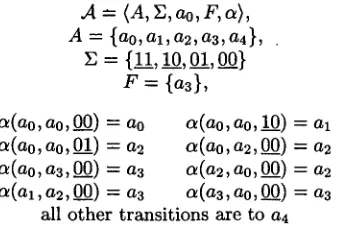
,4 = ( A , ~ , a o , F , a ) , A = {ao,al,a2,a3,a4},
= {11, 10, 01, 00} F = {a3},
(ao,a0,00) = a0 (a0,a0, 10) = a l (a0,a0,01) = a2 (a0,a2,00) = (a0, a 3 , 0 0 ) = a3 (a2, a0, 00) = (al, a : , 00) = a3 a 0 , 0 0 ) =
all other transitions are to a4
Figure 2: The automaton for A C - C o m ( x l , x2)
al on the left subtree and a2 on the right one, we go to the final state aa which again can be percolated as long as empty symbols are read. Clearly, the au- tomaton recognizes all trees which have the desired c-command relation between the two nodes. It com- pactly represents the (infinite) number of possible satisfying assignments.
The proof of the decidability of WS2S furnishes a technique for deriving such a u t o m a t a for recog- nizable relations effectively. (In fact the above au- tomaton was constructed by a simple implementa- tion of such a compiler which we have running at the University of Tiibingen. See Morawietz and Cornell (1997).) The proof is inductive. In the base case, relations defined by atomic formulas are shown to be recognizable by brute force. Then the induction is based on the closure properties of the recognizable sets, so that logical operators correspond to automa- ton constructions in the following way: conjunction and negation just use the obvious corresponding au- tomaton operations and existential quantification is implemented w~th the projection construction. The inductive nature of the proof allows us a fairly free choice of signature, as long as our atomic relations are recognizable. We could, for example, investi- gate theories in which asymmetric c-command was the only primitive, or asymmetric c-command plus dominance, for example.
The projection construction, as noted above, yields nondeterministic a u t o m a t a as output, and the negation construction requires deterministic au- t o m a t a as input, so the subset construction must be used every time a negated existential quantifier is en- countered. The corresponding exponential blowup in the state space is the main cause of the non- elementary complexity of the construction. Since a quantifier prefix of the form 3 - . . 3 V . . . V 3 . . . is equivalent to 3 . . . 3 7 3 - - - 3 7 3 . - - we see that the stack of exponents involved is determined by the number of quantifier alternations.
It is obviously desirable to keep the a u t o m a t a as small as possible. In our own prototype, we min- imize the outputs of all of our a u t o m a t a construc- tions. Note that this gives us another way of deter-
mining satisfiability, since the minimal a u t o m a t o n
recognizing the empty language is readily detectable: its only state is the initial state, and it is not final.
3 D e f i n i n g C o n s t r a i n t s w i t h A u t o m a t a
An obvious goal for the use of the discussed ap- proach would be the (offline) generation of a tree automaton representing an entire grammar. That is, in principle, if we can formalize a grammar in an MSO tree logic, we can apply these compilation techniques to construct an automaton which recog- nizes all and only the valid parse trees. 6 In this set- ting, the parsing problem becomes the problem of conjoining an automaton recognizing the input with the grammar automaton, with the result being an automaton which recognizes all and only the valid parse trees. For example, assume that we have an automaton G r a m ( X ) such that X is a well-formed tree, and suppose we want to recognize the input
John sees Mary. Then we conjoin a description of
the input with the grammar automaton as given be- low.
(3x, y , z E X ) [ x E J o h n A y E Sees A z E M a r y A x -< y -< z A G r a m ( X ) ]
The recognition problem is just the problem of deter- mining whether or not the resulting automaton rec- ognizes a nonempty language. Since the automaton represents the parse forest, we can run it to generate parse trees for this particular input.
Unfortunately, as we have already noted, the problem of generating a tree automaton from an arbitrary MSO formula is of non-elementary com- plexity. Therefore, it seems unlikely that a formal- ization of a realistic principle-based grammar could be compiled into a tree automaton before the heat death of the universe. (The formalization of ideas from Relativized Minimality (Pdzzi 1990) presented in Rogers (1994) fills an entire chapter without spec- ifying even the beginning of a full lexicon, for ex- ample.) Nonetheless there are a number of ways in which these compilation techniques remain use- ful. First, though the construction of a grammar automaton is almost certainly infeasible for realis- tic grammars, the construction of a grammar-and- input automaton--which is a very much smaller
[image:4.612.92.261.42.157.2]m a c h i n e - - m a y not be. We discuss techniques based on constraint logic programming t h a t are applicable to t h a t problem in the next section.
Another use for such a compiler is suggested by the standard divide-and-conquer strategy for prob- lem solving: instead of compiling an entire gram- m a r formula, we isolate interesting subformulas, and a t t e m p t to compile them. Tree a u t o m a t a repre- sent properties of trees and there are m a n y such properties less complex than global well-formedness which are nonetheless important to establish for parse trees. In particular, where the definition of a property of parse trees involves negation or quan- tification, including quantification over sets of nodes, it m a y be easier to express this in an MSO tree logic, compile the resulting formula, and use the resulting a u t o m a t o n as a filter on parse trees originally gen- erated by other means (e.g., by a covering phrase structure g r a m m a r ) .
At the moment, at least, the question of which g r a m m a t i c a l properties can be compiled in a reason- able time is largely empirical. It is made even more difficult by the lack of high quality software tools. This situation should be alleviated in the near future when work on M O N A + + at the University of Aarhus is completed; the usefulness of its older sister MONA (Henriksen et al. 1995), which works on strings and FSA's, has been well demonstrated in the computer science literature. In the meantime, for tests, we are using a comparatively simple implementation of our own. Even with very low-power tools, however, we can construct a u t o m a t a for interesting grammatical constraints.
For example, recall the definition of asymmetric c- c o m m a n d and its associated a u t o m a t o n in Figure 2. In linguistic applications, we generally use versions of c-command which are restricted to be local, in the sense t h a t no element of a certain type is allowed to intervene. The general form of such a locality condition L C might then be formalized as follows.
L C ( x , y )
A C - C o m m ( x , y) A
% there does not exist z with property P: (-~3z)[z E P A
% such t h a t it intervenes between x and y:
( 3 w ) [ w x A w ,a + z A z y]]
Here p r o p e r t y P is meant to be the property iden- tifying a relevant intervener for the relation meant to hold between x and y. Note t h a t this property could include t h a t some other node be the left suc- cessor of z with certain properties, t h a t is, this gen- eral scheme fits cases where the intervening item is
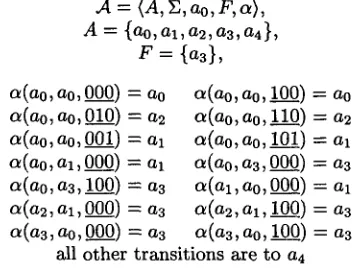
not itself directly on the p a t h between x and y. This formula was compiled by us and yields the automa- ton in Figure 3. Here the first bit position indicates membership in P , the second is for x and the third for y.
A = ( A , E , a o , F , a ) ,
A = {no, al, a2, a3, a4 },
F = { a 3 } ,
a(ao,ao,O00) = ao a ( a o , a o , 100) = ao
a(ao,ao,OlO) -- a2 (~(ao,ao,ll0) = a2
a(ao, ao, 001) = al a(ao, ao, 101) = al a ( a o , a l , 0 0 0 ) -- al ~(ao,a3,000) = a3
a(ao,a3,100) = a3 ~ ( a l , a o , 0 0 0 ) = al O l ( a 2 , a l , 000) = a 3 a(a2, a l , I00) = a 3 o~(a3, ao, 000) = a3 a(a3, ao, 100) = a3
all other transitions are to at
Figure 3: A u t o m a t o n for local c-command. This a u t o m a t o n could in turn be implemented it- self as Prolog code, and considered to be an op- timized implementation of the given specification. Note in particular the role of the compiler as an op- timizer. It outputs a minimized automaton, and the minimal a u t o m a t o n is a unique (up to isomorphism) definition of the given relation. Consider again the definition of A C - C o m m a n d in the previous section. It is far from the most compact and elegant formula defining t h a t relation. There exist much smaller for- mulas equivalent to t h a t definition, and indeed some are suggested by the very structure of the a u t o m a - ton. T h a t formula was chosen because it is an ex- tremely straightforward formalization of the prose definition of the relation. Nonetheless, the a u t o m a - ton compiled from a much cleverer formalization would still be essentially the same. So no particular degree of cleverness is assumed on the p a r t of the formalizer; optimization is done by the compiler. 7 4 M S O L o g i c a n d C o n s t r a i n t L o g i c
P r o g r a m m i n g
[image:5.612.342.521.116.250.2]of the MSO constraint language into a constraint logic programming scheme. The constraint base is an automaton which represents the incremental ac- cumulation of knowledge about the possible valua- tions of variables. As discussed before, automata are a way to represent even infinite numbers of valu- ations with finite means, while still allowing for the efficient extraction of individual valuations. We in- crementally add information to this constraint base by applying and solving clauses with their associated constraints. That is, we actually use the compiler on
line as the constraint solver. Some obvious advan-
tages include that we can still use our succinct and flexible constraint language, but gain (a) a more ex- pressive language, since we now can include induc- tive definitions of relations, and (b) a way of guid- ing the compilation process by the specification of appropriate programs.
We define a relational extension TC(WS2S) of our constraint language following the HShfeld and Smolka scheme (HShfeld and Smolka 1988). From the scheme we get a sound and complete, but now only semi-decidable, operational interpretation of a definite clause-based derivation process. The result- ing structure is an extension of the underlying con- straint structure with the new relations defined via fixpoints.
As usual, a definite clause is an implication with an atom as the head and a body consisting of a sat- isfiable MSO constraint and a (possibly empty) con- junction of atoms. A derivation step consists of two parts: goal reduction, which substitutes the body of a goal for an appropriate head, and constraint solving, which means in our case that we have to check the satisfiability of the constraint associated with the clause in conjunction with the current con- straint store. For simplicity we assume a standard left-to-right, depth-first interpreter for the execution of the programs. The solution to a search branch of a program is a satisfiable constraint, represented in "solved form" as an automaton. Note that a u t o m a t a do make appropriate solved forms for systems of con- straints: minimized a u t o m a t a are normal forms, and they allow for the direct and efficient recovery of par- ticular solutions.
Intuitively, we have a language which has an op- erational interpretation similar to Prolog with the differences that we interpret it not on the Herbrand universe but on N2, that we use M S 0 constraint solving instead of unification and that we can use defined (linguistic) primitives directly.
The resulting system is only semi-decidable, due to the fact that the extension permits monadic sec- ond order variables to appear in recursively defined
clauses. So if we view the inductively defined rela- tions as part of an augmented signature, this sig- nature contains relations on sets. These allow the specification of undecidable relations; for example, Morawietz (1997) shows how to encode the PCP. If we limit ourselves to just singleton variables in any directly or indirectly recursive clause, every relation we define stays within the capacity of MSO logic, s since, if they are first order inductively definable, they are explicitly second order definable (Rogers 1994). Since this does not take us beyond the power of MSO logic and natural language is known not to be context-free, the extra power of TC(WS2S) offers a way to get past the context-free boundary.
To demonstrate how we now split the work be- tween the compiler and the CLP interpreter, we present a simple example. Consider the following naive specification of a lexicon: 9
L e x i c o n ( x ) ~ : ~ ( x E S e e s A x E V A . . . ) V ( x E J o h n A x E N A . . . ) Y ( x E M a r y A x E N A . . . )
We have specified a set called L e x i c o n via a disjunc- tive specification of lexical labels, e.g. S e e s , and the appropriate combination of features, e.g.V. Naively, at least, every feature we use must have its own bit position, since in the logic we treat features as set variables. So, the alphabet size with the encoding as bitstrings will be at least 2 IAlphabet[. It is immedi- ately clear that the compilation of such an automa- ton is extremely unattractive, if at all feasible.
We can avoid having to compile the whole lexi- con by having separate clauses for each lexical en- try in the CLP extension. Notational conventions will be that constraints associated with clauses are written in curly brackets and subgoals in the body are separated by &'s. Note that relations defined in TC(WS2S) are written lowercase.
l e x i c o n ( x ) t--- { x E S e e s A x E V A . . . } l e x i c o n ( x ) +-- { x E J o h n A x E N A . . . } l e x i c o n ( x ) e - - { x E M a r y A x E N A . . . }
This shifts the burden of handling disjunctions to the interpreter. The intuitive point should be clear: it
8Relations on individuals describe sets which are ex- pressible as monadic predicates.
is not the case t h a t every constraint in the g r a m m a r has to be expressed in one single tree automaton. We need only compile into the constraint store those which are really needed. Note t h a t this is true even for variables appearing in the global table. In the CLP extension the appearance in the table is not coupled to the appearance in the constraint store. Only those are present in both which are part of the constraint in an applied clause.
We can also use offline compiled modules in a T~(WS2S) parsing program. As a source of simple examples, we draw on the definitions from the lec- tures on P & P parsing presented in Johnson (1995). In implementing a p r o g r a m such as Johnson's sim- plified
parse
relation--see Figure 4 - - w e can in prin- ciple define any of the subgoals in the body either via precompiled a u t o m a t a (so they are essentially treated as facts), or else providing t h e m with more standard definite clause definitions.parse(Words, Tree)
{Tree(Words)}
&
yield(Words, Tree) &
xbar(Tree)
&
ecp(Tree)
Figure 4:
parse
as in Johnson (1995)In more detail,
Words
denotes a set of nodes la- beled according to the input description. Our initial constraint base, which can be automatically gener- ated from a Prolog list of input words, is the corre- sponding tree automaton. The associated constraintTree
is easily compilable and serves as the initializa- tion for our parse tree. Theyield
andecp
predicates can easily be explicitly defined and, if practically compilable (which is certainly the case foryield),
could then be treated as facts. Thexbar
predicate, on the other hand, is a disjunctive specification of licensing conditions depending on different features and configurations, e.g., whether we are faced with a binary-, unary- or non-branching structure, which is better expressed as several separate rules. In fact, since we want the lexicon to be represented as sev- eral definite clauses, we cannot havexbar
as a sim- ple constraint. This is due to the limitation of the constraints which appear in the definite clauses to (pure) MSO constraints.We now have another well-defined way of using the offiine compiled modules. This, at least, separates the actual processing issues (e.g.,
parse)
from the linguistically motivated modules (e.g., ecp). One can now see t h a t with the relational extension, we can not only use those modules which are compilable di-rectly, but also guide the compilation procedure. In effect this means interleaving the intersection of the g r a m m a r and the input description such t h a t only the minimal amount of information to determine the parse is incrementally stored in the constraint base. Furthermore, the language of 7~(WS2S) is suffi- ciently close to standard Prolog-like programming languages to allow the transfer of techniques and approaches developed in the realm of P & P - b a s e d parsing. In other words, it needs only little effort to translate a Prolog p r o g r a m to a T~(WS2S) one.
5 C o n c l u s i o n s a n d O u t l o o k
In this paper we presented a first step towards the re- alization of a system using a u t o m a t a - b a s e d theorem- proving techniques to implement linguistic process- ing and theory verification. Despite the staggering complexity bound the success of and the continu- ing work on these techniques in computer science promises a useable tool to test formalization of gram- mars. The advantages are readily apparent. The direct use of a succinct and flexible description lan- guage together with an environment to test the for- malizations with the resulting finite, deterministic tree a u t o m a t a offers a way of combining the needs of both formalization and processing. And further- more, the CLP extension offers an even more power- ful language which allows a clear separation of pro- cessing and specification issues while retaining the power and flexibility of the original. Since it allows the control of the generation process, the addition of information to the constraint base is dependent on the input which keeps the number of variables smaller and by this the a u t o m a t a more compact.
Nevertheless it remains to be seen how far the system can be advanced with the use of an opti- mized theorem-prover. The number of variables our current prototype can handle lies between eight and eleven. 1° This is not enough to compile or test all interesting aspects of a formalization. So further work will definitly involve the optimization of the prototype implementation, while we await the devel- opment of more sophisticated tools like M O N A + + . It seems to be promising to improve the (very ba- sic) CLP interpreter, too. T h e HShfeld and Smolka scheme allows the inclusion of existential quantifi- cation into the relational extension. We intend to use this to provide the theoretical background of the implementation of a garbage collection proce- dure which projects variables from the constraint store which are either local to a definite clause or
explicitly marked for projection in the program so that the constraint store can be kept as small as possible.
6
Acknowledgements
This work has been supported by the project A8 of the SFB 340 of the Deutsche Forschungsgemein- schaft. We wish especially to thank Uwe MSnnich and Jim Rogers for discussions and advice. Needless to say, any errors and infelicities which remain are ours alone.
R e f e r e n c e s
Ayari, A., Basin, D. and Podelski, A. (1997). LISA: A specification language based on WS2S, Ms, Uni- versit~it Freiburg. Submitted to CSL'97.
Basin, D. and Klarlund, N. (1995). Hardware verification using monadic second-order logic, Computer-Aided Verification (CAV '95), LNCS 939, Springer, pp. 31-41.
Biehl, M., Klarlund, N. and Rauhe, T. (1996). Algo- rithms for guided tree automata, Proc. WIA '96, LNCS, Springer-Verlag.
Biichi, J. R. (1960). Weak second-order arithmetic and finite automata, Zeitschrift fiir mathematis- ehe Logik und Grundlagen der Mathematik 6: 66- 92.
Doner, J. (1970). Tree acceptors and some of their applications, Journal of Computer and System Sciences 4: 406-451.
Frank, R. and Vijay-Shanker, K. (1995). C- command and grammatical primitives, Presenta- tion at the 18th GLOW Colloquium. University of Troms0.
G@cseg, F. and Steinby, M. (1984). Tree Automata, Akad~miai Kiad6, Budapest.
Henriksen, J. G., Jensen, J., J¢rgensen, M., Klar- lund, N., Paige, R., Rauhe, T. and Sandhol, A. (1995). MONA: Monadic second-order logic in practice, in Brinksma, Cleaveland, Larsen, Mar- garia and Steffen (eds), TACAS '95, LNCS 1019, Springer, pp. 89-110.
HShfeld, M. and Smolka, G. (1988). Definite rela- tions over constraint languages, LILOG Report 53, IBM Deutschland, Stuttgart, Germany.
Johnson, M. (1994). Two ways of formalizing gram- mars, Linguistics and Philosophy 17: 221-248. Johnson, M. (1995). Constraint-based natural lan-
guage parsing, ESSLLI '95, Barcelona, Course notes.
Kayne, R. S. (1994). The Antisymmetry of Syntax, MIT Press, Cambridge, Mass. and London, Eng- land.
Kelb, P., Margaria, T., Mendler, M. and Gsot- tberger, C. (1997). MOSEL: A flexible toolset for monadic second-order logic, in E. Brinksma (ed.), TACAS '97.
Morawietz, F. (1997). Monadic second order logic, tree automata and constraint logic programming, Arbeitspapiere des SFB 340 86, SFB 340, Univer- sit~t Tiibingen.
Morawietz, F. and Cornell, T. L. (1997). On the recognizability of relations over a tree definable in a monadic second order tree description language, Arbeitspapiere des SFB 340 85, SFB 340, Univer- sit,it Tfibingen.
Niehren, J. and Podelski, A. (1992). Feature au- tomata and recognizable sets of feature trees, in M.-C. Gandel and J.-P. Jouannaud (eds), Pro- ceedings of the 4th International Joint Conference on Theory and Practice of Software Development, Springer, LNCS 668, pp. 356-375.
Rabin, M. O. (1969). Decidability of second-order theories and automata on infinite trees, Transac- tions of the AMS 141: 1-35.
Rizzi, L. (1990). Relativized Minimality, MIT Press. Rogers, J. (1994). Studies in the Logic of Trees with Applications to Grammar Formalisms, PhD the- sis, University of Delaware. CS-Technical Report No. 95-04.
Rogers, J. (1996). A model-theoretic framework for theories of syntax, Proc. of the 34th Annual Meet- ing of the ACL, Santa Cruz, USA.
Thatcher, J. W. and Wright, J. B. (1968). Gener- alized finite automata theory with an application to a decision problem of second-order logic, Math-
ematical Systems Theory 2(1): 57-81.