Munich Personal RePEc Archive
Equilibrium Commuting
Berliant, Marcus and Tabuchi, Takatoshi
Washington University in St. Louis, University of Tokyo
6 November 2015
Equilibrium Commuting
Marcus Berliant
yand Takatoshi Tabuchi
zNovember 6, 2015
Abstract
We consider the role of a nonlinear commuting cost function in determina-tion of the equilibrium commuting pattern where all agents are mobile. Previ-ous literature has considered only linear commuting cost, where in equilibrium, all workers are indi¤erent about their workplace location. We show that this no longer holds for nonlinear commuting cost. The equilibrium commuting pattern is completely determined by the concavity or convexity of commuting cost as a function of distance. We show that a monocentric equilibrium ex-ists when the ratio of the …rm agglomeration externality to commuting cost is su¢ciently high. Finally, we …nd empirical evidence of both long and short commutes in equilibrium, implying that the commuting cost function is likely concave.
JEL Codes: R13, R41. Keywords: Commuting; Land rent; Wage gradient.
We thank Kristian Behrens, Shota Fujishima, Yannis Ioannides, Dan McMillen, and Giordano Mion for helpful comments, implicating only ourselves for any errors.
yCorresponding Author. Department of Economics, Washington University, Campus Box 1208,
1 Brookings Drive, St. Louis, MO 63130-4899 USA. Phone: (314) 935-8486. Fax: (314) 935-4156. E-mail: [email protected]
zFaculty of Economics, University of Tokyo, Hongo 7-3-1, Bunkyo-ku, Tokyo 113-0033, Japan.
1
Introduction
How does the local labor market interact with commuting cost to produce the equi-librium commuting pattern? In a model with identical commuters, can cross-commuting, where one commuter’s path to their job strictly contains another com-muter’s path, occur in equilibrium? In fact, Fujita and Thisse (2013, p. 201) state that “in any spatial equilibrium con…guration, cross-commuting does not occur.” We show in this paper that when commuting cost is strictly concave in distance, cross-commuting is an equilibrium phenomenon.
For an empirical viewpoint, consider the 242 municipalities in Tokyo Metropolitan Area consisting of Saitama, Chiba, Tokyo, and Kanagawa prefectures. If we regress the municipal yearly wage paid by …rms in the manufacturing sector in 2012 on a quadratic function of distance of worker residence from Tokyo Station, we have:
wage = 0:0294 distance2+ 1:49 distance+ 429
( 2:26) (1:29) (18:8)
(t-statistics in parentheses)
That is, the wage is decreasing and concave in the distance. This is in accord with the …ndings of Timothy and Wheaton (2001), where the wage is increasing and concave in commuting time in Boston and Minneapolis St. Paul in 1990. We will attempt to explain these phenomena using a simple theoretical model.
In general, the urban labor market interacts with commuting in interesting ways. For instance, the wage arbitrage condition says that no one can gain by changing her workplace location, given her residence location. In the literature, this statement is further specialized to mean that each worker is indi¤erent to her workplace. It is known that in order to satisfy this condition, one has to assume a linear commuting cost, as in the previous literature such as Ogawa and Fujita (1980), Fujita and Ogawa (1982), Lucas and Rossi-Hansberg (2002),1 and Dong and Ross (2015). If commuting
cost is nonlinear, the wage arbitrage condition does not hold, and hence, given her residence location, each worker strictly prefers the one particular location of their
1Although Lucas and Rossi-Hansberg use a time cost of commuting that is exponential in
workplace that maximizes her utility relative to other workplaces. In this case, there is no guarantee that each worker can …nd a workplace so that the urban spatial labor market clears. Nevertheless, we show in this paper that when the commuting cost is either strictly convex or strictly concave in distance, the urban spatial labor market clears. Our paper extends the literature in that we allow the commuting cost to be nonlinear in distance and derive the equilibrium commuting pattern explicitly.
To be precise, our theoretical conclusions are as follows. If the commuting cost function is increasing and convex in distance, then the equilibrium commuting pattern is exclusivelyparallel, where every worker commutes the same distance2 and there is
no cross commuting. If the commuting cost function is increasing and concave in distance, then the equilibrium commuting pattern is exclusively cross commuting.
Our next task in this work is to investigate whether cross commuting occurs in the real world. More precisely, using commuter ‡ow data from Tokyo, we will empirically test whether the actual commuting pattern is cross commuting or parallel commuting. We …nd that cross commuting is prevalent.
Our main purpose here is to investigate commuting patterns as a function of commuting cost, accounting for interactions with the labor market. Hence we sim-plify other aspects of our urban model. We discuss in the conclusions extensions to non-monocentric equilibrium urban patterns, and we leave to future work the in-vestigation of equilibrium under commuting cost functions that are neither convex nor concave. Analyses of the latter issue involves solving complex systems of equa-tions, and likely require computer simulations rather than an analytical solution for tractability reasons.
The remainder of the paper is organized as follows. Section 2 gives our model, Section 3 presents our theoretical results, whereas Section 4 presents the empirics. An Appendix contains the longer proofs of results.
2For simplicity of this statement, we implicitly assume that the total land used by all …rms and
2
The model
2.1
Preliminaries
We build on Ogawa and Fujita (1980) by extending the model to nonlinear commuting cost.3 In particular, we consider a city on a line. The equilibrium con…guration is
endogenous, but we give conditions su¢cient for it to be monocentric.4 The locations
of …rms and workers are denoted by y and x, respectively. The exogenous mass of workers is N, whereas the exogenous mass of …rms is M. There is one unit of land available at every location, so this is an example of a linear city. Let composite consumption good be denoted by z and let s denote quantity of land,sw for workers
and sf for …rms. The wage paid by a …rm at location y is denoted w(y). The rent
paid per unit by a consumer at locationx is denoted by r(x), whereas the rent paid per unit by a …rm at location y is denoted by r(y).
The commuting cost for a consumer living at x but working at y isT(jx yj) =
t (jx yj), wheret is the commuting cost parameter, (0) = 0and ( )is twice con-tinuously di¤erentiable with 0 >0. It represents the generalized cost of commuting
between xand y, consisting of both the pecuniary and time costs of commuting. On the one hand, the pecuniary cost of commuting involves train fares and gasoline prices and is normally increasing and concave in distance due to the presence of …xed costs, for example the cost of a car or the cost of getting to a train station. It might also be concave due to a switch in transportation modes under commuter optimization. On the other hand, the time cost of commuting involves the opportunity cost of time and fatigue from a long commute.5 Thus, from the perspective of non-pecuniary costs,
the commuting cost function is increasing and convex, especially when commuting time is prohibitively long. Therefore, the functional form of the generalized cost of commuting is unknown and subject to empirics.
3Although Ogawa and Fujita (1980) allow endogenous lot sizes for …rms in a technical sense, since
output of each …rm is assumed to be constant and there is a …xed coe¢cient production technology in land and labor, in fact the land and labor demand of …rms are …xed.
4If …rms and workers are spatially integrated, then the only possible spatial equilibrium is where
each worker commutes distance0. In that case, the equilibrium and model are not very interesting for the purpose of analyzing commuting patterns.
To keep the model tractable and our focus on commuting cost, as is common in this literature, we shall assume that factors are inelastic in supply and demand. This will be made precise below.
2.2
Consumers
Each worker supplies 1 unit of labor inelastically, and will demand sw units of land
inelastically. To obtain this from primitives, we assume that the utility function has the following form:
U(z; s) =
(
z if s sw
1 otherwise
The budget constraint faced by a consumer who lives at x but works at y is:
w(y) = z+r(x)s+T(jx yj)
Therefore, if the price of land is positive, the quantity of land consumed by a worker at x issw, whereas the consumption of composite good as well as the utility level of
a worker living atx but working at y is z(x; y):
z(x; y) = w(y) r(x)sw T(jx yj)
A worker residing at x and working at y has indirect utility
V(x; y) = z(x; y) =w(y) r(x)sw T(jx yj) (1)
2.3
Producers
Turning to the production side, let Qbe …rm output and letl be labor input. Recall thatsf is …rm land use. The functionA(y)is the …rm externality, which is increasing
in access to all other …rms in the business district. It is speci…ed as
A(y) =
Z 1
1
h(y0 y)m(y0)dy0 (2)
where h 0 is continuous and increasing, m(y0) is the endogenous density of …rms
at location y0, is an exogenous parameter representing the strength of the …rm
Firms will demand N
M units of labor inelastically and sf units of land inelastically.
To derive this from primitives, the production function of a …rm located aty is given by:
Q(l; s;y) =
(
A(y) if l MN and s sf
0 otherwise The pro…t of a …rm locating at y is therefore given by
(y) =A(y) w(y)l r(y)s (3)
Therefore, if wages and rents are positive, …rms will demand labor l = MN and land
s=sf. Then the indirect pro…t of a …rm locating at y is given by
(y) =A(y) N
Mw(y) r(y)sf = (4)
where 0 represents the equilibrium pro…t of every …rm, since …rms are free to choose their locations.
In what follows, we determine the endogenous variables: wages, land use, land rent, and the commuting pattern.
2.4
Commuting pattern functions and spatial equilibrium
Ifxandyin the commuting cost function are additively separable (conditional on the sign of the di¤erence), for exampleT(x y) =t jx yjas in the previous literature, then the wage arbitrage condition is met, namelyV(x; y) is constant iny for eachx. Hence, it is not di¢cult to show existence of a spatial equilibrium. However, once the transport cost function is slightly di¤erent from linear, which is very likely in the real world, then we can no longer rely on the wage arbitrage condition. In this paper, we explore spatial equilibrium when the transport cost is nonlinear in distance. In our framework, indirect utility V(x; y) is given in equation (1). For reference, we shall call the equilibrium indirect utility level V. Lety =f(x)be the commuting pattern function indicating that all workers living at x commute to …rms locating aty.6
At equilibrium, we do not require that indirect utility V is constant for allx and
y, but rather:
V = M
N A(f(x)) r(f(x))sf r(x)sw T(jx f(x)j); 8x2R
6Implicit in this de…nition is the idea that all consumers at one location commute to the same
and
V w(y) r(x)sw T(jx yj); 8x; y 2R
The densities of …rms and consumers with respect to location will be given by
m(y) and n(x), respectively. The transfer to absentee landlords, who are endowed with all of the land but obtain utility only from consumption commodity is denoted byR 0.
De…nition 1 An allocationis a list of …ve measurable functions and a scalar:
fn(x); m(y); z(x); f(x); A(y);Rg, where the …rst three functions all have domain
R and range R+, the fourth and …fth functions have domain R and range R, whereas
R 0.
De…nition 2 An allocation fn(x); m(y); z(x); f(x); A(y);Rg is called feasible if:
(i) R11m(y)dy=M; R11n(x)dx=N
(ii) m(y)sf +n(y)sw 1 a.s. y2R
(iii) R11A(y)m(y)dy=R11[z(x) +T(jx f(x)j)]n(x)dx+R
(iv) MN RCm(y)dy =Rfx2Rjf(x)2Cgn(x)dx for all Lebesgue measurable C R
(v) A(y) = R11h(jy0 yj)m(y0)dy0 a.s. y2R
The …rst condition represents population balance, the second condition represents material balance in land, the third condition represents material balance in consump-tion good, the fourth condiconsump-tion represents material balance in labor, whereas the last condition says that the externality is correct given the distribution of …rms.
De…nition 3 A spatial equilibrium is a feasible allocation
fn(x); m(y); z(x); f(x); A(y);Rg and a price system fw(y); r(x)g, where w and r are
both measurable functions from R to R+, satisfying the following conditions:
(vi) For almost every x2R where n(x)>0, f(x) solves:
z(x) = max
y w(y) r(x)sw T(jx yj) +
1
N
Z 1
1
(y0)m(y0)dy0
(vii) n(x)>0 if and only if z(x) = supx02Rz(x0) 0
(viii) m(y)>0 if and only if (y) =A(y) w(y)N
M r(y)sf = supy02R (y0) 0
The …rst condition represents consumer optimization over workplaces, the second represents consumer optimization over residential location, the third condition rep-resents producer optimization over locations, whereas the last condition reprep-resents absentee landlord rent collection. For tractability and determinacy reasons, we as-sume that the conas-sumers own the …rms.
De…nition 4 We say that a spatial equilibriumfn(x); m(y); z(x); f(x); A(y); Rg,fw(y); r(x)g
issymmetricif all of its component functions (excludingR) are symmetric around0. We say that a symmetric spatial equilibriumfn(x); m(y); z(x); f(x); A(y)g,fw(y); r(x)g
is monocentric if there exists b 2 R+ such that m(y) > 0 only if jyj b, and n(x)>0 only if jxj> b.
Assuming a symmetric monocentric con…guration with m(y) = 1=sf, we compute
the derivatives of A for future use:
A0(y) =
sf
[h(b+y) h(b y)]Q0 for yR0
A00(y) =
sf
[h0(b+y) +h0(b y)]<0
De…nition 5 We say that a symmetric monocentric spatial equilibrium
fn(x); m(y); z(x); f(x); A(y); Rg, fw(y); r(x)g features parallel commuting if
for almost allx; x0 2R
+ with n(x); n(x0)>0and x0 > x, then f(x0)> f(x). We say
that a symmetric monocentric spatial equilibrium fn(x); m(y); z(x); f(x); A(y); Rg,
fw(y); r(x)gfeaturescross commutingif for almost allx; x0 2R
+withn(x); n(x0)>
0 and x0 > x, f(x)> f(x0).
3
Analysis of equilibrium
We distinguish two cases: commuting cost is convex and commuting cost is concave. First, we perform preliminary calculations that are common to our analysis of both cases to reduce repetition.
3.1
Preliminaries
De…ne R = R11r(x)dx. From the material balance condition for consumption good, let
z(x) =z = 1
N
2
sf
Z b
0
A(y)dy 2 sw
Z B
b
T(x f(x))dx R (5)
Eventually, we must and shall specify z and R in terms only of parameters. Next, we provide informal intuition for the correlation between the second derivative of the commuting cost function and the commuting pattern.
Each worker residing at x chooses the best location y( x) of a …rm. The consumer optimization problem is speci…ed as:
z = max
y w(y) r(x)sw T(x y) +
1
N
Z 1
1
(y0)m(y0)dy0 (6)
with the …rst order condition:
w0(y) = T0(x y) = T0(f 1(y) y) (7)
Since the RHS is negative, the wage gradient w0(y) is always negative. That is, the
wage monotonically decreases from the city centery= 0. The higher wage near the city center o¤sets a longer commute.
Proposition 6 Suppose that the equilibrium is symmetric and monocentric. If the transport cost function is increasing and convex, then parallel commuting is an equi-librium commuting pattern. If the transport cost function is increasing and concave, then cross commuting is an equilibrium commuting pattern.
Proof. Since
w00(y) T00(f 1(y) y) = T00(f 1(y) y)(f 10(y) 1) T00(f 1(y) y)
= T00(f 1(y) y)f 10(y)
the second-order condition is
T00(f 1(y) y)f 10(y)<0 (8)
If (8) is met for all y, y=f(x)is the global maximizer for every worker at residence
If the transport cost function is strictly convex in distance, then the second-order condition (8) is satis…ed when f 10(y)>0. On the other hand, if the transport cost
is strictly concave, then (8) is satis…ed when f 10(y)<0.
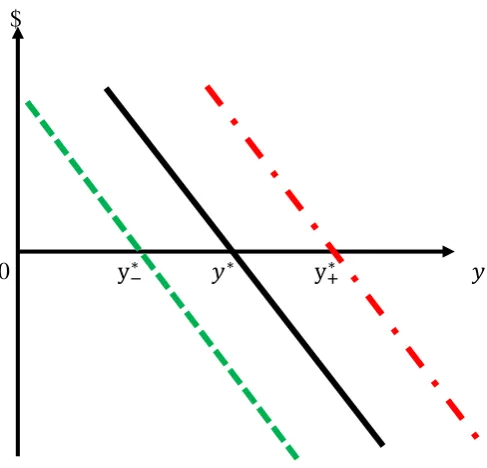
Intuition for Proposition 6 is as follows. Please refer to Figure 1. The horizontal axis is the location of the worker’s job, y, whereas the vertical axis is in dollars. De…ne
z(y;x) =w(y) r(x)sw T(x y) +
1
N
Z 1
1
(y0)m(y0)dy0
so that
@z(y;x)
@y =w
0(y) +T0(x y)
We have graphed @z(@yy;x) in Figure 1. This curve must be downward sloping according to the second order condition. The …rst order condition (7) tells us that where this curve crosses the horizontal axis at y is the solution to the worker’s optimization problem for given residencex. In the case whereT is convex, when we increasex, for each giveny,T0 rises. Hence the @z(y;x)
@y curve shifts up, represented by the red curve,
and the new optimal job location y+ must be to the right of y . In other words, if we look at workers more distant from the …rms, they will pay higher commuting cost. The marginal commuting cost is increasing in distance, so they will choose a job location closer to the residences even though wages are lower. In the case whereT is concave, when we increase x, for each given y, T0 falls. Hence the @z(y;x)
@y curve shifts
down, represented by the green curve, and the new optimal job location y must be to the left of y . In other words, if we look at workers more distant from the …rms, they will pay higher commuting cost. The marginal commuting cost is decreasing in distance, so they will choose a job location farther from the residences where wages are higher.
Due to the inelastic demand for land, the commuting pattern function will be linear in both cases described above.
Set b= M sf
2 ,B =
M sf
2 +
N sw
2 , m(y) = 1
sf for y b, m(y) = 0 for y > b, n(x) = 0
3.2
Convex commuting cost
A monocentric equilibrium exists if the ratio t of the …rm agglomeration externality to the commuting cost is su¢ciently large:
Proposition 7 IfT00 >0, for su¢ciently large
t, there exists a symmetric
monocen-tric equilibrium with only parallel commuting. Moreover, this is the only symmemonocen-tric monocentric equilibrium allocation.
The proof is in the Appendix. We can see from the proof that the sign of
M sf N sw coincides with the signs of the second derivatives of w(y) and r(x) in
the case of T00 >0. Since the business district is much smaller than the residential
district in reality, N sw > M sf holds, and hence the wage and the residential land
rent are decreasing and concave in the distance from the city center. Otherwise, when N sw < M sf, they are decreasing and convex. In either case, business land
rent is not necessarily decreasing in distance from the city center.
In order to understand these conditions further, we specify functional forms as follows: A(y) = Rbb(y y1)2dy1andT (jx yj) =t(x y)2. Then, specializing the calculations in the Appendix to this example, the …rst su¢cient condition for monocentric spatial equilibrium (27) can be written as
w(x) (B x)2t (B b)2t b(x b) (Bx 2bx+bB)t
(B b)2 +
M2(x2 b2)
N 0
Since w00(x)>0, w(x)is convex. Because w(b) = 0, this condition is w0(b)
0, namely
t b(B b)M 2
(B2 2bB+ 2b2)N (9)
The second su¢cient condition for equilibrium can be written as
z(y) N b B2+y2 b2(B + 2y) By2 +b3 t+M2b2(B b) 0
Because z00(y)>0, z(y)is convex. Since the minimizer of z(y)is negative, this
condition is z(0) 0, namely
t b(B b)M 2
The right hand side of equation (9) is larger than that of (10). In fact, we have shown that the condition su¢cient for a monocentric spatial equilibrium is given by (10). It exists when the commuting costt is small and the face-to-face communication cost is large. Substitutingb= M sf
2 andB =
M sf+N sw
2 into the right hand side of equation
(10), it can shown that the right hand side of this equation is increasing in M and decreasing in N. Thus, a monocentric spatial equilibrium exists if the number of …rms is large and the number of workers is small. Whereas the former acts as an agglomeration force for …rms, the latter acts as a dispersion force for workers via the convexity of the commuting cost function.
3.3
Concave commuting cost
Proposition 8 If T00 < 0, for su¢ciently large
t, there exists a symmetric
mono-centric equilibrium with only cross commuting. Moreover, this is the only symmetric monocentric equilibrium allocation.
The proof is in the Appendix. From (7) and (8), the equilibrium wage as a function of …rm location is decreasing and concave in distance from the city center. This coincides with the empirical results in Tokyo Metropolitan Area, Boston, and Minneapolis St. Paul provided in the introduction. The residential land rent is decreasing and convex in the distance from the city center. But business land rent is not necessarily decreasing in distance from the city center.
3.4
Land rent
Proposition 9 Equilibrium residential land rent decreases as distance to the business district becomes larger. Under the assumption that the total land used for o¢ces is
smaller than that used for housing: sfM < swN, equilibrium residential land rent
is convex under concave transport cost, whereas it is concave under convex transport cost.
Proof. From (1), the equilibrium land rent for workers is
r(x) = 1
sw
Its derivative is
r0(x) = 1
sw
[w0(f(x))f0(x) T0(x f(x)) (1 f0(x))]
= 1
sw
T0(x f(x))<0
where the second equality follows from (7). The second derivative is
r00(x) = 1
sw
T00(x f(x)) (1 f0(x))
Because 1 jf0(x)j = 1 s
fM=swN > 0, the sign of r00(x) is the same that of
T00(x f(x)).
The negative gradient of residential land rent is a well-known equilibrium outcome in a monocentric city with a spaceless business district. In contrast, …rms in our model use space. According to the empirical literature such as McMillen (1996), the actual residential land rent is decreasing and convex in the distance from the city center. Therefore, we conjecture that generalized transport cost of commuting
is concave in distance and the commuting pattern is cross commuting. This is to be
tested statistically in Section 4.
We know thatA0(y)<0since the access to all …rms decreases from the city center
and thatw0(y)<0from (7). Hence, computing r0(y) from (4), we see that the slope
of land rent in the business district can be positive or negative. That is, whereas the residential land rent monotonically decreases in the distance from the city center, the business land rent can be non-monotonic.
Given that w0(y) < 0 and that workers cross commute, we can conclude that
the wage received by workers increases with residence distance from the city center. However, we note that our model assumes inelastic land or housing consumption. If this is weakened, then the result could be reversed, as demonstrated in Fujita (1991) Proposition 2.2 in the context of a linear commuting cost function.
4
Empirics
city center. But note that in our model, we have assumed that all consumers, as well as all …rms, are homogeneous. Controlling for heterogeneity would be a major problem with respect to all of these indirect empirical tests. For example, we would expect that education, quality of local schools, and size of household would all a¤ect choice of residence and thus commuting distance. If we tried to control for these variables in regressing say commuting distance on distance from the city center, we would expect an upward sloping function independent of the commuting pattern, be it parallel commuting, cross commuting, or some combination thereof. Therefore, we could not distinguish well the commuting pattern. Moreover, once we control for these other important variables, it’s not clear that there would be any variance left to explain. For this reason, we do not employ indirect tests that could rely on generally available data. Instead, we focus on a direct test of our theory that relies on individual data on residence and employer location.
In order to test whether parallel commuting or cross commuting is dominant, we employ data on commuter ‡ows from the 2010 Population Census in Japan. We extract an origin-destination matrix for12municipalities located along the Chuo Line commuter railroad out of62 total municipalities in the Tokyo prefecture. In Figure 2, the 3 light brown municipalities are in the central city whereas the 9 light green municipalities are suburbs of the central city, for a total of 12 municipalities.
Since we are interested in identifying commuter ‡ows from the suburbs to the central city, we distinguish between the9suburbs (S) and3central city municipalities (C). We have constructed aS C = 9 3matrix of commuter ‡ows, whose elements are denoted bycij. The9suburban municipalities and the3central city municipalities
are sorted according to the distance from Tokyo station. Roughly speaking, parallel (respectively, cross) commuting is dominant if the elements near the diagonal, for examplec11,c21,c83 andc93, are larger (respectively, smaller) than those far from the diagonal, for example c13, c23, c81 and c91. In order to examine this, we conduct a test of Kendall’s c statistic; see Kendall and Gibbons (1990). The test statistic is:
c =
and the average standard error is
ASE = 2q (q 1)W2
" S X i=1 C X j=1
cij(Cij Dij)2
1
W (P Q) 2
#1 2
where
q = minfS; Cg; W =
S X i=1 C X j=1 cij P = S X i=1 C X j=1
cijCij; Q= S X i=1 C X j=1 cijDij
Cij = S X h<i C X k<j
chk+ S X h>i C X k>j
chk; Dij = S X h<i C X k>j
chk+ S X h>i C X k>j chk
It is known that c=ASE is standard normally distributed (Göta¸s and ·I¸sçi, 2011;
Kendall and Gibbons, 1990).
Using the commuter ‡ow data, we …nd that c = 0:0136 and ASE = 0:00259.
Since c=ASE = 5:26, c is negative and signi…cantly di¤erent from zero, implying
that cross commuting is dominant in the Chuo Line.7 That is, there are many
short-distance commutes between nearby municipalities and many long-short-distance commutes between distant municipalities as compared to intermediate-distance commutes. This test also suggests that commuting cost is increasing and concave in distance.
5
Conclusion
We have examined equilibrium of a rather standard model, similar to the previous literature with the exception that we allow general convex or concave commuting cost as a function of distance. We have shown that a monocentric equilibrium exists if the ratio of the …rm agglomeration externality to the commuting cost is su¢ciently large.8 Moreover, when commuting cost is convex, we have the following properties
of equilibrium: residential land rent and business district wages are decreasing and
7Using data from 1995, we have obtained almost the same result:
c= 0:0149,ASE= 0:00228,
and c=ASE= 6:54.
8In the case where the business district and residential area are …xed by zoning, we do not need
concave in distance to the CBD, and there is exclusively parallel commuting. When commuting cost is concave, we have the following: residential land rent is decreas-ing and convex in distance to the CBD, business district wages are decreasdecreas-ing and concave in distance to the CBD, and there is exclusively cross commuting.9 The
empirical evidence is broadly consistent with a concave commuting cost function and cross commuting, in contrast with the statement of Fujita and Thisse cited in the introduction.10
It is important to relate our work to the wasteful commuting found in Hamilton and Röell (1982). Contingent on a version of the classic monocentric city model with a linear commuting cost, they point out that actual average commutingdistance exceeds optimal average commuting distance by a factor of 8. In fact, in our model, equilibrium average commuting distance is the same independent of whether the commuting pattern is parallel commuting or cross commuting. Of course, average commutingcost will di¤er by commuting pattern and with our functionT; moreover, the equilibrium commuting pattern depends on the commuting cost. But our model
district, and our model becomes much simpler. Speci…cally, in the case of T00 > 0, a su¢cient
condition for existence of equilibrium is M A(b) N g, whereas for the case of T00 < 0, a
su¢cient condition for existence of equilibrium is M A(b) N T(B). Of course, this requires strong enforcement of zoning and perfect knowledge on the part of the zoning board concerning the number of …rms and consumers as well as their land use. It could well be that the equilibrium with mobility of agents is not monocentric.
9If the city con…guration is not monocentric, we can infer from our work the following commuting
patterns:
(i) The commuting pattern is a replica of the monocentric one in the case of a duocentric or tricentric con…guration.
(ii) There is no commuting in the case of a fully integrated con…guration.
(iii) The commuting pattern is a combination of (i) and (ii) in the case of an incompletely integrated con…guration.
10If we were to …x the locations of all agents in a monocentric con…guration, it would be possible
has nothing to say about equilibrium average commuting distance.
Further work should focus on analyzing the model with even more general com-muting cost functions, especially those that are neither globally convex nor globally concave. As a preview, consider a more realistic commuting cost function that is concave for shorter distances but convex for longer distances, with exactly one in‡ec-tion point at an intermediate distance. Our conjecture is that there will be cross commuting for shorter distances but parallel commuting for longer distances, with a discontinuity in the commuting pattern function at the in‡ection point. Rents and wages will be continuous but not necessarily di¤erentiable everywhere.
Appendix
Proof of Proposition 7
We focus on locations inR+; the prices and allocations for the other locations are
de…ned symmetrically. The technique of proof that equilibrium exists is guess and verify. Set b = M sf
2 , B =
M sf
2 +
N sw
2 , m(y) = 1
sf for y b, m(y) = 0 for y > b,
n(x) = 0 for x b, n(x) = s1
w for b < x B, n(x) = 0 for x > B. A(y) is de…ned
by equation (2) for this density m. For b < x B, de…ne
f(x) = M sf
N sw
(x b) (11)
The function f is arbitrary otherwise. Hence, for 0 y b,
f 1(y) = N sw
M sf
y+b (12)
Forx > B, de…ne r(x) = 0.
There are two cases to consider:
(i) N sw 6= M sf. We shall …nd an explicit expression for equilibrium rent on the
Integrating (7), we obtain
w(y) =
Z
T0(f 1(y) y)dy
= M sf
N sw M sf
T N sw M sf M sf
y+b +Ca
= b
B 2bT f
1(y) y +C
a (13)
where Ca is the constant of integration.
From (6) and (13),
r(x) = 1
sw
[w(y) T(x y) z]
= 1
sw
b
B 2bT f
1(y) y +C
a T(x y) z
= 1
sw
B b
B 2bT (x f(x)) +Ca z
SettingCb =
1
sw
(Ca z),
= N
2 (B 2b)T (x f(x)) +Cb (14)
Since r(B) = 0, (14) leads to
Cb =
N
2 (B 2b)T (B b)
PluggingCb into (14) yields our ultimate expression for rent (17) below.
(ii)N sw =M sf. We have
w(y) =
Z
T0(f 1(y) y)dy
=
Z
T0 N sw M sf
y+b y dy
=
Z
T0(b)dy
where Cc is again a constant of integration. From (6) and (15),
r(x) = 1
sw
[w(y) T(x y) z]
= 1
sw
[ T0(b)y+Cc T(x y) z]
= 1
sw
T0(b)M sf
N sw
(x b) +Cc T(B b) z
= 1
sw
[ T0(b)x+Cd]
where Cd =bT0(b) +Cc T(B b) z. Sincer(B) = 0, we obtain
r(x) = 1
sw
T0(b) (B x) (16)
Having analyzed both cases, we can summarize as follows:
Forb < x B, de…ne
r(x) =
( N
2(B 2b)[T(B b) T (x f(x))] if N sw 6=M sf
N
2(B b)T
0(b) (B x) if N s
w =M sf
(17)
Let Rw = 2
Z B
b
r(x)dx
For 0 y b, de…ne
w(y) = z+r(f 1(y))sw+T(f 1(y) y) (18)
Using the pro…t function (4) and the fact that the rent for consumers and producers must be equal at b,
For0 y b, de…ne
r(y) = 1
sf
A(y) A(b) + N
M [w(b) w(y)] +C1 (19)
where
C1
( N
2(B 2b)[T (B b) T (b)] if N sw 6=M sf
N
2T
0(b) if N s
w =M sf
(20)
(i) If we substitute (13) into (19), we have
r(y) = 1
sf
A(y) A(b) + N
M w(b) + b
B 2bT f
1(y) y C
a +C1
= 1
sf
A(y) + N
M b
B 2bT f
1(y) y +C2
Using the fact thatr(y) =r(x) evaluated at y=x=b,
C2 N
2 (B 2b)T (b)
M
2bA(b)
(ii) If we substitute (15) into (19), we get
r(y) = 1
sf
A(y) A(b) + N
M [w(b) +T
0(b)y C
c] +C1
= M
2b A(y) + N MT
0(b)y +C
2
Using the fact thatr(y) =r(x) evaluated at y=x=b,
C2 M
2bA(b)
Hence,
r(y) =
( M
2b A(y) A(b) + N M
b
B 2b[T (f 1(y) y) T (b)] if N sw 6=M sf M
2b A(y) A(b) + N MT
0(b)y if N s
w =M sf
(21)
Let
Rf = 2
Z b
0
r(y)dy
Then R=Rf +Rw, a function of only exogenous parameters. So z can be found as
only a function of exogenous parameters by plugging R into (5). In addition, w(y) (0 y b) is a function of only exogenous variables by using (18).
Notice that (4) and (19) imply that pro…ts are constant on 0 y b, namely
(y) = =A(b) N
Mw(b) sfC1 (22)
Hence,
For 0 y b, de…ne
w(y) = M
To show that this represents an equilibrium, we must verify that 0, z 0, that no consumer wishes to move to [0; b], and that no …rm wants to move to (b;1).
In the case of T00 >0and N s
w 6=M sf,11 the total land rent is
R = Rf +Rw = 2
Z b
0
r(y)dy+ 2
Z B
b
r(x)dx
= M
b
Z b
0
A(y) A(b) + N
M b
B 2b T f
1(y) y T (b) dy
+ N
B 2b
Z B
b
[T (B b) T (x f(x))]dx
= M
b
Z b
0
A(y) A(b)dy+ N
B 2b
Z B
b
[T(x f(x)) T (b)] b
B bdx
+ N
B 2b
Z B
b
[T (B b) T (x f(x))]dx
= M
b
Z b
0
A(y) A(b)dy N B b
Z B
b
T (x f(x))dx+N g
where dy= M sf
N swdx=
b
B bdx and
g 1
B 2b[(B b)T (B b) bT (b)]
which is positive for all b6=B=2. So (5) can be rewritten as
z = 1
N M
b
Z b
0
A(y)dy N B b
Z B
b
T(x f(x))dx R
= 1 N " M b Rb
0 A(y)dy
N B b
RB
b T(x f(x))dx M
b
Rb
0 A(y) A(b)dy
+B bN RbBT(x f(x))dx N g
#
= M
NA(b) g
The condition for spatial equilibrium isz 0 or
M A(b) N g (23)
(i) First, we show that no …rm will want to move to the residential area. Suppose a …rm deviates from the business districty2[0; b]to the residential districtx2(b; B]. We compute the wagew(x)that makes a worker indi¤erent if she resides atx1 2[b; B]
11The caseN s
but shifts her workplace from y2 [0; b] tox2 [b; B]. We focus on the case: x x1. The case x > x1 can be ruled out because a worker residing at x1 =x must pay higher land rent than a worker residing atx1 =x+ for all >0due to negative rent gradient r(x) in the residential district. That is, the latter worker always achieves a higher utility level, since compared to the former, their wages are the same, their land rent is lower, and their commuting cost is the same. So if a consumer residing at x1 = x is happier, so is a consumer residing at x1 = x+ . Hence we focus only on the case: x1 2[x; B].
If she works at y = f(x1) 2 [0; b], in equilibrium her consumption of composite good is the same as the consumer who lives atB:
zb = w(f(x1)) r(x1)sw T (x1 f(x1)) +
1
N
Z 1
1
(y0)m(y0)dy0
= w(b) T (B b) + 1
N
Z 1
1
(y0)m(y0)dy0
from (6). On the other hand, if she works atx2[b; B], her consumption of composite good is
za=w(x) r(x1)sw T (x1 x) +
1
N
Z 1
1
(y0)m(y0)dy0
In order to guarantee equal utility, these two consumptions should be the same zb =
za. That is, the wage o¤ered by a …rm at location x for a worker at location x1
should be
w(x) =w(b) T (B b) +r(x1)sw+T (x1 x)
Then, the pro…t of a …rm relocating fromy to x and paying this wagew(x)for a worker living at x1 is
(x; x1) = A(x) N
Mw(x) r(x)sf
= A(x) N
M [w(b) T (B b) +r(x1)sw +T (x1 x)] r(x)sf (24)
For equilibrium, this pro…t does not exceed , which was obtained before relocation:
(x; x1) ; 8b x x1 B (25)
We have
@ (x; x1)
@x1 = N M [T
because x1 f(x1)> x1 x and T00(x)>0. This implies x1 =B is the maximizer
of (x; x1). Hence, the no-deviation condition (25) is replaced with
(x; B) ; 8x2(b; B] (26)
which can be rewritten as
M
N [A(b) A(x)] + [T(B x) T (B b)] + b
B 2b[T(b) T (x f(x))] 0 if N sw 6=M sf M
N [A(b) A(x)] + [T (B x) T (B b)] + b B bT
0(b) (b x) 0 if N s
w =M sf
(27) for all x 2 (b; B] by using (17) and (24). Observe that the term in the …rst brack-ets is positive, whereas those in the second and third brackbrack-ets are negative from sgn [T(b) T (x f(x))] = sgn (B 2b). Condition (27) is rewritten as
t maxy; y1
F1(x; sf; sw; M; N), where
F1(x; sf; sw; M; N)
8 > > > > > > < > > > > > > :
N sf
M
M sf N sw M sf
h
(x f(x)) M sf2 i N sw 2 +
M sf
2 x + (N sw2 ) RM sf2
M sf 2
h(x y0) h M sf
2 y0 dy0
if N sw 6=M sf
N sf
M
M sf N sw h
T0 M sf
2 M sf 2 x i N sw 2 + M sf
2 x + ( N sw
2 ) RM sf2
M sf 2
h(x y0) h M sf
2 y0 dy0
if N sw =M sf
andG1is …nite and di¤erentiable with respect tox2(b; B]. Condition (27) is stricter
than condition (23) because pluggingx=B into (27) yields
M[A(b) A(B)] N g
where A(B)>0.
(ii) Second, we consider no deviation condition of a worker. Suppose a worker deviates to from the residential district x 2 [b; B] to the business district y 2 [0; b). The consumption of composite good before deviation was
zb(y) = w(y) r(f 1(y))sw T f 1(y) y +
1
N
Z 1
1
(y0)m(y0)dy0
On the other hand, the consumption of composite good after deviation is
za(y; y1) =w(y) r(y1)sw T (jy y1j) +
1
N
Z 1
1
Let y1 = y1 be the maximizer of za(y; y1). For a symmetric monocentric spatial
equilibrium, the consumption of composite good before deviation is not smaller than that after deviation. That is,
zb(y) za(y; y1); 8y2[0; b) (28)
or
min
y1
[r(y1)sw+T(jy y1j)] r(f 1(y))sw T f 1(y) y (29)
for all y2[0; b). Condition (29) is rewritten as
t maxy; y1
F2(y; y1; sf; sw; M; N),
where F2(y; y1; sf; sw; M; N)
8 > > > > > > < > > > > > > : s2 f sw N sw N sw M sf
h M sf
2 + (N sw2 ) (f 1(y1) y1) i
(jy y1j) N sw M sfM sf (f 1(y) y) RM sf2
M sf 2
h M sf2 y0 h(jy0 y1j)dy0
if N sw 6=M sf
sf
sw N sw M sf
M sf 2 y1+ 0
M sf 2
M sf
2 +N sw2 f 1(y) (jy y1j)+ (f 1(y) y) RM sf2
M sf 2
h M sf2 y0 h(jy0 y1j)dy0
if N sw =M sf
Hence, the su¢cient conditions for a symmetric monocentric spatial equilibrium is given by (27) and (29).
Next, we show that there is no cross commuting in any symmetric, monocentric equilibrium. Thus, the equilibrium speci…ed above is the only one.
In equilibrium, for a worker residing atxto weakly prefer commuting toyinstead of ye, the following should hold:
w(y) T(jx yj) w(ey) T(jx yej)
In equilibrium, for a worker residing atexto weakly prefer commuting to yeinstead of
y, the following should hold:
w(y) T(jxe yj) w(ey) T(jxe yej)
Hence,
should hold for all x.
Suppose that there is cross commuting. Then for some y < ye x <ex, we have
'0(x) = T0(x ye) T0(x y)
This is positive because x y > xe y and T00(x) > 0. We also get '(ex) = 0, and
thus '(x)<0 for all x <ex, which contradicts'(x) 0.
Hence there is only parallel commuting at a symmetric, monocentric equilibrium. Thus, we conclude that the only such equilibrium is the one we have speci…ed.
Proof of Proposition 8
Similar to the previous proof, we focus on locations in R+. The technique of
proof that equilibrium exists is guess and verify. For b < x B, de…ne
f(x) = M sf
N sw
(B x) (31)
The function f is arbitrary otherwise. Hence, for 0 y b,
f 1(y) = B N sw M sf
y
Forx > B, de…ne r(x) = 0. Integrating (7), we obtain:
w(y) =
Z
T0(f 1(y) y)dy
=
Z
T0 B B b y dy
= b
BT f
1(y) y +C
a (32)
where once again Ca is a constant of integration.
From (6) and (32),
r(x) = 1
sw
[w(y) T(x y) z]
= 1
sw
B b
B T (x f(x)) +Ca z
SettingCb =
1
sw
(Ca z)
= N
Observe that the residential land rent is decreasing and convex inx. Since r(B) = 0 in (33), we get
Cb =
N
2BT(B)
PluggingCb into (33) yields our …nal expression for rent (34):
Forb < x B, de…ne
r(x) = N
2B [T(B) T (x f(x))] (34)
Using the pro…t function and the fact that the rent for consumers and producers must be equal at b,
For0 y b, de…ne
r(y) = 1
sf
A(y) A(b) + N
M [w(b) w(y)] + N
2BT (B) (35)
If we substitute (32) into (35), we obtain
r(y) = 1
sf
A(y) A(b) + N
M w(b) b BT f
1(y) y C
a +
N
2BT(B)
Usingr(y) =r(x) evaluated at y=x=b, we obtain
r(y) = M
2b [A(y) A(b)] N
2B T f
1(y) y T (B) (36)
Then R=Rf +Rw, a function of only exogenous parameters. So z can be found as
only a function of exogenous parameters by plugging R into (5). In addition, w(y) (0 y b) is a function of only exogenous variables by using (18).
Notice that (4) and (36) imply that pro…ts are constant on 0 y b, namely
(y) = =A(b) N
Mw(b)
N b
M BT (B)
Hence,
For 0 y b, de…ne
w(y) = M
N A(y) r(y)sf
As in the previous proof, we verify that what we have constructed is an equilib-rium. In the case of T00<0, the total land rent is
Rf +Rw = 2
Z b
0
r(y)dy+ 2
Z B
b
r(x)dx
=
Z b
0 M
b [A(y) A(b)]dy+ N B b
Z B
b
[T (B) T (x f(x))]dx
So (5) can be rewritten as
z = 1
N M
b
Z b
0
A(y)dy N B b
Z B
b
T(x f(x))dx R
= M
N A(b) T(B)
The condition for spatial equilibrium is then given by
M A(b) N T (B) (37)
which is similar to (23).
(i) First, we seek no deviation condition of a …rm. Suppose a …rm deviates to from
y 2[0; b] to x2 (b; B]. We compute the wage w(x) that makes a worker indi¤erent if she residing at x1 2 [b; B] shifts her workplace from y 2 [0; b] to x 2 [x1; B]. As before, we can focus on the interval of x1 2[x; B].
If she works at y=f(x1), her consumption of composite good is
zb =w(f(x1)) r(x1)sw T (x1 f(x1)) =w(0) T (B) +
1
N
Z 1
1
(y0)m(y0)dy0
On the other hand ,if she works at x, her consumption of composite good is
za=w(x) r(x1)sw T (x1 x) +
1
N
Z 1
1
(y0)m(y0)dy0
Becausezb =za for equal utility, the wage o¤ered by a …rm at locationxfor a worker
at locationx1 should satisfy
w(x; x1) = w(0) T (B) +r(x1)sw+T (x1 x)
The pro…t of a …rm relocating from y tox is
(x; x1) = A(x) N
Mw(x; x1) r(x)sf
= A(x) N
The no-deviation condition is given by
(x; x1) ; 8b x; x1 B
We have
@ (x; x1)
@x1 = N M [T
0(x1 f(x1)) T0(x1 x)]>0
because x1 f(x1) > x1 x and T00(x)>0. This implies x1 =B is the minimizer
of (x; x1). Hence, the no-deviation condition (25) is replaced with
(x; B) ; 8x2(b; B] (38)
We have
(x; B) = A(x) N
M [w(0) T (B) +T (B x)] r(x)sf
= A(x) A(0) + N b
M B [T (x f(x)) T (B)] + + N
M [T(B) T (B x)]
Then, (38) can be rewritten as
M
N [A(0) A(x)] + [T(B x) T (B)] + b
B [T(B) T (x f(x))] 0 (39)
for all x2(b; B]. This is rewritten as
t maxy; y1
G1(x; sf; sw; M; N)
where G1(x; sf; sw; M; N)
N sf
M
N sw
N sw+M sf
N sw
2 +
M sf
2 +
M sf
N sw+M sf (x f(x))
N sw
2 +
M sf
2 x
RM sf=2
M sf=2 h(jy
0j) +h(x y0)dy0
and G1 is …nite and di¤erentiable with respect tox2(b; B]. If we plug x=B into (39), we get
M[A(0) A(B)] N T (B) 0
which is stricter than the previous condition (37).
(ii) Second, we consider no deviation condition of a worker. Suppose a worker deviates to fromx2[b; B]toy1 2[0; b). The consumption of composite good before deviation was
On the other hand, the consumption of composite good after deviation is
za(y; y1) =w(y) r(y1)sw T (jy y1j)
Let y1 = y1 be the maximizer of za(y; y1). For a symmetric monocentric spatial
equilibrium, the consumption of composite good before deviation is not smaller than that after deviation. That is,
zb(y) za(y; y1); 8y2[0; b)
or
min
y1
[r(y1)sw+T (jy y1j)] r(f 1(y))sw T f 1(y) y 0 (40)
for all y2[0; b). This is rewritten as
t maxy; y1
G2(y; y1; sf; sw; M; N)
where G2(y; y1; sf; sw; M; N)
s2
f
sw M sf
N sw+M sf (f
1(y) y) + N sw
N sw+M sf (f
1(y1) y1) (jy y1j)
RM sf=2
M sf=2 h(jy
0 y1j) +h(M s
f=2 y0)dy0
and G2 is …nite and di¤erentiable with respect toy,y1 2[0; b).
Hence, the conditions for a symmetric monocentric spatial equilibrium is given by (39) and (40).
Next, we show that there is no cross commuting in any symmetric, monocentric equilibrium. Thus, the equilibrium speci…ed above is the only one.
In equilibrium, for a worker residing at x to prefer commuting to y instead of ye, the following should hold:
w(y) T(jx yj) w(ey) T(jx yej)
In equilibrium, for a worker residing atxeto prefer commuting to yeinstead ofy, the following should hold:
w(y) T(jxe yj) w(ey) T(jxe yej)
Hence,
should hold for all x.
Suppose that there is parallel commuting. Then for some y < ey x < ex, we have
'0(x) = T0(x ye) T0(x y)>0
becausex y < xe y and T00(x)<0. We also have'(ex) = 0, and thus'(x)<0for
allx <ex, which contradicts'(x) 0.
Hence there is only cross commuting at a symmetric, monocentric equilibrium. Thus, we conclude that the only such equilibrium is the one we have speci…ed.
References
[1] Dong, X. and S.L. Ross, 2015. “Accuracy and E¢ciency in Simulating Equi-librium Land-Use Patterns for Self-Organizing Cities.” Journal of Economic
Geography 15, 707-722.
[2] Fujita, M., 1991. Urban Economic Theory. Cambridge: Cambridge University Press.
[3] Fujita, M. and H. Ogawa, 1982. “Multiple Equilibria and Structural Transi-tion of Non-monocentric Urban Con…guraTransi-tions.” Regional Science and Urban
Economics 12, 161-196.
[4] Fujita, M. and J.-F. Thisse, 2013. Economics of Agglomeration: Cities,
Indus-trial Location, and Globalization, 2nd Edition. Cambridge: Cambridge
Univer-sity Press.
[5] Göta¸s, A. and Ö. ·I¸sçi, 2011. “A Comparison of the Most Commonly Used Mea-sures of Association for Doubly Ordered Square Contingency Tables via Simula-tion.” Metodološki Zvezki 8, 17-37.
[6] Hamilton, B.W. and A. Röell, 1982. “Wasteful Commuting.” Journal of Political
Economy 90, 1035-1053.
[8] Lucas, R. and E. Rossi-Hansberg, 2002. “On the Internal Structure of Cities.”
Econometrica 70, 1445-1476.
[9] McMillen D.P., 1996. “One Hundred Fifty Years of Land Values in Chicago: A Nonparametric Approach.” Journal of Urban Economics 40, 100-124.
[10] Ogawa, H. and M. Fujita, 1980. “Equilibrium Land Use Patterns in a Nonmono-centric City.” Journal of Regional Science 20, 455-475.
[11] Sattinger, M., 1993. “Assignment Models of the Distribution of Earnings.”
Jour-nal of Economic Literature 31, pp. 831-880.
$
0 y−∗ 𝑦∗ y+∗ 𝑦
[image:33.595.168.412.121.355.2]
Tokyo Station
Figure 2: 12 municiparities along the Chuo Line in Tokyo
Chuo Line10km