Bayesian Grammar Induction for Language Modeling
S t a n l e y F . C h e n
A i k e n C o m p u t a t i o n L a b o r a t o r y D i v i s i o n of A p p l i e d Sciences
H a r v a r d U n i v e r s i t y C a m b r i d g e , M A 02138 sfc@das, harvard, edu
A b s t r a c t
We describe a corpus-based induction algo- rithm for probabilistic context-free gram- mars. The algorithm employs a greedy heuristic search within a Bayesian frame- work, and a post-pass using the Inside- Outside algorithm. We compare the per- formance of our algorithm to n-gram mo- dels and the Inside-Outside algorithm in three language modeling tasks. In two of the tasks, the training data is generated by a probabilistic context-free grammar and in both tasks our algorithm outperforms the other techniques. The third task involves naturally-occurring data, and in this task our algorithm does not perform as well as n-gram models but vastly outperforms the Inside-Outside algorithm.
1 I n t r o d u c t i o n
In applications such as speech recognition, hand- writing recognition, and spelling correction, perfor- mance is limited by the quality of the language mo- del utilized (7; 7; 7; 7). However, static language modeling performance has remained basically un- changed since the advent of n-gram language mo- dels forty years ago (7). Yet, n-gram language mo- dels can only capture dependencies within an n- word window, where currently the largest practical n for natural language is three, and many dependen- cies in natural language occur beyond a three-word window. In addition, n-gram models are extremely large, thus making them difficult to implement effi- ciently in memory-constrained applications.
An appealing alternative is grammar-based lan- guage models. Language models expressed as a pro- babilistic grammar tend to be more compact than n-gram language models, and have the ability to mo- del long-distance dependencies (7; 7; 7). However, to date there has been little success in constructing grammar-based language models competitive with n-gram models in problems of any magnitude.
In this paper, we describe a corpus-based indue- tion algorithm for probabilistic context-free gram- mars that outperforms n-gram models and the Inside-Outside algorithm (7) in medium-sized do- mains. This result marks the first time a grammar- based language model has surpassed n-gram mode- ling in a task of at least moderate size. The al- gorithm employs a greedy heuristic search within a Bayesian framework, and a post-pass using the Inside-Outside algorithm.
2 G r a m m a r I n d u c t i o n a s S e a r c h
Grammar induction can be framed as a search pro- blem, and has been framed as such almost without exception in past research (7). The search space is taken to be some class of grammars; for example, in our work we search within the space of probabilistic context-free grammars. The objective function is ta- ken to be some measure dependent on the training data; one generally wants to find a grammar that in some sense accurately models the training data.
Most work in language modeling, including n- gram models and the Inside-Outside algorithm, falls under the maximum-likelihood paradigm, where one takes the objective function to be the likelihood of the training data given the grammar. However, the optimal grammar under this objective function is one which generates only strings in the training data and no other strings. Such grammars are poor lan- guage models, as they
overfit
the training data and do not model the language at large. In n-gram mo- dels and the Inside-Outside algorithm, this issue is evaded by bounding the size and form of the gram- mars considered, so that the "optimal" grammar cannot be expressed. However, in our work we do not wish to limit the size of the grammars conside- red.s --, s x ( l - e )
s
x
(,)
X ~ A (p(A))
Aa ---* a (1)
V A e N - { S , X }
V a E T
N = the set of all n o n t e r m i n a l s y m b o l s T = the set of all terminal symbols
Probabilities for each rule are in parentheses.
Table 1: Initial hypothesis g r a m m a r
large can prevent the objective function f r o m pre- ferring g r a m m a r s t h a t overfit the training data. ?) presents a Bayesian g r a m m a r induction framework t h a t includes such a factor in a m o t i v a t e d m a n n e r .
T h e goM of g r a m m a r induction is taken to be fin- ding the g r a m m a r with the largest a posteriori pro- bability given the training data, t h a t is, finding the g r a m m a r G ~ where
c ' = arg m xp(GIo)
and where we denote the training d a t a as O, for ob- servations. As it is unclear how to e s t i m a t e p(GIO) directly, we a p p l y Bayes' Rule and get
a I = arg p ( O l a ) p ( a )
p ( o ) = arg% xp(O[a)p(a)
Hence, we can f r a m e the search for G ~ as a search with the objective function p(OIG)p(G), the likeli- hood of the training d a t a multiplied by the prior p r o b a b i l i t y of the g r a m m a r .
We satisfy the goal of favoring smaller g r a m m a r s by choosing a prior t h a t assigns higher probabilities to such g r a m m a r s . In particular, Solomonoff propo- ses the use of the universal a priori probability (?), which is closely related to the m i n i m u m description length principle later proposed by (?). In the case of g r a m m a t i c a l language modeling, this corresponds to taking
p(G) = 2 - t ( a )
where l(G) is the length of the description of the g r a m m a r in bits. T h e universal a priori probabi- lity has m a n y elegant properties, the m o s t salient of which is t h a t it d o m i n a t e s all other enumerable probability distributions multiplicativelyJ
3 S e a r c h A l g o r i t h m
As described above, we take g r a m m a r induction to be the search for the g r a m m a r G ~ t h a t optimizes the objective function p(OlG)p(G ). While this frame- work does not restrict us to a particular g r a m m a r formalism, in our work we consider only probabili- stic context-free g r a m m a r s .
1A very thorough discussion of the universal a priori probability is given by 7).
We assume a simple greedy search strategy. We m a i n t a i n a single hypothesis g r a m m a r which is in- itialized to a small, trivial g r a m m a r . We then t r y to find a modification to the hypothesis g r a m m a r , such as the addition of a g r a m m a r rule, t h a t results in a g r a m m a r with a higher score on the objective func- tion. W h e n we find a superior g r a m m a r , we m a k e this the new hypothesis g r a m m a r . We repeat this process until we can no longer find a modification t h a t improves the current hypothesis g r a m m a r .
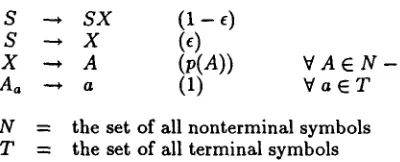
For our initial g r a m m a r , we choose a g r a m m a r t h a t can generate any string, to assure t h a t the g r a m m a r can cover the training data. T h e initial g r a m m a r is listed in Table ??. T h e sentential s y m b o l S expands to a sequence of X ' s , where X expands to every other n o n t e r m i n a l s y m b o l in the g r a m m a r . Initially, the set of n o n t e r m i n a l s y m b o l s consists of a different n o n t e r m i n a l s y m b o l expanding to each terminal symbol.
Notice t h a t this g r a m m a r models a sentence as a sequence of independently generated n o n t e r m i n a l symbols. We m a i n t a i n this p r o p e r t y t h r o u g h o u t the search process, t h a t is, for every s y m b o l A ~ t h a t we add to the g r a m m a r , we also add a rule X ---+ A I. This assures t h a t the sentential s y m b o l can expand to every symbol; otherwise, adding a s y m b o l will not affect the probabilities t h a t the g r a m m a r assigns to strings.
We use the t e r m move set to describe the set of modifications we consider to the current hypothesis g r a m m a r to hopefully produce a superior g r a m m a r . Our move set includes the following moves:
M o v e 1: Create a rule of the f o r m A ---* B C
M o v e 2: Create a rule of the f o r m A --+ BIC
For any context-free g r a m m a r , it is possible to ex- press a weakly equivalent g r a m m a r using only rules of these forms. As mentioned before, with each new s y m b o l A we also create a rule X ---* A.
3.1 Evaluating the Objective Function
[image:2.612.193.393.41.122.2]S
S X
Aslowly
i
i
i
X A = a z ~ s slowly
I
]
A Ma,-y
talksi
M a r y
S
S
X
A,towtv
[
I
$
X Ataak, slowly
I
i
ABo, talks
i
Bob
Figure 1: Initial Viterbi Parse
S
s / / " ' x
s
i
i
I
X
B
X
AMary
Atatks Astowty
ABob
I
i
t
i
M a r y talks slowly Bob S
X
i
B
Atatk, Ajtowty
I
I
talks slowly
Figure 2: Predicted Viterbi Parse
p(G)
= 2 -/(G) is inexpensive2; however, calculatingp(OIG)
requires a parsing of the entire training data. We cannot afford to parse the training d a t a for each g r a m m a r considered; indeed, to ever be practical for d a t a sets of millions of words, it seems likely t h a t we can only afford to parse the d a t a once.To achieve this goal, we e m p l o y several approxi- mations. First, notice t h a t we do not ever need to calculate the actual value of the objective function; we need only to be able to distinguish when a move applied to the current hypothesis g r a m m a r produces a g r a m m a r t h a t has a higher score on the objective function, t h a t is, we need only to be able to calcu- late the
difference
in the objective function resulting f r o m a move. This can be done efficiently if we can quickly a p p r o x i m a t e how the p r o b a b i l i t y of the trai- ning d a t a changes when a move is applied.To m a k e this possible, we a p p r o x i m a t e the proba- bility of the training d a t a
p(OIG ) by the p r o b a b i l i t y
of the single m o s t p r o b a b l e parse, orViterbi
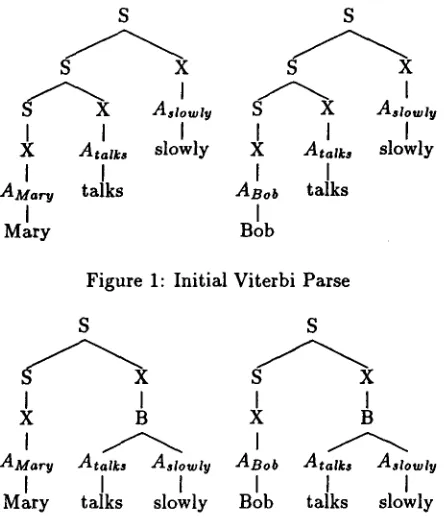
parse, of the training data. F u r t h e r m o r e , instead of recal- culating the Viterbi parse of the training d a t a from scratch when a move is applied, we use heuristics to predict how a m o v e will change the Viterbi parse. For example, consider the case where the training d a t a consists of the two sentencesO = {Bob talks slowly, M a r y talks slowly}
~Due to space limitations, we do not specify our me- thod for encoding grammars, i.e., how we calculate
l(G)
for a given G. However, this will be described in the author's forthcoming Ph.D. dissertation.In Figure ??, we display the Viterbi parse of this d a t a under the initial hypothesis g r a m m a r used in our algorithm.
Now, let us consider the m o v e of adding the rule
B ---* Atalks Aslo~ty
to the initial g r a m m a r (as well as the c o n c o m i t a n t rule X ---* B). A reasonable heuristic for predic- ting how the Viterbi parse will change is to replace adjacent X ' s t h a t e x p a n d to Atazk, and A~zo~,ty re- spectively with a single X t h a t e x p a n d s to B, as displayed in Figure ??. This is the actual heuristic we use for moves of the f o r m A ---* B C , and we have analogous heuristics for each m o v e in our m o v e set. By predicting the differences in the Viterbi parse re- sulting f r o m a move, we can quickly e s t i m a t e the change in the p r o b a b i l i t y of the training data.
[image:3.612.215.438.48.308.2]best g r a m m a r taking into account this new sentence, until the entire training corpus is covered.
Delaying the parsing of a sentence until all of the previous sentences are processed should yield more accurate Viterbi parses during the search process t h a n if we simply parse the whole corpus with the initial hypothesis g r a m m a r . In addition, we still achieve the goal of parsing each sentence but once.
3.2 P a r a m e t e r T r a i n i n g
In this section, we describe how the parameters of our g r a m m a r , the probabilities associated with each g r a m m a r rule, are set. Ideally, in evaluating the ob- jective function for a particular g r a m m a r we should use its optimal p a r a m e t e r settings given the training data, as this is the full score t h a t the given gram- m a r can achieve. However, searching for optimal p a r a m e t e r values is extremely expensive computa- tionally. Instead, we grossly approximate the opti- mal values by deterministically setting parameters based on the Viterbi parse of the training d a t a par- sed so far. We rely on the post-pass, described later, to refine p a r a m e t e r values.
Referring to the rules in Table ??, the parameter e is set to an arbitrary small constant. T h e values of the parameters p(A) are set to the (smoothed) frequency of the X ~ A reduction in the Viterbi parse of the d a t a seen so far. T h e remaining symbols are set to expand uniformly among their possible expansions.
3.3 C o n s t r a i n i n g M o v e s
Consider the move of creating a rule of the form
A --* B C . This corresponds to k 3 different specific rules t h a t might be created, where k is the current number of symbols in the grammar. As it is too computationally expensive to consider each of these rules at every point in the search, we use heuristics to constrain which moves are appraised.
For the left-hand side of a rule, we always create a new symbol. This heuristic selects the optimal choice the vast m a j o r i t y of the time; however, under this constraint the moves described earlier in this section cannot yield arbitrary context-free langua- ges. To partially address this, we add the move M o v e 3: Create a rule of the form A ---* A B [ B
With this iteration move, we can construct gram- mars t h a t generate arbitrary regular languages. As yet, we have not implemented moves t h a t enable the construction of arbitrary context-free grammars; this belongs to future work.
To constrain the symbols we consider on the right-hand side of a new rule, we use what we call
~riggcrs. 3 A ~rigger is a phenomenon in the Viterbi parse of a sentence t h a t is indicative that a particular move might lead to a better grammar. For example,
3This is not to be confused with the use of the term
triggers in dynamic language modeling.
in Figure .9.9 the fact t h a t the symbols Atalks and
Aszo,ozv occur adjacently is indicative t h a t it could be profitable to create a rule B ---* At~t~sAsto,olv. We have developed a set of triggers for each move in our move set, and only consider a specific move if it is triggered in the sentence currently being parsed in the incremental processing.
3.4 P o s t - P a s s
A conspicuous shortcoming in our search framework is that the g r a m m a r s in our search space are fairly unexpressive. Firstly, recall t h a t our g r a m m a r s mo- del a sentence as a sequence of independently gene- rated symbols; however, in language there is a large dependence between adjacent constituents. Further- more, the only free parameters in our search are the parameters p(A); all other symbols (except S) are fixed to expand uniformly. These choices were ne- cessary to make the search tractable.
To address this issue, we use an Inside-Outside al- gorithm post-pass. Our m e t h o d o l o g y is derived from that described by .9). We create n new nonterminal symbols { X 1 , . . . , X , } , and create all rules of the form:
X~ ~ Xj Xk i,j, k e { 1 , . . . , n }
X i - - * A i E { 1 , . . . , n } ,
A E No~d- {S, X }
Nold denotes the set of nonterminal symbols acqui-
red in the initial g r a m m a r induction phase, and X1 is taken to be the new sentential symbol. These new rules replace the first three rules listed in Ta- ble .9.9. T h e parameters of these rules are initiMized randomly. Using this g r a m m a r as the starting point, we run the Inside-Outside algorithm on the training data until convergence.In other words, instead of using the naive S
S X I X rule to attach symbols together in parsing data, we now use the Xi rules and depend on the Inside-Outside algorithm to train these randomly initialized rules intelligently. This post-pass allows us to express dependencies between adjacent sym- bols. In addition, it allows us to train parameters t h a t were fixed during the initial g r a m m a r induc- tion phase.
4 P r e v i o u s W o r k
As mentioned, this work employs the Bayesian gram- mar induction framework described by Solomonoff (.9; ?). However, Solomonoff does not specify a con- crete search algorithm and only makes suggestions as to its nature.
T h e g r a m m a r induction algorithms most suc- cessful in language modeling include the Inside- Outside algorithm (.7; ?; ?), a special case of the Expectation-Maximization algorithm (?), and work by ?). In the latter work, McCandless uses a heu- ristic search procedure similar to ours, but a very different search criteria. To our knowledge, neither algorithm has surpassed the performance of n-gram models in a language modeling task of substantial scale.
5 R e s u l t s
To evaluate our algorithm, we compare the perfor- mance of our algorithm to t h a t of n-gram models and the Inside-Outside algorithm.
For n-gram models, we tried n - 1 , . . . , 1 0 for each domain. For smoothing a particular n-gram model, we took a linear combination of all lower or- der n-gram models. In particular, we follow stan- dard practice (?; ?; ?) and take the smoothed i- gram probability to be a linear combination of the /-gram frequency in the training d a t a and the smoo- thed (i - 1)-gram probability, t h a t is,
p(w01W = w i _ l . . . w - i ) =
c(W~o0) +
Ai,o(w) c(W)
(1 - A i , c ( w ) ) p ( w o l w i _ 2 . . . w - z )
where c ( W ) denotes the count of the word sequence W in the training data. T h e smoothing parameters ,~i,c are trained through the Forward-Backward al- gorithm (?) on held-out data. Parameters Ai.e are tied together for similar c to prevent d a t a sparsity.
For the Inside-Outside algorithm, we follow the methodology described by Lari and Young. For a given n, we create a probabilistic context-free gram- m a r consisting of all Chomsky normal form rules over the n nonterminal symbols {X1, •. • Xn } and the given terminal symbols, that is, all rules
X i ---* X j Xk i , j , k E { 1 , . . . , n } X i ---* a i E {1,. . . , n } , a E T
where T denotes the set of terminal symbols in the domain. All parameters are initialized randomly. From this starting point, the Inside-Outside algo- r i t h m is run until convergence.
For smoothing, we combine the expansion distri- bution of each symbol with a uniform distribution, t h a t is, we take the smoothed parameter ps(A ---* a) to be
1 p , ( A ~ a ) = (1 - A)p,,(A ---* a) + An3 -F n[T[
where p~ (A --~ a ) denotes the unsmoothed parame- ter. T h e value n 3 +
n[TI
is the number of different ways a symbol expands under the Lari and Young methodology. T h e p a r a m e t e r A is trained throughthe Inside-Outside algorithm on held-out data. This smoothing is also performed on the Inside-Outside post-pass of our algorithm. For each domain, we tried n -- 3 , . . . , 10.
Because of the computational demands of our al- gorithm, it is currently impractical to apply it to large vocabulary or large training set problems. Ho- wever, we present the results of our algorithm in three medium-sized domains. In each case, we use 4500 sentences for training, with 500 of these sent- ences held out for smoothing. We test on 500 sent- ences, and measure performance by the entropy of the test data.
In the first two domains, we created the training and test d a t a artificially so as to have an ideal gram- mar in hand to benchmark results. In particular, we used a probabilistic g r a m m a r to generate the data. In the first domain, we created this g r a m m a r by hand; the g r a m m a r was a small English-like probabi- listic context-free g r a m m a r consisting of roughly 10 nonterminal symbols, 20 terminal symbols, and 30 rules. In the second domain, we derived the gram- m a r from manually parsed text. From a million words of parsed Wall Street Journal d a t a from the Penn treebank, we extracted the 20 most frequently occurring symbols, and the 10 most frequently oc- curring rules expanding each of these symbols. For each symbol t h a t occurs on the right-hand side of a rule but which was not one of the most frequent 20 symbols, we create a rule that expands that symbol to a unique terminal symbol. After removing unre- achable rules, this yields a g r a m m a r of roughly 30 nonterminals, 120 terminals, and 160 rules. Para- meters are set to reflect the frequency of the corre- sponding rule in the parsed corpus.
For the third domain, we took English text and reduced the size of the vocabulary by m a p p i n g each word to its part-of-speech tag. We used tagged Wall Street Journal text from the Penn treebank, which has a tag set size of about fifty.
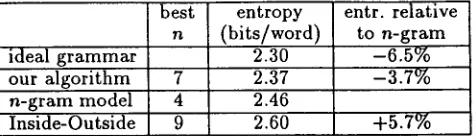
In Tables ??_?.7, we summarize our results. The ideal grammar denotes the g r a m m a r used to gene- rate the training and test data. For each algorithm, we list the best performance achieved over all n tried, and the best n column states which value realized this performance.
We achieve a m o d e r a t e but significant improve- ment in performance over n-gram models and the Inside-Outside algorithm in the first two domains, while in the part-of-speech d o m a i n we are outper- formed by n-gram models but we vastly outperform the Inside-Outside algorithm.
best entropy n (bits/word) ideal g r a m m a r 2.30 our algorithm 7 2.37 n-gram model 4 2.46 Inside-Outside 9 2.60
entr. relative to n-gram
- 6 . 5 % - 3 . 7 %
+5.7%
Table 2: English-like artificial g r a m m a r
best entropy n (bits/word) ideal g r a m m a r
our algorithm 9 n-gram model 4 Inside-Outside 9
4.13 4.44
entr. relative to n-gram
--10.4% - 3 . 7 % 4.61
4.64 +0.7%
Table 3: Wall Street Journal-like artificial g r a m m a r
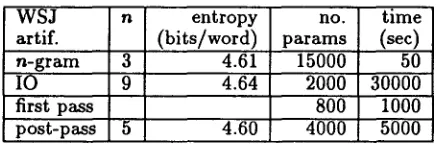
Notice t h a t our algorithm produces a significantly more compact model than the n-gram model, while running significantly faster than the Inside-Outside algorithm even though we use an Inside-Outside post-pass. P a r t of this discrepancy is due to the fact t h a t we require a smaller number of new nonterminal symbols to achieve equivalent performance, but we have also found t h a t our post-pass converges more quickly even given the same number of nonterminal symbols.
6
D i s c u s s i o n
Our algorithm consistently outperformed the Inside- Outside algorithm in these experiments. While we partially attribute this difference to using a Bayesian instead of maximum-likelihood objective function, we believe t h a t part of this difference results from a more effective search strategy. In particular, though both algorithms employ a greedy hill-climbing strat- egy, our algorithm gains an advantage by being able to add new rules to the grammar.
In the Inside-Outside algorithm, the gradient des- cent search discovers the "nearest" local m i n i m u m in the search landscape to the initial grammar. If there are k rules in the g r a m m a r and thus k parameters, then the search takes place in a fixed k-dimensional space IR ~. In our algorithm, it is possible to ex- pand the hypothesis g r a m m a r , thus increasing the dimensionality of the parameter space t h a t is being searched. An apparent local m i n i m u m in the space ]Rk m a y no longer be a local m i n i m u m in the space ]~k+l; the extra dimension m a y provide a pathway for further improvement of the hypothesis grammar. Hence, our algorithm should be less prone to sub- optimal local m i n i m a than the Inside-Outside algo- rithm.
Outperforming n-gram models in the first two do- mains demonstrates t h a t our algorithm is able to
take advantage of the grammatical structure present in data. However, the superiority of n-gram models in the part-of-speech domain indicates t h a t to be competitive in modeling naturally-occurring data, it is necessary to model collocational information ac- curately. We need to modify our algorithm to more aggressively model n-gram information.
7
C o n c l u s i o n
This research represents a step forward in the quest for developing grammar-based language models for natural language. We induce models that, while being substantially more compact, o u t p e r f o r m n- gram language models in medium-sized domains. T h e algorithm runs essentially in time and space li- near in the size of the training data, so larger do- mains are within our reach.
However, we feel the largest contribution of this work does not lie in the actual algorithm specified, but rather in its indication of the potential of the in- duction framework described by Solomonoffin 1964. We have implemented only a subset of the moves that we have developed, and inspection of our re- sults gives reason to believe t h a t these additional moves m a y significantly improve the performance of our algorithm.
Solomonoff's induction framework is not restric- ted to probabilistic context-free grammars. After completing the implementation of our move set, we plan to explore the modeling of context-sensitive phenomena. This work demonstrates t h a t Solomo- noff's elegant framework deserves much further con- sideration.
A c k n o w l e d g e m e n t s
[image:6.612.181.419.54.122.2] [image:6.612.181.417.158.226.2]best entropy n (bits/word) n-gram model 6
our algorithm 7 Inside-Outside 7
entr. relative to n-gram 3.01
3.15 +4.7%
3.93 +30.6%
Table 4: English sentence part-of-speech sequences
WSJ n
artif.
n-gram 3
IO 9
first pass post-pass 5
entropy no. (bits/word) params 4.61 15000 4.64 2000
800 4.60 4000
time (sec) 50 30000 1000 5000
Table 5: Parameters and Training Time
on work supported by the National Science Founda- tion under Grant Number IRI-9350192 to Stuart M. Shieber.
R e f e r e n c e s
D. Angluin and C.H. Smith. 1983. Inductive in- ference: theory and methods. ACM Computing Surveys, 15:237-269.
L.R. Bahl, J.K. Baker, P.S. Cohen, F. Jelinek, B.L. Lewis, and R.L. Mercer. 1978. Recognition of a continuously read natural corpus. In Proceedings of the IEEE International Conference on Acou- stics, Speech and Signal Processing, pages 422- 424, Tulsa, Oklahoma, April.
Lalit R. Bahl, Frederick Jelinek, and Robert L. Mer- cer. 1983. A maximum likelihood approach to continuous speech recognition. IEEE Transac- tions on Pattern Analysis and Machine Intelli- gence, PAMI-5(2):179-190, March.
J.K. Baker. 1975. The DRAGON system - an over- view. IEEE Transactions on Acoustics, Speech
and Signal Processing, 23:24-29, February. J.K. Baker. 1979. Trainable grammars for speech
recognition. In Proceedings of the Spring Confe- rence of the Acoustical Society of America, pages 547-550, Boston, MA, June.
L.E. Baum and J.A. Eagon. 1967. An inequality with application to statistical estimation for pro- babilistic functions of Markov processes and to a model for ecology. Bulletin of the American Ma- thematicians Society, 73:360-363.
Peter F. Brown, Vincent J. DellaPietra, Peter V. deSouza, Jennifer C. Lai, and Robert L. Mercer. 1992. Class-based n-gram models of natural lan- guage. Computational Linguistics, 18(4):467-479, December.
A.P. Dempster, N.M. Laird, and D.B. Rubin. 1977. Maximum likelihood from incomplete data via the EM algorithm. Journal of the Royal Statistical Society, 39(B):1-38.
Frederick Jelinek and Robert L. Mercer. 1980. Inter- polated estimation of Markov source parameters from sparse data. In Proceedings of the Workshop on Pattern Recognition in Practice, Amsterdam, The Netherlands: North-Holland, May.
M.D. Kernighan, K.W. Church, and W.A. Gale. 1990. A spelling correction program based on a noisy channel model. In Proceedings of the Thir- teenth International Conference on Computatio- nal Linguistics, pages 205-210.
K. Lari and S.J. Young. 1990. The estimation of stochastic context-free grammars using the inside- outside algorithm. Computer Speech and Lan- guage, 4:35-56.
K. Lari and S.J. Young. 1991. Applications of sto- chastic context-free grammars using the inside- outside algorithm. Computer Speech and Lan- guage, 5:237-257.
Ming Li and Paul VitAnyi. 1993. An Introduction to Kolmogorov Complexity and its Applications.
Springer-Verlag.
Michael K. McCandless and James R. Glass. 1993. Empirical acquisition of word and phrase classes in the ATIS domain. In Third European Confe- rence on Speech Communication and Technology,
Berlin, Germany, September.
Fernando Pereira and Yves Schabes. 1992. Inside- outside reestimation from partially bracket cor- pora. In Proceedings of the 30th Annual Meeting of the ACL, pages 128-135, Newark, Delaware. P. Resnik. 1992. Probabilistic tree-adjoining gram-
[image:7.612.195.434.67.127.2] [image:7.612.203.424.158.232.2]ternational Conference on Computational £ingui- stics.
J. Rissanen. 1978. Modeling by the shortest data description. Automatica, 14:465-471.
Y. Schabes. 1992. Stochastic lexicalized tree- adjoining grammars. In Proceedings of the l~th International Conference on Computational Lin- guistics.
C.E. Shannon. 1951. Prediction and entropy of printed English. Bell Systems Technical Journal,
30:50-64, January.
R,.J. Solomonoff. 1960. A preliminary report on a general theory of inductive inference. Techni- cal Report ZTB-138, Zator Company, Cambridge, MA, November.
R.J. Solomonoff. 1964. A formal theory of inductive inference. Information and Control, 7:1-22,224- 254, March, June.
Rohini Srihari and Charlotte BMtus. 1992. Combi- ning statisticM and syntactic methods in recogni- zing handwritten sentences. In A A A I Symposium: Probabilistie Approaches to Natural Language, pa-