Proceedings of the 45th Annual Meeting of the Association of Computational Linguistics, pages 408–415,
An Ensemble Method for Selection of High Quality Parses
Roi Reichart
ICNC
Hebrew University of Jerusalem
Ari Rappoport
Institute of Computer Science Hebrew University of Jerusalem
Abstract
While the average performance of statisti-cal parsers gradually improves, they still at-tach to many sentences annotations of rather low quality. The number of such sentences grows when the training and test data are taken from different domains, which is the case for major web applications such as in-formation retrieval and question answering.
In this paper we present a Sample
Ensem-ble Parse Assessment (SEPA) algorithm for
detecting parse quality. We use a function of the agreement among several copies of a parser, each of which trained on a differ-ent sample from the training data, to assess parse quality. We experimented with both generative and reranking parsers (Collins,
Charniak and Johnson respectively). We
show superior results over several baselines, both when the training and test data are from the same domain and when they are from different domains. For a test setting used by previous work, we show an error reduction of 31% as opposed to their 20%.
1 Introduction
Many algorithms for major NLP applications such as information extraction (IE) and question answer-ing (QA) utilize the output of statistical parsers (see (Yates et al., 2006)). While the average per-formance of statistical parsers gradually improves, the quality of many of the parses they produce is too low for applications. When the training and test
data are taken from different domains (the parser
adaptation scenario) the ratio of such low quality
parses becomes even higher. Figure 1 demonstrates these phenomena for two leading models, Collins (1999) model 2, a generative model, and Charniak and Johnson (2005), a reranking model. The parser adaptation scenario is the rule rather than the excep-tion for QA and IE systems, because these usually operate over the highly variable Web, making it very difficult to create a representative corpus for manual annotation. Medium quality parses may seriously harm the performance of such systems.
In this paper we address the problem of assess-ing parse quality, usassess-ing a Sample Ensemble Parse
Assessment (SEPA) algorithm. We use the level of
agreement among several copies of a parser, each of which trained on a different sample from the training data, to predict the quality of a parse. The algorithm does not assume uniformity of training and test data, and is thus suitable to web-based applications such as QA and IE.
Generative statistical parsers compute a
probabil-ityp(a, s)for each sentence annotation, so the
im-mediate technique that comes to mind for
assess-ing parse quality is to simply use p(a, s). Another
seemingly trivial method is to assume that shorter sentences would be parsed better than longer ones. However, these techniques produce results that are far from optimal. In Section 5 we show the superi-ority of our method over these and other baselines.
Surprisingly, as far as we know there is only one previous work explicitly addressing this problem
(Yates et al., 2006). Their WOODWARD algorithm
filters out high quality parses by performing
80 85 90 95 100 0.2
0.4 0.6 0.8 1
F score
Fraction of parses
[image:2.612.115.253.74.180.2]Collins, ID Collins, Adap. Charniak, ID Charniak,Adap.
Figure 1: F-score vs. the fraction of parses whose f-score is at least that f-score. For the in-domain scenario, the parsers are tested on sec 23 of the WSJ Penn Treebank. For the parser adaptation scenario, they are tested on the Brown test section. In both cases they are trained on sections 2-21 of WSJ.
tic analysis. The present paper provides a detailed comparison between the two algorithms, showing both that SEPA produces superior results and that it operates under less restrictive conditions.
We experiment with both the generative parsing model number 2 of Collins (1999) and the reranking parser of Charniak and Johnson (2005), both when the training and test data belong to the same domain (the in-domain scenario) and in the parser adapta-tion scenario. In all four cases, we show substantial improvement over the baselines. The present paper is the first to use a reranking parser and the first to address the adaptation scenario for this problem.
Section 2 discusses relevant previous work, Sec-tion 3 describes the SEPA algorithm, SecSec-tions 4 and 5 present the experimental setup and results, and Section 6 discusses certain aspects of these results
and compares SEPA toWOODWARD.
2 Related Work
The only previous work we are aware of that explic-itly addressed the problem of detecting high quality parses in the output of statistical parsers is (Yates et al., 2006). Based on the observation that incorrect parses often result in implausible semantic
interpre-tations of sentences, they designed theWOODWARD
filtering system. It first maps the parse produced by the parser to a logic-based representation (relational conjunction (RC)) and then employs four methods for semantically analyzing whether a conjunct in the RC is likely to be reasonable. The filters use
seman-tic information obtained from the Web. Measuring errors using filter f-score (see Section 3) and using
the Collins generative model,WOODWARD reduces
errors by 67% on a set of TREC questions and by 20% on a set of a 100 WSJ sentences. Section 5 provides a detailed comparison with our algorithm.
Reranking algorithms (Koo and Collins, 2005; Charniak and Johnson, 2005) search the list of best parses output by a generative parser to find a parse of higher quality than the parse selected by the genera-tive parser. Thus, these algorithms in effect assess parse quality using syntactic and lexical features. The SEPA algorithm does not use such features, and is successful in detecting high quality parses even when working on the output of a reranker. Rerank-ing and SEPA are thus relatively independent.
Bagging (Breiman, 1996) uses an ensemble of in-stances of a model, each trained on a sample of the
training data1. Bagging was suggested in order to
enhance classifiers; the classification outcome was determined using a majority vote among the mod-els. In NLP, bagging was used for active learning for text classification (Argamon-Engelson and Da-gan, 1999; McCallum and Nigam, 1998). Specif-ically in parsing, (Henderson and Brill, 2000) ap-plied a constituent level voting scheme to an en-semble of bagged models to increase parser perfor-mance, and (Becker and Osborne, 2005) suggested an active learning technique in which the agreement among an ensemble of bagged parsers is used to pre-dict examples valuable for human annotation. They reported experiments with small training sets only (up to 5,000 sentences), and their agreement func-tion is very different from ours. Both works experi-mented with generative parsing models only.
Ngai and Yarowsky (2000) used an ensemble based on bagging and partitioning for active learning for base NP chunking. They select top items with-out any graded assessment, and their f-complement
function, which slightly resembles ourM F (see the
next section), is applied to the output of a classifier, while our function is applied to structured output. A survey of several papers dealing with mapping
1
Each sample is created by sampling, with replacement,L
predictors in classifiers’ output to posterior proba-bilities is given in (Caruana and Niculescu-Mizil, 2006). As far as we know, the application of a sam-ple based parser ensemble for assessing parse qual-ity is novel.
Many IE and QA systems rely on the output of parsers (Kwok et al., 2001; Attardi et al., 2001; Moldovan et al., 2003). The latter tries to address incorrect parses using complex relaxation methods. Knowing the quality of a parse could greatly im-prove the performance of such systems.
3 The Sample Ensemble Parse Assessment (SEPA) Algorithm
In this section we detail our parse assessment
algo-rithm. Its input consists of a parsing algorithmA, an
annotated training set T R, and an unannotated test
setT E. The output provides, for each test sentence,
the parse generated for it byA when trained on the
full training set, and a grade assessing the parse’s
quality, on a continuous scale between0to100.
Ap-plications are then free to select a sentence subset that suits their needs using our grades, e.g. by keep-ing only high-quality parses, or by removkeep-ing low-quality parses and keeping the rest. The algorithm has the following stages:
1. ChooseN random samples of size S from the
training setT R. Each sample is selected
with-out replacement.
2. Train N copies of the parsing algorithm A,
each with one of the samples.
3. Parse the test set with each of theN models.
4. For each test sentence, compute the value of an
agreement functionFbetween the models.
5. Sort the test set according toF’s value.
The algorithm uses the level of agreement among several copies of a parser, each trained on a different sample from the training data, to predict the qual-ity of a parse. The higher the agreement, the higher the quality of the parse. Our approach assumes that if the parameters of the model are well designed to annotate a sentence with a high quality parse, then it is likely that the model will output the same (or
a highly similar) parse even if the training data is somewhat changed. In other words, we rely on the stability of the parameters of statistical parsers. Al-though this is not always the case, our results con-firm that strong correlation between agreement and parse quality does exist.
We explored several agreement functions. The one that showed the best results is Mean F-score
(MF)2, defined as follows. Denote the models by
m1. . . mN, and the parse provided by mi for
sen-tencesasmi(s). We randomly choose a modelml,
and compute
M F(s) = 1
N −1
X
i∈[1...N],i6=l
f score(mi, ml) (1)
We use two measures to evaluate the quality of SEPA grades. Both measures are defined using a
threshold parameter T, addressing only sentences
whose SEPA grades are not smaller thanT. We refer
to these sentences as T-sentences.
The first measure is the average f-score of the parses of T-sentences. Note that we compute the f-score of each of the selected sentences and then average the results. This stands in contrast to the way f-score is ordinarily calculated, by computing the labeled precision and recall of the constituents in the whole set and using these as the arguments of the f-score equation. The ordinary f-score is com-puted that way mostly in order to overcome the fact that sentences differ in length. However, for appli-cations such as IE and QA, which work at the single sentence level and which might reach erroneous de-cision due to an inaccurate parse, normalizing over sentence lengths is less of a factor. For this reason, in this paper we present detailed graphs for the aver-age f-score. For completeness, Table 4 also provides some of the results using the ordinary f-score.
The second measure is a generalization of the fil-ter f-score measure suggested by Yates et al. (2006). They define filter precision as the ratio of correctly parsed sentences in the filtered set (the set the algo-rithm choose) to total sentences in the filtered set and
filter recall as the ratio of correctly parsed sentences
in the filtered set to correctly parsed sentences in the
2Recall that sentence f-score is defined as: f
= 2 ×P×R
P+R ,
whole set of sentences parsed by the parser
(unfil-tered set or test set). Correctly parsed sentences are
sentences whose parse got f-score of 100%.
Since requiring a 100% may be too restrictive, we generalize this measure to filter f-score with
param-eterk. In our measure, the filter recall and precision
are calculated with regard to sentences that get an
f-score ofkor more, rather than to correctly parsed
sentences. Filtered f-score is thus a special case of our filtered f-score, with parameter 100.
We now discuss the effect of the number of
mod-elsNand the sample sizeS. The discussion is based
on experiments (using development data, see Sec-tion 4) in which all the parameters are fixed except for the parameter in question, using our development sections.
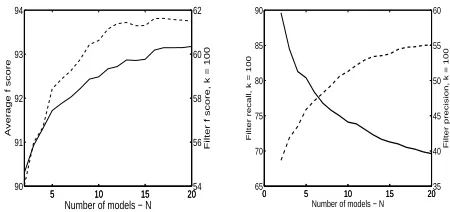
Regarding N (see Figure 2): As the number of
models increases, the number of T-sentences se-lected by SEPA decreases and their quality im-proves, in terms of both average f-score and filter
f-score (with k = 100). The fact that more
mod-els trained on different samples of the training data agree on the syntactic annotation of a sentence im-plies that this syntactic pattern is less sensitive to perturbations in the training data. The number of such sentences is small and it is likely the parser will correctly annotate them. The smaller T-set size leads to a decrease in filter recall, while the better quality leads to an increase in filter precision. Since the in-crease in filter precision is sharper than the dein-crease in filter recall, filter f-score increases with the
num-ber of modelsN.
Regarding S3: As the sample size increases, the
number of T-sentences increases, and their qual-ity degrades in terms of average f-score but im-proves in terms of filter f-score (again, with param-eter k = 100). The overlap among smaller sam-ples is small and the data they supply is sparse. If several models trained on such samples attach to a sentence the same parse, this syntactic pattern must be very prominent in the training data. The num-ber of such sentences is small and it is likely that the parser will correctly annotate them. Therefore smaller sample size leads to smaller T-sets with high average f-score. As the sample size increases, the T-set becomes larger but the average f-score of a parse
3
Graphs are not shown due to lack of space.
5 10 15 20 90
91 92 93 94
Average f score
Number of models − N
5 10 15 2054 56 58 60 62
Filter f score, k = 100
0 5 10 15 20 65
70 75 80 85 90
Filter recall, k = 100
0 5 10 15 2035 40 45 50 55 60
Filter precision, k = 100
[image:4.612.321.546.75.181.2]Number of models − N
Figure 2: The effect of the number of modelsN on
SEPA (Collins’ model). The scenario is in-domain,
sample size S = 33,000 andT = 100. We see:
average f-score of T-sentences (left, solid curve and
left y-axis), filter f-score withk= 100(left, dashed
curve and right y-axis), filter recall with k = 100
(right, solid curve and left y-axis), and filter
preci-sion with k = 100 (right, dashed curve and right
y-axis).
decreases. The larger T-set size leads to increase in filter recall, while the lower average quality leads to decrease in filter precision. Since the increase in filter recall is sharper than the decrease in filter pre-cision, the result is that filter f-score increases with
the sample sizeS.
This discussion demonstrates the importance of using both average f-score and filter f-score, since the two measures reflect characteristics of the se-lected sample that are not necessarily highly (or pos-itively) correlated.
4 Experimental Setup
We performed experiments with two parsing mod-els, the Collins (1999) generative model number 2 and the Charniak and Johnson (2005) reranking model. For the first we used a reimplementation (?). We performed experiments with each model in two scenarios, in-domain and parser adaptation. In both experiments the training data are sections 02-21 of the WSJ PennTreebank (about 40K sen-tences). In the in-domain experiment the test data is section 23 (2416 sentences) of WSJ and in the parser adaptation scenario the test data is Brown test section (2424 sentences). Development sections are WSJ section 00 for the in-domain scenario (1981 sentences) and Brown development section for the
(Gildea, 2001), the Brown test and development sec-tions consist of 10% of Brown sentences (the 9th and 10th of each 10 consecutive sentences in the devel-opment and test sections respectively).
We performed experiments with many configu-rations of the parameters N (number of models),
S (sample size) and F (agreement function). Due
to space limitations we describe only experiments where the values of the parameters N, S and F are
fixed (F is M F, N andS are given in Section 5)
and the threshold parameterT is changed.
5 Results
We first explore the quality of the selected set in terms of average f-score. In Section 3 we reported that the quality of a selected T-set of parses increases
as the number of models N increases and sample
sizeS decreases. We therefore show the results for
relatively highN (20) and relatively lowS(13,000,
which is about a third of the training set). Denote
the cardinality of the set selected by SEPA byn(it
is actually a function ofT but we omit theTin order
to simplify notations).
We use several baseline models. The first,
confi-dence baseline (CB), contains thensentences hav-ing the highest parser assigned probability (when trained on the whole training set). The second,
min-imum length (ML), contains thenshortest sentences in the test set. Since many times it is easier to parse short sentences, a trivial way to increase the aver-age f-score measure of a set is simply to select short sentences. The third, following (Yates et al., 2006), is maximum recall (MR). MR simply predicts that all test set sentences should be contained in the selected T-set. The output set of this model gets filter recall of
1 for anykvalue, but its precision is lower. The MR
baseline is not relevant to the average f-score mea-sure, because it selects all of the sentences in a set, which leads to the same average as a random selec-tion (see below). In order to minimize visual clutter, for the filter f-score measure we use the maximum recall (MR) baseline rather than the minimum length (ML) baseline, since the former outperforms the lat-ter. Thus, ML is only shown for the average f-score measure. We have also experimented with a random
baseline model (containingnrandomly selected test
sentences), whose results are the worst and which is
shown for reference.
Readers of this section may get confused between
the agreement threshold parameterTand the
param-eterkof the filter f-score measure. Please note: as to
T, SEPA sorts the test set by the values of the
agree-ment function. One can then select only sentences
whose agreement score is at leastT. T’s values are
on a continuous scale from 0 to 100. As tok, the
fil-ter f-score measure gives a grade. This grade com-bines three values: (1) the number of sentences in the set (selected by an algorithm) whose f-score
rel-ative to the gold standard parse is at leastk, (2) the
size of the selected set, and (3) the total number of sentences with such a parse in the whole test set. We did not introduce separate notations for these values. Figure 3 (top) shows average f-score results where SEPA is applied to Collins’ generative model in the in-domain (left) and adaptation (middle) scenarios. SEPA outperforms the baselines for all values of the
agreement threshold parameterT. Furthermore, as
T increases, not only does the SEPA set quality
in-crease, but the quality differences between this set and the baseline sets increases as well. The graphs on the right show the number of sentences in the sets
selected by SEPA for each T value. As expected,
this number decreases asT increases.
Figure 3 (bottom) shows the same pattern of re-sults for the Charniak reranking parser in the in-domain (left) and adaptation (middle) scenarios. We see that the effects of the reranker and SEPA are rel-atively independent. Even after some of the errors of the generative model were corrected by the reranker by selecting parses of higher quality among the 50-best, SEPA can detect parses of high quality from the set of parsed sentences.
To explore the quality of the selected set in terms of filter f-score, we recall that the quality of a se-lected set of parses increases as both the number of
modelsN and the sample sizeSincrease, and with
T. Therefore, fork= 85. . .100we show the value
of filter f-score with parameterkwhen the
parame-ters configuration is a relatively highN (20),
rela-tively highS (33,000, which are about 80% of the
training set), and the highestT (100).
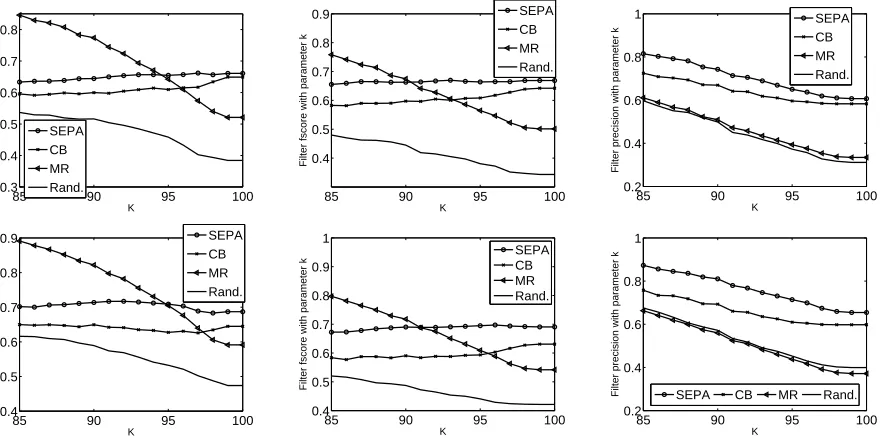
val-ues of the filter f-score parameter k, and
outper-forms the MR baseline where the value ofkis 95 or
more. Although for smallkvalues MR gets a higher
f-score than SEPA, the filter precision of SEPA is much higher (right, shown for adaptation. The in-domain pattern is similar and not shown). This stems from the definition of the MR baseline, which sim-ply predicts any sentence to be in the selected set. Furthermore, since the selected set is meant to be the input for systems that require high quality parses, what matters most is that SEPA outperforms the MR
baseline at the highkranges.
Figure 4 (bottom) shows the same pattern of re-sults for the Charniak reranking parser in the in-domain (left) and adaptation (middle) scenarios. As for the average f-score measure, it demonstrates that the effects of the reranker and SEPA algorithm are relatively independent.
Tables 1 and 2 show the error reduction achieved by SEPA for the filter f-score measure with
param-eters k = 95,97,100 (Table 1) and for the
aver-age f-score measure with several SEPA agreement
threshold (T) values (Table 2) . The error reductions
[image:6.612.314.532.70.146.2]achieved by SEPA for both measures are substantial.
Table 3 compares SEPA andWOODWARDon the
exact same test set used by (Yates et al., 2006) (taken from WSJ sec 23). SEPA achieves error re-duction of 31% over the MR baseline on this set,
compared to only 20% achieved by WOODWARD.
Not shown in the table, in terms of ordinary f-score
WOODWARDachieves error reduction of 37% while
SEPA achieves 43%. These numbers were the only ones reported in (Yates et al., 2006).
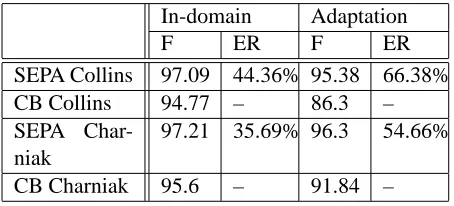
For completeness of reference, Table 4 shows the superiority of SEPA over CB in terms of the usual f-score measure used by the parsing community (num-bers are counted for constituents first). Results for other baselines are even more impressive. The con-figuration is similar to that of Figure 3.
6 Discussion
In this paper we introduced SEPA, a novel algorithm for assessing parse quality in the output of a statis-tical parser. SEPA is the first algorithm shown to be successful when a reranking parser is considered, even though such models use a reranker to detect and fix some of the errors made by the base
gener-Filter f-score
In-domain Adaptation
k value 95 97 100 95 97 100
[image:6.612.315.528.303.378.2]Coll. MR 3.5 20.1 29.2 22.8 29.8 33.6 Coll. CB 11.6 11.7 3.4 14.2 9.9 7.4 Char. MR 1.35 13.6 23.44 21.9 30 32.5 Char. CB 21.9 16.8 11.9 25 20.2 16.2
Table 1: Error reduction in the filter f-score mea-sure obtained by SEPA with Collins’ (top two lines) and Charniak’s (bottom two lines) model, in the two scenarios (in-domain and adaptation), vs. the maximum recall (MR lines 1 and 3) and
confi-dence (CB, lines 2 and 4) baselines, using N =
20, T = 100 and S = 33,000. Shown are
pa-rameter values k = 95,97,100. Error reduction
numbers were computed by100×(f scoreSEP A−
f scorebaseline)/(1−f scorebaseline).
Average f-score
In-domain Adaptation
T 95 97 100 95 97 100
Coll. ML 32.6 37.2 60.8 46.8 52.7 70.7 Coll. CB 26.5 31.4 53.9 46.9 53.6 70 Char. ML 25.1 33.2 58.5 46.9 58.4 77.1 Char. CB 20.4 30 52 44.4 55.5 73.5
Table 2: Error reduction in the average f-score mea-sure obtained by SEPA with Collins (top two lines) and Charniak (bottom two lines) model, in the two scenarios (in-domain and adaptation), vs. the min-imum length (ML lines 1 and 3) and confidence
(CB, lines 2 and 4) baselines, using N = 20 and
S = 13,000. Shown are agreement threhsold
pa-rameter values T = 95,97,100. Error reduction
numbers were computed by100×(f scoreSEP A−
f scorebaseline)/(1−f scorebaseline).
SEPA WOODWARD CB
ER 31% 20% -31%
Table 3: Error reduction compared to the MR base-line, measured by filter f-score with parameter 100. The data is the WSJ sec 23 test set usd by (Yates et al., 2006). All three methods use Collins’ model.
SEPA usesN = 20, S = 33,000, T = 100.
ative model. WOODWARD, the only previously
85 90 95 100 88 90 92 94 96 98 Agreement threshold Average fscore SEPA CB ML Rand.
85 90 95 100
80 85 90 95 100 Agreement threshold Average fscore SEPA CB ML Rand.
85 90 95 100
0 500 1000 1500 2000 2500 Agreement threshold
Number of sentences
In domain Adaptation
85 90 95 100
92 93 94 95 96 97 98 Agreement threshold Average fscore SEPA CB ML Rand.
85 90 95 100
85 90 95 100 Agreement threshold Average fscore SEPA CB ML Rand.
85 90 95 100
500 1000 1500 2000 2500 Agreement threshold
Number of sentences
[image:7.612.86.526.81.300.2]In domain Adaptation
Figure 3: Agreement thresholdT vs. average f-score (left and middle) and number of sentences in the
se-lected set (right), for SEPA with Collins’ generative model (top) and the Charniak reranking model (bottom).
SEPA parameters areS = 13,000, N = 20. In both rows, SEPA results for the in-domain (left) and
adap-tation (middle) scenarios are compared to the confidence (CB) and minimum length (ML) baselines. The graphs on the right show the number of sentences in the selected set for both scenarios.
85 90 95 100
0.3 0.4 0.5 0.6 0.7 0.8 K
Filter fscore with parameter k
SEPA CB MR Rand.
85 90 95 100
0.4 0.5 0.6 0.7 0.8 0.9 K
Filter fscore with parameter k
SEPA CB MR Rand.
85 90 95 100
0.2 0.4 0.6 0.8 1 K
Filter precision with parameter k
SEPA CB MR Rand.
85 90 95 100
0.4 0.5 0.6 0.7 0.8 0.9 K
Filter fscore with parameter k
SEPA CB MR Rand.
85 90 95 100
0.4 0.5 0.6 0.7 0.8 0.9 1 K
Filter fscore with parameter k
SEPA CB MR Rand.
85 90 95 100
0.2 0.4 0.6 0.8 1 K
Filter precision with parameter k SEPA CB MR Rand.
Figure 4: Parameterkvs. filter f-score (left and middle) and filter precision (right) with that parameter, for
[image:7.612.87.527.403.622.2]the parsing model. In the Web environment this is the common situation.
The WSJ and Brown experiments performed with SEPA are much broader than those performed with
WOODWARD, considering all sentences of WSJ sec 23 and Brown test section rather than a subset of carefully selected sentences from WSJ sec 23. However, we did not perform a TREC experiment, as (Yates et al., 2006) did. Our WSJ and Brown results outperformed several baselines. Moreover, WSJ (or Brown) sentences that contain conjunctions were avoided in the experiments of (Yates et al., 2006). We have verified that our algorithm shows substantial error reduction over the baselines for this
type of sentences (in the ranges13 −46% for the
filter f-score with k = 100, and30−60% for the
average f-score).
As Table 3 shows, on a WSJ sec 23 test set similar to that used by (Yates et al., 2006), SEPA achieves
31% error reduction compared to 20% of WOOD
-WARD.
WOODWARD works under several assumptions. Specifically, it requires a corpus whose content over-laps at least in part with the content of the parsed sentences. This corpus is used to extract semanti-cally related statistics for its filters. Furthermore, the filters of this algorithm (except of the QA filter) are focused on verb and preposition relations. Thus, it is more natural for it to deal with mistakes contained in such relations. This is reflected in the WSJ based test set on which it is tested. SEPA does not make any of these assumptions. It does not use any exter-nal information source and is shown to select high quality parses from diverse sets.
In-domain Adaptation
F ER F ER
SEPA Collins 97.09 44.36% 95.38 66.38%
CB Collins 94.77 – 86.3 –
SEPA Char-niak
97.21 35.69% 96.3 54.66%
[image:8.612.71.298.558.661.2]CB Charniak 95.6 – 91.84 –
Table 4: SEPA error reduction vs. the CB base-line in the in-domain and adaptation scenarios, us-ing the traditional f-score of the parsus-ing literature.
N = 20, S = 13,000, T = 100.
For future work, integrating SEPA into the rerank-ing process seems a promisrerank-ing direction for enhanc-ing overall parser performance.
Acknowledgement. We would like to thank Dan
Roth for his constructive comments on this paper.
References
Shlomo Argamon-Engelson and Ido Dagan, 1996. committee-based sample selection for probabilistic classifiers. Journal of Artificial Intelligence Research, 11:335–360.
Giuseppe Attardi, Antonio Cisternino, Francesco Formica, Maria Simi and Alessandro Tommasi, 2001. PiQASso: Pisa question answering system. TREC ’01.
Markus Becker and Miles Osborne, 2005. A two-stage method for active learning of statistical grammars. IJ-CAI ’05.
Daniel Bikel, 2004. Code developed at University of Pennsylvania. http://www.cis.upenn.edu.bikel. Leo Breiman, 1996. Bagging predictors. Machine
Learning, 24(2):123–140.
Rich Caruana and Alexandru Niculescu-Mizil, 2006. An empirical comparison of supervised learning algo-rithms. ICML ’06.
Eugene Charniak and Mark Johnson, 2005. Coarse-to-fine n-best parsing and maxent discriminative rerank-ing. ACL ’05.
Michael Collins, 1999. Head-driven statistical models for natural language parsing. Ph.D. thesis, University of Pennsylvania.
Daniel Gildea, 2001. Corpus variation and parser perfor-mance. EMNLP ’01.
John C. Henderson and Eric Brill, 2000. Bagging and boosting a treebank parser. NAACL ’00.
Terry Koo and Michael Collins, 2005. Hidden-variable models for discriminative reranking. EMNLP ’05. Cody Kwok, Oren Etzioni and Daniel S. Weld, 2001.
Scaling question answering to the web. WWW ’01. Andrew McCallum and Kamal Nigam, 1998. Employing
EM and pool-based active learning for text classifica-tion. ICML ’98.
Dan Moldovan, Christine Clark, Sanda Harabagiu and Steve Maiorano, 2003. Cogex: A logic prover for question answering. HLT-NAACL ’03.
Grace Ngai and David Yarowsky, 2000. Rule writing or annotation: cost-efficient resource usage for base noun phrase chunking. ACL ’00.