Searching for Topics in a Large Collection of Texts
Martin Holub Jiˇr´ı Semeck´y Jiˇr´ı Diviˇs
Center for Computational Linguistics Charles University, Prague
holub|semecky @ufal.mff.cuni.cz
Abstract
We describe an original method that automatically finds specific topics in a large collection of texts. Each topic is first identified as a specific cluster of texts and then represented as a virtual concept, which is a weighted mixture of words. Our intention is to employ these virtual concepts in document indexing.
In this paper we show some preliminary experimental results and discuss direc-tions of future work.
1 Introduction
In the field of information retrieval (for a detailed survey see e.g. (Baeza-Yates and Ribeiro-Neto, 1999)), document indexing and representing doc-uments as vectors belongs among the most suc-cessful techniques. Within the framework of the well known vector model, the indexed elements are usually individual words, which leads to high dimensional vectors. However, there are several approaches that try to reduce the high dimension-ality of the vectors in order to improve the effec-tivity of retrieving. The most famous is probably the method called Latent Semantic Indexing (LSI), introduced by Deerwester et al. (1990), which em-ploys a specific linear transformation of original word-based vectors using a system of “latent se-mantic concepts”. Other two approaches which inspired us, namely (Dhillon and Modha, 2001) and (Torkkola, 2002), are similar to LSI but
dif-ferent in the way how they project the vectors of documents into a space of a lower dimension.
Our idea is to establish a system of “virtual concepts”, which are linear functions represented by vectors, extracted from automatically discov-ered “concept-formative clusters” of documents. Shortly speaking, concept-formative clusters are semantically coherent and specific sets of docu-ments, which represent specific topics. This idea was originally proposed by Holub (2003), who hypothesizes that concept-oriented vector models of documents based on indexing virtual concepts could improve the effectiveness of both automatic comparison of documents and their matching with queries.
The paper is organized as follows. In section 2 we formalize the notion of concept-formative clus-ters and give a heuristic method of finding them. Section 3 first introduces virtual concepts in a formal way and shows an algorithm to construct them. Then, some experiments are shown. In sec-tions 4 we compare our model with another ap-proach and give a brief survey of some open ques-tions. Finally, a short summary is given in sec-tion 5.
2 Concept-formative clusters
2.1 Graph of a text collection
Let be a collection of text
documents; is the size of the collection. Now
suppose that we have a function ! "#$% &'#( )$+* ,-./0, which gives a degree of
Definition: A labeled graph is called graph of collection if $ where
( "'# &( "'#$
and each edge "# * is labeled by
number $ '#$ , called weight of ; - is a given document similarity threshold
(i.e. a threshold weight of edge).
Now we introduce some terminology and neces-sary notation. Let $ be a graph of
col-lection . Each subset is called a cut of ;
stands for the complement . If
are disjoint cuts then
!#"
$ $ %& *'()*+ is a set of edges
within cut ;
!
$ $ ,(-./103254&6 $ is called weight of
cut ; !#"
$ $
"
$879 $:
"
$ $57
"
$ $ $ is a set
of edges between cuts and ;
!
$ $ ;,<-./1032>=?@4A6 $ is called weight
of the connection between cuts and ;
!
$1BDC
FE is the expected weight of
edge in graph ;
!
G $
IH CKJLMJ
E is the expected weight of
cut ;
!
G
$
9HNOHQPRS$ is the expected
weight of the connection between cut X and the rest of the collection;
!
each cut naturally splits the collection into
three disjoint subsets TU7SV
L
7SW
L
whereV
L
YX * Z[\
"
YX (1 $];^
andW
L
R G_7ZV
L
$ .
2.2 Quality of cuts
Now we formalize the property of “being concept--formative” by a positive real function called qual-ity of cut. A high value of qualqual-ity means that a cut must be specific and extensive.
A cut is called specific if (i) the weight G $ is relatively high and (ii) the
connec-tion between and the rest of the collection
G
$ is relatively small. The first
prop-erty is called compactness of cut, and is defined as `a( G $ b G $1B
G $ , while the other is
called exhaustivity of cut, which is defined as
cdFe G $
G $1B% G $ . Both functions
are positive.
Thus, the specificity of cut can be formalized
by the following formula
f
G $
G $&gihkj Hml
G
$
G
$kn hpo
— the greater this value, the more specific the cut ; q and q are positive parameters, which
are used for balancing the two factors.
The extensity of cut is defined as a positive
function cdsr
G $ utva&w OxGy1z
S where { -N|
is a
threshold size of cut.
Definition: The total quality of cut} G $ is a
pos-itive real function composed of all factors men-tioned above and is defined as
} G $ ~`a( G $ hkj
H
cdse G $
hpo
H
cdr G $
hY
where the three lambdas are parameters whose purpose is balancing the three factors.
To be concept-formative, a cut (i) must have a sufficiently high quality and (ii) must be locally optimal.
2.3 Local optimization of cuts
A cut is called locally optimal regarding
quality function } if each cut # which is
only a small modification of the original does
not have greater quality, i.e. } G#$Q} G $ .
Now we describe a local search procedure whose purpose is to optimize any input cut ;
if is not locally optimal, the output of the Local Search procedure is a locally optimal cut# which results from the original as its
lo-cal modification. First we need the following def-inition:
Definition: Potential of document * with
re-spect to cut is a real function
1 $ : < $iP defined as
1 $ } G7 '$P8} G '$
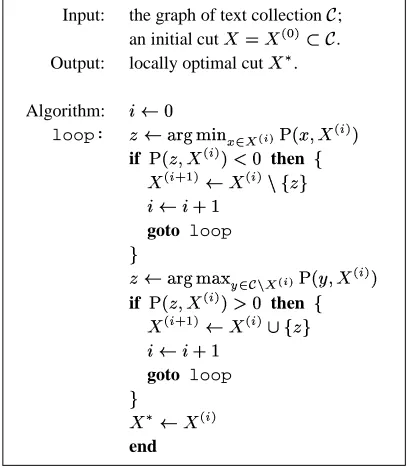
TheLocal Searchprocedure is described in Fig. 1. Note that
1. Local Search gradually generates a se-quence of cuts
04 1
0 4 1
0
4
Input: the graph of text collection ; an initial cut . Output: locally optimal cut .
Algorithm:
loop: y"!$#&%')(+*-,/.102345 76
if *&,890 4)
6;:< then =
45>
j
45 @?
=ACB DFEHG
goto loop
B
IJK9L !$M$N# %O')(P*-,/Q@024) 76
if *&,8904) 76;R< then = 45>
j
45 @S =CB DFEHG
goto loop
B
45
[image:3.612.102.309.37.271.2]end
Figure 1: The Local Search Algorithm
(i) } G
0
UT
4
$WVQ} G 0 4
$ for / , and
(ii) cut 0 4
always arises from
0
UT
4
by adding or taking away one document into/from it;
2. since the quality of modified cuts cannot in-crease infinitely, a finite X - necessarily
exists so that 05Y 4
is locally optimal and con-sequently the program stops at least after the
X -th iteration;
3. each output cut is locally optimal.
Now we are ready to precisely define concept--formative clusters:
Definition: A cut is called a
concept--formative cluster if
(i) } G $ [Z where Z is a threshold quality
and
(ii) b where is the output of the Local Searchalgorithm.
The whole procedure for finding concept-formative clusters consists of two basic stages: first, a set of initial cuts is found within the whole collection, and then each of them is used as a seed for theLocal Searchalgorithm, which locally optimizes the quality function} .
Note that q q q\ are crucial parameters,
which strongly affect the whole process of search-ing and consequently also the character of re-sulting concept-formative clusters. We have op-timized their values by a sort of machine learn-ing, using a small manually annotated collection of texts. When optimized q -parameters are used,
the Local Search procedure tries to simulate the behavior of human annotator who finds topi-cally coherent clusters in a training collection. The task ofq -optimization leads to a system of linear
inequalities, which we solve via linear program-ming. As there is no scope for this issue here, we cannot go into details.
3 Virtual concepts
In this section we first show that concept--formative clusters can be viewed as fuzzy sets. In this sense, each concept-formative cluster can be characterized by a membership function. Fuzzy clustering allows for some ambiguity in the data, and its main advantage over hard clustering is that it yields much more detailed information on the structure of the data (cf. (Kaufman and Rousseeuw, 1990), chapter 4).
Then we define virtual concepts as linear func-tions which estimate degree of membership of documents in concept-formative clusters. Since virtual concepts are weighted mixtures of words represented as vectors, they can also be seen as virtual documents representing specific topics that emerge in the analyzed collection.
Definition: Degree of membership of a document
* in a concept-formative cluster
is a function ] 1 $ : _^ $#P: . For * #7V
L
we define] 1 $
"
dD` ba
1 $ $
whereaS - is a constant. For * W
L
we define
] 1 $ - .
The following holds true for any concept--formative cluster and any document :
!
] 1 $ / iff * ;
!
] 1 $ * -./$ iff *'V
L
.
Now we formalize the notion of virtual con-cepts. Let c Ac Ac *~<d be vector
Input: pairs j 0, j
6 0 0 0, 6 where j
0 0
;
. . . maximal number of words in output concept;
. . . quadratic residual error threshold. Output:
. . . output concept;
. . . quadratic residual error;
. . . number of words in the output concept.
Algorithm: , & E while , : "! R
6 do =
E
for each
= G"0# 0%$ B ?
do =
output of MLR,U= '& 0, (& 6B &) j 0 S =A7B6 , &) j ,*, & 6,+ & 6 o if : then =
, 2&, & B B
S = B
B
-/
[image:4.612.104.324.42.288.2]
end
Figure 2: The Greedy Regression Algorithm
0
is the number of indexed terms. We look for such a vector1
L
*'<d so that
1
L
HCc 32 ] ( "1 $
approximately holds for any * /' . This
vector 1
L
is then called virtual concept corre-sponding to concept-formative cluster .
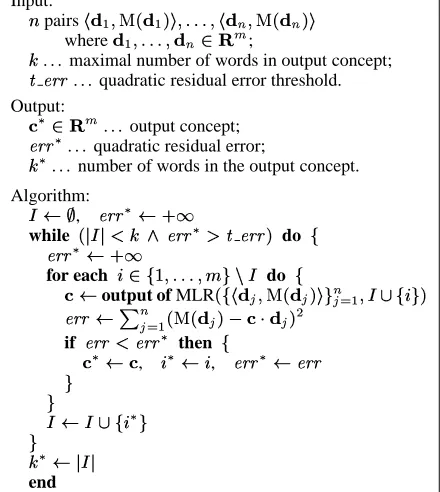
The task of finding virtual concepts can be solved using the Greedy Regression Algorithm (GRA), originally suggested by Semeck´y (2003).
3.1 Greedy Regression Algorithm
The GRA is directly based on multiple linear re-gression (see e.g. (Rice, 1994)). The GRA works in iterations and gradually increases the number of non-zero elements in the resulting vector, i.e. the number of words with non-zero weight in the re-sulting mixture. So this number can be explicitly restricted by a parameter. This feature of the GRA has been designed for the sake of generalization, in order to not overfit the input sample.
The input of the GRA consists of (i) a sam-ple set of document vectors with the correspond-ing values of] 1 $, (ii) a maximum number of
non-zero elements, and (iii) an error threshold.
The GRA, which is described in Fig. 2, quires a procedure for solving multiple linear re-gression (MLR) with a limited number of non-zero elements in the resulting vector. Formally,
]5436 ,87 # 1X#0 :9 #<;
>= $ gets on input
!
a set of? vectors7 #*'<d ;
!
a corresponding set of? valuesX # * to be
approximated; and
!
a set of indexes = +/
0
of the
ele-ments which are allowed to be non-zero in the output vector.
The output of the MLR is a vector
7
A@CBw D
E 9 F #G; 87'HH7 #[P#X#$
where each considered 7 ,8I #I
d
0 must
fulfillI - for any * /
0
J= .
Implementation and time complexity
For solving multiple linear regression we use a public-domain Java package JAMA (2004), devel-oped by the MathWorks and NIST. The computa-tion of inverse matrix is based on the LU decom-position, which makes it faster (Press et al., 1992). As for the asymptotic time complexity of the GRA, it is in K bXRH
0
H complexity of the MLR$
since the outer loop runsX times at maximum and
the inner loop always runs nearly 0
times. The MLR substantially consists of matrix multiplica-tions in dimension ? X and a matrix inversion
in dimension X( X . Thus the complexity of the
MLR is inK bX
H'?ML X
\
$ NK bX
H(? $ because X_VO? . So the total complexity of the GRA is in K
0
HP? H9X
\
$ .
To reduce this high computational complexity, we make a term pre-selection using a heuristic method based on linear programming. Then, the GRA does not need to deal with high-dimensional vectors in d , but works with vectors in
dimen-sion0 RQ
0
. Although the acceleration is only linear, the required time has been reduced more than ten times, which is practically significant.
3.2 Experiments
Czech documents. The texts were articles from two different newspapers and one journal. Each document was morphologically analyzed and lem-matized (Hajiˇc, 2000) and then indexed and rep-resented as a vector. We indexed only lemmas of nouns, adjectives, verbs, adverbs and numer-als whose document frequency was greater than
/-and less than-.- - - . Then the number of indexed
terms was0
AS!VS(T(S . The cosine similarity was
used to compute the document similarity; thresh-old was -.S . There were W!'W edges in
the graph of the collection.
We had computed a set of concept-formative clusters and then approximated the corresponding membership functions by virtual concepts.
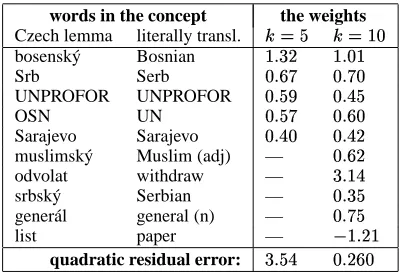
The first thing we have observed was that the quadratic residual error systematically and progre-sivelly decreases in each GRA iteration. More-over, the words in virtual concepts are obviously intelligible for humans and strongly suggest the topic. An example is given in Table 1.
words in the concept the weights
Czech lemma literally transl.
G
bosensk´y Bosnian GG G<9G
Srb Serb : H$
UNPROFOR UNPROFOR H H
OSN UN : H"
Sarajevo Sarajevo H H
muslimsk´y Muslim (adj) — H
odvolat withdraw — HG
srbsk´y Serbian — H
gener´al general (n) — :
list paper — + G<CG
[image:5.612.341.560.43.204.2]quadratic residual error: H :"
Table 1: Two virtual concepts (X and X /- )
corresponding to cluster #318.
Another example is cluster #19 focused on “pension funds”, which was approximated (X - ) by the following words (literally
trans-lated):
pension> (adj), pension> (n), fund> , additional insurance> ,
inheritance> , payment , interest> (n), dealer> , regulation ,
lawsuit> , August (adj), measure (n), approve> ,
increase> (v), appreciation> , property> , trade (adj),
attentively> , improve> , coupon (adj).
[image:5.612.111.312.331.469.2](The signs after the words indicate their positive or negative weights in the concept.) Figure 3 shows the approximation of this cluster by virtual concept.
Figure 3: The approximation of membership func-tion corresponding to cluster #19 by a virtual con-cept (the number of words in the concon-ceptX ).
4 Discussion
4.1 Related work
A similar approach to searching for topics and em-ploying them for document retrieval has been re-cently suggested by Xu and Croft (2000), who, however, try to employ the topics in the area of distributed retrieval.
They use document clustering, treat each clus-ter as a topic, and then define topics as probabil-ity distributions of words. They use the Kullback--Leibler divergence with some modification as a distance metric to determine the closeness of a document to a cluster. Although our virtual con-cepts cannot be interpreted as probability distribu-tions, in this point both approaches are quite simi-lar.
The substantial difference is in the clustering method used. Xu and Croft have chosen the K-Means algorithm, “for its efficiency”. In con-trast to this hard clustering algorithm, (i) our method is consistently based on empirical analysis of a text collection and does not require an a priori given number of topics; (ii) in order to induce per-meable topics, our concept-formative clusters are not disjoint; (iii) the specificity of our clusters is driven by training samples given by human.
against a query is based on statistical correlation between query words and words in a document. Since a document is a small sample of text, the statistics in a document are often too sparse to re-liably predict how likely the document is relevant to a query. In contrast, we have much more texts for a topic and the statistics are more stable. By excluding clearly unrelated topics, we can avoid retrieving many of the non-relevant documents.
4.2 Future work
As our work is still in progress, there are some open questions, which we will concentrate on in the near future. Three main issues are (i) evalua-tion, (ii) parameters setting (which is closely con-nected to the previous one), and (iii) an effective implementation of crucial algorithms (the current implementation is still experimental).
As for the evaluation, we are building a manu-ally annotated test collection using which we want to test the capability of our model to estimate inter--document similarity in comparison with the clas-sic vector model and the LSI model. So far, we have been working with a Czech collection for we also test the impact of morphology and some other NLP methods developed for Czech. Next step will be the evaluation on the English TREC collec-tions, which will enable us to rigorously evaluate if our model really helps to improve IR tasks.
The evaluation will also give us criteria for pa-rameters setting. We expect that a positive value of6 will significantly accelerate the computation
without loss of quality, but finding the right value must be based on the evaluation. As for the most important parameters of the GRA (i.e. the size of the sample set? and the number of words in
con-cept X ), these should be set so that the resulting
concept is a good membership estimator also for documents not included in the sample set.
5 Summary
We have designed and implemented a system that automatically discovers specific topics in a text collection. We try to employ it in document index-ing. The main directions for our future work are thorough evaluation of the model and optimization of the parameters.
Acknowledgments
This work has been supported by the Ministry of Education, project Center for Computational Lin-guistics (project LN00A063).
References
Ricardo A. Baeza-Yates and Berthier A. Ribeiro-Neto. 1999. Modern Information Retrieval. ACM Press / Addison-Wesley.
Scott C. Deerwester, Susan T. Dumais, Thomas K. Lan-dauer, George W. Furnas, and Richard A. Harshman. 1990. Indexing by latent semantic analysis. JASIS, 41(6):391–407.
Inderjit S. Dhillon and D. S. Modha. 2001. Concept decompositions for large sparse text data using clus-tering. Machine Learning, 42(1/2):143–175.
Jan Hajiˇc. 2000. Morphological tagging: Data vs. dic-tionaries. In Proceedings of the 6th ANLP
Confer-ence, 1st NAACL Meeting, pages 94–101, Seattle.
Martin Holub. 2003. A new approach to concep-tual document indexing: Building a hierarchical sys-tem of concepts based on document clusters. In
M. Aleksy et al. (eds.): ISICT 2003, Proceedings of the International Symposium on Information and Communication Technologies, pages 311–316.
Trin-ity College Dublin, Ireland.
JAMA. 2004. JAMA: A Java Matrix Package. Public-domain, http://math.nist.gov/javanumerics/jama/.
Leonard Kaufman and Peter J. Rousseeuw. 1990.
Finding Groups in Data. John Wiley & Sons.
W. H. Press, S. A. Teukolsky, W. T. Vetterling, and B. P. Flannery. 1992. Numerical Recipes in C. Second edition, Cambridge University Press, Cambridge.
John A. Rice. 1994. Mathematical Statistics and Data
Analysis. Second edition, Duxbury Press,
Califor-nia.
Jiˇr´ı Semeck´y. 2003. Semantic word classes extrac-ted from text clusters. In 12th Annual
Confer-ence WDS 2003, Proceeding of Contributed Papers.
MATFYZPRESS, Prague.
Kari Torkkola. 2002. Discriminative features for doc-ument classification. In Proceedings of the
Interna-tional Conference on Pattern Recognition, Quebec
City, Canada, August 11–15.
Jinxi Xu and W. Bruce Croft. 2000. Topic-based lan-guage models for distributed retrieval. In W. Bruce
Croft (ed.): Advances in Information Retrieval,