Rate Independent and Rate Dependent Structural Evolution
during Severe Plastic Deformation
Andrea Bachmaier
*1, Martin Hafok
*2and Reinhard Pippan
Erich Schmid Institute, Austrian Academy of Sciences, Jahnstr. 12, A-8700 Leoben, Austria
High pressure torsion (HPT) deformation enables the grain refinement of bulk materials until a saturation region is reached where no further microstructural refinement can be observed. The influence of deformation temperature, alloying and strain rate on the saturation region was examined by using pure aluminum, an Al-1 mass%Mg alloy and an Al-3 mass%Mg alloy. The deformation temperature was varied between 196C and 450C. Both, temperature and alloying exhibit a pronounced influence on the saturation microstructure. The measurements reveal
either a rate independent behavior of the structural evolution at low temperatures and a rate dependent behavior of the structural evolution at high temperatures. Two different processes are proposed to be the reason for the saturation at low and high homologous temperatures.
[doi:10.2320/matertrans.MB200912]
(Received August 17, 2009; Accepted October 2, 2009; Published December 25, 2009)
Keywords: aluminium alloy, high pressure torsion, saturation, grain boundary migration, strain rate
1. Introduction
Severe plastic deformation (SPD) is well known to allow the grain refinement of bulk materials. An ultra fine grained or even nanocrystalline microstructure is formed by SPD with a high fraction of high-angle boundaries.1–4)At strains larger than a critical value, no further microstructural refinement can be observed and a saturation region is reached which also manifests in a stagnation in hardening of the material. This general behaviour is independent of the material and the processing parameters in single phase materials. Only the minimum size of the crystallites in the saturation and the necessary strain to reach the saturation are influenced by the material. The initial process of fragmenta-tion as well as the most important parameters influencing the grain refinement are well documented in literature.5–10) The grain refinement process is especially influenced by the temperature, alloying, the strain rate and the deformation path.11) Although these major parameters controlling the grain refinement are well known, there still exists no clear explanation for the question how an increasing strain can lead to a steady state in the microstructure and the hardening of a material. To maintain a saturation microstructure, a balance in the structural restoration process must be kept: the same number of dislocations have to be eliminated as produced by the applied strain. In addition, the annihilation and generation of boundaries have to be also in balance. The generation of new boundaries can be caused by a simple increase of boundary length due to an elongation of the grains and by the formation of new boundaries from dense dislocation walls. The reduction in boundary length requires a movement of boundaries.
At very large strains, when the saturation in strength and microstructural refinement is observed, it is evident that the generation and restore mechanisms are in equilibrium. However, the details of the phenomena are not well
under-stood. Temperature and alloying should affect the processes significantly. Therefore both parameters are varied in a wide range in an Al alloy.
In this study, we used aluminium, an Al-1 mass%Mg alloy and an Al-3 mass%Mg alloy in order to investigate the influences of deformation temperature, alloying and strain rate on the saturation region during HPT deformation. The low melting temperature of the Al alloy allows the deformation at homologous temperatures ranging from 0.1– 0.8Tm(Tm being the melting temperature).
2. Experimental
Samples for HPT deformation were cut out of an aluminium (99.99% purity), an 1 mass%Mg and an Al-3 mass%Mg alloy plate. A detailed description of the HPT equipment used for processing the materials present in this paper is given in Ref. 6). The disk-shaped specimens with a diameter of 14 mm and a height of approximately 0.8 mm are pressed between two anvils, which can be heated or cooled to allow SPD at temperatures between 196C and 500C.
Furthermore, the rotation speed of the anvils can be varied over a wide range. The direct measurement of the torque applied to the sample is also possible, which can be used to estimate the change in the flow stress of the material
in-situduring deformation.
The shear strain can be calculated according to ¼2tnr
wherebyr,n,tare the distance from the center of the sample, the number of revolutions and the thickness of the sample, respectively. As the strain is dependent on the radius, all strains and strain rates were calculated for a radius of 6 mm. The thickness t is calculated according to t¼ ðtiþtaÞ=2 wherebyti andtaare the thickness of the sample before and after the deformation, respectively.
The HPT deformation was performed in three different ways: First of all the deformation was performed at constant, but different temperatures ranging from 196C to 450C
with the rotation speed kept constant. In addition to the constant temperature experiments, cooling experiments were performed. The samples were heated up and kept *1Corresponding author, E-mail: [email protected]
*2Present address: Boehler Edelstahl GmbH&Co KG, 8605 Kapfenberg, Austria
Special Issue on Severe Plastic Deformation for Production of Ultrafine Structures and Unusual Mechanical Properties: Aiming Breakthrough in Materials Development
at a constant temperature of 450C for about 5 min.
Afterwards, the deformation with constant, but different rotation speeds was started until a constant torque was measured. Subsequently, the heating device was turned off and the sample cooled down during continued deformation. During the cooling of the sample the change in torque was measured. Additionally, similar experiments during heating from cryogenic temperatures were performed. In the third set of experiments, the samples were heated to constant, but different temperatures between 196C and 450C. Afterwards the HPT deformation was started with a high rotation speed (0.48 rpm) until a constant torque was measured. During the ongoing deformation, the rotation speed was immediately decreased to the lowest possible rotation speed (0.016 rpm) and the change of the torque was measured.
Microstructures were characterized in a scanning electron microscope (SEM) type LEO 1525 using back scattered electrons (BSE) and the microtexture was investigated by electron back scatter diffraction (EBSD) using the EBSD system attached to the SEM. The micrographs were taken at radii of approximately 6 mm on the shear plane of the sample (see Fig. 3). Grain size determination was performed on BSE micrographs. Vickers microhardness measurements were performed with a BUEHLER Mircomet 5100 using a load of 500 g.
3. Results
3.1 Influence of deformation temperature
The influence of the deformation temperature on the saturation region was examined in HPT deformation experi-ments at different but constant temperatures.
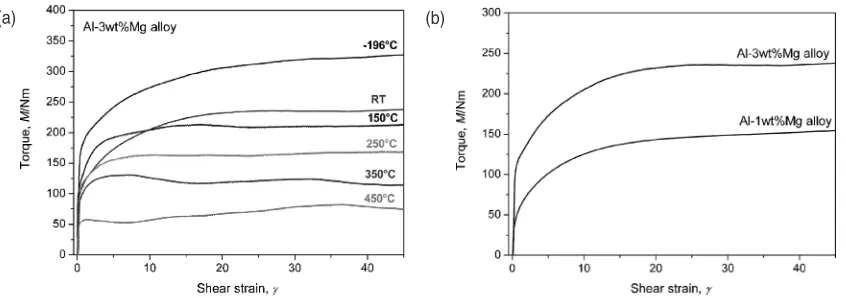
The torque applied during the HPT deformation of the Al-3 mass%Mg alloy versus the applied strain is shown in Fig. 1(a). The strain is calculated for a radius of 6 mm. The HPT deformation was conducted with a constant rotation speed (0.48 rpm). The alloy was deformed at 196C,
room temperature, 150C, 250C, 350C and 450C until a constant torque was measured indicating that the saturation region was reached. Because the measured torque can be
influenced by several experimental parameters, the same experimental conditions were used for these experiments to make a comparison of the measured torque feasible.
All recorded torque curves show a similar behavior: at low strains the torque increases until at a certain shear strain a saturation torque is reached. It can be clearly seen that the deformation temperature affects the saturation torque and the onset strain of saturation of the Al-3 mass%Mg alloy. Increasing the deformation temperature lowers the saturation torque and the saturation shear strain.
Figure 1(b) compares the applied torque during HPT deformation of the 1 mass%Mg alloy and the Al-3 mass%Mg alloy at room temperature. The effect of alloying can be clearly seen: Deformed at room temperature, the Al-1 mass%Mg alloy exhibits a significantly lower saturation torque than the Al-3 mass%Mg alloy.
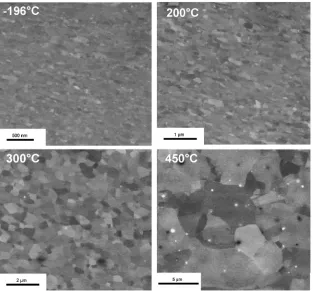
Figure 2 shows the development of the saturation structure of the Al-3 mass%Mg alloy samples. BSE micro-graphs of the Al-3 mass%Mg alloy deformed at 196C,
200C, 300C and 450C at a strain rate of 0.2 s1(rotation
speed: 0.25 rpm) were recorded. For all samples, the applied strain and the deformation conditions were chosen for the microstructure to be in the saturation regime. It is evident that the steady-state size of the structural elements increases with increasing temperature. The first micrograph show a sample which was deformed at196C. It shows elongated grains, which are aligned in tangential direction. This direction coincides with the shear direction during the HPT deforma-tion. The average size of the structural elements is approx-imately 120 nm in the tangential direction and about 70 nm in the direction of the torsion axis. With rising temperature the size of the structural element increases and a change in the microstructure occurs. The grains become more equiaxed and the alignment in the tangential direction loses its significance. At 450C, a more or less equiaxed
micro-structure can be observed and a further increase in the size of the structural element with increasing temperature is measured. Furthermore, the grain boundaries become more defined at higher temperatures. The transition between these two kinds of morphologies occurs in a temperature range between 300C and 350C.
(a) (b)
Fig. 1 (a)In-situtorque measured during the deformation of the Al-3 mass%Mg alloy vs. the shear strain at a strain rate of 0.4 s1 (0.48 rpm). The deformation temperature was varied between196C and 450C. (b) Comparison between thein-situtorques measured
[image:2.595.89.512.72.221.2]Figure 3 shows the development of the microtexture of the Al-3 mass%Mg alloy samples deformed at 200C, 300C
and 450C at the same strain rate as used before.
Consid-erable differences in the obtained microtexture can be observed. The pole figure of the sample deformed at 200C
shows a shear texture which is typical for HPT, but also comparable to face-centered cubic (fcc) materials that underwent cold deformation.12) The microtexture becomes considerably pronounced at 300C and a certain alignment of
the crystal system with respect to the deformation state is apparent. The torsion axis lays parallel to the (111) glide plane and the [011] glide direction is aligned in the shear direction. On the contrary, the pole figure of the sample
deformed at 450C shows a different microtexture where
the glide plane changes from the (111) to the (112) plane. Figure 4 summarizes the development of the size of the structural elements and the measured microhardness as function of the deformation temperature for both aluminium alloys. The microhardness of the Al-3 mass%Mg alloy samples decreases with increasing deformation temperature. The sample deformed at 196C exhibits the highest
hardness values of 1.75 GPa, whereas the lowest hardness values of 0.67 GPa were measured for the sample deformed at 450C. At room temperature the microhardness of the 3 mass%Mg alloy is about 1.48 GPa. Compared to the Al-3 mass%Mg alloy sample, the Al-1 mass%Mg alloy sample Fig. 2 Microstructure on the shear plane of the Al-3 mass%Mg alloy samples deformed at196C, 200C, 300C and 450C at a strain
rate of 0.2 s1(0.25 rpm).
Fig. 3 Microtexture recorded in the center of the cut plane at a radius of 6 mm of the Al-3 mass%Mg alloy samples deformed at 200C,
[image:3.595.143.456.72.363.2] [image:3.595.108.495.413.579.2]deformed at room temperature shows a lower microhardness (1.13 GPa). The microhardness values are in good accord-ance with the determined size of the structural elements: With decreasing deformation temperature the size of the structural elements is reduced whereas the determined size of the structural elements of the Al-1 mass% Mg sample deformed at room temperature is clearly larger than those of the Al-3 mass% Mg alloy sample.
3.2 Influence of strain rate
To investigate the influence of the strain rate on the saturation region during HPT deformation, experiments with different rotational speeds (0.05 rpm–0.50 rpm) were per-formed as well.
During cooling and heating experiments, the influence of the strain rate in a temperature range from196C to 450C
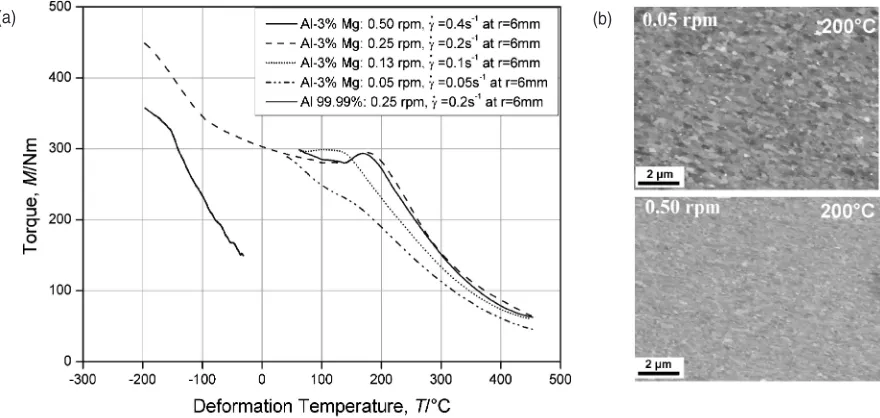
for the Al-3 mass%Mg alloy and for comparison, of pure aluminium was examined. In Fig. 5(a) the results of the
torque measurements are shown. With increasing temper-ature the measured torque and therefore, the flow stress of both materials decreases. Comparing the alloy and the pure aluminium, the measured torque for pure aluminium is lower. At room temperature, the aluminium alloy shows only a low strain rate sensitivity. Between room temperature and 450C, the Al alloy exhibits a certain strain rate sensitivity.
Figure 5(b) shows the microstructure of Al-3 mass%Mg alloy samples deformed at 200C at two different rotation
speeds (0.05 rpm and 0.50 rpm). It can be clearly seen that an increase in strain rate leads to a smaller size of the structural elements in the saturation region. Nevertheless the effect of the strain rate on the saturation size of the structural elements is less pronounced than the effect of the deformation temperature.
Furthermore the aluminium alloys were HPT deformed at different deformation temperatures, but now the rotation speed was directly changed during the deformation. In the beginning, the samples were deformed with the highest possible rotation speed until saturation in the measured torque curve was observed. Afterwards, the rotation speed was abruptly changed from 0.48 rpm to 0.016 rpm and changes in the measured torque curves were directly recorded. Figure 6(a) shows the results of these measure-ments. The fluctuation of the torque is due to the inaccuracy of the alignment of the HPT tool.
For the samples deformed at room temperature and
196C no change in the measured torques were recorded
at the moment of reducing the strain rate. The drop in the torque of the sample deformed at196C results from a short unscheduled stop of the rotation at the time of the strain rate shifting. Moreover, the strain rate sensitivity at higher temperatures could be further confirmed in this experiment. Changing the strain rate during the deformation at 150C and
250C leads to a significant decline in the measured torques.
The torque increases somewhat until a constant torque is measured again after a short time. The same behaviour can Fig. 4 Microhardness Hv and size of structural elements after HPT
deformation of the Al-3 mass%Mg alloy at different temperatures and of the Al-1 mass%Mg alloy at room temperature determined from BSE micrographs.
(a) (b)
Fig. 5 (a)In-situtorque measured during cooling and heating experiments at different rotation speeds ranging from 0.05 rpm to 0.50 rpm (strain rate of 0.05 s1to 0.4 s1). (b) BSE micrographs showing the microstructure of the Al-3 mass%Mg alloy deformed at 200C at two
[image:4.595.60.279.71.225.2] [image:4.595.78.518.539.748.2]be observed during the deformation at 350C and 450C,
although the drop in the measured torques is less pronounced at higher temperatures. Similar shapes of the flow curves by the time of strain rate changes in the steady state flow regime are found in conventional hot working as well. We assume a similar process in the case of HPT deformation at elevated temperatures, although the accurate processes are not completely clear and require further research. Figure 6(b) compares the relative steady state torques differences (M) as function of the different deformation temperatures for both strain rates. M is calculated according to M ¼ ðM2 M1Þ=ðM1ÞwherebyM1andM2are the measured steady state
torques at the high and low rotation speeds, respectively. Comparing M, a decrease of the strain rate has hardly an influence on the steady state torque at room temperature and lower temperatures, but the influence of the strain rate increases significantly at higher deformation temperatures.
4. Discussion
In general, all investigated deformation conditions yield to a saturation of both, the structural element size and the flow stress, at large applied strains. The deformation temper-ature is one major parameter affecting the final size of the structural elements in the saturation. With decreasing deformation temperature, the size of the structural elements continuously decreases. Moreover, the deformation temper-ature influences the amount of strain which must be applied to reach the saturation regime and the saturation torque itself. Both parameters distinctly decrease with increasing deformation temperature. Similar behavior is also found in conventional hot working.13–15)
The second important parameter affecting the size of the structural elements in the saturation and the saturation torque is alloying. It causes significant reduction of the saturation size of the structural elements and therefore leads to an increase in the saturation torque.
Another parameter which has an effect on the saturation torque is the strain rate. Nevertheless, the experiments have shown that the saturation torque is influenced by the strain
rate only in a certain temperature region. In deformation experiments at and below room temperature nearly no strain rate sensitivity is observed. In contrast to the low strain rate sensitivity at low temperatures, an enhanced strain rate sensitivity is observed at deformation temperatures ranging from room temperature to approximately 450C. In the whole
strain rate sensitive regime, the strain rate has also an effect on the size of the structural elements whereby an increase of the strain rate results in a smaller size of the structural elements.
Furthermore, the microstructural investigations indicated a definite change in the morphology of the saturation micro-structure depending on the deformation temperature. The microstructure consists of elongated grains aligned in the shear direction however with certain inclination at low deformation temperatures. This shape of the grains is maintained up to a deformation temperature of approxi-mately 300C. At higher deformation temperatures, a
com-pletely different morphology of the microstructure develops. The shape of the grains is now equiaxed and no explicit alignment in any direction can be observed. Increasing deformation temperature not only alters the microstructural features, it also changes the microtexture in the saturation region. At low deformation temperatures, the typical shear texture after HPT deformation is received. This texture is similar to those obtained for fcc materials after cold deformation.12) At higher deformation temperatures, the texture becomes more pronounced whereby the torsion axis is parallel to the glide plane (111) and the shear direction lays in the direction of the glide direction [110]. If the deformation temperature is further increased, the glide plane changes from (111) to the (112) plane, but the glide direction remains unchanged.
To maintain a steady state during continuous HPT deformation a mechanism for the elimination of dislocations must exist because new dislocations are constantly produced as long as an external strain is applied. In hot working, a steady state can be reached by dynamic recrystallization which is a diffusion-controlled process enhanced by tem-perature.8,15–17)
(a) (b)
[image:5.595.78.518.74.234.2]Based on the in situmeasurements of the torque curves, the microstructural and the microtextural investigations, we assume that two different processes active at low and high temperatures enable the steady state during HPT deformation.
At high temperatures we assume that a certain type of dynamic recrystallization18,19) is responsible for the occur-rence of the observed steady state at large strains. In general, boundaries are mobile and annihilate each other which finally lead to an equiaxed microstructure with mainly high-angle boundaries. Although the exact processes governing the movement of the boundaries are not clear in the case of HPT deformation, the driving force for the boundary migration seems be the reduction of the density of dislocations and the rate determining step the mobility of the boundaries. Because dynamic recrystallization is a diffusion-controlled process, it is enhanced by deformation at high homologous temperatures and influenced by the strain rate as well. The temperature dependence of the size of the structural elements in the saturation, the strain rate sensitivity and influence of the deformation temperature on the onset of the steady state during HPT deformation at high homologous temperatures would encourage this assumption. The morphology of the grains and the microtextural change in the saturation region at high deformation temperatures corroborates this further.
At low temperatures, we assume a process similar to dynamic recrystallization to maintain the steady state. In ultrafine grained and nanocrystalline metals, stress-induced grain boundary migration is proposed as an alternative plasticity mechanism at ambient and low temperatures.20–22) Although there exists a certain temperature dependence, the influence of the deformation temperature is not as high as in the high temperature regime. Furthermore there exists hardly any strain rate sensitivity. The driving force for the boundary migration in this case does not seem to be the reduction of dislocation density, but rather stress induced by means of the external applied strain and strain induced through the stress field of the dislocations. Due to the reduced thermal mobility, the formation of an equiaxed microstructure is not possible.
5. Conclusion
In the present paper, the influence of the deformation temperature and the strain rate on the saturation region during severe plastic deformation were examined by deforming aluminium alloys at homologous temperatures ranging from 0.1–0.8 Tm.
The results are summarized as followed:
(1) HPT deformation of aluminium alloys leads to a steady state for all investigated deformation conditions. (2) Deformation temperature and alloying are the two
major parameters influencing the minimum size of the
structural elements in the saturation and the onset of the steady state.
(3) The measurements reveal either a rate independent or a rate dependent behavior of the structural evolution depending on the temperature during deformation. (4) A process similar to dynamic recrystallization is
proposed to be the reason for the steady state at high homologous deformation temperatures. At low homol-ogous deformation temperatures a typical severe plastic deformation behavior is observed, where the mainte-nance of the steady state is facilitated by stress and strain induced boundary migration.
Acknowledgement
The financial support by the Austrian Fonds zur Fo¨rderung der wissenschaftlichen Forschung (Project number: S10402-N16) is gratefully acknowledged.
REFERENCES
1) M. J. Zehetbauer and R. Z. Valiev:Nanomaterials by Severe Plastic Deformation, (Wiley-VCH, Weinheim, Germany, 2004).
2) R. Z. Valiev, R. K. Islamgaliev and I. V. Alexandrov: Prog. Mater. Sci.
45(2000) 103–189.
3) T. C. Lowe and R. Z. Valiev: JOM56(2004) 64–68. 4) Y. T. Zhu and T. G. Langdon: JOM56(2004) 58–63.
5) T. Hebesberger, H. P. Stu¨we, A. Vorhauer, F. Wetscher and R. Pippan: Acta Mater.53(2005) 393–402.
6) A. Vorhauer, S. Kleber and R. Pippan: Mater. Sci. Eng.281(2005) 410–411.
7) A. Vorhauer, W. Knabl and R. Pippan: Mater. Sci. Forum426–432
(2003) 2747.
8) N. Hansen: Metall. Mater. Trans.32A(2001) 2917.
9) N. Hansen and D. Kuhlmannnn-Wilsdorf: Mater. Sci. Eng.81(1986) 141.
10) E. Schafler and R. Pippan: Mater. Sci. Eng. A387–389(2004) 799. 11) R. Pippan, F. Wetscher, M. Hafok, A. Vorhauer and I. Sabirov: Adv.
Eng. Mater.8(2006) 1046.
12) G. R. Canova, U. F. Kocks and J. J. Jones: Acta Metall.32(1984) 211. 13) H. P. Stu¨we:Proc. Conf. Deformation Under Hot Working Conditions,
(The Iron and Steel Institute, London, 1968) 2–6.
14) Y. Zhang, X. Zeng, C. Lu and W. Ding: Mat. Sci. Eng. A428(2006) 91–97.
15) F. J. Humphreys and M. Hatherly: Recrystallization and Related Annealing Phenomena, (Elsevier, United Kingdom, 2004).
16) R. Sandstorm and R. Lagneborg: Acta Metall.23(1975) 387. 17) W. Roberts and B. Ahlborn: Acta Metall.26(1978) 801.
18) M. E. Kassner and S. Barrabas: Mater. Sci. Eng. A410–411(2005) 152–155.
19) S. Gourdet and F. Montheillet: Mater. Sci. Eng. A283(2000) 274– 288.
20) M. Legros, D. S. Gianola and K. J. Hemker: Acta Mater.56(2008) 3380–3393.
21) F. Mompiou, D. Caillard and M. Legros: Acta Mater. 57 (2009) 2198–2209.